


Jump to content
Twins Daily
  • Create Account
  • Twins News & Analysis

    Sano and the Strikeout


    Seth Stohs

    In 1969, outfielder Bobby Bonds struck out 187 times to set the single-season record for strikeouts. A year later, as a 24-year-old, he added to that record by striking out 189 times. That record lasted 32 years, until 2004, when Jose Hernandez struck out 188 times. That number has since been topped 21 times.

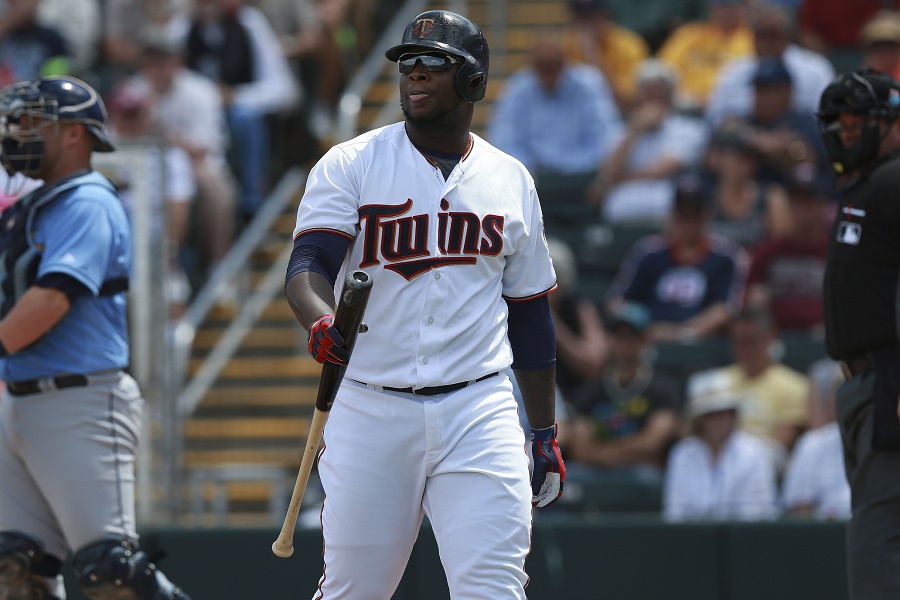
    How does this relate to the Minnesota Twins? In his rookie season of 2015, Miguel Sano struck out in 35.5% of his plate appearances (119 K in 335 plate appearances). In my prediction for his 2016 season, I had him playing 158 games. Based on my projections for plate appearances, if he were to strike out at that same rate, he would easily break the single-season strikeout record with 235.

    Image courtesy of Kim Klement, USA Today

    Twins Video

    Here are the current single-season strikeout leaders in MLB history:

    1. Mark Reynolds - 223 - 2009 (44 HR)
    2. Adam Dunn - 222 - 2012 (41 HR)
    3. Chris Carter - 212 - 2013 (29 HR)
    4. Mark Reynolds - 211 - 2010 (37 HR)
    5. Chris Davis - 208 - 2015 (47 HR)

    --------------------------------------------------------------------------------------

    Now, that’s not to suggest that it will happen, that Sano will actually break that record. In fact, I would be more than a little surprised if he did. Despite striking out plenty in the minor leagues, it was never close to that 35.5% rate. (Even his two strikeouts on Opening Night don’t worry me much.)

    Here are the strikeout rates that Miguel Sano posted in the minor leagues:

    Low A - 26.3%

    High-A - 25.1%

    AA (2013) - 29.3%

    AA (2015) - 23.8%

    ---------------------------------------------------------------------------------------

    We all know that strikeouts don’t matter in the league as much as it did even 20 years ago, especially when you are as productive as Miguel Sano was as a rookie.

    Striking out and not even caring is a concept that I will never understand, and I do think it’s generational. When I was growing up, we were taught a few things.

    First, “protect the plate.” Don’t give the umpire the opportunity to ring you up. Swing the bat if it’s close.

    Second, “choke up with two strikes and put the ball in play.” Anything can happen when you put the ball in play. You could get a hit. You could force the defense to make a play, or an error. In fairness, you could also hit into a double play.

    In today’s game, it appears the general philosophy is to try to crush the ball no matter the count, 3-1 or 1-2. If you strike out, oh well. It’s a trade-off that hitters make, and hitting coaches and teams seem to now accept. Swing hard. You might strike out, or you may rip a double, or a home run. But striking out with a runner on third and less than two outs is commonplace in the game today.

    Frankly, it’s a trend in the game, and I don’t know if we can really say whether it has helped or hurt baseball. I don’t know if that “strategy” is positive or negative. Consider 2015. The Kansas City Royals struck out 973 times, 134 times less than Atlanta’s 1,107 which was the second fewest. The Royals won the World Series. Atlanta became one of the worst teams in baseball. On the other end of the spectrum, the Chicago Cubs struck out 1,518 times, yet they won nearly 100 games and got to the NLCS. They had had 126 more strikeouts last season than the #2 strikeout team, the Houston Astros who surprised many and reached the playoffs.

    Here’s a quick look at a couple of the trends over the last 25 years (note, I normalized each of the three data categories in an attempt to keep the data within a range.):

    ccs-19-0-05870700-1459822390.jpg

    There is nothing definitive in the above chart. It doesn’t factor in variables such as the steroid era, the introduction of new baseball fields, or changes in the baseball. It doesn’t credit today’s pitchers for being better, whether that is true or not.

    What the chart does show is that in the last 25 years, strikeouts have gone up (from about 15% to a little over 20%). Home runs are back to where they were in the early ‘90s, though there was a spike in 2015. Runs scored peaked in 2000 with 5.18 runs/game and in 2015 it was back down to just 4.25. Trend lines certainly indicate that the increase in strikeouts is not helping offensive production, though I won’t pretend to claim that this study is 100% complete or fully answers the question.

    --------------------------------------------------------------------------

    Back to the Twins and Sano, imagine a scenario where he is able to reduce his K-rate from 35.5% down to 25.5% A 10% reduction in strikeout rate would mean about 60 fewer strikeouts per season. Just imagine what damage Sano could do with 60 more plate appearances. How many more walks, doubles and home runs could he produce?

    I don’t expect him to make up that 10% in one season, but any reduction in strikeout rate should be viewed as a positive.

    Bobby Darwin held the Twins single-season strikeout record (145) for 43 years. In 2015, Brian Dozier struck out 148 times to take the record. It is safe to say that Dozier’s record will not last 43 years. In fact, it is highly unlikely to last beyond one year. Of course, it’s also possible that as many as four players could top it, Sano, Byung Ho Park, Byron Buxton and Dozier himself.

    As fans, it’s likely we won’t really care too much about it if the Twins are competing for a playoff spot again.

    Follow Twins Daily For Minnesota Twins News & Analysis

    Recent Twins Articles

    Recent Twins Videos


    User Feedback

    Recommended Comments


    Featured Comments


    Yeah. Walker finished AA with an OPS of 807 last year. Sano was dominating to the tune of 915 and 918 there in his stints.

    At the time Sano left Chattanooga for the Twins - Walker had a .940 OPS to Sano's .918.


    Walker 23 HRs / 67 RBI / 18 2B / 50 runs scored [batting 7th] at the time of Sano's promotion.  .272 BA


    Sano 15 HRs / 52 RBI / 18 2B / 52 runs scored [batting 3rd] with Polanco in front of him and Kepler (MVP) behind him.     .274 BA


    But Sano did walk more :) - Chances are that Sano was already driven home by the time Walker came to the plate or the inning was aready over.  Just saying Sano's BB did not help Walker drive in 106 RBI.  The only time Walker hit 4th was the year he had a 20% K rate.  More to K's than just K's.  Protection is a real thing.


    Yeah this is a good point. If Buxton ends up on pace for the most strikeouts in club history (or even top ten) then he definitely needs to be sent down for some seasoning in AAA.

    Buxton eventually will be fine, he is always a slow starter, but if he looks like he did in 2015 at some point a month or two into the season you have to think hard about whether or not that is costing games.

    Ideally he turns a corner soon and we don't have to worry about any of this!


    I'm not sure where this 'he's always a slow starter' is coming from.  He was decent in rookie ball.  Downright awesome in A ball and A+ in his first full season (and I might add he got off to a pretty quick start there).  He got off to a slow start in high A due to injury and hurt his wrist shortly after, spending nearly all of the season on the DL.  He got off to a slow start in AA last year (though I think rust played a huge part in that).  His situation right now might be related to a slow start, but it might be related to being overmatched.


    Remember, Aaron Hicks had a well documented history of slow starts, moreso than Buxton (he was overmatched too FWIW).  I know Buxton isn't Hicks, but leaving him at the ML level just b/c he's Buxton is a good way to develop Hicks part 2. 


    At the time Sano left Chattanooga for the Twins - Walker had a .940 OPS to Sano's .918.


    Walker 23 HRs / 67 RBI / 18 2B / 50 runs scored [batting 7th] at the time of Sano's promotion.  .272 BA


    Sano 15 HRs / 52 RBI / 18 2B / 52 runs scored [batting 3rd] with Polanco in front of him and Kepler (MVP) behind him.     .274 BA


    But Sano did walk more :) - Chances are that Sano was already driven home by the time Walker came to the plate or the inning was aready over.  Just saying Sano's BB did not help Walker drive in 106 RBI.  The only time Walker hit 4th was the year he had a 20% K rate.  More to K's than just K's.  Protection is a real thing.


    Wrong conclusion.  Sano's walks helped Walker get extra at bats to get all those counting stats.  Outs are a real thing too.  Nothing against Walker, I like him, but he's got flaws... well documented ones at that, and something I'd add that AA pitchers capitalized on during the second half.  Yes, protection is a real thing, but it wasn't Walker protecting Sano.  Sano was likely protecting those guys around him, which is why he was batting in the 3/4 spot. 

    Three points from various posts:

    Sano takes a lot of pitches, including what seems to be an awful lot of good looking called third strikes.

    Protection? Miggy had one or both of of the Martinez behind him, IIRC. That's a lot of protection. I am not sure Plouffe and Rosario strike that amount of fear into the hearts of the mound opponents.

    IF I had my druthers, I would prefer Sano in the 4 hole. But every time I try and fashion a lineup like that, I can't find anyone to hit 3. It's been a problem for the Twins for a long time, a pure 3 hitter.

    Strike outs are overrated (in a negative kind of way).


    I'd prefer a guy who strikes out 300 times, and hits the ball with authority when it's put in play, as opposed to a guy like Mauer who "hates to strike out," so he weakly grounds into 2 DPs per game.

    2 DPs a game would be quite something. That'd be some kind of untouchable record to average 2 DPs a game. And I'm pretty sure it has zero to do with his desire to not strikeout. Edited by jimmer

    Bill James apparently believes that, while strikeout pitchers are more effective than non-strikeout pitchers, strikeout batters are not less effective than non-strikeout batters.  I don't have a subscription, so I can't read the article, but here's an article that references it:  https://www.baseballmusings.com/?p=84350.

    Wrong conclusion. Sano's walks helped Walker get extra at bats to get all those counting stats. Outs are a real thing too. Nothing against Walker, I like him, but he's got flaws... well documented ones at that, and something I'd add that AA pitchers capitalized on during the second half. Yes, protection is a real thing, but it wasn't Walker protecting Sano. Sano was likely protecting those guys around him, which is why he was batting in the 3/4 spot.

    And at the time of promotion, Sano had 66 games at AA in 2013 under his belt with a 913 OPS (with a 47 HR pace)

    Edited by tobi0040

    Bill James apparently believes that, while strikeout pitchers are more effective than non-strikeout pitchers, strikeout batters are not less effective than non-strikeout batters. I don't have a subscription, so I can't read the article, but here's an article that references it: https://www.baseballmusings.com/?p=84350.

    Guessing the caveat is if they are producing runs. That has always been his focus.


    Wrong conclusion.  Sano's walks helped Walker get extra at bats to get all those counting stats.  Outs are a real thing too.  Nothing against Walker, I like him, but he's got flaws... well documented ones at that, and something I'd add that AA pitchers capitalized on during the second half.  Yes, protection is a real thing, but it wasn't Walker protecting Sano.  Sano was likely protecting those guys around him, which is why he was batting in the 3/4 spot. 

    Never said that.  Never suggested that.  My point was that Sano has had the luxuary of having the Polanco's; Rosario's; Kepler's; Vargas's batting in front and behind him for years and has flourished in that role.  Those guys protecting each other.  He is a great player.


    Walker is a strikeout prone hitter who benefitted his only solid year (20% K rate) when he hit 4th in the lineup.  Does batting order have a significant role in why hitters strikeout more or less?  Protection?  Will it help Sano?  Should you see more fastballs with great contact hitters in front and behind you?  Are the Twins built that way?

    Note:  I only bring up Walker because he was the worst in baseball last year (strikeouts).   Despite his .940 OPS and other first half numbers last year, his K rate was ridiculous.   The K rate continued and the other stats dropped as Sano and Buxton moved on.  Are stats a result of the people around you and your tools?  How will this affect Sano this season (better or worse)?  I believe K's are a reflection of lots more than just bad pitch recognition.  How and Why do they pitch to you a certain way?


    A DH who can put up an RC+ of 120 or better is a major league player. In spite of the increasing strikeouts, Walker has been able to maintain that level of production. When he produces at that level in AAA over a season, an opportunity in the majors will arrive.


    The prospect rankings or projections really don't matter. The Twins have steadily moved him up the ladder and Walker has steadily produced. Let's see what he does with his AAA opportunity this year.


    The prospect rankings or projections really don't matter. The Twins have steadily moved him up the ladder and Walker has steadily produced. Let's see what he does with his AAA opportunity this year.

    To me, ABW is a gift card. I didn't expect to get it, I didn't budget for it, and it's basically free money.


    On the other hand, if I never got the gift card, I wouldn't care too much about it.


    There's a high probability of failure with ABW but that's okay. If he turns into something valuable, fantastic!


    A DH who can put up an RC+ of 120 or better is a major league player. In spite of the increasing strikeouts, Walker has been able to maintain that level of production. When he produces at that level in AAA over a season, an opportunity in the majors will arrive.

    The prospect rankings or projections really don't matter. The Twins have steadily moved him up the ladder and Walker has steadily produced. Let's see what he does with his AAA opportunity this year.

    AAA won't matter either.  The same has been said about Walker at every level.  "Wait to see if he can do it at the next level" - Like all prospects, Walker will have to prove it in the majors as well.   Like he should.    His production is without question the best in the system over the last 3 years.    Future probabilities outweigh his production every level.  Is what it is!


    His production is without question the best in the system over the last 3 years.

    Only because the other guys were injured for an entire season or something close to it.


    When healthy, both Buxton and Sano posted numbers far exceeding anything ABW has done in MiLB.


    I do not understand the fascination with ABW. Some people act as if he's a Golden God when his best OPS came in A ball and didn't even crack .850 (.844). And his MiLB OBP of .311 is "ick" territory.


    Buxton has a career MiLB OPS of .872 and Sano is at .937.

    AAA won't matter either.  The same has been said about Walker at every level.  "Wait to see if he can do it at the next level" - Like all prospects, Walker will have to prove it in the majors as well.   Like he should.    His production is without question the best in the system over the last 3 years.    Future probabilities outweigh his production every level.  Is what it is!

    AAA will matter if he doesn't produce. He has produced every year. The Twins have responded by advancing him every year. The only thing that matters now is how well he handles AAA. Success in AAA will lead to opportunity in the majors.

    I like the gift card analogy a lot. To add, you are not going to get a gift card with a huge amount of value on it.


    ABW's power is intriguing. But let's take a step back. He will be a 24 year old in AAA for the first time. He came off an 844 OPS and red flags about k's, BB's, and OBP in AA. So that probably translates to a 750 OPS guy up here, which is not terribly awe inspiring at DH.


    Create an account or sign in to comment

    You need to be a member in order to leave a comment

    Create an account

    Sign up for a new account in our community. It's easy!

    Register a new account

    Sign in

    Already have an account? Sign in here.

    Sign In Now

×
×
  • Create New...
