


Twins Video
Over the years, a somewhat facile narrative has attached itself to Josh Bell: every season, he has one good half, and one bad one. It's not quite true, of course. No player's career divides up that neatly; people just tend to generalize to save themselves time when nuance seems unduly weighty. Bell has had some years in which his first- and second-half splits stood in stark contrast to each other, but even using a generous definition of "good" (anything over an .800 OPS) and an unforgiving definition of "bad" (anything under .750), Bell has four "neutral" halves in his eight full seasons of play, to go with six of each of the other two types. In this table, I've bolded halves that count as "good" by the criteria I just described, and italicized the ones that count as "bad."
| Rk | Split |
Year ▲ |
G | PA | BA | OBP | SLG |
|---|---|---|---|---|---|---|---|
| 1 | 1st Half | 2017 | 88 | 339 | .239 | .322 | .472 |
| 2 | 2nd Half | 2017 | 71 | 281 | .274 | .349 | .460 |
| 3 | 1st Half | 2018 | 96 | 374 | .261 | .342 | .396 |
| 4 | 2nd Half | 2018 | 52 | 209 | .263 | .383 | .440 |
| 5 | 1st Half | 2019 | 88 | 388 | .302 | .376 | .648 |
| 6 | 2nd Half | 2019 | 55 | 225 | .233 | .351 | .429 |
| 7 | 1st Half | 2021 | 73 | 274 | .245 | .310 | .446 |
| 8 | 2nd Half | 2021 | 71 | 294 | .277 | .381 | .506 |
| 9 | 1st Half | 2022 | 93 | 394 | .311 | .390 | .504 |
| 10 | 2nd Half | 2022 | 63 | 253 | .194 | .317 | .289 |
| 11 | 1st Half | 2023 | 82 | 332 | .230 | .319 | .381 |
| 12 | 2nd Half | 2023 | 68 | 285 | .266 | .332 | .461 |
| 13 | 1st Half | 2024 | 94 | 396 | .228 | .289 | .356 |
| 14 | 2nd Half | 2024 | 51 | 207 | .292 | .379 | .506 |
| 15 | 1st Half | 2025 | 84 | 326 | .219 | .307 | .372 |
| 16 | 2nd Half | 2025 | 56 | 207 | .267 | .353 | .489 |
| 17 | 1st Half | 2026 | 70 | 276 | .232 | .286 | .366 |
Generated 6/16/2026.
As Twins fans are finding out, though, facile narratives obscure more complex realities. Bell isn't a guy who just plays at a solid, high level for three months, then slumps for three, or vice-versa. He goes through the same undulations as most hitters; he just has some things that stretch the periods of those rises and falls. For one, he's a switch-hitter. For another, he's always had good (though not elite) plate discipline. Those things set a high floor for him, but the switch-hitting (along with his swing path from each side) also sets a lowish ceiling; he can't reliably produce pulled fly balls in a way that yields lasting power and could make him an elite slugger.
Thus, we've already seen Bell go through a streak and a slump in his brief tenure with the Minnesota Twins. He started the season red-hot, then went ice-cold. That's not some acceleration of his career norms for performance variance; he had multiple slumps (and neatly counterbalancing streaks) in 2024 and 2025.

As yu can see, though, Bell is on the upswing again. In fact, after Monday night's 2-for-4 showing (including a three-run homer), he's now batting .218/.314/.490 over the last 30 days, with five home runs and five doubles in 102 plate appearances. He's not walking much. In fact, he's swinging quite a bit more than his norm, which is a trend we had better keep an eye on.

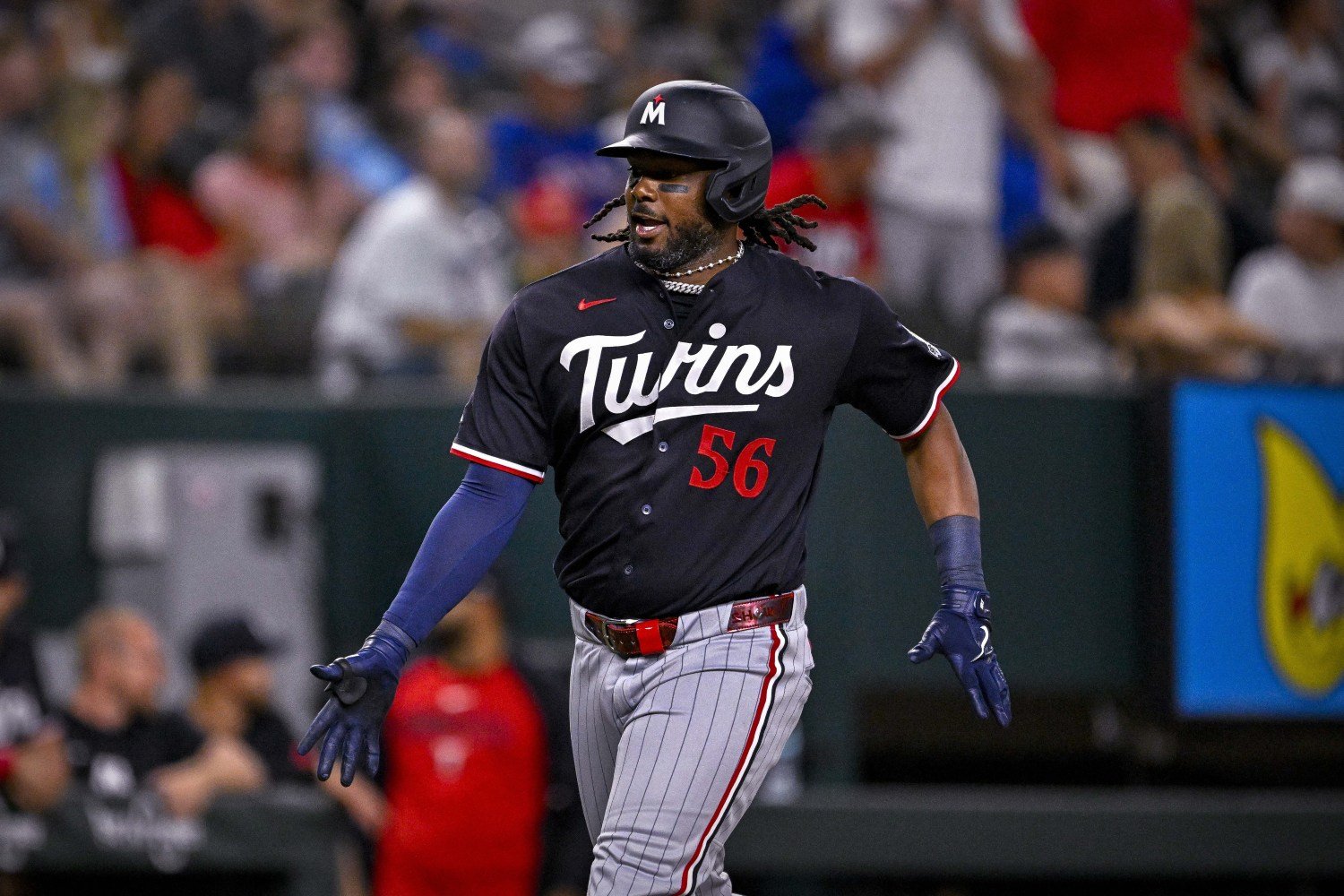
Still, Bell has entered another productive phase of his sinusoidal batting curve, and his three-run homer Monday night against MacKenzie Gore of the Rangers was a good example of how it's happening.
Gore tried to backfoot a breaking ball to Bell, but left it in the lower, inside quadrant of the strike zone. That's a costly mistake to any right-handed batter with power, but especially one who's locked in right now. In fairness to Gore and the Rangers, though, they were trying something clever.
On the previous pitch (a 1-0 fastball), Bell had challenged a strike call. It was a heater down and in, but it nipped the corner, and Bell's challenge failed. In addition to leveling the count, that appeal told Texas that Bell wasn't seeing the ball especially well down in that spot.
Going back to it with another fastball would be one way to take advantage of that, but they were trying the cousin of that strategy: a pitch that would look like the fastball in the same spot, but then dive under Bell's bat. They asked him, in effect, to get himself out (or at least into a 1-2 hole) by chasing a pitch for which he'd been primed by the previous pitch itself and his own frustrating failure to overturn its outcome.

We'll never know what would have happened if Gore had executed better. My guess, though, is that Bell would have just spat on that offering and gotten ahead, anyway. Though the Rangers might have been right to perceive that Bell saw that fastball poorly, they were wrong to conclude that it was because of the location. Here's how we know.
New Statcast metrics available at Baseball Savant show us not only by how much batters miss when they whiff, but how their swing timings are distributed within any given sample. We can see how consistently the hitter centers their swing to put the barrel of the bat in the path of the ball, horizontally; how often they line it up vertically; and how often they're on time (versus being early or late) for the pitch. Here are Bell's swing timing distributions by month, for right-handed swings only.

This month (and, if I were to re-run this and show you the distribution isolating the time since the middle of May, rather than breaking it up by month for easier visual comparison, you'd see the same thing), Bell is a danger to all left-handed pitchers. See how the orange distribution curves representing June rise higher and are more centered in each of the first two images, relative to the previous months? That's Bell consistently finding the barrel and being on time, whereas he was often early or late and working out to the end of the bat in the two previous months. He's locked in, and when you're on time and the ball is on the center of the barrel, exit velocity is going to follow. Charts like this are going to help us understand and explain slumps and streaks much better than we have in the past; Bell's resurgence in power is no surprise given what we see here.
When he's had any trouble at all from the right side, this month, he's found it by getting underneath the ball. Southpaws have had some luck throwing it over his bat, both inside:
and outside:
At this moment, if you try to get Bell out as a right-handed batter by throwing a breaking ball below the zone, you're only setting yourself up for failure. He's not chasing those, and when you miss, he's lined up to punish you ferociously for it. Gore erred as much by even attempting to throw that tricky curveball as by mislocating it. That worked out wonderfully for the Twins, though, and it illustrates another thing we can see more clearly as we get more comfortable with the new Statcast data: everyone's scouting report should be changing often. Sometimes, the back-foot breaking ball is the right pitch to Bell. Right now, he has that covered.
The Twins need Bell to continue producing the way he has over the last month. Whether they end up hanging around in the woebegone AL Central or are looking to trade Bell in July or August, they need his bat to keep humming. He's not some unique case of a player tidily cutting their season in half and choosing to hit in just one of the two, but he's certainly prone to long stretches of cold or hot hitting. During the latter type of run, he can win games for you on his own—as he did, practically, in the very first inning Monday night.
Which team do you dislike the most in the AL Central?
Follow Twins Daily For Minnesota Twins News & Analysis



- DJL44, thelanges5, arby58 and 1 other
-
 4
4


Recommended Comments
Create an account or sign in to comment
You need to be a member in order to leave a comment
Create an account
Sign up for a new account in our community. It's easy!
Register a new accountSign in
Already have an account? Sign in here.
Sign In Now