


Twins Video
Anyone who has followed baseball for a substantial amount of time knows better than to put much stock into spring training performances. Down in Ft. Myers, players and coaches constantly warn against reading too much into statistics compiled or tendencies displayed during exhibition play in March, insisting that this time is all about readying oneself physically and experimenting before the games begin to matter.
I'd certainly agree that it's foolhardy to allow the proceedings in spring training to determine or change your opinion about a player, or unit, on the team. However, I traveled down to Florida with a number of ideas already in my head about this club, and some of what I saw and heard during a week in camp served to reinforce those ideas.
Here are five beliefs I hold about the 2015 Minnesota Twins that were reaffirmed during my time covering spring training.
1) This offense is going to be pretty good.
In 2014, the Twins ranked seventh in the majors in runs scored, and they did so with a career-worst year from arguably their best hitter, Joe Mauer. Sure, there are a few players that are bound to regress this season, but I've felt that a big step forward in home runs and some positive contributions from incoming prospects would at the very least offset the regression.
Miguel Sano was cut from big-league camp the first day I was down there, so I didn't get the chance to see any of his fireworks, but heard plenty of buzz about the way he was crushing the ball. His impending arrival is just one of many wild-cards in play for the lineup in 2015.
Meanwhile, several entrenched players are having excellent offensive springs -- most notably Brian Dozier, who signed a four-year contract on Tuesday -- and the club has already flashed far more power than it did a year ago.
When discussing his lineup, Terry Ryan talked about how much he likes the balance; a blend of left-handed and right-handed hitters, a mix of youth and veterans, a combination of speed and power.
"I would say we've got a chance to be a pretty good offensive club," Ryan said, in his typically understated rhetoric.
They do indeed.
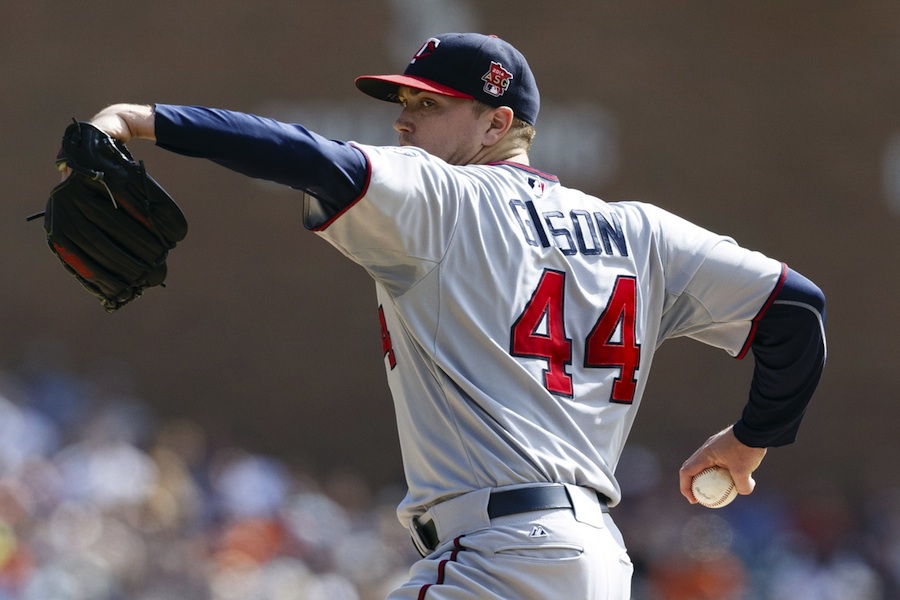
2) Kyle Gibson is going to have a breakout year.
Gibson's 2014 campaign was not spectacular by any means. He averaged fewer than six innings per start, his 4.47 ERA was well below average, and his 5.4 K/9 rate ranked as the fourth-lowest for a qualifying big-league pitcher. But there were plenty of positive signs within the right-hander's first full season, providing a sense that with improvements in a few key areas, he could be on the verge of taking a huge step forward.
When I watched him in Ft. Myers, Gibson looked like a stud. His fastball was buzzing in at 94 MPH regularly, his offspeed pitches were inducing awkward swings and weak contact, and he spoke with a great deal of confidence following his outings.
As an extreme ground ball pitcher, Gibson already has a key ingredient in the recipe for consistently shutting down opposing lineups. With a bit more command and a few more missed bats, he could profile as a No. 3 or even No. 2 caliber starter, which would completely change the complexion of this rotation.
3) The bullpen could be an issue.
The bullpen has generally been a strong point for the Twins, even in their leaner times. Last year, however, Minnesota's relief corps ranked bottom 10 in the majors in most key categories (ERA, BAA, WHIP, etc.), and faltered late in the season. Glen Perkins struggled down the stretch before being shut down. Casey Fien coughed up multiple runs in three of his 10 September appearances. Brian Duensing put up a 6.28 ERA over the final two months.
The only offseason move made to address this unit was replacing Anthony Swarzak with Tim Stauffer, and Stauffer's rocky month of March has inspired little confidence in that swap. Meanwhile, Perkins got a late start due to an injury and several relievers have been hit hard.
The three arms that are effectively vying for that final spot in the bullpen -- J.R. Graham, Blaine Boyer and Mark Hamburger -- all offer some level of intrigue, but none are really established, reliable options.
The Twins have some potentially dominant relievers coming up through the system, but in the meantime, protecting leads could be a struggle.
4) Paul Molitor will be a different type of manager.
When the Twins hired from within when naming Ron Gardenhire's successor, many fans expressed skepticism over whether the managerial switch would really lead to significant change.
After spending more time around Molitor, and hearing him talk about the importance of OBP at the top of the order, the evolving role of the No. 2 hitter ("it's turned into a little bit more of an offensive position in the lineup"), and his openness to using the closer outside of save situations or hitters in platoons, I feel more confident than ever that he will represent a meaningful change in direction.
Obviously we'll need to see it play out on the field, but based on the things Molitor's been saying, I believe fans who gravitate toward modern baseball philosophy and strategy will be pleased with the new hire.
5) Alex Meyer has a ways to go.
In our annual prospect rankings, Meyer was bumped down to No. 5 this year after appearing at No. 3 a year ago. In part, that's because the two pitchers that passed him, Jose Berrios and Kohl Stewart, did plenty to help their cases in 2014. But it's also because Meyer's flaws -- or at least his lack of polish -- have become more evident.
I watched him throw live in Port Charlotte, and afterwards I wrote about the outing, which featured inconsistent mechanics, erratic pitches and a visible lack of confidence.
There's no question that Meyer has the stuff to blow away hitters at any level, but from watching him pitch, it's quite clear that -- regardless of his age -- he shouldn't be pitching in the majors right now.




Recommended Comments
Create an account or sign in to comment
You need to be a member in order to leave a comment
Create an account
Sign up for a new account in our community. It's easy!
Register a new accountSign in
Already have an account? Sign in here.
Sign In Now