


Twins Video
Can’t handle the heat? Trevor Plouffe’s .220 average against fastballs was the fourth-lowest among all qualified hitters. On the other hand, he was one of the game’s best when it came to doing damage on breaking balls (curves and sliders). His OPS against those pitches was .820 -- 9th-highest among MLB hitters. In fact, Plouffe collected 25 extra base hits on breaking balls (only Yoenis Cespedes [26] had more) and was able to do that damage because he attacked the hangers up in the zone.
http://i.imgur.com/yYyfMhh.gif
Plouffe also had five extra base hits with the bases loaded this season. Only Boston’s Xander Bogaerts had more (6).
Miguel Sano’s season was incredible for a 22-year-old. According to Baseball-Reference.com’s Play Index, dating back to 1914 Sano’s .916 OPS is the 21st highest among 22-year-olds with a minimum of 300 plate appearances. He demonstrated a unique blend of patience and power as he drew walks in 15.8% of his plate appearances (11th highest among 22-year-olds) and, according to BaseballSavant.com’s batting ball velocity, he put balls in play at an average of 94.45 MPH. Only Miami’s Giancarlo Stanton pelted balls harder (97.73 MPH).
On September 30, Sano hit this Zach McAllister 95.2 MPH fastball into the bleachers at 114 MPH. This would be the hardest hit ball for the Twins in 2015, according to BaseballSavant.com:
http://i.imgur.com/A5RPDn8.gif
Sano’s .916 OPS also ties him with Tony Oliva for the highest OPS by a Twins’ rookie.
Bryon Buxton is really fast. I don’t have a stat or a number or anything but...just...just trust me on this.
Brian Dozier hit a team-leading 28 home runs this year. Seven of those bad boys came on pitches outside of the strike zone (tied for MLB-high with Colorado’s Nolan Arenado).

Dozier also had the honors of facing two of the three fastest pitches in the 2015 in his at bat against Cincinnati’s Aroldis Chapman. According to MLB’s Statcast, Chapman’s 1-2 offering reached 103.9 mile per hour but had the perceived speed of 105 miles per hour thanks to Chapman’s long limbs. It is amazing that Dozier was able to even get a piece of it.
http://i.imgur.com/gIdnDoy.gif
For the bulk of the season Dozier was used as the team’s primary leadoff hitters (102 games) but the combination of him, Aaron Hicks (31 games) and Danny Santana (18 games) led to one of the lowest productivity from the top of the lineup across baseball. Thanks in part to Dozier’s 22 home runs out of the leadoff spot (only Curtis Granderson [26] and Manny Machado [23] had more), the Twins did score 104 runs (7th out of 30), but in terms of setting up the offense to do further damage, they finished 27th in on-base percentage (.298).
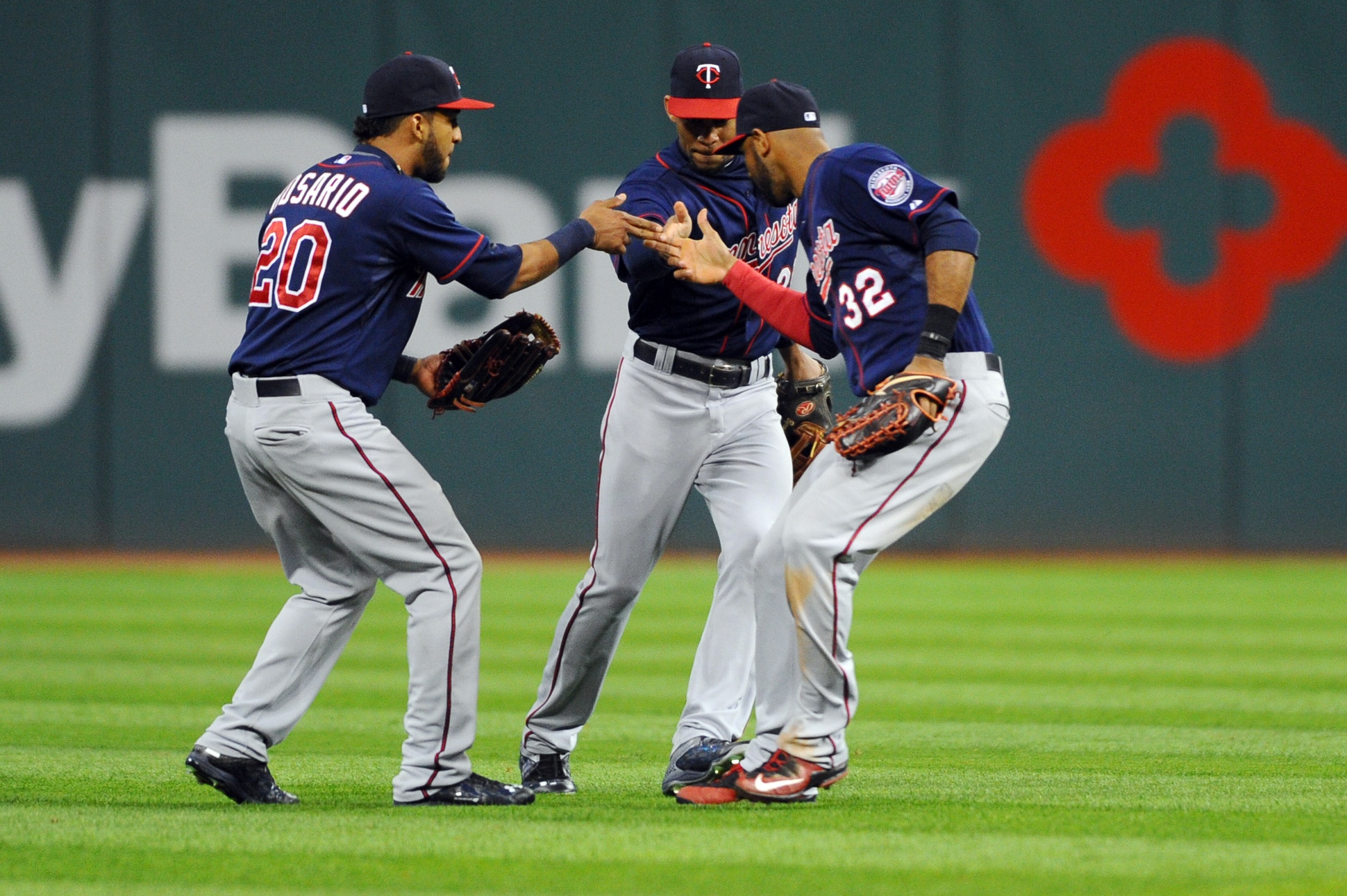
Speaking of out-of-zone home runs...rookie Eddie Rosario’s free-swinging tendencies landed him with some unexpected home runs this year. He was able to launch two shots on pitches not only out-of-zone pitches but those classified as “non-competitive” (basically those pitches categorized as no one in their right mind would swing at). Of course, the outfielder also struck out 45 times on non-competitive pitches, the 8th-most in MLB.

Rosario’s triple total of 15 was the most by a rookie since Philadelphia’s Juan Samuel stretched out 19 three-baggers in 1984. Since 1950, only Samuel and the Dodgers’ Jim Gilliam (17) hit more triples in their rookie year than Rosario.
Can’t start a fire without a spark. The Twins overall had the lowest batting average (.227) and on-base percentage (.280) when the bases were empty. However, with men in scoring position, they had the third-highest batting average (.279) and fourth-highest on-base percentage (.351).
By most offensive yardsticks, Joe Mauer’s 2015 season wasn’t...you know...good. That said, when it came to getting hits with runners in scoring position, Mauer was able to contribute to the cause. His .352 average in 125 at-bats was the 9th-highest but, more importantly, he only made an out in 52.7% on a ball in play in those situations -- the lowest rate in MLB.
Mauer also led baseball by reaching base on an error 14 times. ¯\_(ツ)_/¯
Among all starting right fielders Torii Hunter’s .702 OPS was the third-lowest and his WAR (0.5) was fifth-lowest. While everything was statistically bad overall, Hunter did post a .289/.368/.529 slash line in 144 plate appearances with runners in scoring position.
Eduardo Nunez’s helmet came off a lot.
http://i.imgur.com/MrYCTw3.gif
Outs all over the place. Danny Santana’s magical BABIP-drive 2014 season was followed by a horrific nightmare of a year in 2015. Among all Twins shortstops who were afforded 200 plate appearances, Santana’s .241 OBP was only better than Houston Jimenez (.238, 1984) and Jackie Hernandez (.218, 1968). That's a ton of outs.
How about the outs Santana didn’t make? Since Fangraphs.com began tracking the revised zone metric (RZR) defensive rating in 2003, Santana’s .758 RZR was the worst among all Twins’ shortstops. What that means is that Santana has converted only 75.8% of plays in his zone into outs. The Twins eventually replaced him with Eduardo Escobar and Fangraphs/Inside Edge’s fielding data shows a remarkable difference for where Santana was significantly worse than Escobar at making simple routine plays:
http://i.imgur.com/9S5l1iN.gif
Aaron Hicks would lead the team in stolen bases with 13...it was the lowest amount of swipes for a Twins season leader since Ron Washington (10) in 1983.
According to Baseball-Reference.com, the Twins managed to thwart just 22 would-be base stealers. Their 19% caught stealing rate was lowest in baseball. Kurt Suzuki threw out just 15% of runners, the lowest rate among all qualified catchers.
For no reason whatsoever, here is the Berenguer Boogie.
http://i.imgur.com/Kv7SYGD.gif
The Twins starting rotation allowed 163 home runs in 2015 (the 18th most in the majors). However 80 of those dingers came when there was men on base -- only Philadelphia (82) and Oakland (85) allowed more.
Among all qualified starters, Kyle Gibson threw the lowest percentage of his pitches in the strike zone (40.5%) but that did not stop hitters from swinging: Only Cleveland’s Carlos Carrasco (37.8%) posted a high chase rate than Gibson (40.5%). Avoiding the zone was a sound strategy for Gibson as opponents held a .831 OPS on pitches in the zone, well above the MLB average of .751.
Rookie pitcher Tyler Duffey compiled a solid stat line, going 5-1 with a 3.10 ERA and a 53/20 K/BB ratio over 58 innings. There may be an element of luck in play for Duffey’s totals: According to BaseballSavant.com’s Batting Ball Velocity warehouse obtained from MLBAM’s statcast cameras, opponents had a 91.22 MPH exit velocity average -- that’s the 8th highest among all pitchers with 100 or more at-bats.
Making contact was an issue for hitters in his outing: Duffey struck out 21.8% of batters faced, only second to Francisco Liriano’s 30.2% strikeout rate by a Twins rookie pitcher. The reason for that was his knee-buckling and whiff-inducing knuckle-curve. No pitcher in 2015 threw a higher percentage of curves than Duffy did (39.8%) but the yakker was responsible for 45 of his 53 strikeouts.
Ricky Nolasco has now pitched 194.1 innings in a Twins uniform and his 5.56 ERA is the sixth highest for a Twins starter with a minimum of 150 innings or more thrown. Ahead of him? Jim Deshaies (5.71), Anthony Swarzak (5.87), LaTroy Hawkins (6.11), Pat Mahomes (6.26) and Scott Aldred (6.54). His .313 batting average against is the highest. Oh, and he is the only Twins pitcher to allow a home run that landed on a boat.
Phil Hughes’ second season in the Twins uniform did not go quite as planned. Despite the loud contact and home runs and injuries, Hughes did the one thing he was really good at: He didn’t issue any free passes. Hughes walked 0.95 batters per nine innings in 2015 which is the third lowest season total behind Carlos Silva’s ridiculous 2005 (0.43) and Hughes’ 2014 (0.69).
Hitters were getting good wood on Hughes’ pitches in the first half: His .201 well-hit average trailed behind only Colorado’s Kyle Kendrick for the highest in baseball.
http://i.imgur.com/GNmXJm1.gif
An elite All Star closer for the first half of the season, injuries once again marred Glen Perkins’ second half. Perkins’ fastball velocity has declined over the past two seasons, mostly likely injury related. In 2013, he chucked 111 fastballs at 96 MPH or above. Last season he failed to crack 96 at all. This year? Four times he was able to amp it up to 96 -- three of which happened in the same game versus the St. Louis Cardinals on June 17.
Perkins’ 78% contact rate (contact per swing) was the second-highest among closers (minimum 15 saves). Only the Dodgers’ Kenley Jansen (72.5%) and Jonathan Papelbon (70.8%) fired more strikes than Perkins (70.1%) and only Papelbon (3.47) used fewer pitches per batter than Perkins (3.50).
Kevin Jepsen’s 75 appearances (33 with the Twins) was the highest in the American League over the entire year but Casey Fien’s 35 appearances in the second half was one behind Texas’ Shawn Tolleson for the most by an AL reliever post-All Star Game.
Before we go, a young Kent Hrbek striking out and flipping his bat.
http://i.imgur.com/AbzVQcW.gif





Recommended Comments
Create an account or sign in to comment
You need to be a member in order to leave a comment
Create an account
Sign up for a new account in our community. It's easy!
Register a new accountSign in
Already have an account? Sign in here.
Sign In Now