



Matthew Trueblood
-
Posts
1,033 -
Joined
-
Last visited
Content Type
Profiles
News
Minnesota Twins Videos
2026 Minnesota Twins Top Prospects Ranking
2022 Minnesota Twins Draft Picks
Minnesota Twins Free Agent & Trade Rumors, Notes, & Tidbits
Guides & Resources
2023 Minnesota Twins Draft Picks
The Minnesota Twins Players Project
2024 Minnesota Twins Draft Picks
2025 Minnesota Twins Draft Pick Tracker
2026 Minnesota Twins Draft Tracker: Picks & Bonuses
Forums
Blogs
Events
Store
Downloads
Gallery
Everything posted by Matthew Trueblood
-
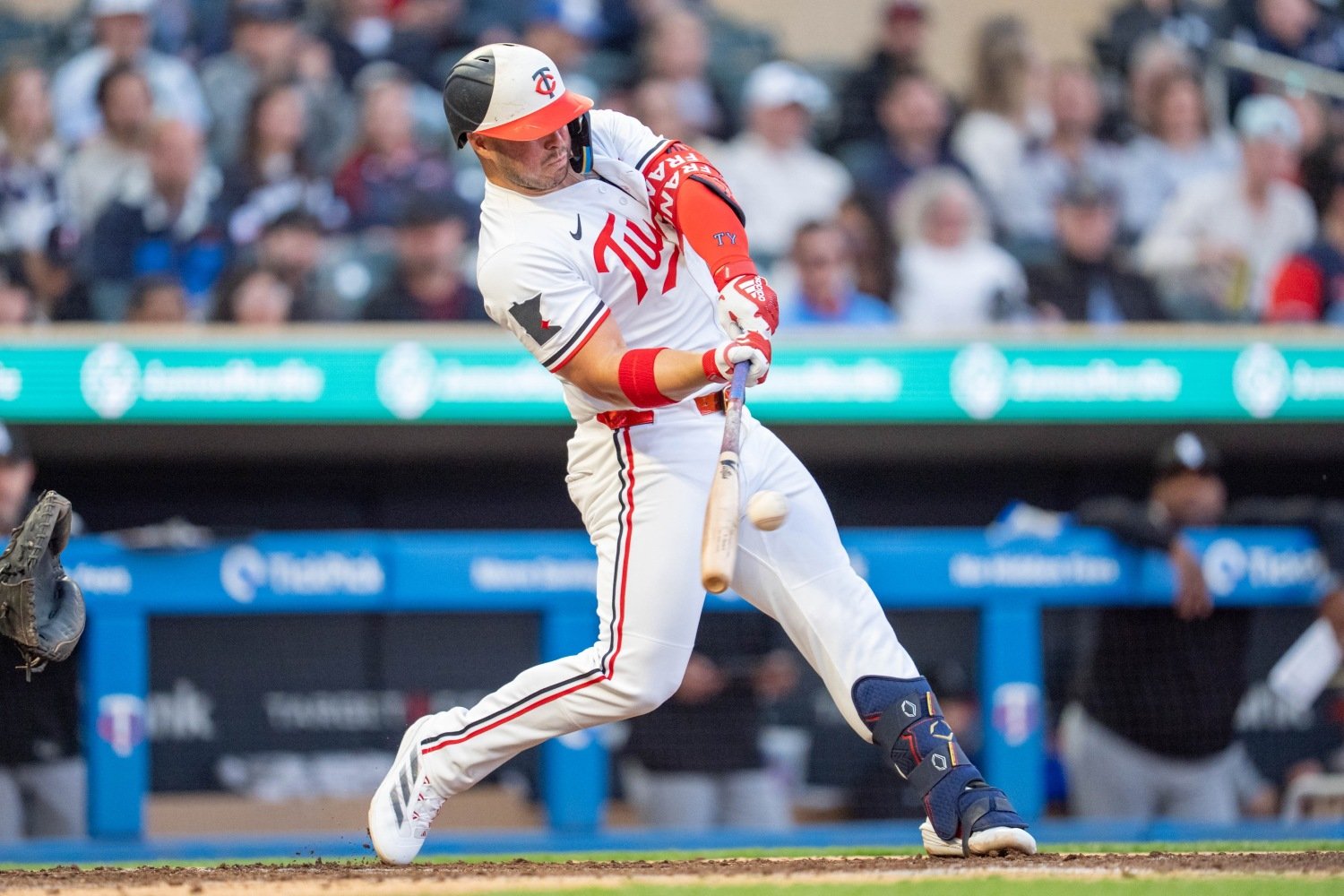 If he wants it (or, perhaps, if he simply doesn't get as filthy-rich as this game still has a chance to make him), Ty France has a future in sales. He's got the flair for it. When the topic of his new torpedo bat is broached, he immediately effuses—and mostly, what he wants to tell you is that there's nothing to tell. "Yeah, I used it last night for the first time. Feels just like my other bat," France said Thursday morning, sounding much more excited than one normally would about something not feeling remotely different. But as he's quick to demonstrate, there's a reason for his excitement. "Actually, here, I'll do a test with you," he said. "Close your eyes." In turns, France handed me two of his 'gamers'—one an original model, with the traditional barrel, and one with the torpedo shape that moves slightly more of the batweight toward the handle and narrows the end of the shaft. He encouraged me to take a batter's stance, move each around a bit, and feel their balance. Then he asked me to identify which was which. I failed—which is the expected result, for a person a bit older than France but with perhaps 20 years less dirt between their cleats than he has. But the point, of course, is that even some pro hitters also feel no difference, as France himself doesn't. "That's what we want. We don't want something that feels drastically different," he said, simply. He's excited about the possibility of adapting the new tool of the trade, because it won't change how he feels in the box but might change how much wood is behind the ball when he meets it, at times. The magnitude of the help torpedo bats can provide has been vastly overstated, based on a fluky first series at Yankee Stadium between the Bronx Bombers and the Milwaukee Brewers and a broadcast segment that was just meant to inform—not to dramatize. There are also plenty of hitters who aren't good candidates for the change. France, however, is a superb one. "For me, personally, more of my misses are closer to the handle, so it makes sense for me," France said. "But the biggest thing was making sure it felt like my original bat." While a subtle shift in weight toward the hands can improve bat control and allow a hitter to either generate more swing speed or better manipulate a swing at the same clip, hitters themselves don't want to feel that. Rightfully, many of them worry that such a change could mess with their mechanics, leaving them in danger of whiffing on formerly friendly pitches or even hurting themselves. While they're less common than torn ligaments in pitching elbows, broken hamates haunt the nightmares of some hitters, because it can be so easy to do that on a swing that felt routine until the last moment—and the result can vary from just a few weeks' missed time to a few months', plus months more of not quite having your swing back. France is among those who feel comfortable because they don't feel a major change in the swing weight, but he's also a good fit for the new technology because of where and how he tends to hit the ball. He mentioned that most of his misses are slightly toward the handle. One way we can view that (while we all anxiously await further bat-tracking data from Statcast, perhaps as soon as next month, that might give us more direct info on it) is by looking at a hitter's contact point. France is a guy who contacts the ball deep in his hitting zone—behind the front edge of home plate, quite often, and about 27 inches in front of his center of mass. Compare that to, for instance, teammate Trevor Larnach, whose average contact point is a few inches in front of home plate and about 32 inches in front of his center of mass. I placed the blue diagonal lines here to help you see how Larnach's bat is more likely to have come around fully and be square to the path of the incoming pitch, or wrapping slightly around it. That's why Larnach is the more dangerous of the two, in terms of pull power. It's why he struggles against offspeed stuff; he has to fight to stay back enough to meet the ball squarely. France, meanwhile, is more likely to have his mishits happen deep in the hitting zone, which might mean that the bat isn't fully square to the incoming pitch yet. When that happens, the ball connects with the bat just a bit up the handle. We don't have to rely on hypotheticals to say this. Of 294 qualifying hitters, last year, France ranked 97th in the differential between his hard-hit balls and non-hard-hit balls, in terms of contact point. On the same list, Larnach was 182nd, where a lower ranking means your hard-hit balls have deeper contact points. In short, the lower you are on this list, the more likely that your mishits tend to come off the end of the bat. The higher you are, the more likely that your mishits come off the handle. Thus, Larnach would be a very poor candidate for a torpedo bat. So would Royce Lewis, one of the hitters at the extreme end of the spectrum; his mishits nearly all come off the end of the bat. France, however, is a great fit for it. That doesn't mean he'll get red-hot and start hitting like the game's elite first basemen, once he gets the torpedo bat working. It does, however, mean he's right to feel that excitement, even if it's about the absence of a feeling of difference.
 -
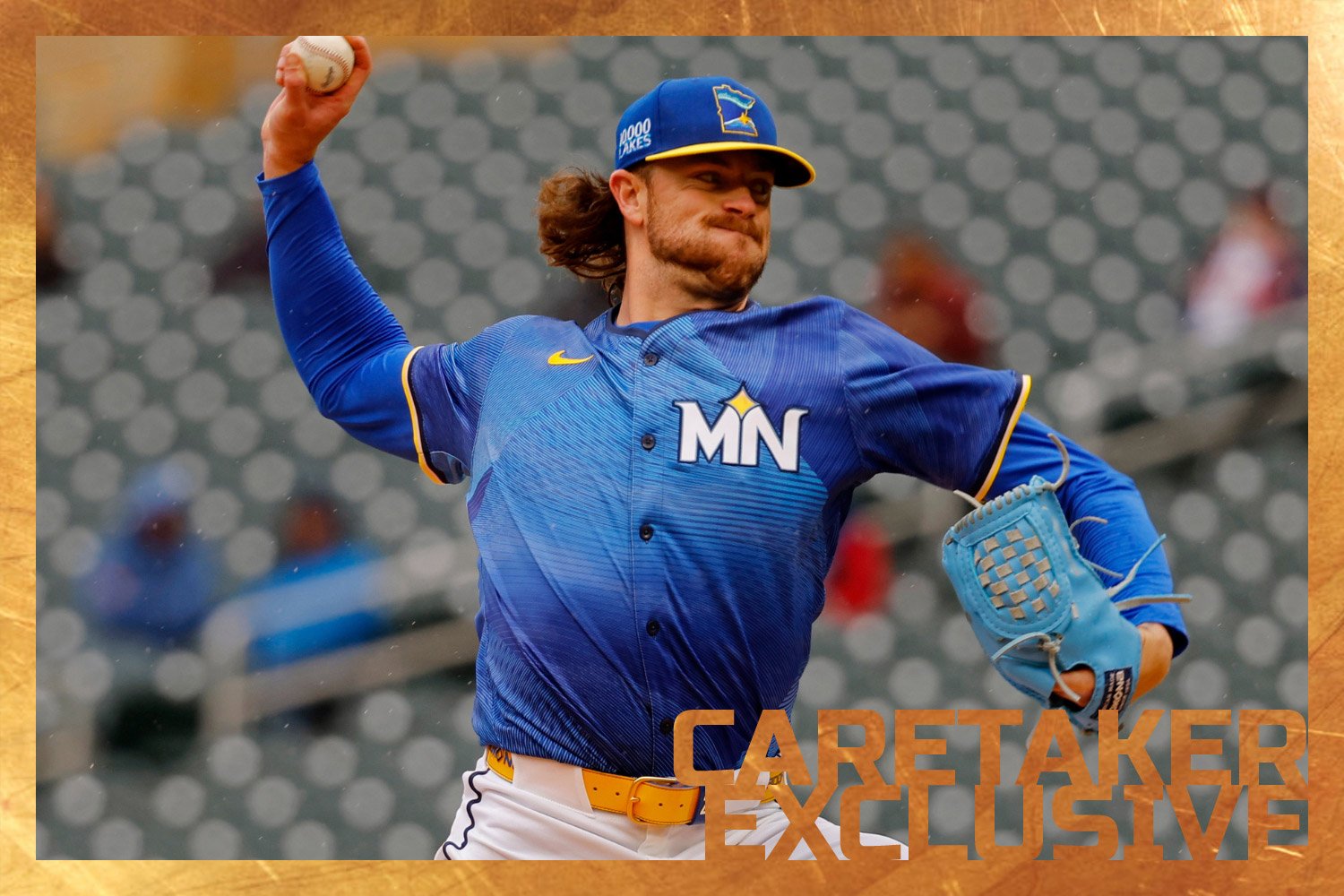 span>Though he's fundamentally a competitive, instinctual hurler, Chris Paddack has no problem switching into a more cerebral mode when it comes to his favorite subtopic: being a fastball pitcher, and locating that pitch up and away from opposing batters. "I call it the blind spot, because I feel like there’s not a lot of guys who work on hitting up-and-away pitches," Paddack said Wednesday afternoon, inside the Twins clubhouse at Target Field. "Usually, you see them working on the tee down in the zone, or top-of-the-zone heaters from tee work or flips, or against the machine, but you don’t ever see them trying to extend their hands." You can quibble with Paddack's results, or even with the logical underpinnings of his theory, but you can't accuse him of not being committed to the concept. Some 147 right-handed pitchers have thrown at least 100 fastballs this season. Among them, Paddack throws the largest share of his high and to the glove side—that is, the outside edge of the plate to righties, or the inner edge to lefties. Nor is the efficacy of that pitch, in broad strokes, up for much debate. Right behind Paddack on this (carefully defined) leaderboard is Tyler Mahle, the ex-Twins righty who now toils for the Rangers. Mahle had a few pitching nerds a bit stumped Monday, when Thomas Nestico shared the leaderboard for in-zone whiff rate against fastballs—topped not by any of the league's hardest-throwing or most famous fireballers, but by Mahle. Mahle's heater doesn't even have as much life on it as Paddack's, which itself is not beating hitters with its raw velocity. He gets all those whiffs because, by and large, hitters really do have a blind spot when it comes to pitchers consistently executing the high fastball to their glove side. Hurlers who can do that gain a small but crucial advantage. Their opponents feel more defensive, like they're trying to cover a larger strike zone and can't commit as readily to a swing that will do so. Within the top 10 on the same leaderboard, even in their old age and having lost some of their ability to fire into that corner, are Jacob deGrom and Justin Verlander, each of whom benefited enormously from creating that kind of discomfort at their peaks. Throwing your fastball high and to the glove side can make a mediocre pitcher average, an average pitcher good, and a good pitcher downright great. Paddack's fastball consistently rates as average-ish, in Stuff models. When he commands it to that quadrant, though, it plays up. Indeed, because it bakes in his locations, Baseball Prospectus's PitchPro rates Paddack's fastball better than its location-agnostic StuffPro does, both this season and for his career. Not only that, but the more he hammers away at that high, glove-side target, the better his StuffPro is. This year, it's been a better-than-average pitch, as illustrated by the new graphics that capture a pitcher's arsenal at a glance on BP's invaluable player cards. "There are a couple of guys that do get to that pitch fairly well, and targeting in is better than away," Paddack acknowledged, "but I would say a majority of the time, there’s more swing-and-miss up and away, just because there’s not a lot of guys that also can command their fastball to that quadrant." While he's the league's preeminent practitioner of the pitch, though, Paddack is far from alone in that Twins clubhouse in understanding the importance of the blind-spot fastball.
-
- 3
-

-
- chris paddack
- bailey ober
- (and 1 more)
-
Hitters hate this one weird trick. Image courtesy of © Bruce Kluckhohn-Imagn Images span>Though he's fundamentally a competitive, instinctual hurler, Chris Paddack has no problem switching into a more cerebral mode when it comes to his favorite subtopic: being a fastball pitcher, and locating that pitch up and away from opposing batters. "I call it the blind spot, because I feel like there’s not a lot of guys who work on hitting up-and-away pitches," Paddack said Wednesday afternoon, inside the Twins clubhouse at Target Field. "Usually, you see them working on the tee down in the zone, or top-of-the-zone heaters from tee work or flips, or against the machine, but you don’t ever see them trying to extend their hands." You can quibble with Paddack's results, or even with the logical underpinnings of his theory, but you can't accuse him of not being committed to the concept. Some 147 right-handed pitchers have thrown at least 100 fastballs this season. Among them, Paddack throws the largest share of his high and to the glove side—that is, the outside edge of the plate to righties, or the inner edge to lefties. Nor is the efficacy of that pitch, in broad strokes, up for much debate. Right behind Paddack on this (carefully defined) leaderboard is Tyler Mahle, the ex-Twins righty who now toils for the Rangers. Mahle had a few pitching nerds a bit stumped Monday, when Thomas Nestico shared the leaderboard for in-zone whiff rate against fastballs—topped not by any of the league's hardest-throwing or most famous fireballers, but by Mahle. Mahle's heater doesn't even have as much life on it as Paddack's, which itself is not beating hitters with its raw velocity. He gets all those whiffs because, by and large, hitters really do have a blind spot when it comes to pitchers consistently executing the high fastball to their glove side. Hurlers who can do that gain a small but crucial advantage. Their opponents feel more defensive, like they're trying to cover a larger strike zone and can't commit as readily to a swing that will do so. Within the top 10 on the same leaderboard, even in their old age and having lost some of their ability to fire into that corner, are Jacob deGrom and Justin Verlander, each of whom benefited enormously from creating that kind of discomfort at their peaks. Throwing your fastball high and to the glove side can make a mediocre pitcher average, an average pitcher good, and a good pitcher downright great. Paddack's fastball consistently rates as average-ish, in Stuff models. When he commands it to that quadrant, though, it plays up. Indeed, because it bakes in his locations, Baseball Prospectus's PitchPro rates Paddack's fastball better than its location-agnostic StuffPro does, both this season and for his career. Not only that, but the more he hammers away at that high, glove-side target, the better his StuffPro is. This year, it's been a better-than-average pitch, as illustrated by the new graphics that capture a pitcher's arsenal at a glance on BP's invaluable player cards. "There are a couple of guys that do get to that pitch fairly well, and targeting in is better than away," Paddack acknowledged, "but I would say a majority of the time, there’s more swing-and-miss up and away, just because there’s not a lot of guys that also can command their fastball to that quadrant." While he's the league's preeminent practitioner of the pitch, though, Paddack is far from alone in that Twins clubhouse in understanding the importance of the blind-spot fastball. View full article
-
Not the longest one I've written about a single play! But probably close. Haha.
- 10 replies
-
- 2
-

-
- byron buxton
- dashawn keirsey jr
- (and 1 more)
-
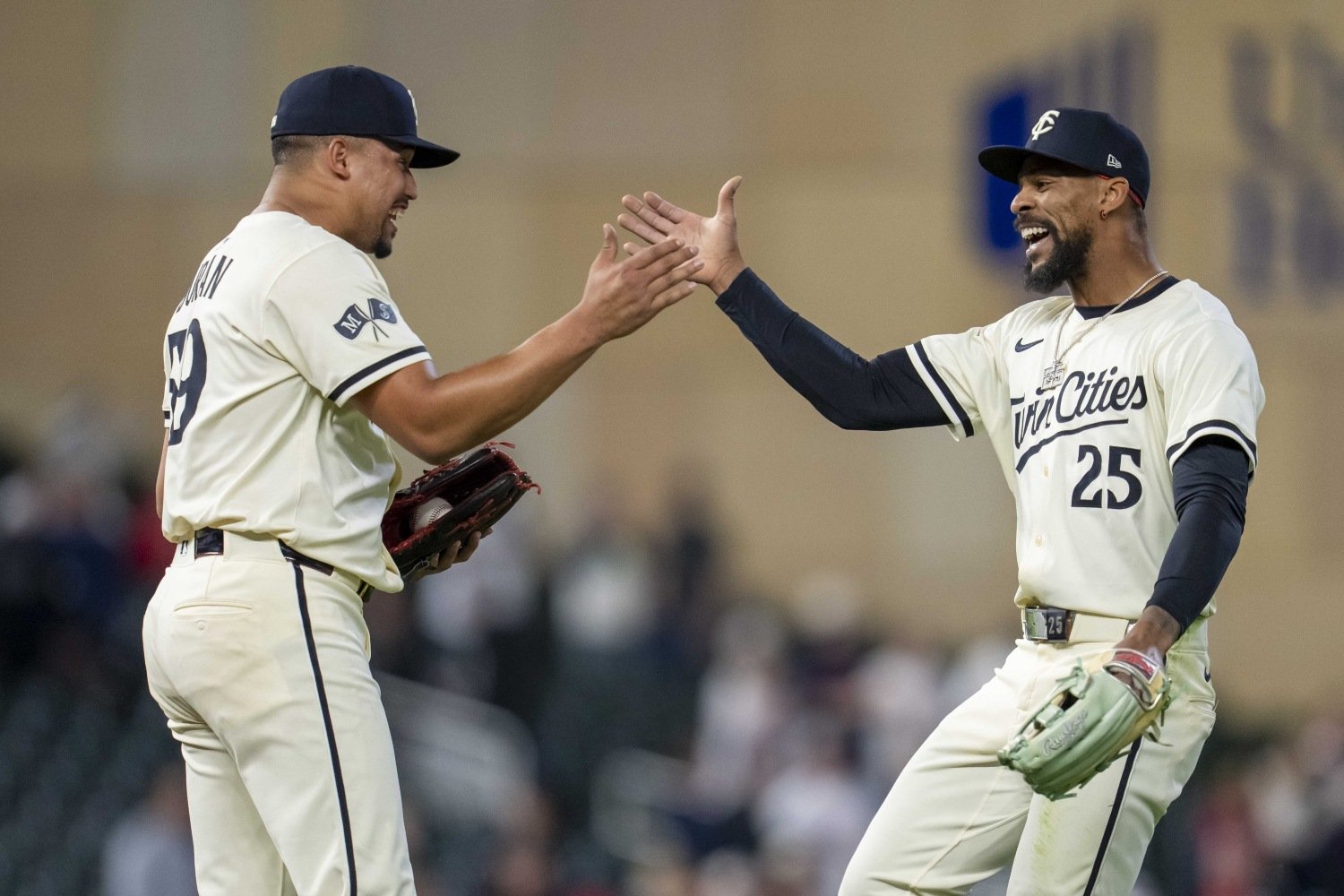 Sport, like war, is all about grace and guile under pressure. That parallel is uncomfortable for many people, because it seems to overdramatize sport or glorify war, but if you refuse those connotations and examine it as a factual contention, it holds up well. Games and fights have always been the surest ways to raise the stakes of our day-to-day lives; they make clear what really lies behind the facades we construct and utilize when things are calm. They test our resiliency, our intelligence, and our courage. David Halberstam, perhaps the best sports writer of the 20th century, saw those tests as the essential stuff of sports. And he believed, in a way we might now regard as quaint, that you passed or failed based on your ability to meet the moment when it slammed up against you hardest. "Big games, and late innings and fourth quarters," he once wrote. "That's when the test is real." In an unsettling, unhappy way, the Twins' contest against the visiting White Sox Tuesday night—an April game between two losing teams, before 11,828 fans—was a big game. The team had just come home from a brutally fruitless trip to Smyrna, Ga., where they were swept by the otherwise inept would-be contender who hosts games there. They'd blown a late lead in the first game of the set, and never bounced back. After the sweep, they were 7-15. It was a minor surprise that no one was fired on the off day as the team trudged home. Though it was against a truly terrible opponent, the game Rocco Baldelli's team played Tuesday had been an impressive response to their latest flirtation with implosion. Bad Chicago defense and a bad non-call by the umpires had helped them take a 2-1 lead, but sharp defense and poised, unflappable pitching performances had made it stand up, and the Twins finally cracked the thin White Sox pitching staff in the bottom of the eighth, putting up two lovely insurance runs. And then, suddenly, they were staring another mortifying defeat in the face. The White Sox scored, and they pushed the tying runs into scoring position, and they sent their best hitter (a backhanded compliment, but still) to the plate with the game on the line. Andrew Benintendi did one extraordinary thing we all take for granted, by recognizing and squaring up a 101-mph fastball from Jhoan Duran. He sent a 101-mph projectile of his own toward right-center field, at a launch angle that would give Byron Buxton just 4.4 seconds to flag the ball down. For those of us on the outside—the men and women anywhere but the arena, entertained or even engrossed but not actually involved—the suspense was enormous, but short-lived. For all the center fielders involved in the play, though, it felt much longer. These guys process visual information and react to it on a different level than most of us. "Well, I've learned to almost think he's gonna catch all of them. He's even caught some where I'm like, 'Ah, man, probably not much of a chance on this ball,'" said Baldelli, who is not only Buxton's manager but a former center fielder himself. "And then you start to look. You shift your eyes, on some of these plays. The ball gets hit, you look at him, you watch him go after it, and then at some point, you look at where the baserunners are at, and you start looking at the other outfielders. And then when you look back up, sometimes, he's just kind of there." That sounds like a manager speaking—taking stock of the situation, zooming out, thinking about everything—but it is, if you read between the lines, also a center fielder. For this caliber of athlete and physical thinker, there's time to assess, adjust, and consider, even on a scalded ball with as much line drive as of fly ball to it. "I've got a chance at everything; I've just gotta run," Buxton said after the game. "I knew once he hit it, he hit it good. Not many fans here, so you can hear how loud it comes off the bat, so I knew off the jump I had to get on my horses." Some of this is hindsight making these guys sound more conscious and multilevel in their thinking than they actually were, in the moment. Of course that's true. It shouldn't diminish our admiration for their ability to compress conscious thought and make a huge series of careful judgments, in specific and highly variable contexts, all without impeding their ability to get their body moving at top speed. "You're also battling so many other factors," said DaShawn Keirsey Jr., a center fielder by trade who took over in right field as a defensive substitute in that ninth frame. "You're running into the wall, essentially—or towards the wall—so it's not like you just have free rein or room to work with. As outfielders, you're always kind of conscious of that." Again: there's a context in which the fielder has to make their decisions about how to pursue a ball. Keirsey is only half-right, though. Maybe most outfielders are always conscious of that, but Buxton used to belong to the class of ballhawks so proud and exceptional and stubborn that they would sooner run through a wall than stop short of one and allow a ball to drop unmolested. There are two or three Aaron Rowands for every actual star in such groups, but one other member of that fraternity is the one who looms over Buxton at all times: Willie Mays. From its very best, center field has always asked not only for exceptional speed, arm strength, and ballistic judgment of the ball in flight, but also for fearlessness—even recklessness. Buxton, though, has learned to gird himself against that siren song, so while Keirsey might have been wrong to think the wall crossed his teammate's mind in the past, he's right that it was a consideration Tuesday. "I took a glance—I can't tell you how far, now, but I took a glance at the wall, and I knew I had a good bit of space for me, if I needed to dive," Buxton said of his pursuit. "And for me, that's all I need to be able to feel safe for myself to do something like that now. Normally, I wouldn't care. I'd just go play Superman. But just trying to be smart about the balls that I go for, and the balls I go after, to make sure that I don't put myself in a bad situation to where I'm not on the field to be able to make plays like that at the end of the game." It's hard to pinpoint when he snuck in this look, but we do have a close-up angle of him for the final four or five strides before he leaped toward the baseball. He didn't take his eyes off the ball during them. That leads us to another observation: to make a play like this is to gaze slightly and subconsciously into the future. Buxton didn't just need speed to catch the ball Benintendi tattooed to the warning track. He was able, very early, to calculate where he would be ending up if he caught the ball—even though his brain couldn't possibly have verbally communicated that it was performing that calculation. That's what gave him the confidence to tear after the ball and make the leap and sprawl he did: he knew where he was going to be doing that two seconds before he did it. "The biggest thing was making sure I had a good line to the ball, because the ball didn't get up too high, for me to kind of run up under it," he said of Benintendi's 24° fly ball. "So, just being able to make the right instincts and first step was a big key." As Keirsey noted, the stakes of that initial read were raised—although the job was also, perhaps, made incrementally easier—by where Buxton was positioned at the time of the pitch. "When a ball's hit as hard as it was, and he's also—I'm pretty sure he was playing on the other side of the bag, kind of covering that [left-center] gap. But to make that read right off the bat, and then not only to read it, but then to get there," Keirsey said. "It takes a special talent." It was only sensible that Buxton would be shading Benintendi to spray on the play, especially if Duran was going to throw him fastballs. Because he did so, though, he had lots of ground to cover, and the ball was slicing away from him even as he pursued it. "With a lefty hitting, it was kind of going back towards right," Buxton said. "It's one of those things where I'm glad I play center, because I didn't see it until I looked at the video and I was like, 'Oh, that was tailing back towards right.' But as a center fielder, I see that ball as straight." That's a fascinating insight, although (once it's pulled to your attention) not a shocking one. Just as hitters see incoming pitches from specific vantage points that might affect how much a pitch appears to move or how two offerings interact with one another, outfielders have to experience the ball in flight from their own perspective. Buxton might be something almost like a time-traveler, but he's not seeing the ball in 3-D computer vision or from multiple angles. Playing center, the ball might be moving away from you, but it's doing so even as you're chasing it. Often, that makes it easier to read and chase the ball than it is for a corner outfielder, toward whom such balls are usually hooking or slicing in a more noticeable, less easily tracked way. Buxton can also feel fortunate that he was in position to make the play at all, because whether he was shaded toward left field or not, the young versions of Buxton—the ones from his first few years in the majors, 2015-18—could never have gotten there. Back then, he played too shallow, even (or especially) in situations like the one the team faced Tuesday night in the ninth. Season Avg. Starting Dist. 2015 310 2016 313 2017 314 2018 314 2019 321 2020 329 2021 332 2022 330 2023 N/A 2024 321 2025 327 With the tying run on second, Buxton was already playing a step more shallow than he otherwise would have, knowing he might need to charge a single hard to get the ball home in time to prevent the tie. But because that was from a deeper base positioning, he was deep enough to run down Benintendi's drive as it neared the wall. "There's a few plays—not just this game, but I get mad about balls falling in front of me," Buxton said of his changes in playstyle over the years. "But at the end of the day, I'm still able to go out there day in and day out, and take my position in center. You've gotta give up something to get something, sometimes." Some portion of the brilliance we see in great center-field defenders, then, comes from good preparation. Still, you can also see the remarkable capacity to slow the play down in hearing Keirsey's up close-and-personal account of the play. "I was telling him, it's weird, because normally, I'm the one making plays like that," Keirsey said. "I can't say I've ever really been in an outfield with guys who are that good. It was like it was slo-mo. As I'm running, I see him, and he just jumps in the air, and it was like slow motion. It was one of the most incredible catches I've ever seen." The exhilarating thing for Keirsey, who was like a solid hobbyist painter watching Da Vinci apply brushstrokes in that moment, was that he got to take it in so completely. By the time Buxton caught the ball, Keirsey had gone through his own profound processing of it and was watching his teammate, as he tried to check off the list of things he can do to help on any given play. "Pretty early, I know that play's not me. So as the corner outfielder—or even in center, for a guy in the corner—I try to help him as far as, he's looking at the ball to make the play, so he's not looking at the wall," Keirsey said. "So I'll try to communicate in that aspect for guys. In that circumstance, he wasn't necessarily getting to the wall, but that's what I'm looking for. I've just gotta watch him, basically." In the end, we can see Buxton start from that ultimately disadvantageous spot; quickly pick a straight line to the ball, but one that angles him away from the plate and makes the catch daunting; measure a few steps; and snare the ball, with enough suavity to distract you from the moderately violent crash of his landing. What we can't see is all the thoughts that zipped across his mind, and his eyes, and his manager's and fellow outfielder's minds and eyes. Most of us lack not only that grace under pressure, but that raw mental processing power. Most great center fielders have a trademark catch to save a game much earlier in their career than Buxton did. That was the price of all the injuries he suffered and all the time he lost during his 20s: so many games that might have included a pivotal, long fly to center found someone else patrolling the spot. "I don't think I've ended a game with a catch like that—especially with everything that's going on, us battling, getting through some tough series," Buxton said later, proving he did and does feel the pressure bearing down on the team—and confirming the realness of the test he passed by catching the ball. "Just trying to get things to fall for us, and have something be able to fall our way was fun. Last weekend, Michael Harris—that's exactly what he did. For me, I'm glad the game's over, but that kind of gets you started on the offensive side. Especially when you have a tough day at the plate, to make a play like that gets you motivated. It gets you back in the dugout to get things going." Turning defense into offense, in baseball, is a different, more fraught, and less generally believed-in art than doing so in the NBA, the NFL, or even Baldelli's beloved English Premier League. It's direct and real only to whatever extent players can concretize the surge in confidence or focus they gain by making a great play. Great center fielders have a way of making you buy into the notion, though. Buxton clearly believes in it, based on the conviction in his voice when talking about that. Baldelli would only note that those kinds of plays are rare, and that they alter games in and of themselves. "The athleticism, the range, the body control to make that play—all things that we've seen from him before, and that you don't see every day on the baseball field."
- 10 comments
-
- 5
-
-
- byron buxton
- dashawn keirsey jr
- (and 1 more)
-
At the crack of the bat, fans and onlookers at Target Field sucked in a sharp breath. In a season of heartbreak, the arc of the line drive screaming toward the wall in right-center field looked terrifyingly like that of a scythe delivering a lethal blow to the helpless Twins' season. For the people inside the play, though, there was nothing but time. Image courtesy of © Jesse Johnson-Imagn Images Sport, like war, is all about grace and guile under pressure. That parallel is uncomfortable for many people, because it seems to overdramatize sport or glorify war, but if you refuse those connotations and examine it as a factual contention, it holds up well. Games and fights have always been the surest ways to raise the stakes of our day-to-day lives; they make clear what really lies behind the facades we construct and utilize when things are calm. They test our resiliency, our intelligence, and our courage. David Halberstam, perhaps the best sports writer of the 20th century, saw those tests as the essential stuff of sports. And he believed, in a way we might now regard as quaint, that you passed or failed based on your ability to meet the moment when it slammed up against you hardest. "Big games, and late innings and fourth quarters," he once wrote. "That's when the test is real." In an unsettling, unhappy way, the Twins' contest against the visiting White Sox Tuesday night—an April game between two losing teams, before 11,828 fans—was a big game. The team had just come home from a brutally fruitless trip to Smyrna, Ga., where they were swept by the otherwise inept would-be contender who hosts games there. They'd blown a late lead in the first game of the set, and never bounced back. After the sweep, they were 7-15. It was a minor surprise that no one was fired on the off day as the team trudged home. Though it was against a truly terrible opponent, the game Rocco Baldelli's team played Tuesday had been an impressive response to their latest flirtation with implosion. Bad Chicago defense and a bad non-call by the umpires had helped them take a 2-1 lead, but sharp defense and poised, unflappable pitching performances had made it stand up, and the Twins finally cracked the thin White Sox pitching staff in the bottom of the eighth, putting up two lovely insurance runs. And then, suddenly, they were staring another mortifying defeat in the face. The White Sox scored, and they pushed the tying runs into scoring position, and they sent their best hitter (a backhanded compliment, but still) to the plate with the game on the line. Andrew Benintendi did one extraordinary thing we all take for granted, by recognizing and squaring up a 101-mph fastball from Jhoan Duran. He sent a 101-mph projectile of his own toward right-center field, at a launch angle that would give Byron Buxton just 4.4 seconds to flag the ball down. For those of us on the outside—the men and women anywhere but the arena, entertained or even engrossed but not actually involved—the suspense was enormous, but short-lived. For all the center fielders involved in the play, though, it felt much longer. These guys process visual information and react to it on a different level than most of us. "Well, I've learned to almost think he's gonna catch all of them. He's even caught some where I'm like, 'Ah, man, probably not much of a chance on this ball,'" said Baldelli, who is not only Buxton's manager but a former center fielder himself. "And then you start to look. You shift your eyes, on some of these plays. The ball gets hit, you look at him, you watch him go after it, and then at some point, you look at where the baserunners are at, and you start looking at the other outfielders. And then when you look back up, sometimes, he's just kind of there." That sounds like a manager speaking—taking stock of the situation, zooming out, thinking about everything—but it is, if you read between the lines, also a center fielder. For this caliber of athlete and physical thinker, there's time to assess, adjust, and consider, even on a scalded ball with as much line drive as of fly ball to it. "I've got a chance at everything; I've just gotta run," Buxton said after the game. "I knew once he hit it, he hit it good. Not many fans here, so you can hear how loud it comes off the bat, so I knew off the jump I had to get on my horses." Some of this is hindsight making these guys sound more conscious and multilevel in their thinking than they actually were, in the moment. Of course that's true. It shouldn't diminish our admiration for their ability to compress conscious thought and make a huge series of careful judgments, in specific and highly variable contexts, all without impeding their ability to get their body moving at top speed. "You're also battling so many other factors," said DaShawn Keirsey Jr., a center fielder by trade who took over in right field as a defensive substitute in that ninth frame. "You're running into the wall, essentially—or towards the wall—so it's not like you just have free rein or room to work with. As outfielders, you're always kind of conscious of that." Again: there's a context in which the fielder has to make their decisions about how to pursue a ball. Keirsey is only half-right, though. Maybe most outfielders are always conscious of that, but Buxton used to belong to the class of ballhawks so proud and exceptional and stubborn that they would sooner run through a wall than stop short of one and allow a ball to drop unmolested. There are two or three Aaron Rowands for every actual star in such groups, but one other member of that fraternity is the one who looms over Buxton at all times: Willie Mays. From its very best, center field has always asked not only for exceptional speed, arm strength, and ballistic judgment of the ball in flight, but also for fearlessness—even recklessness. Buxton, though, has learned to gird himself against that siren song, so while Keirsey might have been wrong to think the wall crossed his teammate's mind in the past, he's right that it was a consideration Tuesday. "I took a glance—I can't tell you how far, now, but I took a glance at the wall, and I knew I had a good bit of space for me, if I needed to dive," Buxton said of his pursuit. "And for me, that's all I need to be able to feel safe for myself to do something like that now. Normally, I wouldn't care. I'd just go play Superman. But just trying to be smart about the balls that I go for, and the balls I go after, to make sure that I don't put myself in a bad situation to where I'm not on the field to be able to make plays like that at the end of the game." It's hard to pinpoint when he snuck in this look, but we do have a close-up angle of him for the final four or five strides before he leaped toward the baseball. He didn't take his eyes off the ball during them. That leads us to another observation: to make a play like this is to gaze slightly and subconsciously into the future. Buxton didn't just need speed to catch the ball Benintendi tattooed to the warning track. He was able, very early, to calculate where he would be ending up if he caught the ball—even though his brain couldn't possibly have verbally communicated that it was performing that calculation. That's what gave him the confidence to tear after the ball and make the leap and sprawl he did: he knew where he was going to be doing that two seconds before he did it. "The biggest thing was making sure I had a good line to the ball, because the ball didn't get up too high, for me to kind of run up under it," he said of Benintendi's 24° fly ball. "So, just being able to make the right instincts and first step was a big key." As Keirsey noted, the stakes of that initial read were raised—although the job was also, perhaps, made incrementally easier—by where Buxton was positioned at the time of the pitch. "When a ball's hit as hard as it was, and he's also—I'm pretty sure he was playing on the other side of the bag, kind of covering that [left-center] gap. But to make that read right off the bat, and then not only to read it, but then to get there," Keirsey said. "It takes a special talent." It was only sensible that Buxton would be shading Benintendi to spray on the play, especially if Duran was going to throw him fastballs. Because he did so, though, he had lots of ground to cover, and the ball was slicing away from him even as he pursued it. "With a lefty hitting, it was kind of going back towards right," Buxton said. "It's one of those things where I'm glad I play center, because I didn't see it until I looked at the video and I was like, 'Oh, that was tailing back towards right.' But as a center fielder, I see that ball as straight." That's a fascinating insight, although (once it's pulled to your attention) not a shocking one. Just as hitters see incoming pitches from specific vantage points that might affect how much a pitch appears to move or how two offerings interact with one another, outfielders have to experience the ball in flight from their own perspective. Buxton might be something almost like a time-traveler, but he's not seeing the ball in 3-D computer vision or from multiple angles. Playing center, the ball might be moving away from you, but it's doing so even as you're chasing it. Often, that makes it easier to read and chase the ball than it is for a corner outfielder, toward whom such balls are usually hooking or slicing in a more noticeable, less easily tracked way. Buxton can also feel fortunate that he was in position to make the play at all, because whether he was shaded toward left field or not, the young versions of Buxton—the ones from his first few years in the majors, 2015-18—could never have gotten there. Back then, he played too shallow, even (or especially) in situations like the one the team faced Tuesday night in the ninth. Season Avg. Starting Dist. 2015 310 2016 313 2017 314 2018 314 2019 321 2020 329 2021 332 2022 330 2023 N/A 2024 321 2025 327 With the tying run on second, Buxton was already playing a step more shallow than he otherwise would have, knowing he might need to charge a single hard to get the ball home in time to prevent the tie. But because that was from a deeper base positioning, he was deep enough to run down Benintendi's drive as it neared the wall. "There's a few plays—not just this game, but I get mad about balls falling in front of me," Buxton said of his changes in playstyle over the years. "But at the end of the day, I'm still able to go out there day in and day out, and take my position in center. You've gotta give up something to get something, sometimes." Some portion of the brilliance we see in great center-field defenders, then, comes from good preparation. Still, you can also see the remarkable capacity to slow the play down in hearing Keirsey's up close-and-personal account of the play. "I was telling him, it's weird, because normally, I'm the one making plays like that," Keirsey said. "I can't say I've ever really been in an outfield with guys who are that good. It was like it was slo-mo. As I'm running, I see him, and he just jumps in the air, and it was like slow motion. It was one of the most incredible catches I've ever seen." The exhilarating thing for Keirsey, who was like a solid hobbyist painter watching Da Vinci apply brushstrokes in that moment, was that he got to take it in so completely. By the time Buxton caught the ball, Keirsey had gone through his own profound processing of it and was watching his teammate, as he tried to check off the list of things he can do to help on any given play. "Pretty early, I know that play's not me. So as the corner outfielder—or even in center, for a guy in the corner—I try to help him as far as, he's looking at the ball to make the play, so he's not looking at the wall," Keirsey said. "So I'll try to communicate in that aspect for guys. In that circumstance, he wasn't necessarily getting to the wall, but that's what I'm looking for. I've just gotta watch him, basically." In the end, we can see Buxton start from that ultimately disadvantageous spot; quickly pick a straight line to the ball, but one that angles him away from the plate and makes the catch daunting; measure a few steps; and snare the ball, with enough suavity to distract you from the moderately violent crash of his landing. What we can't see is all the thoughts that zipped across his mind, and his eyes, and his manager's and fellow outfielder's minds and eyes. Most of us lack not only that grace under pressure, but that raw mental processing power. Most great center fielders have a trademark catch to save a game much earlier in their career than Buxton did. That was the price of all the injuries he suffered and all the time he lost during his 20s: so many games that might have included a pivotal, long fly to center found someone else patrolling the spot. "I don't think I've ended a game with a catch like that—especially with everything that's going on, us battling, getting through some tough series," Buxton said later, proving he did and does feel the pressure bearing down on the team—and confirming the realness of the test he passed by catching the ball. "Just trying to get things to fall for us, and have something be able to fall our way was fun. Last weekend, Michael Harris—that's exactly what he did. For me, I'm glad the game's over, but that kind of gets you started on the offensive side. Especially when you have a tough day at the plate, to make a play like that gets you motivated. It gets you back in the dugout to get things going." Turning defense into offense, in baseball, is a different, more fraught, and less generally believed-in art than doing so in the NBA, the NFL, or even Baldelli's beloved English Premier League. It's direct and real only to whatever extent players can concretize the surge in confidence or focus they gain by making a great play. Great center fielders have a way of making you buy into the notion, though. Buxton clearly believes in it, based on the conviction in his voice when talking about that. Baldelli would only note that those kinds of plays are rare, and that they alter games in and of themselves. "The athleticism, the range, the body control to make that play—all things that we've seen from him before, and that you don't see every day on the baseball field." View full article
-
.png.e37757069d2e0ab8243fdd5db0584072.png) If you just watch Twins games on TV, you might not even notice it. In our heads, we've all gotten used to mentally categorizing the alignment of the infield defense based on a simple test: can I see a middle infielder's head at the bottom of the screen, as we watch from the center-field camera? After all, most of the game is fed to us through that lens, looking in from a perch above center field to the main street of baseball: the lane from the pitcher's mound to home plate. When we can see (most often, with a lefty up) the shortstop's or (much less often, because of the specific way many cameras are offset to the right, but occasionally) the second baseman's head at the bottom of the frame, we broadly assume that the defense is deploying the legal version of the old infield shift—now called, a bit euphemistically, "Shades". The Twins, you might not be shocked to hear, use Shades almost as aggressively as any team in baseball. Until about a week ago, they were second in MLB in the use of them. Now, they've dropped back to fifth, but there's still only one team—the San Diego Padres—who shades more often against lefty batters. The Twins' personnel has shifted (not shaded; I mean the roster and the lineup have actually changed) recently, with Jose Miranda being optioned, Brooks Lee being activated, and Carlos Correa getting hurt, but they remain steadfast in their approach. Rocco Baldelli certainly doesn't foresee changing the frequency with which they deploy their flavors of the shaded defense much, because of these changes. "The positioning side won’t change more than marginally, based on who we have out on the field," Baldelli said Sunday. "Could it affect some things? Yes. But is it going to affect the overriding way that we put our players on the field? No." If you think deeply about it, the traditional way of aligning defenders never made that much sense. It was a hedge, basically. It took the field and the four fielders assigned to defend it and scattered them in a roughly even pattern, trying to minimize the chance that a ball hit to any random location would sneak through. But the distribution of batted balls in modern major-league baseball is far from random, and Baldelli doesn't want his club anchored to that outdated mindset. "We put our guys in certain spots because that’s where the hitters hit the balls, and that’s where they hit balls against certain types of pitchers, specifically," Baldelli said. Then, however, he made the admission I had been waiting for. With all these moving parts, could the team adjust not whether it uses a shaded infield, but how extreme that shading is? "Are we talking a step? Yeah. We might open our guys up or close them in toward each other at times, based on who we have on the field," the skipper said. "But it’s not going to be more than small differences." It's baseball, Rocco. There are no small differences. Let's dig into these.
If you just watch Twins games on TV, you might not even notice it. In our heads, we've all gotten used to mentally categorizing the alignment of the infield defense based on a simple test: can I see a middle infielder's head at the bottom of the screen, as we watch from the center-field camera? After all, most of the game is fed to us through that lens, looking in from a perch above center field to the main street of baseball: the lane from the pitcher's mound to home plate. When we can see (most often, with a lefty up) the shortstop's or (much less often, because of the specific way many cameras are offset to the right, but occasionally) the second baseman's head at the bottom of the frame, we broadly assume that the defense is deploying the legal version of the old infield shift—now called, a bit euphemistically, "Shades". The Twins, you might not be shocked to hear, use Shades almost as aggressively as any team in baseball. Until about a week ago, they were second in MLB in the use of them. Now, they've dropped back to fifth, but there's still only one team—the San Diego Padres—who shades more often against lefty batters. The Twins' personnel has shifted (not shaded; I mean the roster and the lineup have actually changed) recently, with Jose Miranda being optioned, Brooks Lee being activated, and Carlos Correa getting hurt, but they remain steadfast in their approach. Rocco Baldelli certainly doesn't foresee changing the frequency with which they deploy their flavors of the shaded defense much, because of these changes. "The positioning side won’t change more than marginally, based on who we have out on the field," Baldelli said Sunday. "Could it affect some things? Yes. But is it going to affect the overriding way that we put our players on the field? No." If you think deeply about it, the traditional way of aligning defenders never made that much sense. It was a hedge, basically. It took the field and the four fielders assigned to defend it and scattered them in a roughly even pattern, trying to minimize the chance that a ball hit to any random location would sneak through. But the distribution of batted balls in modern major-league baseball is far from random, and Baldelli doesn't want his club anchored to that outdated mindset. "We put our guys in certain spots because that’s where the hitters hit the balls, and that’s where they hit balls against certain types of pitchers, specifically," Baldelli said. Then, however, he made the admission I had been waiting for. With all these moving parts, could the team adjust not whether it uses a shaded infield, but how extreme that shading is? "Are we talking a step? Yeah. We might open our guys up or close them in toward each other at times, based on who we have on the field," the skipper said. "But it’s not going to be more than small differences." It's baseball, Rocco. There are no small differences. Let's dig into these.- 3 comments
-
- 1
-
-
- carlos correa
- ty france
- (and 4 more)
-
Beginning in 2023, Major League Baseball required each team to have four players (other than the pitcher and catcher) on the infield when each pitch was thrown, and for two of them to be on each side of second base. That rule has eliminated one subset of tailored defensive alignments, but the Twins are pioneering another. Image courtesy of © Jesse Johnson-Imagn Images If you just watch Twins games on TV, you might not even notice it. In our heads, we've all gotten used to mentally categorizing the alignment of the infield defense based on a simple test: can I see a middle infielder's head at the bottom of the screen, as we watch from the center-field camera? After all, most of the game is fed to us through that lens, looking in from a perch above center field to the main street of baseball: the lane from the pitcher's mound to home plate. When we can see (most often, with a lefty up) the shortstop's or (much less often, because of the specific way many cameras are offset to the right, but occasionally) the second baseman's head at the bottom of the frame, we broadly assume that the defense is deploying the legal version of the old infield shift—now called, a bit euphemistically, "Shades". The Twins, you might not be shocked to hear, use Shades almost as aggressively as any team in baseball. Until about a week ago, they were second in MLB in the use of them. Now, they've dropped back to fifth, but there's still only one team—the San Diego Padres—who shades more often against lefty batters. The Twins' personnel has shifted (not shaded; I mean the roster and the lineup have actually changed) recently, with Jose Miranda being optioned, Brooks Lee being activated, and Carlos Correa getting hurt, but they remain steadfast in their approach. Rocco Baldelli certainly doesn't foresee changing the frequency with which they deploy their flavors of the shaded defense much, because of these changes. "The positioning side won’t change more than marginally, based on who we have out on the field," Baldelli said Sunday. "Could it affect some things? Yes. But is it going to affect the overriding way that we put our players on the field? No." If you think deeply about it, the traditional way of aligning defenders never made that much sense. It was a hedge, basically. It took the field and the four fielders assigned to defend it and scattered them in a roughly even pattern, trying to minimize the chance that a ball hit to any random location would sneak through. But the distribution of batted balls in modern major-league baseball is far from random, and Baldelli doesn't want his club anchored to that outdated mindset. "We put our guys in certain spots because that’s where the hitters hit the balls, and that’s where they hit balls against certain types of pitchers, specifically," Baldelli said. Then, however, he made the admission I had been waiting for. With all these moving parts, could the team adjust not whether it uses a shaded infield, but how extreme that shading is? "Are we talking a step? Yeah. We might open our guys up or close them in toward each other at times, based on who we have on the field," the skipper said. "But it’s not going to be more than small differences." It's baseball, Rocco. There are no small differences. Let's dig into these. View full article
-
There's always what we say, and what we mean, and a gap between the two; what we mean to do, and what we really do, and a gap between the two. We all have a habit of saying what we mean to do, but what we really do tends to align with what we meant but wouldn't say. Image courtesy of © Isaiah J. Downing-Imagn Images Four score minus two years ago, a few brave people (with hundreds of thousands at their backs and millions standing shoulder-to-shoulder in their path) brought forth upon this continent the first worthwhile version of the United States of America. Jackie Robinson took the field for the Brooklyn Dodgers that day, breaking what had been a six-decade color barrier for entry into Major League Baseball. Robinson, a former Army officer who made a stand against segregation on the Texas base where he served during World War II, was an acutely self-aware symbol of the nascent 20th-century Civil Rights Movement. At various times in the decades since then, biographers and orthogonal narrators of that moment have downplayed that fact, preferring to cast Robinson as someone who just wanted to play his beloved game without fetter or restriction. He did want that equality of opportunity, but not in some boyish, vapid way, and not just because he had a deep competitive fire. By the time Robinson and Branch Rickey set fire to the official barrier between MLB and the Negro Leagues, the fire of the Civil Rights Movement had been burning for a handful of years. It wasn't just Robinson who spoke up and fought successfully against segregation during World War II, but he had a certain level of privilege and leverage: he was serving domestically, not in combat, and his excellent educational background (he was raised in an integrated Pasadena, California, and attended UCLA) made him much more difficult to cast as a troublemaker or to browbeat than many other servicepeople of color were. When the Allies defeated the Nazis in May 1945 and then mercilessly crushed Japan with the atomic bombings of Hiroshima and Nagasaki in August, huge waves of soldiers returned from battlefields where they and their fellows had been wounded, tortured, killed, or traumatized by the violence they themselves had had to inflict, in order to stay alive or complete a mission on which they were told the fate of their beloved Republic hinged. A great many of those soldiers, Black and White alike, came home disillusioned and resentful. The way the Armed Services themselves treated divisions of different colors was intentionally disparate. White soldiers got better weapons, better assignments, better supplies, and far, far more respect. At times, Black soldiers—and not a few White ones, watching it all happen—felt that they were fighting to preserve a country built on lip service to ideals it was betraying even as it demanded they put their lives in peril. When all those soldiers came home, the disparity in the opportunities and the aid that awaited them was just as wide. It was galvanizing, for Black communities beginning to be empowered by the Great Migration and the roots they'd put down over the previous generation in places more like Pasadena than like Shreveport, La. It was also eye-opening, for many White people who had previously held segregationist, racist views or had failed to grasp the profundity of the rot at the root of the American flower. Robinson was not uniquely talented, among the greats of the Negro Leagues. He was not a happy accident—a "lucky us" scouting find by Rickey and the Dodgers. He was not just a ballplayer, though even he sometimes used that oversimplification as a shield to keep the (literal) haters at bay. He was the result of a monthslong pressure campaign by local and national groups in favor of racial progress, involving coordinated letter-writing; a rising tide of editorials and opinion columns in even White-owned newspapers, from even White columnists; and boycotts. He was carefully chosen for his background as a part of that movement, having won a court-martial after being arrested for refusing to move to the back of a military transport bus. He was chosen for his commitment to nonviolence and for his refusal to compromise on the question of his own qualifications or humanity. He was the tip of the spear that would be shoved into the heart of Jim Crow, inch by inch, by Rosa Parks, Malcolm X, Martin Luther King Jr., Fannie Lou Hamer, John Lewis, and millions more over the ensuing three decades. He was also a beneficiary of the time being right. Seeing the widespread disrespect and maltreatment that befell even heroes of battles on which hung the question of the survival of American democracy made many see the dark hypocrisy at the heart of their country. Spending a decade fighting (not, at first, with weapons and troops, but fighting straight through, from 1935 or so through the end of the war) the Nazis and their atrocious, vile extermination campaign against so many innocent civilians threw the sins of American racism into such sharp relief that it could no longer be ignored. Yes, therefore, Robinson was a DEI hire. That is, unequivocally, a good thing, and the clearest illustration of the need for such hires that can be offered. He was an exceptionally qualified applicant for a job long held by players who were much worse than him, sheltered from competition with him by systematic racism. He brought diversity, equality and inclusion into the workplace, not diminishing meritocracy in the process, but introducing real meritocracy for the first time in the history of that workplace. It's important to say these things now, because the United States has sagged badly since gaining all the ground that Robinson helped begin claiming 80 years ago. America has never been what it claimed to be, and for some, that illegitimizes it entirely. For others, inexcusably but truly, it's not a problem, because they never wanted America to be what it claimed to be, anyway. A plurality of us live in the middle. We believe that what America aspires to—not what Thomas Jefferson or George Washington (let alone Andrew Jackson or Richard Nixon) aspired to, but what the country has stood for in a broad sense over almost two and a half centuries—is worthwhile. We believe that its failure to even come especially close to that goal is unacceptable, but not in such a way as to make continuing to pursue that goal unworthy. The United States has never met its own standards for success. The American dream has yet to be realized. Until this date in 1947, though, the country didn't even try—not really, not hard enough. Beginning with the movements and efforts that culminated in that day, though, we did try, and try hard, for a long time. The results weren't good enough, because "good enough", like the American dream itself, is perhaps something only to be chased, and never to be grasped. However, looking back over the last 78 years—to Parks on the bus in Montgomery, Alabama, and to Lewis and King on the bridge in Selma; to Harry Truman following Rickey's lead by desegregating the military, and the Supreme Court following it by desegregating the nation's schools; to movements that gave rise to generations of genuinely empowered Black thinkers, artists, and businesspeople; to Barack Obama in Grant Park in 2008—it's impossible to conclude that there wasn't progress. It's impossible not to believe that that progress was worthwhile, and hard for me not to conclude that there is hope yet for the country Robinson brought forth upon the diamond in 1947. Yet, we're surrounded by urgent indicators that all that progress is in jeopardy. The Department of Defense, newly led by a coalition dedicated to erasing that progress and the hope it infused in so many, tried to remove Robinson's story from before he became a sports hero, because they know how much power lies in the connection between his service (and the racism he faced therein) and his later barrier-breaking, given the way World War II stirred the movement. Corporations, including MLB, are being bullied and cowed into either doing away with DEI initiatives or pretending they matter less than they do, all on the urgent and diametrically dishonest premise that DEI damages meritocracy, rather than being its only reliable set of guiding principles in a multicultural world. Abraham Lincoln, himself a deeply flawed man with no stainless racial record, faced a moment like this. He stood astride a country that was fracturing and falling apart, because (in two very different ways) its two halves could no longer live with the lies they had told each other to make the union work in the first place. Lincoln himself saw right through the Declaration of Independence, to its hidden agendas and crucial elisions. Still, he knew that the best hope for the future of his people—even the ones in the opposing uniforms—was to re-establish that the United States was "conceived in liberty, and dedicated to the proposition that all men are created equal." He knew that promise had not been delivered upon, and he knew it would be a long time before it would be, but he believed it was worth persisting in the pursuit. Now, as then, we find ourselves facing a test of "whether any nation so conceived and so dedicated can long endure." It's not a hopeful moment. When Lincoln resorted to those words, he was standing amid a battlefield still pockmarked by pools of blood. It's comforting, though, to remember that while Lincoln came just 80 years after Jefferson and his Declaration, Robinson came just 80 years after Lincoln. Robinson was the first beacon of light in a generation of it—of shining, surging hope, and huge victories. He's the first symbol of America making a more serious, informed, earnest dedication to its founding ideals, and although those ideals now seem as much in danger as they did in the days just before Gettysburg or D-Day, Robinson's legacy is the reminder that we have already come a long way, and that bravely pushing forward against resistance can take us even further. The last two decades, with a bit less bloodshed than the Civil War or World War II on the parts of American soldiers, have done plenty to open the eyes and the minds of Americans. That hopeful plurality with which I identified myself above is better able to see and name the things they're fighting for, and the things they're fighting against, than such pluralities could have been at any previous moment of American history. Ultimately, that only matters if we all here dedicate ourselves to the great task remaining before us. Today, when you turn on a baseball game and everyone is wearing Jackie Robinson's 42, consider the gravity of that symbol, but remember that it's a mere echo of the real moment that mattered. Robinson, whose most famous bit of wisdom was that we only matter if we leave a mark on one another, would surely want you to see his mark on the backs of so many players and think about how you can leave your own. View full article
-
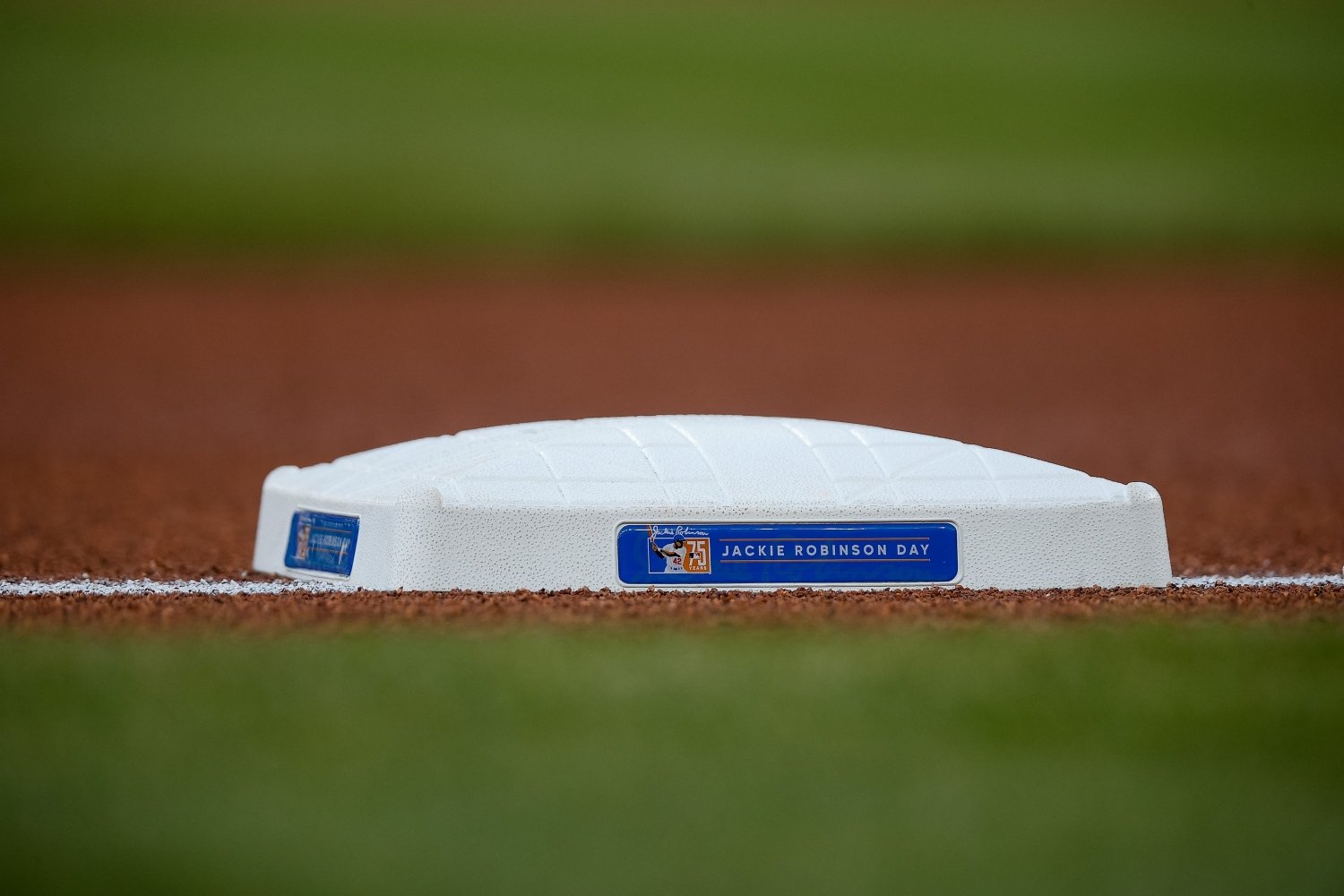 Four score minus two years ago, a few brave people (with hundreds of thousands at their backs and millions standing shoulder-to-shoulder in their path) brought forth upon this continent the first worthwhile version of the United States of America. Jackie Robinson took the field for the Brooklyn Dodgers that day, breaking what had been a six-decade color barrier for entry into Major League Baseball. Robinson, a former Army officer who made a stand against segregation on the Texas base where he served during World War II, was an acutely self-aware symbol of the nascent 20th-century Civil Rights Movement. At various times in the decades since then, biographers and orthogonal narrators of that moment have downplayed that fact, preferring to cast Robinson as someone who just wanted to play his beloved game without fetter or restriction. He did want that equality of opportunity, but not in some boyish, vapid way, and not just because he had a deep competitive fire. By the time Robinson and Branch Rickey set fire to the official barrier between MLB and the Negro Leagues, the fire of the Civil Rights Movement had been burning for a handful of years. It wasn't just Robinson who spoke up and fought successfully against segregation during World War II, but he had a certain level of privilege and leverage: he was serving domestically, not in combat, and his excellent educational background (he was raised in an integrated Pasadena, California, and attended UCLA) made him much more difficult to cast as a troublemaker or to browbeat than many other servicepeople of color were. When the Allies defeated the Nazis in May 1945 and then mercilessly crushed Japan with the atomic bombings of Hiroshima and Nagasaki in August, huge waves of soldiers returned from battlefields where they and their fellows had been wounded, tortured, killed, or traumatized by the violence they themselves had had to inflict, in order to stay alive or complete a mission on which they were told the fate of their beloved Republic hinged. A great many of those soldiers, Black and White alike, came home disillusioned and resentful. The way the Armed Services themselves treated divisions of different colors was intentionally disparate. White soldiers got better weapons, better assignments, better supplies, and far, far more respect. At times, Black soldiers—and not a few White ones, watching it all happen—felt that they were fighting to preserve a country built on lip service to ideals it was betraying even as it demanded they put their lives in peril. When all those soldiers came home, the disparity in the opportunities and the aid that awaited them was just as wide. It was galvanizing, for Black communities beginning to be empowered by the Great Migration and the roots they'd put down over the previous generation in places more like Pasadena than like Shreveport, La. It was also eye-opening, for many White people who had previously held segregationist, racist views or had failed to grasp the profundity of the rot at the root of the American flower. Robinson was not uniquely talented, among the greats of the Negro Leagues. He was not a happy accident—a "lucky us" scouting find by Rickey and the Dodgers. He was not just a ballplayer, though even he sometimes used that oversimplification as a shield to keep the (literal) haters at bay. He was the result of a monthslong pressure campaign by local and national groups in favor of racial progress, involving coordinated letter-writing; a rising tide of editorials and opinion columns in even White-owned newspapers, from even White columnists; and boycotts. He was carefully chosen for his background as a part of that movement, having won a court-martial after being arrested for refusing to move to the back of a military transport bus. He was chosen for his commitment to nonviolence and for his refusal to compromise on the question of his own qualifications or humanity. He was the tip of the spear that would be shoved into the heart of Jim Crow, inch by inch, by Rosa Parks, Malcolm X, Martin Luther King Jr., Fannie Lou Hamer, John Lewis, and millions more over the ensuing three decades. He was also a beneficiary of the time being right. Seeing the widespread disrespect and maltreatment that befell even heroes of battles on which hung the question of the survival of American democracy made many see the dark hypocrisy at the heart of their country. Spending a decade fighting (not, at first, with weapons and troops, but fighting straight through, from 1935 or so through the end of the war) the Nazis and their atrocious, vile extermination campaign against so many innocent civilians threw the sins of American racism into such sharp relief that it could no longer be ignored. Yes, therefore, Robinson was a DEI hire. That is, unequivocally, a good thing, and the clearest illustration of the need for such hires that can be offered. He was an exceptionally qualified applicant for a job long held by players who were much worse than him, sheltered from competition with him by systematic racism. He brought diversity, equality and inclusion into the workplace, not diminishing meritocracy in the process, but introducing real meritocracy for the first time in the history of that workplace. It's important to say these things now, because the United States has sagged badly since gaining all the ground that Robinson helped begin claiming 80 years ago. America has never been what it claimed to be, and for some, that illegitimizes it entirely. For others, inexcusably but truly, it's not a problem, because they never wanted America to be what it claimed to be, anyway. A plurality of us live in the middle. We believe that what America aspires to—not what Thomas Jefferson or George Washington (let alone Andrew Jackson or Richard Nixon) aspired to, but what the country has stood for in a broad sense over almost two and a half centuries—is worthwhile. We believe that its failure to even come especially close to that goal is unacceptable, but not in such a way as to make continuing to pursue that goal unworthy. The United States has never met its own standards for success. The American dream has yet to be realized. Until this date in 1947, though, the country didn't even try—not really, not hard enough. Beginning with the movements and efforts that culminated in that day, though, we did try, and try hard, for a long time. The results weren't good enough, because "good enough", like the American dream itself, is perhaps something only to be chased, and never to be grasped. However, looking back over the last 78 years—to Parks on the bus in Montgomery, Alabama, and to Lewis and King on the bridge in Selma; to Harry Truman following Rickey's lead by desegregating the military, and the Supreme Court following it by desegregating the nation's schools; to movements that gave rise to generations of genuinely empowered Black thinkers, artists, and businesspeople; to Barack Obama in Grant Park in 2008—it's impossible to conclude that there wasn't progress. It's impossible not to believe that that progress was worthwhile, and hard for me not to conclude that there is hope yet for the country Robinson brought forth upon the diamond in 1947. Yet, we're surrounded by urgent indicators that all that progress is in jeopardy. The Department of Defense, newly led by a coalition dedicated to erasing that progress and the hope it infused in so many, tried to remove Robinson's story from before he became a sports hero, because they know how much power lies in the connection between his service (and the racism he faced therein) and his later barrier-breaking, given the way World War II stirred the movement. Corporations, including MLB, are being bullied and cowed into either doing away with DEI initiatives or pretending they matter less than they do, all on the urgent and diametrically dishonest premise that DEI damages meritocracy, rather than being its only reliable set of guiding principles in a multicultural world. Abraham Lincoln, himself a deeply flawed man with no stainless racial record, faced a moment like this. He stood astride a country that was fracturing and falling apart, because (in two very different ways) its two halves could no longer live with the lies they had told each other to make the union work in the first place. Lincoln himself saw right through the Declaration of Independence, to its hidden agendas and crucial elisions. Still, he knew that the best hope for the future of his people—even the ones in the opposing uniforms—was to re-establish that the United States was "conceived in liberty, and dedicated to the proposition that all men are created equal." He knew that promise had not been delivered upon, and he knew it would be a long time before it would be, but he believed it was worth persisting in the pursuit. Now, as then, we find ourselves facing a test of "whether any nation so conceived and so dedicated can long endure." It's not a hopeful moment. When Lincoln resorted to those words, he was standing amid a battlefield still pockmarked by pools of blood. It's comforting, though, to remember that while Lincoln came just 80 years after Jefferson and his Declaration, Robinson came just 80 years after Lincoln. Robinson was the first beacon of light in a generation of it—of shining, surging hope, and huge victories. He's the first symbol of America making a more serious, informed, earnest dedication to its founding ideals, and although those ideals now seem as much in danger as they did in the days just before Gettysburg or D-Day, Robinson's legacy is the reminder that we have already come a long way, and that bravely pushing forward against resistance can take us even further. The last two decades, with a bit less bloodshed than the Civil War or World War II on the parts of American soldiers, have done plenty to open the eyes and the minds of Americans. That hopeful plurality with which I identified myself above is better able to see and name the things they're fighting for, and the things they're fighting against, than such pluralities could have been at any previous moment of American history. Ultimately, that only matters if we all here dedicate ourselves to the great task remaining before us. Today, when you turn on a baseball game and everyone is wearing Jackie Robinson's 42, consider the gravity of that symbol, but remember that it's a mere echo of the real moment that mattered. Robinson, whose most famous bit of wisdom was that we only matter if we leave a mark on one another, would surely want you to see his mark on the backs of so many players and think about how you can leave your own.
 -
The Twins' injured ace hit the injured list last week, but remains the beating heart of the team as it tries to escape another lousy start. He also remains the club's resident pitching philosopher, and he spoke thoughtfully about his change in mound position this spring before Sunday's game. Image courtesy of © Jeff Curry-Imagn Images Last week, I wrote about Pablo López moving away from the extreme first-base side of the pitching rubber in 2025, after that had been the starting point for his delivery throughout his time with the Twins. I speculated that that might have been an accommodation for his new kick-change, an extra wrinkle in his already-strong pitch mix. López, however, says the cause and effect there was reversed. "It helps now, but when I thought about shifting to the third-base side, I didn’t even have in my mind throwing the kick-change or anything," López said Sunday, standing on the top step of the Twins dugout at Target Field and watching his teammates take batting practice. "But I did have in mind, because my changeup runs so much, if I’m now shading more to the third-base side, I can’t start it in front of me, because it’s gonna be a non-competitive miss. So it did go along with the changeup, like, I just have to be a little more thorough thinking where I have to aim a little bit, so the movement always brings it back to the plate." In other words, the veteran righthander committed to sliding over before introducing a new offering into his impressive arsenal. Adding the kick-change was a way to ensure he would have an offspeed pitch he can keep on the plate, in certain situations, despite being in a new spot and knowing that his traditional changeup would then run off the dish away from a lefty. Rather than being geared toward the addition of a new pitch, then, López's new position was a result of holistic considerations about how to attack hitters. "Deception," he said, to sum up his initial motivation for the move. "Trade a little bit more angle, coming in to the lefties, and be more on top of righties—which, you do hear from righties, when they feel that pitcher being on top of them, makes it a little more uncomfortable. It allowed my breaking balls—both my sweeper and the curveball, they tend to move a little down but also to my glove side, so it keeps them in the zone longer before they break." That was the thought, but it didn't happen overnight. López said he hadn't worked anywhere but the first-base side of the rubber since he was pitching in High A in 2017. Back then, since he didn't yet have a consistent breaking ball and was very dependent on his changeup, he quickly retreated back after testing out the third-base side. This spring, that was where he began his experimenting anew. "I actually—in spring training, I tested and tried being all the way to the third-base side. I found that to be a little drastic, but I gave it a shot," he said. "And then obviously, you’ve gotta start paying attention to your misses. So I started missing toward my arm side, which made sense, because I had transitioned, maybe like 12 inches. So slowly, like, ‘Ok, let me move back a couple inches,’ so the misses got smaller and smaller, up until the point that I’m able to reduce the amount of misses, while still making somewhat of a shift." The place where he's landed—more or less in the middle of the mound—is not one where a pitcher is likely to automatically go. Hurlers think in terms of giving batters extreme looks, and being in the middle of the rubber has a bit of a no-man's land vibe. López acknowledged that he does have to modify his own cues for how to release the ball, based on his targets, given that the angle from his release point to that target has subtly but importantly changed. "[I'm being] conscious in the sense of, I’m not as tuned to my glove side as I was last year. So I do have to be a little more intentional, when it’s time to expand, just be like, ok, when I want to expand, I have to either feel that I’m releasing more in front of me, or when I’m just trying to throw to my arm side, I’m already shifted more there, so I don’t have to think too much about it," he put it. "So those are things that I’m still keeping in mind in bullpens, and in games, because I want to make competitive pitches, putaway pitches: get ahead, stay ahead. So there is a level of staying focused and concentrated when I’m executing." Unfortunately, of course, all of these tweaks are on hold for the time being. As he spoke Sunday, he was still carrying his glove, and the rubber hose used for flexibility exercises was draped across his neck. He's on the injured list with a strained right hamstring, but his daily work and approach reflect the shared hope of team and player for a rapid return. López can't further perfect his altered angle or his updated pitch mix right now, but he's still very much engaged, and seems eager to continue attacking hitters from his new spot as soon as his body allows. View full article
-
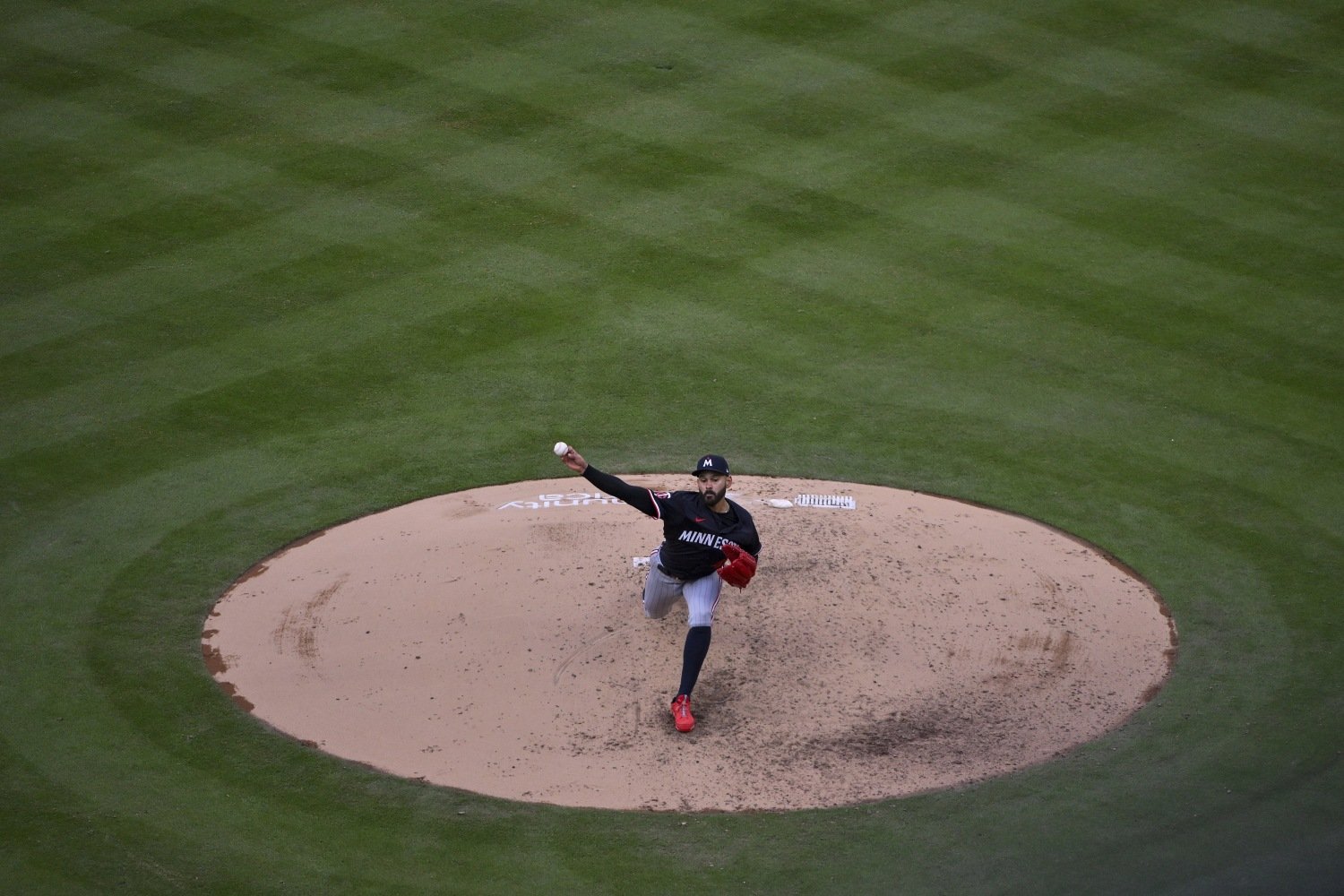 Last week, I wrote about Pablo López moving away from the extreme first-base side of the pitching rubber in 2025, after that had been the starting point for his delivery throughout his time with the Twins. I speculated that that might have been an accommodation for his new kick-change, an extra wrinkle in his already-strong pitch mix. López, however, says the cause and effect there was reversed. "It helps now, but when I thought about shifting to the third-base side, I didn’t even have in my mind throwing the kick-change or anything," López said Sunday, standing on the top step of the Twins dugout at Target Field and watching his teammates take batting practice. "But I did have in mind, because my changeup runs so much, if I’m now shading more to the third-base side, I can’t start it in front of me, because it’s gonna be a non-competitive miss. So it did go along with the changeup, like, I just have to be a little more thorough thinking where I have to aim a little bit, so the movement always brings it back to the plate." In other words, the veteran righthander committed to sliding over before introducing a new offering into his impressive arsenal. Adding the kick-change was a way to ensure he would have an offspeed pitch he can keep on the plate, in certain situations, despite being in a new spot and knowing that his traditional changeup would then run off the dish away from a lefty. Rather than being geared toward the addition of a new pitch, then, López's new position was a result of holistic considerations about how to attack hitters. "Deception," he said, to sum up his initial motivation for the move. "Trade a little bit more angle, coming in to the lefties, and be more on top of righties—which, you do hear from righties, when they feel that pitcher being on top of them, makes it a little more uncomfortable. It allowed my breaking balls—both my sweeper and the curveball, they tend to move a little down but also to my glove side, so it keeps them in the zone longer before they break." That was the thought, but it didn't happen overnight. López said he hadn't worked anywhere but the first-base side of the rubber since he was pitching in High A in 2017. Back then, since he didn't yet have a consistent breaking ball and was very dependent on his changeup, he quickly retreated back after testing out the third-base side. This spring, that was where he began his experimenting anew. "I actually—in spring training, I tested and tried being all the way to the third-base side. I found that to be a little drastic, but I gave it a shot," he said. "And then obviously, you’ve gotta start paying attention to your misses. So I started missing toward my arm side, which made sense, because I had transitioned, maybe like 12 inches. So slowly, like, ‘Ok, let me move back a couple inches,’ so the misses got smaller and smaller, up until the point that I’m able to reduce the amount of misses, while still making somewhat of a shift." The place where he's landed—more or less in the middle of the mound—is not one where a pitcher is likely to automatically go. Hurlers think in terms of giving batters extreme looks, and being in the middle of the rubber has a bit of a no-man's land vibe. López acknowledged that he does have to modify his own cues for how to release the ball, based on his targets, given that the angle from his release point to that target has subtly but importantly changed. "[I'm being] conscious in the sense of, I’m not as tuned to my glove side as I was last year. So I do have to be a little more intentional, when it’s time to expand, just be like, ok, when I want to expand, I have to either feel that I’m releasing more in front of me, or when I’m just trying to throw to my arm side, I’m already shifted more there, so I don’t have to think too much about it," he put it. "So those are things that I’m still keeping in mind in bullpens, and in games, because I want to make competitive pitches, putaway pitches: get ahead, stay ahead. So there is a level of staying focused and concentrated when I’m executing." Unfortunately, of course, all of these tweaks are on hold for the time being. As he spoke Sunday, he was still carrying his glove, and the rubber hose used for flexibility exercises was draped across his neck. He's on the injured list with a strained right hamstring, but his daily work and approach reflect the shared hope of team and player for a rapid return. López can't further perfect his altered angle or his updated pitch mix right now, but he's still very much engaged, and seems eager to continue attacking hitters from his new spot as soon as his body allows.
 -
The Twins barely showed up in another dispiriting loss. Image courtesy of © Jordan Johnson-Imagn Images Box Score Starting Pitcher: Chris Paddack: 5 IP, 2 H, 2 R (1 ER), 2 BB, 5 SO, 93 Pitches Home Runs: None Bottom 3 WPA: Kody Funderburk -0.111, Harrison Bader -0.108, Trevor Larnach -0.091 Win Probability Chart (via FanGraphs) On their third try, the Twins got the start they hoped they would see most of the time from Chris Paddack in 2025. The sturdy veteran righthander induced 12 whiffs in a 93-pitch, five-inning outing, after getting just 14 total whiffs in his first two starts, combined. His fastball sat comfortably in the 93-94 mph range, and as the game progressed, he worked in his changeup (a lot) and his two breaking balls (a little), acceding to the wishes his manager espoused for him in a pregame media session. "I do think his other stuff is there, yes, to get a swing and a miss on occasion, but also to keep the other teams off of the fastball," Rocco Baldelli said Saturday. "And I think that that’s a very important key for him. So his usage will always be important, because it’s one thing to have a very good fastball, which Paddy’s fastball has always played well, but it’s another thing if the other teams are gonna lean on that pitch and just sell out to that pitch at times. So the ability to mix his other pitches in there effectively and successfully will be key for him, and how his fastball plays." His approach worked well against the Tigers. Though the lefty-loaded lineup with which Tigers manager A.J. Hinch countered Paddack did work deep counts and force Paddack out of the game a bit sooner than the team might have preferred, Paddack held Detroit without an extra-base hit—and he might have held them scoreless, with better defensive support. In the first inning, Paddack got himself into trouble by issuing a leadoff walk, but Carlos Correa compounded that peril by failing to retire Kerry Carpenter, on what was ruled an infield single. He threw the ball past first baseman Ty France, allowing Zach McKinstry to reach third base, and Spencer Torkelson cashed in the chance by hitting a long sacrifice fly to right field. Paddack stopped the bleeding there, but the Twins were working from behind against Tigers starter Jackson Jobe before they even went to the bat rack. In the fourth, Paddack again helped create his own jam. A leadoff single by Torkelson became more of a problem when Paddack walked Riley Greene. However, the Twins' peculiar unwillingness to position their infield to seize chances for a double play then came into play. When a lefty has been at bat with a runner on first and zero or one out this season, only the Padres have used a shaded infield alignment more often than the Twins' 82.9% of the time. They don't have their middle infielders play closer to second base, or even come in by a step or two to get to ground balls faster and facilitate a double play turn. In this case, that meant that France, Edouard Julien and Correa each had their heels just in front of the grass on the outer rim of the infield, with all three pulled around toward the pull side of Detroit second baseman Colt Keith. When Keith hit a medium-speed, high-bounce chopper toward Julien, he came in to collect it—but had no chance to make a twin killing. He merely took the out at first, while both runners advanced into scoring position. Next up was designated hitter Justyn-Henry Malloy, who lifted a high, lazy fly ball to right field. Matt Wallner drew a bead and came in several steps to catch the ball, but he was slow on the release, and his throw was well offline, to the first-base side of home plate. It was cut off, and the Tigers scored their second run. The ball landed in Wallner's glove 266 feet from home plate, according to Statcast. Since the start of 2023, there have been 32 batted balls to right field, with a distance between 260 and 272 feet and a launch angle north of 45° (Malloy's was 51°), with a runner on third and less than two outs. Twenty-five of those have become sacrifice flies, though one of those still resulted in a double play when a runner heading to third was thrown out. Four have seen the right fielder throw the runner out at the plate. Three times, the runner at third didn't test the arm of the fielder. In short, there was something like a 22% chance for the Twins not to yield a run on that ball, and if we adjust for both Wallner's arm strength (it's been one of the two or three strongest outfield arms in baseball each of the last two seasons) and Torkelson's below-average speed, it's fair to push that number closer to 40%. In the end, though, it didn't even look like a play with close-call potential. Maybe it didn't matter, and maybe that play was the right microcosm for this contest—and the Twins' season, to date. After chasing Paddack, Detroit put up two quick, defense-independent runs in the sixth, with Torkelson launching a two-run homer off newly recalled southpaw Kody Funderburk. Baldelli had hoped Funderburk would come in and go right after hitters, and claimed not to be worried much about whether he faced lefties or righties. He brought him in to face a lefty-righty-lefty pocket of the Tigers lineup, though, and the righty in the middle doubled Detroit's advantage with a single swing. Meanwhile, the Twins could do nothing with the rookie Jobe, who pitched six innings of two-hit, shutout ball. As has often been the case this year, the offense put the ball in play, striking out just twice against Jobe and his high-90s heater, but they also made the underwhelming kind of contact that has become their hallmark. Jobe only allowed six hard-hit balls, two of which were hit straight into the ground for easy outs. Jhoan Duran came on to work the top of the eighth, with all the usual attendant fanfare from the Target Field gameday operations team. He pitched well, and has looked good most of the time this year, but the special tingle of that big entry has never been less in evidence. The game situation made it fall flat. Nonetheless, with his performance, he put a bit of life back into a hopeful weekend crowd, and when Jose Miranda led off the bottom of the frame with a pinch-hit single, the buzz picked up. Harrison Bader put together a pesky at-bat against Tigers reliever Tyler Holton, but when it ended with a lineout to right field, the writing was on the wall. Endlessly fascinated by the nuances of their capacity to torture and disappoint, however, the Twins reached deep into their bag to find a novel one. On a ground ball to Torkelson at first base off the bat of Christian Vázquez, second baseman Keith took his foot off the base too soon, leaving Miranda safe at second. It was a boneheaded play by Keith, on a ball that yielded no real chance to turn a double play—but Miranda one-upped him. After sliding into the base, and without noticing the safe call from the second-base umpire, Miranda turned and began trotting off the field. Keith, aghast and relieved at the same time, tagged him out. Wallner then struck out to kill the feeble rally, in relatively conventional fashion. Notes Ryan Jeffers was originally scheduled to start Saturday, but after being hit in the thumb Friday night, he came in with swelling in the area Saturday morning and Vázquez got the start, instead. Baldelli indicated that Jeffers could play if the team needed him, but they preferred to give him the day to let that swelling subside. The injury is not expected to keep him out for a prolonged period. Castro's insertion into the No. 2 spot against right-handed pitchers appears to be semi-permanent. With Correa, Byron Buxton and Trevor Larnach all struggling, making Castro a bridge piece in the top half of the batting order makes sense. What's Next The Twins will send Simeon Woods-Richardson to the mound to try to salvage one in the three-game intradivisional set. Righthander Casey Mize will take the ball for the Tigers, in a 1:10 PM CT start at Target Field. Bullpen Usage Report TUE WED THU FRI SAT TOT Sands 15 0 24 0 0 39 Alcalá 16 0 0 23 10 49 Topa 0 0 0 37 0 37 Funderburk 0 0 0 0 43 43 Coulombe 13 0 4 6 0 23 Jax 12 10 0 0 0 22 Varland 0 0 18 0 0 18 Durán 0 15 0 0 12 27 View full article
-
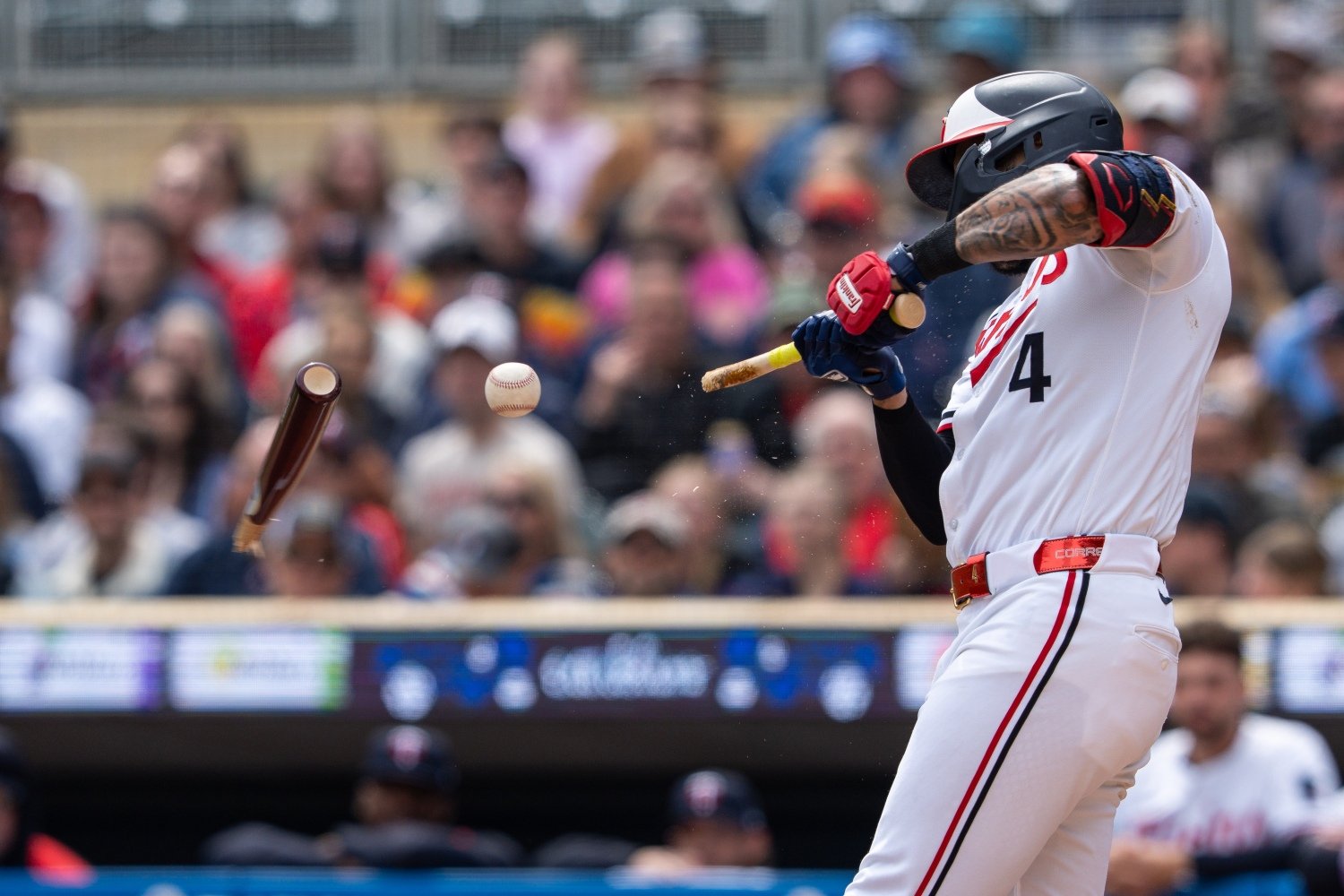 Box Score Starting Pitcher: Chris Paddack: 5 IP, 2 H, 2 R (1 ER), 2 BB, 5 SO, 93 Pitches Home Runs: None Bottom 3 WPA: Kody Funderburk -0.111, Harrison Bader -0.108, Trevor Larnach -0.091 Win Probability Chart (via FanGraphs) On their third try, the Twins got the start they hoped they would see most of the time from Chris Paddack in 2025. The sturdy veteran righthander induced 12 whiffs in a 93-pitch, five-inning outing, after getting just 14 total whiffs in his first two starts, combined. His fastball sat comfortably in the 93-94 mph range, and as the game progressed, he worked in his changeup (a lot) and his two breaking balls (a little), acceding to the wishes his manager espoused for him in a pregame media session. "I do think his other stuff is there, yes, to get a swing and a miss on occasion, but also to keep the other teams off of the fastball," Rocco Baldelli said Saturday. "And I think that that’s a very important key for him. So his usage will always be important, because it’s one thing to have a very good fastball, which Paddy’s fastball has always played well, but it’s another thing if the other teams are gonna lean on that pitch and just sell out to that pitch at times. So the ability to mix his other pitches in there effectively and successfully will be key for him, and how his fastball plays." His approach worked well against the Tigers. Though the lefty-loaded lineup with which Tigers manager A.J. Hinch countered Paddack did work deep counts and force Paddack out of the game a bit sooner than the team might have preferred, Paddack held Detroit without an extra-base hit—and he might have held them scoreless, with better defensive support. In the first inning, Paddack got himself into trouble by issuing a leadoff walk, but Carlos Correa compounded that peril by failing to retire Kerry Carpenter, on what was ruled an infield single. He threw the ball past first baseman Ty France, allowing Zach McKinstry to reach third base, and Spencer Torkelson cashed in the chance by hitting a long sacrifice fly to right field. Paddack stopped the bleeding there, but the Twins were working from behind against Tigers starter Jackson Jobe before they even went to the bat rack. In the fourth, Paddack again helped create his own jam. A leadoff single by Torkelson became more of a problem when Paddack walked Riley Greene. However, the Twins' peculiar unwillingness to position their infield to seize chances for a double play then came into play. When a lefty has been at bat with a runner on first and zero or one out this season, only the Padres have used a shaded infield alignment more often than the Twins' 82.9% of the time. They don't have their middle infielders play closer to second base, or even come in by a step or two to get to ground balls faster and facilitate a double play turn. In this case, that meant that France, Edouard Julien and Correa each had their heels just in front of the grass on the outer rim of the infield, with all three pulled around toward the pull side of Detroit second baseman Colt Keith. When Keith hit a medium-speed, high-bounce chopper toward Julien, he came in to collect it—but had no chance to make a twin killing. He merely took the out at first, while both runners advanced into scoring position. Next up was designated hitter Justyn-Henry Malloy, who lifted a high, lazy fly ball to right field. Matt Wallner drew a bead and came in several steps to catch the ball, but he was slow on the release, and his throw was well offline, to the first-base side of home plate. It was cut off, and the Tigers scored their second run. The ball landed in Wallner's glove 266 feet from home plate, according to Statcast. Since the start of 2023, there have been 32 batted balls to right field, with a distance between 260 and 272 feet and a launch angle north of 45° (Malloy's was 51°), with a runner on third and less than two outs. Twenty-five of those have become sacrifice flies, though one of those still resulted in a double play when a runner heading to third was thrown out. Four have seen the right fielder throw the runner out at the plate. Three times, the runner at third didn't test the arm of the fielder. In short, there was something like a 22% chance for the Twins not to yield a run on that ball, and if we adjust for both Wallner's arm strength (it's been one of the two or three strongest outfield arms in baseball each of the last two seasons) and Torkelson's below-average speed, it's fair to push that number closer to 40%. In the end, though, it didn't even look like a play with close-call potential. Maybe it didn't matter, and maybe that play was the right microcosm for this contest—and the Twins' season, to date. After chasing Paddack, Detroit put up two quick, defense-independent runs in the sixth, with Torkelson launching a two-run homer off newly recalled southpaw Kody Funderburk. Baldelli had hoped Funderburk would come in and go right after hitters, and claimed not to be worried much about whether he faced lefties or righties. He brought him in to face a lefty-righty-lefty pocket of the Tigers lineup, though, and the righty in the middle doubled Detroit's advantage with a single swing. Meanwhile, the Twins could do nothing with the rookie Jobe, who pitched six innings of two-hit, shutout ball. As has often been the case this year, the offense put the ball in play, striking out just twice against Jobe and his high-90s heater, but they also made the underwhelming kind of contact that has become their hallmark. Jobe only allowed six hard-hit balls, two of which were hit straight into the ground for easy outs. Jhoan Duran came on to work the top of the eighth, with all the usual attendant fanfare from the Target Field gameday operations team. He pitched well, and has looked good most of the time this year, but the special tingle of that big entry has never been less in evidence. The game situation made it fall flat. Nonetheless, with his performance, he put a bit of life back into a hopeful weekend crowd, and when Jose Miranda led off the bottom of the frame with a pinch-hit single, the buzz picked up. Harrison Bader put together a pesky at-bat against Tigers reliever Tyler Holton, but when it ended with a lineout to right field, the writing was on the wall. Endlessly fascinated by the nuances of their capacity to torture and disappoint, however, the Twins reached deep into their bag to find a novel one. On a ground ball to Torkelson at first base off the bat of Christian Vázquez, second baseman Keith took his foot off the base too soon, leaving Miranda safe at second. It was a boneheaded play by Keith, on a ball that yielded no real chance to turn a double play—but Miranda one-upped him. After sliding into the base, and without noticing the safe call from the second-base umpire, Miranda turned and began trotting off the field. Keith, aghast and relieved at the same time, tagged him out. Wallner then struck out to kill the feeble rally, in relatively conventional fashion. Notes Ryan Jeffers was originally scheduled to start Saturday, but after being hit in the thumb Friday night, he came in with swelling in the area Saturday morning and Vázquez got the start, instead. Baldelli indicated that Jeffers could play if the team needed him, but they preferred to give him the day to let that swelling subside. The injury is not expected to keep him out for a prolonged period. Castro's insertion into the No. 2 spot against right-handed pitchers appears to be semi-permanent. With Correa, Byron Buxton and Trevor Larnach all struggling, making Castro a bridge piece in the top half of the batting order makes sense. What's Next The Twins will send Simeon Woods-Richardson to the mound to try to salvage one in the three-game intradivisional set. Righthander Casey Mize will take the ball for the Tigers, in a 1:10 PM CT start at Target Field. Bullpen Usage Report TUE WED THU FRI SAT TOT Sands 15 0 24 0 0 39 Alcalá 16 0 0 23 10 49 Topa 0 0 0 37 0 37 Funderburk 0 0 0 0 43 43 Coulombe 13 0 4 6 0 23 Jax 12 10 0 0 0 22 Varland 0 0 18 0 0 18 Durán 0 15 0 0 12 27
- 112 comments
-
- 4
-
-

-
- matt wallner
- chris paddack
- (and 1 more)
-
The team's rotation anchor left his start Tuesday with a hamstring injury. Given what we've learned, how long should fans expect him to be out of their mix? Image courtesy of © Jeff Curry-Imagn Images After he had to leave in the fifth inning of his latest start against the Kansas City Royals, Pablo López is ticketed for the injured list. An MRI revealed a mild strain in his right hamstring. According to Dan Hayes of The Athletic, the team hopes for a minimum stay on the injured list. Given the early date on the calendar and the cold weather in which the team will continue to work for several weeks, they have to err on the side of caution. Maybe, if this were a later stage of the season, we would even see López remain active and miss just one start. However, while the strain is mild, even such minor variations of this injury can flare up or heal more slowly than expected. I analyzed all hamstring strains with which big-league pitchers have missed time since the start of the 2016 season, when Baseball Prospectus's Return to Play Dashboard begins. There have been 126 such documented cases, and because the implications might be supposed to be different for the processes of both recovery and performance, I broke them down by whether the injury was to a hurler's push-off leg (the same one as the hand with which they throw) or their landing leg. Here's a snapshot of some of those injuries, with the most severe cases filtered out for the purposes of estimating the likely timeline on a return. I found that injuries to a pitcher's push-off leg (like López's) are notably less common. There were 70 hamstring strains in the landing leg that cost pitchers time over this span, but just 56 to the push-off leg. Strains of the push-off leg tend a bit more toward extremes, which (since this seems to be on the mild end of the spectrum) is good news for López. I found that 46.2% of hurlers who strained their post leg's hamstring came back within 20 days, whereas only 43.9% of those who strained the muscle in their landing legs returned that soon. If the Twins' initial read of this injury is accurate, the prognosis is good. López could well be back by the end of April. On average, though, the non-extreme versions of this injury still tend to keep pitchers on the shelf for 25 days, whichever leg is affected. Alas, not all the news is good. One pattern that turned up in this analysis is the high rate of re-injury. If a pitcher suffers one hamstring injury, they have about a 25% chance of suffering a second one. The 126 injuries I studied were suffered by 100 pitchers, and 21 of them suffered at least two strains. Once you correct for the hurlers for whom the first strain coincided with or closely preceded the end of their career, it's over a one-in-four shot that a guy who suffers one strain will suffer another. The Twins themselves have dealt with this recently: Both Sonny Gray and Caleb Thielbar suffered multiple hamstring strains during their Twins tenures. The Twins need their ace starter back as soon as possible, but they'll have to be cautious in bringing him along, to minimize that risk of re-injury and ensure that he's ramped back up when he returns. Expect López to miss something in the neighborhood of three weeks. In the meantime, the good news is that the team has good depth options at Triple-A St. Paul. Once López does assume his place in the rotation again, they could be stronger than ever for briefly having been without him. Unfortunately, from now on, we'll have to keep in mind that there's a meaningful chance of this happening to him again. View full article
-
How Long Will Minnesota Twins Be Without Injured Ace Pablo López?
Matthew Trueblood posted an article in Twins
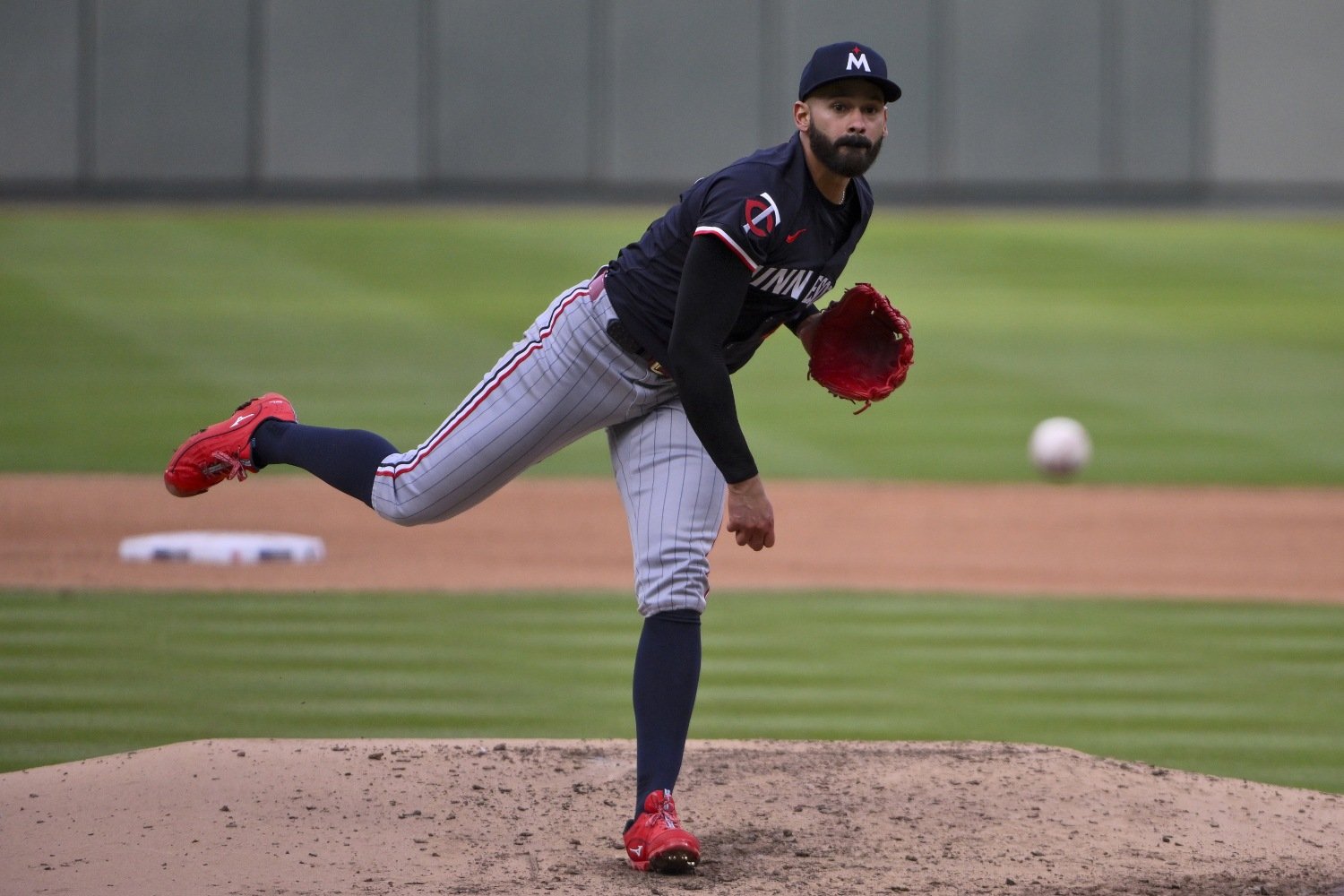 After he had to leave in the fifth inning of his latest start against the Kansas City Royals, Pablo López is ticketed for the injured list. An MRI revealed a mild strain in his right hamstring. According to Dan Hayes of The Athletic, the team hopes for a minimum stay on the injured list. Given the early date on the calendar and the cold weather in which the team will continue to work for several weeks, they have to err on the side of caution. Maybe, if this were a later stage of the season, we would even see López remain active and miss just one start. However, while the strain is mild, even such minor variations of this injury can flare up or heal more slowly than expected. I analyzed all hamstring strains with which big-league pitchers have missed time since the start of the 2016 season, when Baseball Prospectus's Return to Play Dashboard begins. There have been 126 such documented cases, and because the implications might be supposed to be different for the processes of both recovery and performance, I broke them down by whether the injury was to a hurler's push-off leg (the same one as the hand with which they throw) or their landing leg. Here's a snapshot of some of those injuries, with the most severe cases filtered out for the purposes of estimating the likely timeline on a return. I found that injuries to a pitcher's push-off leg (like López's) are notably less common. There were 70 hamstring strains in the landing leg that cost pitchers time over this span, but just 56 to the push-off leg. Strains of the push-off leg tend a bit more toward extremes, which (since this seems to be on the mild end of the spectrum) is good news for López. I found that 46.2% of hurlers who strained their post leg's hamstring came back within 20 days, whereas only 43.9% of those who strained the muscle in their landing legs returned that soon. If the Twins' initial read of this injury is accurate, the prognosis is good. López could well be back by the end of April. On average, though, the non-extreme versions of this injury still tend to keep pitchers on the shelf for 25 days, whichever leg is affected. Alas, not all the news is good. One pattern that turned up in this analysis is the high rate of re-injury. If a pitcher suffers one hamstring injury, they have about a 25% chance of suffering a second one. The 126 injuries I studied were suffered by 100 pitchers, and 21 of them suffered at least two strains. Once you correct for the hurlers for whom the first strain coincided with or closely preceded the end of their career, it's over a one-in-four shot that a guy who suffers one strain will suffer another. The Twins themselves have dealt with this recently: Both Sonny Gray and Caleb Thielbar suffered multiple hamstring strains during their Twins tenures. The Twins need their ace starter back as soon as possible, but they'll have to be cautious in bringing him along, to minimize that risk of re-injury and ensure that he's ramped back up when he returns. Expect López to miss something in the neighborhood of three weeks. In the meantime, the good news is that the team has good depth options at Triple-A St. Paul. Once López does assume his place in the rotation again, they could be stronger than ever for briefly having been without him. Unfortunately, from now on, we'll have to keep in mind that there's a meaningful chance of this happening to him again.
 -
The Twins' ace righthander has twice as many changeups as he had when the 2024 season ended. After a slight but important change of position on the rubber, he's hoping to give hitters twice as many problems, too. Image courtesy of © Matt Marton-Imagn Images Say what he will about meditation, the nature of pressure in athletic endeavors, and being a self-possessed, well-rounded person, Pablo López is not immune to FOMO. When he came to the Twins in the offseason before the 2023 season, he and the team acted quickly to suit him up with the newest trend in pitching: a sweeper. It became, perhaps, the most important driver of his stellar first season in Minnesota, and it kept him hip to the trends of his craft. Last year, the vogue pitch of the year was the splitter, and López was left out. The Twins aren't entirely averse to throwing the splitter, but it's not the way they prefer their pitchers to achieve the desirable effects of a good changeup. López already had a strong changeup. In fact, it was his best and most talked-about pitch, before he was traded from the Marlins to the Twins. Even if he wanted to throw the splitter last year, it would have been like when you wore down your parents and got that PS2, and then the XBox came out shortly afterward. You're not selling them on that one, at least until Christmas. Happily, though, Christmas has come for the venerable Venezuelan, because this year's hot new pitch is a changeup even a nervous mother can love. The kick-change could turn out to be carcinogenic or something, but there's no evidence of that right now and it seems wildly unlikely. All your parents or López's pitching coach has to know is that it doesn't create that ominous tension in the tendons of your elbow that comes with shoving the ball deep into the 'V' of your first two fingers to throw the splitter. (Have you ever tried this? Go grab a ball, and grip it for a splitter, and just fe—oh, ok, you've heard it. Well, anyway.) The wild and fun choice López has made, though, is to add this new variant of the changeup—because of the way it kills spin without diminishing speed, it plays much like a splitter and is thus tagged by most pitch classification systems—without scrapping his old reliable one. The league is seeing a greater proliferation all the time of guys with multiple fastballs and multiple breaking balls, and now, López joins a small but growing fraternity of hurlers with multiple changeups. You know what they say, though. Change (not just changeups, but big-C Change, like the kind effected on a pitcher's whole approach and arsenal by the addition of a second changeup, am I saying 'change' too much?) can't be achieved while standing still. So, López is literally on the move. Don't adjust your screen. Yes, there are two of Pablo López there. The main López—the one native to the rest of the frame we're looking at, which is from a game at Sox Park in Chicago last August—is the guy on the left, just releasing a fastball to then-Sox batter Gavin Sheets. López′ is the one who, because I'm not as good at Canva as Jim O'Heir, looks very definitely like he's been artificially dropped in. Here's the key, though: Whatever aspects of the superimposition I did clumsily, the part I got right is alignment. López′ is about eight inches farther toward third base (away from the first-base edge of the pitching rubber, where he's lived of late) than he was last year. Why does that matter? Read on. View full article
-
.png.e2328927356b23e3439b327bea7f6416.png) Say what he will about meditation, the nature of pressure in athletic endeavors, and being a self-possessed, well-rounded person, Pablo López is not immune to FOMO. When he came to the Twins in the offseason before the 2023 season, he and the team acted quickly to suit him up with the newest trend in pitching: a sweeper. It became, perhaps, the most important driver of his stellar first season in Minnesota, and it kept him hip to the trends of his craft. Last year, the vogue pitch of the year was the splitter, and López was left out. The Twins aren't entirely averse to throwing the splitter, but it's not the way they prefer their pitchers to achieve the desirable effects of a good changeup. López already had a strong changeup. In fact, it was his best and most talked-about pitch, before he was traded from the Marlins to the Twins. Even if he wanted to throw the splitter last year, it would have been like when you wore down your parents and got that PS2, and then the XBox came out shortly afterward. You're not selling them on that one, at least until Christmas. Happily, though, Christmas has come for the venerable Venezuelan, because this year's hot new pitch is a changeup even a nervous mother can love. The kick-change could turn out to be carcinogenic or something, but there's no evidence of that right now and it seems wildly unlikely. All your parents or López's pitching coach has to know is that it doesn't create that ominous tension in the tendons of your elbow that comes with shoving the ball deep into the 'V' of your first two fingers to throw the splitter. (Have you ever tried this? Go grab a ball, and grip it for a splitter, and just fe—oh, ok, you've heard it. Well, anyway.) The wild and fun choice López has made, though, is to add this new variant of the changeup—because of the way it kills spin without diminishing speed, it plays much like a splitter and is thus tagged by most pitch classification systems—without scrapping his old reliable one. The league is seeing a greater proliferation all the time of guys with multiple fastballs and multiple breaking balls, and now, López joins a small but growing fraternity of hurlers with multiple changeups. You know what they say, though. Change (not just changeups, but big-C Change, like the kind effected on a pitcher's whole approach and arsenal by the addition of a second changeup, am I saying 'change' too much?) can't be achieved while standing still. So, López is literally on the move. Don't adjust your screen. Yes, there are two of Pablo López there. The main López—the one native to the rest of the frame we're looking at, which is from a game at Sox Park in Chicago last August—is the guy on the left, just releasing a fastball to then-Sox batter Gavin Sheets. López′ is the one who, because I'm not as good at Canva as Jim O'Heir, looks very definitely like he's been artificially dropped in. Here's the key, though: Whatever aspects of the superimposition I did clumsily, the part I got right is alignment. López′ is about eight inches farther toward third base (away from the first-base edge of the pitching rubber, where he's lived of late) than he was last year. Why does that matter? Read on.
Say what he will about meditation, the nature of pressure in athletic endeavors, and being a self-possessed, well-rounded person, Pablo López is not immune to FOMO. When he came to the Twins in the offseason before the 2023 season, he and the team acted quickly to suit him up with the newest trend in pitching: a sweeper. It became, perhaps, the most important driver of his stellar first season in Minnesota, and it kept him hip to the trends of his craft. Last year, the vogue pitch of the year was the splitter, and López was left out. The Twins aren't entirely averse to throwing the splitter, but it's not the way they prefer their pitchers to achieve the desirable effects of a good changeup. López already had a strong changeup. In fact, it was his best and most talked-about pitch, before he was traded from the Marlins to the Twins. Even if he wanted to throw the splitter last year, it would have been like when you wore down your parents and got that PS2, and then the XBox came out shortly afterward. You're not selling them on that one, at least until Christmas. Happily, though, Christmas has come for the venerable Venezuelan, because this year's hot new pitch is a changeup even a nervous mother can love. The kick-change could turn out to be carcinogenic or something, but there's no evidence of that right now and it seems wildly unlikely. All your parents or López's pitching coach has to know is that it doesn't create that ominous tension in the tendons of your elbow that comes with shoving the ball deep into the 'V' of your first two fingers to throw the splitter. (Have you ever tried this? Go grab a ball, and grip it for a splitter, and just fe—oh, ok, you've heard it. Well, anyway.) The wild and fun choice López has made, though, is to add this new variant of the changeup—because of the way it kills spin without diminishing speed, it plays much like a splitter and is thus tagged by most pitch classification systems—without scrapping his old reliable one. The league is seeing a greater proliferation all the time of guys with multiple fastballs and multiple breaking balls, and now, López joins a small but growing fraternity of hurlers with multiple changeups. You know what they say, though. Change (not just changeups, but big-C Change, like the kind effected on a pitcher's whole approach and arsenal by the addition of a second changeup, am I saying 'change' too much?) can't be achieved while standing still. So, López is literally on the move. Don't adjust your screen. Yes, there are two of Pablo López there. The main López—the one native to the rest of the frame we're looking at, which is from a game at Sox Park in Chicago last August—is the guy on the left, just releasing a fastball to then-Sox batter Gavin Sheets. López′ is the one who, because I'm not as good at Canva as Jim O'Heir, looks very definitely like he's been artificially dropped in. Here's the key, though: Whatever aspects of the superimposition I did clumsily, the part I got right is alignment. López′ is about eight inches farther toward third base (away from the first-base edge of the pitching rubber, where he's lived of late) than he was last year. Why does that matter? Read on. -
The Twins' slugging infielder is trying to be smart about building back up and preparing for a rehab assignment, without giving in to impatience or frustration about the number and nature of injuries that continue to pile up. Image courtesy of © Kim Klement Neitzel-Imagn Images By now, the Twins know they can't fully trust Royce Lewis's own accounts of the severity of his injuries, or of the indicators of healing he experiences as he tries to return therefrom. Thus, they listen to his input and opinion on his own health—but apply some external constraints on the rehab process, too. "Anytime they let me do something, that’s always pretty good," said Lewis, who ran on the field for a second straight day Sunday. "They know, I think they said, like, I can tell them how I feel up to 60%, and after that, they know if I’m 80 percent, [I'll say] I’m ready to go. So they have to give me a governor per se, and so right now, the governor is we’re gonna take it easy and make sure we continue to progress." Lewis said the plan is to rest one day, then try to run for three straight days, as he continues to ramp up his baseball activities. "You know, it’s a long progression," he told reporters in the dugout at Target Field. "Running, it’s not just like ‘Run two days, and then you’re back.’ As much as I wish it was. Trust me, I would love to be playing right now. But that’s just not the case." Lewis is grateful to be around the team during this part of the rehab process, though he won't travel with them to Kansas City for the four-game series beginning Monday. Instead, he'll continue his work in Minnesota, with the goal being to progress to baserunning and changing direction by the following week. Swelling lingers in the area where he suffered a strained hamstring on March 16th, but Lewis downplayed that as a point of concern. "I talk to someone like Randy Dobnak; he deals with swelling still on that ankle that he had," Lewis said. "Everyone is different, every body’s different and every injury’s different, but especially when you’re doing high-volume stuff, that swelling will come back. So it’s more about what can you tolerate, and was it down enough? And for sure, we had it down enough, and we started right around Opening Day, actually." While Lewis reports no pain in the area of the injury since the day after he suffered it (when he wasn't even able to straighten his leg), the continued swelling could be one reason why the Twins are keeping that governor on his recovery. Another, of course, is his track record of getting hurt—and then, after returning, getting hurt again. Lewis hears the rumblings from those outside the team who would prefer to see him make changes to his playing style or his preparation, but (while he understands them in a constructive way) isn't willing to stop playing the whole game, the way he believes he's capable of playing it. "I’ve only made it here because of who I am. I’m not gonna change who I am," he said. "If I start changing who I am, then I think as a player, I’ll start diminishing my value. And what I do is very special. I think everyone’s able to see that, and I think that’s why everyone is so mad that I keep getting hurt." You can, however, hear the frustration taking a toll on the relentlessly positive Lewis. The online chatter finds its way to him, and he sounded a pained tone by comparing his highly kinetic, athletic game to those of players who might be more durable but lack the same potential for multidimensional impact. "You see guys get hurt more that tend to be more athletic and explosive, because they put themselves in those positions, because they can do things that a lot of people, frankly, can’t do," he said. "And unfortunately, I’ve joked about it, maybe I should just play more like Kyle Schwarber and be smart about it. But at the same time, if I start doing that, I’ll diminish my value. And I want to play the game and help the team win, and not worry about being hurt." Lewis also had sharp words for those who criticize his injury problems anonymously and online. "That’s just the world that we live in, man. People behind a screen, whether they’re in a basement, or I don’t know where they’re at, but then they’re on Twitter and they think they’re safe, but say something to someone’s face and see what happens." Those sentiments are unsurprising, from an extraordinarily talented player and a proud professional. As he pointed out, fans don't see the hard work he puts into conditioning and treatment off the field, and they tend to make unduly ungenerous assumptions about those things. As most big-leaguers do, Lewis works hard to reduce his risk of injury by keeping himself in great shape and preparing his body for the grind of each game, as well as the long season—sometimes, two different and competing objectives. At the same time, some of those fans might fairly observe that Schwarber has found ample ways to contribute to winning teams since changing his own style of play. When he came up as a part-time catcher and outfielder, he took the latter duties so seriously that he wrecked his knee in a collision with a teammate early in 2016. Since then (and especially since 2021), he's taken a much more cautious approach to all facets of his game, but has been a consistently superb producer at the plate. Lewis, whose pride and dedication to the whole game includes a fierce belief in his own value as a defender and baserunner, has rated out as a merely average fielder and a below-average baserunner over the parts of three seasons he's played. Schwarber has been worse in both categories, but the increased volume (and a more consistent level of offensive production) has made him more valuable over the last three-plus seasons than Lewis has been, by almost any measurement. "It’s hard to tell guys how to play Major League Baseball once they take the field—how to tell a guy to give a certain amount of effort, that never feels productive," said Rocco Baldelli, Thursday, with regard to players like Lewis and Byron Buxton. "Even if the message seems to be correct, it never feels good or productive to have to do that, or want to do that. The right message is almost always to go play. And they can regulate themselves better than a manager can ever tell a guy to do." That makes Baldelli a good fit with his pupil, in Lewis. The one doesn't want to tone down his players' effort. The other wouldn't hear of doing so, anyway. As Lewis acknowledged, though, the organization is putting some safeguards in place for him, at least during the rehabilitative process. Once he takes the field again, he'll seek maximal impact. That's the best thing for all parties—as long as he can find a way to play the full-out version of the game without continuing to get hurt at such a high rate. View full article
-
 By now, the Twins know they can't fully trust Royce Lewis's own accounts of the severity of his injuries, or of the indicators of healing he experiences as he tries to return therefrom. Thus, they listen to his input and opinion on his own health—but apply some external constraints on the rehab process, too. "Anytime they let me do something, that’s always pretty good," said Lewis, who ran on the field for a second straight day Sunday. "They know, I think they said, like, I can tell them how I feel up to 60%, and after that, they know if I’m 80 percent, [I'll say] I’m ready to go. So they have to give me a governor per se, and so right now, the governor is we’re gonna take it easy and make sure we continue to progress." Lewis said the plan is to rest one day, then try to run for three straight days, as he continues to ramp up his baseball activities. "You know, it’s a long progression," he told reporters in the dugout at Target Field. "Running, it’s not just like ‘Run two days, and then you’re back.’ As much as I wish it was. Trust me, I would love to be playing right now. But that’s just not the case." Lewis is grateful to be around the team during this part of the rehab process, though he won't travel with them to Kansas City for the four-game series beginning Monday. Instead, he'll continue his work in Minnesota, with the goal being to progress to baserunning and changing direction by the following week. Swelling lingers in the area where he suffered a strained hamstring on March 16th, but Lewis downplayed that as a point of concern. "I talk to someone like Randy Dobnak; he deals with swelling still on that ankle that he had," Lewis said. "Everyone is different, every body’s different and every injury’s different, but especially when you’re doing high-volume stuff, that swelling will come back. So it’s more about what can you tolerate, and was it down enough? And for sure, we had it down enough, and we started right around Opening Day, actually." While Lewis reports no pain in the area of the injury since the day after he suffered it (when he wasn't even able to straighten his leg), the continued swelling could be one reason why the Twins are keeping that governor on his recovery. Another, of course, is his track record of getting hurt—and then, after returning, getting hurt again. Lewis hears the rumblings from those outside the team who would prefer to see him make changes to his playing style or his preparation, but (while he understands them in a constructive way) isn't willing to stop playing the whole game, the way he believes he's capable of playing it. "I’ve only made it here because of who I am. I’m not gonna change who I am," he said. "If I start changing who I am, then I think as a player, I’ll start diminishing my value. And what I do is very special. I think everyone’s able to see that, and I think that’s why everyone is so mad that I keep getting hurt." You can, however, hear the frustration taking a toll on the relentlessly positive Lewis. The online chatter finds its way to him, and he sounded a pained tone by comparing his highly kinetic, athletic game to those of players who might be more durable but lack the same potential for multidimensional impact. "You see guys get hurt more that tend to be more athletic and explosive, because they put themselves in those positions, because they can do things that a lot of people, frankly, can’t do," he said. "And unfortunately, I’ve joked about it, maybe I should just play more like Kyle Schwarber and be smart about it. But at the same time, if I start doing that, I’ll diminish my value. And I want to play the game and help the team win, and not worry about being hurt." Lewis also had sharp words for those who criticize his injury problems anonymously and online. "That’s just the world that we live in, man. People behind a screen, whether they’re in a basement, or I don’t know where they’re at, but then they’re on Twitter and they think they’re safe, but say something to someone’s face and see what happens." Those sentiments are unsurprising, from an extraordinarily talented player and a proud professional. As he pointed out, fans don't see the hard work he puts into conditioning and treatment off the field, and they tend to make unduly ungenerous assumptions about those things. As most big-leaguers do, Lewis works hard to reduce his risk of injury by keeping himself in great shape and preparing his body for the grind of each game, as well as the long season—sometimes, two different and competing objectives. At the same time, some of those fans might fairly observe that Schwarber has found ample ways to contribute to winning teams since changing his own style of play. When he came up as a part-time catcher and outfielder, he took the latter duties so seriously that he wrecked his knee in a collision with a teammate early in 2016. Since then (and especially since 2021), he's taken a much more cautious approach to all facets of his game, but has been a consistently superb producer at the plate. Lewis, whose pride and dedication to the whole game includes a fierce belief in his own value as a defender and baserunner, has rated out as a merely average fielder and a below-average baserunner over the parts of three seasons he's played. Schwarber has been worse in both categories, but the increased volume (and a more consistent level of offensive production) has made him more valuable over the last three-plus seasons than Lewis has been, by almost any measurement. "It’s hard to tell guys how to play Major League Baseball once they take the field—how to tell a guy to give a certain amount of effort, that never feels productive," said Rocco Baldelli, Thursday, with regard to players like Lewis and Byron Buxton. "Even if the message seems to be correct, it never feels good or productive to have to do that, or want to do that. The right message is almost always to go play. And they can regulate themselves better than a manager can ever tell a guy to do." That makes Baldelli a good fit with his pupil, in Lewis. The one doesn't want to tone down his players' effort. The other wouldn't hear of doing so, anyway. As Lewis acknowledged, though, the organization is putting some safeguards in place for him, at least during the rehabilitative process. Once he takes the field again, he'll seek maximal impact. That's the best thing for all parties—as long as he can find a way to play the full-out version of the game without continuing to get hurt at such a high rate.
 -
Every game is worth .006 in win percentage at the end of the year, and each win is only 1.1% of what you need to reach the playoffs. But not all games are created equal. The Twins desperately need a win, so every can do the important work of shutting the heck up. Image courtesy of © Kim Klement Neitzel-Imagn Images There are two realities to everything: the objective, and the actual. They don't overlap perfectly. In fact, often, they barely touch at all. It would be great if the world and its inhabitants eventually bent themselves to the objective reality of each situation, but for the most part, we live in a world dominated by emotional and misinformed reactions to things—because the ramifications of those reactions can't be erased simply because they're misgiven. Humans are irrational, and worse, they're bad at corralling the irrationality of others. Much more often, they give in to it, because they were fighting strong impulses to be the same way before they encountered the irrational person right in front of them. Thence come the shrieks and allegations of cheating in response to the Yankees becoming one of several teams to try out slightly different-shaped baseball bats. Thence, too, comes everyone's angst about their team's performance with the bases loaded, or the way their team hits left-handed pitchers, or the reliability of their bullpen. There are fans who are very worried about the ball being juiced this spring, and there are fans who are very worried about the ball being especially dead, and the near-certain truth that the ball is playing fair will take weeks to get a full hearing—if it does, at all. This is just how our culture is wired—especially online, and especially, perhaps, in sports. Unfair as this might be, then, I'm forced to admit it: The Twins simply have to win Tuesday night. Losing a fifth straight game to start this particular season—coming off a collapse last August and September; after an unsatisfying offseason and an abortive effort to sell the team on the part of unpopular owners; and against two teams who don't even expect to post winning records this year—might just shatter the already-fragile collective mind of the Minnesota sports fan. Twins TV had a rocky launch. Carlos Correa, Byron Buxton and Matt Wallner are a combined 2-for-36 to start the season. The White Sox didn't just beat the Twins in the first game of their series. They blew their doors off, and nearly no-hit them in the process. Rocco Baldelli beat a hasty fourth-inning retreat, removing Buxton and Correa in the name of workload management in the very first week of a long season, before his team has had their first win or even their first sustained lead. The vibes are rancid, and yet, they can get worse. I'm here, and I'm more online than I care to be and I have family members who love the Twins, and I'm telling you: the truly radioactive vibes around this team can get even worse. If the Sox beat the Twins again Tuesday night, with Rule 5 Draft pick Shane Smith (see, they found a way to keep their hard-throwing Rule 5 guy in the building!) taking the mound for his first career appearance, we're all going to need contamination suits and evacuation plans. I don't want to eat Spam. I hate Spam. Will the Twins be much less likely to win the AL Central if they lose Tuesday night than they are right now? No. But that just doesn't matter. This is the same case I tried to make when the team first scaled back their payroll in late 2023—the break of containment that has led to a rising risk of radioactivity poisoning in the broader baseball population. We're not automatons. We're not even healthy, well-adjusted, balanced humans who go to our jobs during the day, read to our kids at night, and check the box score each morning or the standings each Sunday in the newspaper. We are 24-hour news cycle gremlins, constantly overstimulated and obsessed and very, very worried, and the Twins need to win, because otherwise, people are going to continue freaking out. It won't fix everything, but the Twins need to win so the deeply damaged brains of this particular set of baseball fans can be soothed for a while. Then, we can revisit the urgency of a win again Wednesday. View full article
-
It is So, So Important That the Twins Win a Game Tuesday Night
Matthew Trueblood posted an article in Twins
 There are two realities to everything: the objective, and the actual. They don't overlap perfectly. In fact, often, they barely touch at all. It would be great if the world and its inhabitants eventually bent themselves to the objective reality of each situation, but for the most part, we live in a world dominated by emotional and misinformed reactions to things—because the ramifications of those reactions can't be erased simply because they're misgiven. Humans are irrational, and worse, they're bad at corralling the irrationality of others. Much more often, they give in to it, because they were fighting strong impulses to be the same way before they encountered the irrational person right in front of them. Thence come the shrieks and allegations of cheating in response to the Yankees becoming one of several teams to try out slightly different-shaped baseball bats. Thence, too, comes everyone's angst about their team's performance with the bases loaded, or the way their team hits left-handed pitchers, or the reliability of their bullpen. There are fans who are very worried about the ball being juiced this spring, and there are fans who are very worried about the ball being especially dead, and the near-certain truth that the ball is playing fair will take weeks to get a full hearing—if it does, at all. This is just how our culture is wired—especially online, and especially, perhaps, in sports. Unfair as this might be, then, I'm forced to admit it: The Twins simply have to win Tuesday night. Losing a fifth straight game to start this particular season—coming off a collapse last August and September; after an unsatisfying offseason and an abortive effort to sell the team on the part of unpopular owners; and against two teams who don't even expect to post winning records this year—might just shatter the already-fragile collective mind of the Minnesota sports fan. Twins TV had a rocky launch. Carlos Correa, Byron Buxton and Matt Wallner are a combined 2-for-36 to start the season. The White Sox didn't just beat the Twins in the first game of their series. They blew their doors off, and nearly no-hit them in the process. Rocco Baldelli beat a hasty fourth-inning retreat, removing Buxton and Correa in the name of workload management in the very first week of a long season, before his team has had their first win or even their first sustained lead. The vibes are rancid, and yet, they can get worse. I'm here, and I'm more online than I care to be and I have family members who love the Twins, and I'm telling you: the truly radioactive vibes around this team can get even worse. If the Sox beat the Twins again Tuesday night, with Rule 5 Draft pick Shane Smith (see, they found a way to keep their hard-throwing Rule 5 guy in the building!) taking the mound for his first career appearance, we're all going to need contamination suits and evacuation plans. I don't want to eat Spam. I hate Spam. Will the Twins be much less likely to win the AL Central if they lose Tuesday night than they are right now? No. But that just doesn't matter. This is the same case I tried to make when the team first scaled back their payroll in late 2023—the break of containment that has led to a rising risk of radioactivity poisoning in the broader baseball population. We're not automatons. We're not even healthy, well-adjusted, balanced humans who go to our jobs during the day, read to our kids at night, and check the box score each morning or the standings each Sunday in the newspaper. We are 24-hour news cycle gremlins, constantly overstimulated and obsessed and very, very worried, and the Twins need to win, because otherwise, people are going to continue freaking out. It won't fix everything, but the Twins need to win so the deeply damaged brains of this particular set of baseball fans can be soothed for a while. Then, we can revisit the urgency of a win again Wednesday.
- 18 comments
-
- 1
-
-
- byron buxton
- carlos correa
- (and 1 more)
-
Whenever a new stream of information about the way baseball is played at the highest level becomes available, it reveals something new about a facet of the game we've always sought to understand better. What have we learned this week? Image courtesy of © Matt Krohn-Imagn Images It's been a week since Statcast released public-facing data on batter's box position and contact points for batters throughout the league. It's been a fascinating new source of insight into the pitcher-batter confrontation, and it's also just a fun toy. We've seen, for instance, how Willi Castro's extreme proximity to the plate continues to his tendency to get hit by so many pitches, or how Ryan Jeffers makes a major change of approach when he reaches two strikes in the count. More epiphanies await, though. For instance, we can break down where a hitter sets up and where they tend to make contact with the ball (or, at least, where their swing path would lead them to do so; the theoretical intercept point is tracked even when the batter whiffs on the pitch) not only by count, but by the handedness of the opposing pitcher—and doing so tells us much about how contact points interact with platoon splits. I wrote a piece introducing this idea at a more basic level at our sister site for the Boston Red Sox Monday morning; check that out here. Last season, the Twins had some of the right-handed hitters who handled right-handed pitching best, in all of baseball. As a whole, after adjusting for park effects, their righties hit righty hurlers 11% better than average. Carlos Correa (.884 OPS), Byron Buxton (.859) and Jose Miranda (.856) were each at least 45% better than a typical righty when facing same-handed pitchers. For Correa and Buxton, that was still worse than their overall numbers, meaning they were even more dangerous against lefties—but Miranda was actually considerably better against same-handed hurlers. The idea of a hitter with true-talent reverse platoon splits has been largely rebuffed throughout the sabermetric era, and with good reason. The only modern hitters to retire with better numbers against same-handed pitchers over long careers were extremely unusual lefty batters Ichiro Suzuki and Kelly Johnson. It's just not how baseball works. You hit opposite-handed pitchers better, because their breaking stuff moves toward you instead of away, and because you can usually pick up the ball sooner and clearer out of those pitchers' h ands. Now, though, we have a new way to see the question of platoon skills, and Miranda is an instructive example. His average contact point against righty hurlers is 6.7 inches in front of home plate. For context, the average right-handed batter's contact point in those matchups is just 3.4" in front. Some of the righty batters who handled righties best last year shared that trait with Miranda—they go get the ball well in front of home. The 25 best righty batters against righties last year averaged a contact point 4.1" in front of the plate, despite the fact that (in general) there are diminishing returns once you get some distance from the average: you're likely to be too early on a lot of balls. The edge for the righty who catches it out front, when facing same-handed hurlers, is that they can get to the ball before it's finished dipping below the zone or sliding off the plate away. There's danger in that ability, since it sometimes prompts such hitters to make bad swing decisions and chase too many of those pitches, but being able to get the barrel to a slider before it reaches a location where that kind of barreling-up would be impossible is a skill, rooted in that natural (or organically practiced) contact point. Hitters whose swings do best when they go get the ball early anyway make it harder for same-handed opponents to sneak a breaking ball past. Miranda captures all of this nicely. He chases too much for his own good, but still managed to pull the ball in the air at an above-average rate in 2024. He makes more contact than you'd expect, based on the pitches he sees and swings at, and does a good amount of damage on breaking stuff. Where he struggles—and this is another layer to examine when it comes to contact points and platoon skills—is with offspeed stuff from lefties. On those pitches, Miranda was below average last season, which is why he doesn't crush lefties the way you'd expect such a competent righty batter to. His swing is about going and getting the ball, not waiting for it, but that often means jumping at a changeup that would have faded out of the zone, or seeing it right in terms of location but having to decelerate the swing to make contact. Contact point informs plate discipline, but doesn't determine it. To figure out how well a batter will handle both same- and opposite-handed batters, you need to assess their swing decisions and their swing itself, understanding that they're related but distinct. Miranda's vulnerability to lefty changeups might be fixable, if he can learn to tone down his aggressiveness against them. He might even do well to move his own contact point deeper against lefties, as most hitters do. Right now, he belongs to a small set of players (guys like Christopher Morel, Tyler O'Neill, and Randy Arozarena) who both catch the ball out front from the right side and let it travel deeper against righties than against lefties. Unlike those guys, though, Miranda has one more wrinkle: he's a full-extension hitter. In addition to seeing where a hitter tends to strike the ball relative to the front edge of the plate, we have data on how far their contact point is from their center of mass. Of the 294 batters who swung at least 500 times in 2024, Miranda ranked 23rd with a contact point almost three full feet (35.3") away from his center of mass. It's hard to stay back on the changeup and hit it hard if your swing is designed to make contact with such a big stride and long forward swing. Miranda has a (excuse the pun; it's halfway intended) twin elsewhere in the league to whom we can compare him, for these purposes. Austin Riley, the slugging Atlanta third baseman, sets up at the same depth in the box, averages almost identical contact points against both lefties and righties, and gets almost identical extension from his center of mass at contact. Yet, Riley not only holds his own against righties, but lays waste to lefties. On offspeed stuff from lefties, specifically, he was 5 runs better per 100 pitches seen than Miranda in 2024, according to Baseball Savant. How? There are two reasons. First, Riley stands about three inches closer to the plate, which makes it easier for him to get the barrel to outside pitches. This is a mixed blessing, though. Riley had his hand broken when he was hit by a pitch last year, and just had a similar scare near the end of spring training. Miranda could and should stand a bit closer to the plate, but the nature of swings like these is such that each inch of such movement increases the risk of a pitch running inside that the hitter can't avoid taking in a vulnerable spot. The other difference, of course, is this. Miranda probably won't ever have Riley's power, so the ability to blast off on that lefty changeup even as one gives up a little bit of bat speed might never be there. Again, we see an interplay between a swing path (in this case, more in terms of the forward-sweeping arc of the swing from its start to the contact point, and less about the matching of pitch trajectory in the vertical plane that we usually mean by this) and another skill, this time power. There are still confounding factors, then, when we try to read platoon skills and glean as much intelligence as possible about a hitter's profile by looking at their contact points. Nonetheless, these insights are invaluable. Why does Miranda handle righties well? Because he catches the ball out front, with a swing that remains controlled and adaptable. Why does he struggle to match the production you might hope to get from such a hitter, against lefties? Because his plate discipline and power are each a bit less impressive than those of similar hitters who do better. These nuggets give us something to watch and root for. If Miranda does scoot a bit closer to the plate, that might matter. If he makes better swing decisions on the outer edge, that might matter, too. And when Rocco Baldelli writes Miranda's name into the lineup regularly against righties, even at the expense of Edouard Julien or Mickey Gasper, we can understand that it's because of physical data that underpins and reinforces the outcome-centered numbers around his platoon splits. View full article
-
Why Jose Miranda Handles Righties So Well—and How He Could Get Better
Matthew Trueblood posted an article in Twins
 It's been a week since Statcast released public-facing data on batter's box position and contact points for batters throughout the league. It's been a fascinating new source of insight into the pitcher-batter confrontation, and it's also just a fun toy. We've seen, for instance, how Willi Castro's extreme proximity to the plate continues to his tendency to get hit by so many pitches, or how Ryan Jeffers makes a major change of approach when he reaches two strikes in the count. More epiphanies await, though. For instance, we can break down where a hitter sets up and where they tend to make contact with the ball (or, at least, where their swing path would lead them to do so; the theoretical intercept point is tracked even when the batter whiffs on the pitch) not only by count, but by the handedness of the opposing pitcher—and doing so tells us much about how contact points interact with platoon splits. I wrote a piece introducing this idea at a more basic level at our sister site for the Boston Red Sox Monday morning; check that out here. Last season, the Twins had some of the right-handed hitters who handled right-handed pitching best, in all of baseball. As a whole, after adjusting for park effects, their righties hit righty hurlers 11% better than average. Carlos Correa (.884 OPS), Byron Buxton (.859) and Jose Miranda (.856) were each at least 45% better than a typical righty when facing same-handed pitchers. For Correa and Buxton, that was still worse than their overall numbers, meaning they were even more dangerous against lefties—but Miranda was actually considerably better against same-handed hurlers. The idea of a hitter with true-talent reverse platoon splits has been largely rebuffed throughout the sabermetric era, and with good reason. The only modern hitters to retire with better numbers against same-handed pitchers over long careers were extremely unusual lefty batters Ichiro Suzuki and Kelly Johnson. It's just not how baseball works. You hit opposite-handed pitchers better, because their breaking stuff moves toward you instead of away, and because you can usually pick up the ball sooner and clearer out of those pitchers' h ands. Now, though, we have a new way to see the question of platoon skills, and Miranda is an instructive example. His average contact point against righty hurlers is 6.7 inches in front of home plate. For context, the average right-handed batter's contact point in those matchups is just 3.4" in front. Some of the righty batters who handled righties best last year shared that trait with Miranda—they go get the ball well in front of home. The 25 best righty batters against righties last year averaged a contact point 4.1" in front of the plate, despite the fact that (in general) there are diminishing returns once you get some distance from the average: you're likely to be too early on a lot of balls. The edge for the righty who catches it out front, when facing same-handed hurlers, is that they can get to the ball before it's finished dipping below the zone or sliding off the plate away. There's danger in that ability, since it sometimes prompts such hitters to make bad swing decisions and chase too many of those pitches, but being able to get the barrel to a slider before it reaches a location where that kind of barreling-up would be impossible is a skill, rooted in that natural (or organically practiced) contact point. Hitters whose swings do best when they go get the ball early anyway make it harder for same-handed opponents to sneak a breaking ball past. Miranda captures all of this nicely. He chases too much for his own good, but still managed to pull the ball in the air at an above-average rate in 2024. He makes more contact than you'd expect, based on the pitches he sees and swings at, and does a good amount of damage on breaking stuff. Where he struggles—and this is another layer to examine when it comes to contact points and platoon skills—is with offspeed stuff from lefties. On those pitches, Miranda was below average last season, which is why he doesn't crush lefties the way you'd expect such a competent righty batter to. His swing is about going and getting the ball, not waiting for it, but that often means jumping at a changeup that would have faded out of the zone, or seeing it right in terms of location but having to decelerate the swing to make contact. Contact point informs plate discipline, but doesn't determine it. To figure out how well a batter will handle both same- and opposite-handed batters, you need to assess their swing decisions and their swing itself, understanding that they're related but distinct. Miranda's vulnerability to lefty changeups might be fixable, if he can learn to tone down his aggressiveness against them. He might even do well to move his own contact point deeper against lefties, as most hitters do. Right now, he belongs to a small set of players (guys like Christopher Morel, Tyler O'Neill, and Randy Arozarena) who both catch the ball out front from the right side and let it travel deeper against righties than against lefties. Unlike those guys, though, Miranda has one more wrinkle: he's a full-extension hitter. In addition to seeing where a hitter tends to strike the ball relative to the front edge of the plate, we have data on how far their contact point is from their center of mass. Of the 294 batters who swung at least 500 times in 2024, Miranda ranked 23rd with a contact point almost three full feet (35.3") away from his center of mass. It's hard to stay back on the changeup and hit it hard if your swing is designed to make contact with such a big stride and long forward swing. Miranda has a (excuse the pun; it's halfway intended) twin elsewhere in the league to whom we can compare him, for these purposes. Austin Riley, the slugging Atlanta third baseman, sets up at the same depth in the box, averages almost identical contact points against both lefties and righties, and gets almost identical extension from his center of mass at contact. Yet, Riley not only holds his own against righties, but lays waste to lefties. On offspeed stuff from lefties, specifically, he was 5 runs better per 100 pitches seen than Miranda in 2024, according to Baseball Savant. How? There are two reasons. First, Riley stands about three inches closer to the plate, which makes it easier for him to get the barrel to outside pitches. This is a mixed blessing, though. Riley had his hand broken when he was hit by a pitch last year, and just had a similar scare near the end of spring training. Miranda could and should stand a bit closer to the plate, but the nature of swings like these is such that each inch of such movement increases the risk of a pitch running inside that the hitter can't avoid taking in a vulnerable spot. The other difference, of course, is this. Miranda probably won't ever have Riley's power, so the ability to blast off on that lefty changeup even as one gives up a little bit of bat speed might never be there. Again, we see an interplay between a swing path (in this case, more in terms of the forward-sweeping arc of the swing from its start to the contact point, and less about the matching of pitch trajectory in the vertical plane that we usually mean by this) and another skill, this time power. There are still confounding factors, then, when we try to read platoon skills and glean as much intelligence as possible about a hitter's profile by looking at their contact points. Nonetheless, these insights are invaluable. Why does Miranda handle righties well? Because he catches the ball out front, with a swing that remains controlled and adaptable. Why does he struggle to match the production you might hope to get from such a hitter, against lefties? Because his plate discipline and power are each a bit less impressive than those of similar hitters who do better. These nuggets give us something to watch and root for. If Miranda does scoot a bit closer to the plate, that might matter. If he makes better swing decisions on the outer edge, that might matter, too. And when Rocco Baldelli writes Miranda's name into the lineup regularly against righties, even at the expense of Edouard Julien or Mickey Gasper, we can understand that it's because of physical data that underpins and reinforces the outcome-centered numbers around his platoon splits.
 -
We all get into bad situations sometimes. The surest path to happiness is to make the best of those bad spots, and the Twins' catcher is good at that. Image courtesy of © Dave Nelson-Imagn Images On Sunday night, Baseball Savant rolled out their latest set of new data, offering us a new kind of insight into baseball. The numbers indicate where a batter sets up in the batter's box, how they orient their body, and where they make contact with the ball. It's immensely valuable, because it lets us see how hitters move en route to the ball—not just their bats, but the players themselves. Over time, this will unfold a whole new dimension of understanding of the game. For now, though, it's also just lots of fun. For instance: We can now visualize what I call The Lew Step—Royce Lewis's near-unique two-phase stride. It's a delicate hitting signature, but when it's right, it can be lethal, and these data help us see how unusual it really is. Screen Recording 2025-03-23 214253.mp4 But hey!, you say. This article didn't bill itself as being about Lewis. And you're right. It billed itself as being about Ryan Jeffers, because it is. Of all the early glimpses into the processes of Twins hitters from this new trove of information, it's Jeffers who stands out the most. Whatever problems they did have at the plate in 2024, it's hard to criticize the Twins' two-strike approach. They had seven different batters who got to two strikes in at least 160 plate appearances and had an OPS at least 16% better than the league's average in those counts. That doesn't mean any of them were truly productive with two strikes, of course. It's extremely hard to do that. League-wide, batters hit .168/.244/.264 with two strikes on them in 2024. Strikeouts are a major risk, of course, but hitters also tend to be more defensive in those moments, and therefore, they generate less power. The ceiling is very low. Jeffers, however, batted .179/.240/.350 in those seemingly desperate counts. Adjusting for parks and other factors, that was 31% better than average. How did he do it? By transforming. You hear hitters talk about spreading out in the box a bit with two strikes all the time—and fascinatingly, most of them do so, this new data shows. Most of them do it by about an inch, though. Not Jeffers. View full article
.png.e37757069d2e0ab8243fdd5db0584072.png)

.png.e2328927356b23e3439b327bea7f6416.png)
