IndianaTwin
-
Posts
6,604 -
Joined
-
Last visited
-
Days Won
27
Content Type
Profiles
Minnesota Twins News, Rumors & Analysis
Minnesota Twins Videos
2026 Minnesota Twins Top Prospect Rankings
2022 Minnesota Twins Draft Picks & Signing Bonuses
Minnesota Twins Trade & Free Agent Rumors
Minnesota Twins Fan Guides & Resources
2023 Minnesota Twins Draft Picks & Signing Bonuses
The Minnesota Twins Players Project
2024 Minnesota Twins Draft Picks & Signing Bonuses
2025 Minnesota Twins Draft Picks & Signing Bonuses
2026 Minnesota Twins Draft Picks & Signing Bonuses
Forums
Blogs
Events
Store
Downloads
Gallery
Everything posted by IndianaTwin
-
What Player Made You Fall in Love With the Twins?
IndianaTwin replied to Andrew Mahlke's topic in Minnesota Twins Talk
Tony O -
Let’s Remember Some Guys: Twins Players with Short Stints
IndianaTwin replied to Vanimal46's topic in Minnesota Twins Talk
Yikes. Bad as he was with the Twins (5.79 ERA in 4.2 innings over eight games), his career was even less illustrious in his preceding stint with the Yankees, where he served as a LLTOOGY (Lefty Less-Than One Out Guy) with 4.1 innings over 15 games. -
Let’s Remember Some Guys: Twins Players with Short Stints
IndianaTwin replied to Vanimal46's topic in Minnesota Twins Talk
Tippy Martinez, signed by the Twins April 4, 1988, released 17 days later after four innings spread over three games. -
Willie isn't gone, however. ?
-
I'm in the in-between generation, but he's always been my favorite as well. I was five during his last great season in 1971, so I don't remember that. And though his last decent season came in 1975, when I was nine, he had the game-winning homer every day when I was throwing the tennis ball against the side of the house.
-
Poll: Lockout and potential viewing habit changes
IndianaTwin replied to wsnydes's topic in Other Baseball
Channeling (see what I did there?) my inner Yogi, if there aren't any games, I won't watch 'em. -
Twins Claim Trevor Megill, Outright Jake Cave
IndianaTwin replied to Seth Stohs's topic in Twins Daily Front Page News
Thanks, LA Vikes Fan! Could you please add this perspective to the bazillion TD posts we're seeing about the Twins not yet having made any moves to address the rotation? Tomorrow is only Dec. 1, folks. (And while you're at it, please cut-and-paste to most "news" sites these days, but that's another discussion. ?) -
Twins Claim Trevor Megill, Outright Jake Cave
IndianaTwin replied to Seth Stohs's topic in Twins Daily Front Page News
Not sure how these rules all work, but according to Seth's "Arbitration Deadline Day Thread,"... "...lefty Devin Smeltzer was DFAd, cleared waivers and was outrighted to Triple-A." -
A Possible Pitcher Trade Target: Luis Severino
IndianaTwin commented on cjm0926's blog entry in cjm0926's Blogs
The Yanks have already demonstrated they are willing to be patient with Severino, and he was healthy enough by year-end to be back on the mound. Realistically, they probably consider him their No. 2 behind Cole. To quote a Minnesotan, he ain't going nowhere. -
Who Will Be Buxton’s Backup in 2022?
IndianaTwin replied to Theodore Tollefson's topic in Twins Daily Front Page News
Mostly unrelated, a question I've been wondering about is this: Even though No. 7 is retired for Joe Mauer, can Austin Martin be issued uniform number .007? I've heard he has a Golden Eye at the plate.- 34 replies
-
- 2
-

-

-
- byron buxton
- jake cave
- (and 3 more)
-
Who Will Be Buxton’s Backup in 2022?
IndianaTwin replied to Theodore Tollefson's topic in Twins Daily Front Page News
Yes. -
FO's tentativeness is killing the team
IndianaTwin replied to Twinfan603's topic in Minnesota Twins Talk
You’ve hit the nail on the head, PW. On Wednesday, I plan to turn my calendar to December (I’m old-fashioned and have one of those on my wall.). I know that this year Dec. 1 has extra significance, but it’s basically a month since the season is over and a long time until spring training. In addition to there still being activity on the free agent market, teams haven’t non-tendered yet, and trades haven’t been happening yet. -
And the good news for many Twins Daily readers is that they’ll be able to walk more comfortably tomorrow after getting their shorts unwadded. By my count, we had at least five posts with more than 200 comments in response to one article from Ken Rosenthal saying that unnamed executives were suggesting (hoping?) that the Twins would be trading him. I, too, hope there are some starting pitcher signings/trades, but I’ll choose to continuing walk comfortably for a couple more months. Can we at least stay calm on that one, folks?
-
Go back and read the OP. It had no such qualifiers. I also don’t see anything in the context that suggests such qualifiers.
-
To clarify, I was not suggesting that any of those deals were particularly good or particularly bad. In fact, in a later post you’ll see that I said that it’s indeed looking like Dobnak could turn out to be an overpay. Rather, I was saying that the OP’s statement that the current front office has not signed any current players to multiyear contracts is inaccurate. There are four players on the current roster who have indeed received multiyear deals.
-
I’m not a student of contracts, but the ones for Sano and Kepler seem to be around market value. And the way things are looking, Dobnak’s may be over market value. ? The following isn’t a comment directed to you in specific, but to TD in general over the last 24 hours. It seems like we’ve generated a lot of keystrokes in response to an article that basically said, “There’s no news to report,” leaving unsaid the part of “But I’ve got to report something.”
-
Do you mean besides Polanco, Kepler, Sano and Dobnak? Or are you defining those contracts differently?
-
20-20 Hindsight: My 2020-21 Offseason Blueprint
IndianaTwin replied to IndianaTwin's topic in Minnesota Twins Talk
I was making the rules on this, so I'm saying they can't do that. Besides, my options were $1.7M cheaper, so let's just say that I paid an extra $250K to get each of my guys. With the remaining $250K, I'm buying lots of padding for Buxton's hand. -
20-20 Hindsight: My 2020 Offseason Blueprint Each winter, folks offer a great deal of entertainment on Twins Daily by offering their perspective on what the team should do for the following season. While that’s a fun exercise, I find that I can make a much better team if I wait until AFTER the season is over to make my preseason blueprint! So with the benefit of 20-20 hindsight, what could/should the Twins have done differently to prevent the debacle of the 2021 season? The easy answer, of course, is to say that in signing a SS, a DH, two starters and two relievers, they should have spent what it would have taken to sign Marcus Semien ($18M), Nelson Cruz ($13M), Charlie Morton ($15M), Robbie Ray ($8M), Liam Hendricks (3 yrs/$54M), and Blake Treinen (2 yrs/$17.5). Unfortunately, doing that wasn’t practical, since it would have taken $80.75M, plus whatever it took to outbid the teams that actually signed those guys. I’m pretty sure that wasn’t in the budget. We don’t know what the actual budget was, but they spent $41M on Simmons, Cruz, Happ, Shoemaker, Colome, and Robles. Let’s take a look at those piece-by-piece and look at the alternatives. For purposes of this exercise, we’ll use the actual salaries of guys they could have signed, though again, that’s not accurate, since they would have had to pay more to outbid the actual signing team. Different circumstances would have changed results, but we’ll use what the players actually did to compare performances. In a few cases (including Cruz, Happ, Shoemaker, and Colome), guys changed hands midyear, but to keep things simple, I used full-season stats. Andrelton Simmons Let’s start with Simmons. The Twins spent $10.5 million and got an OPS+ of 57, yes, only 57, on 412 at bats. Rightly or wrongly, Simmons bore a lot of the brunt for the season’s disappointment, but how did he stack up to the alternatives? Marcus Semien: Though he ended up playing 2B, Semien was considered the best SS option on the market, and he’ll get MVP votes for a season that ended with a 133 OPS+ on 652 at bats. Signing him would have been awesome, but at $18M, that would have taken more than 40 percent of the free agent budget, severely hampering what could have been done with the remainder. Didi Gregorius: The other established SS veteran on the market signed a 2/$28M contract with the Phillies and turned in a 71 OPS+ in 408 at bats. Bad as Simmons was at times, the Twins were lucky they didn’t spend an extra $3.5M for Gregorius, including having the $14M commitment for 2022. Kim Ha-Seong: He was posted from South Korea and signed a 4/$28M contract with the Padres, plus the $5.25M release fee. He ended up with a 73 OPS+ in 267 at bats, splitting time evenly between SS, 2B, and 3B. That looks like utility player stats, but he was playing behind Tatis, Croneworth, and Machado, respectively. I don’t know defensive stats well enough to know how he would have handled SS full time, but his offense isn’t that much better than Simmons, and with the release fee, he would have been more expensive last year and locked up money for the next three years as well. If it turns out well, that may have addressed the SS need for 2022, but there’s also the memory of Tsuyoshi Nishioka that makes one reluctant to go that route. Keep Polanco at SS and wing it: They could have left Polanco at SS, but there seems to be general agreement that moving back to 2B was beneficial, and he turned in the team’s highest WAR at 4.8. We don’t know how much of the career-high OPS+ or 125 was being healthy and how much came from the benefit of having the easier defensive position. Keeping Polanco at SS would have also meant making Arraez the full-time 2B. Maybe he would have hit better if he wasn’t playing all over, but with the issues they had in LF and with Donaldson’s health at 3B, his flexibility was needed. They could also have gone with more time from Nick Gordon, but he wasn’t ready at the beginning of the year. Or they could have re-signed Ehire Adrianza to be in the mix. He signed with the Braves at $1.5M and turned in a 90 OPS+. In summary, going this route would have weakened the team, but would have provided the advantage of saving a lot of cash for elsewhere. Sign another middle infield option. If you want to maintain the roster flexibility to let Arraez move around and not weaken the lineup with lots of time from Gordon or Adrianza, they could have signed another option for the middle infield. In the mix of free agents were a number of guys who played at least a little shortstop or who played a lot at 2B. Jonathan Villar signed for $3.55M with the Mets and played 26 games at SS for the Mets when Lindor was hurt, but otherwise was the starting 3B. In the past, he’s played more games at SS than anywhere. He was serviceable at a 102 ERA+ in 454 at bats, but I'll take that from my No. 9 hitter. Another option would have been Kike Hernandez, who signed a 2/$14M contract with Boston. He ended up with a 107 ERA+ in 508 plate plate appearances He played eight games at SS, though they had Bogaerts. He’s played a bit of SS in the past, but has never been a regular. The biggest advantage to signing him would have been the CF insurance he would have provided with Buxton out. Or they could have signed someone who was a regular at 2B. That likely would mean keeping Polanco at SS full-time, the issues of which are described above. It would also mean having Arraez or this person as the backup at SS or find a way to get a Gordon/Adrianza-type on the roster. If you want to go this route, one option would have been Kolton Wong, who signed a 2/$18M contract with Milwaukee at had a 108 OPS+ in 445 at bats. Slightly better and without the second year commitment would have been a reunion with Jonathan Schoop, who signed for $4.5M with Detroit and had a 110 OPS+. And significantly more expensive was D.J. LeMahieu, who ended up with an OPS of 97, but would have required a contract better than the 6/$90M he got from the Yankees. EVALUATION AND SOLUTION: Disappointed through we were with Simmons, I think signing him provided the second-best outcome of all these options. Knowing what we know now, I think the best option would have been to sign Villar, using him as the primary shortstop while also providing some roster flexibility. Being able to slide him to 3B for Donaldson, with Polanco to SS and Arraez to 2B is probably better than having Arraez play 3B. Nelson Cruz Cruz eventually signed for $13M, but was a monster. Even with tailing off in Tampa, he finished the season with a 148 OPS+ on 584 plate appearances. How does that stack up to the alternatives? Don’t sign anyone and wing it. Sure, it would have saved $13M for elsewhere, but with the way things played out with injuries and rookies not coming through, that would have been a huge loss offensively. Sign someone else. Eddie Rosario, Joc Pederson, Brett Gardner, Cesar Hernandez, Carlos Santana, Jackie Bradley Jr., D.J. LeMahAdam Eaton, James McDann and Adam Duvall all signed contracts with an AAV of $4M-$8.75M (plus Bradley’s $12M and McCann’s 4/$40.6M), several with multiple years. All had an OPS+ of 102 or less, so they wouldn’t have been good DH options, though they may have helped elsewhere. Slightly better is Brad Miller, who had an OPS+ of 107 for Philadelphia on $3.5M. Schoop, Wong, and Hernandez are described in the Simmons section. With a range of 101-110 in OPS+, they aren’t great DH options, though signing them in addition to Villar would have added still more position flexibility. A reunion with Robbie Grossman would have saved significant cash, but required a second year at 2/$10M. With a 116 OPS+, he’s a slight improvement from the previous group and would have provided another outfield option, but he’s still no Cruz. In Cruz’s price range, but needing a second year were Michael Brantley (2/$28M) and Justin Turner (2/$34M). Both hit well, but neither was a Cruz, though in both cases, they would have solved other issues, with adding Brantley to the OF mix and adding Turner to 3B. And significantly more expensive, both in AAV and years, were Marcell Ozuna (4/$65M), George Springer (6/$150), and J.T. Realmuto (5/$125). Realmuto would have added to the catcher mix, obviously, which isn’t a good DH fit, and Springer and Ozuna had less than 300 and 200 at bats respectively. Leaving Kyle Schwarber. The Schwarbs matched Cruz’s 148 OPS+ and was slightly cheaper at $10M. He only had 471 plate appearances, primarily because of his extreme splits, so his stats might not look as glamorous with another 100 plate appearances, since they’d be disproportionately against lefties. Compared to Cruz, however, he would at least have provided some defensively flexibility. EVALUATION AND SOLUTION: There’s no disappointment in the performance of Cruz, who was undoubtedly the Twins’ best free agent signing of the six. He also netted a nice haul in trade. But even so, I think they would have done slightly better in signing Schwarber, primarily because of the small $3M savings and what it could have done in acquiring pitching. Relief pitching They signed Colome at $5.5M, with a $5.5M option on 2022 and a $1.25 buyout, and Robles at $2M. Colome’s numbers in 65 innings ended up being respectable, but the brutality of the early-season saves he blew was a killer for the season, setting a horrible tone from which the team never recovered. Robles ended up with an ERA+ of 100 in 69 innings. For this one, I’m going to look at groupings in salary ranges. I still don’t like committing a 3/$54M contract to a reliever, but Liam Hendricks may have been worth it for the first year. With $41M to spend as a team, however, that wasn’t really an option. They are lucky they didn’t sign Trevor Rosenthal at $11M. He didn’t pitch an inning. There are three guys from $7.75M-$10.50M, slightly more than Colome. Each of whom turned in 62-72 innings. Brad Hand, was somewhat better than Colome with a 121 ERA+, but cost nearly twice as much at $10.5M. Old friend Trevor May was slightly better than Colome at a 112 ERA+, but required a significantly bigger total commitment with his 2/$15.5 contract. Though May’s overall numbers were a little better than Colome, he also had a month that was just as bad as Colome’s April. It just wasn’t as noticeable because it was from mid-May to mid-June. And then there’s Blake Treinen. Though the commitment was even more than May at 2/$17.5, he was lights out with a 206 ERA+ and even through a few more innings at 72.1. In Colome’s immediate salary range are Kirby Yates at $5.5M and Archie Bradley at $6M. However, Yates missed the entire year and Bradley missed more than a month and ended up with a dozen fewer innings than Colome. And then there’s the low-dollar group of a dozen guys that Robles was part of, with salaries ranging from Robles’s $2M to Ken Giles and Tyler Clippard at $3.5M. Among them: Giles required a 2/$7M and missed the entire year. Darren O’Day, Clippard, and Brandon Kintzler ended up with less than 30 innings and Joakim Soria just 37.1. Greg Holland (95 ERA+ in 55.2 innings) and Sergio Romo (88 ERA+ in 61.2 innings) cost a few bucks more and were a bit less effective in slightly fewer innings than Robles (100 ERA+ in 69 innings). Anthony Bass was a bit more effective (110 ERA+) in slightly fewer innings (61.1), but cost a second year. The outlier is Mark Melancon ($3M), who threw nearly as many innings (64.2) as Robles but was outstanding with a 175 ERA+ and 39 saves. EVALUATION AND SOLUTION: In the low-budget group, Robles was probably the second-best option, but it would have been worth spending the extra million to sign Melancon. In Colome’s direct group, he was actually the best buy. In the next group up, I’m not convinced that the extra money for Hand or the extra year for May would have been worth it over Colome, but Treinen was so incredibly effective that he probably was the best buy. Starting pitching They signed J.A. Happ at $8M and Matt Shoemaker at $2. Both stunk. That’s enough summary. It’s pretty easy to assume the Twins could have done better, so let’s look at the options. Do nothing. There’s a sense that they probably stiffed Randy Dobnak by bouncing him around at the beginning of the year after he had a great spring. But the reality is that he when he did pitch, his ERA+ of 56 was barely better than Shoemaker’s 53. And the other alternatives were Devin Smeltzer, Lewis Thorpe, etc. While Happ and Shoemaker stunk, they did buy time for younger players to get more developmental time, but going with rookies would not have produced better results than Happ and Shoemaker. Sign Jake Arrietta, Matt Moore, Jose Quintana, James Paxton, Jon Lester, Chris Archer, Corey Kluber, or Julio Teheren. Each pitched 80 innings or fewer, had an OPS+ less than 90, or both. All would have been bad ideas at any price, though the seven with major league contracts (all but Teheran) averaged about $6.86M. Sign Drew Smyly, Garrett Richards, Mike Minor or Taijuan Walker. Marginally better. Each pitched 126-159 innings and had an OPS+ between 90 and 100. As the fourth and fifth starters, that might be okay if the top of the rotation is outstanding, but each would have cost at least $9M, so they were not bargains. Walker and Minor also required two years contracts. Take Martin Perez from the bargain bin and get 114 innings of 100 ERA+ for $5M. That’s getting a little more for the money, but still isn’t great. Spend a little more ($7.83M) for Jake Odorizzi and get 104 innings of 102 ERA+. Take into account that you would have had to commit to three years, and you’d have been better off with Perez. Better than both in the so-so bin would have been Rich Hill, who gave 158.2 innings of 103 ERA+, but only cost $2.5M. Which means that out of 21 available starting pitchers, there were only four who would have genuinely helped the team. Two would have been difficult signings: Adam Wainwright. Like he was going to sign anywhere but with St. Louis, but he was worth it for them, cranking out 206 innings and a 127 ERA+ on a modest $8M. Charlie Morton. Again, it seemed clear that geography was going to play a significant role in where he went. He had the highest WAR among free agent pitchers at 4.6, thanks to his 185 innings and 132 ERA+. He also would have broken the budget at $15M. Leaving two standing: There was a lot of interest in Robbie Ray, and he turned out to be the best signing for the money. Toronto paid the same $8M for one year that the Twins paid for Happ, but the Jays got 3.9 WAR on 193 innings of 154 ERA+. I don’t remember as much clamoring for Anthony DeSclafani, but he would have been a good signing. The Giants paid $6M and got 3.0 WAR, 167 innings, and 129 ERA+. EVALUATION AND SOLUTION: With the other four Twins signings, one could say that they actually did okay, though they could have done better. With the starters, they couldn’t have done much worse. But it’s also worth noting that there were a lot of starting pitching options that also didn’t turn out well either. It’s easy to say that they shouldn’t have been in the bargain bin, but frankly, Hill’s $2.5M would have been one of the better buys for the money, particularly as a No. 5. But shopping at the top end wasn’t necessarily the solution either. Morton was great as the outlier on the high end of the salary, but four of the five guys in the $9M-$11M ended up below 100 ERA+ and the fifth (Kluber) only threw 80 innings. In the $7.5M-$8.5M range, where the Twins shopped with Happ, only two of six were better than 102+. Combine those, and only 2 of 11 guys from $7.5M-$11M had an ERA+ over 102 and threw more than 80 innings. All that to say, the only solution that would have really succeeded was to use some of the offensive savings to sign Ray and DeSclafini. Summary: So, for my 2020-21 offseason, rather than spending $41M on Cruz, Singleton, Colome, Robles, Happ and Shoemaker, I propose that we sign Robbie Ray ($8M), Anthony DeSclafini ($6M), Jonathan Villar ($3.55M), Kyle Schwarber ($10M), Mark Melancon ($3M), and Blake Treinen ($8.75M) for a total of $39.3M. Can we start last season over?
-
I just looked at Dick Allen's page on baseball-reference.com. A couple of tidbits: 1. He was born in the town of Wampum, Pa. Fitting -- not only was he money at the plate, but that's a good onomatopoeia for what he did to baseballs. 2. How good of a hitter was he? Well, he's 22nd on the career OPS+ list at 156. At 155 are Henry Aaron, Willie Mays, Mel Ott and Joe Dimaggio. Much as I want Oliva and Kaat, this guy belongs.
-
Folk singer Chuck Brodsky wrote a poignant song about Dick Allen. In this concert clip, he tells the story of sharing the song with Allen at the Hall of Fame.
-
Former Twins on the 2022 regular HOF ballot
IndianaTwin replied to mikelink45's topic in Minnesota Twins Talk
Is 9.5 percent a projection on Hunter? Because that's exactly what he got last year, his first year on the ballot. Here's last year's results: https://www.baseball-reference.com/awards/hof_2021.shtml And the list of guys eligible for this year's ballot: https://www.baseball-reference.com/awards/hof_2022.shtml Most guys track upward over time, with many particularly getting a bump in the final year. With Schilling throwing a fit over not getting elected last year, one wonders whether he'll change much. He might pick up a few voters, but also have alienated others. Bonds and Clemens were both a little ways away in the low 60s in their ninth year. Normally, that's probably a bigger jump than is typical for making it, but there's at least a sense that some voters have been taking an approach of "He was good enough to be in, but I'm going to make him sweat as long as possible" on both, so I think they could make it. Add A-Rod on his first ballot, and this has the potential to be the most polarizing induction ceremony. As to Ortiz -- I don't think he makes it. As you note, Edgar Martinez did, but not until his 10th year. I think the steroid stuff will affect Ortiz enough that he'll have to wait. And as to the Twins -- I'm a little surprised that Hunter got as high as 9.5 percent. Guys in that range often tail off in years 2 and 3, so I'm guessing he'll be right around the 5 percent and then fall off next year if he doesn't this year. Nathan will get votes, but I suspect not get enough to stay on the ballot. JAWS doesn't handle relief pitchers well, but it's interesting to note that he is lodged between Lee Smith and Bruce Sutter on that list and is above Rollie Fingers and Trevor Hoffman. I think we often don't realize how really good he was and how well he stacks up to the best in history. Unfortunately, his career lined up with some guy in New York, so he was easily overlooked. He's a relief pitcher, however, and they've generally not done well. It also doesn't help to have Papelbon in the class. Similarly, I think Morneau will get a handful or two of votes, but he'll almost certainly not stay on the ballot. If LaTroy Hawkins got two votes last year, Pierzynski might get a vote or two, but won't make it to next year. -
I don't think your definition is "wrong," but I'd tweak it a bit. Namely, I'd expand it a little. WIth the definition of "mediocre" as 76-86 wins, there were only eight mediocre teams this year, with 12 "good" teams and 10 "bad" teams. I didn't look at prior years to see whether that's a normal distribution, but I'd expect a little more of a bell curve. In many ways, this is as productive as arguing what an "ace" is, but I'd be inclined to use a range more like 73-89 wins. That's saying you have to be a 90-win team to be "good" and a 90-loss team to be "bad." Otherwise you're mediocre. Of course in doing that, we've just crowned a "mediocre" team World Champion, since Atlanta went 88-73. And one of the two Twins WS winners would also classify as "mediocre." With the WS win, I doubt Atlanta fans will consider this a mediocre season, but I also don't think they'll rank it with the dominant teams in franchise history. Similarly, I think most of us realize that the 1987 Twins team used the playoffs and WS to turn a mediocre-ish to slightly better than mediocre team into a wonderful fan experience. It may also be worth noting that by that definition, the Twins were "mediocre" this year, rather than bad. Don't get me wrong -- I've told plenty of folks that this was the most disappointing year I've ever had as a Twins fan, given the high expectations that I had going in. But that speaks to the inherent challenge of definitions like this. Not only was the team a disappointment, but they finished LAST, by golly. Behind Detroit, no less. So how could it be considered anything but horrible? What the last place finish and complete unfulfillment of expectations ignores is the REALLY bad records by Baltimore and Texas. And in the National League, this year's team wouldn't have finished last in any division. They beat two teams in the East and two teams in the Central, and they beat one team and were within a game of matching a second team in the West. They finished 16 games under, but were 14 under through 42 games, so they were basically horrible (54-win pace) through the first quarter of the season and then almost the definition of average over the last 120 games (59-61). But because the horrible 42 were the first 42, it colors our perception of the whole year and our perception of what needs to happen now. So related to your point (I think), I do think that the regular season "success" (i.e., lack of mediocrity) of Twins teams over the past two decades leads to over-reactions on the part of many. It creates a lot of "tear everything down, sack every player who didn't live up to expectations last year, get rid of every contract that sniffs of overpriced, and bring up everyone who had some success in the minors" reactions when you have a year like this year. In this particular off season, that strong overreaction is the result of that 42-game stretch from April to mid-May. If that's kind of overhaul is what people are expecting, I think there's going to be a lot of disappointed folks this offseason.
-
When Hamilton was with the Sox a couple years, I managed to get a picture of him sitting beside Ryan Burr in the bullpen.
- 15 replies
-
- 4
-
-
- ian hamilton
- ryan mason
- (and 1 more)
-
I Will Always Miss The Metrodome
IndianaTwin replied to Dave Overlund's topic in Twins Daily Front Page News
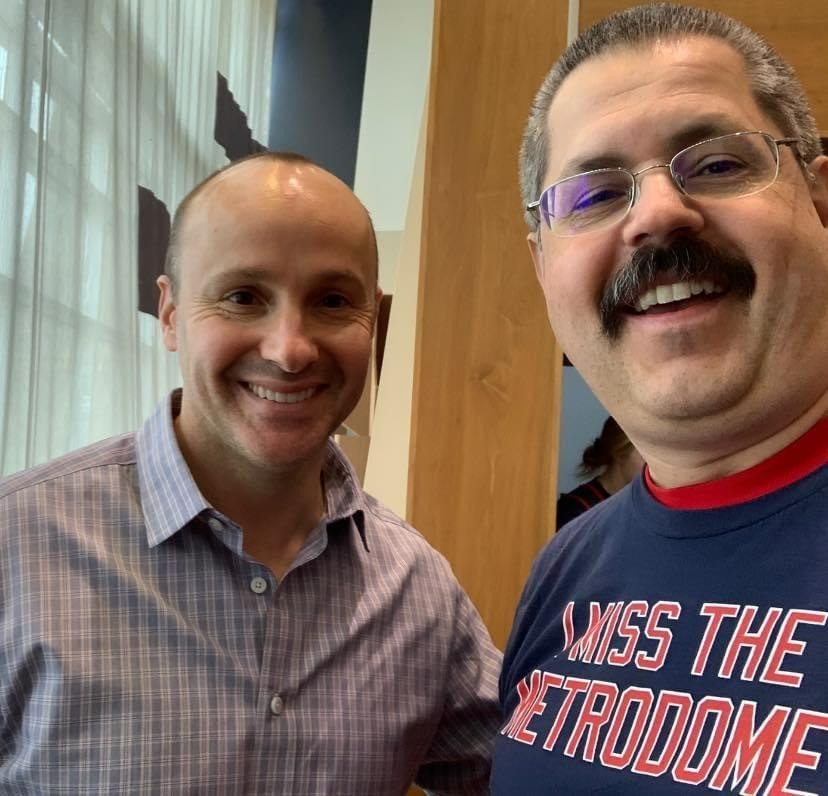
Most enjoyable Christmas gift I've gotten in a long time is this T-shirt. (I'm the one on the right.) It was especially cool to have Provus track me down on social media and ask for a copy of the picture. And, when asking a question during one of the sessions at TwinsFest, to have LaTroy Hawkins say, "I miss the Metrodome too." I'll go with what's been said -- 8-0 in the World Series, cheap ($29 for four tickets, four sodas, four hot dogs and a program, if I recall), the pressure rush at the doors, and the knowledge that there would be a game when I drove 300-500 miles.