



Parker Hageman
-
Posts
4,152 -
Joined
-
Last visited
-
Days Won
6
Content Type
Profiles
News
Minnesota Twins Videos
2026 Minnesota Twins Top Prospects Ranking
2022 Minnesota Twins Draft Picks
Minnesota Twins Free Agent & Trade Rumors, Notes, & Tidbits
Guides & Resources
2023 Minnesota Twins Draft Picks
The Minnesota Twins Players Project
2024 Minnesota Twins Draft Picks
2025 Minnesota Twins Draft Pick Tracker
2026 Minnesota Twins Draft Tracker: Picks & Bonuses
Forums
Blogs
Events
Store
Downloads
Gallery
Everything posted by Parker Hageman
-

Twins Daily Short-Season Hitter Of The Year
Parker Hageman replied to Seth Stohs's topic in Twins Daily Front Page News
Lewin Diaz was definitely one of my five favorite swingers coming into the season -- http://twinsdaily.com/_/minnesota-twins-news/minnesota-twins-minor-leagues/five-hitters-deserving-of-your-attention-r4332 (four out of five ain't bad) -- good to see that he continued to mash.- 13 replies
-
- 3
-

-
- lewin diaz
- alex kirilloff
- (and 3 more)
-
As much as I like Bautista and having his presence around the lineup and clubhouse, I'm not sure there is room for him in the outfield -- as the Twins current envision things. He's another corner outfielder/first base/DH type that the system is lousy with. Now, if the Twins move Rosario/Kepler or someone else this offseason for pitching, Bautista would make some sense. I don't know what he is looking for but I'm sure it is a hefty price tag after the years he has had and, at age-35, he's prime for regression. How's that for talking in a full circle?
-
¯\_(ツ)_/¯ But I will say, the Blue Jays routinely use Jose Bautista in the leadoff spot. The difference, I think, is that the Blue Jays have two or three other 30 home run bats behind him. What a terrible problem to have.
-
As the Minnesota Twins slipped across Lake Erie and back into the United States on Sunday night following a three-game series in Toronto, the pitching staff would not be blamed if they sat the entire flight curled in the fetal position. The stats were horrific. Over the weekend series the Blue Jays mashed nine home runs, ten doubles and scampered for one triple. They compiled 38 hits overall and plated 32 runs. They walked more than they struck out. This was nothing new. Since the beginning of 2015 Toronto has out-slugged, out-homered and out-scored everybody. They also have the second-highest on-base percentage, falling just being the Red Sox. The series against the Twins was just business as usual for the pride of Canada. When it comes to hitting, the Toronto Blue Jays just get it.Twins hitting coach Tom Brunansky doesn’t think Toronto’s style of offense -- from the big movements and swings from likes of Jose Bautista, Josh Donaldson, Edwin Encarnacion and others -- is anything new to the club. “It started a long time ago,” said Twins hitting coach Tom Brunansky. “I think that philosophy started when Cito Gaston was there, when he was their hitting guy. Then it kinda took off when Cito was the manager and then they had Dwayne Murphy there, you know Murph had a leg kick. I think you can go back to the days when George Bell, Lloyd Moseby and Jesse Barfield and the era that I played, those were the same type of guys, a bunch of free swingers.” It is true that Gaston and Murphy are credited with helping Bautista unlock his swing that has resulted in 243 home runs in 6 years -- the most in baseball in that time -- but there are also guys like Donaldson who refined his mechanics while in Oakland and other players such as Danny Valencia, Chris Colabello and Kevin Pillar who have patterned some elements of their swing after Donaldson (in conjunction with the Blue Jays coaching staff). After all, the Blue Jays third baseman blew the lid off the hitting community with his recent breakdown of his process on the MLB Network. That ideology goes beyond just grip-and-rip, what Donaldson talks about is closer to a cheat code. Twins third baseman Trevor Plouffe agrees that it is invaluable to have players around who like to bounce swing talk off one another. Brian Dozier said he learned how to decimate fastballs by watching and picking the brains of Justin Morneau and Josh Willingham. If it is Bautista and Donaldson encouraging organizational newcomers like Russell Martin and Troy Tulowitzki to add more rhythm to their swing or transfer more weight on their back legs before driving at the the ball, that type of communication can influence the makeup of an entire lineup. Plouffe, who the Twins drafted out of Crespi Carmelite High School in 2004, highlighted some of the differences in philosophy between the two organizations. Early in his development, Plouffe said there was an emphasis placed on just making contact and that came with a request to alter his swing. “I remember coming into my rookie ball season and I went and just played,” Plouffe said. “I thought I did a pretty good job. Then the following spring training our hitting coordinator, [Jim Dwyer], wanted to change some things and I was up for the change. I wanted to produce and do well by the team and the organization. He started to have me do a toe-tap thing. It started to evolve from there. I didn’t really have success with [the toe tap] and as I got a little older and further up the line, I realized that you have to do what’s comfortable for you.” Plouffe’s story does not differ much from that of Byron Buxton. Buxton says that the Twins staff changed him in rookie ball, slowing down his movement and installing a toe-tap stride. Four years later, Buxton is struggling to rediscover his original swing which made him the most sought after draft pick in 2012. Plouffe eventually landed on a leg lift as a timing mechanism, which coincides when he started hitting for power. According to Plouffe, Brunansky calls his swing “awkward” and “unorthodox”. The Twins do have plenty of hitters who come into the system, either by draft, trade or signing, who have incorporated the big movements in their swing similar to what is seen from the Blue Jays lineup. Some hitters who have passed through the organization have complained that the Twins have tried to get them to eliminate that portion of their swing, sending them into disastrous stretches because they are trying to overhaul a key component of their swing in season. Brunansky said that is not his philosophy and that the organization does not tell their hitters to tone down the swing. “One thing is you never want to take away somebody’s ability,” said Brunansky. “If they want to use a leg kick and that’s something they feel good about and that’s who they are, we will certainly work with it. [The leg kick] is gonna continue until they prove that they can’t [use it]. That’s the one thing once you get to this level up here, the game dictates whether you can or can’t.” In regards to copying the Blue Jays’ approach, Brunansky bristles a bit. “I think that they come in free to not worry about certain things,” Brunansky said of Toronto’s organizational hitting philosophy. “They’re not worried about striking out. They are not worried about putting the ball in play in certain situations. They are going to go attack. They figure they are going to do enough damage.” Brunansky said that differs from his philosophy, which places priority on not striking out in key situations. The Blue Jays approach, he believes, will lead to more strikeouts. “I’m not a big fan of strikeouts and I know the game has progressed to the point where strikeouts have become commonplace,” he emphasized. “I certainly don’t want it to be such a negative where hitters fear getting in the box with two strikes. I don’t like strikeouts with runners on base -- and certainly not with a runner on third. And I get it, you are not always going to put the ball in play with a runner on third but that has been a backbreaker for us.” It is a misconception that the Blue Jays’ approach equates to strikeouts. After all, since the start of the 2015 season, they have struck out in 20% of their plate appearances, 20th of the 30 teams. And their contributors in Jose Bautista, Josh Donaldson and Edwin Encarnacion all have strikeout rates well below the league’s average. Meanwhile, the Twins’ just-put-it-play mindset has led to a 21.5% strikeout rate, 9th highest out of 30. The Twins have had a history of players who have had minimal, foot-down-early approaches over the last decade plus. Joe Mauer excels at the craft of hitting by reducing his movement. Miguel Sano’s approach involves minimal movements. Brian Dozier’s power numbers are a testament to the notion that you don’t have to have any leg kick if you do everything else right in the swing. In the modern game, however, that kind of thinking has gone by the wayside, along with pitch-to-contact pitchers. “There is a lot more video available now, I think people understand now that you need to get to a certain spot but you can get to that spot in a lot of different ways,” Plouffe said. “In my opinion you don’t want to conform everybody to the same type of swing because everybody has grown up swinging differently. We’ve swung for 27 years now and it’s who we are. If you can get to that certain spot, people are realizing there are a million different ways to get there.” Click here to view the article
-
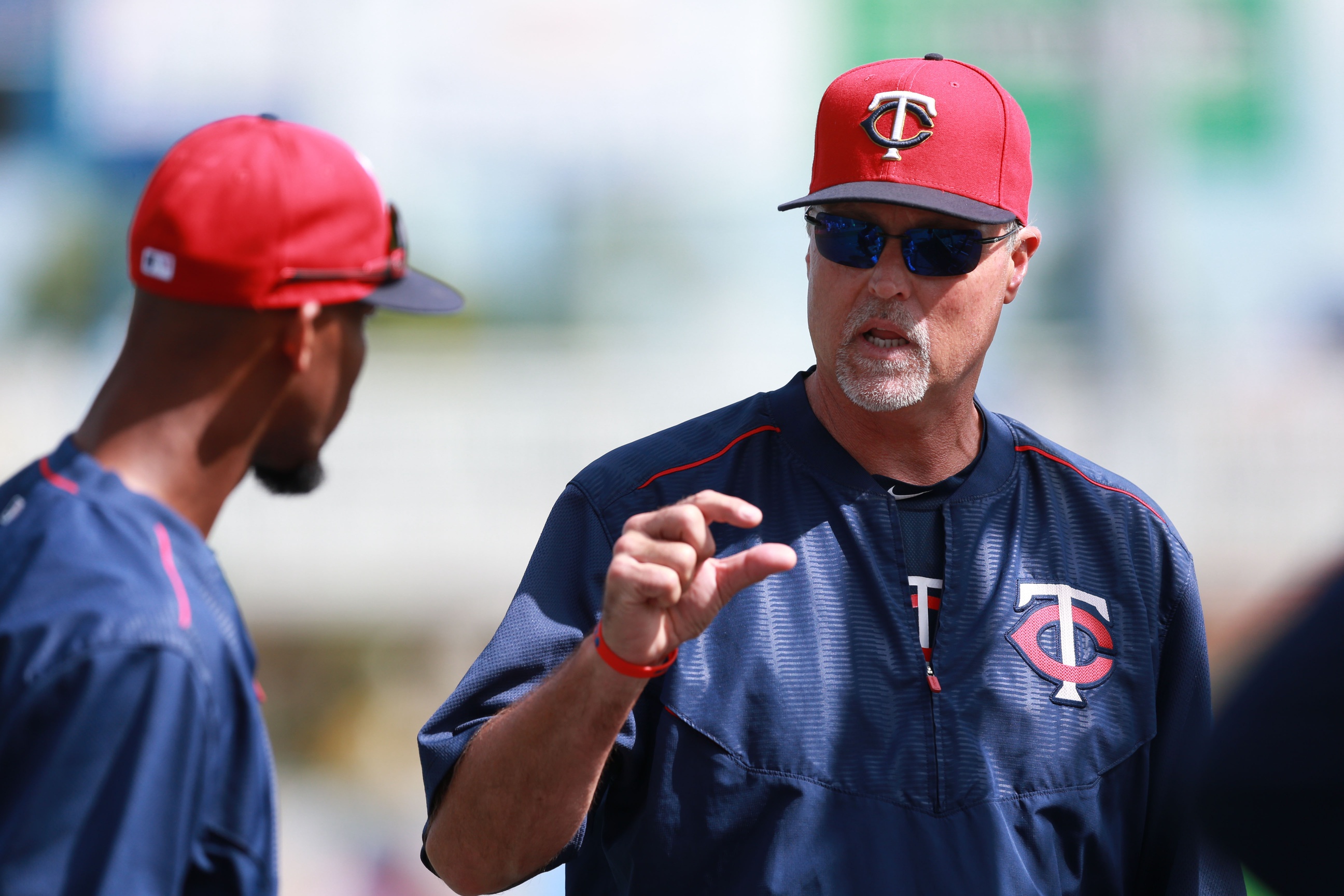 Twins hitting coach Tom Brunansky doesn’t think Toronto’s style of offense -- from the big movements and swings from likes of Jose Bautista, Josh Donaldson, Edwin Encarnacion and others -- is anything new to the club. “It started a long time ago,” said Twins hitting coach Tom Brunansky. “I think that philosophy started when Cito Gaston was there, when he was their hitting guy. Then it kinda took off when Cito was the manager and then they had Dwayne Murphy there, you know Murph had a leg kick. I think you can go back to the days when George Bell, Lloyd Moseby and Jesse Barfield and the era that I played, those were the same type of guys, a bunch of free swingers.” It is true that Gaston and Murphy are credited with helping Bautista unlock his swing that has resulted in 243 home runs in 6 years -- the most in baseball in that time -- but there are also guys like Donaldson who refined his mechanics while in Oakland and other players such as Danny Valencia, Chris Colabello and Kevin Pillar who have patterned some elements of their swing after Donaldson (in conjunction with the Blue Jays coaching staff). After all, the Blue Jays third baseman blew the lid off the hitting community with his recent breakdown of his process on the MLB Network. That ideology goes beyond just grip-and-rip, what Donaldson talks about is closer to a cheat code. Twins third baseman Trevor Plouffe agrees that it is invaluable to have players around who like to bounce swing talk off one another. Brian Dozier said he learned how to decimate fastballs by watching and picking the brains of Justin Morneau and Josh Willingham. If it is Bautista and Donaldson encouraging organizational newcomers like Russell Martin and Troy Tulowitzki to add more rhythm to their swing or transfer more weight on their back legs before driving at the the ball, that type of communication can influence the makeup of an entire lineup. Plouffe, who the Twins drafted out of Crespi Carmelite High School in 2004, highlighted some of the differences in philosophy between the two organizations. Early in his development, Plouffe said there was an emphasis placed on just making contact and that came with a request to alter his swing. “I remember coming into my rookie ball season and I went and just played,” Plouffe said. “I thought I did a pretty good job. Then the following spring training our hitting coordinator, [Jim Dwyer], wanted to change some things and I was up for the change. I wanted to produce and do well by the team and the organization. He started to have me do a toe-tap thing. It started to evolve from there. I didn’t really have success with [the toe tap] and as I got a little older and further up the line, I realized that you have to do what’s comfortable for you.” Plouffe’s story does not differ much from that of Byron Buxton. Buxton says that the Twins staff changed him in rookie ball, slowing down his movement and installing a toe-tap stride. Four years later, Buxton is struggling to rediscover his original swing which made him the most sought after draft pick in 2012. Plouffe eventually landed on a leg lift as a timing mechanism, which coincides when he started hitting for power. According to Plouffe, Brunansky calls his swing “awkward” and “unorthodox”. The Twins do have plenty of hitters who come into the system, either by draft, trade or signing, who have incorporated the big movements in their swing similar to what is seen from the Blue Jays lineup. Some hitters who have passed through the organization have complained that the Twins have tried to get them to eliminate that portion of their swing, sending them into disastrous stretches because they are trying to overhaul a key component of their swing in season. Brunansky said that is not his philosophy and that the organization does not tell their hitters to tone down the swing. “One thing is you never want to take away somebody’s ability,” said Brunansky. “If they want to use a leg kick and that’s something they feel good about and that’s who they are, we will certainly work with it. [The leg kick] is gonna continue until they prove that they can’t [use it]. That’s the one thing once you get to this level up here, the game dictates whether you can or can’t.” In regards to copying the Blue Jays’ approach, Brunansky bristles a bit. “I think that they come in free to not worry about certain things,” Brunansky said of Toronto’s organizational hitting philosophy. “They’re not worried about striking out. They are not worried about putting the ball in play in certain situations. They are going to go attack. They figure they are going to do enough damage.” Brunansky said that differs from his philosophy, which places priority on not striking out in key situations. The Blue Jays approach, he believes, will lead to more strikeouts. “I’m not a big fan of strikeouts and I know the game has progressed to the point where strikeouts have become commonplace,” he emphasized. “I certainly don’t want it to be such a negative where hitters fear getting in the box with two strikes. I don’t like strikeouts with runners on base -- and certainly not with a runner on third. And I get it, you are not always going to put the ball in play with a runner on third but that has been a backbreaker for us.” It is a misconception that the Blue Jays’ approach equates to strikeouts. After all, since the start of the 2015 season, they have struck out in 20% of their plate appearances, 20th of the 30 teams. And their contributors in Jose Bautista, Josh Donaldson and Edwin Encarnacion all have strikeout rates well below the league’s average. Meanwhile, the Twins’ just-put-it-play mindset has led to a 21.5% strikeout rate, 9th highest out of 30. The Twins have had a history of players who have had minimal, foot-down-early approaches over the last decade plus. Joe Mauer excels at the craft of hitting by reducing his movement. Miguel Sano’s approach involves minimal movements. Brian Dozier’s power numbers are a testament to the notion that you don’t have to have any leg kick if you do everything else right in the swing. In the modern game, however, that kind of thinking has gone by the wayside, along with pitch-to-contact pitchers. “There is a lot more video available now, I think people understand now that you need to get to a certain spot but you can get to that spot in a lot of different ways,” Plouffe said. “In my opinion you don’t want to conform everybody to the same type of swing because everybody has grown up swinging differently. We’ve swung for 27 years now and it’s who we are. If you can get to that certain spot, people are realizing there are a million different ways to get there.”
 -
Article: Fixing Jose Berrios
Parker Hageman replied to Parker Hageman's topic in Twins Daily Front Page News
Per reporters: Twins are sending him and Tyler Duffey down to Rochester. -
Article: Fixing Jose Berrios
Parker Hageman replied to Parker Hageman's topic in Twins Daily Front Page News
Still not fixed, btw. -
Article: Fixing Jose Berrios
Parker Hageman replied to Parker Hageman's topic in Twins Daily Front Page News
Gotcha. -
Article: Fixing Jose Berrios
Parker Hageman replied to Parker Hageman's topic in Twins Daily Front Page News
What? I'm not being technical. The point is the Twins are being too technical, and in this case, feeding him false information. -
Article: Fixing Jose Berrios
Parker Hageman replied to Parker Hageman's topic in Twins Daily Front Page News
Another interesting tidbit is Berrios' release point has dropped some in August. Obviously there is not a ton of data from earlier in his development (mostly AZ Fall and MiLB All Star Game appearances) and the drop is roughly .3 inches but the Twins have driven home finding his release point.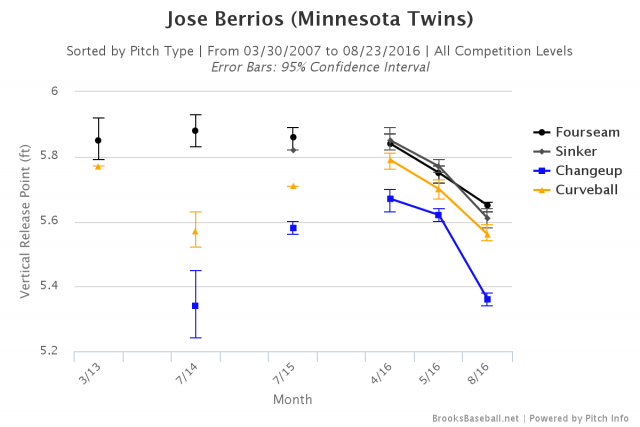
-
Article: Dozier's Not Jerking Around
Parker Hageman replied to Cody Christie's topic in Twins Daily Front Page News
Most Pitches Pulled, Last 30 Days: 1. Carlos Santana: 64% 2. BRIAN DOZIER 62% 3. Danny Espinosa 60% (Career Avg 51%) 4. Edwin Encarnacion 58% 5. Gregory Polanco 57% League Avg.............40% Don't believe the hype. As he has said, they've worked on keeping his barrel in the zone longer which has resulted in better struck balls going the other way versus rolling over on them, but his bread and butter is being able to yank pitches into the seats. -
Article: Fixing Jose Berrios
Parker Hageman replied to Parker Hageman's topic in Twins Daily Front Page News
That was the best thing he said. -
Article: Fixing Jose Berrios
Parker Hageman replied to Parker Hageman's topic in Twins Daily Front Page News
Let's just summarize all the (known) advice Jose Berrios has been given: 1. Ervin Santana told him he was "opening up his front hip too fast, spinning away from the target". http://www.twincities.com/2016/08/15/twins-using-village-to-help-struggling-jose-berrios/ 2. Neil Allen told him he needs to pick up the tempo. http://www.startribune.com/twins-ask-jose-berrios-to-pick-up-the-pace-on-the-mound/390656141/ 3. In the same article, Allen also told Berrios that wrapping the ball behind his back was hurting his command. 4. Bert Blyleven had told him to work on his release point. 5. And, finally, Blyleven said that they were working on pushing off that pitching rubber. That's a lot of things for a pitcher to take with him into a start. -
Article: Fixing Jose Berrios
Parker Hageman replied to Parker Hageman's topic in Twins Daily Front Page News
Overall point: "pushing off the rubber" -- as he was describing it during the broadcast -- does little for power or command. I know (hope?) Bert means something different that what he explained on TV when he and/or Neil Allen were working with Berrios in the bullpen. -
On Friday night in Kansas City Bert Blyleven described to viewers what he and the Twins’ coaching staff were working on with Jose Berrios in order to straighten him out. “Right...there!” Blyleven exclaimed as Berrios delivered a fastball for strike three to the Royals’ Jarrod Dyson in the bottom of the first. It was a beautiful pitch that was beautifully executed by the rookie. “EXPLODE towards home plate,” he emphasized. As the replay of the strikeout rolled, Blyleven further elaborated by saying “once you get to that balance point, utilize the rubber and explode towards home plate” and that Berrios needed to “push off” the rubber more. And just like that, Jose Berrios was fixed forever, right?For those who are able to see the embedded Twitter post, you can watch and listen to the entire conversation here: Berrios, of course, came unglued shortly thereafter. He issued four walks and allowed four runs to score during his four innings of work. He either stopped exploding towards home plate or that wasn’t the pitching tip that was going to remedy what ails him. Now, regular Twins broadcast viewers will recall this pitching advice. This, along with a “good downward plane”, have become common pitching jargon slung around for years. Scott Baker never figured out how to get a good downward plane. It has come to the point where if any Twins pitcher is struggling, the inevitable cure from the broadcast booth would likely be one of those two remedies. To be clear, I’m not suggesting that Bert Blyleven doesn’t know pitching. Bert Blyleven has forgotten more about pitching in the time it took you to get to this point in the sentence than most people hope to learn in a lifetime. However, when it comes to utilizing the rubber by pushing off, as Blyleven suggests, science might not agree with the Dutchman’s assessment. According to Kyle Boddy and his Driveline Baseball think tank in Seattle, Washington has studied the “push off” phenomenon and his preliminary research shows that the back leg push off is not the velocity-inducing catalyst that people think it is. Boddy offered the Mariners’ Arquimedes Caminero as a good example of how velocity isn’t generated off the back leg. When he gets to his balance point and goes forward, his foot disengages the rubber area but doesn’t push off. http://i.imgur.com/cxLJzHG.gif When it comes this particular pitching cue, Blyleven is incorrect. By Boddy’s account, coming from someone who has dedicated his career to understanding the science behind it, pushing from the back leg has little influence on velocity or command. What we hear from players, former players and coaches is a disconnect between what they FELT and what is actually happening during the process. To Blyleven, the act of driving off the back leg may have felt like pushing off the pitching rubber but that is not what actually transpires in the kinetic chain. Berrios’ problem does not stem from not utilizing the pitching rubber enough. In the case of Berrios’ development, as Mike Berardino of the St Paul Pioneer Press recently phrased it, the Twins are using a “village” approach. In addition to Blyleven, Berrios has been receiving advice from Neil Allen, Eddie Guardado and teammate Ervin Santana. While the guidance from multiple experienced baseball men can be beneficial, there is also the danger that a young prospect has too many messages being communicated -- especially when some of the advice, in spite of the well-meaning nature, is wrong. There is no denying that Berrios needs refinement. When it comes to his fastball command, he has found the zone just 46% of the time -- compared to the 53.5% major league average. In fact, of those who have thrown 350 or more fastballs, Berrios’ in-zone rate is the fifth lowest. Beyond that, Berrios also struggles to command his fastball in the zone, missing the glove by a wide margin and winding up in a hitter’s whump-em zone. Download attachment: Berrios KC.PNG That being said, in spite of the poor command, Berrios’ movement and velocity on his fastball has also incited plenty of swing-and-misses making it a very good potential weapon. Right now his fastball gets a swinging strike 9.3% of the time it’s thrown -- well above the league average of 7.5%. By comparison, the hard-throwing Noah Syndergaard gets a swinging strike 9.5% of the time. That would be good over the course of an entire season. That would be really good. http://i.imgur.com/VH4xtUF.gif Guardado told me something in spring training that resonated about his instructional approach and the psyche of pitchers in general. “I don’t like to go in there and fix a damn engine when you only need to change a spark plug,” he said. “That’s what I try to do. Keep it simple, keep it easy. Not too much to think about because it is already tough to go out there and the pressure out there trying to compete.” There is a lot of pressure. Especially for someone who has been deemed the team’s top pitching prospect and one -- through various social media channels -- who has also set a lofty expectation for himself as well. Berrios has talent, skill and dedication like few others have ever had or ever wish to have and he has carved up hitters in the minor leagues. It is only a matter of time before it all clicks. Click here to view the article
-
 For those who are able to see the embedded Twitter post, you can watch and listen to the entire conversation here: https://twitter.com/ParkerHageman/status/766878258956644353 Berrios, of course, came unglued shortly thereafter. He issued four walks and allowed four runs to score during his four innings of work. He either stopped exploding towards home plate or that wasn’t the pitching tip that was going to remedy what ails him. Now, regular Twins broadcast viewers will recall this pitching advice. This, along with a “good downward plane”, have become common pitching jargon slung around for years. Scott Baker never figured out how to get a good downward plane. It has come to the point where if any Twins pitcher is struggling, the inevitable cure from the broadcast booth would likely be one of those two remedies. To be clear, I’m not suggesting that Bert Blyleven doesn’t know pitching. Bert Blyleven has forgotten more about pitching in the time it took you to get to this point in the sentence than most people hope to learn in a lifetime. However, when it comes to utilizing the rubber by pushing off, as Blyleven suggests, science might not agree with the Dutchman’s assessment. According to Kyle Boddy and his Driveline Baseball think tank in Seattle, Washington has studied the “push off” phenomenon and his preliminary research shows that the back leg push off is not the velocity-inducing catalyst that people think it is. Boddy offered the Mariners’ Arquimedes Caminero as a good example of how velocity isn’t generated off the back leg. When he gets to his balance point and goes forward, his foot disengages the rubber area but doesn’t push off. http://i.imgur.com/cxLJzHG.gif When it comes this particular pitching cue, Blyleven is incorrect. By Boddy’s account, coming from someone who has dedicated his career to understanding the science behind it, pushing from the back leg has little influence on velocity or command. What we hear from players, former players and coaches is a disconnect between what they FELT and what is actually happening during the process. To Blyleven, the act of driving off the back leg may have felt like pushing off the pitching rubber but that is not what actually transpires in the kinetic chain. Berrios’ problem does not stem from not utilizing the pitching rubber enough. In the case of Berrios’ development, as Mike Berardino of the St Paul Pioneer Press recently phrased it, the Twins are using a “village” approach. In addition to Blyleven, Berrios has been receiving advice from Neil Allen, Eddie Guardado and teammate Ervin Santana. While the guidance from multiple experienced baseball men can be beneficial, there is also the danger that a young prospect has too many messages being communicated -- especially when some of the advice, in spite of the well-meaning nature, is wrong. There is no denying that Berrios needs refinement. When it comes to his fastball command, he has found the zone just 46% of the time -- compared to the 53.5% major league average. In fact, of those who have thrown 350 or more fastballs, Berrios’ in-zone rate is the fifth lowest. Beyond that, Berrios also struggles to command his fastball in the zone, missing the glove by a wide margin and winding up in a hitter’s whump-em zone. That being said, in spite of the poor command, Berrios’ movement and velocity on his fastball has also incited plenty of swing-and-misses making it a very good potential weapon. Right now his fastball gets a swinging strike 9.3% of the time it’s thrown -- well above the league average of 7.5%. By comparison, the hard-throwing Noah Syndergaard gets a swinging strike 9.5% of the time. That would be good over the course of an entire season. That would be really good. http://i.imgur.com/VH4xtUF.gif Guardado told me something in spring training that resonated about his instructional approach and the psyche of pitchers in general. “I don’t like to go in there and fix a damn engine when you only need to change a spark plug,” he said. “That’s what I try to do. Keep it simple, keep it easy. Not too much to think about because it is already tough to go out there and the pressure out there trying to compete.” There is a lot of pressure. Especially for someone who has been deemed the team’s top pitching prospect and one -- through various social media channels -- who has also set a lofty expectation for himself as well. Berrios has talent, skill and dedication like few others have ever had or ever wish to have and he has carved up hitters in the minor leagues. It is only a matter of time before it all clicks.
 -
Article: Buxton Stalls Out, Again
Parker Hageman replied to Nick Nelson's topic in Twins Daily Front Page News
https://twitter.com/ParkerHageman/status/762718005440589824 -
Article: Official Trade Deadline Day Thread
Parker Hageman replied to Seth Stohs's topic in Twins Daily Front Page News
Jon Heyman is reporting the Twins and Red Sox have an agreement on Fernando Abad.- 553 replies
-
- 4
-
-
- kurt suzuki
- brandon kintzler
- (and 2 more)
-
Article: Brandon Kintzler: Proven Closer?
Parker Hageman replied to Cody Christie's topic in Twins Daily Front Page News
Before we get too excited about this, let's keep in mind that pitch f/x hasn't always categorized fastballs accurately. For instance, in 2014 they said he threw 17% 4-seam but he was almost exclusively sinkers. When you look at the game charts, the ones labeled "4-seamers" moved the same as the ones labeled "sinkers". The impressive part is that he is throwing very few secondary pitches in the mix. He's essentially a one-pitch pitcher. Only Kenley Jansen, Zach Britton and Sean Doolittle have leaned on one-pitch more than Kintzler. **Here's another thing: Britton probably has the best sinking fastball in the game right now. He grips it like a 2-seamer with a slight cross grip. Kintzler, who they categorize as a "sinker", holds his in almost the exact same way. They both have very similar vertical movement (Britton's is thrown much harder) resulting in sink but one is a sinker and the other is a 2-seamer. Shruggy guy.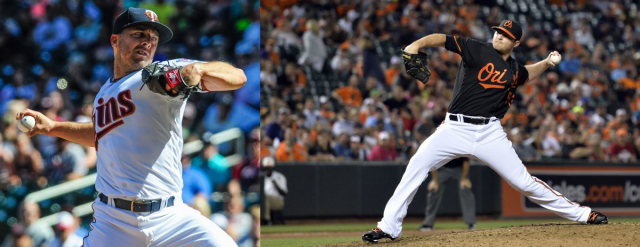
- 25 replies
-
- 1
-
-
- brandon kintzler
- glen perkins
- (and 2 more)
-
Article: Minnesota's Defensive Dilemma
Parker Hageman replied to Cody Christie's topic in Twins Daily Front Page News
HEY! Speaking of defensive metrics, here is Rob Antony's take on them from our 2010 interview: -
Being the one who conducted the original interview with Rob Antony in 2010, I probably should clarify several things. During a spring training visit in 2010, I attempted to get time with Terry Ryan. I was told that he was unavailable (like he typically is outside of his pre-game huddles) and that Antony would gladly answer my questions. My point was to gauge what the level of knowledge was for baseball analytics inside the organization. In addition to some current event questions, I added a few questions from the book Behind-The Scenes Baseball (the Doug Decatur book discussed what life was like as an analytics “advisor” to several teams in 1984) which would be telling of the mindset of a team’s GM. Those questions were something like, does he prefer RBI to Slugging Percentage? Does the GM know basic advanced stats (I used FIP and BABIP as mine)? As you can see in the link above, Antony shaded toward the old-school mindset, not very familiar with what were, at the time, advanced stat concepts. To be sure, Antony readily acknowledged this short-coming as well, remarking that the organization definitely slanted old-school and mentioned that they had just hired a guy to focus solely on analytics (Jack Goin). Shortly after publishing the interview, Aaron Gleeman shared it on his site and it gained national steam. I was told that there was definite unhappiness about the interview and how it portrayed Antony. In fact, I’m told that the Twins reached out to Gleeman to have him sit down with Antony so he could clarify his position on analytics. Later on, several members within the organization told me later that the interview prompted Antony to educate himself on a lot of those stats and concepts. I haven’t had the opportunity to sit down one-on-one with Antony since the interview was published. I would love to sit down with him again and revisit some of those topics but let me make this much clear: I have been around him during his time leading the pre-game media huddles, I’ve read all of the TwinkieTown interviews with him over the past several years -- he’s a very sharp guy. Would he make a good GM? ¯\_(ツ)_/¯
-
Frankly, I don't know who to believe. The Twins' track record for identifying injuries is not stellar. And players hide injuries all the time. Dozier said he wasn't hurt in the second half of last year but was playing through a torn labrum in his hip. Phil Hughes said he wasn't hurt and was playing through thoracic outlet syndrome in his shoulder. Glen Perkins said no one should worry about his velocity and he had a torn labrum in his shoulder. Chris Colabello told no one about his thumb injury. And so on and so on and so on. I can certainly see a scenario where Park hurt his wrist in camp, had it feel better for a stretch and then tweaked it. Multiple reasons why he wouldn't say anything and try to keep playing through it. Not true. In hitter's counts during his hot stretch he saw fastballs 63% of the time and during the slump he saw them 59% of the time. This isn't enough of a variation. He actually saw MORE fastballs (57% to 54%) on the first pitch during his slump. Teams were not pitching him backwards overall during the bulk of his slump. What they did do, as indicated in the heat map GIF in the article, was avoid the middle of the plate -- particularly in hitter's counts....I will add, however, that teams rarely threw him fastballs AT ALL during his last 8 games before being demoted. He was already taking water at this point -- I just think that might have been what opened the floodgates.
-
When the Twins signed Byung Ho Park this offseason, they knew they were getting a strikeout-prone slugger who could regularly destroy baseballs. For about a month and half, he lived up to that billing. Midway through May that changed. He turned into a strikeout prone player who gently hit baseballs. Multiple explanations for this massive slump were offered. Teams finally adjusted to him. He focused too much on hard fastballs. His confidence was gone. As such, the Twins sent him to Rochester to regain his swing. If reports are accurate, however, it would appear that, in addition to the issues above, Park has also been playing through an injury.On May 13, in the opener of a three game series in Cleveland, Park had his first multi-homer game of his career and giving him nine on the season, pulling him within three of the AL pace-setting in Robinson Cano. He was tops among rookies in the junior circuit in home runs, and his overall numbers, while not otherworldly, were highly respectable. When the sun set on the Buckeye State that night, Park carried a .245/.324/.582 batting line. He had the shine of a legit Rookie Of The Year candidate. But just as meteoric as his rise, Park fell quickly back to earth. Over the next 33 games, he posted a measly batting line of .145/.233/.265. His exit velocity average dropped from 90.9 MPH to 87.2. His average fly ball distance went from 250 to 208. As a predominant fly ball hitter, these metrics were troubling. Pitchers confounded him as he reportedly obsessed with higher velocity. His confidence waned. Something was amiss. Park’s Korean Baseball Organization-honed upper-cut swing path has been perfect for mashing breaking balls: Of his 12 home runs, 8 were on curves or sliders. Only Colorado’s Trevor Story (10) and the Dodgers’ Corey Seager (9) hit more on those types of pitches. There was no doubt that Park could manhandle mistakes but he has been carved up when the sequences included fastballs with velocity 93 miles per hour or higher. In fact, Park’s struggles are so prolific, his .089 batting average against fastballs 93 MPH or higher was the lowest in baseball… with the exception of the Phillies’ Ryan Howard (.042). Was it truly the competition and the velocity in the major leagues that bested Park? On one hand, prior to his signing, scouts did express concern over his ability to catch up to inside fastballs. On the other, hitters who graduated from the Korean league have done quite well against these exact same type of fastballs. Pittsburgh’s Jung Ho Kang, Baltimore’s Hyun Soo Kim and Seattle Dae Ho Lee all had averages over .300 on fastballs over 93 MPH this year. Not being able to face elite velocity while developing in Korea certainly did not hinder their careers. Teams also adjusted to Park. While over a month of play seems like a crazytown amount of time to continue to throw middle-middle pitches to a guy who would obliterate them, it really took opponents that long to actively avoid that location. In short, he saw fewer mistakes. Download attachment: output_aTtQFn.gif Another possible factor for Park’s dismal performance emerged during last night’s Rochester Red Wings’ broadcast. As Seth Stohs pointed out on Twitter last night, the Lehigh Valley IronPigs announcers, noting Park’s absence from the game, said that Park had been struggling with a hand injury -- one that had lingered since spring training -- and was unable to maintain proper contact with the bat. Per the broadcast: On Friday Brad Steil, the Twins' Director of Minor League Operations, dismissed the broadcast banter, writing in an email to Twins Daily that there is nothing accurate about that report. "Park does not have a hand injury and he didn't have a hand injury (or anything else) in spring training," Steil noted. "He does have some wrist soreness at the moment, but it’s not something that prevents him from playing. Players deal with bumps, bruises, soreness, and general fatigue throughout the course of a six month season, and we will occasionally give them days off to help manage those things." That kind of information seems noteworthy. It would appear, however, that there were no reports of Park’s condition mentioned anywhere dating back to spring training. To be sure, this would not be the first time a player has downplayed an injury in an effort to keep playing. While rest would be in their best interest, competitiveness and machismo drives them to play night after night in spite of falling numbers and aching body parts. In baseball, communicating with the coaching and medical staff the extent of an injury can be complicated and certainly a language barrier (even with a translator) can also add a wrinkle. Even so, if the team had knowledge of a hand injury dating back to spring training, the subsequent poor performance should have necessitated some time off rather than continuing to insert him into the lineup, further damaging his confidence. Park’s slump could be both an issue of confidence and a nagging injury. Teams did adjust and Park seemingly did not adjust with them. At the same time, the same balls he was hitting hard into play simply were not hit with as much vigor as of late and a hand injury would be one viable reason for that. Whether you view the hand injury as an excuse rather than an explanation for his performance is inconsequential. What does matter is his ability to hit again. Regardless of the current circumstance, Park needs confidence and rest and Rochester is an appropriate setting for both. Click here to view the article
-
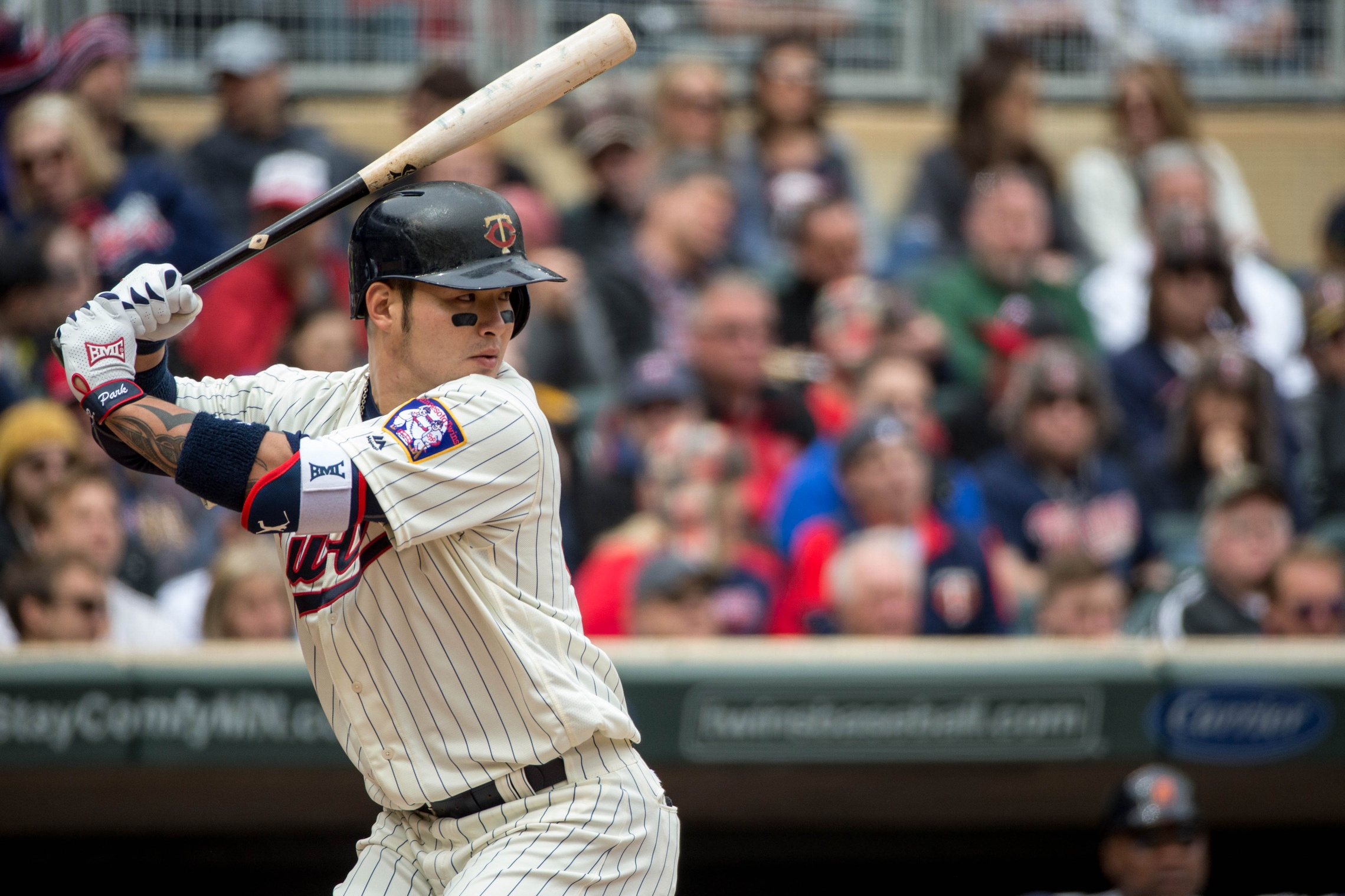 On May 13, in the opener of a three game series in Cleveland, Park had his first multi-homer game of his career and giving him nine on the season, pulling him within three of the AL pace-setting in Robinson Cano. He was tops among rookies in the junior circuit in home runs, and his overall numbers, while not otherworldly, were highly respectable. When the sun set on the Buckeye State that night, Park carried a .245/.324/.582 batting line. He had the shine of a legit Rookie Of The Year candidate. But just as meteoric as his rise, Park fell quickly back to earth. Over the next 33 games, he posted a measly batting line of .145/.233/.265. His exit velocity average dropped from 90.9 MPH to 87.2. His average fly ball distance went from 250 to 208. As a predominant fly ball hitter, these metrics were troubling. Pitchers confounded him as he reportedly obsessed with higher velocity. His confidence waned. Something was amiss. Park’s Korean Baseball Organization-honed upper-cut swing path has been perfect for mashing breaking balls: Of his 12 home runs, 8 were on curves or sliders. Only Colorado’s Trevor Story (10) and the Dodgers’ Corey Seager (9) hit more on those types of pitches. There was no doubt that Park could manhandle mistakes but he has been carved up when the sequences included fastballs with velocity 93 miles per hour or higher. In fact, Park’s struggles are so prolific, his .089 batting average against fastballs 93 MPH or higher was the lowest in baseball… with the exception of the Phillies’ Ryan Howard (.042). Was it truly the competition and the velocity in the major leagues that bested Park? On one hand, prior to his signing, scouts did express concern over his ability to catch up to inside fastballs. On the other, hitters who graduated from the Korean league have done quite well against these exact same type of fastballs. Pittsburgh’s Jung Ho Kang, Baltimore’s Hyun Soo Kim and Seattle Dae Ho Lee all had averages over .300 on fastballs over 93 MPH this year. Not being able to face elite velocity while developing in Korea certainly did not hinder their careers. Teams also adjusted to Park. While over a month of play seems like a crazytown amount of time to continue to throw middle-middle pitches to a guy who would obliterate them, it really took opponents that long to actively avoid that location. In short, he saw fewer mistakes. Another possible factor for Park’s dismal performance emerged during last night’s Rochester Red Wings’ broadcast. As Seth Stohs pointed out on Twitter last night, the Lehigh Valley IronPigs announcers, noting Park’s absence from the game, said that Park had been struggling with a hand injury -- one that had lingered since spring training -- and was unable to maintain proper contact with the bat. https://twitter.com/twinsdaily/status/751428998572285952 Per the broadcast: On Friday Brad Steil, the Twins' Director of Minor League Operations, dismissed the broadcast banter, writing in an email to Twins Daily that there is nothing accurate about that report. "Park does not have a hand injury and he didn't have a hand injury (or anything else) in spring training," Steil noted. "He does have some wrist soreness at the moment, but it’s not something that prevents him from playing. Players deal with bumps, bruises, soreness, and general fatigue throughout the course of a six month season, and we will occasionally give them days off to help manage those things." That kind of information seems noteworthy. It would appear, however, that there were no reports of Park’s condition mentioned anywhere dating back to spring training. To be sure, this would not be the first time a player has downplayed an injury in an effort to keep playing. While rest would be in their best interest, competitiveness and machismo drives them to play night after night in spite of falling numbers and aching body parts. In baseball, communicating with the coaching and medical staff the extent of an injury can be complicated and certainly a language barrier (even with a translator) can also add a wrinkle. Even so, if the team had knowledge of a hand injury dating back to spring training, the subsequent poor performance should have necessitated some time off rather than continuing to insert him into the lineup, further damaging his confidence. Park’s slump could be both an issue of confidence and a nagging injury. Teams did adjust and Park seemingly did not adjust with them. At the same time, the same balls he was hitting hard into play simply were not hit with as much vigor as of late and a hand injury would be one viable reason for that. Whether you view the hand injury as an excuse rather than an explanation for his performance is inconsequential. What does matter is his ability to hit again. Regardless of the current circumstance, Park needs confidence and rest and Rochester is an appropriate setting for both.
 -
In the middle of a roster shuffle which includes the recall of outfielder Eddie Rosario, the Minnesota Twins announced today that they have designated reliever Kevin Jepsen for assignment.Jepsen played a vital bullpen role for the Twins in 2015 after being acquired at the trade deadline. After closer Glen Perkins struggled in the second-half of the season, Jepsen successfully converted 10 saves in 11 opportunities while posting a minuscule 1.61 ERA and limiting opponents to a .176 average against in 28 innings. 2016, however, was an unmitigated disaster for the 31-year-old and one of the main reasons the Twins' bullpen has been such a disaster. When the Twins signed him to a one-year, $5.3 million deal, they figured they had a solid back-end arm to support Perkins. Given the closer's role once again following another injury to Perkins, Jepsen blew four saves in 11 opportunities and was demoted to a set-up spot. He allowed a career-high seven home runs as teams posted a 972 OPS. Download attachment: Jepsen.PNG For Jepsen, it was the loss of his secondary pitches that spoiled his season. He lost the feel for his changeup and seemed to lack the same precision with his curveball. Without these pitches, hitters homed in on his fastball, hitting .323 with six home runs on the pitch. The prior season hitters held a .173 average on the fastball with just one extra base hit. Trevor May, who has completed his rehab assignment and is at least a day or two away from being reinstated, has reportedly shortened his stride in order to alleviate pressure on his lower back. Click here to view the article


