



Nick Nelson
-
Posts
8,327 -
Joined
-
Last visited
-
Days Won
56
Content Type
Profiles
News
Minnesota Twins Videos
2026 Minnesota Twins Top Prospects Ranking
2022 Minnesota Twins Draft Picks
Minnesota Twins Free Agent & Trade Rumors, Notes, & Tidbits
Guides & Resources
2023 Minnesota Twins Draft Picks
The Minnesota Twins Players Project
2024 Minnesota Twins Draft Picks
2025 Minnesota Twins Draft Pick Tracker
2026 Minnesota Twins Draft Tracker: Picks & Bonuses
Forums
Blogs
Events
Store
Downloads
Gallery
Everything posted by Nick Nelson
-
Here's my problem with the "Wait until the right moment and push your chips in" stance: Nobody knows when that right moment will be. The Twins won 71 games in 1986. They won 74 in 1990.
- 182 replies
-
- 18
-

-
- jonathan schoop
- cj cron
- (and 2 more)
-
While it's true that the Twins pushed their payroll to unprecedented heights in 2018, it's not accurate to suggest the front office executed some sort of aggressive offseason plan that fizzled in practice. Instead, they adhered to their "opportunistic" credo, jumping on players who were passed up by other clubs in hopes of surfacing overlooked values. It didn't really work out. And this winter, the Twins have more or less done the same thing.You can make cases that C.J. Cron, Jonathan Schoop, Blake Parker and (to a lesser extent) Martin Perez are all logical, savvy additions. But you can't make the case that these players were in any kind of demand. Each was optionally let loose by his former team, and all those teams are looking to compete in 2019. The Rays, Brewers, Angels and Rangers deemed these players to not be worthwhile at their projected (non-exorbitant) 2019 salaries, so each made the active decision to move on, via non-tender/DFA/declined option. It is essentially tantamount to the way Minnesota viewed Robbie Grossman. Even Nelson Cruz fell to the Twins at a surprising bargain because the market was lukewarm on him, despite his monstrous offensive production. Seattle didn't show much interest in bringing Cruz back, and Minnesota ultimately found itself bidding against only one or two other teams. And so, when fans question – or at least attempt to critically analyze – the front office's approach this offseason, it's not so much about the collective expense for these players, which amounts to less than $32 million at a time where the team theoretically had upwards of $50 million to spend. It's more about the context of how they were acquired. The Twins have been drawing from the discard pile. Does that mean these moves are all doomed to fail? Not by any means. Personally, I have enough faith in the team's current assembly of analysts and baseball minds that I'm inclined to get behind this strategy for the most part. I like the fact that they've added several players under 30, with every signing other than Schoop coming in the form of a one-year guarantee plus team option. Those are good, team-friendly deals that strike a reasonable low-risk/medium-upside balance. What's been amiss is that clear, decisive upgrade to the pitching staff. Or that landscape-altering trade that charts a bold new direction for this perpetually stagnating franchise. I can't blame fans who feel underwhelmed with what's been acquired thus far – a collection of cast-offs and a 38-year-old DH who settled for less than almost anyone expected. The Twins still have about four weeks before their first full-squad workout in Fort Myers, so there's time yet for further additions, but one gets the sense it'll be more of the same. For better or worse, Minnesota appears content to stand pat and roll with what they've got, mixing in mostly gambles and secondary role players rather than clear-cut difference-makers. The upside is that whatever flexibility they end up preserving through these low-wattage free agent signings will potentially put them in an advantageous position around the trade deadline, should things play out as hoped in the first half. The downside is that they might be hurting their chances of reaching such a "buyer" position to begin with. Click here to view the article
- 182 replies
-
- 4
-
-
- jonathan schoop
- cj cron
- (and 2 more)
-
 You can make cases that C.J. Cron, Jonathan Schoop, Blake Parker and (to a lesser extent) Martin Perez are all logical, savvy additions. But you can't make the case that these players were in any kind of demand. Each was optionally let loose by his former team, and all those teams are looking to compete in 2019. The Rays, Brewers, Angels and Rangers deemed these players to not be worthwhile at their projected (non-exorbitant) 2019 salaries, so each made the active decision to move on, via non-tender/DFA/declined option. It is essentially tantamount to the way Minnesota viewed Robbie Grossman. Even Nelson Cruz fell to the Twins at a surprising bargain because the market was lukewarm on him, despite his monstrous offensive production. Seattle didn't show much interest in bringing Cruz back, and Minnesota ultimately found itself bidding against only one or two other teams. And so, when fans question – or at least attempt to critically analyze – the front office's approach this offseason, it's not so much about the collective expense for these players, which amounts to less than $32 million at a time where the team theoretically had upwards of $50 million to spend. It's more about the context of how they were acquired. The Twins have been drawing from the discard pile. Does that mean these moves are all doomed to fail? Not by any means. Personally, I have enough faith in the team's current assembly of analysts and baseball minds that I'm inclined to get behind this strategy for the most part. I like the fact that they've added several players under 30, with every signing other than Schoop coming in the form of a one-year guarantee plus team option. Those are good, team-friendly deals that strike a reasonable low-risk/medium-upside balance. What's been amiss is that clear, decisive upgrade to the pitching staff. Or that landscape-altering trade that charts a bold new direction for this perpetually stagnating franchise. I can't blame fans who feel underwhelmed with what's been acquired thus far – a collection of cast-offs and a 38-year-old DH who settled for less than almost anyone expected. The Twins still have about four weeks before their first full-squad workout in Fort Myers, so there's time yet for further additions, but one gets the sense it'll be more of the same. For better or worse, Minnesota appears content to stand pat and roll with what they've got, mixing in mostly gambles and secondary role players rather than clear-cut difference-makers. The upside is that whatever flexibility they end up preserving through these low-wattage free agent signings will potentially put them in an advantageous position around the trade deadline, should things play out as hoped in the first half. The downside is that they might be hurting their chances of reaching such a "buyer" position to begin with.
 -

Article: Sizing Up Cody Allen
Nick Nelson replied to Nick Nelson's topic in Twins Daily Front Page News
I posted the average payrolls to show there is no validity to your claim that last year's increase was driven solely by the BAMtech infusion. If that was the case it would've been reflected elsewhere around the league. If you think that was some unique situation I suggest you research further; there have been several instances in recent years where MLB teams/owners received large sums of money as part of enormous MLBAM/TV contracts, and in those cases payroll was not affected. What happened last year wasn't a "coincidence." The front office saw short-term opportunities late in the offseason and ownership signed off. There's no reason to think that couldn't/shouldn't happen in this case. I honestly don't know why you and MLR have decided to grind this axe once again. The article suggests the Twins have money to spend and theorizes a $14M deal which would put them around $112M in payroll. I'm not the one confusing the issue at hand. -
Article: Sizing Up Cody Allen
Nick Nelson replied to Nick Nelson's topic in Twins Daily Front Page News
I'm not asking them to spend at an average or above-average level, I'm asking them to spend at a reasonable level. We're talking about signing Cody Allen, not Bryce Harper. A $115M payroll will be near the bottom 10, if not among it. Again: the average MLB payroll has increased by almost $40M during the Target Field era. Minnesota's spending has remained mostly stagnant. Context is important here. -
Article: Sizing Up Cody Allen
Nick Nelson replied to Nick Nelson's topic in Twins Daily Front Page News
There is no payroll "cap." All of these restrictions are self-imposed. The Twins can easily afford to spend plenty more than these baselines have established and stay within the ~50% of revenue range. I am confident in that. You and MLR are going to need to produce some actual data and evidence to convince me otherwise. You cite this BAMtech windfall as the reason the Twins boosted their spending last year, which is completely unsubstantiated. Every owner received the same infusion, and the average overall spending hardly budged, which is why I shared those annual league-wide averages. -
Article: Sizing Up Cody Allen
Nick Nelson replied to Nick Nelson's topic in Twins Daily Front Page News
Ticket sales are no longer an overwhelming component of the revenue equation for baseball teams. Money is pouring in across the league from giant media deals. The notion being suggested above that last year's spending increase was driven by some isolated cash infusion is misguided. The game is flush with money. Also, declining to invest in your team because a lack of quality is deterring fan interest seems like a poor strategy to me. -
Article: Sizing Up Cody Allen
Nick Nelson replied to Nick Nelson's topic in Twins Daily Front Page News
Average payroll in MLB over the past 5 years (via BP): 2014: $115M 2015: $125M 2016: $130M 2017: $136M 2018: $135M The Twins are currently at $98 million. They have money to spend. Lots. -
Article: Sizing Up Cody Allen
Nick Nelson replied to Nick Nelson's topic in Twins Daily Front Page News
He lost less than 1 MPH on both his FB and CB. With that drop, he still allowed a .230 batting average and struck out 80 hitters in 67 innings. Sure, I'd love to get Kimbrel. I'd love to get Ottavino. But in practical terms: people have to want to sign here, and the Twins are clearly shying away from multi-year commitments. Allen just makes a ton of sense from that perspective, and after Kimbrel/Ottavino he's the best bet in free agency from my view. -
Article: Sizing Up Cody Allen
Nick Nelson replied to Nick Nelson's topic in Twins Daily Front Page News
You might be right. What I'm saying is, why not pay whatever it takes to get him on a one-year deal? If someone else is offering 2/16 he'd obviously take the 1/14 offer, right? There's basically no cap to what the Twins could offer him on a one-year deal, and it still aligns with their established no-commitments strategy. If Allen is fiercely determined to get a multi-year deal, even at a far lesser annual salary, then maybe the Twins should stay away. That sends all the wrong signals coming off a season like he just had. -
After reaching agreement with all of their arbitration eligible players last week, the Twins have solidified their projected 2019 payroll at around $96 million. That's about $30M below where they were last year (which was just below the MLB average), so needless to say they've got spending flexibility. The back end of the bullpen is the clearest need, and in that market, one name stands out as a fairly obvious fit.From 2014 through 2017, Cody Allen was consistently one of the better relievers in baseball. Serving as closer in Cleveland, he averaged 30 saves per season while posting a 2.62 ERA, 2.82 FIP, 1.10 WHIP, and 12.1 K/9 rate. In 2018, at age 29, he took a sizable step back, posting a 4.70 ERA with career highs in WHIP (1.36), BB/9 rate (4.4) and blown saves (5). His strikeouts were down along with his velocity. It was a troubling season for Allen and it couldn't have come at a worse time for him. But these circumstances make him an ideal fit for the Twins, who evidently aren't interested in any long-term commitments this winter. With another typical campaign in 2018, Allen might've been in line for a three- or four-year contract. But his major lapse creates too much risk for any team to make that leap now. Allen's most realistic hope now is for a high-dollar short-term deal, which is exactly what Minnesota's positioned to hand out. That's just one reason this match makes sense. There's also the team's need for a dominant late-inning reliever, and Allen's familiarity with Twins CBO Derek Falvey, who was Cleveland's co-director of baseball operations when the Indians drafted him in 2011. La Velle E. Neal III of the Star Tribune reported a month ago that the Twins were interested in Allen, but obviously nothing has come to fruition as of yet. It's been a slow-moving relief market. Perhaps the right-hander is waiting on Craig Kimbrel and Adam Ottavino – the two names clearly ahead of him in the pecking order – to sign and set precedent. I'm wondering if something like a one-year, $14 million offer might get it done with Allen, who would reel in more than half of his career earnings up to this point (he's totaled about $24 mil) with an opportunity to rebuild value in a prominent role and hit the market again next offseason. The upside here for the Twins is plain to see. But there is downside. It'd mean having $20M-plus tied up in two relievers who were both not very good in 2018. The money isn't really an issue, but the hefty guaranteed contracts mean Allen and Addison Reed will get every chance to earn them, possibly at the expense of worthy younger arms. Adding Allen to a bullpen that includes Reed, Taylor Rogers, Trevor May, and Blake Parker would leave few vacancies. Someone like Trevor Hildenberger, Gabriel Moya or Andrew Vasquez could more easily become blocked even if he proves deserving. The opportunity to try converting a younger starter, like Fernando Romero or Adalberto Mejia, becomes more limited. These aren't necessarily huge stumbling blocks, but they're worth keeping in mind for a team focused on rebuilding via the internal pipeline. Players need opportunities to develop. It's basically a moot point if Allen returns to his pre-2018 form or anything close. He'd significantly upgrade and legitimize Minnesota's bullpen unit. In light of that upside, and given the fact that – even in his down year – Allen's K and whiff rates would've ranked among the best in the Twins bullpen, I think the reward far outweighs the risk here. So I'm only left asking one question: What are we waiting for? Click here to view the article
-
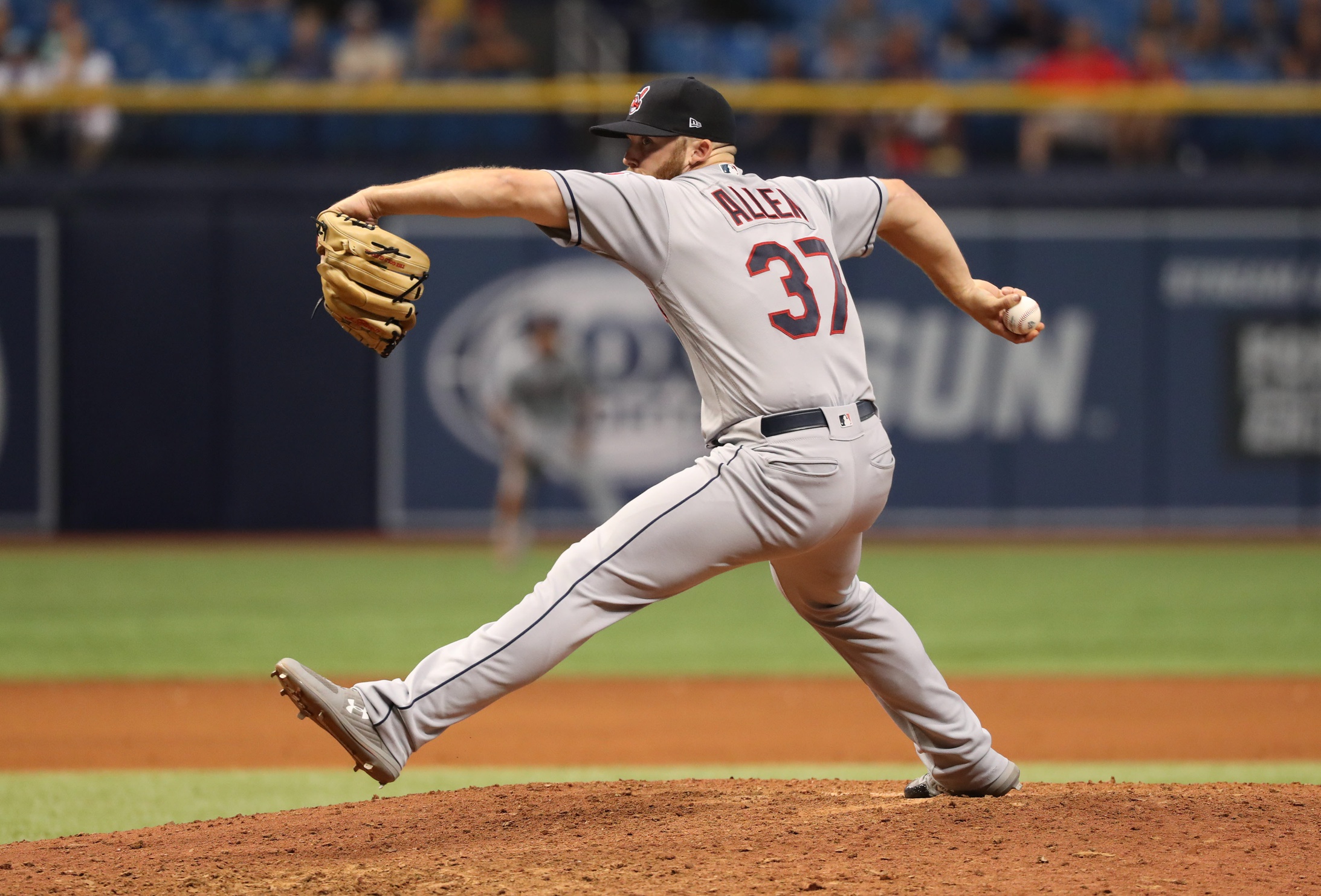 From 2014 through 2017, Cody Allen was consistently one of the better relievers in baseball. Serving as closer in Cleveland, he averaged 30 saves per season while posting a 2.62 ERA, 2.82 FIP, 1.10 WHIP, and 12.1 K/9 rate. In 2018, at age 29, he took a sizable step back, posting a 4.70 ERA with career highs in WHIP (1.36), BB/9 rate (4.4) and blown saves (5). His strikeouts were down along with his velocity. It was a troubling season for Allen and it couldn't have come at a worse time for him. But these circumstances make him an ideal fit for the Twins, who evidently aren't interested in any long-term commitments this winter. With another typical campaign in 2018, Allen might've been in line for a three- or four-year contract. But his major lapse creates too much risk for any team to make that leap now. Allen's most realistic hope now is for a high-dollar short-term deal, which is exactly what Minnesota's positioned to hand out. That's just one reason this match makes sense. There's also the team's need for a dominant late-inning reliever, and Allen's familiarity with Twins CBO Derek Falvey, who was Cleveland's co-director of baseball operations when the Indians drafted him in 2011. La Velle E. Neal III of the Star Tribune reported a month ago that the Twins were interested in Allen, but obviously nothing has come to fruition as of yet. It's been a slow-moving relief market. Perhaps the right-hander is waiting on Craig Kimbrel and Adam Ottavino – the two names clearly ahead of him in the pecking order – to sign and set precedent. I'm wondering if something like a one-year, $14 million offer might get it done with Allen, who would reel in more than half of his career earnings up to this point (he's totaled about $24 mil) with an opportunity to rebuild value in a prominent role and hit the market again next offseason. The upside here for the Twins is plain to see. But there is downside. It'd mean having $20M-plus tied up in two relievers who were both not very good in 2018. The money isn't really an issue, but the hefty guaranteed contracts mean Allen and Addison Reed will get every chance to earn them, possibly at the expense of worthy younger arms. Adding Allen to a bullpen that includes Reed, Taylor Rogers, Trevor May, and Blake Parker would leave few vacancies. Someone like Trevor Hildenberger, Gabriel Moya or Andrew Vasquez could more easily become blocked even if he proves deserving. The opportunity to try converting a younger starter, like Fernando Romero or Adalberto Mejia, becomes more limited. These aren't necessarily huge stumbling blocks, but they're worth keeping in mind for a team focused on rebuilding via the internal pipeline. Players need opportunities to develop. It's basically a moot point if Allen returns to his pre-2018 form or anything close. He'd significantly upgrade and legitimize Minnesota's bullpen unit. In light of that upside, and given the fact that – even in his down year – Allen's K and whiff rates would've ranked among the best in the Twins bullpen, I think the reward far outweighs the risk here. So I'm only left asking one question: What are we waiting for?
 -
With all due respect, based on your description of his effort at home plate I'm gonna go ahead and assume you're mischaracterizing whatever comments he made. It takes more than one player to win a ballgame. Cuddyer had one of the team's two hits and was the only one to move past first base. If you wanna criticize the guy do so with some level of intellectual honesty, please.
-
I'd love to hear Thrylos as the announcer for Game 7 of the '91 World Series. "Here's the pitch... lazy drive to center field... Puckett ranging back... takes a half-hearted leap at the wall... ohhh, looks like it somehow managed to land in his glove. He bounces off the wall and throws a wimpy five-hopper back toward the infield."
-
"Lackadaisical"
-
Today at Twins Daily we are excited to announce that Michael Cuddyer will be our special guest at the Winter Meltdown, now less than two weeks away. (Last-chance tickets go on sale Tuesday morning.) For a couple of reasons, Cuddyer feels like a fitting choice to have on-stage as we look ahead to the 2019 season. The story of his playing career holds acute relevance for this year's team.Cuddyer, who played in 1,139 games for Twins and was inducted into the team's Hall of Fame in 2017, is known for many things: His dimpled smile. His cannon arm. His magic tricks in the clubhouse. His slugging prowess. From my view, there are two specific elements of Cuddyer the player that are worth reflecting on for Twins fans at this moment in time. #1: Cuddyer is a poster child for the circuitous path to stardom As a high school shortstop in Chesapeake, VA, Cuddyer emerged as one of the top prep talents in the country. The Twins selected him ninth overall in 1997. He went straight to Single-A and raked, ascending the minor-league ranks rapidly and bypassing Triple-A entirely on his way to an MLB debut at age 22. From 1999 through 2003 he was a perennial Top 100 prospect according to Baseball America, peaking at #17 in his last year of eligibility. Cuddyer's initial ascent to the big leagues was as smooth as could be. His acclimation there was anything but. From 2001 through 2005, he yo-yoed back and forth between the majors and minors, continually crushing Triple-A but failing to establish himself at the highest level. Not until he was 27 did Cuddyer finally turn the corner, posting an .867 OPS in 2006 with 24 homers, 41 doubles and 109 RBIs in a career-high 150 games. He was a key component of a team that won 96 games. From there he went on to slash .281/.347/.468 and hit 165 home runs over the remainder of his career, making two All-Star teams. It's helpful to remember this path as we look at the various current Twins players who seem to be stuck in neutral (or worse). Byron Buxton and Miguel Sano, like Cuddyer, were both highly touted prospects that arrived in the majors at a young age but have failed to gain full traction. They're both 25 now. Max Kepler, who follows Cuddyer in Minnesota's right field lineage, may be a more apt parallel. Like Cuddyer, Kepler earned himself a September call-up at age 22 following a monster year at Double-A. And like Cuddyer, Kepler's MLB production stagnated in the years following: Michael Cuddyer, OPS+ 2002: 95 2003: 97 2004: 100 2005: 97 2006: 124 Max Kepler, OPS+ 2016: 96 2017: 95 2018: 96 2019: ? Granted, Kepler hasn't really had to fight for his playing time like Cuddyer did; he's been a regular ever since he arrived, despite the unspectacular offensive numbers. This is, in part, because of his elevated defensive value. But don't despair too much about the lack of offensive progression so far. Out of Cuddyer's 17 Wins Above Replacement accumulated in the big leagues, 15 came after he turned 26. Kepler turns 26 on February 10th. #2: Cuddyer was a model of defensive versatility When I think about Cuddyer playing the field, I picture him out in right, gathering a carom off the Metrodome's baggy and spinning around to rifle it toward the infield. It's easy to forget, now, that he moved all over the place. In his career, Cuddyer played at least 500 innings at five different positions (RF, LF, 1B, 3B, 2B). He wasn't great at all of them, but having the option to plug him in at so many spots was a major convenience for Ron Gardenhire. The current Twins will need to embrace this kind of flexibility, to the extent they can. Rostering a full-time DH like Nelson Cruz puts a further crunch on what'll likely be a short bench. Rocco Baldelli's life will be made easier if some players are able to help out at multiple positions, as Cuddy did. This is another possible connection to Kepler. I've suggested before that it'd be wise to get him up to speed at first base, given his past experience there. Eddie Rosario's brief but flashy appearance in the infield last year may have had substance (he did play second for a spell in the minors). Jonathan Schoop would be an even bigger asset if he could step in at third here and there to spell Sano. I'd like to hear about how Cuddyer kept his skills sharp enough that even at age 32, in his last season with the Twins (2011), he was able to make 41 starts at first base and 17 at second, in addition to his 77 games in right field. I also want to hear about how he dealt with the discouragement of setbacks and sideways progress over four years between reaching the majors and becoming a true bona fide big-leaguer. These insights are not only compelling to the longtime Twins fan in me who enjoys reminiscing upon the team's greatest era of my lifetime, but also for the forward-looking fan in me who sees similar scenarios playing out before my eyes. Fortunately, I'll have a chance to hear Cuddyer talk about these topics and more on January 26th at the Winter Meltdown, along with all of you who are able to attend. For those who aren't, the Q&A session will (hopefully) be available via John and Aaron's podcast. Feel free to share your favorite Cuddyer memories in the comments section – especially if you can connect them to any current Twins narrative. Click here to view the article
-
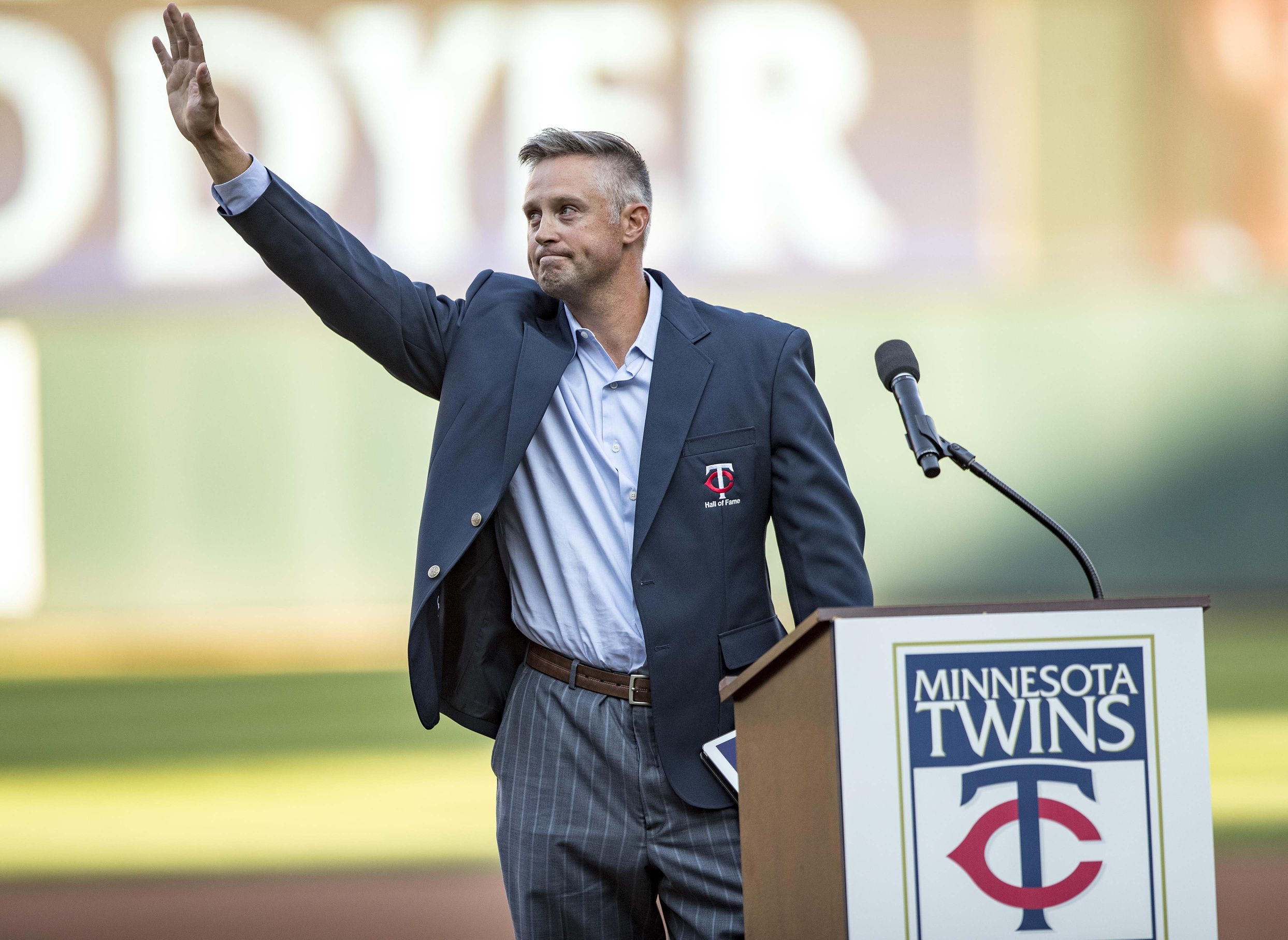 Cuddyer, who played in 1,139 games for Twins and was inducted into the team's Hall of Fame in 2017, is known for many things: His dimpled smile. His cannon arm. His magic tricks in the clubhouse. His slugging prowess. From my view, there are two specific elements of Cuddyer the player that are worth reflecting on for Twins fans at this moment in time. #1: Cuddyer is a poster child for the circuitous path to stardom As a high school shortstop in Chesapeake, VA, Cuddyer emerged as one of the top prep talents in the country. The Twins selected him ninth overall in 1997. He went straight to Single-A and raked, ascending the minor-league ranks rapidly and bypassing Triple-A entirely on his way to an MLB debut at age 22. From 1999 through 2003 he was a perennial Top 100 prospect according to Baseball America, peaking at #17 in his last year of eligibility. Cuddyer's initial ascent to the big leagues was as smooth as could be. His acclimation there was anything but. From 2001 through 2005, he yo-yoed back and forth between the majors and minors, continually crushing Triple-A but failing to establish himself at the highest level. Not until he was 27 did Cuddyer finally turn the corner, posting an .867 OPS in 2006 with 24 homers, 41 doubles and 109 RBIs in a career-high 150 games. He was a key component of a team that won 96 games. From there he went on to slash .281/.347/.468 and hit 165 home runs over the remainder of his career, making two All-Star teams. It's helpful to remember this path as we look at the various current Twins players who seem to be stuck in neutral (or worse). Byron Buxton and Miguel Sano, like Cuddyer, were both highly touted prospects that arrived in the majors at a young age but have failed to gain full traction. They're both 25 now. Max Kepler, who follows Cuddyer in Minnesota's right field lineage, may be a more apt parallel. Like Cuddyer, Kepler earned himself a September call-up at age 22 following a monster year at Double-A. And like Cuddyer, Kepler's MLB production stagnated in the years following: Michael Cuddyer, OPS+ 2002: 95 2003: 97 2004: 100 2005: 97 2006: 124 Max Kepler, OPS+ 2016: 96 2017: 95 2018: 96 2019: ? Granted, Kepler hasn't really had to fight for his playing time like Cuddyer did; he's been a regular ever since he arrived, despite the unspectacular offensive numbers. This is, in part, because of his elevated defensive value. But don't despair too much about the lack of offensive progression so far. Out of Cuddyer's 17 Wins Above Replacement accumulated in the big leagues, 15 came after he turned 26. Kepler turns 26 on February 10th. #2: Cuddyer was a model of defensive versatility When I think about Cuddyer playing the field, I picture him out in right, gathering a carom off the Metrodome's baggy and spinning around to rifle it toward the infield. It's easy to forget, now, that he moved all over the place. In his career, Cuddyer played at least 500 innings at five different positions (RF, LF, 1B, 3B, 2B). He wasn't great at all of them, but having the option to plug him in at so many spots was a major convenience for Ron Gardenhire. The current Twins will need to embrace this kind of flexibility, to the extent they can. Rostering a full-time DH like Nelson Cruz puts a further crunch on what'll likely be a short bench. Rocco Baldelli's life will be made easier if some players are able to help out at multiple positions, as Cuddy did. This is another possible connection to Kepler. I've suggested before that it'd be wise to get him up to speed at first base, given his past experience there. Eddie Rosario's brief but flashy appearance in the infield last year may have had substance (he did play second for a spell in the minors). Jonathan Schoop would be an even bigger asset if he could step in at third here and there to spell Sano. I'd like to hear about how Cuddyer kept his skills sharp enough that even at age 32, in his last season with the Twins (2011), he was able to make 41 starts at first base and 17 at second, in addition to his 77 games in right field. I also want to hear about how he dealt with the discouragement of setbacks and sideways progress over four years between reaching the majors and becoming a true bona fide big-leaguer. These insights are not only compelling to the longtime Twins fan in me who enjoys reminiscing upon the team's greatest era of my lifetime, but also for the forward-looking fan in me who sees similar scenarios playing out before my eyes. Fortunately, I'll have a chance to hear Cuddyer talk about these topics and more on January 26th at the Winter Meltdown, along with all of you who are able to attend. For those who aren't, the Q&A session will (hopefully) be available via John and Aaron's podcast. Feel free to share your favorite Cuddyer memories in the comments section – especially if you can connect them to any current Twins narrative.
 -
I understand this inclination, but I think it's outdated. Has that happened with this current front office? Last year they brought in Erick Aybar for a look but ended up cutting him, even with the Polanco suspension. In 2017 they brought in Ryan Vogelsong and Nick Tepesch, but picked a rookie Adalberto Mejia over both.
-
Then you give him the option to head to Triple-A, or opt-out and become a free agent again. These kinds of arrangements take place almost every spring. (IF you don't need him anyway because others aren't ready/healthy.) It's a game of musical chairs and someone like Tillman doesn't have a ton of leverage. Compared to other destinations, Minnesota is an attractive destination. No one has a firm grasp on the Twins' final rotation spot, and Pineda is penciled in despite throwing zero MLB innings last year.
-
Exactly. The Twins made a mistake by pivoting away from the reclamation project and going with the "buy (relatively) high" route instead. Had they just stuck with Sanchez they'd have ended up with a nice asset on their hands. But I'm not totally sure why that anomaly of a situation has any bearing on what we're talking about here. If, say, Chris Tillman comes into camp healthy, and Johnson or Hefner help him solve a few things, he could very well look like the best option for the fifth spot. This is a guy who had a 3.99 ERA in the AL East from 2014-16, and is only 30. So, in that event, you push Mejia and Romero to the bullpen and roll with him, or he fills the spot of someone else who gets hurt. I'm not seeing what's overly complex about this.
-
I don't understand the mindset that it's preferable to trade a player and guarantee a roster spot (+ $9M) for Gray rather than sign one of the players listed here to a non-guaranteed deal. If Gray has upside then so do a number of these guys. He's been terrible in two of the last three seasons while averaging 130 innings.
-
It's a fine Triple-A rotation. I just don't wanna be pigeonholed into having one of those guys in the season-opening rotation because I failed to install any legitimate veteran safety valves. To be clear: these deals are mostly just spring-training auditions. I suspect most of the players listed would opt-out if they don't make the team and that's fine. This happens in spring training pretty much every year. I don't see it as an issue. These players don't have guaranteed deals or roster spots so of course they're in it for themselves.
-
They're not blocking spots. That's the whole point! You don't have to remove anyone from the 40-man roster to add them, and you're not beholden to them in any way. The only way one of these guys beats out a Mejia is if they convince you they're clearly better options. I'm pro-Mejia. I want to see him in that fifth starter role. That's why I don't really want anyone on an MLB deal. But failing to equip yourself with feasible backup options is malpractice.
-
Personally I'd rather just go with Mejia than guarantee Perez a roster spot. He's not a clear enough upgrade to me. Despite the solid velo his K-rates have been terrible. 4.78 FIP over the past three seasons. If you're talking about adding him as a reliever that's another story (though not really germane to this particular thread). Exactly. There is value in experience, and having some track record of actual major-league success. Obviously none of the guys I listed are especially attractive right now (thus the "buy-low" concept) but there's more substantive reason to believe in them -- if healthy -- than someone like Littell or De Jong. If you don't think players like the ones in this article ever turn it around and get back on track, you're just not paying attention. Sanchez last year is as good an example as any.
-
He was a borderline choice for this list. His age (27) definitely makes him interesting. But I kinda expect him to get an MLB deal somewhere after finishing really strong last year.
