RpR
-
Posts
9,942 -
Joined
-
Last visited
Content Type
Profiles
News
Minnesota Twins Videos
2026 Minnesota Twins Top Prospects Ranking
2022 Minnesota Twins Draft Picks
Minnesota Twins Free Agent & Trade Rumors, Notes, & Tidbits
Guides & Resources
2023 Minnesota Twins Draft Picks
The Minnesota Twins Players Project
2024 Minnesota Twins Draft Picks
2025 Minnesota Twins Draft Pick Tracker
2026 Minnesota Twins Draft Tracker: Picks & Bonuses
Forums
Blogs
Events
Store
Downloads
Gallery
Everything posted by RpR
-
Royals (Cameron) vs Twins (Ober): 7/30/26, 12:40pm
RpR replied to Brock Beauchamp's topic in Archived Game Threads
Are they all trying to hit dingers , rather than simple little Texas league singles? The "hitting the ball hard" is more bull ****, when a simple soft single is worth more than a 100 mph out. -
Royals (Cameron) vs Twins (Ober): 7/30/26, 12:40pm
RpR replied to Brock Beauchamp's topic in Archived Game Threads
Not wanting to jinx him, but at 2nd base Lewis' does not seem to have the iron glove he has at First Base. -
Royals (Cameron) vs Twins (Ober): 7/30/26, 12:40pm
RpR replied to Brock Beauchamp's topic in Archived Game Threads
Kreidler plugged the gaping hole at Short Stop and has a batting average higher than Lewis, although that is not hard to do. -
Royals (Cameron) vs Twins (Ober): 7/30/26, 12:40pm
RpR replied to Brock Beauchamp's topic in Archived Game Threads
Who? -
Royals (Cameron) vs Twins (Ober): 7/30/26, 12:40pm
RpR replied to Brock Beauchamp's topic in Archived Game Threads
I believe they knew what he could have done as a catcher if he had not been injured; a courtesy not given to Tony Oliva. -
Royals (Cameron) vs Twins (Ober): 7/30/26, 12:40pm
RpR replied to Brock Beauchamp's topic in Archived Game Threads
The most disappointing/choking team in Minn. history. I was once a football fanatic, reality set in decades ago, partly caused by the Tarkenton hype verses reality of his talent, although the collapse of the 1969 season , starting with the last game of the season lost to Atlanta was an omen of the future. -
Royals (Cameron) vs Twins (Ober): 7/30/26, 12:40pm
RpR replied to Brock Beauchamp's topic in Archived Game Threads
The game is on TV here but I found other things to be more worth my time, and the fact I did not hear any crowd getting excited, I knew I missed nothing. -
Royals (Cameron) vs Twins (Ober): 7/30/26, 12:40pm
RpR replied to Brock Beauchamp's topic in Archived Game Threads
War, huh, yeah What is it good for? Absolutely nothing, uhh -
Royals (Cameron) vs Twins (Ober): 7/30/26, 12:40pm
RpR replied to Brock Beauchamp's topic in Archived Game Threads
Martin is either slow, or their catcher is really good. -
Royals (Cameron) vs Twins (Ober): 7/30/26, 12:40pm
RpR replied to Brock Beauchamp's topic in Archived Game Threads
Just found out the Twins game is already on TV. Lewis at 2nd base, Lord help them. -
Video: Royce Lewis's True Potential Is Sky-High
RpR replied to Cory Sparks's topic in Twins Daily Front Page News
Turning into vinegar? -
Royals (Dobnak) vs Twins (Ryan): 7/29/26, 6:40pm
RpR replied to Brock Beauchamp's topic in Archived Game Threads
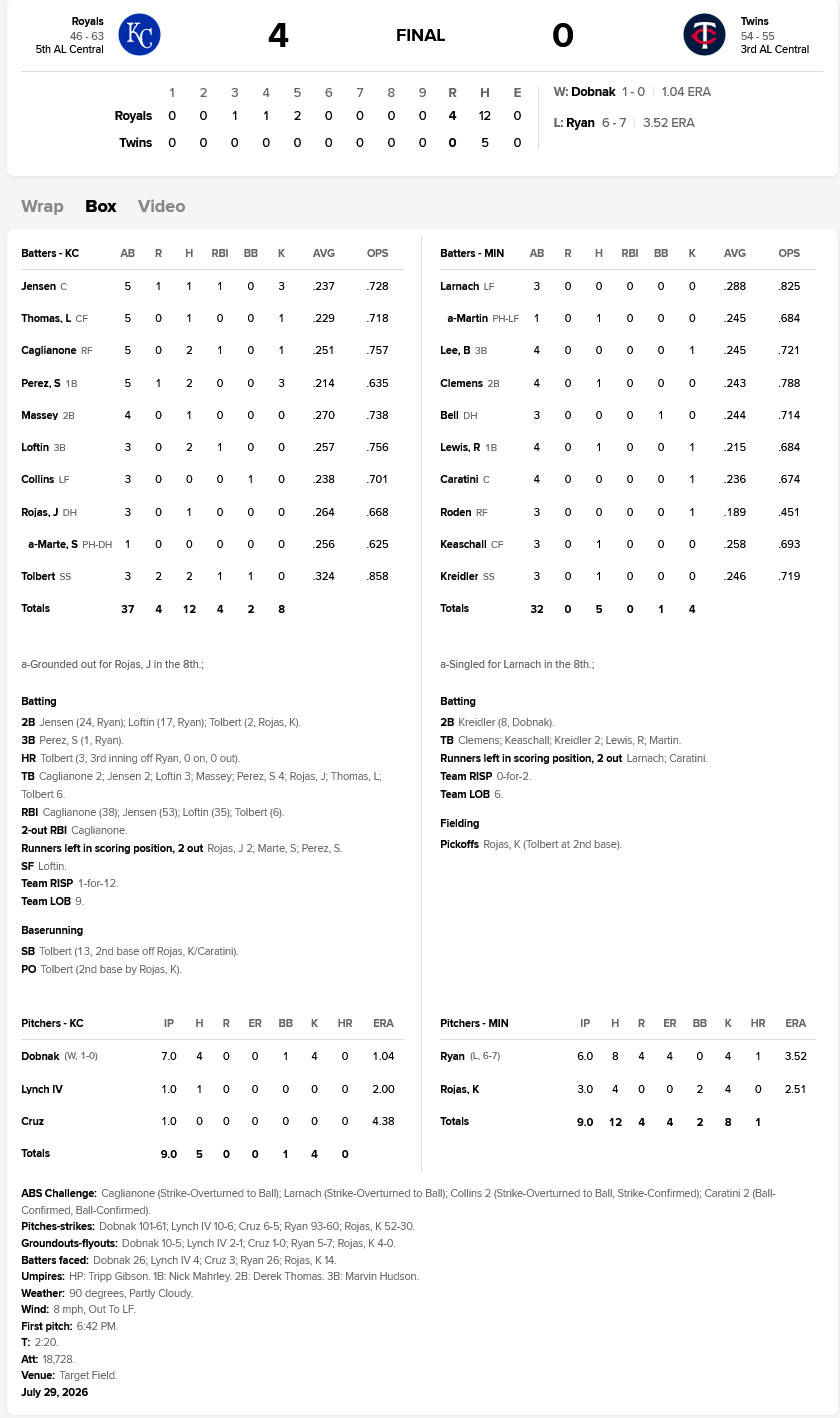
-
Royals (Dobnak) vs Twins (Ryan): 7/29/26, 6:40pm
RpR replied to Brock Beauchamp's topic in Archived Game Threads
Good for him to have daddy do that for him.. -
Royals (Dobnak) vs Twins (Ryan): 7/29/26, 6:40pm
RpR replied to Brock Beauchamp's topic in Archived Game Threads
""One thing to think about...America glorifies sports....." Some - sports, have become the new God to too many people, women included. -
Royals (Dobnak) vs Twins (Ryan): 7/29/26, 6:40pm
RpR replied to Brock Beauchamp's topic in Archived Game Threads
Booger juice. -
Royals (Dobnak) vs Twins (Ryan): 7/29/26, 6:40pm
RpR replied to Brock Beauchamp's topic in Archived Game Threads
Pay for quick food joints has been in the mid teens since the oughts in the Twin Cities area, mostly due though to, kids today do not want to do manual labor. -
Royals (Dobnak) vs Twins (Ryan): 7/29/26, 6:40pm
RpR replied to Brock Beauchamp's topic in Archived Game Threads
If the new set-up brings back Wally The Beerman, it is a good set-up, wait - it was the Twin Cities gestapo that killed jobs like his. -
Royals (Dobnak) vs Twins (Ryan): 7/29/26, 6:40pm
RpR replied to Brock Beauchamp's topic in Archived Game Threads
Such a baseball situation would be fascinating. A redo of the original Saints. -
Royals (Dobnak) vs Twins (Ryan): 7/29/26, 6:40pm
RpR replied to Brock Beauchamp's topic in Archived Game Threads
I said earlier bringing up Gray made no sense. -
Royals (Dobnak) vs Twins (Ryan): 7/29/26, 6:40pm
RpR replied to Brock Beauchamp's topic in Archived Game Threads
We know you are infatuated with the AAA boys, you don't need to keep telling us. -
Royals (Dobnak) vs Twins (Ryan): 7/29/26, 6:40pm
RpR replied to Brock Beauchamp's topic in Archived Game Threads
Culpepper doesn't do slumps. -
Royals (Dobnak) vs Twins (Ryan): 7/29/26, 6:40pm
RpR replied to Brock Beauchamp's topic in Archived Game Threads
Twins at bats were more impressive when they hit into 5 double plays. -
Royals (Dobnak) vs Twins (Ryan): 7/29/26, 6:40pm
RpR replied to Brock Beauchamp's topic in Archived Game Threads
Too many times, so far. -
Royals (Dobnak) vs Twins (Ryan): 7/29/26, 6:40pm
RpR replied to Brock Beauchamp's topic in Archived Game Threads
Lewis once again shows the old Lewis, still lives. -
Royals (Dobnak) vs Twins (Ryan): 7/29/26, 6:40pm
RpR replied to Brock Beauchamp's topic in Archived Game Threads
OH my, hmmm, then Clemens would have scooted over to third, maybe.