



ashbury
-
Posts
42,583 -
Joined
-
Last visited
-
Days Won
473
Content Type
Profiles
Minnesota Twins News, Rumors & Analysis
Minnesota Twins Videos
2026 Minnesota Twins Top Prospect Rankings
2022 Minnesota Twins Draft Picks & Signing Bonuses
Minnesota Twins Trade & Free Agent Rumors
Minnesota Twins Fan Guides & Resources
2023 Minnesota Twins Draft Picks & Signing Bonuses
The Minnesota Twins Players Project
2024 Minnesota Twins Draft Picks & Signing Bonuses
2025 Minnesota Twins Draft Picks & Signing Bonuses
2026 Minnesota Twins Draft Picks & Signing Bonuses
Forums
Blogs
Events
Store
Downloads
Gallery
Everything posted by ashbury
-
The 60-day IL doesn't necessarily get used when an injury is serious. Only if the team needs the use of that 40-man roster spot. When the 60 days are up, they then could have a roster decision to make, as to whom to DFA or whatever, in order to re-activate Garver, so I don't know if they make the move lightly, right now. Only if they want someone on the 25-man roster who isn't currently on the 40-man; that could well be a pitcher, but they also may prefer to leave room for Telis or other AAA catcher in case of a 10-day injury to someone, but not commit to that as yet.
- 47 replies
-
- 1
-

-
- byron buxton
- mitch garver
- (and 2 more)
-

Lew Ford Continues to Live His Baseball Dream
ashbury replied to Cody Christie's topic in Twins Daily Front Page News
You might hold some kind of site record for longest time between posts. Don't be a stranger. -
Game Thread: 5/15/19 Twins vs. Angels 12:10 CDT
ashbury replied to Diesel's topic in Archived Game Threads
Best Bar Band Name Evar! -
Yes and no. For me, it boils down to this: certain starters are almost guaranteed (usually by needing too many pitches to record outs) to be followed by a succession of relievers, quite probably three of them even in a win. Whether your relievers are lights-out or not, they will be in the game. Probably you have a pretty good idea from the outset as to who they will be, based on availability due to bullpen usage in prior games. What is the best deployment of those arms? You go into the game hoping for a win (otherwise why are we discussing this?) and the only inning you know for sure who will be the first three batters, is the first, and those are usually good batters. Assigning a good arm to that inning, and taking your chances with the rest of the innings, seems like a modest improvement over hoping to find a high-leverage use for that one guy. So I don't see it as "sparing" that guy. You're just changing his entry into the game. People are assuming too high a standard for the choice of opener. It need not be your very best arm. Suppose in a traditional strategy you've got a small lead and your #5 starter falters mid-game, already at about 90 pitches, and walks the #8 and #9 batters, with nobody out and the top of the order now coming up, and you decide to bring in a reliever. It's too soon for your closer, or even your #1 setup guy. Who would you pick, subject to availability, as the guy with the best chance to put out this fire? That's the guy you probably want as the opener. (If you're a revolutionary thinker and would bring in your setup guy or closer so early, I'm fine with that logic too. And if your bullpen is so bad that you might leave the faltering starter in, then ugh, yeah, maybe you shouldn't try the opener strategy, but as manager you also should probably rent and not buy a house.) Of course no plan of battle survives first contact with the enemy. You have to have a Plan B for this, just like you have a Plan B for a traditional arrangement.
-
Thanks for being that guy, so I didn't have to. I bite my tongue pretty much every time I see it.
- 43 replies
-
- 3
-
-
- royce lewis
- edwar colina
- (and 3 more)
-
Game Thread: Twins vs. Angels 5/14/19, 6:40pm CST
ashbury replied to twinssporto's topic in Archived Game Threads
"Sometimes the free agents beer drinkers just won't take your money beer."- 249 replies
-
- 4
-
-
- game thread
- twins
- (and 1 more)
-
Game Thread: Twins vs. Angels 5/14/19, 6:40pm CST
ashbury replied to twinssporto's topic in Archived Game Threads
Chicken dinner, courtesy of our guests from SoCal.- 249 replies
-
- 4
-
-
- game thread
- twins
- (and 1 more)
-
Game Thread: Twins vs. Angels 5/14/19, 6:40pm CST
ashbury replied to twinssporto's topic in Archived Game Threads
Nice to see Schoop on the spot for that grounder. He's so smooth. -
Game Thread: Twins vs. Angels 5/14/19, 6:40pm CST
ashbury replied to twinssporto's topic in Archived Game Threads
Safe for them. Maybe not for you. Wish I was near enough to take you up on the offer.- 249 replies
-
- 2
-
-
- game thread
- twins
- (and 1 more)
-
LAA 5, MIN 4: More Missed Opportunities
ashbury replied to Andrew Gebo's topic in Twins Daily Front Page News
Yes. This is key. (The other points you raised are also valid.) In the early part of the game, you don't really have much idea how many runs you need. So don't do things that reduce the average number of runs. Late in the game when it's close, you have a better idea of the value of one solitary run. Then you do things that increase the chance of scoring anything at all. Unless I missed something, the tables in the linked article were for average numbers of runs. "We’ll touch on run expectancy and bunting today, and cover probability another day." Someone needs to go find that other article. -
Twins Minor League Report (5/13): Baller-Zovic
ashbury replied to Steve Lein's topic in Twins Daily Front Page News
Is there a corresponding move, or will they keep three catchers at AA? -
My thinking is that this news based on the headline can only go well:
-
Twins Minor League Report (5/13): Baller-Zovic
ashbury replied to Steve Lein's topic in Twins Daily Front Page News
Releasing him, letting him sign as a minor-league free-agent with whomever he pleased, would also have accomplished this. Do the Dodgers still need cash? -
And if you don't like him in the Arby's ads, you may really hate him in this. Apparently this is what Arby's thought they were getting. Or, more to the point, they thought viewers would know all about him and attach his "edgy" style of humor to them and buy more meats. https://www.youtube.com/watch?v=JuKJkghC2u0
-
(H. Jon Benjamin is the voice for Archer and also the Bob's Burgers guy. This latest is perhaps not the wisest career move.)
-
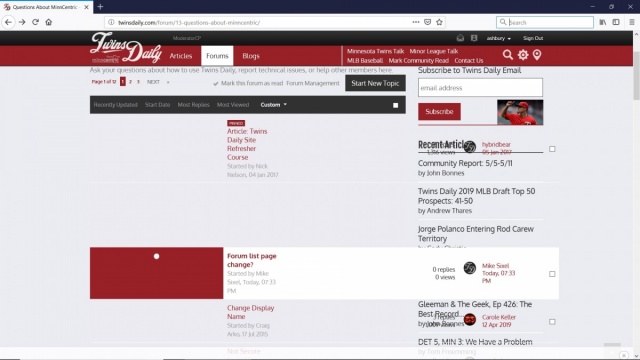
Forum list page change and more ads?
ashbury replied to Mike Sixel's topic in Twins Daily Issues & Suggestions
I took it to mean you saw roughly the same layout, and were saving bandwidth by not replying. Then you replied. Then I replied. -
Forum list page change and more ads?
ashbury replied to Mike Sixel's topic in Twins Daily Issues & Suggestions
-
Forum list page change and more ads?
ashbury replied to Mike Sixel's topic in Twins Daily Issues & Suggestions
Same experience here, both in Firefox and Edge on my Windows 10 laptop. Likewise on my Android phone when I switch to Full Version. -
https://www.baseball-reference.com/players/gl.fcgi?id=adriaeh01&t=b&year=2019 They are 13-10 in games in which he appeared. But among those, he is 6-2 when he entered the game after the first inning. That leaves 7-8 as a starter.
-
Schoop sits 2 in a row, Adrianza starts 4 in a row
ashbury replied to psturnbloom's topic in Minnesota Twins Talk
I doubt Adrianza has significant trade value; some low-A lottery ticket at best, if our FO can locate two teams who would make a waiver claim. But I likewise see the additional playing time in light of the coming roster decision. My interpretation is they intend to DFA/trade Adrianza and want to do it with the best information they can glean as to his in-game performance. Due diligence, IOW. And to his credit, Ehire has come through in these past three days, at least with decent stats, even though my memory is of him leaving guys on base. -
Week in Review: Firing On All Cylinders
ashbury replied to Nick Nelson's topic in Twins Daily Front Page News
Presumably trapezius, a muscle in the upper back. -
Looks like Victor Hugo's adage needs to be updated to reflect current longevity charts: 60 is the youth of old age, while 40 is still the old age of youth.
- 34 replies
-
- 2
-
-
- byron buxton
- zack granite
- (and 1 more)
-
Week in Review: Firing On All Cylinders
ashbury replied to Nick Nelson's topic in Twins Daily Front Page News
Not to mention that most pitchers are constantly tinkering, so that by now Gardy's/Andy's direct knowledge amounts to "I think he still drops down." -
Game Thread: Tigers @ Twins, 5/12 @ 1:10pm CT
ashbury replied to Squirrel's topic in Archived Game Threads
Yes, concur, and ditto. -
Maybe RandBall's Stu wants to take a crack at writing a game wrap-up. "The Red Wings' game today wound up with a score of 6-4. Several of their players had plate appearances, and quite a few pitchers tried their luck. Read on, to not find out whether they won and who their opponent was."
- 14 replies
-
- 5
-
-
- miguel sano
- john andreoli
- (and 3 more)
