



arby58
-
Posts
1,723 -
Joined
-
Last visited
-
Days Won
8
Content Type
Profiles
News
Minnesota Twins Videos
2026 Minnesota Twins Top Prospects Ranking
2022 Minnesota Twins Draft Picks
Minnesota Twins Free Agent & Trade Rumors, Notes, & Tidbits
Guides & Resources
2023 Minnesota Twins Draft Picks
The Minnesota Twins Players Project
2024 Minnesota Twins Draft Picks
2025 Minnesota Twins Draft Pick Tracker
2026 Minnesota Twins Draft Tracker: Picks & Bonuses
Forums
Blogs
Events
Store
Downloads
Gallery
Everything posted by arby58
-
Projecting the Twins’ 2025 Opening Day Roster, v. 3.0
arby58 replied to Cody Christie's topic in Twins Daily Front Page News
Cole Sands has pitched in TWO spring training games, 1 2/3rds innings, given up 3 runs. Last year, in the regular season, he appeared in 62 games, 71 1/3 innings pitched, 85 Ks, 3.28 ERA and a WHIP of 0.995. I would bet the house that Sands is on the 26 man roster and is pitching in medium to high leverage situations.- 58 replies
-
- 3
-

-
- brooks lee
- austin martin
- (and 5 more)
-
Projecting the Twins’ 2025 Opening Day Roster, v. 3.0
arby58 replied to Cody Christie's topic in Twins Daily Front Page News
I understand that, but they can be placed on IL - they do not have to stay on the 26 man roster the entire season.- 58 replies
-
- 1
-
-
- brooks lee
- austin martin
- (and 5 more)
-
Projecting the Twins’ 2025 Opening Day Roster, v. 3.0
arby58 replied to Cody Christie's topic in Twins Daily Front Page News
Sands was one of their better relief pitchers last year, particularly in the second half. There is no comparison between Tonkin and Sands.- 58 replies
-
- 15
-
-
- brooks lee
- austin martin
- (and 5 more)
-
Projecting the Twins’ 2025 Opening Day Roster, v. 3.0
arby58 replied to Cody Christie's topic in Twins Daily Front Page News
He can be put on the injured list.- 58 replies
-
- 1
-

-
- brooks lee
- austin martin
- (and 5 more)
-
Projecting the Twins’ 2025 Opening Day Roster, v. 3.0
arby58 replied to Cody Christie's topic in Twins Daily Front Page News
So far, the Yankees are giving Headrick a look. 3 appearances, 5 2/3 innings. He's struck out 10 batters (wow) but also walked 3. As a result, his WHIP is nothing to write home about (1.59). Only 2 earned runs for a 3.18 ERA. It will be interesting to see how he performs the rest of the spring. I'd probably also rather have him with the Twins than Tonkin.- 58 replies
-
- 5
-
-

-
- brooks lee
- austin martin
- (and 5 more)
-
Projecting the Twins’ 2025 Opening Day Roster, v. 3.0
arby58 replied to Cody Christie's topic in Twins Daily Front Page News
I've yet to be convinced that Tonkin is worthy of a 40 man roster spot - let alone 26. He hasn't exactly been stellar in his 3 relief appearances so far in spring training. The claim that he is a 'rubber arm' isn't compelling, especially early in the season. Meanwhile, if they really like the looks of Castellano, as a 23 year old he has a lot more promise than a 35 year old reliever who was released by three separate teams last year (including the Twins). Castellano was a starting pitcher in the minors, on the rare occasion when they will need 3 innings out of the bullpen, he should be able to deliver it.- 58 replies
-
- 13
-
-
-
- brooks lee
- austin martin
- (and 5 more)
-
Topa being down hardly changes that. The headliners are Duran, Jax, Sands, Coulombe, Alcala, Stewart. Topa and Tonkin are next in line (and I'd rather have Varland than Tonkin).
- 62 replies
-
- 5
-
-
- justin topa
- matt canterino
- (and 2 more)
-
He's got to be seeking a raise, and he made $11.5 million last year. He's 40 years old - seems like a lot to pay when the Twins have a pretty good front end of the bullpen already.
- 62 replies
-
- 6
-
-
- justin topa
- matt canterino
- (and 2 more)
-
The prize for 'the most laconic exchange' is awarded to tony&rodney and USAFCHIEF. Congrats to you both!
-
In 2023, in 9 relief appearances (including 2 in the post-season) he had a 1.50 ERA and struck out 18 batters in 12 2/3 innings. That's nearly 1 1/2 batters an inning. You don't do that without having swing and miss stuff.
-
When I was a kid, audiophiles would talk about 'dynamic headroom' - the ability of speakers to burst out sound without distortion. To me, the baseball equivalent is that Jax and Duran have that, and Varland has the potential - Tonkin does not.
-
I think you just throw last year's stats away with Varland - the disastrous start to the season messed him up. If you go back to 2023, down the stretch (in games that mattered, including two play-off appearances), he was electric as a relief pitcher. In 7 appearances during the regular season, it was 12 innings pitched, 1.50 ERA, 17 Ks and 1 walk - for a WHIP of 0.583. Then two relief appearances in the play-offs (each 1/3 of an inning) no runs allowed and an additional K. That's a might nice stat line. Agreed, small sample size, but it gives you an idea that he isn't just a 'number eight' arm in the bullpen. I would be shocked if you can find a stretch like that for Tonkin, when games really mattered. He's just another arm, where Varland, in the right role, just might be special.
-
Royce Lewis and One Last Chance to Stick at Third Base
arby58 replied to Cody Christie's topic in Twins Daily Front Page News
He certainly could end up at 1B, as plenty of 3Bers have done in the past (paging Harmon Killebrew and Miguel Sano). He's tall enough to have a pretty good reach, you'd prefer he was left handed, but nobody's perfect. I'm still not completely sold on Lee, and maybe (between he and Keaschal) he is the less athletic and ends up at 2B. The other issue (not this year, but maybe in 2-3 years) is Correa will probably be moved off SS, and there again, 3B is where a lot of shortstops go in their later years. -
He was cut and picked up - and cut again - by three teams last year. Sure, somebody will pick him up, but that doesn't mean it's much of a loss when they do. If you really liked him, wait around, you can probably pick him up again.
-
In 7 MLB seasons, Tonkin has pitched 3 innings 6 times, only one of which was last year. Last year, until their starting pitching went off the rails in early August, through the first 111 games, they had a 'true' relief pitcher pitch 3 innings only once (Matt Bowman went 3 innings in a mop up role on April 15th). There was one case where Okert 'started' and went 1/3 of an inning, then Festa followed with 4 1/3 innings and one case where Paddock went 2 1/3 innings then Varland went 4 1/3, but otherwise just that 1 out of 111 games. You're keeping Tonkin around for that? Besides, it's not as if the Twins don't have relief pitchers who can go more than 1 inning. Through those first 111 games (I stopped counting after that) , Cole Sands did it 10 times, including 2 and 1/3 and 2 and 2/3rds appearances. Funderburk did it 7 times, Alcala 5 times - and, yes, Tonkin once. Even Duran did it. Keep a 'real' arm in the bullpen, not somebody you need to trot out for mop up duty once in a blue moon (even Dobnak did that last year).
-
Yep - Cubs.
-
Pretty much in agreement on most - definitely on Tonkin. He was released by three MLB teams last year, he's not an arm you should lose any sleep over losing.
-
Yeah, besides Rooker, Liam Hendricks is another player who was given ample opportunity (by multiple teams) and then suddenly became a very good relief pitcher.
-
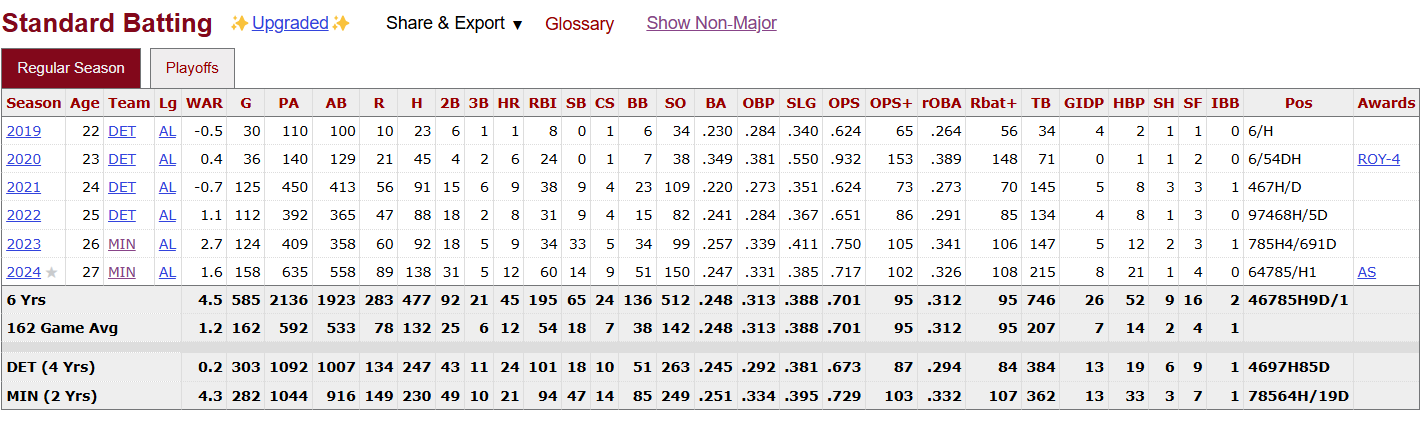
Not sure where you are getting the BA numbers from - Baseball Reference disagrees. Besides, BA is a poor statistic for overall value. Look at his WAR - barely above zero in his years with the Tigers (there is a reason they released him), and much better with the Twins.
-
These sort of run the gamut of the types of players an organization can try to 'fix.' Gray was coming off probably his worst season, and his ERA dropped over a full run per game with the Twins - just a coincidence? Ryan was pretty much a one-pitch pitcher who hadn't been able to break out of the minors - that is not the pitcher he is now. Yes, Stewart was/is injury prone, but he was a reclamation project. If the Dodgers could see what he became in 2023, you really think they would have released him? 'Just needed a place to play' for Castro - he got as many or more plate appearances his last two years in Detroit as his first year in Minnesota. I guess they were all just luck.
-
There is no personal trainer that is going to be able to conclusively prevent ankle sprains.
-
Injuries don't only impact the Twins - they were not even close to the MLB team that lost the most games to injury last year (11th, according to Spotrack, 13th the year before, and 12th the year before that). When we're talking stuff like sprained ankles, I think we should all relax. That said, Emma is the one that is most concerning, given his history.
- 17 replies
-
- 5
-
-
- walker jenkins
- emmanuel rodriguez
- (and 1 more)
-
The pen is the place for him - and I'd much rather have him there than Tonkin. He's had more than ample opportunity to make it as a starter. Let him unleash that curve (and add a bit extra to the fast ball) one inning at a time.
-
I appreciated your 'he can't hit them' comment - a true first LOL of the day. Taking Rodriguez and Jenkins out of the discussion because we have no way of knowing how the Twins would use them, but one of the differentiators for a player besides offense is defense. None of the remainder of the group you mentioned (Wallner, Julien, Larnach) is a particularly good defensive player, and Julien's defensive runs saved at 2B is well below average. Even when Buxton isn't hitting, you want him in the lineup for his defensive play and disrupting speed on the bases. It's possible either Rodriguez or Jenkins will also provide that differentiation. Also, none of the three were ever a top 10 prospect in all of minor league baseball, ala Jenkins. He might end up being a Kyle Tucker type of player who plays every day regardless of who is pitching. My prediction is that if he is putting up Tucker-like numbers, he'll play everyday.
