


Twins Video
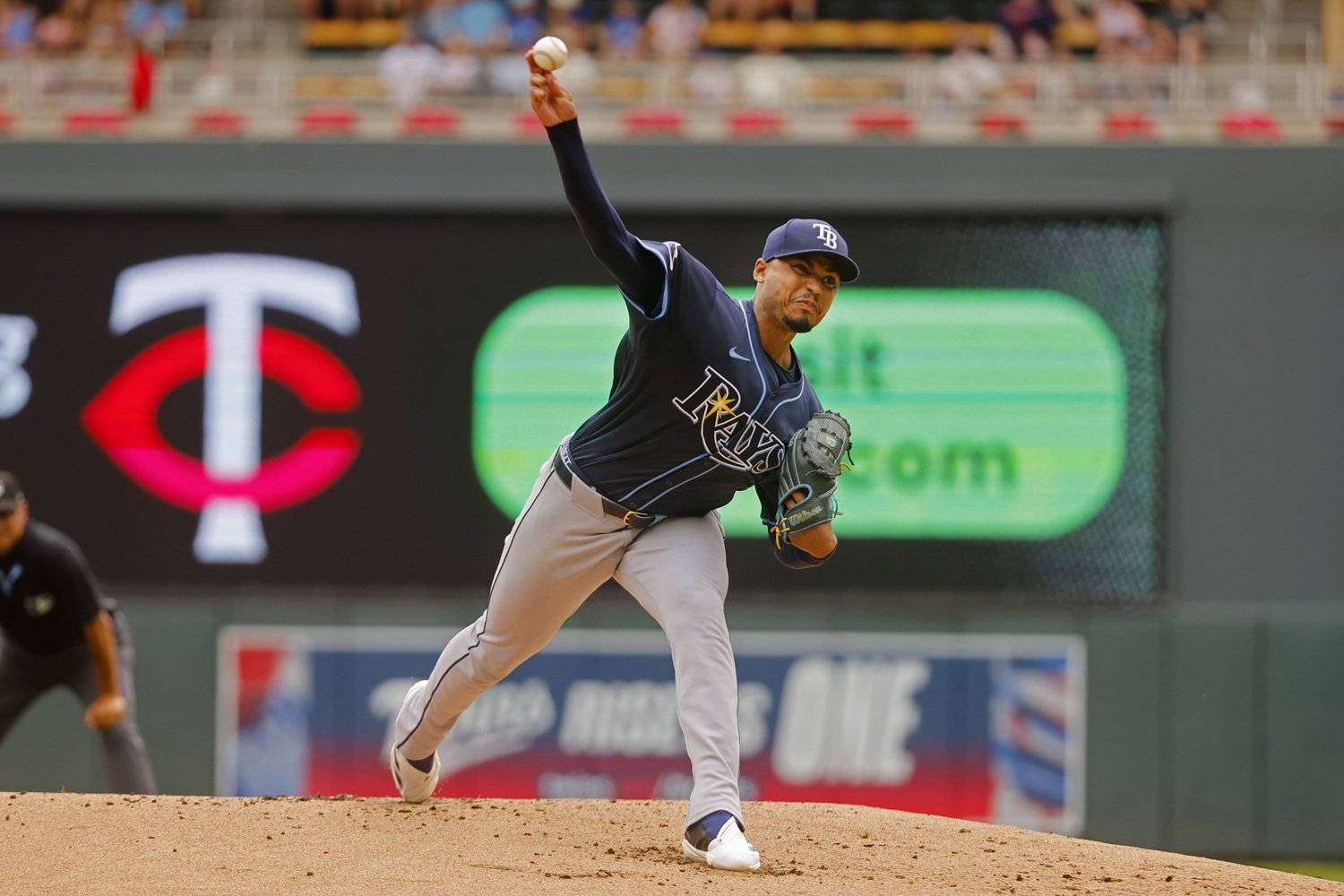
Taj Bradley’s big-league career has been a tale of two pitchers. At times, the 24-year-old right-hander has looked like a future frontline starter, armed with swing-and-miss stuff that leaves hitters baffled. At other times, he has struggled to find efficiency, leaning too heavily on certain pitches and failing to work consistently deep into games.
Tampa Bay Roots: A Strikeout Arm
When Bradley first broke in with Tampa Bay, his electric fastball and devastating splitter turned heads across baseball. In parts of two seasons with the Rays (2023-24), he struck out over 27 percent of the batters he faced, an impressive figure for a young arm still learning the league.
Across 240 innings, Bradley posted a 4.75 ERA (86 ERA+) with a 1.29 WHIP. The numbers reflected both his upside and his growing pains. He averaged only five innings per start, showing swing-and-miss ability but not yet the polish to work through lineups multiple times consistently.
His best weapon was the splitter. In 2024, the pitch produced a 33.0 Whiff% while holding opponents to a .280 expected slugging percentage. By itself, that offering looked like the foundation for a long-term role in the rotation. Bradley struck out 154 batters in just 138 innings, a sign of how dangerous his arsenal could be when locked in.
A Shift in Approach
But the Rays, always tinkering with pitching models, tried to steer Bradley in a different direction this season. Instead of chasing whiffs, they emphasized ground balls. His cutter became more prominent, and his curveball usage jumped by over five percent.
The trade-off was clear. Bradley’s splitter, once his most reliable out-pitch, lost its bite. His strikeout rate with the splitter plummeted from 37.1 percent last season to just 21.1 percent this year, and its Run Value fell from plus-four to zero. For a pitcher whose identity was built on missing bats, the adjustment came with growing pains.
“It’s one of the harder pitches to learn,” Bradley said. “A lot of guys struggle with it. I can get the feel for it if I remain athletic and don’t think too much about it. Every other pitch, it feels like wrist position is going to fix everything. But this is a release point kind of thing, finger on the ball, pressure. I’m learning what pronating and supinating is. Figuring out what you do best and putting it all in one pitch. It’s a lot to think about, but if I can keep athletic, I think I’ll be good at it.”
Searching in St. Paul
That loss of feel is a big reason the Twins have kept Bradley at Triple-A St. Paul. Instead of being forced to learn on the fly against the league’s best hitters, the organization wants him to rediscover the splitter in a lower-pressure environment.
“It’s still not quite where it was last year or the year before,” Twins pitching development director Tommy Bergjans said. “He’s still going to have to make another comparable jump to what he’s done the past few weeks. … It’s specifically trying to get the shape and some of the underlying movement quality back to what it was in ’24 and ’23.”
For now, Bradley’s two identities remain in tension with the strikeout-heavy arm that looks like a rotation anchor, and the contact-focused experiment still searching for balance. The Twins are betting they can help him thread the needle, blending efficiency with swing-and-miss stuff.
If he can rediscover the splitter and pair it with his cutter-heavy approach, Bradley has the tools to finally bridge the gap between flashes of brilliance and consistent performance. The question is whether the Twins can help unlock the correct version of Bradley and whether he can keep it unlocked.
What It Means for the Twins' Rotation
Minnesota’s starting staff already features long-term anchors in Pablo López and Joe Ryan, with Bailey Ober and Simeon Woods Richardson carving out important roles. But the organization still lacks depth behind that core, especially as injuries and workload management continue to test the rotation. There are also questions swirling about whether or not the Twins will look to trade arms like López and Ryan this winter.
Bradley represents a potential difference-maker. If he regains the strikeout version of himself, he could be a mid-rotation weapon with top-of-the-rotation upside. If the adjustments stall, his profile will resemble that of a depth starter who struggles to cover innings consistently.
The Twins don’t need him to be an ace right away. They need him to become a reliable option who can slot into the middle of the rotation and take pressure off younger arms. In the long run, his development could be one of the key factors that determine whether the Twins are merely competitive in the AL Central or build a staff capable of carrying them deep into October.
Are you a Bradley believer? How can he reach his ceiling? Leave a comment and start the discussion.
Do you approve of Twins ownership?

Follow Twins Daily For Minnesota Twins News & Analysis



- Patzky, thelanges5, DannySD and 3 others
-
 6
6


Recommended Comments
Create an account or sign in to comment
You need to be a member in order to leave a comment
Create an account
Sign up for a new account in our community. It's easy!
Register a new accountSign in
Already have an account? Sign in here.
Sign In Now