


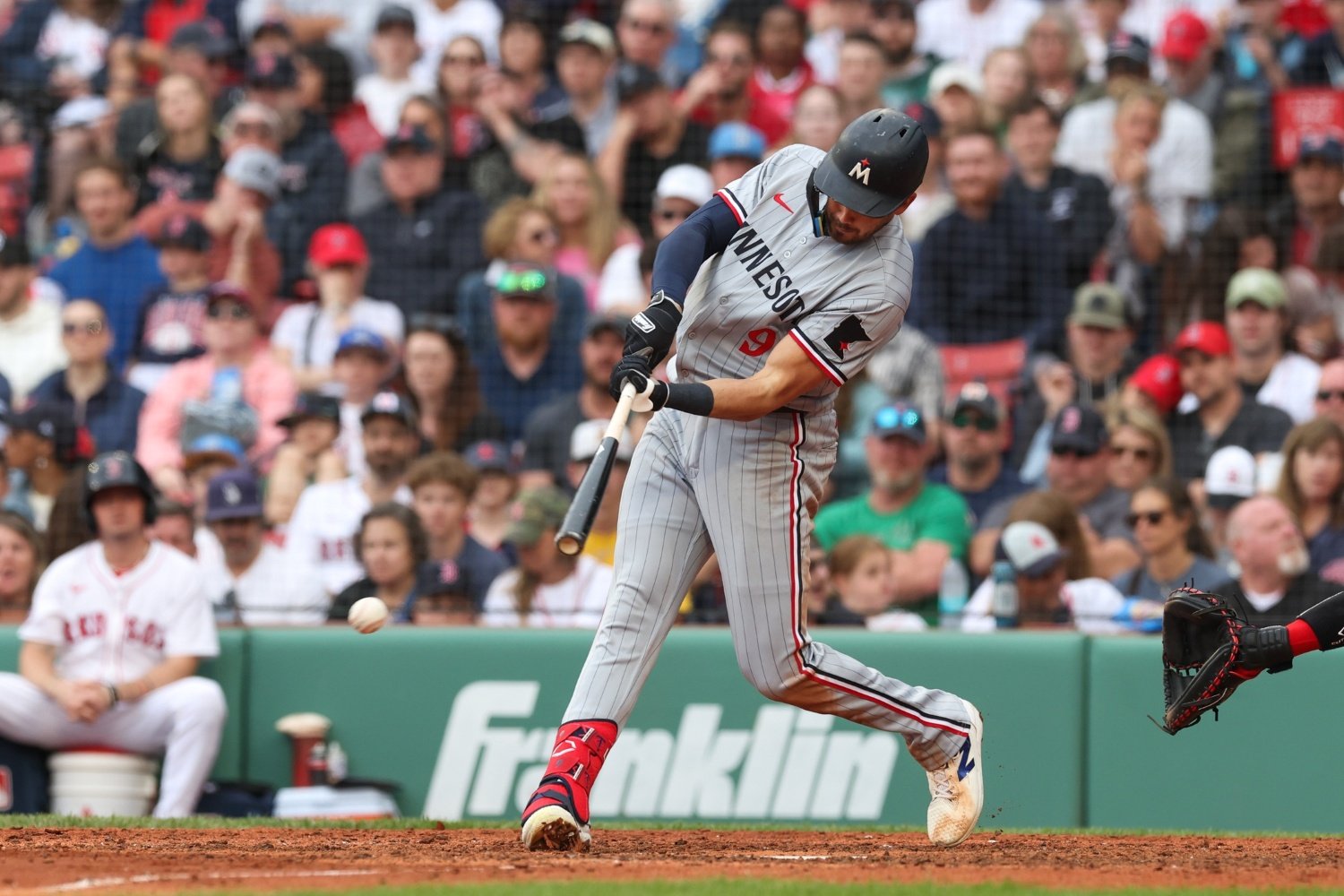
Twins Video
The simplest and most effective hitter's credo goes: swing at strikes, lay off balls. It's the surest way to find success at any level of baseball, and nowhere is it invalid. It just becomes less helpful with each rung of the ladder of competition one climbs, because by the time you reach the majors, pitchers have good enough stuff and command to both bully you within the zone (even when you swing with gusto there) and lure you into bad swings beyond it. The task of every player, team, and coaching staff is to fight back against the pressure applied by such sensational pitching.
You have to find ways to win within and around the zone. About 70% of pitches thrown in the majors are either squarely within the zone or close enough to the edges of it to force a difficult swing decision, even for a polished hitter. Statcast bins such pitches under the headers "Heart," which is what it sounds like, and "Shadow," which is a rectangular frame around the Heart zone that shadows the invisible edges of the rulebook strike zone. Beyond those lie "Chase," a frame around the Shadow area that identifies places pitchers might intentionally throw the ball to induce a swing but in which a hitter is unlikely to produce anything good. Finally, there is the "Waste" zone, a space so far beyond the hittable pitch territory that no one should ever swing there—and hardly anyone ever does.
Because Baseball Savant presents those four categories for pitch locations, one might be tempted to treat all four zones as equally important. We often face a similar impulse with in-zone and out-of-zone pitches: to treat that binary as real and the two subsets it creates as equally worthy of our attention. Neither is a good instinct, though, of course. In the case of Heart, Shadow, Chase, and Waste, there are two reasons why the first two categories matter far, far more than the latter two:
- The aforementioned fact that many more pitches are thrown within them than in Chase and Waste. It's more than 2-to-1; and
- There's little elasticity in what happens in the Waste zone, from player to player or team to team, based on talent. You just have to not swing at those pitches, and mostly, hitters don't. All takes, at least in that area, have the same value. Aaron Judge isn't deriving more value from spitting on a slider in the dirt than Brooks Lee is, unless Judge does so more consistently and Lee occasionally goes fishing. On the other hand, when a ball is right in the heart of the zone, there's likely to be little difference in the quality of Judge's and Lee's swing decisions—but a big difference in the value of the swings they put on those pitches.
When evaluating a team or a player at a glance, then, it's a pretty good idea to exclude at least the Waste category from your examination. You can winnow down to true talent (and good overall process, since the latter should lead to a more robust tapping of the former) even better by cutting out Chase pitches, too. Let's do that, for all teams in each of the last two full seasons and the early going of this one, to see where the Twins stand.

Firstly, you'll notice that even the very best team in this sample (the 2023 team from unincorporated territory in Cobb County, Ga.) has a negative run value on those pitches. That's not surprising, when you think about, right? At their core, the pitches we're studying here are basically strikes. An exceptionally well-calibrated, patient approach can earn a team meaningful value from pitches taken for balls just off one corner or another, but these are mostly strikes, so the Run Value metric we're using is measuring mostly the ability to actually hit the ball and do damage. It's baking in some plate discipline, but that plays a small role here.
The 2023 Twins were one of the best teams in the league at fighting back when pitchers came into the zone. They weren't quite the 2019 Bomba Squad (no team in any uniform has topped them in this metric since that season), but they could rake, and specifically, they made pitchers pay for trying to live over the plate. Last year, there was still some of that danger to them, but they faded to 13th in the majors. It wasn't an outright disaster, but the team did treat it a bit like one, firing hitting coaches and changing out their preparation paradigm for hitters.
That hasn't worked, at all. The 2025 team is getting beaten in and around the zone, with a prorated Run Value that ranks 21st in baseball on those offerings. You can be a tolerable offense with that kind of ranking, but even that isn't easy. Most of the time, below-average teams in the Heart and Shadow zones are bad overall lineups.
But, are the Twins making up ground by being more disciplined on the truly unworthy pitches, well beyond the bounds of the strike zone? Here's the equivalent chart for all teams since the start of 2023, in the Chase and Waste spaces.

Uh, nope. As you can see, this chart is basically a mirror of the other, not with regard to the order and identity of the teams, but with regard to shape and scale. This Run Value statistic is anchored to average production, so for every run destroyed, one must be created. When pitchers work far outside the zone, they tend to issue walks—or fall behind, and end up needing to come back to the middle of the plate. Either way, it's bad for the pitchers, so the runs prevented within and around the zone are allowed on the truly errant offerings.
For batters, that means what the headline of the chart says: Just don't swing, baby. There are, of course, players who hit bad balls better than others, and that can make up for some otherwise lousy swing decisions, but by and large, the teams who chase most will rank lowest here.
The Twins are, in a sense, an interesting counterpoint. They were 23rd in 2023, when their offense was humming, and 14th in 2024, when things went sour. They're back to 23rd this year, but the problem isn't solely that they expand the zone too much. They do, given their skill sets, but that's not the whole story here. The Twins have built a lineup that strongly tends toward grooved swings. Their guys are wired to hammer mistakes, rather than to fight off or flare pitches outside the zone to the opposite field. The Twins might chase less than some of the teams ahead of them, especially this year, but they also produce less when they do chase than most of their rivals do. It's a double-whammy.
A functioning Carlos Correa would solve a few of these problems. A healthy Royce Lewis should address them, too. Lewis and Matt Wallner are (other than Byron Buxton, perhaps) the players the team most counts on to make it hurt whenever a pitcher tries to sneak a strike by. Right now, though, the pivot to Matt Borgschulte doesn't seem to be paying any new dividends. In the places where they most need to be good (and usually have been, even in tough times), the Twins are just getting dominated at the plate.







Recommended Comments
Create an account or sign in to comment
You need to be a member in order to leave a comment
Create an account
Sign up for a new account in our community. It's easy!
Register a new accountSign in
Already have an account? Sign in here.
Sign In Now