Jump to content
Twins Daily
  • Create Account
  • Twins News & Analysis

    On The Twins' Cheapness And Showing Your Work


    William Parker

    I want to talk about the Twins and payroll, and how we talk about the Twins’ payroll.

    It’s been about a month since Jack Moore wrote the excellent and scathing The Minnesota Small-Market Con over at Baseball Prospectus Milwaukee. The points it makes are numerous and wide-ranging -- the most important, I think, is “if the billionaire Pohlads had been willing to take a short-term loss, they could have made their way out of the Metrodome years earlier without taking the public for such a ride" -- but being published as it was in the latter part of an offseason in which fans have watched the team take very few substantial visible steps toward getting better, most seemed to take it as a chance to complain about the team's unwillingness in recent years to spend on free agents.

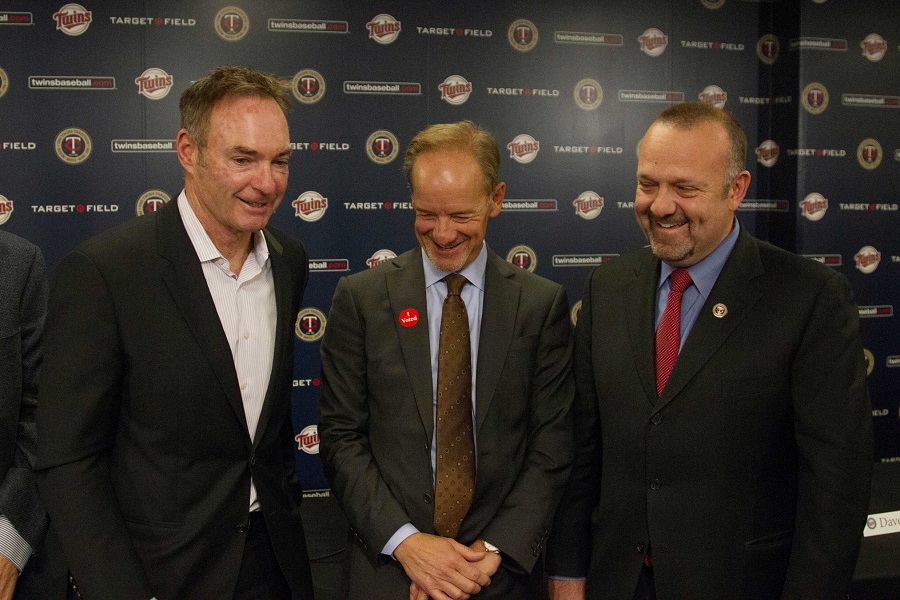
    Image courtesy of Brad Rempel, USA Today

    Twins Video

    And I get it. Having taken the public for said ride and secured a stadium that is maybe the most appealing in baseball, the Twins (per Cot’s Contracts) ended their first two seasons in Target Field with top-ten payrolls, but then fell back to 13th in 2012, and haven’t been out of the 20s since. While attendance predictably declined from 2011 to 2015, it seems a safe bet that they could generally have spent more money than they did in those years and still turned a nice profit.

    The problem I’ve always had, though, is that this (at the most) is generally where the fan’s analysis stops. They could have spent more money, but they didn’t, and they should have. The obvious next questions that gets left on the table, though, are “on what?” and “why?”: what could that money have gotten them, and what makes it a good idea? The 2011 Twins had a $115 million payroll and were coming off a 94-win, first-place year, but with injuries to almost literally everyone -- only Danny Valencia and Michael Cuddyer would play as many as 120 games for the Twins in 2011 -- they lost 99, finishing a whopping 28 games out of a wildcard spot, and it was pretty clear their window had slammed shut. They lost 96 in both 2012 and 2013 (22 and 26 games out of the playoffs, respectively), and 92 (18 out) in 2014. Their season-ending payroll declined, meanwhile, from 9th in 2011, to 13th, to 24th.

    But, again, what could and should they have spent more money on, and what could we have expected it to bring them? In a league in which the very best player might be worth about nine wins and four is a typical All-Star, the Twins would’ve had to add the equivalent of four or five All-Stars, two Mike Trouts, or some combination thereof (assuming each of them takes the place of true replacement-level players, to boot) in order to have had any chance at a postseason berth in any of those years. That’s not the kind of thing that’s ever happened via free agency--teams have tried, typically with disastrous consequences (check out the turn-of-the-century Devil Rays sometime).

    But what if the postseason isn’t the goal? What about just putting a marginally more entertaining product on the field? I question whether that’s a thing, personally--it’s the competing that draws the crowds, the Timberwolves are as entertaining as a bad basketball team can get right now and not drawing substantially more than their terribly depressing squads of the last couple years did--but I get that, too. It’s not as though a team puts those savings in an interest-bearing account and adds them to the pot for next year. They would, in a perfect world, but they don’t; those savings go to the owners, and the next year’s budget is its own thing. So to the extent you’re concerned only about this season, yes, you as a fan should want the team to spend as much money as they can possibly get away with, because that money’s gone for your purposes after the season either way.

    The problem with that is that the one-year deal for a good (or even just “entertaining”) player exists in baseball only when that player comes with huge risks. Most free agents worth signing as anything more than filler in this game demand commitments of three years, or four or five or more. Most free agents are also in their 30s, which means almost without exception that they’re likely to get worse over those three to five years, not better. What that means is that most of the free agents the Twins could’ve signed to make them marginally better or more fun in 2013 or 2014 would still be getting paid as Twins in 2016, and would be less good or fun now than they were then (but probably making at least as much money). When you don’t expect to win, you probably shouldn’t (and can’t, to field a team that avoids challenging the ‘62 Mets) stop spending entirely. But your focus in spending, way ahead of getting better for the now, has to be to avoid hamstringing the team in future seasons, when -- if your prospects pan out and you’re not too bogged down by aging players’ contracts -- you might be positioned to spend to fill more immediate needs and make a run at it.

    In that light, I tended to think the Twins’ spending from 2012 through 2014 was just about perfect--a weird thing for me to say, as I’ve never been one to go easy on the front office (Tony Batista and Ruben Sierra? Seriously?). In 2012, there was just a long, black-dark road ahead, and nothing to do but fill a couple of the gaps to try to be interesting and wait it out. And that’s exactly what they did, bringing in Josh Willingham (who worked) and Ryan Doumit (who didn’t) to fill in for the departing Michael Cuddyer and Jason Kubel, and otherwise just stayed put and take their lumps. Heading into 2014, with Byron Buxton, Miguel Sano and others now on their way, it made sense to take a look at some relatively low-risk, 30-or-younger free agents who could reasonably be expected to be contributing at about the same level a couple years down the line, and they did that, bringing in Phil Hughes (who I’d argue worked) and Ricky Nolasco (who thus far clearly hasn’t), along with more stopgaps like Mike Pelfrey and Kurt Suzuki. For whatever else the Twins have done right or wrong, this is exactly how a non-contending team should spend its money. Should they have spent more of it? Perhaps--but it’s on the one arguing they should to identify where they should’ve spent it and why. Whining that they’re cheap and run by billionaires just doesn’t cut it; they’re losing ninety-plus either way. Show your work.

    I’ve left out 2015 so far, of course, and that’s a tough one because we know how it ends: the Twins win 83 games, surprising everyone, and miss the wildcard play-in game by just three wins. They entered the last week with a real shot, and as it turns out, even one modest upgrade in the offseason could have gotten them there. That’s cheating, though: the Twins didn’t know how it would end, and I really think they were looking at 2016 or 2017 as their next legitimate chance, and so they stayed the course, bringing in 32-year-old Ervin Santana to add to their stable of average starters who seem likely to still be about average by the next time they thought they’d be competitive. Were there moves that not only could have put them over the top as things turned out, but that they should have made in December or January 2014-15, knowing and believing what they reasonably did then? Maybe! But I’d like to know what those specifically were. (Note also that a first half from Santana might itself ultimately have put them in the playoffs.)

    So that gets us to today. I’ve been as frustrated as anyone with the lack of activity: Byung-Ho Park is certainly interesting, but hardly fills a glaring need, and there’s not much else that’s even worth mentioning. It feels much like a team with two third basemen and three or four 1B/DH types, which seems to suggest moves to be made, and I would’ve loved to see them land, say, Darren O’Day, an elite reliever who signed a four-year deal to stay with the Orioles similar to the ones the Twins gave Santana and Nolasco. But: O’Day is 32 years old, and at his very best -- at any modern reliever’s best -- is worth about three wins. The Twins had a lot of luck last year, and while I’m looking forward to seeing what they can do in 2016, there’s good reason to believe they’re not quite there yet, with or without the upgraded bullpen. If, as Baseball Prospectus’ PECOTA expects, they go 79-83 and miss the playoffs by seven games, O’Day probably wouldn’t have made a difference, and neither would most anyone else. And then what about in 2018, when Buxton and Sano are MVP candidates, but O’Day is 35 and ineffective, while his $9 million salary helps prevent you from signing that year’s Darren O’Day, who could be the difference between an LDS loss and a world championship?

    I have no answers. I thought they should have done more this offseason, and I sure hope that they do well enough that there’s a worry it might come back to bite them. But too often, we collectively seem to want the team to spend more money without considering a.) the limits of what that spending can actually do, or b.) the risks down the road of imprudently committing money now. Fans can complain that the team is cheap all they want -- and why not, it’s just baseball, it’s all in fun, you do you -- but without an idea of how they should spend that extra money, why they should and what might happen if it goes bad, all it is is whining for whining’s sake. Seems to me it’s more fun, more instructive, and, at least in this case, harder to argue with the plan, if you show your work.

    Follow Twins Daily For Minnesota Twins News & Analysis

    Recent Twins Articles

    Recent Twins Videos

    Twins Top Prospects

    Marek Houston

    Cedar Rapids Kernels - A+, SS
    The 22-year-old went 2-for-5 on Friday night, his fourth straight multi-hit game. Heading into the week, he was hitting .246/.328/.404 (.732). Four games later, he is hitting .303/.361/.447 (.808).

    User Feedback

    Recommended Comments


    Featured Comments


    As a side note, I wonder if the Zumaya experiment turned them off from future signings of the same ilk - which was a mistake if true.

    I hope not.  They only bet $850k on Zumaya, and at least he blew out his elbow promptly and didn't drag things out.  It's not like, say, the Padres' Josh Johnson deal ($8 mil for nothing).


    They also got Harden the following winter, although his timetable always seemed like he was a pretty big longshot.  I really wanted Kazmir that winter, he had big question marks too but at least he was throwing for teams that winter.  Harden seemed more like the recent Johan comebacks, he was always planning to throw / return to game action at some undetermined future date...


    While I hate May in the bullpen, Berrios has a better chance of becoming an ace.


    Hell, I'd argue that Meyer has a better chance of becoming an ace.


    Trevor May has almost zero chance of becoming an ace. His ceiling is a very good #2 if everything breaks right. That's an extremely valuable pitcher - and one that should be in the rotation - but it's not an ace by any definition other than "the guy who starts on Opening Day". A Brad Radke-style "ace", that is.

    May HAS proven he can get big league hitters out, something neither Berrios nor Meyer has done.  Granted, Berrios has not had the opportunity.  Regardless until one of them comes up and actually performs he's a hell of a lot closer to being an ace than either one of them.  It is also highly unlikely that anyone who will leave Florida as a member of the rotation has a better chance of being an ace either.  As far as Berrios & Meyer are concerned, I'd have no issue with the two of them and May being part of our rotation by the end of this season and for many years beyond.  As far as who gets to be considered the "ace", it's all just semantics anyway, let them decide that over the next 5-10 years on the field.


    I hope not.  They only bet $850k on Zumaya, and at least he blew out his elbow promptly and didn't drag things out.  It's not like, say, the Padres' Josh Johnson deal ($8 mil for nothing).


    They also got Harden the following winter, although his timetable always seemed like he was a pretty big longshot.  I really wanted Kazmir that winter, he had big question marks too but at least he was throwing for teams that winter.  Harden seemed more like the recent Johan comebacks, he was always planning to throw / return to game action at some undetermined future date...


    I hope not too, but even more than the money options (eating salary for a better prospect in trade, taking on bad contract to acquire other assets) signing so few flyer arms since 2012 is something that really bothered me about the rebuild.


    The original poster was specifically requesting people to use hindsight. So why is Anibal Sanchez suddenly not valid?


    Sanchez is absolutely valid to have signed, but currently shows the consequence of why signing him would not have been ideal for the franchise.


    Sanchez is absolutely valid to have signed, but currently shows the consequence of why signing him would not have been ideal for the franchise.


    if you aren't willing to have "dead money" basically, you have to practically admit you will never sign a free agent. Also, that you will never sign your own players to long term deals to keep them past their FA time frame. No team does that and wins. Teams build the core thru draft, trade, development, and fill the holes with free agents.


    *those are some terrible sentences, I hope my points are clear.

    Edited by Mike Sixel


    Sanchez is absolutely valid to have signed, but currently shows the consequence of why signing him would not have been ideal for the franchise.

    I don't think original poster claimed there were no consequences.


    We weren't in an ideal position in 2011.  We didn't turn in ideal performances from 2012-2014 either.  The guys we did eventually sign are less than ideal too.  There would be greatly non-ideal aspects to a complete tear-down and rebuild approach as advocated by others.


    Sanchez's 2013-2015 performances, with 2/34 remaining, might actually be the most "ideal" (or least non-ideal, if you prefer) option of the bunch.

    if you aren't willing to have "dead money" basically, you have to practically admit you will never sign a free agent. Also, that you will never sign your own players to long term deals to keep them past their FA time frame. No team does that and wins. Teams build the core thru draft, trade, development, and fill the holes with free agents.


    *those are some terrible sentences, I hope my points are clear.

    The dead money should be at the back end or after the competitive window, not right as it opens up.


    That, in my mind, is the crux of this debate. Is it worth more wins during years the team is not making the playoffs to have more money tied into diminishing players as the competitive window is opening up?


    Sanchez is the perfect illustration of why partaking in free agency as aggresively as was suggested is not a great strategy. Doesn't mean you don't sign anyone, but you should be hesitant to increase big money into a player before the team is ready.


    For the record, this is year they should have went big, but the Twins might also be locked into too many free agent contracts.

    I don't think original poster claimed there were no consequences.


    We weren't in an ideal position in 2011. We didn't turn in ideal performances from 2012-2014 either. The guys we did eventually sign are less than ideal too. There would be greatly non-ideal aspects to a complete tear-down and rebuild approach as advocated by others.


    Sanchez's 2013-2015 performances, with 2/34 remaining, might actually be the most "ideal" (or least non-ideal, if you prefer) option of the bunch.

    15 wasn't that good, and 13-14 would have been meaningless, especially with the likely consequence of the next two years.

    If Pohlad was serious about winning he would be willing to spend more. He doesn't care though. He is one of the richer owners in baseball and the Twins have been making pretty good profits the last 5 years:


    2014: $21.3 million- Highest profit of 4 major sports teams in MN

    2013: $30.2 million- #6 in baseball

    2012: $10.8 million

    2011: $16.8 million- #15 in baseball

    2010: $26.5 million


    Even though the Twins were terrible from 2011-2014 Pohlad still made a nice profit. Also, the Forbes valuation of the Twins, prior to the start of 2011 season, was $490 million. Prior the start of last season the Twins were valued at $895 million and I would bet that valuation will top $1 billion in the next year or two. Jim Pohlad is laughing all the way to the bank, while we sit here watching a mediocre product that he refuses to go out and try to improve.


    If Pohlad was serious about winning he would be willing to spend more. He doesn't care though. He is one of the richer owners in baseball and the Twins have been making pretty good profits the last 5 years:

    2014: $21.3 million- Highest profit of 4 major sports teams in MN
    2013: $30.2 million- #6 in baseball
    2012: $10.8 million
    2011: $16.8 million- #15 in baseball
    2010: $26.5 million

    Even though the Twins were terrible from 2011-2014 Pohlad still made a nice profit. Also, the Forbes valuation of the Twins, prior to the start of 2011 season, was $490 million. Prior the start of last season the Twins were valued at $895 million and I would bet that valuation will top $1 billion in the next year or two. Jim Pohlad is laughing all the way to the bank, while we sit here watching a mediocre product that he refuses to go out and try to improve.


    This topic has been beat to death multiple times, but the easy response is that if the Twins were better, even with a higher payroll, Pohlad would be making significantly more money.


    And I am highly skeptical of any measure that doesn't have the nfl team making the most money, but that is a minor digression.

    Agreed. But who cares in 13-14? And last year he was mediocre and got hurt and will likely be hurt off and on the next two years.

    I concede that I can't find a scenario where the Twins make a deep postseason run in those seasons (which is an understatement), but there are other guys on the payroll like Hunter who might have improved the team and maybe made it somewhat exciting. Though maybe Hunter didn't purchase his smoke machine until this season? Edited by Hosken Bombo Disco

    I don't begrudge them making money. I want them to make money. I want the team to be successful on and off the field.


    But, when they are competitive, I want them to fill the holes with difference makers, who will likely cost money/prospects. 


    If Pohlad was serious about winning he would be willing to spend more. He doesn't care though. He is one of the richer owners in baseball and the Twins have been making pretty good profits the last 5 years:

    2014: $21.3 million- Highest profit of 4 major sports teams in MN
    2013: $30.2 million- #6 in baseball
    2012: $10.8 million
    2011: $16.8 million- #15 in baseball
    2010: $26.5 million

    Even though the Twins were terrible from 2011-2014 Pohlad still made a nice profit. Also, the Forbes valuation of the Twins, prior to the start of 2011 season, was $490 million. Prior the start of last season the Twins were valued at $895 million and I would bet that valuation will top $1 billion in the next year or two. Jim Pohlad is laughing all the way to the bank, while we sit here watching a mediocre product that he refuses to go out and try to improve.

    The Pohlad's, hell most every owner in sports minus Jerry Jones and Mark Cuban, aren't the ones pounding the pavement to improve their teams. That's the job of the GM... So you may be putting your frustrations towards the wrong person. 

    I'm just as frustrated as anyone here that there seems to be a budget put in place that the GM can't go over. At the end of the day, it's the constraints we have to live with as fans as long as a Pohlad owns this club. 

    There's a couple of guarantees in life: death, taxes, Jeffrey Loria having a fire sale every 5 years, the Cleveland Browns being awful at football, and the Twins having a set payroll budget. 


    I concede that I can't find a scenario where the Twins make a deep postseason run in those seasons (which is an understatement), but there are other guys on the payroll like Hunter who might have improved the team and maybe made it somewhat exciting. Though maybe Hunter didn't purchase his smoke machine until this season?


    Why would Hunter have signed with the Twins in 13? He was going for a title opportunity.


    My one quibble with the alternative plan offered is that it is a little disingenuous to say they would get free agents to sign elsewhere to sign with the Twins. Wouldn't work that way, good rule of thumb is one more year and 10% increase to annual salary, but that is also a little bit of a minor digression.


    15 wasn't that good, and 13-14 would have been meaningless, especially with the likely consequence of the next two years.

    Not necessarily meaningless, given the entire hypothetical.  With Sanchez, Buehrle, Hardy, etc., 2013-2014 could have seen us contending not unlike 2015.  That has value.  And the 2/34 left on his hypothetical deal wouldn't hurt us any more than the 2/25 left on Nolasco's.  And he's not without hope to salvage some more value yet, he hasn't missed a lot of time due to the shoulder yet, and he managed a league-average xFIP and SIERA in 2015 -- he was pretty much sunk by 29 HR allowed.


    He'd probably be a better bounceback candidate to put at the back of the rotation now than Nolasco, with Berrios waiting to step in.  If that's the price paid for something resembling relevance in 2013-2014, so be it.


    Why would Hunter have signed with the Twins in 13? He was going for a title opportunity.


    My one quibble with the alternative plan offered is that it is a little disingenuous to say they would get free agents to sign elsewhere to sign with the Twins. Wouldn't work that way, good rule of thumb is one more year and 10% increase to annual salary, but that is also a little bit of a minor digression.

    Why did Hunter sign here last year, instead of pennant winner KC?  I think he could have made the same calculation in 2013, especially if we were coming off a ~75 win season with Buehrle, Sanchez, Hardy, etc. rather than having Vance Worley, opening day starter.


    I thought the alternative plan author did a pretty solid job of keeping it in the ballpark of realism.  As far as hypotheticals go, it's one of the best I've seen.  He didn't have us landing Greinke, or finding Arrieta, etc.


    Why did Hunter sign here last year, instead of pennant winner KC?  I think he could have made the same calculation in 2013, especially if we were coming off a ~75 win season with Buehrle, Sanchez, Hardy, etc. rather than having Vance Worley, opening day starter.


    I thought the alternative plan author did a pretty solid job of keeping it in the ballpark of realism.  As far as hypotheticals go, it's one of the best I've seen.  He didn't have us landing Greinke, or finding Arrieta, etc.


    He had different incentives in 13 vs. 15, including money.


    I'm not criticizing the plan per se, very reasonable (if not how I would do it), the contract structure issue is a small quibble.


    Didn't we anyway?


    And yes, Hughes was a much better upside move.  I completely agree.  It was one of the best FA signings the Twins could have done that year and I applauded them for it.


    But Correia?  That signing remains indefensible because it had no upside.

    In a pack full of mutt pitchers he was above average.  As an alternative to Duensing, Swarzak, Blackburn, et al it would be an improvement.

    Fantastic post but my feeling is go scorched earth rebuild or go big in free agency, don't half-ass it.


    If with a straight face you can look at 2012-14 and say the Twins needed to spend real big to not be a really poor team, why can't you look at 2015 and say, if they had put good dough into 2 relief pitchers in the offseason they would have had a real shot at the playoffs? What's the threshold for hindsight 20/20 rule? I think you could repeat that meme again in 2016


    A fair point on Buerhle. I was being lazy and didn't feel like referencing both WAR numbers. Still, the general point stands in my eyes. The Twins could have made several good moves but unless they spend big and hit on every move, they're still a very bad team.


    And if competitiveness hinges on being right 100% of the time, IMO it's a better idea to wipe the board clean and start anew. I'm not saying Markos' (or your) strategy can't work, I simply believe my strategy has a higher probability of working in the long run.

    Wiping the board clean has its own risks and challenges. I definitely go back and forth with the different strategies. It is easy to look at the Cubs, Astros and Rays and think that a tear down and rebuild only takes 2-3 years, but the Pirates had 5 losing seasons under Neil Huntington before they had a season above .500, and the Royals had 6 under Dayton Moore. If you were the GM of the Twins after the 2012 season and you are committed to wiping the board clean, what is your target seasons to get back into contention? 2016 2017? Maybe even 2018? What do you do with the late emergence of Dozier, Plouffe and Perkins? If your target season to get back into contention is, let's say, 2017, do you hang on to them even though they will all be leaving their primes? 


    I'm mostly just thinking outloud here, so don't think that I'm against rebuilding. I have, at times, definitely been a strong advocate of the total rebuild like you suggest, so don't hold it against me if I argue for rebuilding in a different thread at a later date. :) I just feel like the last year changed my perspective as a fan a little bit. Maybe it has been all the losing, but it was shockingly fun to actually care about the results of the team for the entire season. It has definitely made me reconsider the value of just muddling along as a .500 team. Though I'm sure that would get old after a while, too!


    Wiping the board clean has its own risks and challenges. I definitely go back and forth with the different strategies. It is easy to look at the Cubs, Astros and Rays and think that a tear down and rebuild only takes 2-3 years, but the Pirates had 5 losing seasons under Neil Huntington before they had a season above .500, and the Royals had 6 under Dayton Moore. If you were the GM of the Twins after the 2012 season and you are committed to wiping the board clean, what is your target seasons to get back into contention? 2016 2017? Maybe even 2018? What do you do with the late emergence of Dozier, Plouffe and Perkins? If your target season to get back into contention is, let's say, 2017, do you hang on to them even though they will all be leaving their primes?

    Well, the Twins were in a somewhat peculiar situation. They went from 94 wins to 99 losses in a season. They also had some promising youngsters who were a few years away in Arcia, Sano, Gibson, etc. That makes it easier to speed up the timeline back to competitiveness, as you have something in the system that should arrive before any of your high draft picks (as it turns out, Berrios and Buxton flew through the system so that worked out well).


    I suppose a target of 2015 was reasonable under those circumstances.


    The Royals and Pirates aren't really comparable. Moore was a bad GM for some time. He did a lot of dumb things and the Royals stumbled for a long time because of it.


    And IIRC, Huntington inherited an abysmal farm system. For obvious reasons, that's going to slow the timeline.


    The dead money should be at the back end or after the competitive window, not right as it opens up.

    That, in my mind, is the crux of this debate. Is it worth more wins during years the team is not making the playoffs to have more money tied into diminishing players as the competitive window is opening up?

    Sanchez is the perfect illustration of why partaking in free agency as aggresively as was suggested is not a great strategy. Doesn't mean you don't sign anyone, but you should be hesitant to increase big money into a player before the team is ready.

    For the record, this is year they should have went big, but the Twins might also be locked into too many free agent contracts.

    I think there is a decent argument that if you are going to have money tied to diminishing players, the best time is as the competitive window is opening up. The Twins maximum payroll flexibility should be the next three years, where the production-to-dollars ratio for Sano, Buxton, Berrios, Duffey, Rosario, Kepler, et al is a its absolute highest. Maybe Sanchez was a little too early for this window, but I'd definitely argue that going after Russell Martin a year ago certainly would not have been. And as my little exercise (surprisingly, at least to me) showed, the payroll situation right now between my moves and the status quo is practically zero. It is just as easy to clog payroll with multiple small moves as it is with a handful a big moves, and the small moves have the added downside of clogging the roster as well.


    Well, the Twins were in a somewhat peculiar situation. They went from 94 wins to 99 losses in a season. They also had some promising youngsters who were a few years away in Arcia, Sano, Gibson, etc. That makes it easier to speed up the timeline back to competitiveness, as you have something in the system that should arrive before any of your high draft picks (as it turns out, Berrios and Buxton flew through the system so that worked out well).


    I suppose a target of 2015 was reasonable under those circumstances.


    The Royals and Pirates aren't really comparable. Moore was a bad GM for some time. He did a lot of dumb things and the Royals stumbled for a long time because of it.


    And IIRC, Huntington inherited an abysmal farm system. For obvious reasons, that's going to slow the timeline.

    That is an interesting answer, and way more optimistic than I would have been back then. Do you think that is the norm? Like that a team should only be bad for basically 4 years before being good again, or something went wrong? I think if I was put in that position at the end of the 2012 season and asked to tear down and rebuild, I would have promised 2016 as the earliest, but maybe 2017. Basically 2 seasons to tear-down and acquire talent, and then a year or two for that new talent to take its lumps in the majors. And Dozier, Plouffe and Perkins would all have been traded away.

    That is an interesting answer, and way more optimistic than I would have been back then. Do you think that is the norm? Like that a team should only be bad for basically 4 years before being good again, or something went wrong? I think if I was put in that position at the end of the 2012 season and asked to tear down and rebuild, I would have promised 2016 as the earliest, but maybe 2017. Basically 2 seasons to tear-down and acquire talent, and then a year or two for that new talent to take its lumps in the majors. And Dozier, Plouffe and Perkins would all have been traded away.

    I think 4-5 years is reasonable. I believe the Astros required five, the Cubs four, and the Pirates six.


    I think there is a decent argument that if you are going to have money tied to diminishing players, the best time is as the competitive window is opening up. The Twins maximum payroll flexibility should be the next three years, where the production-to-dollars ratio for Sano, Buxton, Berrios, Duffey, Rosario, Kepler, et al is a its absolute highest. Maybe Sanchez was a little too early for this window, but I'd definitely argue that going after Russell Martin a year ago certainly would not have been. And as my little exercise (surprisingly, at least to me) showed, the payroll situation right now between my moves and the status quo is practically zero. It is just as easy to clog payroll with multiple small moves as it is with a handful a big moves, and the small moves have the added downside of clogging the roster as well.


    Wow. I have to say this has been perhaps the most impressive exchange on the subject of "payroll" I've observed on TD. Great and insightful (as opposed to inciteful) contributions by a large group, so thank you markos, Brock, drjim, spycake, Mike, et al.


    The debate reinforces a few things for me. One, there is more than one "reasonable" or "right" way to skin the cat. Second, it's not an easy job to claw your way out of a hole. Markos, your plan is so well thought out and reasonable, but even so, we have to concede that in real time, some of the moves may have been undoable, and perhaps the alternative move would not have been as fortuitous as, say, Sanchez. GM's aren't going to bat 100% and they have zero benefit of hindsight.


    A third thing that gets reinforced for me, is that the relationship between some incremental spending and the two presumed benefits are really nebulous and sketchy. One presumed benefit is a few extra wins. The second presumed benefit would potentially be a higher level of fan satisfaction based on those few extra wins. I'm not convinced much of the discussion on these TD threads would have changed a great deal if Markos's plan had been Terry Ryan's  plan. (The Bill Smith mistakes are another matter entirely). 


    One of the things I find impressive about the Markos Plan is the low level of dead money that would reduce flexibility in 2017 and beyond, This particular subject alone, I believe, is at the heart of things when we find ourselves in an irreconcilable argument about spending. When one argument accepts the notion that some budget number should be recognized as acceptable and another person wants to ignore the concept or rant about the Pohlads, we usually have a pissing match on our hands.


    Thanks for the great thread gentlemen.


    Edited by birdwatcher


    I think 4-5 years is reasonable. I believe the Astros required five, the Cubs four, and the Pirates six.


    I'm thinking an important variable affecting the timetable for a "rebuild" is the asset value in place. What are you getting in return for the players being sold off? Is it Kubel, Nathan, and Pavano, or is it Cespedes, Soria, and Price?


    Create an account or sign in to comment

    You need to be a member in order to leave a comment

    Create an account

    Sign up for a new account in our community. It's easy!

    Register a new account

    Sign in

    Already have an account? Sign in here.

    Sign In Now

×
×
  • Create New...