


Twins Video
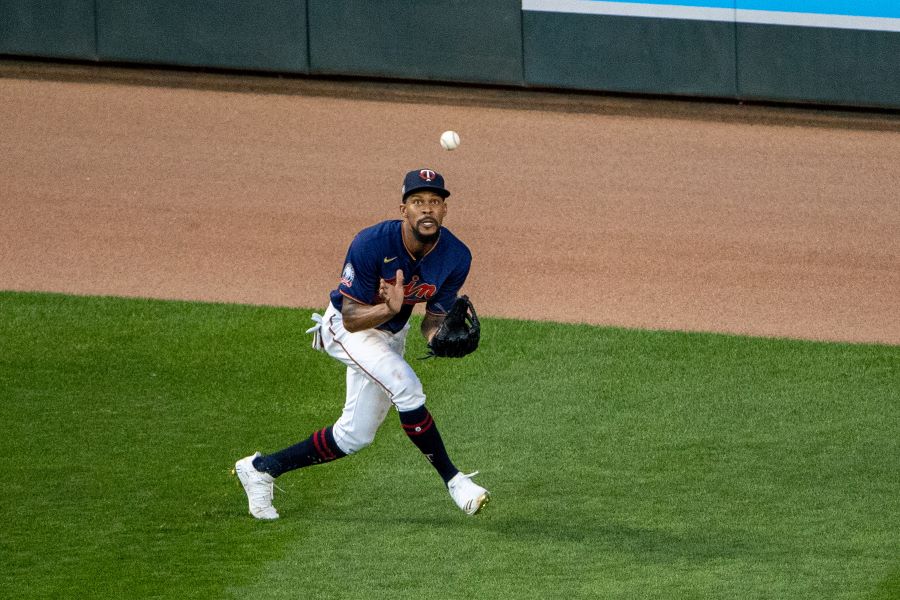
The Twins’ center fielder has a multi-faceted strategy for avoiding the shoulder-subluxing, skull-scrambling wall collisions that have plagued him recently. The numbers show how he’s dramatically changed his defensive positioning to minimize those risks. Now, the question will be how much he can change his actions, without losing the adventurousness that helped make him an elite defender.
There was a particular fly ball in Saturday night’s game against Cleveland on which Buxton’s chief adjustment was thrown into sharp relief. Franmil Reyes tagged a Kenta Maeda slider to dead center field, hit at 100.3 miles per hour. It flew 396 feet, but Buxton caught it easily. Here’s how Statcast mapped the play:

Obviously, Reyes has great power, so Buxton was playing deep against him anyway. Still, the positioning that made that an easy play has been a hallmark of Buxton’s approach to his defense all season. Here are his average starting depths for each season of his career.
Byron Buxton, Average Starting Distance, 2015-20
Season
Distance
2015
310
2016
313
2017
314
2018
314
2019
321
2020
334
In order to make going back on deep fly balls less threatening to his health (and, for that matter, to the structural integrity of outfield walls throughout the big leagues), Buxton has moved a full two dozen feet deeper (on average) than he played as a rookie. He began to make the adjustment last year, but as you can see, he’s gone from adjusting to fully reimagining his own position in 2020. The only center fielder who plays deeper than Buxton, on average, is Atlanta’s Ender Inciarte.
This is in keeping with league-wide trends, at a collective level, even if it’s a bit unorthodox at an individual one. The fastest center fielders in the game still tend to play shallower than slower ones, and Buxton’s move certainly bucks that notion, but in general, the league has steadily been nudging its outfielders further out for at least half a decade. Anecdotally, it seems to have been going on longer than that.
Some of the change, to be sure, is a response to the highly aerodynamic baseball, and to the profusion of power across all teams and positions. There are very few hitters left in the majors who can’t hit the ball 375 or 400 feet often enough to justify a respectful outfield depth. However, teams have also used Statcast data to better understand defense itself, and they’ve realized that playing outfielders shallow rarely steals enough bloop singles to make up for the extra doubles and triples that can happen on deep flies and line drives to the gaps. Outfielders who play deeper usually make more plays, prevent opponents from taking extra bases better, and stay healthier.
If the Derek Falvey-Thad Levine regime has one trademark, it’s that in every season since they’ve arrived in Minnesota, the team has found a new way to get better, or has doubled down on some previous area of improvement. They never call any aspect of their organization good enough, and stop trying to improve it. They never make half the necessary changes, hit a wall, and stop. The Twins are a franchise dedicated to the growth mindset. They don’t ask whether they’ve made adequate progress, but rather, what progress might still reasonably be made. Keeping Buxton healthy is one area in which they still had room to make progress. Now, they (and Buxton himself) have done just about all they can do.





Recommended Comments
Create an account or sign in to comment
You need to be a member in order to leave a comment
Create an account
Sign up for a new account in our community. It's easy!
Register a new accountSign in
Already have an account? Sign in here.
Sign In Now