


Twins Video
Box Score
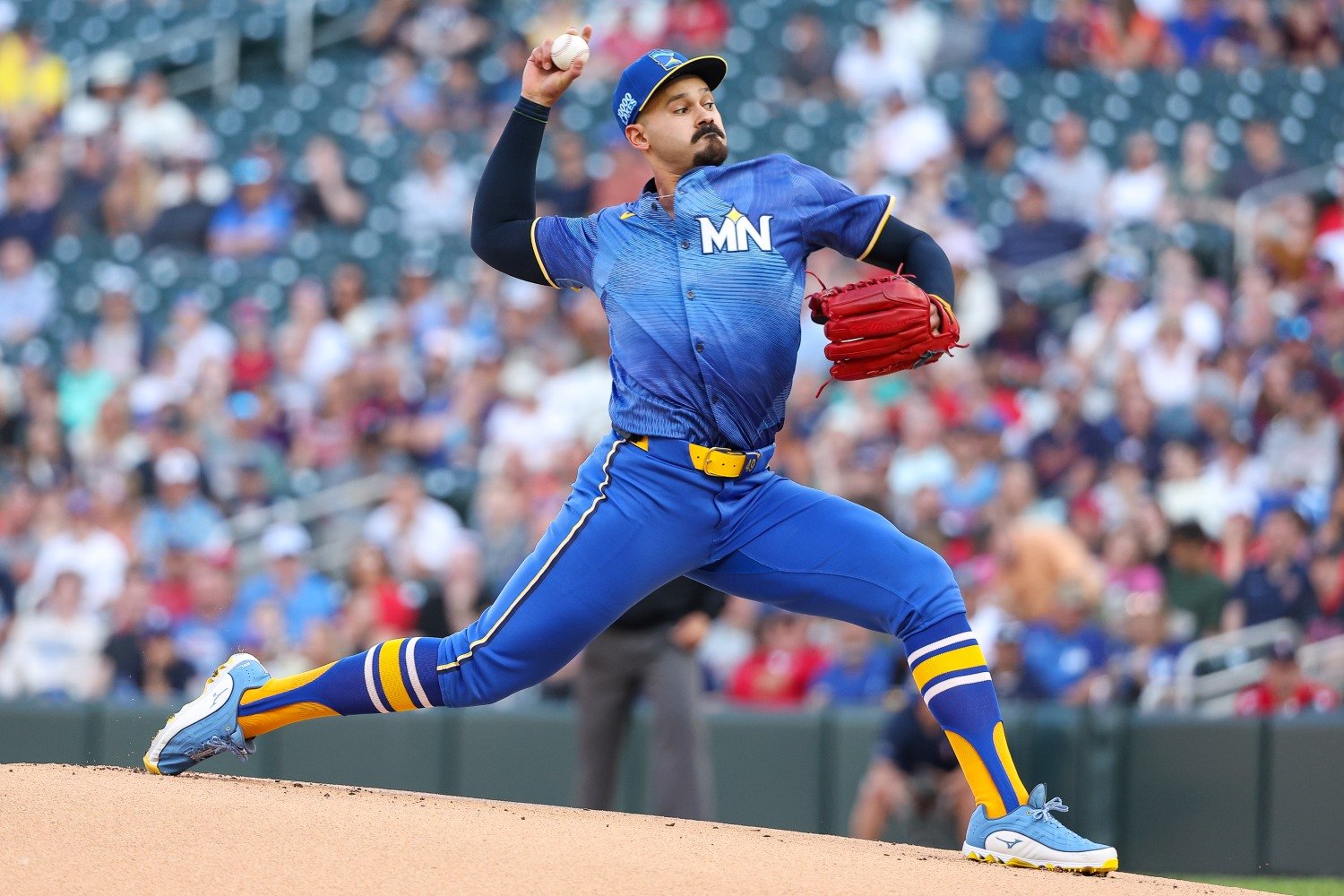
Starting Pitcher: Pablo López - 7 IP, 4 H, 1 ER, 1 BB, 7 K (109 pitches, 68 strikes)
Home Runs: Carlos Santana (14)
Bottom 3 WPA: Josh Staumont (-.428), Cole Sands (-.230), Ryan Jeffers (-.216)
Win Probability Chart (Via Fangraphs):

As an organization, the Twins weren't thrilled to have to wait five days between games for the All-Star break, thanks to the quirk of playing one of their two-game series against the rival Brewers on this weekend coming out of that layoff. As an extra poke in the eye, then, Mother Nature dropped a brief pop-up shower on Target Field minutes before the scheduled game time, pushing the season's resumption back an extra 14 minutes.
Once the action began, though, it was a little slice of Baseball Heaven--and hopefully, for Joe Pohlad (who was in attendance), a reminder of what's possible. A buzzy crowd of both Twins and visiting Brewers fans packed the place to the rafters, giving the game a charge and a self-consciously inflated sense of importance right from the first pitch. The crowd was big and enthusiastic enough, on a summer Saturday evening, to sustain the cheerful thump and palaver that makes it great to take in a game when the team is winning. It's the environment the Twins should be trying to cultivate at all times. As he always does, too, Pablo López rose to the heightened occasion, striking out the first two batters in a 1-2-3 top of the first.
The early stages of the game were as even as the records of the two playoff hopefuls contesting it. Through two scoreless innings, each side's hitters could console themselves by noting some tough at-bats and walks drawn, but each defense showed its quality, too. The top of the second ended when Ryan Jeffers threw out Sal Frelick attempting to steal second, and while his throw was on the money, Willi Castro (whom Rocco Baldelli said will be the everyday shortstop in Carlos Correa's absence) matched Jeffers's effort with a deft tag.
Willi drip dropped the perfect tag ? pic.twitter.com/foX5Bvt4p7
— Minnesota Twins (@Twins) July 20, 2024
The Brewers did get to López in the third, though, and he was probably fortunate to give up just one run. A leadoff double set them up to score, and a single from ninth hitter Andruw Monasterio did bring Garrett Mitchell around, but a 108-MPH screamer off the bat of Joey Ortiz became a groundout, and a long fly ball by Brice Turang found the glove of a gliding Byron Buxton at the wall in right-center. López righted the ship with a scoreless fourth, despite more hard contact, and the game stayed taut.
Meanwhile, though, Freddy Peralta frustrated the Twins at every turn. They worked two early walks and forced his pitch count to balloon, but they couldn't break through in the bottom of the third, despite putting two runners on with Buxton at bat. While the team awaits the convalescence of Correa, José Miranda, and Royce Lewis, Buxton is back in the heart of their order, and if we're honest, we have to admit that the 2-3-4 sequence of Trevor Larnach, Buxton, and Brooks Lee is conspicuously non-threatening. The team still has multiple threats and ways to score, but they're not the best lineup on the junior circuit in their current form.
Working on extra rest on a perfect night, the aces of each team rode the rise and fall and clash of two fan base's cheers packed into a single venue, keeping the game 1-0 through six frames. Neither blinked, but López (slightly more economical through six) got through a tough seventh inning without letting the lead lengthen, whereas Peralta departed after 102 offerings in six frames.
That would turn out to mean everything. Milwaukee reliever Bryan Hudson sailed through the seventh, but only faced two batters in the eighth, giving up well-struck balls to each. Austin Martin's fly ball nestled into the glove of Mitchell in center field, but Willi Castro laced a bounding gapper the same direction. Jackson Chourio came up throwing, and might have had a chance to nail the hustling Castro at second, but he mishandled the transfer and lost his opportunity.
Next came the chess match, with Baldelli and Milwaukee manager Pat Murphy trading maneuvers. Baldelli used his second pinch-hitter of the inning and third of the game to force Murphy to lift Hudson. Elvis Peguero replaced Hudson, and on a 1-2 pitch to Diego A. Castillo, he uncorked what would turn out to be an enormous wild pitch. Castro advanced to third, forcing the Brewers infield to come up. Castillo then hit a sharp ground ball to Turang at second, but Castro was off on contact.
It was an incredibly close play. Turang's throw beat the diving Castro, but Castro was aimed like a missile at the back corner of home plate. William Contreras did what catchers nearly always do on such plays, trained by years of instruction on pitch framing and following the natural momentum of a play on which they necessarily come forward to set up for the hurried throw: He snatrched it too soon. Traveling more slowly under the control of Contreras's muscles than it had been in flight, the ball didn't quite swipe Castro's side until his hand had acquired its target. A replay review confirmed the game-tying run.
Castillo reached in the process, and after a Buxton strikeout, Brooks Lee reached on an infield single. It was the Twins' second-most promising rally of the game, but it didn't bear any more fruit, as Max Kepler flew out deep to center.
It only felt right for the game to go to the ninth inning knotted; each team played too well to give the other a clear advantage any sooner than the game's final breath. Griffin Jax got the call for the top of the frame and took care of business, but so did Joel Payamps in the bottom half.
That brought on a funny bit of baseball irony, as Frelick (who had just been picked off to record the final out of the previous inning, marking his second out on the bases in one contest) took second as the automatic runner for the 10th inning. For his sins in past innings, Frelick's penance in the extra frame was to stand mostly motionless at his station, helpless to do anything. Jhoan Durán came on (to the delight of the sellout crowd, with the effects of the lowered lights and scoreboard animations heightened by the deepening darkness) and put away three straight Milwaukee batters, without even allowing for much in the way of luck.
Austin Martin was the automatic runner for the Twins' end of the 10th, but Willi Castro couldn't move him over. Leading off against an extremely aggressive bunt defense from the Brewers, Castro, instead, took a full swing--but he flied out, and Martin couldn't advance. Castillo therefore got his a chance to play hero a second time, but he struck out looking. Murphy elected to intentionally walk Byron Buxton, after Trevor Megill threw two unintentional balls to him, but Brooks Lee couldn't make the visitors pay, grounding out to first base.
The tension of this game--from the stands, where warring chants of "Let's Go Brewers" and "Let's Go Twins" bounced off each other every time a sequence even hinted at the possibility of runs scoring--refused to break. In the 11th, the Brewers scored on an infield-in fielder's choice (sound familiar?) and a subsequent squeeze bunt. The Brewers play that kind of game often. The Twins don't, at all.
No, the Twins get their runs this way, mostly.
Down to their last strike, the Twins were saved by the seemingly unstoppably clutch Carlos Santana, and though they could do no more than tie the game, they forced a 12th inning. That would, eventually, mean turning to their seventh pitcher, on a night when their starter bravely threw seven frames, but sometimes, the game grabs ahold of you and won't let go. Though those nights are less frequent, now that there are automatic runners in play as soon as the game reaches extra innings, they're even more special when they happen.
Alas, someone has to win those games, and the Brewers had the depth and the energy to do it Saturday night. A pair of infield singles (one on a nearly-botched but ultimately perfectly placed pop-up bunt) ignited a rally that finally gave the Brewers real breathing room. After a Joey Ortiz sacrifice fly, Jackson Chourio stroked his third hit of the game, bringing home an insurance run against Josh Staumont. Chourio then alertly stole second, taking the double play off the table and forcing the Twins to play the infield up again against Turang. He hit a sizzling single that probably would have punched through anyway, cleanly into right field to break the game open. By the time the relentless Brewers were done, it was a five-run cushion, and the bottom half of the frame was all protracted anticlimax.
The Good: I don't need the national anthem to be played before baseball games. I'm not hungry for the fight that would be required to get there, but I'd be fine with the tradition being discontinued. I often make myself busy with something else during the song, not protesting but not concelebrating, either.
As a men's quartet sang the song before the game Saturday evening, though, I was struck by something I rarely think of when it comes to the anthem: It can be a very beautiful song, when prepared and performed with loving craftsmanship. It's a challenging piece of music, but in such pieces lies the opportunity to create beauty. Sports are, ultimately, an artistic endeavor, though we rarely consider them that way. The performers Saturday evening gave a rendition as pretty as a 4-6-3 double play, setting an aesthetically wonderful tone for the event. It was one of the tiny ways that the game will surprise you, even in ways that stretch beyond the game itself.
On the field, there were plenty of encouraging things. Ryan Jeffers's bat seemed to have slowed down as the summer heat hit--because it did.

But Jeffers's swing looked better Saturday night, from a process standpoint. His first two at-bats yielded well-struck but not torched balls, but it was the way he swung that seemed encouraging. Pair that with the great throw to nail Frelick, and he looks somewhat rejuvenated after the break, which would be welcome news for the Twins.
López, too, gave encouraging returns. He held his velocity throughout the start, survived an early wobble unfazed, found feel for his sweeper late in the going and gave the team an excellent chance to win. If he can pitch like this down the stretch, the Twins not only have a chance to catch Cleveland for the AL Central leadership, but would feel supremely confident going into almost any first-round playoff matchup.
The Bad: It would be grossly unfair to blame the Twins offense for being dominated by Peralta, an ace in his own right who was one of the best pitchers in baseball in the second half of last season and still possesses every bit of the talent López does. We have to return, though, to that sense that the team is more than just depleted by the absence of (arguably) their three best hitters; they seem utterly deflated without them. That's not a knock on Baldelli or the character of the team; it's just how it goes. There's a certain amount of talent and production that, added together, creates a critical mass. No club can replace guys who were doing as much for the team as Correa, Lewis, and Miranda. They just have to wait for them to return. That's a worrisome reality, though, since there's no guarantee that any of them will be back (and at full strength) soon.
Once extra innings arrived, we also saw a glimpse of the lurking issue that is the soft underbelly of the bullpen. With injuries to Chris Paddack and Brock Stewart still stretching the staff a bit out of its optimal shape, they could use some reinforcement there. Otherwise, it will be important for them to play from ahead, because games like this one (and those in which they face a narrow deficit going into the late innings) will continue to get away from them.
What’s Next: Though next year's schedule will restore the annual interleague rivalry series to a pair of three-game sets, this season's Border Battle with the Brewers concludes with the fourth game between the two teams on Sunday. Joe Ryan and Milwaukee trade addition Aaron Civale will toe the rubber, for a 12:05 PM local start. It's so early for a good reason, too: The game will be on Roku, so for disenfranchised fans who want to see their team, this is a rare opportunity.
Postgame Interviews:
Bullpen Usage Chart
| TUE | WED | THU | FRI | SAT | TOT | |
| Sands | 0 | 0 | 0 | 0 | 10 | 10 |
| Jax | 0 | 0 | 0 | 0 | 14 | 14 |
| Durán | 0 | 0 | 0 | 0 | 12 | 12 |
| Staumont | 0 | 0 | 0 | 0 | 20 | 20 |
| Alcalá | 0 | 0 | 0 | 0 | 17 | 17 |
| Funderburk | 0 | 0 | 0 | 0 | 0 | 0 |
| Thielbar | 0 | 0 | 0 | 0 | 0 | 0 |
| Okert | 0 | 0 | 0 | 0 | 11 | 11 |
Which team do you dislike the most in the AL Central?
Follow Twins Daily For Minnesota Twins News & Analysis



- nclahammer, Patzky and mikelink45
-
 3
3


Recommended Comments
Create an account or sign in to comment
You need to be a member in order to leave a comment
Create an account
Sign up for a new account in our community. It's easy!
Register a new accountSign in
Already have an account? Sign in here.
Sign In Now