


Twins Video
Since 2014, the Twins have had catchers by the names of Suzuki, Eric Fryer, Chris Herrmann, Juan Centeno and John Ryan Murphy. None of them filled the role with any semblance of staying power. Prior to the 2017 season, Jason Castro was handed a three-year, $24.5 million deal from Derek Falvey and Thad Levine in hopes he would provide a high level of performance and consistency behind the plate.
Looking back at year one, Castro provided the best output behind the dish since Suzuki’s All-Star appearance. His 1.6 fWAR slotted in just behind Suzuki’s 2.0 fWAR mark, and the tandem with Chris Gimenez (1.0 fWAR) proved to be a decent pairing. While plenty was made about Castro’s pitch framing, his receiving and throw skills should get plenty of notice as well. After Suzuki failed to be league average or better, topping out at 25% in regard to catching base runners, Castro bested that mark a year ago and was run on significantly less.
On the offensive side of things, Castro put forth the best season of his career since being named an All-Star with the Astros in 2013. On top of seeing a significant boost in the average department, he also got back to his ways of being an on-base threat. Despite the .720 OPS leaving some room for improvement, it’s actually the splits that Minnesota fans can begin to salivate over.
As a lefty, Castro presents Paul Molitor with an opportunity to maximize his future output. A year ago, the Twins backstop actually had similar splits facing righties and lefties, if not a bit skewed towards the reverse. His .737 OPS against lefties slotted in just a bit higher than the .714 OPS he posted against right-handed pitchers. Over the course of his career however, Castro’s splits tell a different story. The .568 OPS against lefties is buoyed by a .747 OPS against righties, leaving a relatively exposable deficiency.
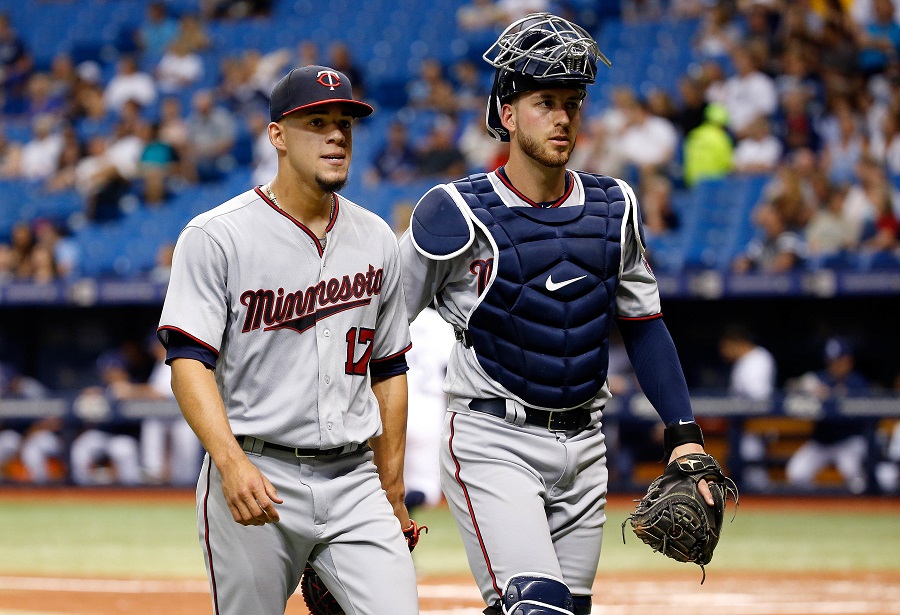
Enter his assumed partner for the 2018 Twins season, Mitch Garver.
At Triple-A Rochester in 2017, Garver post a .928 OPS (a career high) across 88 games. It was quite the jump from the .753 OPS at Double-A in 2016 (95 games), and even a boost from the .815 OPS in his first 22 games of Triple-A action. After having a strong 2017, it’s not surprising that Garver’s numbers tallied well against both lefties (.938 OPS) and righties (.870). Over the course of his career however, he’s proven capable of mashing against lefties.
You can expect that there will still be a learning curve, and a significant bit of development needing to take place in 2018 for the former New Mexico Lobos backstop. He has just 52 major league plate appearances to his name, and despite being 27 years old, he’ll be thrown into a sink-or-swim scenario. Fortunately, there’s plenty of room for him to bring the water level of the Twins backstops up a notch.
The bar Chris Gimenez set in 2017 is what Garver should be looking to clear. He was given 54 starts, which could be a number that Mitch expands upon. A 30% caught stealing rate was great, but ten passed balls was something that was an apparent issue when Gimenez was behind the dish a season ago. His .731 OPS was a career high (over at least a 40 game sample size), and will be the offensive mark that Garver is looking to best.
Last year, the Castro and Gimenez duo actually performed above average across the big leagues. The 2.8 fWAR put up by the duo, was good enough for tenth in the major leagues. In the American League, only the Mariners, Orioles, Yankees, and Tigers put up better fWAR totals from the catching position. In 2018, Minnesota will be looking to do no worse than replicate that scenario.
In short, Joe Mauer catching is the last scenario in which the Twins could legitimately point to the catcher position as being an asset long term. Suzuki’s 2014 outburst appeared fluky, and proved to be as such during the rest of his tenure with the Twins. He was paired with fly-by-night types who had little opportunity of sticking, and it wasn’t until 2017 when something clicked for the Twins backstop position. The Castro signing paved the way for the role to be held by a strong duo, and the torch can now be passed to Garver.
There’s more than enough reason to believe Jason Castro is above strict platoon, and there’s plenty of reason to be skeptical about what Garver will contribute during his rookie season, but a blueprint is in place. Minnesota may not have a solo superstar behind the dish anymore, but it appears they’ve got a tandem plan that will work just fine.





Recommended Comments
Create an account or sign in to comment
You need to be a member in order to leave a comment
Create an account
Sign up for a new account in our community. It's easy!
Register a new accountSign in
Already have an account? Sign in here.
Sign In Now