



Peter Labuza
-
Posts
233 -
Joined
-
Last visited
Content Type
Profiles
News
Minnesota Twins Videos
2026 Minnesota Twins Top Prospects Ranking
2022 Minnesota Twins Draft Picks
Minnesota Twins Free Agent & Trade Rumors, Notes, & Tidbits
Guides & Resources
2023 Minnesota Twins Draft Picks
The Minnesota Twins Players Project
2024 Minnesota Twins Draft Picks
2025 Minnesota Twins Draft Pick Tracker
2026 Minnesota Twins Draft Tracker: Picks & Bonuses
Forums
Blogs
Events
Store
Downloads
Gallery
Everything posted by Peter Labuza
-

Wild Wrinkles Keep Opening the Door Wider for Twins to Reach Postseason
Peter Labuza posted an article in Twins
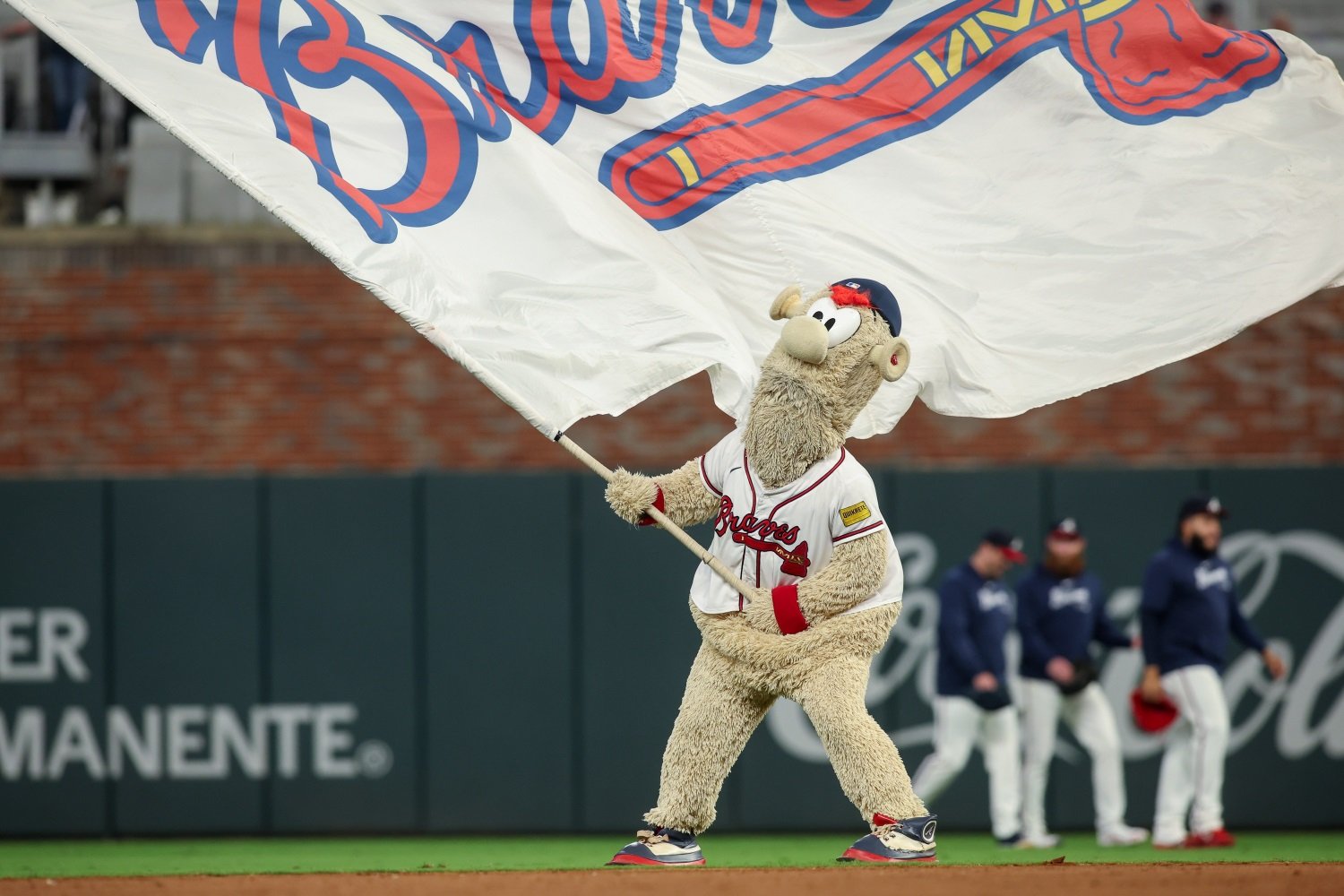 We all know the situation is dire. The Twins’ chances to make the playoffs are down to a sliver. They started today at 22.9%, and that's already come down substantially. Yet, despite the Tigers and Royals finishing off sweeps of the Rays and Nationals, respectively, things are not over yet. A lot must go right for the Twins, though as colleague Matthew Taylor wrote this week, a Baltimore team with nothing to play for will provide a nice little boost. But the Twins need to take a mile when given an inch, and two more little advantages might swing it all in their favor. Here’s the Story of a Hurricane While three AL Central teams battle out for Wild Card spots, the NL Wild Card race has remained extremely tight as well, between the Diamondbacks, Mets, and Braves. The big showcase series of the week was a showdown between the two NL East powerhouses. But after Atlanta took the first game, the impending floods of Hurricane Helene shut down yesterday’s and today’s matchups. Despite desires by MLB to simply move the games to a neutral site, the vanity of owners—who of course moved their stadium outside of the downtown area and made it entirely inaccessible by public transportation for “reasons”—could not imagine lost ticket sales for a pair of games. (Tuesday’s matchup drew over 40,000 people.) To make it up, MLB has created what can only be called a makeshift “Game 163” day, with the Mets and Braves playing a doubleheader on Monday to decide a trip to the postseason. And if the rains persist on Friday, the Braves might have to do a doubleheader with the Royals on Saturday, as well. That means the Braves now begin their series with Kansas City Friday, seeing a chance to play first against a weaker team that has looked shaky in recent weeks, rather than a team whose vibes are the stuff memes are made of. The Diamondbacks and Mets will spend their weekend against two tough opponents, in the Padres and Brewers, respectively. Both those teams clinched their seeding earlier this week, but are still unlikely to show much mercy. That gives a Braves team that looks quite different from the powerhouse that began the season a chance to prove their worth. It also means that the two starters lined up for the Mets series, Cy Young leader Chris Sale and the very good Max Fried, are in play for this weekend, rather than some of Atlanta’s younger and more inexperienced arms. Braves manager Brian Snitker has said his plan is to watch the status of the other games games and make decisions as needed, with Fried getting the start Friday and waiting on what to do with Sale. But being able to toss them against the Royals (not to mention potentially using reliever-turned-starter Reynaldo López as he returns from a brief IL stint) might give the Royals more trouble than they want. “I'm not dead!...I’m actually getting better!” The Chicago White Sox have been one of the funniest, saddest and most revealing franchises of modern baseball (you likely only need one guess who is responsible for this one), now tied for the record with the 1962 Mets for the most games lost. And yet, the team is slightly surging in this most dire hour. Chicago’s South Side experiment in lousiness has perhaps decided to show a little life, going 5-5 in their last 10, including their first ever come-from-behind win against the Angels and an extra-innings bloop from Andrew Benintendi to win last night’s affair. Then they jumped out to a 7-0 lead on Anaheim again Thursday. Now the White Sox line up against Detroit with their best starter, in Garrett Crochet, as well as rookie Sean Burke. Burke will be making his fourth start, and over three previous ones (against Cleveland, Oakland, and San Diego, all of which have some impressive offensive power) has only allowed 3 runs over 14 innings. As others have noted, the White Sox can avoid not just the mantle of most losses, but just one win will give them the chance to avoid the worst winning percentage of all time (that belonging to Connie Mack’s 1916 Philadelphia Athletics). Will the White Sox show up in Detroit with something to prove? If they do, they might give the Twins the shoulder they need. Who is to say if the Twins can pull this out? These slight advantages, though, give us all a reason to watch and hope, rather than lament.
 -
I think this is fair but it's more fair to say "we have no idea what Zebby's numbers the third time through the order actually are." I agree, probably leave him in, partially because worst case you get a home run that ties, and then maybe you get one of your better (or even so-so but not Cole Irvin) arms against the righties and pray your hitters do anything.
-
The Twins will face another major financial challenge with on-field implications this offseason, as they become free agents looking for a service to broadcast and stream their games. But will they actually deliver on the promises they broke last offseason? Image courtesy of © Reid Glenn / USA TODAY NETWORK The Twins will face another major financial challenge with on-field implications this offseason, as they become free agents looking for a service to broadcast and stream their games. But will they actually deliver on the promises they broke last offseason? Last week, Twins fans tuning into their game against the Rays experienced something quite strange. Technical issues plagued the broadcast, causing it to remain fixed on the center-field camera view. The valiant technician zoomed in and out for hitter and pitcher reactions between the pitches, though he had no way to actually follow any ball hit into play. Some might call it an avant-garde performance: Others will call it part of a long line of injustices, in the worst experience for Twins fans wanting to watch the game this season in recent memory. To recap: After promising “the end of blackouts” via new broadcaster Cory Provus early last offseason, the Twins re-upped with Bally Sports Network, despite its continued bankruptcy issues being settled in a Texas court. Games were, instead, only available to cable subscribers in the regional area. Aggravatingly, though that choice was about maximizing revenue, no meaningful reinvestment of that money into payroll took place. The choice came to a head in May, when Diamond began its fight with Comcast over carrier fees, leaving around 80% of Minnesotans essentially without baseball months into what should have been seen as Year Two of a new dynasty. The flare-up has been seen as part of the critical loss in revenue for the Twins, who have failed to build their audience, dropping from 19th to 23rd in average attendance with only a handful of home games to play. Minnesota has fallen behind resurgent teams like Baltimore and Arizona, who took their successful 2023 rosters and infused them with new talent. As September rolls along, the Twins now have two weeks left on the Bally Sports Network, and it’s about time to begin asking where things stand. As Dave St. Peter recently told Front Office Sports, they “remain undecided” and continue “reviewing and exploring different options.” But where exactly might fans watch the team next year? While the Twins are free agents once again, they will have 29 other owners looking over their shoulder. As a mid-market team dependent on broadcast revenue—a recent filing suggested that the average MLB team gets 25% of its earnings from broadcast rights—they will be looking to Rob Manfred to assist in ensuring a big deal going forward. As St. Peter remarked, that needs to include some sort of streaming option. “Digital rights have become a gating issue for us, meaning we have to have those on some level.” That should be good news for Twins fans, as another year without streaming would be an unqualified failure. But what Manfred can do to help secure a package similar to previous cable deals remains the big question. Much of that depends on Diamond Sports Holdings (DSH), the Sinclair subsidiary that has been the center of the chaos with their continued bankruptcy procedures. The story has been twisting throughout the year. To recap, DSH received a large influx of cash in January from Sinclair and Amazon—who remain very interested in expanding Prime’s sports offerings beyond Thursday Night Football—that likely meant a deal that would include streaming of five MLB teams. Approval of the plan was delayed throughout the summer, all while the Comcast carrier fees fight soured things further between the three main leagues and DSH. Other carriers like Cox and DirecTV (which just concluded their own carrier fee dispute with Disney) found that MLB stonewalled these cable carriers from their deals with DHS. While the NBA and NHL have a deal in principle to cement a future with Bally, Manfred and his team (who must approve any part of Diamond’s restructuring, as creditors) petitioned to see the other league deals, which the judge denied. From the atmosphere, Manfred seems wary to give approval, preferring to rip off the Regional Sports Network Band-Aid. It seems like a no-brainer for the league, which would then be able to take over half of the league into a package for a major streaming service going into 2025--though none of the teams in question would be major media market teams like the Dodgers, Yankees, or Cubs. In a recent court filing, MLB has argued that the bankruptcy needs a swift resolution, with major teams unable to plan for free agency (not that these teams are planning for the Soto Sweepstakes). St. Peter himself has said the Twins want to have something in place much earlier in the offseason than last year’s disaster. Such a future being ensured will be critical to any choices (though almost certainly limited) the Twins front office might make during the offseason. Even if Bally finds a way out of court, will it find a way to survive the streaming era? Amazon pulled out of their current cash infusion arrangement, but recently re-joined as a partner to move forward with streaming Bally RSNs on Prime. Others suggest that Manfred has entered discussions with ESPN, perhaps to develop a package for either ESPN+ or Disney’s proposed Venu joint venture with Warner Bros-Discovery and Fox Broadcast (itself now facing an antitrust lawsuit). Either deal—if it included the end of backouts across the Minnesota territory—would be the right one for St. Peter and crew. But streaming is simply not worth the value of old-fashioned cable rights, and if the Twins are only receiving half of what they once received in broadcast money, many might wonder how the team will proceed—or who might be on it. The MLB and MLBPA recently agreed to move some money to teams struggling with this transition, but whether that goes to players or owners' pockets will be a testy issue. But what else can the Twins do? Both the Wild and Timberwolves will remain with Bally, as long as the bankruptcy is approved and the company stays afloat. For as much as the team has made its own mistakes along the way, they are also fighting with their hands behind their back. They could go their own way, of course--an idea I proposed last offseason to embrace local TV and forgo revenue to rebuild the fanbase. (St. Peter responded to the idea with very little interest.) Or else, Twins fans could simply hope to watch more Virtual Game Experiences, as they had the option to the other night--an experience that I would prefer never to see again: Where would you prefer to watch the Twins next year? Sound off in the comments. View full article
-
 Last week, Twins fans tuning into their game against the Rays experienced something quite strange. Technical issues plagued the broadcast, causing it to remain fixed on the center-field camera view. The valiant technician zoomed in and out for hitter and pitcher reactions between the pitches, though he had no way to actually follow any ball hit into play. Some might call it an avant-garde performance: Others will call it part of a long line of injustices, in the worst experience for Twins fans wanting to watch the game this season in recent memory. To recap: After promising “the end of blackouts” via new broadcaster Cory Provus early last offseason, the Twins re-upped with Bally Sports Network, despite its continued bankruptcy issues being settled in a Texas court. Games were, instead, only available to cable subscribers in the regional area. Aggravatingly, though that choice was about maximizing revenue, no meaningful reinvestment of that money into payroll took place. The choice came to a head in May, when Diamond began its fight with Comcast over carrier fees, leaving around 80% of Minnesotans essentially without baseball months into what should have been seen as Year Two of a new dynasty. The flare-up has been seen as part of the critical loss in revenue for the Twins, who have failed to build their audience, dropping from 19th to 23rd in average attendance with only a handful of home games to play. Minnesota has fallen behind resurgent teams like Baltimore and Arizona, who took their successful 2023 rosters and infused them with new talent. As September rolls along, the Twins now have two weeks left on the Bally Sports Network, and it’s about time to begin asking where things stand. As Dave St. Peter recently told Front Office Sports, they “remain undecided” and continue “reviewing and exploring different options.” But where exactly might fans watch the team next year? While the Twins are free agents once again, they will have 29 other owners looking over their shoulder. As a mid-market team dependent on broadcast revenue—a recent filing suggested that the average MLB team gets 25% of its earnings from broadcast rights—they will be looking to Rob Manfred to assist in ensuring a big deal going forward. As St. Peter remarked, that needs to include some sort of streaming option. “Digital rights have become a gating issue for us, meaning we have to have those on some level.” That should be good news for Twins fans, as another year without streaming would be an unqualified failure. But what Manfred can do to help secure a package similar to previous cable deals remains the big question. Much of that depends on Diamond Sports Holdings (DSH), the Sinclair subsidiary that has been the center of the chaos with their continued bankruptcy procedures. The story has been twisting throughout the year. To recap, DSH received a large influx of cash in January from Sinclair and Amazon—who remain very interested in expanding Prime’s sports offerings beyond Thursday Night Football—that likely meant a deal that would include streaming of five MLB teams. Approval of the plan was delayed throughout the summer, all while the Comcast carrier fees fight soured things further between the three main leagues and DSH. Other carriers like Cox and DirecTV (which just concluded their own carrier fee dispute with Disney) found that MLB stonewalled these cable carriers from their deals with DHS. While the NBA and NHL have a deal in principle to cement a future with Bally, Manfred and his team (who must approve any part of Diamond’s restructuring, as creditors) petitioned to see the other league deals, which the judge denied. From the atmosphere, Manfred seems wary to give approval, preferring to rip off the Regional Sports Network Band-Aid. It seems like a no-brainer for the league, which would then be able to take over half of the league into a package for a major streaming service going into 2025--though none of the teams in question would be major media market teams like the Dodgers, Yankees, or Cubs. In a recent court filing, MLB has argued that the bankruptcy needs a swift resolution, with major teams unable to plan for free agency (not that these teams are planning for the Soto Sweepstakes). St. Peter himself has said the Twins want to have something in place much earlier in the offseason than last year’s disaster. Such a future being ensured will be critical to any choices (though almost certainly limited) the Twins front office might make during the offseason. Even if Bally finds a way out of court, will it find a way to survive the streaming era? Amazon pulled out of their current cash infusion arrangement, but recently re-joined as a partner to move forward with streaming Bally RSNs on Prime. Others suggest that Manfred has entered discussions with ESPN, perhaps to develop a package for either ESPN+ or Disney’s proposed Venu joint venture with Warner Bros-Discovery and Fox Broadcast (itself now facing an antitrust lawsuit). Either deal—if it included the end of backouts across the Minnesota territory—would be the right one for St. Peter and crew. But streaming is simply not worth the value of old-fashioned cable rights, and if the Twins are only receiving half of what they once received in broadcast money, many might wonder how the team will proceed—or who might be on it. The MLB and MLBPA recently agreed to move some money to teams struggling with this transition, but whether that goes to players or owners' pockets will be a testy issue. But what else can the Twins do? Both the Wild and Timberwolves will remain with Bally, as long as the bankruptcy is approved and the company stays afloat. For as much as the team has made its own mistakes along the way, they are also fighting with their hands behind their back. They could go their own way, of course--an idea I proposed last offseason to embrace local TV and forgo revenue to rebuild the fanbase. (St. Peter responded to the idea with very little interest.) Or else, Twins fans could simply hope to watch more Virtual Game Experiences, as they had the option to the other night--an experience that I would prefer never to see again: Where would you prefer to watch the Twins next year? Sound off in the comments.
 -
That wouldn't explain his numbers in later innings. He often faces those players again and does great.
-
The Twins starter has had the most reliable track record of any of the arms Minnesota has used all season. So why can’t he simply start the game with a clean first inning? Image courtesy of © Bruce Kluckhohn-USA TODAY Sports The Twins starter has had the most reliable track record of any of the arms Minnesota has used all season. So why can’t he simply start the game with a clean first inning? Bailey Ober turned in another stellar start on Sunday afternoon against the Toronto Blue Jays. Bouncing back from a rough outing against the Atlanta Braves, Ober struck out eight over six innings. The afternoon became Ober’s 11th quality start (six innings with three earned runs or fewer) in twelve outings, putting him in a very good place to lead the Twins through the rest of the season with a lock on the second playoff spot. Ober also once again demonstrated his Achilles heel, allowing a home run to Ernie Clement in the first. The 6-foot-9 righty has one of the more unique problems in baseball: flopping in first innings. Ober spots a 7.27 ERA in the first inning. While a lot of that has to do with his disastrous Kansas City start to begin the season and his recent Atlanta Braves mishap, removing those games still leaves him a 5.09 ERA, with a shockingly high 5.48 FIP. That includes 10 extra-base hits (including six dingers) and eight walks, even removing the catastrophic outings. Comparatively, the 2nd through 5th innings are gems for Ober: a 2.48 ERA and a 2.83 FIP. The strikeout-to-walk ratio is even more telling: Ober sports a 2.3 K/BB ratio to begin the game, but then it doubles to 5.2 from the 2nd inning onward. Of all MLB starters, Ober ranks sixth-worst when comparing his xWOBA in the 1st inning against what he puts up during 2nd through 5th inning. (Ironically, Cy Young candidate Chris Sale ranks worse than Ober, but only because he has been so dominant otherwise). It is a notable difference among the Twins’ four main starters this season: Player 1st Inning BA 2nd-5th Inning BA 1st Inning xWOBA 2nd-5th Inning xWOBA Bailey Ober .281 .212 .364 .279 Pablo López .240 .257 .291 .301 Simeon Woods Richardson .169 .249 .269 .325 Joe Ryan .247 .208 .255 .274 So why does Ober perform so poorly to start the game, only to bounce back seemingly every time? Smart baseball people will tell you that innings are irrelevant: what matters is how many times through the order, with most pitchers fairing quite poorly the third time through. And while Ober’s stats certainly improve the second time through, they are nowhere near as distinctive as those first-inning stats: his xWOBA drops from .281 to .235, while opponents' batting average increases from .192 to .200. So what does Ober do differently when it comes to his first inning? He's not the first pitcher to suffer from the problem. Some pitchers have had an even worse case. But in the aggregate, bad first innings often lead to bad outings. Not so for Ober. My first theory was his pitch type; Ober throws too much of his fastball, or cutter, or what-have-you. But as Ober has suffered bad first innings, he has switched up his approach multiple times, only to see the plans go awry. Ober uses his three main pitches—the fastball, cutter, and changeup—about the same amount in the first three innings, with slight variations, though hardly enough to make any meaningful argument. The next argument would be about the zone. Does Ober change up where he is landing pitches? We can see his pitches staying relatively in the same place when it comes to righties on the outside: But you see more and more movement when it comes to lefties and the inside part of the plate: This chart finally put me onto what might be happening. If you look at xWOBA, left-handed hitters have been lighting up Ober on inside pitches, for a difference of .258 for righties but .391 for lefties. And the lefties in the first inning absolutely have his spot: In the 2nd through 5th innings, righties marginally improve to .298, but lefties drop precipitously, to .225. Ober seemingly cannot figure out lefties until after the first inning. Nine of the 12 extra-base hits by Ober opponents have come from lefties (who have a first-inning SLG of .659, vs. .256 for righties). And notably, all of them are in pitcher-friendly counts: six with two strikes, and two on the first pitch (the only one on 3-2 count was also the only one on a misplaced changeup, to José Ramírez). These are some of the best players in the game—Shohei Ohtani, Corey Seager, Bryce Harper—but Ober clearly has struggled all season with this situation. Teams have been very aware of Ober’s early lefty problem, which explains why the problem manifests in the first inning rather than the entire first time through the order. He’s faced 57 lefties in the first inning, but only 44 lefties in the second, and often that means the top players in baseball. Meanwhile, he’s faced 55 righties in the first, compared to 51 in the second inning. So can Ober figure it out? Ironically, his start against the Blue Jays might have showed a path forward. Clement got the home run, but the other three hitters that inning were lefties. None of them would see a pitch on the inside portion of the plate. In fact, the only pitch anywhere near the inside was this harmless pop out by Nathan Lukes: Lukes Pop up.mp4 Moreover, Matt Olson’s home run was Ober’s first hit allowed in the first against a lefty since Jul. 22. Perhaps this is all relatively unimportant, since Ober remains not just this team’s co-ace, but one of the league’s best pitchers. If Sale can win a Cy Young with the same problem, why not Ober? In part, it's the potential. It's taken Sale almost a decade for him to put together a season like the one he is having now. And if Ober wants to enter that echelon early (or more importantly, not give every Twins fan a nervous breakdown in October), solving this problem now is necessary. If Ober can manage to end his first-inning woes, he might legitimately reach the ace level we hope for. View full article
-
Bailey Ober and the Terrible, Horrible, No-Good, Very Bad First Inning
Peter Labuza posted an article in Twins
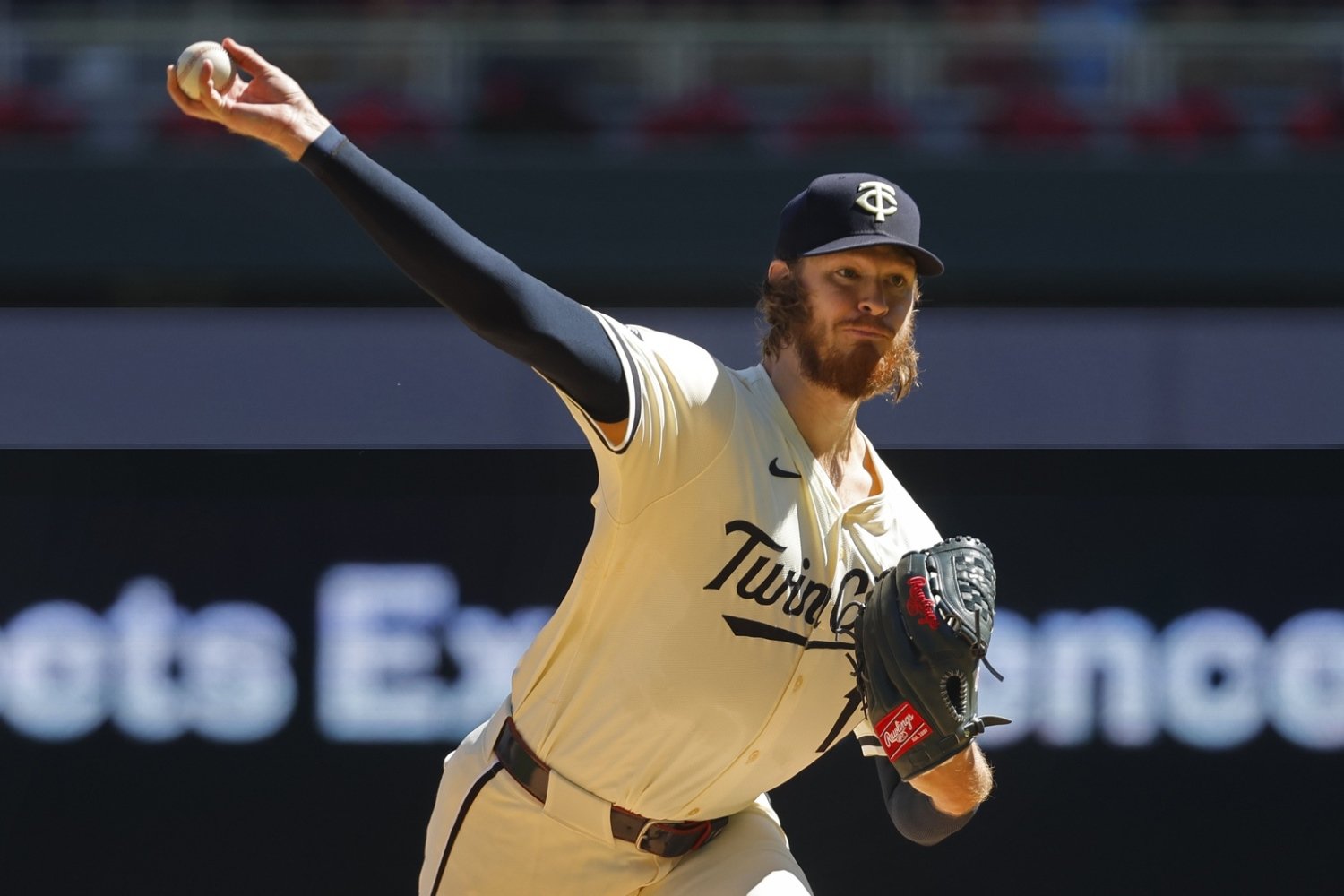 Bailey Ober turned in another stellar start on Sunday afternoon against the Toronto Blue Jays. Bouncing back from a rough outing against the Atlanta Braves, Ober struck out eight over six innings. The afternoon became Ober’s 11th quality start (six innings with three earned runs or fewer) in twelve outings, putting him in a very good place to lead the Twins through the rest of the season with a lock on the second playoff spot. Ober also once again demonstrated his Achilles heel, allowing a home run to Ernie Clement in the first. The 6-foot-9 righty has one of the more unique problems in baseball: flopping in first innings. Ober spots a 7.27 ERA in the first inning. While a lot of that has to do with his disastrous Kansas City start to begin the season and his recent Atlanta Braves mishap, removing those games still leaves him a 5.09 ERA, with a shockingly high 5.48 FIP. That includes 10 extra-base hits (including six dingers) and eight walks, even removing the catastrophic outings. Comparatively, the 2nd through 5th innings are gems for Ober: a 2.48 ERA and a 2.83 FIP. The strikeout-to-walk ratio is even more telling: Ober sports a 2.3 K/BB ratio to begin the game, but then it doubles to 5.2 from the 2nd inning onward. Of all MLB starters, Ober ranks sixth-worst when comparing his xWOBA in the 1st inning against what he puts up during 2nd through 5th inning. (Ironically, Cy Young candidate Chris Sale ranks worse than Ober, but only because he has been so dominant otherwise). It is a notable difference among the Twins’ four main starters this season: Player 1st Inning BA 2nd-5th Inning BA 1st Inning xWOBA 2nd-5th Inning xWOBA Bailey Ober .281 .212 .364 .279 Pablo López .240 .257 .291 .301 Simeon Woods Richardson .169 .249 .269 .325 Joe Ryan .247 .208 .255 .274 So why does Ober perform so poorly to start the game, only to bounce back seemingly every time? Smart baseball people will tell you that innings are irrelevant: what matters is how many times through the order, with most pitchers fairing quite poorly the third time through. And while Ober’s stats certainly improve the second time through, they are nowhere near as distinctive as those first-inning stats: his xWOBA drops from .281 to .235, while opponents' batting average increases from .192 to .200. So what does Ober do differently when it comes to his first inning? He's not the first pitcher to suffer from the problem. Some pitchers have had an even worse case. But in the aggregate, bad first innings often lead to bad outings. Not so for Ober. My first theory was his pitch type; Ober throws too much of his fastball, or cutter, or what-have-you. But as Ober has suffered bad first innings, he has switched up his approach multiple times, only to see the plans go awry. Ober uses his three main pitches—the fastball, cutter, and changeup—about the same amount in the first three innings, with slight variations, though hardly enough to make any meaningful argument. The next argument would be about the zone. Does Ober change up where he is landing pitches? We can see his pitches staying relatively in the same place when it comes to righties on the outside: But you see more and more movement when it comes to lefties and the inside part of the plate: This chart finally put me onto what might be happening. If you look at xWOBA, left-handed hitters have been lighting up Ober on inside pitches, for a difference of .258 for righties but .391 for lefties. And the lefties in the first inning absolutely have his spot: In the 2nd through 5th innings, righties marginally improve to .298, but lefties drop precipitously, to .225. Ober seemingly cannot figure out lefties until after the first inning. Nine of the 12 extra-base hits by Ober opponents have come from lefties (who have a first-inning SLG of .659, vs. .256 for righties). And notably, all of them are in pitcher-friendly counts: six with two strikes, and two on the first pitch (the only one on 3-2 count was also the only one on a misplaced changeup, to José Ramírez). These are some of the best players in the game—Shohei Ohtani, Corey Seager, Bryce Harper—but Ober clearly has struggled all season with this situation. Teams have been very aware of Ober’s early lefty problem, which explains why the problem manifests in the first inning rather than the entire first time through the order. He’s faced 57 lefties in the first inning, but only 44 lefties in the second, and often that means the top players in baseball. Meanwhile, he’s faced 55 righties in the first, compared to 51 in the second inning. So can Ober figure it out? Ironically, his start against the Blue Jays might have showed a path forward. Clement got the home run, but the other three hitters that inning were lefties. None of them would see a pitch on the inside portion of the plate. In fact, the only pitch anywhere near the inside was this harmless pop out by Nathan Lukes: Lukes Pop up.mp4 Moreover, Matt Olson’s home run was Ober’s first hit allowed in the first against a lefty since Jul. 22. Perhaps this is all relatively unimportant, since Ober remains not just this team’s co-ace, but one of the league’s best pitchers. If Sale can win a Cy Young with the same problem, why not Ober? In part, it's the potential. It's taken Sale almost a decade for him to put together a season like the one he is having now. And if Ober wants to enter that echelon early (or more importantly, not give every Twins fan a nervous breakdown in October), solving this problem now is necessary. If Ober can manage to end his first-inning woes, he might legitimately reach the ace level we hope for.
 -
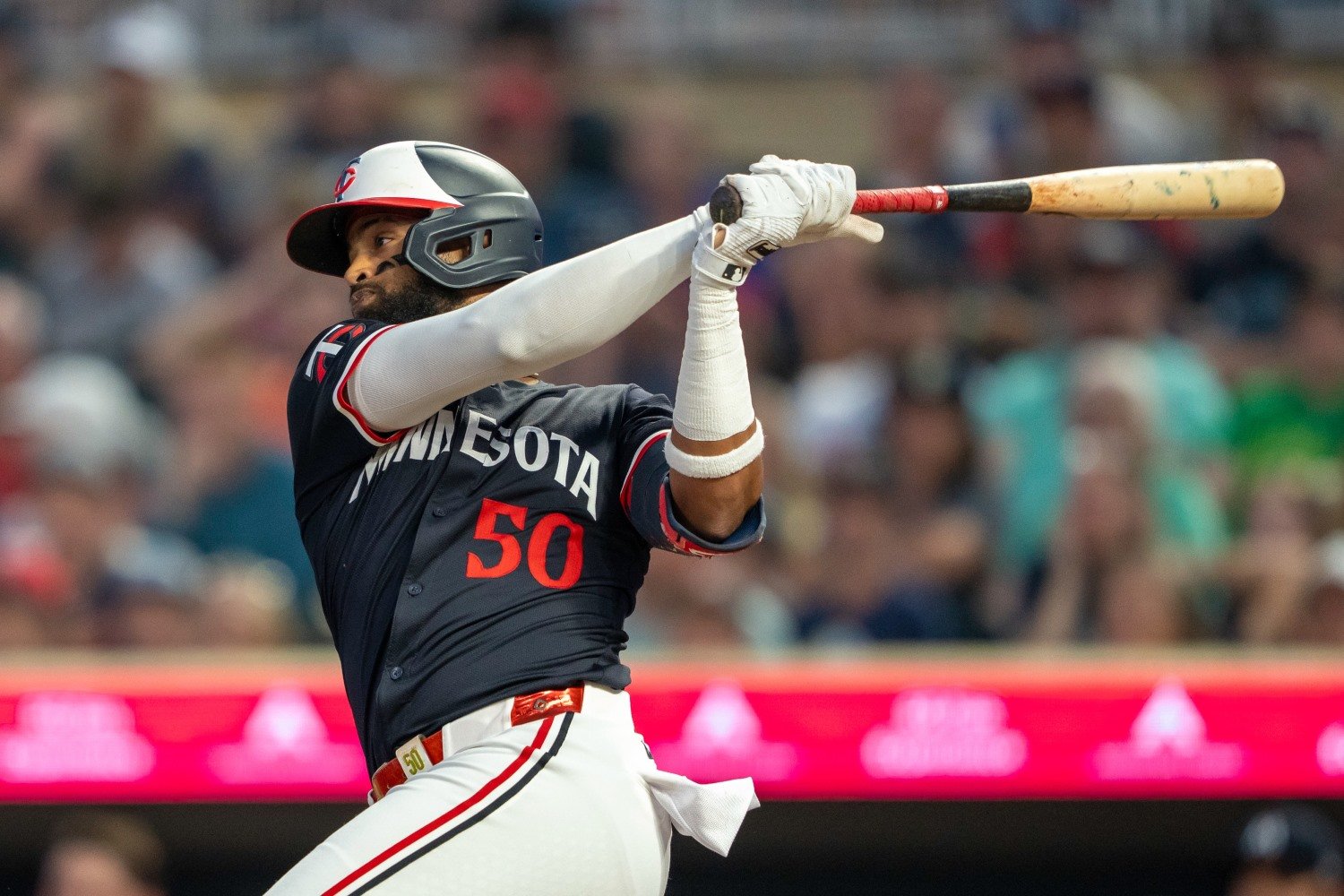 On Monday night against the Royals, Willi Castro had another signature moment in his impressive, burgeoning career. Down by a run, Castro launched a homer off right-hander Brady Singer, giving the Twins a two-run lead and pushing the team on toward an 8-3 win. In Wednesday’s loss, Castro fared less well, with two strikeouts and an extremely soft line out to lefty Cole Ragans. An 0-for-3 day against one of the best starters in the game (plus a popout against reliever Lucas Erceg) would usually be nothing to worry about. However, the bad day fits into an alarming trend for Castro since the end of June. He became an All-Star, in part, due to his switch-hitting prowess--especially his ability to punish left-handed pitching. But since the start of July, he has become an automatic out for southpaws. The numbers should be ringing alarms within the Twins front office. Castro dropped from a stellar 202 WRC+ against left-handed pitching in the first half to a mind-bogglingly low -49 WRC+. He is 2-for-38, with only two walks and 10 strikeouts. I cannot emphasize this enough: From the beginning of the season through June, Castro was the best hitter against left-handed pitching on the team. Now, he sits dead last. Lefty pitching usually means small sample sizes, but it is quite impossible to look at these numbers and not see someone who has lost themselves at the plate. Month BA Against RHP xBA Against RHP BA Against LHP xBA Against LHP Mar/Apr .197 .225 .345 .259 May .250 .266 .417 .276 June .274 .255 .360 .291 July .250 .221 .080 .208 August .355 .341 .000 .107 Castro’s usefulness to the Twins remains substantial. He fills multiple shoes throughout the defense, and plays practically every day. Crucially, during this disastrous period, he still holds a more-than-healthy 120 wRC+ against right-handed pitching. But if the team’s health improves, it will be hard to imagine a role for him with a lefty on the mound; he could be relegated to platoon duty. What is behind this brutal drop? Simply put, lefty pitchers are finding out where to put fastballs against him. Castro has yet to hit a single fastball by a left-handed pitcher for a hit, and you can see here that they’ve finally found his weak spot from the right side of the plate, where Castro is letting balls go by and putting himself in weak counts. That often means he forces himself into swinging at anything coming by, in the hope of finding contact. Although it looks much more red all over in his early months, what the data is showing is how Castro had no particular spot that he would hold back. Now it’s clear what to do as a southpaw: start on the outside part of the plate and get him quickly into pitcher-friendly counts. This remains a fascinating wrinkle in Castro’s game. After all, the reason Castro has been a recipient of a staggering number of Hit-By-Pitches is because of right-handed pitchers trying to play him inside. But comparatively, left-handed pitchers are working him away, where he gets overeager. His whiff rate against lefties is just a hair under 50%, meaning half the time he swings, he just flat-out misses the ball. Left-handed pitchers are simply putting the ball on the outside edge, where he cannot seem to find it. Castro's best spots are more inside the plate; he finds himself reaching out for balls on the outside and making weak contact. One theory was floated by broadcaster Cory Provus during a game this week. Provus reminded viewers that Castro originally had a poor start to the season, but as he moved around to each position, he quickly found his swing. Since the beginning of July, Castro has almost entirely been relegated to the infield (despite the needs in the outfield), and since Brooks Lee’s injury, he's remained at shortstop. It would be hard to believe this kind of change in defensive responsibilities could make a difference, especially when Castro remains an essential hitter against right-handed pitching, but perhaps the repetitive motion of throwing strongly with his right side across his body over to first base is adding a strain. Or, perhaps more conspiratorially, Castro is nursing an injury unbeknownst to the clubhouse that has affected his right side. Let's assume, for a moment, that he's healthy. That certainly doesn't preclude the rest of Provus's theory. One very difficult thing about being a switch-hitter is that one must maintain two different swings, which can be exhausting and extra difficult. Paradoxically, though, you're two different hitters, but you're still only one person. A change from nomadic defensive responsibilities to playing the same place every day means changing one's mindset to half of one's job, and it's plausible that that would lead a switch-hitter into some trouble with the highly plastic task of maintaining two distinct offensive approaches. Hurt or healthy, what is notable is how controlled Castro's recent swings are--but not always in a good way. When batting as a lefty, Castro can look a bit all over the place, leaning in and out from the plate and losing his balance in the process. But look at this pitch against Cubs reliever Drew Smyly on an 0-2 count, in an area where Castro once punished the ball: Smyly Out.mp4 The swing seems almost casual, and the lack of power is quite obvious. Look at how his hands seem to drop immediately after making contact. It is, simply put, not a Big Swing. Look at a recent left-handed swing where Castro finds a hanging cutter and see the difference: castro double.mp4 You can see the power on display. The whole body leans into the swing. Something different is happening when Castro swings from the right. Castro’s days as a starter against southpaws feel numbered, if things do not turn around. While Rocco Baldelli has kept him hitting first against right-handed pitching, he found himself in the six-hole against Ragans Wednesday. If Correa returns soon, I might imagine him dropping down even below catchers Ryan Jeffers and Christian Vázquez. Nobody wants to see it, but moves might become necessary faster than expected. What do you think is behind Castro’s plummeting numbers? Sound off in the comments.
 -
Switch-hitter Willi Castro won an All-Star spot in the first half by smashing both lefties and righties. Now, he suddenly can't buy a hit against a southpaw. Image courtesy of © Jesse Johnson-USA TODAY Sports Switch-hitter Willi Castro won an All-Star spot in the first half by smashing both lefties and righties. Now, he suddenly can't buy a hit against a southpaw. On Monday night against the Royals, Willi Castro had another signature moment in his impressive, burgeoning career. Down by a run, Castro launched a homer off right-hander Brady Singer, giving the Twins a two-run lead and pushing the team on toward an 8-3 win. In Wednesday’s loss, Castro fared less well, with two strikeouts and an extremely soft line out to lefty Cole Ragans. An 0-for-3 day against one of the best starters in the game (plus a popout against reliever Lucas Erceg) would usually be nothing to worry about. However, the bad day fits into an alarming trend for Castro since the end of June. He became an All-Star, in part, due to his switch-hitting prowess--especially his ability to punish left-handed pitching. But since the start of July, he has become an automatic out for southpaws. The numbers should be ringing alarms within the Twins front office. Castro dropped from a stellar 202 WRC+ against left-handed pitching in the first half to a mind-bogglingly low -49 WRC+. He is 2-for-38, with only two walks and 10 strikeouts. I cannot emphasize this enough: From the beginning of the season through June, Castro was the best hitter against left-handed pitching on the team. Now, he sits dead last. Lefty pitching usually means small sample sizes, but it is quite impossible to look at these numbers and not see someone who has lost themselves at the plate. Month BA Against RHP xBA Against RHP BA Against LHP xBA Against LHP Mar/Apr .197 .225 .345 .259 May .250 .266 .417 .276 June .274 .255 .360 .291 July .250 .221 .080 .208 August .355 .341 .000 .107 Castro’s usefulness to the Twins remains substantial. He fills multiple shoes throughout the defense, and plays practically every day. Crucially, during this disastrous period, he still holds a more-than-healthy 120 wRC+ against right-handed pitching. But if the team’s health improves, it will be hard to imagine a role for him with a lefty on the mound; he could be relegated to platoon duty. What is behind this brutal drop? Simply put, lefty pitchers are finding out where to put fastballs against him. Castro has yet to hit a single fastball by a left-handed pitcher for a hit, and you can see here that they’ve finally found his weak spot from the right side of the plate, where Castro is letting balls go by and putting himself in weak counts. That often means he forces himself into swinging at anything coming by, in the hope of finding contact. Although it looks much more red all over in his early months, what the data is showing is how Castro had no particular spot that he would hold back. Now it’s clear what to do as a southpaw: start on the outside part of the plate and get him quickly into pitcher-friendly counts. This remains a fascinating wrinkle in Castro’s game. After all, the reason Castro has been a recipient of a staggering number of Hit-By-Pitches is because of right-handed pitchers trying to play him inside. But comparatively, left-handed pitchers are working him away, where he gets overeager. His whiff rate against lefties is just a hair under 50%, meaning half the time he swings, he just flat-out misses the ball. Left-handed pitchers are simply putting the ball on the outside edge, where he cannot seem to find it. Castro's best spots are more inside the plate; he finds himself reaching out for balls on the outside and making weak contact. One theory was floated by broadcaster Cory Provus during a game this week. Provus reminded viewers that Castro originally had a poor start to the season, but as he moved around to each position, he quickly found his swing. Since the beginning of July, Castro has almost entirely been relegated to the infield (despite the needs in the outfield), and since Brooks Lee’s injury, he's remained at shortstop. It would be hard to believe this kind of change in defensive responsibilities could make a difference, especially when Castro remains an essential hitter against right-handed pitching, but perhaps the repetitive motion of throwing strongly with his right side across his body over to first base is adding a strain. Or, perhaps more conspiratorially, Castro is nursing an injury unbeknownst to the clubhouse that has affected his right side. Let's assume, for a moment, that he's healthy. That certainly doesn't preclude the rest of Provus's theory. One very difficult thing about being a switch-hitter is that one must maintain two different swings, which can be exhausting and extra difficult. Paradoxically, though, you're two different hitters, but you're still only one person. A change from nomadic defensive responsibilities to playing the same place every day means changing one's mindset to half of one's job, and it's plausible that that would lead a switch-hitter into some trouble with the highly plastic task of maintaining two distinct offensive approaches. Hurt or healthy, what is notable is how controlled Castro's recent swings are--but not always in a good way. When batting as a lefty, Castro can look a bit all over the place, leaning in and out from the plate and losing his balance in the process. But look at this pitch against Cubs reliever Drew Smyly on an 0-2 count, in an area where Castro once punished the ball: Smyly Out.mp4 The swing seems almost casual, and the lack of power is quite obvious. Look at how his hands seem to drop immediately after making contact. It is, simply put, not a Big Swing. Look at a recent left-handed swing where Castro finds a hanging cutter and see the difference: castro double.mp4 You can see the power on display. The whole body leans into the swing. Something different is happening when Castro swings from the right. Castro’s days as a starter against southpaws feel numbered, if things do not turn around. While Rocco Baldelli has kept him hitting first against right-handed pitching, he found himself in the six-hole against Ragans Wednesday. If Correa returns soon, I might imagine him dropping down even below catchers Ryan Jeffers and Christian Vázquez. Nobody wants to see it, but moves might become necessary faster than expected. What do you think is behind Castro’s plummeting numbers? Sound off in the comments. View full article
-
After multiple shortened, hampered campaigns, the Twins have managed to keep a healthy Byron Buxton on the lineup card and stationed in center field, while still having him smashing at the plate. Image courtesy of © Brian Bradshaw Sevald-USA TODAY Sports After multiple shortened, hampered campaigns, the Twins have managed to keep a healthy Byron Buxton on the lineup card and stationed in center field, while still having him smashing at the plate. When Byron Buxton signed his extension in the late winter of 2021, there was one central question on most Twins’ fans mind: even with a team-friendly deal, would Buxton play enough to make it worth it? Both the 2019 and 2020 campaigns ended with injuries. When a fastball to the hand limited his 2021 season, he came back too late to make a difference in the losing season. The next year reminded us all how great he can be when he's on the field, but ended without him, while 2023 demonstrated the pitfalls of protecting his playing time. This campaign has been entirely different, however. Buxton has been a consistent center fielder, whose bat has only gotten hotter every month. He's slashing .276/.335/.517 on the season. Since May 1, the only outfielders who have accumulated more WAR are Aaron Judge, Juan Soto, and Jarren Duran. Any long-term worries an early slump prompted have dissipated. More importantly, he has done it not by spending most days as a DH, but in the field, where fans have come to love him. For once, Buxton seems to have survived a collision with the wall unharmed. He's only a fistful of games from matching his 2019 innings total in the outfield, a number he hasn't reached in any of the intervening years. Let’s just say this guy has been out of work. The Twins’ approach in 2024 has been defined clearly: rather than protect Buxton to keep him all season, they have let him loose, without special constraints. But a few notable differences have kept Buxton healthy, and might make for his star-turning moment in October. Forget the DH In 2023, the Twins organization decided it was their job to protect Buxton from injuries, but their plan backfired. The team watched him struggle as the designated hitter, a skill that has made a number of players frustrated in recent years. In an in-depth article by Hannah Keyser, a number of regular DHs—including Andrew McCutchen, Bryce Harper, and Giancarlo Stanton—discussed the difficulty of finding a groove when not spending their time on their toes. Early in the season, Buxton was still seeing a mixture of scheduled off days, center field time, and DH duty. He started as the DH four times in April, and had six off days that month, leading up to his stint on the injured list in early May. Their initial strategy continued to be the same disaster as last year, resulting in a .211/.211/.263 line. He has not done a day at DH since May 22. Buxton still gets more days off than other teammates, but this change in policy has worked for the best. Buxton had the third-best month of his career in July, and he's blasted five homers and three doubles in his last 12 games. Good, Not Great Defense Notably, Buxton’s defensive metrics are down. He's been worth 3 Defensive Runs Saved, but that reflects a pace toward only 5 or 6 in a full season, which would be the worst such mark for him since his rookie campaign of 2016. Meanwhile, SABR’s Defensive Index, which is used to determine Gold Glove winners, has given Buxton a negative rating so far. Defensive metrics (not to mention Gold Glove finalists) are notoriously difficult to evaluate, and sometimes have resulted in questionable winners. Plus, all the metrics still put him above his stopgaps, like Willi Castro and Austin Martin. Buxton has certainly made fewer superstar catches than he had in previous years (though there have been a few stellar moments, like the daring play he made Sunday). And as much as I have watched, I cannot recall many moments where I felt he had taken his foot off the gas. Perhaps Buxton only goes 80% to 90% while out in the field, rather than 110%. Only he could say. But if there are no moments where one could point to his defense as a problem, one must admit this plan is working. Speed Over Steals Earlier in the season, Buxton suggested he and Willi Castro would fight it out for 30 stolen bases. Neither has come close, with Buxton only nabbing six bases so far (while being caught twice). That’s even less than last year, when he managed 15 steals over the disappointing half-season. That follows out of a year where—Elly De La Cruz excepted—stealing has continued its upward tick, with new rules making steals easier. So what happened to that early confidence? While steals are certainly aesthetically pleasing, they are also not worth that much in value. Buxton has instead used his speed with the ball in play—by speeding across bases, turning singles into doubles or bringing a run across when others put the ball in play. Buxton has always had elite sprint speed, but his 29.6 feet per second this season is his fastest since 2021. Stealing is an art, but baserunning aggressiveness can often create runs in a way steals cannot. Perhaps there is an injury Buxton is trying to avoid by stealing—it would be worth asking him why his early season prediction went south. (The team is set to have a similar number of steals to last year, but Castro has significantly decreased his stolen base attempts, as well.) But if the Twins are getting all the beauty of Buxton’s hustle along the bases without having to resort to steals, then all the better for it. All for October The Byron Buxton Resurgence can end at any moment. Twins fans know it too well. A misplaced ball could end it all. Or perhaps a lumbering sausage. Sunday was the latest close call. But the Twins have found an adjustment that works, giving us the Buxton we all want. Now, we just need to hope it lasts. View full article
-
How Byron Buxton Has Remained on the Field While Playing His Best Baseball
Peter Labuza posted an article in Twins
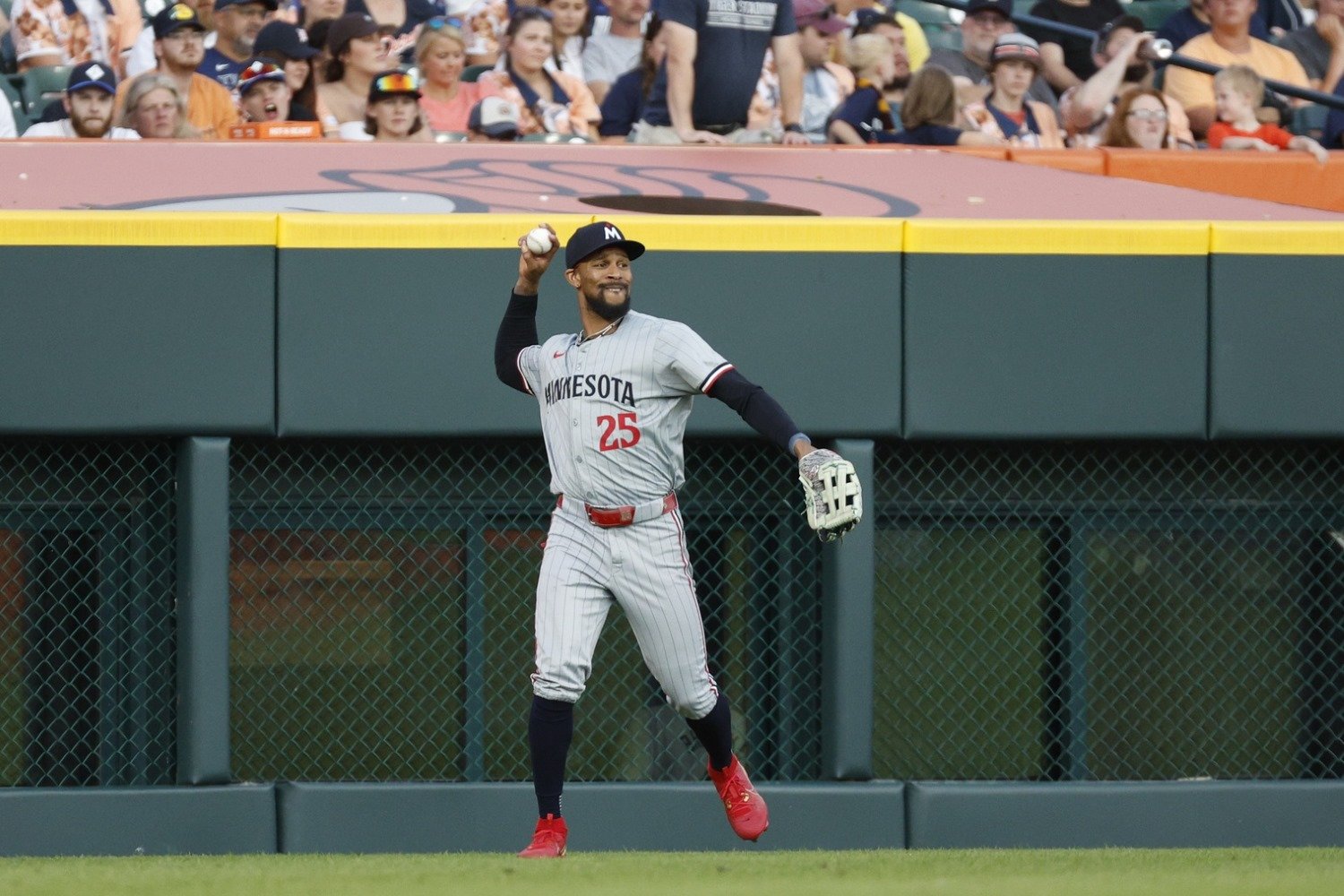 When Byron Buxton signed his extension in the late winter of 2021, there was one central question on most Twins’ fans mind: even with a team-friendly deal, would Buxton play enough to make it worth it? Both the 2019 and 2020 campaigns ended with injuries. When a fastball to the hand limited his 2021 season, he came back too late to make a difference in the losing season. The next year reminded us all how great he can be when he's on the field, but ended without him, while 2023 demonstrated the pitfalls of protecting his playing time. This campaign has been entirely different, however. Buxton has been a consistent center fielder, whose bat has only gotten hotter every month. He's slashing .276/.335/.517 on the season. Since May 1, the only outfielders who have accumulated more WAR are Aaron Judge, Juan Soto, and Jarren Duran. Any long-term worries an early slump prompted have dissipated. More importantly, he has done it not by spending most days as a DH, but in the field, where fans have come to love him. For once, Buxton seems to have survived a collision with the wall unharmed. He's only a fistful of games from matching his 2019 innings total in the outfield, a number he hasn't reached in any of the intervening years. Let’s just say this guy has been out of work. The Twins’ approach in 2024 has been defined clearly: rather than protect Buxton to keep him all season, they have let him loose, without special constraints. But a few notable differences have kept Buxton healthy, and might make for his star-turning moment in October. Forget the DH In 2023, the Twins organization decided it was their job to protect Buxton from injuries, but their plan backfired. The team watched him struggle as the designated hitter, a skill that has made a number of players frustrated in recent years. In an in-depth article by Hannah Keyser, a number of regular DHs—including Andrew McCutchen, Bryce Harper, and Giancarlo Stanton—discussed the difficulty of finding a groove when not spending their time on their toes. Early in the season, Buxton was still seeing a mixture of scheduled off days, center field time, and DH duty. He started as the DH four times in April, and had six off days that month, leading up to his stint on the injured list in early May. Their initial strategy continued to be the same disaster as last year, resulting in a .211/.211/.263 line. He has not done a day at DH since May 22. Buxton still gets more days off than other teammates, but this change in policy has worked for the best. Buxton had the third-best month of his career in July, and he's blasted five homers and three doubles in his last 12 games. Good, Not Great Defense Notably, Buxton’s defensive metrics are down. He's been worth 3 Defensive Runs Saved, but that reflects a pace toward only 5 or 6 in a full season, which would be the worst such mark for him since his rookie campaign of 2016. Meanwhile, SABR’s Defensive Index, which is used to determine Gold Glove winners, has given Buxton a negative rating so far. Defensive metrics (not to mention Gold Glove finalists) are notoriously difficult to evaluate, and sometimes have resulted in questionable winners. Plus, all the metrics still put him above his stopgaps, like Willi Castro and Austin Martin. Buxton has certainly made fewer superstar catches than he had in previous years (though there have been a few stellar moments, like the daring play he made Sunday). And as much as I have watched, I cannot recall many moments where I felt he had taken his foot off the gas. Perhaps Buxton only goes 80% to 90% while out in the field, rather than 110%. Only he could say. But if there are no moments where one could point to his defense as a problem, one must admit this plan is working. Speed Over Steals Earlier in the season, Buxton suggested he and Willi Castro would fight it out for 30 stolen bases. Neither has come close, with Buxton only nabbing six bases so far (while being caught twice). That’s even less than last year, when he managed 15 steals over the disappointing half-season. That follows out of a year where—Elly De La Cruz excepted—stealing has continued its upward tick, with new rules making steals easier. So what happened to that early confidence? While steals are certainly aesthetically pleasing, they are also not worth that much in value. Buxton has instead used his speed with the ball in play—by speeding across bases, turning singles into doubles or bringing a run across when others put the ball in play. Buxton has always had elite sprint speed, but his 29.6 feet per second this season is his fastest since 2021. Stealing is an art, but baserunning aggressiveness can often create runs in a way steals cannot. Perhaps there is an injury Buxton is trying to avoid by stealing—it would be worth asking him why his early season prediction went south. (The team is set to have a similar number of steals to last year, but Castro has significantly decreased his stolen base attempts, as well.) But if the Twins are getting all the beauty of Buxton’s hustle along the bases without having to resort to steals, then all the better for it. All for October The Byron Buxton Resurgence can end at any moment. Twins fans know it too well. A misplaced ball could end it all. Or perhaps a lumbering sausage. Sunday was the latest close call. But the Twins have found an adjustment that works, giving us the Buxton we all want. Now, we just need to hope it lasts.
 -
The Minnesota Twins are on pace to break a painful record in 2024: most times hit by a pitch at bat. Here's a look behind how players like Willi Castro and Ryan Jeffers are taking lead on a not-so-pleasant stat. Image courtesy of © Matt Kartozian-USA TODAY Sports The Minnesota Twins are on pace to break a painful record in 2024: most times hit by a pitch at bat. Here's a look behind how players like Willi Castro and Ryan Jeffers are taking lead on a not-so-pleasant stat. Willi Castro had a chance to break the game open against the Pittsburgh Pirates. It was the top of the 10th inning. Although the Twins had brought a run across the plate, the automatic runner in extra innings meant no guarantee of a win. Castro fell behind early with two strikes, but then got a lucky break. Except in his mind, it wasn’t so lucky: The Twins have been the recipients of 57 plunkings over the first half of the season—one ahead of their rivals, the Cleveland Guardians. That’s on pace for over 114 hit by pitches (HBPs), eight more than the record set by Buck Showalter’s Mets in 2022. And if Matt Wallner rejoins the squad, given his penchant for hit by pitches, they will almost certainly set an unexpected record. Plunk me once, shame on you. Plunk me twice, shame on me? It certainly seems like more than dumb luck that the Twins have become targets for those on the mound (and on top of that, very good luck that Carlos Correa narrowly missed a few broken bones in the rubber game against the Diamondbacks). But there are some surprising decisions by the batters that have resulted in the not-so-lucky chase for bruised glory. Hit by pitches have generally increased in recent years. What was once limited to a revenge decision (and as we saw Kody Funderburk plunk Blaze Alexander, occasionally still is) has become quite common in recent years. While I cannot say for certain, I do not believe any of the HBPs this season have been thrown with malice. Instead, it's just the new norm. With pitchers throwing more gas on off speed pitches and three true outcomes pushing for more pitches in general, teams seemed to have accepted there is little difference between a walk and an HBP. And in the same way that “he gets on base” might have become the first turn toward baseball analytics, teams are willing to let players take the base. Teams have certainly begun strategizing for “plate crowding.” During the 2021 Astros-Braves World Series, the not-so-great catcher Martín Maldonado came up to bat with the bases loaded in Game 5. Maldonado specifically chose to crowd the plate and took a plunk from A.J. Minter’s wild cutter. “Did you guys notice how close he was to the plate on the at-bat against Minter?” A future Twins shortstop told The Athletic at the time. “That was sick.” Perhaps Correa brought that energy to the Twins, though in the words of Jean Renoir, everyone has their reasons. There is one curious stat that helps us understand exactly why these HBPs might be landing on Twins’ arms more than others. Baseball Savant provides a stat called Plate X, an advanced metric that measures the horizontal distance of the ball when crossing the plate from its direct center. Obviously, the Plate X for all HBPs is going to be further out than 0. But when you break out each player, most of them are below the MLB average. These are not balls traveling that far outside the zone. # of Ht By Pitches Plate X (Closer to 0, Closer to Plate) MLB Average - Righties -1.94 Margot 3 -1.66 Correa 2 -1.68 Jeffers 11 -1.77 Castro (RHB) 1 -1.81 Farmer 6 -1.83 Buxton 7 -2.21 Miranda 3 -2.18 MLB Average - Lefties 1.99 Castro (LHB) 10 1.76 Wallner 4 1.52 Kepler 3 1.76 Santana (LHB) 3 2.01 Two hitters in particular are leading the way: Ryan Jeffers and Willi Castro. Both have been hit 11 times. There are obvious reasons why pitchers pound them low and inside. They swing and miss most often when locating there, and when they do it, it’s most likely to be a ground ball: Jeffers is a curious case. When asked about the bruises, Jeffers simply described himself as turning into an armadillo, unable to really move out of the way. But looking at his actual plate appearances, there is a curious problem he faces: Jeffers is a toe tapper when he swings: Many players throughout baseball end up tapping their foot before grounding, but what makes Jeffers a curious case is he does it so late in his swing. Here are three images from games where Jeffers is right about to be hit—the ball is halfway to the plate and Jeffers has not yet begun to move. He’s too busy setting his timing with the darn toe: No wonder why he has little time to get out of the way. Castro is a different case. At 6’1” and just a bit over 200 lbs, he is a rather slight player. He has also admitted he likes to crowd the plate. But more than anything, he really, really loves to swing across the whole plate. This would not be a problem if Castro was Aaron Judge. But because he is a little guy with a below-average swing length, he often throws his whole body into it. If you look at his home runs, he will often end up with a foot right in the middle of the zone because of the amount of spin on his body. Here are three home run machines and Castro at the end of their home runs, and you can see where the body lands: Castro uses his body so much that, well, he can end up on his ass, which we saw against the Diamondbacks: Castro Falls Down.mp4 So what does that have to do with HBPs? Castro loves hunting for that nicely placed ball on the outside of the zone, so he is certainly standing closer to the plate. This is not someone thinking about getting hit. Instead, he is simply fishing to ensure those meatballs end up as dingers. The common thread here is balance, and the ability it provides to get out of the way when the ball comes at you. Jeffers gets his front foot down very late, which leaves him almost no time in which to make a move, because you can't bail out effectively with that foot in the air. Castro has the foot down sooner, but is transferring his weight and a whole lot of kinetic energy down through that leg just as the ball is reaching him. He's even more locked into his spot in the box than Jeffers, just with the other leg. You'll often see some hitters raise their hands, go casually up on tip-toes, and let a ball sail by, within a few inches of their pants or shirtfront. Neither Jeffers nor Castro really has that move in their bag of tricks. Other Twins are creeping up in HBPs: Byron Buxton has now reached seven, a curious case given how much he deliberately chooses to not crowd the plate, while Kyle Farmer has six (notably in low playing time) and Santana sits at four. (Wallner, in his brief time at the beginning of the season, also amassed four.) But no one is doing it like Jeffers and Castro. After becoming the Bomba Squad in 2019, I doubt the Twins hoped to become the Bruise Squad. But, recent offensive production suggests whatever the team is doing at the plate is working. So, let us salute the beans! Let those smacks lead to runs scored. Just watch out for those dear little bones. View full article
-
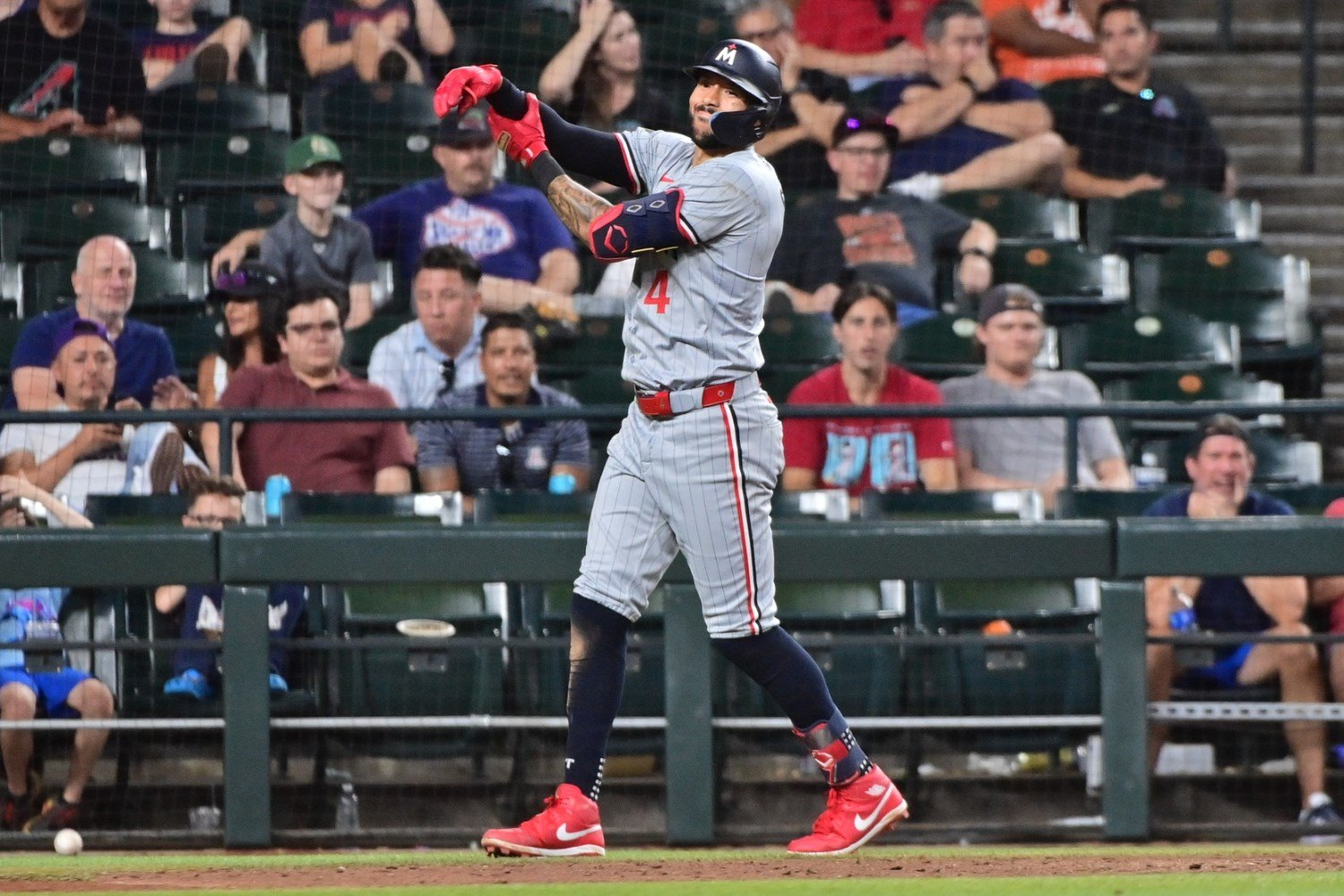 Willi Castro had a chance to break the game open against the Pittsburgh Pirates. It was the top of the 10th inning. Although the Twins had brought a run across the plate, the automatic runner in extra innings meant no guarantee of a win. Castro fell behind early with two strikes, but then got a lucky break. Except in his mind, it wasn’t so lucky: The Twins have been the recipients of 57 plunkings over the first half of the season—one ahead of their rivals, the Cleveland Guardians. That’s on pace for over 114 hit by pitches (HBPs), eight more than the record set by Buck Showalter’s Mets in 2022. And if Matt Wallner rejoins the squad, given his penchant for hit by pitches, they will almost certainly set an unexpected record. Plunk me once, shame on you. Plunk me twice, shame on me? It certainly seems like more than dumb luck that the Twins have become targets for those on the mound (and on top of that, very good luck that Carlos Correa narrowly missed a few broken bones in the rubber game against the Diamondbacks). But there are some surprising decisions by the batters that have resulted in the not-so-lucky chase for bruised glory. Hit by pitches have generally increased in recent years. What was once limited to a revenge decision (and as we saw Kody Funderburk plunk Blaze Alexander, occasionally still is) has become quite common in recent years. While I cannot say for certain, I do not believe any of the HBPs this season have been thrown with malice. Instead, it's just the new norm. With pitchers throwing more gas on off speed pitches and three true outcomes pushing for more pitches in general, teams seemed to have accepted there is little difference between a walk and an HBP. And in the same way that “he gets on base” might have become the first turn toward baseball analytics, teams are willing to let players take the base. Teams have certainly begun strategizing for “plate crowding.” During the 2021 Astros-Braves World Series, the not-so-great catcher Martín Maldonado came up to bat with the bases loaded in Game 5. Maldonado specifically chose to crowd the plate and took a plunk from A.J. Minter’s wild cutter. “Did you guys notice how close he was to the plate on the at-bat against Minter?” A future Twins shortstop told The Athletic at the time. “That was sick.” Perhaps Correa brought that energy to the Twins, though in the words of Jean Renoir, everyone has their reasons. There is one curious stat that helps us understand exactly why these HBPs might be landing on Twins’ arms more than others. Baseball Savant provides a stat called Plate X, an advanced metric that measures the horizontal distance of the ball when crossing the plate from its direct center. Obviously, the Plate X for all HBPs is going to be further out than 0. But when you break out each player, most of them are below the MLB average. These are not balls traveling that far outside the zone. # of Ht By Pitches Plate X (Closer to 0, Closer to Plate) MLB Average - Righties -1.94 Margot 3 -1.66 Correa 2 -1.68 Jeffers 11 -1.77 Castro (RHB) 1 -1.81 Farmer 6 -1.83 Buxton 7 -2.21 Miranda 3 -2.18 MLB Average - Lefties 1.99 Castro (LHB) 10 1.76 Wallner 4 1.52 Kepler 3 1.76 Santana (LHB) 3 2.01 Two hitters in particular are leading the way: Ryan Jeffers and Willi Castro. Both have been hit 11 times. There are obvious reasons why pitchers pound them low and inside. They swing and miss most often when locating there, and when they do it, it’s most likely to be a ground ball: Jeffers is a curious case. When asked about the bruises, Jeffers simply described himself as turning into an armadillo, unable to really move out of the way. But looking at his actual plate appearances, there is a curious problem he faces: Jeffers is a toe tapper when he swings: Many players throughout baseball end up tapping their foot before grounding, but what makes Jeffers a curious case is he does it so late in his swing. Here are three images from games where Jeffers is right about to be hit—the ball is halfway to the plate and Jeffers has not yet begun to move. He’s too busy setting his timing with the darn toe: No wonder why he has little time to get out of the way. Castro is a different case. At 6’1” and just a bit over 200 lbs, he is a rather slight player. He has also admitted he likes to crowd the plate. But more than anything, he really, really loves to swing across the whole plate. This would not be a problem if Castro was Aaron Judge. But because he is a little guy with a below-average swing length, he often throws his whole body into it. If you look at his home runs, he will often end up with a foot right in the middle of the zone because of the amount of spin on his body. Here are three home run machines and Castro at the end of their home runs, and you can see where the body lands: Castro uses his body so much that, well, he can end up on his ass, which we saw against the Diamondbacks: Castro Falls Down.mp4 So what does that have to do with HBPs? Castro loves hunting for that nicely placed ball on the outside of the zone, so he is certainly standing closer to the plate. This is not someone thinking about getting hit. Instead, he is simply fishing to ensure those meatballs end up as dingers. The common thread here is balance, and the ability it provides to get out of the way when the ball comes at you. Jeffers gets his front foot down very late, which leaves him almost no time in which to make a move, because you can't bail out effectively with that foot in the air. Castro has the foot down sooner, but is transferring his weight and a whole lot of kinetic energy down through that leg just as the ball is reaching him. He's even more locked into his spot in the box than Jeffers, just with the other leg. You'll often see some hitters raise their hands, go casually up on tip-toes, and let a ball sail by, within a few inches of their pants or shirtfront. Neither Jeffers nor Castro really has that move in their bag of tricks. Other Twins are creeping up in HBPs: Byron Buxton has now reached seven, a curious case given how much he deliberately chooses to not crowd the plate, while Kyle Farmer has six (notably in low playing time) and Santana sits at four. (Wallner, in his brief time at the beginning of the season, also amassed four.) But no one is doing it like Jeffers and Castro. After becoming the Bomba Squad in 2019, I doubt the Twins hoped to become the Bruise Squad. But, recent offensive production suggests whatever the team is doing at the plate is working. So, let us salute the beans! Let those smacks lead to runs scored. Just watch out for those dear little bones.
- 18 comments
-
- 3
-

-
- willi castro
- ryan jeffers
- (and 1 more)
-
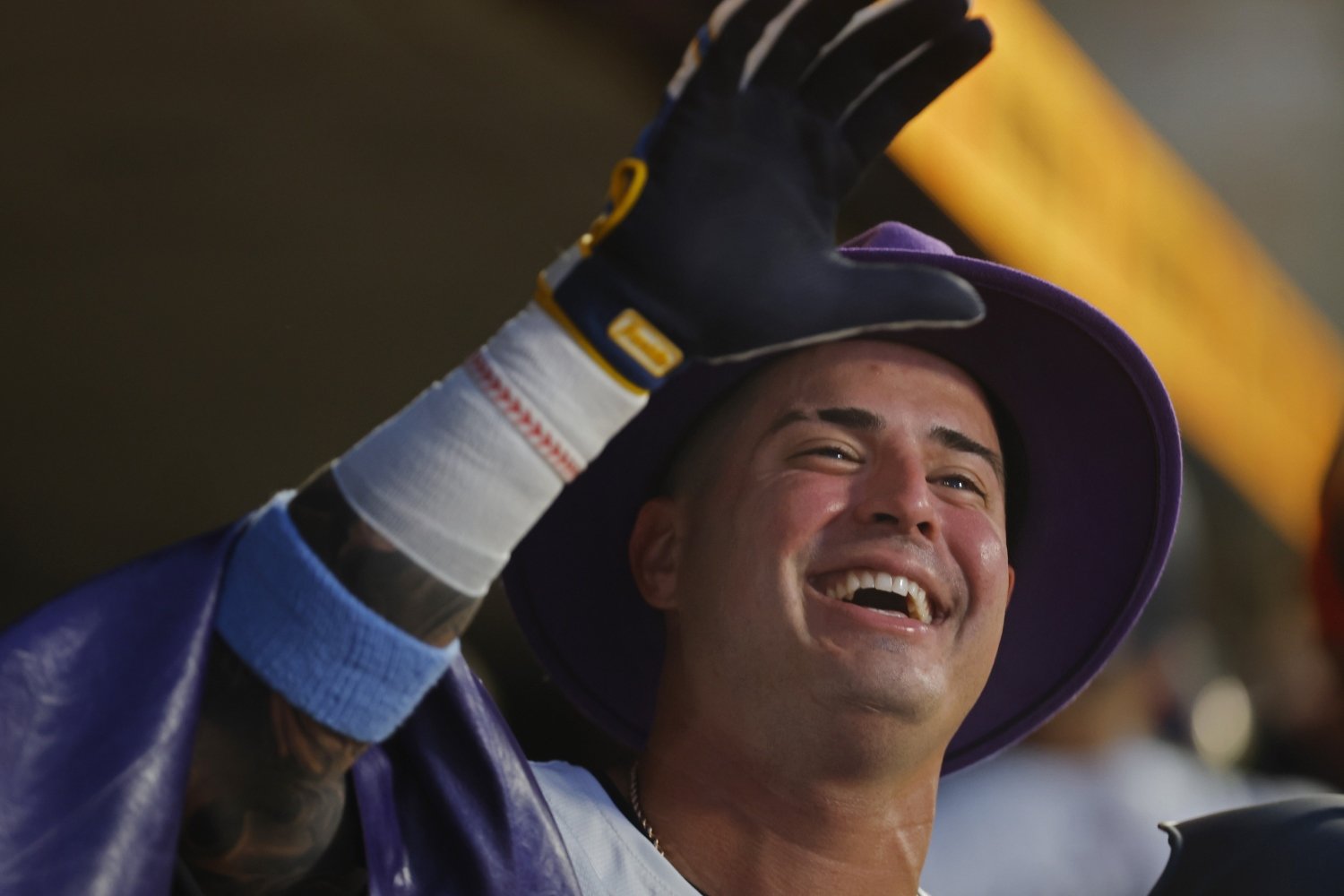 If you tried to rattle off a list of hot Twins players right now, you’d probably mention José Miranda in the second tier of solid hitters for this team. But what is interesting about Miranda’s renaissance is how little has changed from his disastrous 2023 season, when a bad start sent him back to the minors before a shoulder injury ended his season. In 2024, Miranda still lacks true power in his swing. He draws very few walks. And his strikeout rate has shown only marginal improvement. Instead, Miranda is simply hitting more in the zone. When players fix their approach at the plate, it usually has a lot to do with finding their sweet spots. When Carlos Correa struggled at first in 2022, he snapped out of it when he finally stopped chasing difficult pitches outside the zone. Miranda still swings at the same number of pitches outside the zone, though he has improved how often he hits them by about 5%. Instead, Miranda has found more contact within the zone. In fact, Miranda has an in-zone contact rate of 90.5%, which puts him in the top 50 within the league for players with over 150 plate appearances and is the highest for any Twins player (except Max Kepler, who just caught up). But the case becomes more complicated when we look at his heat maps. Miranda is focusing entirely on his sweet spots. Rather than simply swing if a ball is in the zone, Miranda now focuses on mostly hitting in the top of the zone: Because he’s been a foul machine, Miranda is the best Twins hitter with two strikes, hitting .244/.261/.384. The closest regular is Carlos Santana, who is only hitting .214. Miranda has only let seven called third strikes go by. How does Miranda take advantage of fouls? Let’s take a look at this at-bat in Houston against Ronel Blanco. The result here is a walk, but Miranda fouls off seven pitches to get there. Blanco starts off with two pitches pretty far outside the zone, so Miranda let both of them sail by. That puts him into swing mode. He then gets a pitch just above the zone and right in his sweet spot, so he smacks it foul. Pitch 3.mp4 Blanco puts the next outside the zone, but quite close to Miranda’s sweet spot. He chases and makes contact, making it 2-2. Every pitch here, now, could put him away, so Blanco goes to the slider up in the zone, and Miranda takes a swing at it, throwing it into the stands. Pitch 5.mp4 He then tries a fastball in the same position, hoping that the batter won’t catch up. Miranda makes contact anyways. Pitch 6.mp4 He then tries the change up down in the zone. This time Miranda tries for his low angle swing but ends up topping the ball into the ground. Pitch 7.mp4 Blanco tosses another slider away that Miranda refuses to chase, so he tries another changeup, just a little inside. But Miranda still catches most of it and throws it away foul. Pitch 8.mp4 Finally Blanco will throw it away, and Miranda will take his base. Five of the pitches he saw were two-strike offerings in the zone. And Miranda refused to let a single one of them go by. While Miranda has improved, one wonders if this approach will last. Miranda has the highest “called strike” rate of his career, at 16.4%. And as pitchers adjust to his more controlled approach, they will certainly work on pinpointing those spots he prefers to avoid. It’s also affecting his power. Miranda is generally hitting harder and has a stronger barrel rate, but a significantly lower Hard Hit rate. That could mean that when pitchers find the right spot, they force him into more dribblers, rather than line drives. His swing doesn't seem able to sustain its speed down in the zone, the way it does when he gets the ball up at the belt or above. More adjustments loom. That's always the case. But for now, Miranda has got his shot. And he certainly got his bat speed up on a pitch down in the zone Thursday afternoon. What do you think about Miranda’s changed approach at the plate? Or do you think pitchers will take advantage?
 -
Better swing discipline in the zone has put the Twins' infielder into the everyday lineup. With the minors likely behind him, he's coming into his own. Image courtesy of © Bruce Kluckhohn-USA TODAY Sports Better swing discipline in the zone has put the Twins' infielder into the everyday lineup. With the minors likely behind him, he's coming into his own. If you tried to rattle off a list of hot Twins players right now, you’d probably mention José Miranda in the second tier of solid hitters for this team. But what is interesting about Miranda’s renaissance is how little has changed from his disastrous 2023 season, when a bad start sent him back to the minors before a shoulder injury ended his season. In 2024, Miranda still lacks true power in his swing. He draws very few walks. And his strikeout rate has shown only marginal improvement. Instead, Miranda is simply hitting more in the zone. When players fix their approach at the plate, it usually has a lot to do with finding their sweet spots. When Carlos Correa struggled at first in 2022, he snapped out of it when he finally stopped chasing difficult pitches outside the zone. Miranda still swings at the same number of pitches outside the zone, though he has improved how often he hits them by about 5%. Instead, Miranda has found more contact within the zone. In fact, Miranda has an in-zone contact rate of 90.5%, which puts him in the top 50 within the league for players with over 150 plate appearances and is the highest for any Twins player (except Max Kepler, who just caught up). But the case becomes more complicated when we look at his heat maps. Miranda is focusing entirely on his sweet spots. Rather than simply swing if a ball is in the zone, Miranda now focuses on mostly hitting in the top of the zone: Because he’s been a foul machine, Miranda is the best Twins hitter with two strikes, hitting .244/.261/.384. The closest regular is Carlos Santana, who is only hitting .214. Miranda has only let seven called third strikes go by. How does Miranda take advantage of fouls? Let’s take a look at this at-bat in Houston against Ronel Blanco. The result here is a walk, but Miranda fouls off seven pitches to get there. Blanco starts off with two pitches pretty far outside the zone, so Miranda let both of them sail by. That puts him into swing mode. He then gets a pitch just above the zone and right in his sweet spot, so he smacks it foul. Pitch 3.mp4 Blanco puts the next outside the zone, but quite close to Miranda’s sweet spot. He chases and makes contact, making it 2-2. Every pitch here, now, could put him away, so Blanco goes to the slider up in the zone, and Miranda takes a swing at it, throwing it into the stands. Pitch 5.mp4 He then tries a fastball in the same position, hoping that the batter won’t catch up. Miranda makes contact anyways. Pitch 6.mp4 He then tries the change up down in the zone. This time Miranda tries for his low angle swing but ends up topping the ball into the ground. Pitch 7.mp4 Blanco tosses another slider away that Miranda refuses to chase, so he tries another changeup, just a little inside. But Miranda still catches most of it and throws it away foul. Pitch 8.mp4 Finally Blanco will throw it away, and Miranda will take his base. Five of the pitches he saw were two-strike offerings in the zone. And Miranda refused to let a single one of them go by. While Miranda has improved, one wonders if this approach will last. Miranda has the highest “called strike” rate of his career, at 16.4%. And as pitchers adjust to his more controlled approach, they will certainly work on pinpointing those spots he prefers to avoid. It’s also affecting his power. Miranda is generally hitting harder and has a stronger barrel rate, but a significantly lower Hard Hit rate. That could mean that when pitchers find the right spot, they force him into more dribblers, rather than line drives. His swing doesn't seem able to sustain its speed down in the zone, the way it does when he gets the ball up at the belt or above. More adjustments loom. That's always the case. But for now, Miranda has got his shot. And he certainly got his bat speed up on a pitch down in the zone Thursday afternoon. What do you think about Miranda’s changed approach at the plate? Or do you think pitchers will take advantage? View full article
-
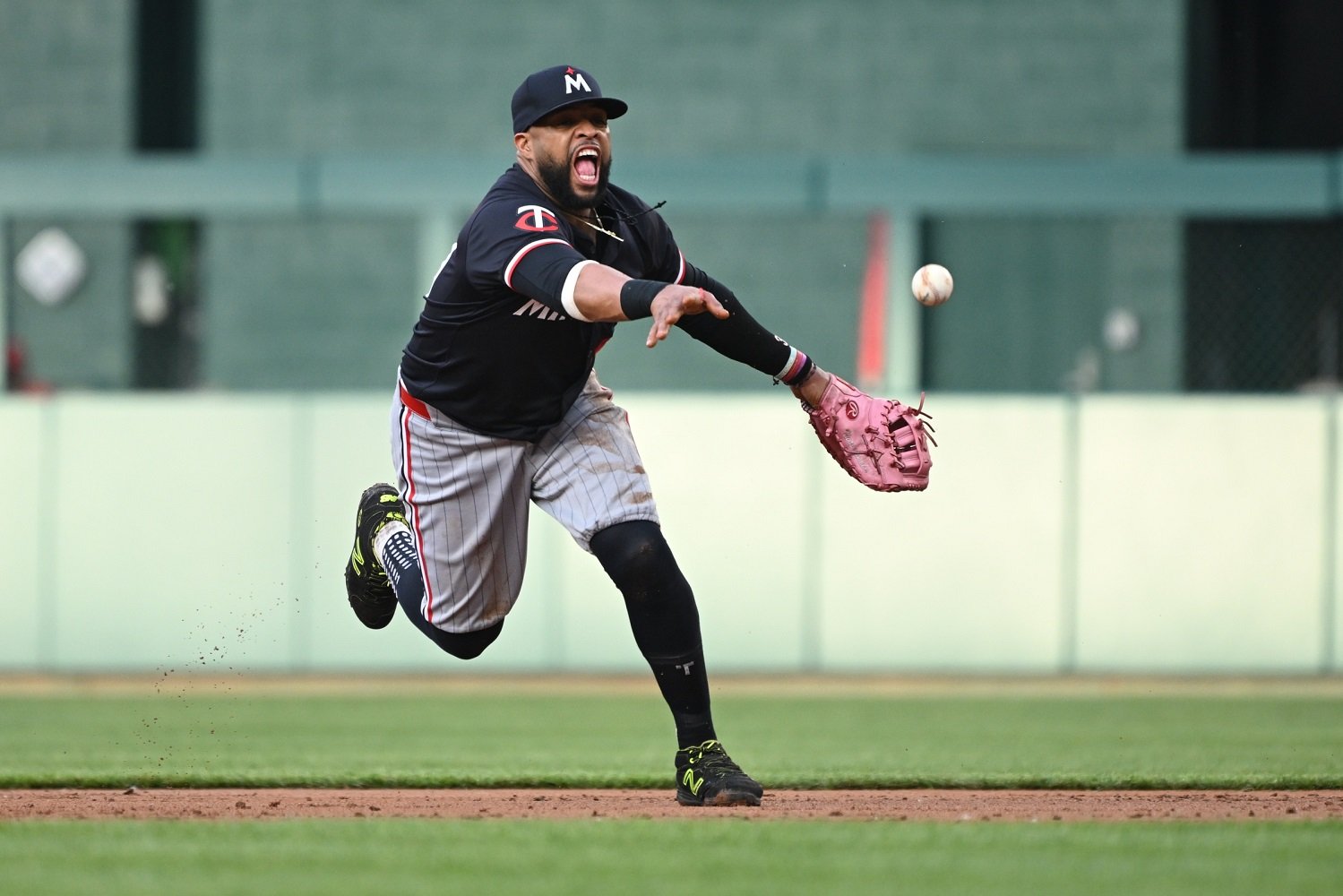 If you've watched the Twins broadcast this season (or at least have fond memories, as it remains blacked out), perhaps you recall hearing Cory Provus say this (as I have noticed quite a few times): “And Santana will take it himself, as he often does.” Provus is, of course, referring to the Twins' primary first baseman, Carlos Santana, whose excellent defense has made up for his lagging offense. But Provus’s point was getting at something different. If a grounder is hit at Santana near first, he is more likely to get up and make for the bag rather than make the toss to the pitcher to get the out. Occasionally, as we saw in Thursday’s win over the Royals, this can be quite spectacular to watch: But sometimes, in cases where a toss would be easier, Santana will take it himself: But this remark got me asking: is it true? Does Santana actually lead the league in what TD Managing Editor Matt Trueblood and I have coined as the TiH (Take it Himself) Rate? Or is Cory Provus a liar, deceiving audiences everywhere with claims to create the wrong perceptions to poison this beautiful game? (If you’re reading this, Cory, this a joke and we love you here at TD. Even if Cory's not reading this, we love him.) Choosing whether to make the run to first is a split-second decision. It depends on the position of the first baseman, the speed of the batter, whether the pitcher is hustling over, how the ball was hit, and well, a lot of things. It's always a risk. In one costly decision earlier this season, Santana tossed it to pitcher Simeon Woods Richardson, whose run had briefly paused earlier and thus allowed a single: But sometimes Santana is just playing nice with the pitcher, who perhaps wants a reward for his little hustle: In trying to look at the obvious statistics, such as Exit Velocity or Expected Batting Average, there was no obvious pattern to when Santana made which choice. But we can use two key stats from Statcast—hc_x and hc_y—alongside a little trigonometry to estimate the Spray Angle of the ball (with the higher number essentially closer to first base and the foul line). We can thus evaluate whether the proximity to first base matters: As we can see here, the spray angle does certainly make a difference, though not always. In the examples closer to second, Santana usually waits a bit on soft contact to field the ball, thus requiring the pitcher to head over and the toss to be made: But what is most remarkable in this data is the overlap space. And we can certainly see from the data points that Santana has a positive TiH. But does he have one higher than the rest of the league? What exactly is an average TiH%? Using Baseball Savant, I was able to take every single grounder to first this season by any player (this data also removed singles and errors like the one with Woods Richardson above, so there is potential for more to be examined here). After removing those who had yet to have many opportunities, we can see where Santana ranks among this season’s first basemen: Player Team Opportunities TiH Count TiH% Encarnacion-Strand, Christian Cincinnati 34 24 70.6% Montero, Elehuris Colorado 32 22 68.8% Cronenworth, Jake San Diego 57 38 66.7% Díaz, Yandy Tampa Bay 42 27 64.3% Olson, Matt Atlanta 56 36 64.3% Walker, Christian Arizona 78 50 64.1% Vaughn, Andrew Chi White Sox 50 32 64.0% Santana, Carlos Minnesota 54 34 63.0% Flores, Wilmer San Francisco 38 23 60.5% Busch, Michael Chi Cubs 50 30 60.0% Tellez, Rowdy Milwaukee 40 23 57.5% Schanuel, Nolan LA Angels 40 23 57.5% Naylor, Josh Cleveland 51 29 56.9% Alonso, Pete NY Mets 56 31 55.4% Mountcastle, Ryan Baltimore 49 27 55.1% Torkelson, Spencer Detroit 50 26 52.0% Goldschmidt, Paul St. Louis 58 30 51.7% Lowe, Nathaniel Texas 37 19 51.4% Guerrero Jr., Vladimir Toronto 34 17 50.0% Bell, Josh Miami 33 16 48.5% Harper, Bryce Philadelphia 64 31 48.4% Pasquantino, Vinnie Kansas City 47 22 46.8% France, Ty Seattle 56 23 41.1% Rizzo, Anthony NY Yankees 57 19 33.3% Freeman, Freddie LA Dodgers 64 19 29.7% Wade Jr., LaMonte San Francisco 34 10 29.4% As it turns out, Provus is on the right track. Santana sits at 63%, in about the top third of regular MLB first basemen. His rate is especially high when compared to some of the league’s better-known first basemen like Freddie Freeman and Anthony Rizzo; the shorter and slower Santana is, in fact, more than twice as likely to hustle the ball to first than toss it to the pitcher. Of course, 2024 provides a small sample size. What happens when we go back to the 2023 season and put Santana’s time between the Pirates and the Brewers in context? Player Team Opportunities TiH TiH% Cronenworth, Jake San Diego 96 75 78.1% Pratto, Nick Kansas City 79 61 77.2% Flores, Wilmer San Francisco 73 53 72.6% Cooper, Garrett Miami / San Diego 74 53 71.6% Gurriel, Yuli Miami 73 51 69.9% Abreu, José Houston 141 97 68.8% Noda, Ryan Oakland 83 56 67.5% Vaughn, Andrew Chi White Sox 146 98 67.1% Olson, Matt Atlanta 169 112 66.3% Walker, Christian Arizona 158 103 65.2% Guerrero Jr., Vladimir Toronto 119 77 64.7% Naylor, Josh Cleveland 94 59 62.8% Wade Jr., LaMonte San Francisco 128 74 57.8% Santana, Carlos Pittsburgh / Milwaukee 175 99 56.6% Díaz, Yandy Tampa Bay 119 66 55.5% Torkelson, Spencer Detroit 120 62 51.7% Lowe, Nathaniel Texas 151 74 49.0% Mountcastle, Ryan Baltimore 112 53 47.3% Casas, Triston Boston 128 59 46.1% Goldschmidt, Paul St. Louis 161 73 45.3% Tellez, Rowdy Milwaukee 70 31 44.3% France, Ty Seattle 152 65 42.8% Freeman, Freddie LA Dodgers 160 67 41.9% Smith, Dominic Washington 164 66 40.2% Alonso, Pete NY Mets 163 62 38.0% Rizzo, Anthony NY Yankees 122 38 31.1% Here we notice a few things. Firstly, Santana’s rate is notably higher so far this year than it was in 2023, only taking it to first base just over half the time (he also notably had the most opportunities for a TiH at 175). We also can see that for those with the most playing time—such as Matt Olson, Christian Walker, and José Abreu—a top rate ends up around 65-69%, which Santana currently sits just under for the season. The exception is Jake Cronenworth, who both this and last year is a league leader in TiH%. That might make sense—the former shortstop has been an elite second baseman for the team but currently finds himself over at first due to an influx of shortstop prospects on the team. So, Santana has been "better" (more TiH-y, anyway) this year, but what can we expect career-wise? Santana began playing first base with regularity in 2015, so we can look at his historical TiH% with each team he’s played with: Here we can see that once Santana got to a point of playing first base with some regularity, he has always been above-average in TiH rate. It seems to vary by team, and while we might speculate that the Guardians and the Mariners have above-average pitching (and thus create above-average TiH rates), nothing can explain Santana's monster 2021 season--wherein he Took It Himself on 92 of 122 opportunities (the Royals had an abysmal pitching staff that year). But then there’s one last question: where does Carlos Santana rank among the Twins greats? Provus has been calling for the squad since 2011; surely he knows a high TiH-er when he sees one. This is where things are a bit surprising: Player Opportunities TiH TiH% Miranda, Jose 63 54 85.7% Sanó, Miguel 170 132 77.6% Arraez, Luis 51 39 76.5% Cron, C.J. 118 86 72.9% Cuddyer, Michael 172 117 68.0% Vargas, Kennys 102 69 67.6% Kirilloff, Alex 92 61 66.3% Parmelee, Chris 117 75 64.1% Santana, Carlos 54 34 63.0% Colabello, Chris 51 30 58.8% Morneau, Justin 639 354 55.4% Santana ranks near the bottom in TiH Rate for Twins first basemen, notably lagging behind recent regulars like José Miranda and Luis Arráez (who has played notably less first base this year, but has a perfect 12 for 12 TiH Rate in 2024). However, Santana does rank behind both Minnesota greats, including Cory’s broadcast partner Justin Morneau, who put up a middling 55%. Does Cory mention it less when Glen Perkins or LaTroy Hawkins is in the booth instead? Perhaps Cory’s comments are meant to remind Justin how little he hustled in his career! (Justin, if you're reading this, this is also a joke. If Justin isn't reading this, though, screw him.) We do have to finally ask: is there any value in TiH%? Are you more likely to win a Gold Glove with a high TiH%? That might require a further study to link up the quality of first basemen and other defensive metrics with their actual performance. On the other hand, TiH could also be described as the ultimate eyewash. After all, Freddie Freeman is considered one of the best first basemen in the game, and he has one of the lowest TiH rates in the game. Watch Anthony Rizzo make the game's most frequent, fluid, flawless feeds to pitchers a handful of times, and you could convince me that that toss is an art form as worthy of praise as the hustle and assertiveness of Taking It Oneself. T1FkUTRfWGw0TUFRPT1fQjFBQ1UxZFFBd1VBWFZNQ1ZnQUFCVk5RQUFNRkFnY0FDbFJVQWxFTkJBUUdDUXBT.mp4 There's no reward for TiH, or for the pleasing parabola of a Rizzo flip—each way results in an out. But maybe it can tell us something a little about the stylistic choices of first base defense. If nothing else, it's a fun thing to file away, as a fan trying to get into closer contact with the game. So here’s to you, Cory! You (mostly) got it right about Carlos. And we’ll be watching TiH% throughout the season, and we hope you will keep up as well.
 -
A casual remark on by Twins Broadcast Cory Provus ignites a deep dive on a fascinating statistic within baseball: how often do first basemen take a ground ball to their base themselves? Featuring charts and graphs! Image courtesy of Rafael Suanes-USA TODAY Sports A casual remark on by Twins Broadcast Cory Provus ignites a deep dive on a fascinating statistic within baseball: how often do first basemen take a ground ball to their base themselves? Featuring charts and graphs! If you've watched the Twins broadcast this season (or at least have fond memories, as it remains blacked out), perhaps you recall hearing Cory Provus say this (as I have noticed quite a few times): “And Santana will take it himself, as he often does.” Provus is, of course, referring to the Twins' primary first baseman, Carlos Santana, whose excellent defense has made up for his lagging offense. But Provus’s point was getting at something different. If a grounder is hit at Santana near first, he is more likely to get up and make for the bag rather than make the toss to the pitcher to get the out. Occasionally, as we saw in Thursday’s win over the Royals, this can be quite spectacular to watch: But sometimes, in cases where a toss would be easier, Santana will take it himself: But this remark got me asking: is it true? Does Santana actually lead the league in what TD Managing Editor Matt Trueblood and I have coined as the TiH (Take it Himself) Rate? Or is Cory Provus a liar, deceiving audiences everywhere with claims to create the wrong perceptions to poison this beautiful game? (If you’re reading this, Cory, this a joke and we love you here at TD. Even if Cory's not reading this, we love him.) Choosing whether to make the run to first is a split-second decision. It depends on the position of the first baseman, the speed of the batter, whether the pitcher is hustling over, how the ball was hit, and well, a lot of things. It's always a risk. In one costly decision earlier this season, Santana tossed it to pitcher Simeon Woods Richardson, whose run had briefly paused earlier and thus allowed a single: But sometimes Santana is just playing nice with the pitcher, who perhaps wants a reward for his little hustle: In trying to look at the obvious statistics, such as Exit Velocity or Expected Batting Average, there was no obvious pattern to when Santana made which choice. But we can use two key stats from Statcast—hc_x and hc_y—alongside a little trigonometry to estimate the Spray Angle of the ball (with the higher number essentially closer to first base and the foul line). We can thus evaluate whether the proximity to first base matters: As we can see here, the spray angle does certainly make a difference, though not always. In the examples closer to second, Santana usually waits a bit on soft contact to field the ball, thus requiring the pitcher to head over and the toss to be made: But what is most remarkable in this data is the overlap space. And we can certainly see from the data points that Santana has a positive TiH. But does he have one higher than the rest of the league? What exactly is an average TiH%? Using Baseball Savant, I was able to take every single grounder to first this season by any player (this data also removed singles and errors like the one with Woods Richardson above, so there is potential for more to be examined here). After removing those who had yet to have many opportunities, we can see where Santana ranks among this season’s first basemen: Player Team Opportunities TiH Count TiH% Encarnacion-Strand, Christian Cincinnati 34 24 70.6% Montero, Elehuris Colorado 32 22 68.8% Cronenworth, Jake San Diego 57 38 66.7% Díaz, Yandy Tampa Bay 42 27 64.3% Olson, Matt Atlanta 56 36 64.3% Walker, Christian Arizona 78 50 64.1% Vaughn, Andrew Chi White Sox 50 32 64.0% Santana, Carlos Minnesota 54 34 63.0% Flores, Wilmer San Francisco 38 23 60.5% Busch, Michael Chi Cubs 50 30 60.0% Tellez, Rowdy Milwaukee 40 23 57.5% Schanuel, Nolan LA Angels 40 23 57.5% Naylor, Josh Cleveland 51 29 56.9% Alonso, Pete NY Mets 56 31 55.4% Mountcastle, Ryan Baltimore 49 27 55.1% Torkelson, Spencer Detroit 50 26 52.0% Goldschmidt, Paul St. Louis 58 30 51.7% Lowe, Nathaniel Texas 37 19 51.4% Guerrero Jr., Vladimir Toronto 34 17 50.0% Bell, Josh Miami 33 16 48.5% Harper, Bryce Philadelphia 64 31 48.4% Pasquantino, Vinnie Kansas City 47 22 46.8% France, Ty Seattle 56 23 41.1% Rizzo, Anthony NY Yankees 57 19 33.3% Freeman, Freddie LA Dodgers 64 19 29.7% Wade Jr., LaMonte San Francisco 34 10 29.4% As it turns out, Provus is on the right track. Santana sits at 63%, in about the top third of regular MLB first basemen. His rate is especially high when compared to some of the league’s better-known first basemen like Freddie Freeman and Anthony Rizzo; the shorter and slower Santana is, in fact, more than twice as likely to hustle the ball to first than toss it to the pitcher. Of course, 2024 provides a small sample size. What happens when we go back to the 2023 season and put Santana’s time between the Pirates and the Brewers in context? Player Team Opportunities TiH TiH% Cronenworth, Jake San Diego 96 75 78.1% Pratto, Nick Kansas City 79 61 77.2% Flores, Wilmer San Francisco 73 53 72.6% Cooper, Garrett Miami / San Diego 74 53 71.6% Gurriel, Yuli Miami 73 51 69.9% Abreu, José Houston 141 97 68.8% Noda, Ryan Oakland 83 56 67.5% Vaughn, Andrew Chi White Sox 146 98 67.1% Olson, Matt Atlanta 169 112 66.3% Walker, Christian Arizona 158 103 65.2% Guerrero Jr., Vladimir Toronto 119 77 64.7% Naylor, Josh Cleveland 94 59 62.8% Wade Jr., LaMonte San Francisco 128 74 57.8% Santana, Carlos Pittsburgh / Milwaukee 175 99 56.6% Díaz, Yandy Tampa Bay 119 66 55.5% Torkelson, Spencer Detroit 120 62 51.7% Lowe, Nathaniel Texas 151 74 49.0% Mountcastle, Ryan Baltimore 112 53 47.3% Casas, Triston Boston 128 59 46.1% Goldschmidt, Paul St. Louis 161 73 45.3% Tellez, Rowdy Milwaukee 70 31 44.3% France, Ty Seattle 152 65 42.8% Freeman, Freddie LA Dodgers 160 67 41.9% Smith, Dominic Washington 164 66 40.2% Alonso, Pete NY Mets 163 62 38.0% Rizzo, Anthony NY Yankees 122 38 31.1% Here we notice a few things. Firstly, Santana’s rate is notably higher so far this year than it was in 2023, only taking it to first base just over half the time (he also notably had the most opportunities for a TiH at 175). We also can see that for those with the most playing time—such as Matt Olson, Christian Walker, and José Abreu—a top rate ends up around 65-69%, which Santana currently sits just under for the season. The exception is Jake Cronenworth, who both this and last year is a league leader in TiH%. That might make sense—the former shortstop has been an elite second baseman for the team but currently finds himself over at first due to an influx of shortstop prospects on the team. So, Santana has been "better" (more TiH-y, anyway) this year, but what can we expect career-wise? Santana began playing first base with regularity in 2015, so we can look at his historical TiH% with each team he’s played with: Here we can see that once Santana got to a point of playing first base with some regularity, he has always been above-average in TiH rate. It seems to vary by team, and while we might speculate that the Guardians and the Mariners have above-average pitching (and thus create above-average TiH rates), nothing can explain Santana's monster 2021 season--wherein he Took It Himself on 92 of 122 opportunities (the Royals had an abysmal pitching staff that year). But then there’s one last question: where does Carlos Santana rank among the Twins greats? Provus has been calling for the squad since 2011; surely he knows a high TiH-er when he sees one. This is where things are a bit surprising: Player Opportunities TiH TiH% Miranda, Jose 63 54 85.7% Sanó, Miguel 170 132 77.6% Arraez, Luis 51 39 76.5% Cron, C.J. 118 86 72.9% Cuddyer, Michael 172 117 68.0% Vargas, Kennys 102 69 67.6% Kirilloff, Alex 92 61 66.3% Parmelee, Chris 117 75 64.1% Santana, Carlos 54 34 63.0% Colabello, Chris 51 30 58.8% Morneau, Justin 639 354 55.4% Santana ranks near the bottom in TiH Rate for Twins first basemen, notably lagging behind recent regulars like José Miranda and Luis Arráez (who has played notably less first base this year, but has a perfect 12 for 12 TiH Rate in 2024). However, Santana does rank behind both Minnesota greats, including Cory’s broadcast partner Justin Morneau, who put up a middling 55%. Does Cory mention it less when Glen Perkins or LaTroy Hawkins is in the booth instead? Perhaps Cory’s comments are meant to remind Justin how little he hustled in his career! (Justin, if you're reading this, this is also a joke. If Justin isn't reading this, though, screw him.) We do have to finally ask: is there any value in TiH%? Are you more likely to win a Gold Glove with a high TiH%? That might require a further study to link up the quality of first basemen and other defensive metrics with their actual performance. On the other hand, TiH could also be described as the ultimate eyewash. After all, Freddie Freeman is considered one of the best first basemen in the game, and he has one of the lowest TiH rates in the game. Watch Anthony Rizzo make the game's most frequent, fluid, flawless feeds to pitchers a handful of times, and you could convince me that that toss is an art form as worthy of praise as the hustle and assertiveness of Taking It Oneself. T1FkUTRfWGw0TUFRPT1fQjFBQ1UxZFFBd1VBWFZNQ1ZnQUFCVk5RQUFNRkFnY0FDbFJVQWxFTkJBUUdDUXBT.mp4 There's no reward for TiH, or for the pleasing parabola of a Rizzo flip—each way results in an out. But maybe it can tell us something a little about the stylistic choices of first base defense. If nothing else, it's a fun thing to file away, as a fan trying to get into closer contact with the game. So here’s to you, Cory! You (mostly) got it right about Carlos. And we’ll be watching TiH% throughout the season, and we hope you will keep up as well. View full article
-
A look behind the scenes at an unexpected delight during the Nationals Series, as a Twins relief pitcher makes an odd and wondrous gesture. Image courtesy of © Tommy Gilligan-USA TODAY Sports A look behind the scenes at an unexpected delight during the Nationals Series, as a Twins relief pitcher makes an odd and wondrous gesture. Keith Morrisroe has been part of the Nationals crew since 2022 but had never driven anyone. He’s one of five drivers who switch out days, waiting patiently for whoever from the bullpen might want a ride on their cart that day. “We pull up right outside the gate, and, if they hop in, we take them for a ride.” Morrisroe was just as surprised as anyone when Twins reliever Steven Okert jumped in during Wednesday’s 3-2 win over the Nationals as he came in relief for Simeon Woods Richardson. He had a plan to buy the uniform of whoever took the opportunity. “I told myself when I started, whoever my first rider was, I'm going to buy their jersey.” Of course, he did not expect the $5 tip—or the social media frenzy—that came his way after Okert reached out with the bill. “He hopped out, and, you know, he was the motion of handing me something. I was not expecting a tip and the dugout right there was laughing pretty good. I was kind of shocked, and, you know, I thought it was a fun, good hearted moment.” From all accounts, Okert made history with his tip. As noted by the Nationals PR, Okert has taken the bullpen cart every time during his Miami days. But this is the first time he—or any player— has ever offered a tip. According to Morrisroe, “The group chat [between the driving crew] were all pretty excited, so it seemed to be the first.” He’s already gone ahead and framed the bill, just like a restaurant or bar receiving its first dollar. The history of bullpen carts is a sad and lost art. Cleveland first debuted on in the 1950s, with other teams following suit. Perhaps most infamously was the M.S. Relief, a tugboat shaped one used by the Mariners for a season in the 1980s. But today, only the Nationals seem to have one in (not particularly) regular use. According to a report by the Washington Post’s Jesse Dougherty, most pitchers find it might throw off their routine, or that they are not senior enough to participate in the fun. Not Okert, who got four outs in the close game between the Twins and the Nationals. As he told The Athletic's Dan Hayes, “I was carrying it the whole series waiting to get in. Got to use it.” In his performances at Nationals Park, Okert has given up nine hits—including two home runs—over 42 plate appearances with 12 strikeouts and three walks. His OBP is notably lower at Nationals Park than it is at every other stadium combined. Perhaps the cart does a little wonder. Rather than tip his pitches, he is simply a pitcher who tips. Morrisroe balances both the seriousness the pitchers might be facing in the moment with the entertainment for the fans. “We don’t speak to them most of the time. They’re in their zone.” At the same time, the gimmick provides a little extra. “We just want to be a part of the fun game day experience for, for all the fans and, and the players, and I think people got a good hearted story rom that moment, so I think, you who wouldn't want more of those? View full article
-
 Keith Morrisroe has been part of the Nationals crew since 2022 but had never driven anyone. He’s one of five drivers who switch out days, waiting patiently for whoever from the bullpen might want a ride on their cart that day. “We pull up right outside the gate, and, if they hop in, we take them for a ride.” Morrisroe was just as surprised as anyone when Twins reliever Steven Okert jumped in during Wednesday’s 3-2 win over the Nationals as he came in relief for Simeon Woods Richardson. He had a plan to buy the uniform of whoever took the opportunity. “I told myself when I started, whoever my first rider was, I'm going to buy their jersey.” Of course, he did not expect the $5 tip—or the social media frenzy—that came his way after Okert reached out with the bill. “He hopped out, and, you know, he was the motion of handing me something. I was not expecting a tip and the dugout right there was laughing pretty good. I was kind of shocked, and, you know, I thought it was a fun, good hearted moment.” From all accounts, Okert made history with his tip. As noted by the Nationals PR, Okert has taken the bullpen cart every time during his Miami days. But this is the first time he—or any player— has ever offered a tip. According to Morrisroe, “The group chat [between the driving crew] were all pretty excited, so it seemed to be the first.” He’s already gone ahead and framed the bill, just like a restaurant or bar receiving its first dollar. The history of bullpen carts is a sad and lost art. Cleveland first debuted on in the 1950s, with other teams following suit. Perhaps most infamously was the M.S. Relief, a tugboat shaped one used by the Mariners for a season in the 1980s. But today, only the Nationals seem to have one in (not particularly) regular use. According to a report by the Washington Post’s Jesse Dougherty, most pitchers find it might throw off their routine, or that they are not senior enough to participate in the fun. Not Okert, who got four outs in the close game between the Twins and the Nationals. As he told The Athletic's Dan Hayes, “I was carrying it the whole series waiting to get in. Got to use it.” In his performances at Nationals Park, Okert has given up nine hits—including two home runs—over 42 plate appearances with 12 strikeouts and three walks. His OBP is notably lower at Nationals Park than it is at every other stadium combined. Perhaps the cart does a little wonder. Rather than tip his pitches, he is simply a pitcher who tips. Morrisroe balances both the seriousness the pitchers might be facing in the moment with the entertainment for the fans. “We don’t speak to them most of the time. They’re in their zone.” At the same time, the gimmick provides a little extra. “We just want to be a part of the fun game day experience for, for all the fans and, and the players, and I think people got a good hearted story rom that moment, so I think, you who wouldn't want more of those?
 -
Desperate for innings, teams are transforming ace closers into starters. Should the Twins solve their rotation depth issues by moving their best bullpen arm? Image courtesy of Brad Rempel-USA TODAY Sports Desperate for innings, teams are transforming ace closers into starters. Should the Twins solve their rotation depth issues by moving their best bullpen arm? Twins fans probably don’t remember much about Zack Littell. The cruise-ship loving pitcher began as a weak starter before becoming a reliable reliever in 2019 (though he posted a xERA of 5.51). During the 2020 season, his underwhelming stuff became too much for the playoff-bound team to keep and he was outrighted off the roster. Littell bounced around between the Giants, Rangers and Red Sox before making his home with Tampa in the middle of last year. And the Rays did what they do best. Littell was converted back from reliever to starter, throwing 87 innings with a 3.93 ERA. So far, he looks even better this season; over 27 innings, the righty has a 3.11 ERA and a top 20 FIP. Not bad for a literal mid-season DFA pick up. But the Rays are not unique. Converting bullpen arms into quality starters has become a bit of a trend for 2024. The Braves’ best starter is former White Sox ace Reynaldo Lopez. Michael King took a no hitter into the eighth for the Padres. Jordan Hicks is crushing for SF. Seth Lugo is building a Cy Young candidacy in Kansas City. Converted Starters IP ERA- FIP- Zack Littell (Rays) 27 91 76 Reynaldo Lopez (Braves) 25 18 71 Michael King (Padres) 30.2 107 144 Jordan Hicks (Giants) 28 41 99 Seth Lugo (Royals) 38 41 85 So that opens the question: could Durán join this crew? Cody Schoenmann speculated on the same topic in January, though there was no data to back up that these conversions would work. It’s hard to say how many innings each of these starters have in them, but now it does seem that this seems to be working. More so, the Twins now need innings and good ones. Anthony DeSclafani never made it to the mound; Louie Varland got pushed to the minors to fix his stuff. Simeon Woods Richardson has looked capable in the fifth slot, but the reinforcements behind him are scant. The Twins could always pick up a veteran for a minor league deal, but what about five strong innings from Jhoan Durán? Durán never got a real chance with the Twins organization as a starter. After coming over in the Eduardo Escobar trade, the lost minor league season in 2020 and an elbow strain in 2021 pushed the Twins to rethink a pitcher who had never topped 115 innings. He abandoned his changeup, relying entirely on his fastball, “splinker,” and curveball. A few things have changed in Durán’s profile since making the majors. He throws his now infamous splinker as much as his curveball, creating a three-pitch mix. That’s maybe not enough to go deep into games, but perhaps it’s enough to make it five innings and limit his need. After all, Durán has comfortably gone two innings plenty of times, including his elite performance in the Twins’ final playoff game. When Durán debuted in 2022, there was very little hope in the bullpen besides him. Now, the Twins have a bonafide army with Griffin Jax and Brock Stewart headlining the group that remains a top 5 bullpen (and top 2 in strikeouts). Durán would only push that group into elite territory, but right now the Twins need to be asking what they need more. Of course, this is a pipe dream. When asked about this possibility last year, Rocco Baldelli poured some cold water. “I daydream about him closing big games for us. I don't daydream about him starting.” And more than that, how can one want to get rid of the league’s most epic closer entrance It might be too late to convert Durán into a full-blown starter for 2024, especially with the Twins wanting to be careful with his injury as he returns. But unless the Twins have other plans to bolster their back end rotation, they might need to have a serious conversation going into 2025. What do you think? Should Durán become a starter? Sound off in the comments. View full article
-
Jhoan Durán Will Soon Return for the Twins. Should He Be Starting?
Peter Labuza posted an article in Twins
 Twins fans probably don’t remember much about Zack Littell. The cruise-ship loving pitcher began as a weak starter before becoming a reliable reliever in 2019 (though he posted a xERA of 5.51). During the 2020 season, his underwhelming stuff became too much for the playoff-bound team to keep and he was outrighted off the roster. Littell bounced around between the Giants, Rangers and Red Sox before making his home with Tampa in the middle of last year. And the Rays did what they do best. Littell was converted back from reliever to starter, throwing 87 innings with a 3.93 ERA. So far, he looks even better this season; over 27 innings, the righty has a 3.11 ERA and a top 20 FIP. Not bad for a literal mid-season DFA pick up. But the Rays are not unique. Converting bullpen arms into quality starters has become a bit of a trend for 2024. The Braves’ best starter is former White Sox ace Reynaldo Lopez. Michael King took a no hitter into the eighth for the Padres. Jordan Hicks is crushing for SF. Seth Lugo is building a Cy Young candidacy in Kansas City. Converted Starters IP ERA- FIP- Zack Littell (Rays) 27 91 76 Reynaldo Lopez (Braves) 25 18 71 Michael King (Padres) 30.2 107 144 Jordan Hicks (Giants) 28 41 99 Seth Lugo (Royals) 38 41 85 So that opens the question: could Durán join this crew? Cody Schoenmann speculated on the same topic in January, though there was no data to back up that these conversions would work. It’s hard to say how many innings each of these starters have in them, but now it does seem that this seems to be working. More so, the Twins now need innings and good ones. Anthony DeSclafani never made it to the mound; Louie Varland got pushed to the minors to fix his stuff. Simeon Woods Richardson has looked capable in the fifth slot, but the reinforcements behind him are scant. The Twins could always pick up a veteran for a minor league deal, but what about five strong innings from Jhoan Durán? Durán never got a real chance with the Twins organization as a starter. After coming over in the Eduardo Escobar trade, the lost minor league season in 2020 and an elbow strain in 2021 pushed the Twins to rethink a pitcher who had never topped 115 innings. He abandoned his changeup, relying entirely on his fastball, “splinker,” and curveball. A few things have changed in Durán’s profile since making the majors. He throws his now infamous splinker as much as his curveball, creating a three-pitch mix. That’s maybe not enough to go deep into games, but perhaps it’s enough to make it five innings and limit his need. After all, Durán has comfortably gone two innings plenty of times, including his elite performance in the Twins’ final playoff game. When Durán debuted in 2022, there was very little hope in the bullpen besides him. Now, the Twins have a bonafide army with Griffin Jax and Brock Stewart headlining the group that remains a top 5 bullpen (and top 2 in strikeouts). Durán would only push that group into elite territory, but right now the Twins need to be asking what they need more. Of course, this is a pipe dream. When asked about this possibility last year, Rocco Baldelli poured some cold water. “I daydream about him closing big games for us. I don't daydream about him starting.” And more than that, how can one want to get rid of the league’s most epic closer entrance It might be too late to convert Durán into a full-blown starter for 2024, especially with the Twins wanting to be careful with his injury as he returns. But unless the Twins have other plans to bolster their back end rotation, they might need to have a serious conversation going into 2025. What do you think? Should Durán become a starter? Sound off in the comments.
 -
Pitcher Injuries are Plaguing the Game. Are the Twins Different, or Due?
Peter Labuza posted an article in Twins
 Beyond major betting scandals and uniforms ripping apart, one other story has dominated the start of the Major League Baseball season: pitching injuries. A recent slew of stories—from Ben Lindbergh, Lindsey Adler, and even an anonymous MLB pitcher—has covered the string of star pitchers who have lost significant time to elbow trouble, including Gerrit Cole, Shane Bieber, and top Marlins prospect Eury Pérez. That’s on top of major pitchers out before the season began, including Shohei Ohtani, Sandy Alcántara, and Jacob deGrom. Tyler Glasnow discussed the issue on Sunday Night Baseball on ESPN. The issue has become part of a cold war between owners and players. Tony Clark, head of the Major League Baseball Players Association, issued a statement blaming new rule changes that were implemented without any player votes. The league fired back, noting the mounds of research that suggest other issues are at play. Whatever the causes, Twins fans might be relieved to see that the list of injured pitchers has not included any of their top starters. That. however, invites the question: have the Twins found a way to improve their pitchers without sustaining injury? Or should we brace ourselves to see Pablo López or Bailey Ober walking off the mound grabbing their arm with a year-long recovery timeline? Most Twins fans may scoff at the idea that the team has not been plagued with injuries. Since 2020, the Twins have had six pitchers suffer major injuries that essentially ended their seasons. But most of them come with an asterisk. Anthony DeSclafani came over as damaged goods (and arguably as a necessary part of the financial balancing act to make the Jorge Polanco trade happen). The same could be said of Tyler Mahle and Chris Paddack, who each had significant injury histories and weren't yet out of the woods with regard to previous issues when the team traded for them. One might ask why the Twins acquired pitchers who were so plainly due for injury, but the team's pitching development approach did not cause those issues. That leaves two notable injuries: Kenta Maeda and reliever José De León. After pitching to a Cy Young runner-up finish in the shortened 2020 season, Maeda saw diminished velocity throughout 2021 before requiring an internal brace repair after 21 starts. That said, Maeda was injury-prone throughout his career, and the Los Angeles Dodgers had in part designed his contract with such risk in mind. That only leaves De León, a reliever who pitched 17 1/3 innings for Minnesota in 2023, who came to the team as a minor-league free agent at the start of the season. While it was a frustrating injury, this was not the same as a top-line starter. Part of the interest here is the fact that Twins pitching philosophy has significantly changed with Pete Maki becoming the full-time pitching coach following the departure of Wes Johnson. The talk of the town in Spring Training in 2022 was the added velocity from every pitcher, which not only carried throughout last season but has continued since, on both fastballs and off-speed pitches. Many of the top pitchers have visited Driveline, which others see as a culprit. FASTBALL 2021 2022 2023 2024 Pablo López 93.4 92.7 94.8 94.7 Joe Ryan 91.2 92 92.3 93.4 Bailey Ober 92.3 91.5 91.3 90.4 Louie Varland MiLB 92.4 92.8 93.3 Chris Paddack 94.8 93 95.5 94.6 Caleb Thielbar 91.3 92.8 93.1 N/A Griffix Jax MiLB 95.4 96.2 96.4 Jhoan Duran MiLB 100.8 101.8 N/A BREAKING 2021 2022 2023 2024 Pablo López 80.2 80.9 83.7 83.3 Joe Ryan 78.1 80.1 80.3 84.4 Bailey Ober 79.1 80.8 80.1 79.4 Louie Varland MiLB 83.3 83.9 84.6 Chris Paddack 78.7 77.3 83.5 83 Caleb Thielbar 77.5 77.2 78.4 N/A Griffix Jax MiLB 86.1 86.7 88.5 Jhoan Duran MiLB 88 87.7 N/A Blue refers to former Team While the causes of more pitcher injuries are myriad, velocity is seen as a top culprit. Pitchers—from high school to All Stars—are now almost entirely focused on velocity as a central goal. As one anonymous pitching coach told The Athletic, “Pitchers and analysts pursue velo. The pitchers that don’t do this retire. The ones that stay take on some injury risk to avoid working at Costco.” So what does that mean for the Twins’ staff? Last year, the staff avoided any major injuries; the most notable one was Joe Ryan’s groin strain. And while the bullpen is slightly depleted to begin the year, no one’s injury has hinted at likely heading for Tommy John. So perhaps Maki is doing things differently. In an article about López’s more effective and elite sweeper, the pitcher suggested it was more the grip than any other changes. “The seams are doing the work for you.” Ryan also worked over the offseason to change his grip and find more velocity. Others have suggested some warning signs, however. For Maki’s part, he has said in interviews that his goal is not to reach for high velocity. "I think we are still a pitch to contact [organization]…The whole pitch to contact, and wanting misses, and wanting strikeouts, that coexists together for us.” But the Twins, so far, are acting as a strikeout team, ranking 1st in the majors for strikeouts per nine innings and third-lowest in xFIP. And even if they're not reaching for it, the Twins throw the fifth-hardest fastballs (four-seamers and sinkers) in MLB so far this year--and that's with Durán on the injured list. Maybe there's one explanation worth considering, though we can't come anywhere near calling it conclusive: The Twins throw fast fastballs, but they also throw very few fastballs. So far this season, only the Red Sox (who recently hired Justin Willard away from the Twins to act as their director of pitching) have thrown fewer heaters than Minnesota. If velocity is the enemy, leaning on your breaking stuff might not just be about piling up whiffs at the risk of extra walks. It might be a way to protect your arm, too. Pitcher injuries are no fun, even when they happen to opponents. It's more fun to see the Twins crush Shane Bieber than not to see him at all. But the bigger worry is whether there is a ticking time bomb. The Twins' pitching and training staff should be carefully monitoring these arms. With very little depth this season, one Tommy John surgery could cost the entire season.
 -
Tommy John injuries have become more common as pitchers prize and optimize velocity. As Pete Maki pushes the same for both starters and relievers, are the Twins due to lose an arm? Image courtesy of © David Reginek-USA TODAY Sports Tommy John injuries have become more common as pitchers prize and optimize velocity. As Pete Maki pushes the same for both starters and relievers, are the Twins due to lose an arm? Beyond major betting scandals and uniforms ripping apart, one other story has dominated the start of the Major League Baseball season: pitching injuries. A recent slew of stories—from Ben Lindbergh, Lindsey Adler, and even an anonymous MLB pitcher—has covered the string of star pitchers who have lost significant time to elbow trouble, including Gerrit Cole, Shane Bieber, and top Marlins prospect Eury Pérez. That’s on top of major pitchers out before the season began, including Shohei Ohtani, Sandy Alcántara, and Jacob deGrom. Tyler Glasnow discussed the issue on Sunday Night Baseball on ESPN. The issue has become part of a cold war between owners and players. Tony Clark, head of the Major League Baseball Players Association, issued a statement blaming new rule changes that were implemented without any player votes. The league fired back, noting the mounds of research that suggest other issues are at play. Whatever the causes, Twins fans might be relieved to see that the list of injured pitchers has not included any of their top starters. That. however, invites the question: have the Twins found a way to improve their pitchers without sustaining injury? Or should we brace ourselves to see Pablo López or Bailey Ober walking off the mound grabbing their arm with a year-long recovery timeline? Most Twins fans may scoff at the idea that the team has not been plagued with injuries. Since 2020, the Twins have had six pitchers suffer major injuries that essentially ended their seasons. But most of them come with an asterisk. Anthony DeSclafani came over as damaged goods (and arguably as a necessary part of the financial balancing act to make the Jorge Polanco trade happen). The same could be said of Tyler Mahle and Chris Paddack, who each had significant injury histories and weren't yet out of the woods with regard to previous issues when the team traded for them. One might ask why the Twins acquired pitchers who were so plainly due for injury, but the team's pitching development approach did not cause those issues. That leaves two notable injuries: Kenta Maeda and reliever José De León. After pitching to a Cy Young runner-up finish in the shortened 2020 season, Maeda saw diminished velocity throughout 2021 before requiring an internal brace repair after 21 starts. That said, Maeda was injury-prone throughout his career, and the Los Angeles Dodgers had in part designed his contract with such risk in mind. That only leaves De León, a reliever who pitched 17 1/3 innings for Minnesota in 2023, who came to the team as a minor-league free agent at the start of the season. While it was a frustrating injury, this was not the same as a top-line starter. Part of the interest here is the fact that Twins pitching philosophy has significantly changed with Pete Maki becoming the full-time pitching coach following the departure of Wes Johnson. The talk of the town in Spring Training in 2022 was the added velocity from every pitcher, which not only carried throughout last season but has continued since, on both fastballs and off-speed pitches. Many of the top pitchers have visited Driveline, which others see as a culprit. FASTBALL 2021 2022 2023 2024 Pablo López 93.4 92.7 94.8 94.7 Joe Ryan 91.2 92 92.3 93.4 Bailey Ober 92.3 91.5 91.3 90.4 Louie Varland MiLB 92.4 92.8 93.3 Chris Paddack 94.8 93 95.5 94.6 Caleb Thielbar 91.3 92.8 93.1 N/A Griffix Jax MiLB 95.4 96.2 96.4 Jhoan Duran MiLB 100.8 101.8 N/A BREAKING 2021 2022 2023 2024 Pablo López 80.2 80.9 83.7 83.3 Joe Ryan 78.1 80.1 80.3 84.4 Bailey Ober 79.1 80.8 80.1 79.4 Louie Varland MiLB 83.3 83.9 84.6 Chris Paddack 78.7 77.3 83.5 83 Caleb Thielbar 77.5 77.2 78.4 N/A Griffix Jax MiLB 86.1 86.7 88.5 Jhoan Duran MiLB 88 87.7 N/A Blue refers to former Team While the causes of more pitcher injuries are myriad, velocity is seen as a top culprit. Pitchers—from high school to All Stars—are now almost entirely focused on velocity as a central goal. As one anonymous pitching coach told The Athletic, “Pitchers and analysts pursue velo. The pitchers that don’t do this retire. The ones that stay take on some injury risk to avoid working at Costco.” So what does that mean for the Twins’ staff? Last year, the staff avoided any major injuries; the most notable one was Joe Ryan’s groin strain. And while the bullpen is slightly depleted to begin the year, no one’s injury has hinted at likely heading for Tommy John. So perhaps Maki is doing things differently. In an article about López’s more effective and elite sweeper, the pitcher suggested it was more the grip than any other changes. “The seams are doing the work for you.” Ryan also worked over the offseason to change his grip and find more velocity. Others have suggested some warning signs, however. For Maki’s part, he has said in interviews that his goal is not to reach for high velocity. "I think we are still a pitch to contact [organization]…The whole pitch to contact, and wanting misses, and wanting strikeouts, that coexists together for us.” But the Twins, so far, are acting as a strikeout team, ranking 1st in the majors for strikeouts per nine innings and third-lowest in xFIP. And even if they're not reaching for it, the Twins throw the fifth-hardest fastballs (four-seamers and sinkers) in MLB so far this year--and that's with Durán on the injured list. Maybe there's one explanation worth considering, though we can't come anywhere near calling it conclusive: The Twins throw fast fastballs, but they also throw very few fastballs. So far this season, only the Red Sox (who recently hired Justin Willard away from the Twins to act as their director of pitching) have thrown fewer heaters than Minnesota. If velocity is the enemy, leaning on your breaking stuff might not just be about piling up whiffs at the risk of extra walks. It might be a way to protect your arm, too. Pitcher injuries are no fun, even when they happen to opponents. It's more fun to see the Twins crush Shane Bieber than not to see him at all. But the bigger worry is whether there is a ticking time bomb. The Twins' pitching and training staff should be carefully monitoring these arms. With very little depth this season, one Tommy John surgery could cost the entire season. View full article
-
.png.20a94d74a1b5b0a26bcdc060f5377a46.png) Box Score Pablo López: 7 IP, 4 H, 1 ER, 0 BB, 6 K Home Runs: Royce Lewis (1) Top 3 WPA: Win Probability Chart (via FanGraphs): Check back for this later; FanGraphs is experiencing some Opening Day hiccups. With a lefty on the mound in Cole Ragans, Rocco Baldelli surprised some with his Opening Day lineup—Byron Buxton leading off, Ryan Jeffers batting second, and Manuel Margot as DH while placing Willi Castro in left field. Twins Dailys winning "Make It Official!" game recaps are sponsored by Official Fried Chicken, which you can find in center field of Target Field. With a name like "Official," we know we have to be the best in the game every day, and from your first bite, you'll know that's a promise we make good on. First Inning Dinger Trade If anyone was worried Royce Lewis might have something of a sophomore slump, the Twins third baseman tried to dispel them quickly. He took a second-pitch fastball 423 feet to left field and gave the good guys an early lead. However, the Royals answered, giving López a bit of an early scare. Kansas City third baseman Maikel García had only four home runs over 500 plate appearances in the majors, but managed to put the bat on a hanging sweeper and land it on the wrong side of the wall in left, himself. López recovered in the inning, with strikeouts of Bobby Witt Jr. and Salvador Pérez. Settling in for a Duel If the first-inning bombs suggested the teams might be in for a derby contest, both pitchers shook off their shaky starts and found their dominant 2023 selves. Ragans responded to the dinger by striking out the next four consecutive batters (with a little bit of help by umpire Laz Diaz). He managed a first-pitch strike on over three-quarters of Minnesota’s plate appearances against him, leaving Twins hitters continually fighting uphill. The Twins demonstrated some power—eight of the nine batters smacked a hard-hit ball against him—but the team failed to create any rallies beyond the third inning against the southpaw. The former Texas Rangers prospect pushed through six innings with nine strikeouts and three free passes. López settled down into what seems to be a Cy Young-caliber rhythm, compiling a total of seven strikeouts with a few critical outs from Carlos Correa and Castro. López refused to walk a single batter, and remained efficient throughout his 84 pitches. Baldelli originally threatened to take López out after managing a flyout to begin the seventh—the bullpen door literally swung open—but the Venezuelan ace talked himself into two more batters with a groundout and a strikeout. Injury Woes After lining a single in the third inning to follow up from his homer, Royce Lewis took an awkward turn around second on a Correa double that would have otherwise scored two. Lewis left the game, and the Twins later reported it as a “right quad injury,” though details over the extent of the injury aren't yet satisfying anyone. From some close analysis on the tape, no one can say for sure what happened. That injury put a damper on the Twins rally as the team managed only a single run. Lewis’s injury led to Julien entering the game, with Kyle Farmer flipping over from second to third. For fans demanding that Julien face left-handed pitching, the Canadian smashed hard hit single against Ragans in the fifth, though he would not reach home. Bullpen Tests With Ragans out, Alex Kirilloff, now sporting a comically large beard, subbed for Margot at DH to face righty Nick Anderson, though nothing came of the new match up Though Correa and Santana managed a pair of singles with no outs in the eighth inning against Angel Zerpa, the Twins once again remained scoreless thanks to a Max Kepler pop up (after taking one to the knee) and a pair of strikeouts by Farmer and Castro. The ninth played out differently, with journeyman Chris Stratton on the mound. Once again, the Twins managed to put two on with a Kirilloff single and a walk by Buxton. Jeffers managed to push the runners on a dribbler. During a tough Julien at bat, Santana missed a high ball four, pushing Kirilloff in for an insurance run. Correa managed a dribbler that Vinnie Pasquantino failed to scoop out at first, allowing Buxton to pass by home and sending Royals fans toward the stands. Given the taut shape of the game, this was a close test for how Baldelli and Pete Maki would manage their unexpected bullpen construction that looked quite different from their plans before Spring Training. Stewart opened up the eighth inning, with a pair of outs before allowing a single to Kyle Isbel, but Buxton tracked down a sharp line out from Garcia (something Twins fans hope to see again and again). Jax took on the ninth inning and had trouble locating the plate at first, allowing a walk to Bobby Witt Jr. before managing a strikeout on Perez and a harmless fly ball from MJ Melendez to open the season with a win. What’s Next? Updates on Royce Lewis will probably define what comes next, and the Twins must decide whether to call up former major leaguers like Trevor Larnach or Jose Miranda, or give a first cup of coffee to someone like Austin Martin. More importantly, Joe Ryan will take the mound and face up against former Padre Seth Lugo on Saturday. Postgame Interviews Bullpen Usage Spreadsheet THU SAT SUN TUE WED TOT Alcala 0 0 0 0 0 0 Duarte 0 0 0 0 0 0 Funderburk 0 0 0 0 0 0 Jackson 0 0 0 0 0 0 Jax 18 0 0 0 0 18 Okert 0 0 0 0 0 0 Sands 0 0 0 0 0 0 Stewart 17 0 0 0 0 17
Box Score Pablo López: 7 IP, 4 H, 1 ER, 0 BB, 6 K Home Runs: Royce Lewis (1) Top 3 WPA: Win Probability Chart (via FanGraphs): Check back for this later; FanGraphs is experiencing some Opening Day hiccups. With a lefty on the mound in Cole Ragans, Rocco Baldelli surprised some with his Opening Day lineup—Byron Buxton leading off, Ryan Jeffers batting second, and Manuel Margot as DH while placing Willi Castro in left field. Twins Dailys winning "Make It Official!" game recaps are sponsored by Official Fried Chicken, which you can find in center field of Target Field. With a name like "Official," we know we have to be the best in the game every day, and from your first bite, you'll know that's a promise we make good on. First Inning Dinger Trade If anyone was worried Royce Lewis might have something of a sophomore slump, the Twins third baseman tried to dispel them quickly. He took a second-pitch fastball 423 feet to left field and gave the good guys an early lead. However, the Royals answered, giving López a bit of an early scare. Kansas City third baseman Maikel García had only four home runs over 500 plate appearances in the majors, but managed to put the bat on a hanging sweeper and land it on the wrong side of the wall in left, himself. López recovered in the inning, with strikeouts of Bobby Witt Jr. and Salvador Pérez. Settling in for a Duel If the first-inning bombs suggested the teams might be in for a derby contest, both pitchers shook off their shaky starts and found their dominant 2023 selves. Ragans responded to the dinger by striking out the next four consecutive batters (with a little bit of help by umpire Laz Diaz). He managed a first-pitch strike on over three-quarters of Minnesota’s plate appearances against him, leaving Twins hitters continually fighting uphill. The Twins demonstrated some power—eight of the nine batters smacked a hard-hit ball against him—but the team failed to create any rallies beyond the third inning against the southpaw. The former Texas Rangers prospect pushed through six innings with nine strikeouts and three free passes. López settled down into what seems to be a Cy Young-caliber rhythm, compiling a total of seven strikeouts with a few critical outs from Carlos Correa and Castro. López refused to walk a single batter, and remained efficient throughout his 84 pitches. Baldelli originally threatened to take López out after managing a flyout to begin the seventh—the bullpen door literally swung open—but the Venezuelan ace talked himself into two more batters with a groundout and a strikeout. Injury Woes After lining a single in the third inning to follow up from his homer, Royce Lewis took an awkward turn around second on a Correa double that would have otherwise scored two. Lewis left the game, and the Twins later reported it as a “right quad injury,” though details over the extent of the injury aren't yet satisfying anyone. From some close analysis on the tape, no one can say for sure what happened. That injury put a damper on the Twins rally as the team managed only a single run. Lewis’s injury led to Julien entering the game, with Kyle Farmer flipping over from second to third. For fans demanding that Julien face left-handed pitching, the Canadian smashed hard hit single against Ragans in the fifth, though he would not reach home. Bullpen Tests With Ragans out, Alex Kirilloff, now sporting a comically large beard, subbed for Margot at DH to face righty Nick Anderson, though nothing came of the new match up Though Correa and Santana managed a pair of singles with no outs in the eighth inning against Angel Zerpa, the Twins once again remained scoreless thanks to a Max Kepler pop up (after taking one to the knee) and a pair of strikeouts by Farmer and Castro. The ninth played out differently, with journeyman Chris Stratton on the mound. Once again, the Twins managed to put two on with a Kirilloff single and a walk by Buxton. Jeffers managed to push the runners on a dribbler. During a tough Julien at bat, Santana missed a high ball four, pushing Kirilloff in for an insurance run. Correa managed a dribbler that Vinnie Pasquantino failed to scoop out at first, allowing Buxton to pass by home and sending Royals fans toward the stands. Given the taut shape of the game, this was a close test for how Baldelli and Pete Maki would manage their unexpected bullpen construction that looked quite different from their plans before Spring Training. Stewart opened up the eighth inning, with a pair of outs before allowing a single to Kyle Isbel, but Buxton tracked down a sharp line out from Garcia (something Twins fans hope to see again and again). Jax took on the ninth inning and had trouble locating the plate at first, allowing a walk to Bobby Witt Jr. before managing a strikeout on Perez and a harmless fly ball from MJ Melendez to open the season with a win. What’s Next? Updates on Royce Lewis will probably define what comes next, and the Twins must decide whether to call up former major leaguers like Trevor Larnach or Jose Miranda, or give a first cup of coffee to someone like Austin Martin. More importantly, Joe Ryan will take the mound and face up against former Padre Seth Lugo on Saturday. Postgame Interviews Bullpen Usage Spreadsheet THU SAT SUN TUE WED TOT Alcala 0 0 0 0 0 0 Duarte 0 0 0 0 0 0 Funderburk 0 0 0 0 0 0 Jackson 0 0 0 0 0 0 Jax 18 0 0 0 0 18 Okert 0 0 0 0 0 0 Sands 0 0 0 0 0 0 Stewart 17 0 0 0 0 17 -
The Minnesota Twins began the season with a win and an ace start by Pablo Lopez, but the story of the game was the awe of a Royce Lewis dinger quickly followed by the tragedy of a potential IL stint. Bullpen Usage Spreadsheet THU SAT SUN TUE WED TOT Alcala 0 0 0 0 0 0 Duarte 0 0 0 0 0 0 Funderburk 0 0 0 0 0 0 Jackson 0 0 0 0 0 0 Jax 18 0 0 0 0 18 Okert 0 0 0 0 0 0 Sands 0 0 0 0 0 0 Stewart 17 0 0 0 0 17 View full article




.png.20a94d74a1b5b0a26bcdc060f5377a46.png)