



Parker Hageman
-
Posts
4,152 -
Joined
-
Last visited
-
Days Won
6
Content Type
Profiles
News
Minnesota Twins Videos
2026 Minnesota Twins Top Prospects Ranking
2022 Minnesota Twins Draft Picks
Minnesota Twins Free Agent & Trade Rumors, Notes, & Tidbits
Guides & Resources
2023 Minnesota Twins Draft Picks
The Minnesota Twins Players Project
2024 Minnesota Twins Draft Picks
2025 Minnesota Twins Draft Pick Tracker
2026 Minnesota Twins Draft Tracker: Picks & Bonuses
Forums
Blogs
Events
Store
Downloads
Gallery
Everything posted by Parker Hageman
-
 When the Minnesota Twins signed Lewin Diaz for $1.4 million in 2013, he was a 16-year-old kid who was weighing in at a reported 210 pounds. Two years later he had grown to 263 and was being compared to having “Miguel Sano-type” power. That’s certainly intriguing but baseball has seemingly lost interest in the 30-plus home run guys who add no other value. So the question is, can Lewin Diaz provide some other value?Age: 20 (DOB: 11/19/96) 2015 Stats (Rk): 46 G, .310/.353/.575, 9 HR, 37 RBI ETA: 2019 2016 Ranking: 18 National Top 100 Rankings BA: NR | MLB: NR | ESPN: NR | BP: NR What’s To Like With the exception of Daniel Palka (our 14th-highest rated prospect in the system), Diaz represents the only source of raw power on Twins Daily’s top prospect list. While the long ball potential is substantial, the baseball industry has started to devalue the power-only players. Teams no longer place a premium on dingers, as evidenced by the offseason employment plight of Chris Carter and former Twins prospect Adam Walker (11th on our list in 2016). With his size, Diaz’s career is limited to a first base or designated hitter role but he has shown signs of being more than an all-or-nothing type of hitter like Walker. Admittedly it was only rookie ball, but Diaz’s .310 average is a mark that Walker never even came close to matching. The Twins believe that Diaz may also be able to provide batting average value (for whatever that’s worth) as well as avoid making regular outs. What’s Left To Work On Despite teeming with raw power potential, Diaz hasn’t applied that much in game action until this past season when he hit nine home runs in 187 plate appearances as a 19-year-old in the Appalachian League. That is not out of the norm for prospects -- especially at his age -- but there are some indications that a few tweaks for Diaz could tap into that talent. Big and strong, Diaz’s swing has a solid foundation but his current barrel path doesn’t necessarily lead to towering fly balls which translate into huge home run totals. When the Twins signed him as a 16-year-old in 2013, Baseball America said that Diaz struggled to “tap into that power in game situations”. The swing is level down to and through the ball and results in plenty of base hits but his power is limited to almost exclusively his pull side. That's not a bad thing, but with his size you would like to see a few more towering flies to the alleys as opposed to just at the right field foul pole. There is time to develop that swing. What’s Next Diaz has yet to play over 50 games in a season so that will be his first challenge in 2017. The second is just continuing to produce like he did last year. Remember: At 20 years old this season, Diaz has plenty of time to develop as a player. However, as a 2013 signee, he is starting to get to the point where the Twins will need to consider adding him to the 40-man roster, which makes 2017 an important season. Click here to view the article
 -
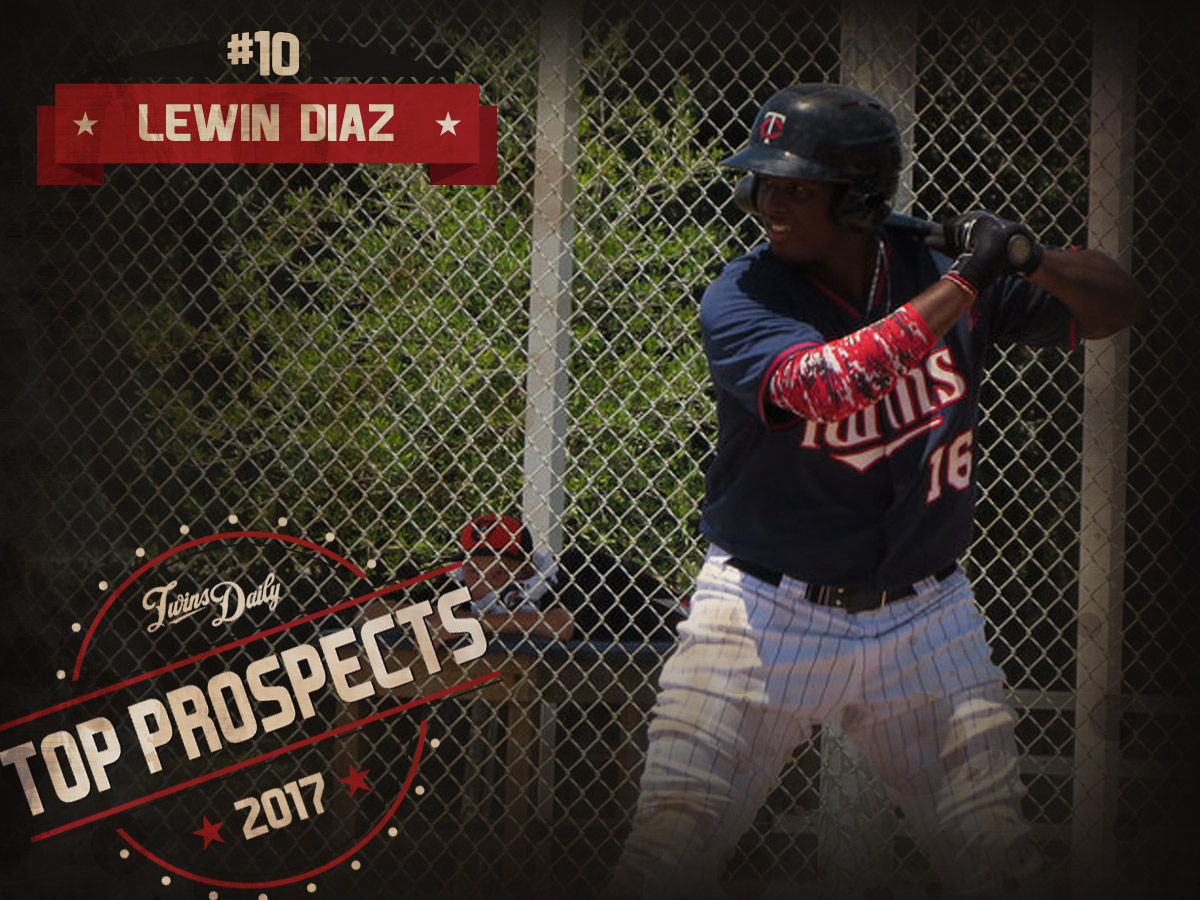 Age: 20 (DOB: 11/19/96) 2015 Stats (Rk): 46 G, .310/.353/.575, 9 HR, 37 RBI ETA: 2019 2016 Ranking: 18 National Top 100 Rankings BA: NR | MLB: NR | ESPN: NR | BP: NR What’s To Like With the exception of Daniel Palka (our 14th-highest rated prospect in the system), Diaz represents the only source of raw power on Twins Daily’s top prospect list. While the long ball potential is substantial, the baseball industry has started to devalue the power-only players. Teams no longer place a premium on dingers, as evidenced by the offseason employment plight of Chris Carter and former Twins prospect Adam Walker (11th on our list in 2016). With his size, Diaz’s career is limited to a first base or designated hitter role but he has shown signs of being more than an all-or-nothing type of hitter like Walker. Admittedly it was only rookie ball, but Diaz’s .310 average is a mark that Walker never even came close to matching. The Twins believe that Diaz may also be able to provide batting average value (for whatever that’s worth) as well as avoid making regular outs. What’s Left To Work On Despite teeming with raw power potential, Diaz hasn’t applied that much in game action until this past season when he hit nine home runs in 187 plate appearances as a 19-year-old in the Appalachian League. That is not out of the norm for prospects -- especially at his age -- but there are some indications that a few tweaks for Diaz could tap into that talent. Big and strong, Diaz’s swing has a solid foundation but his current barrel path doesn’t necessarily lead to towering fly balls which translate into huge home run totals. When the Twins signed him as a 16-year-old in 2013, Baseball America said that Diaz struggled to “tap into that power in game situations”. The swing is level down to and through the ball and results in plenty of base hits but his power is limited to almost exclusively his pull side. That's not a bad thing, but with his size you would like to see a few more towering flies to the alleys as opposed to just at the right field foul pole. There is time to develop that swing. What’s Next Diaz has yet to play over 50 games in a season so that will be his first challenge in 2017. The second is just continuing to produce like he did last year. Remember: At 20 years old this season, Diaz has plenty of time to develop as a player. However, as a 2013 signee, he is starting to get to the point where the Twins will need to consider adding him to the 40-man roster, which makes 2017 an important season.
 -
Finally. I was waiting for some wet, hot urban planning takes on this message board.
- 17 replies
-
- 11
-

-
- zack granite
- engelb vielma
- (and 3 more)
-
When the Minnesota Twins hired Derek Falvey to rebuild the organization, the most significant task to tackle was to improve the pitching. Pitching is one of the most important facets of baseball and being able to reach into one’s own minor league system for more talent is crucial to long-term success. For the Twins, numerous high draft pick arms have stalled out. While there are several graduates like Kyle Gibson or contributors like Jose Berrios or Tyler Duffey, the development pipeline has been rather scarce when it comes to providing Major League-ready pitching. In response, the Twins have had to spend big on free agent pitchers like Ricky Nolasco, Phil Hughes and Ervin Santana. How exactly does Derek Falvey intend on improving the broken system?Here is just one example of how the organization can and will change. Across America weighted ball training has become an integral part in pitching development. Out east, Eric Cressey’s Cressey Performance Center has used those training methods since 2007. Down south, just outside of Houston, Ron Wolforth’s Texas Baseball Ranch has launched and re-established the careers of numerous arms, including the resurrection of Scott Kazmir. In Seattle, Driveline Baseball’s Kyle Boddy has made weighted ball training a household name. At baseball training centers everywhere in between young pitchers are picking up heavy spheres and throwing them in the name of velocity. Major League Baseball’s evolutionary process moves at a glacial pace and pro teams are slow to embrace change. MLB.com’s Lindsay Berra pointed out in December, organizations such as the Dodgers and Indians have tapped into the benefits of the systems designed by Cressey, Wolforth, Boddy and company. Still, there are some teams who have flat out refused to allow their pitchers to participate in those kinds of workouts. Perhaps not surprising, as recently as last year the Twins have reportedly discouraged some of their prospects from throwing heavy baseballs, suggesting that the practice can lead to more arm injuries despite the science saying otherwise. Thanks to new leadership, that mentality will change. Falvey arrived in Minnesota touting “evidence-based practices” at his introductory press conference, signaling that the days of discouraging new methods for unfounded reasons are over. His time with Cleveland’s player development system -- a more forward-thinking front office by comparison -- enlightened him to the benefits of working with weighted baseballs and other programs not necessarily on the mainstream radar. That said, even with the successful track record Falvey was not so quick to say that the Twins would be distributing heavy baseballs across the organization tomorrow. “Everything has to be individualized,” Falvey told Twins Daily. “I think what we need to do if find out what systems work for some of our players, what they are already doing. We need to learn what they are doing now and ask how do we build toward a vision and if that vision means a different type of arm care, or maybe a different type of velocity and growth, we’ll employ those tools for those players. I never like to shut the door on any of those systems. I like to evaluate them and see where they fit within the mix of what we are doing.” To be clear, this is not about weighted balls. Throwing weighted baseballs is not a magic elixir that is going to help someone’s arm suddenly from throwing pooh to pumping one-oh-two. What Falvey is saying is about more than that. For the Twins front office, this is about a bold step in exploring new methodologies for improving performance -- not restricting ideas based on gut feelings about a practice. In 2015 Cleveland’s minor league pitching coordinator Ruben Niebla provided a peek behind the Indians’ development curtain. One of their organization’s main objectives was to help their pitchers reach their maximum velocity in the minor leagues. In order to do so, Niebla told Fox Sports that they try to “enhance our pitchers’ flexibility, explosion, and athleticism” overall and feed the arm through various long-toss, symmetry bands and weighted ball programs. More importantly, Cleveland did not have a one-size-fits-all program in place in order to achieve their objective; they learned from Trevor Bauer’s experience with the Arizona Diamondbacks, who bristled at Bauer’s unorthodox conditioning and pre-game warm-up routine, that pushing a prospect into a team-mandated regimen can have backlash. Individualization is key. Furthermore, Niebla said that Cleveland emphasized building strength in their pitchers, which means dabbling in some powerlifting. That’s why in the offseason, Bauer can be found at Driveline’s squat rack or Corey Kluber deadlifting at Cressey Performance. Other flamethrowing pitchers like Aroldis Chapman and White Sox prospect Micheal Kopech both owe part their eye-popping radar gun readings to their adherence of lifting heavy things. The Twins, on the other hand, historically haven’t pushed their pitchers in that direction. Locally, you will find stories about Trevor May’s yoga practice or Glen Perkins’ avoidance of weight lifting. That doesn’t mean that one or the other is better. ”Ultimately we’re going to blend some of the things I think we do well here with maybe some of things that I felt was part of developing in Cleveland over time,” said Falvey. “I talked to [pitching coordinator] Eric Rasmussen about it and [Director of Minor League Operations] Brad Steil and what we are going to do in the minor leagues and I think we’re going to open the doors to new ideas that haven’t existed here in this organization before but I have every expectation that there is an embracing of that conversation.” In addition to the physical contributions of the player, Falvey also believes that leveraging data -- even at the lowest levels (an area in which the Twins might actually already have a head start) -- will help improve pitching development. Understanding through the numbers what works best for them and what they may need to improve upon quickly. Baseball is enamored by its new tool, StatCast, and the data it has produced at the Major League level. That left teams wanted to measure and analyze pitching prospects with the same lens so they have installed the Trackman systems in their minor league parks. One significant credit to Terry Ryan’s leadership was the Twins got ahead of the industry when they installed the same system in their top four minor league affiliates, providing the same velocity, spin rate and other metadata as their big league counterpart. “I can’t speak to how it was utilized in the past [in Minnesota] but I do know how we used it in Cleveland,” Falvey said, “and I felt that it was really something that was a difference maker for us.” How big of a difference maker can that be? So much so that the Los Angeles Dodgers, the second largest employer in the state of California, have created a “Pitching Department” which consists of six people including three former pitchers and an ex-Driveline Baseball medical expert dedicated to researching the hell out of it. Fangraphs’ David Laurila recently interviewed Brandon Gomes, a former pitcher added to that staff, who discussed how they will leverage that data. “The biggest thing is to understand the characteristics,” Gomes said. “It might be, ‘Hey, this guy has elite carry, so we want to look at pitching in this part of the zone.’ Or maybe it’s, ‘This is a power-sinker guy, so we want this,’ or, ‘He has an above-average slider, so he should use it more than he’s currently using it.’ Those kind of avenues. Nothing overly new, but we’re implementing it in a slightly different way.” Pitchers are not always certain about their identity. They may feel certain pitches are behaving one way when they are not. Providing them with the concrete data will give the a better direction or a quicker understand of what makes them successful. Training systems and data analysis improvements aside, player development comes back to the individual and Falvey places great emphasis on the human side as well. In his vision, there will be more communication and dialogue between the front office and the players. “It is a two-way conversation,” he said in regards to handling a player’s career. ”You go to a player and you talk about who do you want to be. How do you want to develop? All these guys have goals. All these guys want to be big league pitchers. What’s that look like?” It is honesty. “Let’s not be afraid to have a candid conversation about that. Let’s not be afraid to have some feedback on here’s where you are and here’s where you want to be. There’s a gap, how do we close the gap? And not focus on limitations but focus on opportunities to build and grow and develop. Build goals.” You could take that entire last statement from Falvey and apply it to the redevelopment of the pitching pipeline overall. Build goals not only applies for the individual, but for the team as whole. As Falvey said himself, there is a gap, a gap for where the Twins are as an organization when it comes to developing talent and where they want to be. How do they close that gap? It is not an easy nor quick fix but Falvey appears to have the right plan in the works. Click here to view the article
- 44 replies
-
- 5
-
-
- minnesota twins
- derek falvey
- (and 1 more)
-
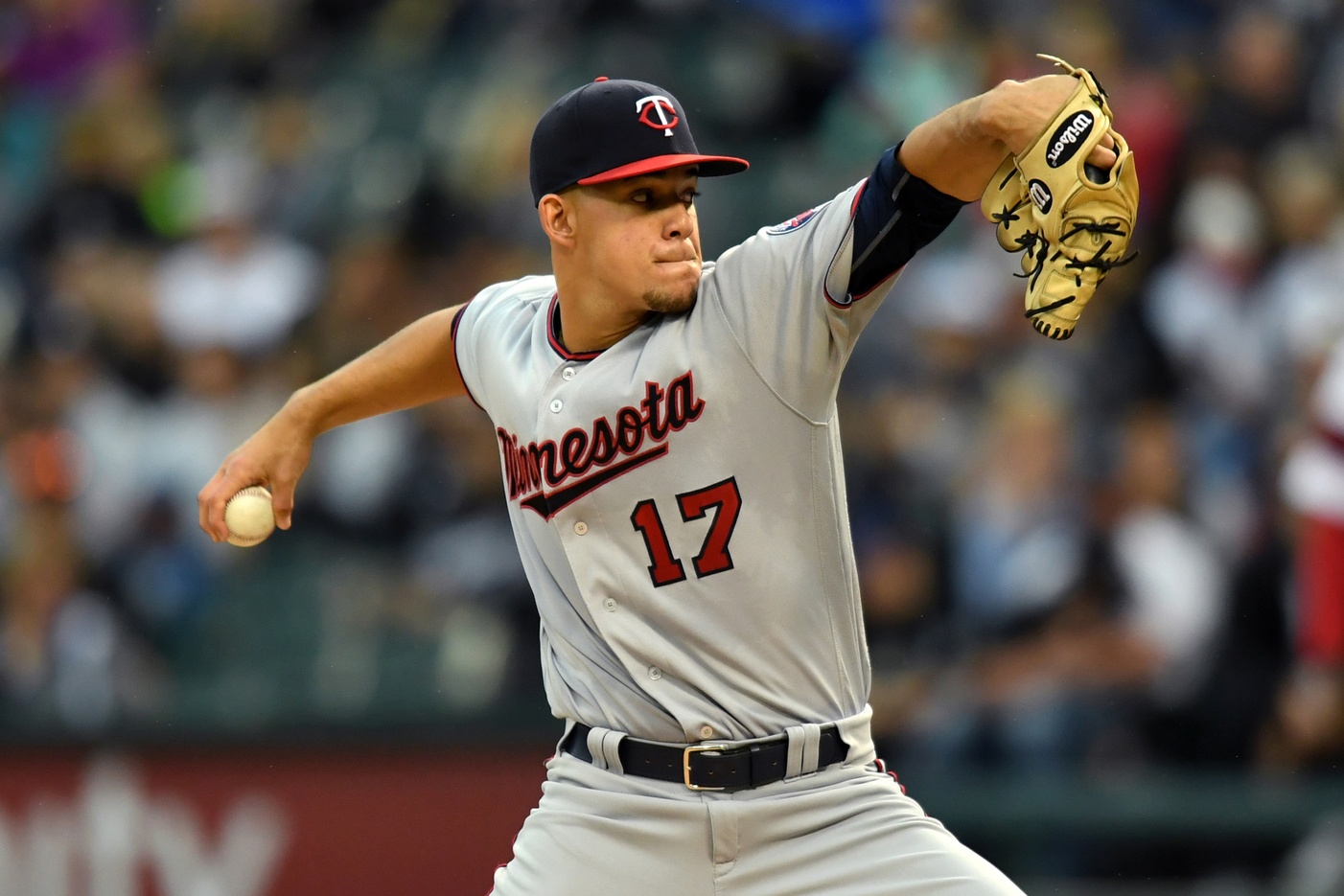 Here is just one example of how the organization can and will change. Across America weighted ball training has become an integral part in pitching development. Out east, Eric Cressey’s Cressey Performance Center has used those training methods since 2007. Down south, just outside of Houston, Ron Wolforth’s Texas Baseball Ranch has launched and re-established the careers of numerous arms, including the resurrection of Scott Kazmir. In Seattle, Driveline Baseball’s Kyle Boddy has made weighted ball training a household name. At baseball training centers everywhere in between young pitchers are picking up heavy spheres and throwing them in the name of velocity. Major League Baseball’s evolutionary process moves at a glacial pace and pro teams are slow to embrace change. MLB.com’s Lindsay Berra pointed out in December, organizations such as the Dodgers and Indians have tapped into the benefits of the systems designed by Cressey, Wolforth, Boddy and company. Still, there are some teams who have flat out refused to allow their pitchers to participate in those kinds of workouts. Perhaps not surprising, as recently as last year the Twins have reportedly discouraged some of their prospects from throwing heavy baseballs, suggesting that the practice can lead to more arm injuries despite the science saying otherwise. Thanks to new leadership, that mentality will change. Falvey arrived in Minnesota touting “evidence-based practices” at his introductory press conference, signaling that the days of discouraging new methods for unfounded reasons are over. His time with Cleveland’s player development system -- a more forward-thinking front office by comparison -- enlightened him to the benefits of working with weighted baseballs and other programs not necessarily on the mainstream radar. That said, even with the successful track record Falvey was not so quick to say that the Twins would be distributing heavy baseballs across the organization tomorrow. “Everything has to be individualized,” Falvey told Twins Daily. “I think what we need to do if find out what systems work for some of our players, what they are already doing. We need to learn what they are doing now and ask how do we build toward a vision and if that vision means a different type of arm care, or maybe a different type of velocity and growth, we’ll employ those tools for those players. I never like to shut the door on any of those systems. I like to evaluate them and see where they fit within the mix of what we are doing.” To be clear, this is not about weighted balls. Throwing weighted baseballs is not a magic elixir that is going to help someone’s arm suddenly from throwing pooh to pumping one-oh-two. What Falvey is saying is about more than that. For the Twins front office, this is about a bold step in exploring new methodologies for improving performance -- not restricting ideas based on gut feelings about a practice. In 2015 Cleveland’s minor league pitching coordinator Ruben Niebla provided a peek behind the Indians’ development curtain. One of their organization’s main objectives was to help their pitchers reach their maximum velocity in the minor leagues. In order to do so, Niebla told Fox Sports that they try to “enhance our pitchers’ flexibility, explosion, and athleticism” overall and feed the arm through various long-toss, symmetry bands and weighted ball programs. More importantly, Cleveland did not have a one-size-fits-all program in place in order to achieve their objective; they learned from Trevor Bauer’s experience with the Arizona Diamondbacks, who bristled at Bauer’s unorthodox conditioning and pre-game warm-up routine, that pushing a prospect into a team-mandated regimen can have backlash. Individualization is key. Furthermore, Niebla said that Cleveland emphasized building strength in their pitchers, which means dabbling in some powerlifting. That’s why in the offseason, Bauer can be found at Driveline’s squat rack or Corey Kluber deadlifting at Cressey Performance. Other flamethrowing pitchers like Aroldis Chapman and White Sox prospect Micheal Kopech both owe part their eye-popping radar gun readings to their adherence of lifting heavy things. The Twins, on the other hand, historically haven’t pushed their pitchers in that direction. Locally, you will find stories about Trevor May’s yoga practice or Glen Perkins’ avoidance of weight lifting. That doesn’t mean that one or the other is better. ”Ultimately we’re going to blend some of the things I think we do well here with maybe some of things that I felt was part of developing in Cleveland over time,” said Falvey. “I talked to [pitching coordinator] Eric Rasmussen about it and [Director of Minor League Operations] Brad Steil and what we are going to do in the minor leagues and I think we’re going to open the doors to new ideas that haven’t existed here in this organization before but I have every expectation that there is an embracing of that conversation.” In addition to the physical contributions of the player, Falvey also believes that leveraging data -- even at the lowest levels (an area in which the Twins might actually already have a head start) -- will help improve pitching development. Understanding through the numbers what works best for them and what they may need to improve upon quickly. Baseball is enamored by its new tool, StatCast, and the data it has produced at the Major League level. That left teams wanted to measure and analyze pitching prospects with the same lens so they have installed the Trackman systems in their minor league parks. One significant credit to Terry Ryan’s leadership was the Twins got ahead of the industry when they installed the same system in their top four minor league affiliates, providing the same velocity, spin rate and other metadata as their big league counterpart. “I can’t speak to how it was utilized in the past [in Minnesota] but I do know how we used it in Cleveland,” Falvey said, “and I felt that it was really something that was a difference maker for us.” How big of a difference maker can that be? So much so that the Los Angeles Dodgers, the second largest employer in the state of California, have created a “Pitching Department” which consists of six people including three former pitchers and an ex-Driveline Baseball medical expert dedicated to researching the hell out of it. Fangraphs’ David Laurila recently interviewed Brandon Gomes, a former pitcher added to that staff, who discussed how they will leverage that data. “The biggest thing is to understand the characteristics,” Gomes said. “It might be, ‘Hey, this guy has elite carry, so we want to look at pitching in this part of the zone.’ Or maybe it’s, ‘This is a power-sinker guy, so we want this,’ or, ‘He has an above-average slider, so he should use it more than he’s currently using it.’ Those kind of avenues. Nothing overly new, but we’re implementing it in a slightly different way.” Pitchers are not always certain about their identity. They may feel certain pitches are behaving one way when they are not. Providing them with the concrete data will give the a better direction or a quicker understand of what makes them successful. Training systems and data analysis improvements aside, player development comes back to the individual and Falvey places great emphasis on the human side as well. In his vision, there will be more communication and dialogue between the front office and the players. “It is a two-way conversation,” he said in regards to handling a player’s career. ”You go to a player and you talk about who do you want to be. How do you want to develop? All these guys have goals. All these guys want to be big league pitchers. What’s that look like?” It is honesty. “Let’s not be afraid to have a candid conversation about that. Let’s not be afraid to have some feedback on here’s where you are and here’s where you want to be. There’s a gap, how do we close the gap? And not focus on limitations but focus on opportunities to build and grow and develop. Build goals.” You could take that entire last statement from Falvey and apply it to the redevelopment of the pitching pipeline overall. Build goals not only applies for the individual, but for the team as whole. As Falvey said himself, there is a gap, a gap for where the Twins are as an organization when it comes to developing talent and where they want to be. How do they close that gap? It is not an easy nor quick fix but Falvey appears to have the right plan in the works.
 -
I also enjoyed when Hawkins said he would punch a certain umpire in the throat if he saw him again.
-
Not only do they have video, they also have Trackman radar -- the same data captured by StatCast. I think there are still some questions regarding how to implement that data but they have been capturing plenty on their own players and data on other players when they visit.
- 13 replies
-
- 2
-
-
- jose bautista
- corey koskie
- (and 3 more)
-
I believe baseball is starting to realize how much information they have and how important it is for players to have a basic understanding of how it works. The Boston Red Sox bench coach Tony Lovullo discussed how their organization emphasized it from day one so that when those draft picks or signees reached the big leagues, they weren't overwhelmed by the data reports. This offseason Houston (I believe) was hiring coaches for their minor league affiliates specifically with analytics backgrounds in order to communicate the message to the players better at a lower level. So when a guy like Byron Buxton reaches the bigs, the language he hears is the same thing he heard at low-A ball. Again, the hitting side is just one aspect of using data. Pitchers and fielders have to get used to being fed reports regarding pitch breakdowns and various positioning in the field.
- 13 replies
-
- 5
-
-
- jose bautista
- corey koskie
- (and 3 more)
-
Work smarter, not harder. That’s a mantra which permeates the corporate world, imploring workers to take full advantage of tools and resources available to improve productivity. It’s cliche, to be sure, but there is something behind the notion that production can be improved by simply leveraging existing systems and processes. When it comes to getting the information into the hands of the hitters, the Minnesota Twins appear to have moved in the direction of working smarter.For almost a decade now baseball’s front offices have been harvesting analytical insight which could positively influence on-field performance. Well educated and highly trained individuals front office staffers have been slicing and compiling video, PitchF/X data, and now StatCast data in attempts to deliver potentially beneficial information to a roster of players who, by and large, have varying degrees of interest in receiving it. Since the conduit of communication is occasionally faulty, one of the growing trends over the last few seasons in Major League Baseball is that teams have been hiring analytically savvy coaches to work the dugouts and clubhouses. These new hires with real on-field baseball experience are able to distill the information into digestible bites for the players. The Twins recent hire Jeff Pickler doesn’t pretend to be a heady stat guy, but his experience with technology has made him uniquely qualified to dissect the video and data while working with players. As an assistant coach with the University of Arizona Wildcats in 2009, Pickler introduced the video BATS system to the program. The BATS system captures all plays on video, adds the necessary metadata, and is able to index and recall at-bats at a click of the mouse. “The thing about statistics — and this includes BATS — is that it allows you to explain the 'how' and 'why,' as opposed to just the 'what',” Pickler told the Arizona Daily Star in 2009. “We can all see the 'what' — we can see a guy's 3 for his last 14, that he might as well not be in the lineup tomorrow. The 'how' and 'why' is a little more complicated; that's what the data and video is able to show us. … We can figure out the how and why, and maybe fix things a lot sooner.” Pickler’s role with the Twins has not been crystallized and yet his addition could be necessary to maximize the growing mountain of information. And for coaches and players, the growing mountain of information can be overwhelming. As Tom Brunansky once said after he assumed the duties of the Twins’ hitting coach, he was fed enough data to “choke a cow” and that was before launch angles and exit velocity were in the common lexicon. Taking all of that info and trying to deliver the message to his hitters takes tact. The key to coaching is to be able to help players make adjustments to their weaknesses without drowning them in the numbers. Boiling it down, it's the old line from Tommy Boy about trusting the butcher. For instance, if the data shows fastballs on the outer-half of the zone have proven to be a hitter’s kryptonite, coaches should set up drills that helps address the issue. That way players can continue their careers blissfully unaware of the amount of computing and brain power went into solving that problem. While the insight can be valuable, using it can be a matter of personal preference for players. Some may crave it, others may avoid it at all costs. For Jose Bautista, one of the game’s most impressive and cerebral hitters, knowing the information is a key component of his success. In 2011 he shared with the Toronto Star how he uses this data. Bautista revisited a matchup with White Sox pitcher John Danks. “I know he only throws a change-up away and a cutter, which is a small slider, inside,” Bautista told the Star reporters. “He complements that with a fastball on both sides of the plate. He only throws like 7 [percent] curveballs. He threw me five curveballs. I didn’t swing at any of them because I eliminated that pitch from his repertoire before the game started. So I knew anything that had a big spin or that started up in the zone would either be a ball or a curveball.” Bautista’s preparation and knowledge allowed him to look for one pitch in one zone or one area. That being said, longevity plays a role just as much as being fed a detailed heat map or chart breakdown. Bautista was able to draw upon his years of experience to know what the shape of Danks’ curveball was. Or the tilt of his slider. There’s no substitute for major league reps yet a hitter can layer on information to better their odds. For instance, recent Oakland A’s acquisition Trevor Plouffe said that over his career he was able to internalize what certain pitchers were doing and pair that with the data nuggets in order to capitalize in certain situations. “I think you get to know pitchers around the league and understand what they are trying to do to you,” Plouffe said last spring training. “And also we have so much data now, we can look and see, 2-1 count, seventy percent of the time this [pitch] is coming. If you have seen a guy enough and you understand what his breaking ball does, why not look for it in that count? If he wants to throw it for a strike it’s probably going to go.” Historically, that information was available through observation. Players weren’t asked to trust the data like they can with PitchF/X and StatCast in the modern era. In the not too distant past they also had to simply trust the scout or peers. "When I came up, there was none of this," Atlanta's Chipper Jones told MLB.com in 2009 regarding the proliferation of video. "You basically relied on word-of-mouth from your teammates to get the pitcher's repertoire and what their tendencies might be." Former Twins third baseman Corey Koskie recently shared his thoughts on using analytics as a player earlier this month at the MinneAnalytics hosted SportCon at St. Thomas in Minneapolis. Koskie was asked by the moderator Mike Max how much information he wanted to know going into an at-bat. Koskie responded by saying he was a ‘see-ball, hit-ball’ player in his career. The more information he got, the more it clogged his brain. Past experience getting burned when playing the percentages had created a bit of a distrust for the big lefty. “I didn’t want to be the one guy that gets up in a situation where I’m like, 3-2, runners on second and third and this guy throws a change-up (at) 3-2 seventy-six percent of the time or eighty-two percent of the time and the pitcher throws a fastball right down the middle and I was sitting on a change-up,” Koskie told the crowd. Koskie pivoted and said that he did have one example where trusting the information paid big dividends for him and the team. “We were in the ALDS against the A’s and Tim Hudson was throwing,” Koskie said. “Paul Molitor, who the Twins had him doing some advanced scouting, and he comes up and says, Corey, I know how you feel about this stuff but when Tim Hudson gets 2-and-0 he throws a change-up ninety-seven percent of the time over the last four weeks.” As it would just so happen, Koskie found himself in the exact situation during the third inning of Game 1 of the 2002 ALDS. The Twins were in a 5-1 hole at the Coliseum courtesy of some shaky defense. With one out, Cristian Guzman laced a single to center, bringing Koskie to the plate. Hudson quickly fell behind 2-and-0. “So I’m stepping in and all this stuff is going through my mind. Should I chance it? Should I chance it? Timeout, timeout,” He recalled as Molitor’s advice came flooding into his mind. “I took a step out, I said, you know what? If I’m ever going to do this now is the time because I have a ninety-seven percent likelihood he’s going to throw a change-up here and I gotta sit on this thing because if I don’t sit on this thing and he throws it and I’m sitting fastball, I’m going to look like an idiot anyway, so why don’t I just sit on this thing?” Koskie, of course, sat on it: For hitters, there is no right or wrong answer when it comes to how much information you should consume. Koskie had a fairly solid offensive career relying on his own experience to guide him. Plouffe has found the data to be a good supplement to his internal catalogue of pitchers. Bautista, meanwhile, believes the information to be a vital part of his mental preparation. Coaches, on the other hand, need to examine all the data in order to be effective. From the outside, with the hiring of Pickler as well as James Rowson as the hitting coach, the Twins appear to be moving toward working smarter. Click here to view the article
- 13 replies
-
- 7
-
-
- jose bautista
- corey koskie
- (and 3 more)
-
 For almost a decade now baseball’s front offices have been harvesting analytical insight which could positively influence on-field performance. Well educated and highly trained individuals front office staffers have been slicing and compiling video, PitchF/X data, and now StatCast data in attempts to deliver potentially beneficial information to a roster of players who, by and large, have varying degrees of interest in receiving it. Since the conduit of communication is occasionally faulty, one of the growing trends over the last few seasons in Major League Baseball is that teams have been hiring analytically savvy coaches to work the dugouts and clubhouses. These new hires with real on-field baseball experience are able to distill the information into digestible bites for the players. The Twins recent hire Jeff Pickler doesn’t pretend to be a heady stat guy, but his experience with technology has made him uniquely qualified to dissect the video and data while working with players. As an assistant coach with the University of Arizona Wildcats in 2009, Pickler introduced the video BATS system to the program. The BATS system captures all plays on video, adds the necessary metadata, and is able to index and recall at-bats at a click of the mouse. “The thing about statistics — and this includes BATS — is that it allows you to explain the 'how' and 'why,' as opposed to just the 'what',” Pickler told the Arizona Daily Star in 2009. “We can all see the 'what' — we can see a guy's 3 for his last 14, that he might as well not be in the lineup tomorrow. The 'how' and 'why' is a little more complicated; that's what the data and video is able to show us. … We can figure out the how and why, and maybe fix things a lot sooner.” Pickler’s role with the Twins has not been crystallized and yet his addition could be necessary to maximize the growing mountain of information. And for coaches and players, the growing mountain of information can be overwhelming. As Tom Brunansky once said after he assumed the duties of the Twins’ hitting coach, he was fed enough data to “choke a cow” and that was before launch angles and exit velocity were in the common lexicon. Taking all of that info and trying to deliver the message to his hitters takes tact. The key to coaching is to be able to help players make adjustments to their weaknesses without drowning them in the numbers. Boiling it down, it's the old line from Tommy Boy about trusting the butcher. For instance, if the data shows fastballs on the outer-half of the zone have proven to be a hitter’s kryptonite, coaches should set up drills that helps address the issue. That way players can continue their careers blissfully unaware of the amount of computing and brain power went into solving that problem. While the insight can be valuable, using it can be a matter of personal preference for players. Some may crave it, others may avoid it at all costs. For Jose Bautista, one of the game’s most impressive and cerebral hitters, knowing the information is a key component of his success. In 2011 he shared with the Toronto Star how he uses this data. Bautista revisited a matchup with White Sox pitcher John Danks. “I know he only throws a change-up away and a cutter, which is a small slider, inside,” Bautista told the Star reporters. “He complements that with a fastball on both sides of the plate. He only throws like 7 [percent] curveballs. He threw me five curveballs. I didn’t swing at any of them because I eliminated that pitch from his repertoire before the game started. So I knew anything that had a big spin or that started up in the zone would either be a ball or a curveball.” Bautista’s preparation and knowledge allowed him to look for one pitch in one zone or one area. That being said, longevity plays a role just as much as being fed a detailed heat map or chart breakdown. Bautista was able to draw upon his years of experience to know what the shape of Danks’ curveball was. Or the tilt of his slider. There’s no substitute for major league reps yet a hitter can layer on information to better their odds. For instance, recent Oakland A’s acquisition Trevor Plouffe said that over his career he was able to internalize what certain pitchers were doing and pair that with the data nuggets in order to capitalize in certain situations. “I think you get to know pitchers around the league and understand what they are trying to do to you,” Plouffe said last spring training. “And also we have so much data now, we can look and see, 2-1 count, seventy percent of the time this [pitch] is coming. If you have seen a guy enough and you understand what his breaking ball does, why not look for it in that count? If he wants to throw it for a strike it’s probably going to go.” Historically, that information was available through observation. Players weren’t asked to trust the data like they can with PitchF/X and StatCast in the modern era. In the not too distant past they also had to simply trust the scout or peers. "When I came up, there was none of this," Atlanta's Chipper Jones told MLB.com in 2009 regarding the proliferation of video. "You basically relied on word-of-mouth from your teammates to get the pitcher's repertoire and what their tendencies might be." Former Twins third baseman Corey Koskie recently shared his thoughts on using analytics as a player earlier this month at the MinneAnalytics hosted SportCon at St. Thomas in Minneapolis. Koskie was asked by the moderator Mike Max how much information he wanted to know going into an at-bat. Koskie responded by saying he was a ‘see-ball, hit-ball’ player in his career. The more information he got, the more it clogged his brain. Past experience getting burned when playing the percentages had created a bit of a distrust for the big lefty. “I didn’t want to be the one guy that gets up in a situation where I’m like, 3-2, runners on second and third and this guy throws a change-up (at) 3-2 seventy-six percent of the time or eighty-two percent of the time and the pitcher throws a fastball right down the middle and I was sitting on a change-up,” Koskie told the crowd. Koskie pivoted and said that he did have one example where trusting the information paid big dividends for him and the team. “We were in the ALDS against the A’s and Tim Hudson was throwing,” Koskie said. “Paul Molitor, who the Twins had him doing some advanced scouting, and he comes up and says, Corey, I know how you feel about this stuff but when Tim Hudson gets 2-and-0 he throws a change-up ninety-seven percent of the time over the last four weeks.” As it would just so happen, Koskie found himself in the exact situation during the third inning of Game 1 of the 2002 ALDS. The Twins were in a 5-1 hole at the Coliseum courtesy of some shaky defense. With one out, Cristian Guzman laced a single to center, bringing Koskie to the plate. Hudson quickly fell behind 2-and-0. “So I’m stepping in and all this stuff is going through my mind. Should I chance it? Should I chance it? Timeout, timeout,” He recalled as Molitor’s advice came flooding into his mind. “I took a step out, I said, you know what? If I’m ever going to do this now is the time because I have a ninety-seven percent likelihood he’s going to throw a change-up here and I gotta sit on this thing because if I don’t sit on this thing and he throws it and I’m sitting fastball, I’m going to look like an idiot anyway, so why don’t I just sit on this thing?” Koskie, of course, sat on it: https://twitter.com/ParkerHageman/status/808092460941537281 For hitters, there is no right or wrong answer when it comes to how much information you should consume. Koskie had a fairly solid offensive career relying on his own experience to guide him. Plouffe has found the data to be a good supplement to his internal catalogue of pitchers. Bautista, meanwhile, believes the information to be a vital part of his mental preparation. Coaches, on the other hand, need to examine all the data in order to be effective. From the outside, with the hiring of Pickler as well as James Rowson as the hitting coach, the Twins appear to be moving toward working smarter.
 -
Article: Jorge Polanco At SS Could Be Disastrous
Parker Hageman replied to Nick Nelson's topic in Twins Daily Front Page News
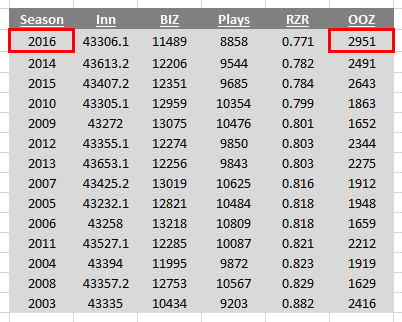
I want to preface this by saying, like Nick, I'm not confident in Polanco being an everyday shortstop. As he wrote, I believe Polanco has some tools to be serviceable but does not seem to have that first step necessary to be an elite defender at the position. This isn’t meant as an add-on to Nick’s Polanco analysis and it is a bit of a tangent and data dump and a steam of consciousness, but I do want to clear up some issues when weighing analysis on advanced defensive metrics -- especially regarding middle infielders – which have been bandied about the site lately. Since 2003, when Fangraphs began to collect and publish Revised Zone Rating (RZR), shortstop conversion rate for plays within a shortstop's zone was at an all-time low in 2016. For those unfamiliar, RZR is essentially the raw form of Ultimate Zone Rate (UZR). Last year, just 77% of balls in a shortstop's designated zone were converted to outs. By comparison, they were converted to outs at an 82%+ rate in 2008, 2011, 2009 and 2003 (although I think 2003’s 88% is an outlier). The biggest difference, of course, is the increased use in defensive shifts over the last three seasons. According to Fangraphs, traditional shifts were employed in 13,000 plate appearances in 2014 and 28,000 in 2016. These means there were that many alignments where the shortstop was positioned not in the designated shortstop zone. When a grounder slips through the left side while the shortstop was positioned on the right side of second base, well, that data point is still bucketed in RZR's "ball in zone" (BIZ) and the shortstop is marked for not having made that play. On the flip side, with some many additional shifts, shortstops now have seen a large jump in Out Of Zone plays (OOZ). This past season, there were over 1,300 plays made outside of the standard zone by a shortstop over the 2003 season mostly due to the new positioning. For those unfamiliar, RZR is essentially the raw form of Ultimate Zone Rate (UZR). UZR is based on a grid zone chart of plays made/missed before they synthesize it to make it comparable across the league’s average. However, before UZR spits out its final number, they remove all shift plays from the equation. If a shortstop is lined up on the right side of the base and makes a play, UZR doesn’t count it. Likewise, if he’s in a shift and Adam Eaton slaps a ball to the left side to the vacated space, the shortstop doesn’t get hurt on the play (like he would in the RZR metric). So UZR simply ignores potentially hundreds of batted balls a year. UZR is also factored into other metrics such as WAR and the SABR Defensive Index. To me this feels incomplete and reducing the metric – particularly in the face of a growing practice of defensive shifts. Even the founder of UZR has voiced his opinions regarding the use of the data: https://twitter.com/mitchellichtman/status/720422490359476225 More and more I wonder if those elite shortstop defenders – the Carlos Correas and the Francisco Lindors – also benefit from having outstanding coaches/front office members who are able to line them up in the optimal location (as well as a pitching staff who executes their pitches). The Cubs curbed their use of defensive shifts in part because they believed they could put their players in the right spot and have their pitchers execute. Likewise, the Dodger, who have every sabermatrician born in their front office, rarely used the defensive shifts. Now, both teams have very good defenders at short that may compensate but the Twins seemingly used limited batted ball data compared to those two organizations. If the Twins are truly gearing up the front office and coaching staff to utilize data more, defensive positioning will be critical and could lead to improvements (so long as pitchers do their jobs which, yeah…). Again, I know the Twins’ coaching staff has been privy to batted ball data and chart for years but from reports, what the Dodgers, Cubs, Astros and others are doing with that information is way ahead of other teams.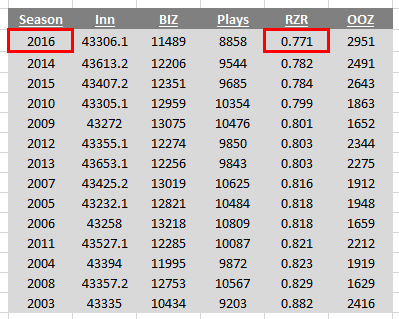
-
http://m.mlb.com/images/6/3/8/154473638/101415_tor_bats_batflip_lowres_gjvlzoc9.gif PIMP EVERYTHING.
- 41 replies
-
- 5
-
-
- jose bautista
- brian dozier
- (and 3 more)
-
We will have a check-in at the door of Brothers.
-
Funny story about Erickson and our first Meltdown: We contacted the Twins looking for a former player to participate in the event. They said Erickson would be interested and he'd be there. So Erickson shows up, I escort him through the entry and get him over to the bar to give him the rundown of what we were planning for the night. We're going to have you do a Q&A on the stage over there, I say, and then feel free to mingle with the guests. He looks around the bar all confused and then says "You guys are bloggers, right?" Yeah? "I thought I would be doing a Q&A on a computer...you know..." and he pantomimes typing on a keyboard. He was genuinely surprised that "bloggers" can be social too. It was a very legendary night.
-
Minnesota Twins manager Paul Molitor met with the media at Winter Meetings on Wednesday morning, answering questions and sharing his thoughts on what went wrong in 2016 and the recovery ahead. The talk ranged from working with the two new members of the front office, the Jason Castro signing, the Brian Dozier trade rumors and more. If you weren’t a credentialed member of the press or had the opportunity to watch it on the team’s official Facebook page, the people at ASAP Sports has transcribed the conversation in its entirety. Here are some of the notable highlights. You can read the conversation in it's entirely here or watch it at the Minnesota Twins' Facebook page here. Molitor on adding more coaches: "It's been a good process. It's obviously important to me to try to assemble that the best way we can in terms of the right personality, the right knowledge, making sure we have all the areas covered that we need to to run a staff thoroughly. Through the interview process and getting James [Rowson] on board was I thought a really good hire for us and we're kind of getting down to where we're finalizing it. And it's kind of like your player rosters, you try to get good people but then you've got to make it fit as far as making sure everything you want to have covered is covered." On adding a "quality control coach" to the staff: "I don't know how someone came up with that term to describe that. The way I've looked at it and what I've tried to feel around from people in the game and certainly those two guys is that you add someone with very good crossover ability who can, you know, supply a variety of services to try to help. You have your infield guy, your base runner guy but if there is someone with skills to help formulate a game plan in terms of how you want to pitch people, maybe how we want to implement shifts on the defensive side, you know, communication between the majors and the minor leagues throughout the year, there are a lot of things that that could potentially include." On Miguel Sano's offseason: "I haven't talked to him directly. I've been monitoring more what he's been up to through other people in our system, including our training staff. You know, we hear good reports about his focus and you guys heard what he had to say at the end of the year about coming back and things that he wants to do both in terms of being physically prepared as well as trying to undo some of the things that he found were a little bit humbling this year in his second time around. Not to say that there weren't positives. When he first came up two years ago the impact was tremendous. Then not atypical from some of our guys who come through the second time around, there were adjustments made and at times he seemed to be figuring things out and other times a little bit of regression. That's just part of the growth of young players. Still consider him a very high-impact guy on our team and coming in, not having the problem of having to be concerned about playing right field. I have a fairly high level of confidence about his defensive third base of what I think it can turn into. There is still going to be some growing pains there as he settles in and we gotta see how he will respond to potentially playing that position a high number of games. Just a guy you want to try to find a way to keep on the field in some way." On Sano's playing time at third base: "I don't want to get too much in a box there." On how good Byron Buxton can be: "I don't know how to answer that in terms of -- what you see creates the potential in your mind as far as where his talent might take him. I was somewhat jokingly at the end of the year saying I might have misgauged him a little bit in terms of what he could do because I was focused on bunting and putting the ball in play and cutting the swing down and strike outs and then he comes up and hits eight or nine home runs in September." On improving the pitching: "I think that's part of the studying going on. Talking about guys with spin rate and launch angles and figuring out how to pitch better and smarter. I don't think what I did and what my coaches do -- I don't think we're going to try to work any harder, we might try to work a little smarter. And if we can figure out how to do that with better resources and application, that's what we're going to do." Molitor also shared his thoughts on the moves in the American League Central, the increase use of analytics as an organization, retaining pitching coach Neil Allen and a variety of other subjects that are well worth your time to read. Click here to view the article
-
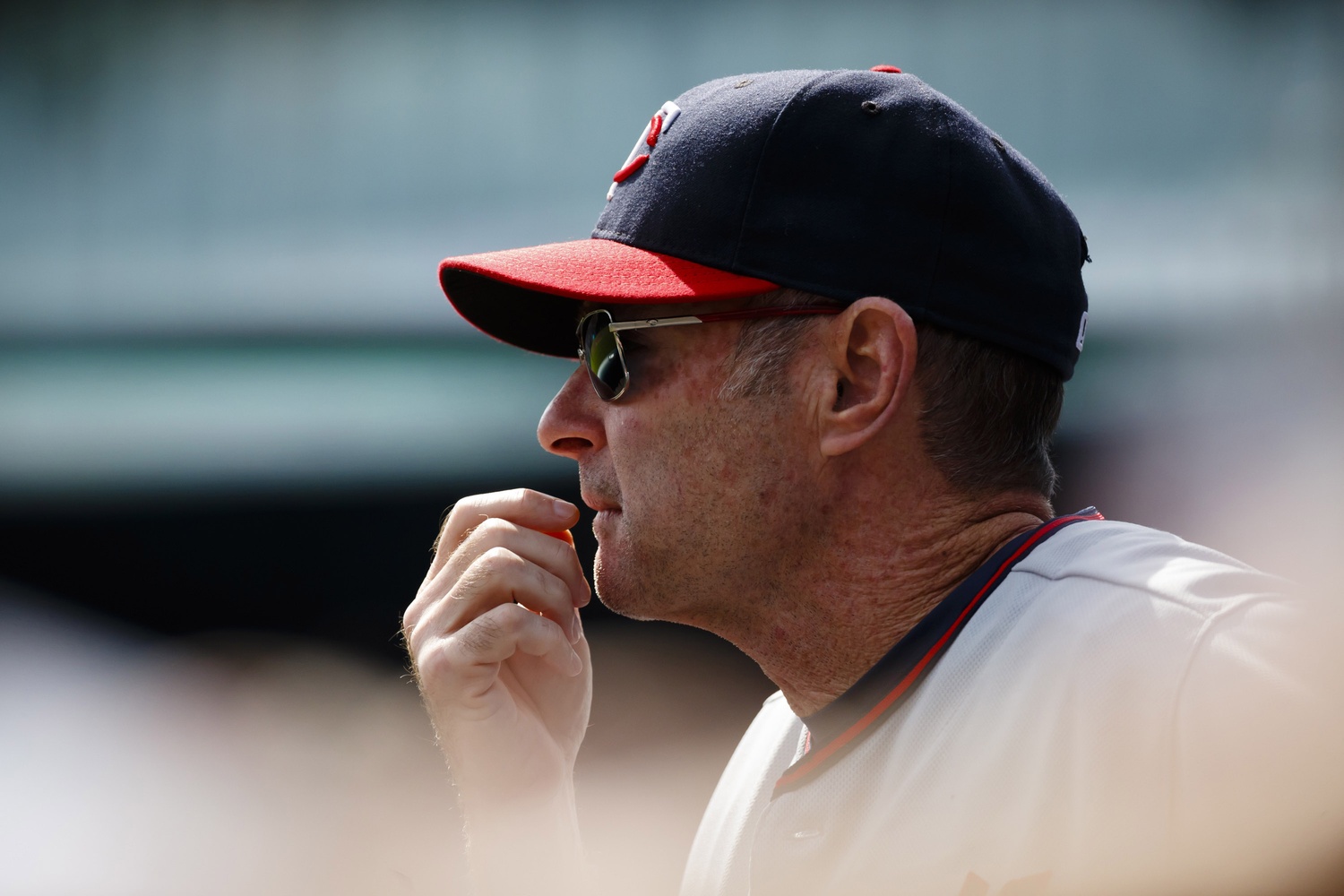 You can read the conversation in it's entirely here or watch it at the Minnesota Twins' Facebook page here. Molitor on adding more coaches: "It's been a good process. It's obviously important to me to try to assemble that the best way we can in terms of the right personality, the right knowledge, making sure we have all the areas covered that we need to to run a staff thoroughly. Through the interview process and getting James [Rowson] on board was I thought a really good hire for us and we're kind of getting down to where we're finalizing it. And it's kind of like your player rosters, you try to get good people but then you've got to make it fit as far as making sure everything you want to have covered is covered." On adding a "quality control coach" to the staff: "I don't know how someone came up with that term to describe that. The way I've looked at it and what I've tried to feel around from people in the game and certainly those two guys is that you add someone with very good crossover ability who can, you know, supply a variety of services to try to help. You have your infield guy, your base runner guy but if there is someone with skills to help formulate a game plan in terms of how you want to pitch people, maybe how we want to implement shifts on the defensive side, you know, communication between the majors and the minor leagues throughout the year, there are a lot of things that that could potentially include." On Miguel Sano's offseason: "I haven't talked to him directly. I've been monitoring more what he's been up to through other people in our system, including our training staff. You know, we hear good reports about his focus and you guys heard what he had to say at the end of the year about coming back and things that he wants to do both in terms of being physically prepared as well as trying to undo some of the things that he found were a little bit humbling this year in his second time around. Not to say that there weren't positives. When he first came up two years ago the impact was tremendous. Then not atypical from some of our guys who come through the second time around, there were adjustments made and at times he seemed to be figuring things out and other times a little bit of regression. That's just part of the growth of young players. Still consider him a very high-impact guy on our team and coming in, not having the problem of having to be concerned about playing right field. I have a fairly high level of confidence about his defensive third base of what I think it can turn into. There is still going to be some growing pains there as he settles in and we gotta see how he will respond to potentially playing that position a high number of games. Just a guy you want to try to find a way to keep on the field in some way." On Sano's playing time at third base: "I don't want to get too much in a box there." On how good Byron Buxton can be: "I don't know how to answer that in terms of -- what you see creates the potential in your mind as far as where his talent might take him. I was somewhat jokingly at the end of the year saying I might have misgauged him a little bit in terms of what he could do because I was focused on bunting and putting the ball in play and cutting the swing down and strike outs and then he comes up and hits eight or nine home runs in September." On improving the pitching: "I think that's part of the studying going on. Talking about guys with spin rate and launch angles and figuring out how to pitch better and smarter. I don't think what I did and what my coaches do -- I don't think we're going to try to work any harder, we might try to work a little smarter. And if we can figure out how to do that with better resources and application, that's what we're going to do." Molitor also shared his thoughts on the moves in the American League Central, the increase use of analytics as an organization, retaining pitching coach Neil Allen and a variety of other subjects that are well worth your time to read.
 -
Duffey is another guy who should benefit from that type of analytics as well as Castro behind the plate. That being said, he still needs to locate that fastball better.
-
Derek Falvey has inherited an organization that allowed the most runs in the American League. Hopefully he is a person who enjoys a good challenge. The Twins hired Falvey, in part, because he was analytically inclined and also carried a reputation as a pitching hawk while with Cleveland, two significant deficiencies of the previous regime. Although Jack Goin has done a good job establishing the analytics department it seemed obvious that the growth of that department was handcuffed by budgets and the prior leadership’s skeptical view toward the data. With Falvey in charge, he might be able to give Goin’s team the necessary support to take full advantage of the science of baseball. Falvey’s vision for his team may already include something similar to what these two clubs have been doing. However, in terms of improving run prevention, both short-term and long-term, the Twins may want to consider creating at least two new positions. ***This is an excerpt of one of several features from the Twins Daily Offseason Handbook. To read this and more, be sure to download your FREE Twins Daily Offseason Handbook now.*** Boston's Pitching Guru At the end of the 2015 season, the Boston Red Sox added a new position for former major league pitcher Brian Bannister in the front office. Already a member of the team’s scouting department, his acute insight into pitching analytics prompted Boston to give Bannister the title of Director of Pitching Analysis and Development. Bannister’s new job, as described by Red Sox team president Dave Dombrowski, was to develop pitching through an "analytical approach" using the power of PitchF/X and Trackman to improve arm angles, pitch types, spin rates and more. Essentially, Bannister would process the science and deliver it to the organization’s pitching coaches who could distribute it to players in easier to swallow bites. The overall goal would be to fully exploit a pitcher’s talent. One of Bannister’s early successes includes turning around left-handed hurler Rich Hill. Hill was pitching for the independent Long Island Ducks in 2015 when Bannister made a scouting visit. Bannister knew Hill’s curveball had one of the highest spin rates in all of baseball, making it a very tough pitch to barrel, and yet Hill often opted to throw other pitches in situations where his best offering would suffice. So Bannister dropped some pitching knowledge on Hill. He told him to throw his curveball more. He told him to increase the spin on his fastball. Since the conversation with Bannister, Hill has made 24 starts with Boston, Oakland and Los Angeles, striking out 165 over 139.1 innings of work. You'll note that he's the top starting pitcher in this Handbook's free agency section. “It was so refreshing, talking about shaping pitches, shaping the breaking ball. We talked about other pitchers — Zack Greinke, Clayton Kershaw — specifically about how they can shape their different breaking balls that they throw,” Hill told the Boston Globe’s Alex Speier in February. “All of those things took me from four pitches to maybe 12. It was like I had 12 pitches because of changing speeds, changing shapes, changing locations.” It is not hard to envision a pitcher like Tyler Duffey benefiting from that kind of insight. Duffey’s curveball can be a monster pitch at times but he struggles to locate his two types of fastballs consistently thanks to a lowered arm slot. Having a person in the front office focused on identifying issues and isolating strengths could help Duffey reach his ceiling more quickly. Bannister’s methods and pitching knowledge were so well received by the pitchers that the team requested that he join the coaching staff for the remainder of the 2016 season in order to better communicate with the major league roster. While right-hander Rick Porcello doesn’t credit Bannister with his career-best season, the tall sinkerballer said that in addition to Red Sox pitching coach Carl Willis, Bannister's presence has helped provide concrete insight beyond the mental aspects of the mound. When he feels like he is in a funk and doesn’t get the right movement on his sinker, Porcello told the Boston Herald that Bannister’s ability to recall data on arm angles and spin rates to quickly diagnose what is going wrong assisted in keeping him from falling into a prolonged slump. That’s something Bannister said he emphasizes -- not only getting pitchers to their ceiling but sustaining as well. Someone like Kyle Gibson, who has had flashes of brilliance but has had consistency evade him, could follow in similar footsteps. Though the Twins do not have a Brian Bannister in the front office, they do have the foundation in place to capture the necessary data that can lead to swift player development improvements. Across their minor league affiliates -- with the exception of Elizabethton and the Gulf Coast League Twins -- the organization has installed Trackman systems, the very same 3D Doppler hardware that feeds MLB’s StatCast with speed, spin and launch angles. Ensuring that a person or a team of people in similar roles to how the Red Sox employed Bannister, constantly dissecting and disseminating that information throughout the organization, could rapidly improve the pitching program. Chicago's Defensive Coordinator Often found perched high above the field in the press box, looming over the game like a football defensive coordinator, is the Chicago Cubs’ Director of Run Prevention, Tommy Hottovy. ***To read the rest of this feature and more, be sure to download your FREE Twins Daily Offseason Handbook now.*** Click here to view the article
-
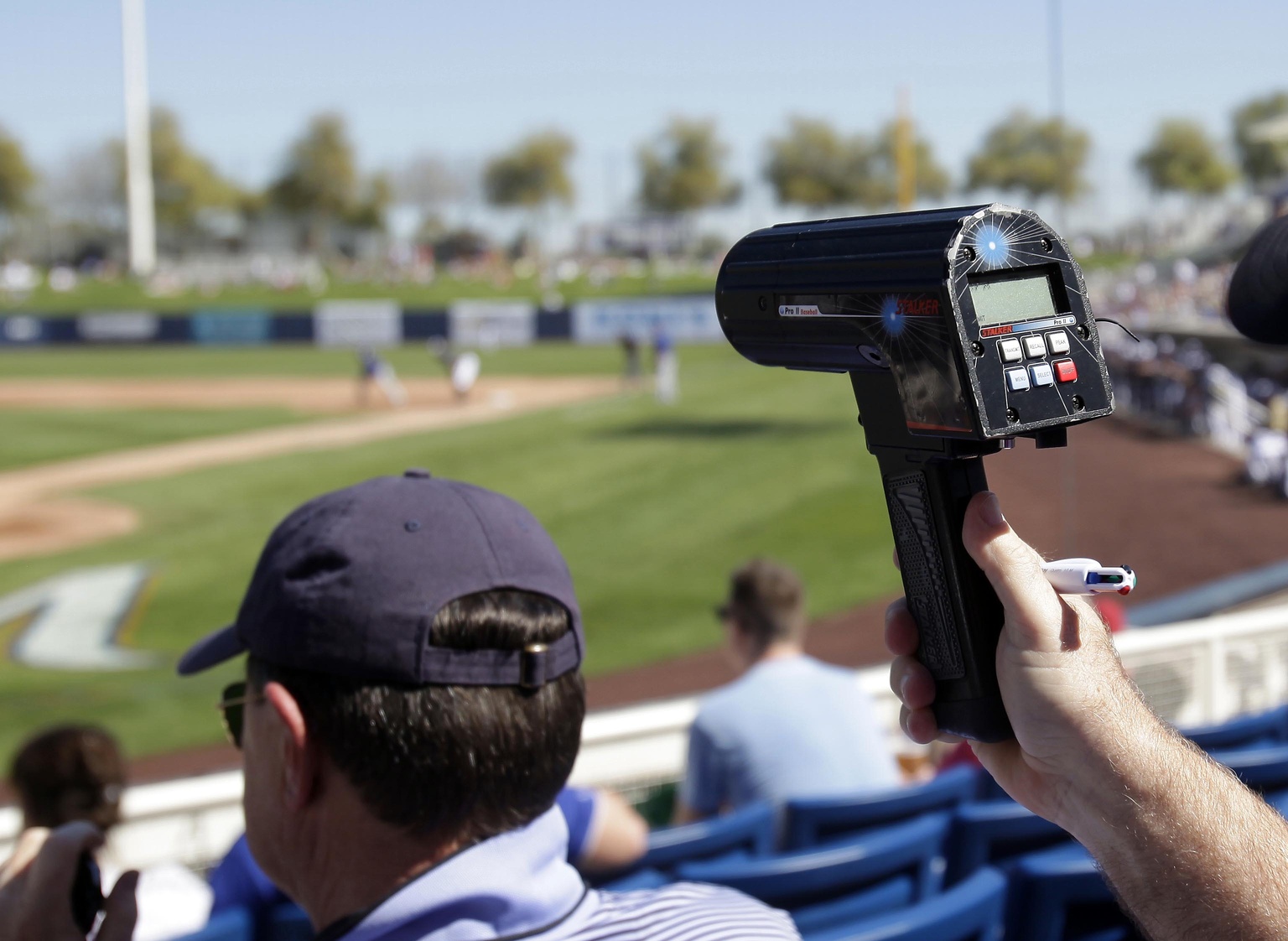 ***This is an excerpt of one of several features from the Twins Daily Offseason Handbook. To read this and more, be sure to download your FREE Twins Daily Offseason Handbook now.*** Boston's Pitching Guru At the end of the 2015 season, the Boston Red Sox added a new position for former major league pitcher Brian Bannister in the front office. Already a member of the team’s scouting department, his acute insight into pitching analytics prompted Boston to give Bannister the title of Director of Pitching Analysis and Development. Bannister’s new job, as described by Red Sox team president Dave Dombrowski, was to develop pitching through an "analytical approach" using the power of PitchF/X and Trackman to improve arm angles, pitch types, spin rates and more. Essentially, Bannister would process the science and deliver it to the organization’s pitching coaches who could distribute it to players in easier to swallow bites. The overall goal would be to fully exploit a pitcher’s talent. One of Bannister’s early successes includes turning around left-handed hurler Rich Hill. Hill was pitching for the independent Long Island Ducks in 2015 when Bannister made a scouting visit. Bannister knew Hill’s curveball had one of the highest spin rates in all of baseball, making it a very tough pitch to barrel, and yet Hill often opted to throw other pitches in situations where his best offering would suffice. So Bannister dropped some pitching knowledge on Hill. He told him to throw his curveball more. He told him to increase the spin on his fastball. Since the conversation with Bannister, Hill has made 24 starts with Boston, Oakland and Los Angeles, striking out 165 over 139.1 innings of work. You'll note that he's the top starting pitcher in this Handbook's free agency section. “It was so refreshing, talking about shaping pitches, shaping the breaking ball. We talked about other pitchers — Zack Greinke, Clayton Kershaw — specifically about how they can shape their different breaking balls that they throw,” Hill told the Boston Globe’s Alex Speier in February. “All of those things took me from four pitches to maybe 12. It was like I had 12 pitches because of changing speeds, changing shapes, changing locations.” It is not hard to envision a pitcher like Tyler Duffey benefiting from that kind of insight. Duffey’s curveball can be a monster pitch at times but he struggles to locate his two types of fastballs consistently thanks to a lowered arm slot. Having a person in the front office focused on identifying issues and isolating strengths could help Duffey reach his ceiling more quickly. Bannister’s methods and pitching knowledge were so well received by the pitchers that the team requested that he join the coaching staff for the remainder of the 2016 season in order to better communicate with the major league roster. While right-hander Rick Porcello doesn’t credit Bannister with his career-best season, the tall sinkerballer said that in addition to Red Sox pitching coach Carl Willis, Bannister's presence has helped provide concrete insight beyond the mental aspects of the mound. When he feels like he is in a funk and doesn’t get the right movement on his sinker, Porcello told the Boston Herald that Bannister’s ability to recall data on arm angles and spin rates to quickly diagnose what is going wrong assisted in keeping him from falling into a prolonged slump. That’s something Bannister said he emphasizes -- not only getting pitchers to their ceiling but sustaining as well. Someone like Kyle Gibson, who has had flashes of brilliance but has had consistency evade him, could follow in similar footsteps. Though the Twins do not have a Brian Bannister in the front office, they do have the foundation in place to capture the necessary data that can lead to swift player development improvements. Across their minor league affiliates -- with the exception of Elizabethton and the Gulf Coast League Twins -- the organization has installed Trackman systems, the very same 3D Doppler hardware that feeds MLB’s StatCast with speed, spin and launch angles. Ensuring that a person or a team of people in similar roles to how the Red Sox employed Bannister, constantly dissecting and disseminating that information throughout the organization, could rapidly improve the pitching program. Chicago's Defensive Coordinator Often found perched high above the field in the press box, looming over the game like a football defensive coordinator, is the Chicago Cubs’ Director of Run Prevention, Tommy Hottovy. ***To read the rest of this feature and more, be sure to download your FREE Twins Daily Offseason Handbook now.***
 -
The Minnesota Twins new front office did not waste much time addressing issues this offseason, first cutting ties with veteran third baseman Trevor Plouffe, now Fox Sport's Ken Rosenthal says the team has a deal in place with free agent catcher Jason Castro.Yahoo Sport's Jeff Passan reports that the two sides have agreed upon a three-year, $24.5 million contract. As Nick Nelson detailed in the Offseason Handbook, Castro hasn't shown much with his bat over the last three seasons, posting a combined .215/.291/.369 line over that time. It would seem in the Twins' best interested to use him in a platoon role with the right-handed swinging John Ryan Murphy. Over the last two seasons Castro hit a passable .225/.315/.417 against right-handed pitching. In that sense, the $8.2 million per year is a hefty fee for a platoon candidate but as the left-handed hitting one, Castro would play the lion's share of the games. Castro's biggest upside has been his defense. Specifically his ability to steal strikes from outside of the zone, particularly against right-handed hitters. Download attachment: output_7BIM7U.gif This could be an immediate impact for pitchers. Consider Kyle Gibson. Gibson does not possess swing-and-miss stuff but has plenty of movement and stays around the zone. With his sinker and slider combo, Gibson could be one big benefactor to Castro's outer-half framing skills. Castro's receiving skill set goes beyond gaining a strike call from off the plate. It is ensuring that pitches that cut through the zone are also acknowledged as such. Consider this: over the last three season with Kurt Suzuki as the primary catcher, the Twins have had 81.3% of pitches that were in the strike zone and the batter watched it go by, called a strike -- the lowest in baseball. The Twins pitching staff, who did not need to be further behind the eight ball, was victimized to some degree by their catchers' performance. We cannot rule out some influence on inconsistent location or umpire biases, to be sure. However by comparison the Astros pitching staff, backstopped by Castro, had baseball's second best rate at 85.3%. While it may seem like a small percentage, that can make a significant difference in any given at bat. "Framing" might be the word that makes people cringe, as if the act is dishonest and swindling a human who is paid to make accurate calls. The reality is framing is receiving the ball in the right way. It is positioning your body to give the umpire a good look at a pitch. It is making a pitch that is one ball length off the plate look more like it clipped a part of the zone. What exactly does Castro's framing skills look like? Here he is stealing a called third strike, coaxing a pitch that passed by the zone back into it. http://i.imgur.com/Elr7puf.gif The previous front office regime did not put much, if any, emphasis on the value of catcher framing. The recent signings of Kurt Suzuki and Ryan Doumit did little to assist the pitching staff. Castro, on the other hand, has gone from a mediocre receiver to one of the game's highest valued, saving 32.2 framing runs above average (7th out of 103 qualified catchers) for the Astros over the last three seasons compared to Suzuki's -32.0 framing runs (100 out of 103 catchers). In theory, that is a six-game swing or could have been a two-game improvement in each season had the Twins employed Castro over Suzuki. When you break the numbers down further, we find that Castro is extremely adept at getting strikes called in hitter's counts. According to ESPN/Tru Media's framing stats, Castro was second in baseball among all catchers with a 15.3 framing runs above average mark when the hitter's were ahead. That means Castro was able to help get his pitcher from dangerous territory into more manageable areas. The move is not sexy from an offseason standpoint, however, this signing could give the Twins' pitching staff a much needed shot in the arm. Click here to view the article
- 223 replies
-
- 4
-
-
- jason castro
- free agent
- (and 1 more)
-
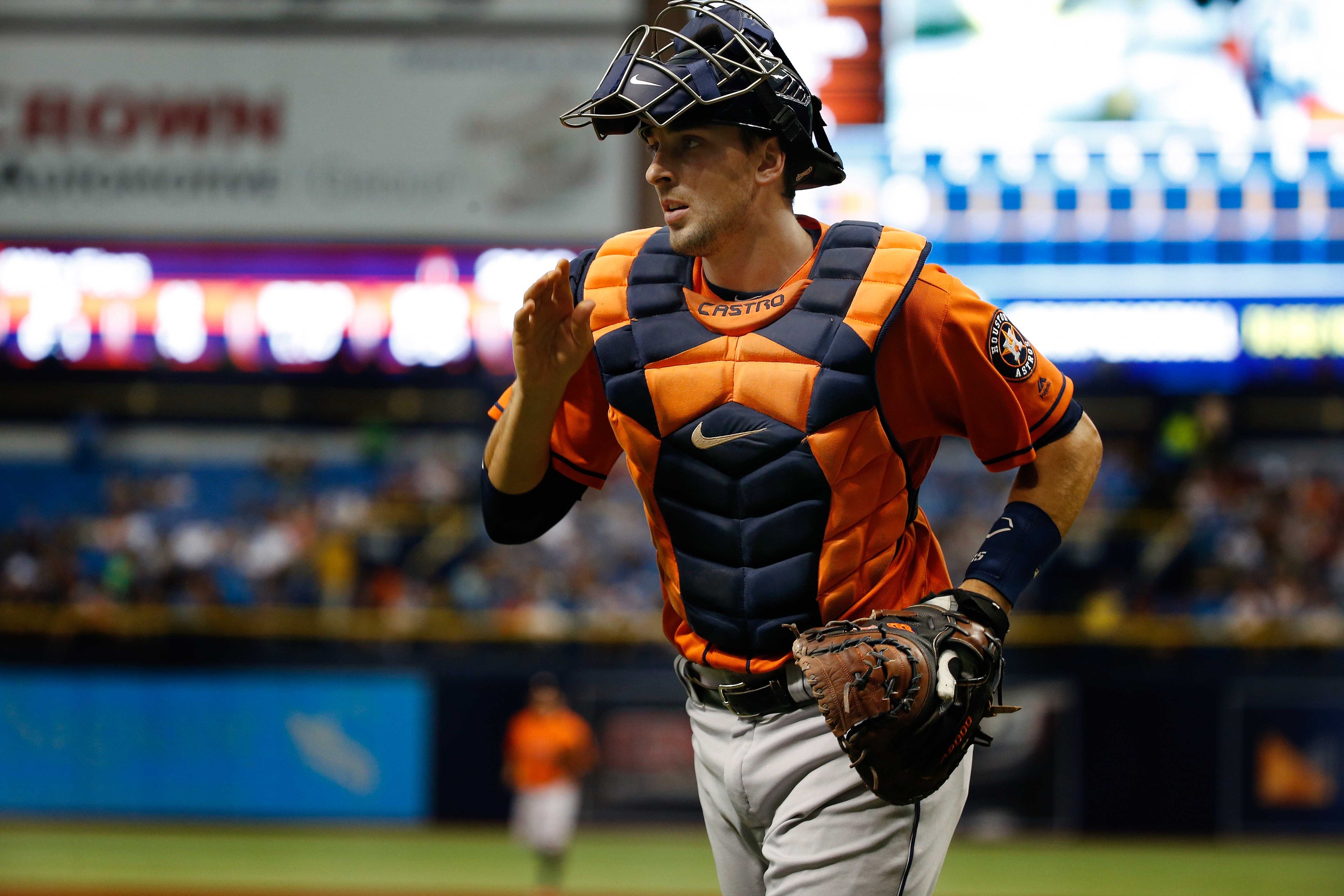 Yahoo Sport's Jeff Passan reports that the two sides have agreed upon a three-year, $24.5 million contract. As Nick Nelson detailed in the Offseason Handbook, Castro hasn't shown much with his bat over the last three seasons, posting a combined .215/.291/.369 line over that time. It would seem in the Twins' best interested to use him in a platoon role with the right-handed swinging John Ryan Murphy. Over the last two seasons Castro hit a passable .225/.315/.417 against right-handed pitching. In that sense, the $8.2 million per year is a hefty fee for a platoon candidate but as the left-handed hitting one, Castro would play the lion's share of the games. Castro's biggest upside has been his defense. Specifically his ability to steal strikes from outside of the zone, particularly against right-handed hitters. This could be an immediate impact for pitchers. Consider Kyle Gibson. Gibson does not possess swing-and-miss stuff but has plenty of movement and stays around the zone. With his sinker and slider combo, Gibson could be one big benefactor to Castro's outer-half framing skills. Castro's receiving skill set goes beyond gaining a strike call from off the plate. It is ensuring that pitches that cut through the zone are also acknowledged as such. Consider this: over the last three season with Kurt Suzuki as the primary catcher, the Twins have had 81.3% of pitches that were in the strike zone and the batter watched it go by, called a strike -- the lowest in baseball. The Twins pitching staff, who did not need to be further behind the eight ball, was victimized to some degree by their catchers' performance. We cannot rule out some influence on inconsistent location or umpire biases, to be sure. However by comparison the Astros pitching staff, backstopped by Castro, had baseball's second best rate at 85.3%. While it may seem like a small percentage, that can make a significant difference in any given at bat. "Framing" might be the word that makes people cringe, as if the act is dishonest and swindling a human who is paid to make accurate calls. The reality is framing is receiving the ball in the right way. It is positioning your body to give the umpire a good look at a pitch. It is making a pitch that is one ball length off the plate look more like it clipped a part of the zone. What exactly does Castro's framing skills look like? Here he is stealing a called third strike, coaxing a pitch that passed by the zone back into it. http://i.imgur.com/Elr7puf.gif The previous front office regime did not put much, if any, emphasis on the value of catcher framing. The recent signings of Kurt Suzuki and Ryan Doumit did little to assist the pitching staff. Castro, on the other hand, has gone from a mediocre receiver to one of the game's highest valued, saving 32.2 framing runs above average (7th out of 103 qualified catchers) for the Astros over the last three seasons compared to Suzuki's -32.0 framing runs (100 out of 103 catchers). In theory, that is a six-game swing or could have been a two-game improvement in each season had the Twins employed Castro over Suzuki. When you break the numbers down further, we find that Castro is extremely adept at getting strikes called in hitter's counts. According to ESPN/Tru Media's framing stats, Castro was second in baseball among all catchers with a 15.3 framing runs above average mark when the hitter's were ahead. That means Castro was able to help get his pitcher from dangerous territory into more manageable areas. The move is not sexy from an offseason standpoint, however, this signing could give the Twins' pitching staff a much needed shot in the arm.
 -
For a visual, here's Castro's last 3 season versus Suzuki's in terms of pitch framing against right-handed hitters: https://twitter.com/ParkerHageman/status/796194876614385664
-
As part of Twins Daily’s on-going efforts to make sure the Offseason Handbook remains a dynamic and functional component of your long, dark, baseball-less winter, we have created a feature that should greatly improve your overall shopping experience. Introducing: The 2016 Free Agent Tracker.Why the Free Agent Tracker? ***DOWNLOAD THE 2016 OFFSEASON HANDBOOK*** One of the areas in which we feel the Offseason Handbook can be improved is in its static nature, particularly in the sections where the landscape can change rapidly as the hot stove heats up. Each year countless hours are spent curating a list of the available free agents, finding their stats, creating a profile, and providing an estimated contract. We truly feel like you receive a valuable service to pull this information into one document. However, once free agency period kicks in and names begin to fly off the board, the functionality is gone. Download attachment: FA.JPG For a more dynamic experience, we’ve created the 2016 Free Agent Tracker, a database complete with all the information you would normally find with the Offseason Handbook’s Free Agent section only now you can manipulate the things that you want to see, when you want to see them. For example, as KSTP’s Darren Wolfson reported earlier this week, the Twins and free agent Kurt Suzuki appear to be headed in opposite directions and the Twins will likely need to find themselves a new backstop. Who is available on the free agent market? Simply toggle the catcher position and you will have a list of all the free agent catchers. Download attachment: FA2.JPG Now let’s say you want to know more details on a specific free agent, such as that Wilson Ramos fella (because you paid little attention to him while he was here the first time around), just click on his name and voila: you are whisked away to a magical land of detailed player profile and a section for any rumors and updates that is pertinent to the player’s free agent status. Download attachment: FA3.JPG As the offseason develops and players are signed, the Free Agent Tracker will update, providing the team which inked that player and the eventual contract (usually a rate so high your grandfather can’t believe people who play a kid’s game get paid so much). Unlike some other free agent lists out there, you will be able to sort through the signed and unsigned players. ***DOWNLOAD THE 2016 OFFSEASON HANDBOOK*** So there you have it. We feel that the Free Agent Tracker is a simple yet vital upgrade to the free agency experience, that complements the Offseason Handbook (which, mahgawd, download it now if you haven’t done so already) like pine tar and maple bats. Take some time to roam around the new database and explore the player profiles. Feel free to leave comments or submit your own contract estimates within any of the player profiles. Enjoy. Click here to view the article

