



Parker Hageman
-
Posts
4,152 -
Joined
-
Last visited
-
Days Won
6
Content Type
Profiles
News
Minnesota Twins Videos
2026 Minnesota Twins Top Prospects Ranking
2022 Minnesota Twins Draft Picks
Minnesota Twins Free Agent & Trade Rumors, Notes, & Tidbits
Guides & Resources
2023 Minnesota Twins Draft Picks
The Minnesota Twins Players Project
2024 Minnesota Twins Draft Picks
2025 Minnesota Twins Draft Pick Tracker
2026 Minnesota Twins Draft Tracker: Picks & Bonuses
Forums
Blogs
Events
Store
Downloads
Gallery
Everything posted by Parker Hageman
-
 It is a shame considering he was starting to find his rhythm at the plate, too. Byron Buxton was beginning to make some noise with the bat -- producing a .387/.457/.516 batting line over his last ten games -- but now he will be sidelined with a groin strain. Buxton suffered the strain while racing for a double during the sixth inning of the contest in Houston on Friday night. In addition to Buxton, the Minnesota Twins announced that they will have Bartolo Colon start against the New York Yankees on Tuesday.As far as Buxton injury goes, it would appear that he was growing more comfortable with his new swing mechanics, as evidence by his hard drive into the left field corner, but he clearly tweaked something on his way into second base. It is possible that he is able to return to the team by next week but the Twins will likely be cautious with their best defender. Download attachment: z0BgLrl.gif In addition to moving Buxton to the disabled list, the Minnesota Twins also announce they have reinstated Joe Mauer, who was placed on the DL on July 7 with a lower back issue. Mauer was having a decent campaign at the plate and was emerging as a high caliber defender at first base this season. Perhaps most interesting, however, is the word that the Twins will have the recently acquired Bartolo Colon start Tuesday’s game against the Yankees. Colon made one start for the Rochester Red Wings last Thursday, working 3.2 innings, strikeout out five but surrendered four runs on four loud hits. Reports were that his outing wasn’t sharp, allowing some solid contact, and that the organization may have opted to keep him in Rochester for at least one more outing. This season Colon has seen more horizontal movement from his two-seam fastball rather than the tilt he has gotten in the past. In short, the pitch has stayed up in the zone instead of darting down. Coincidentally or not Colon’s release point has dropped considerable over the last two years (from 5.9 feet to 5.7 to 5.5 this year) which could explain the difference in movement. If it is mechanical and he is able to regain that same release point, he might be able to piece things back together. Click here to view the article
 -
Byron Buxton To The DL, Bartolo Colon To Start Against Yankees
Parker Hageman posted an article in Twins
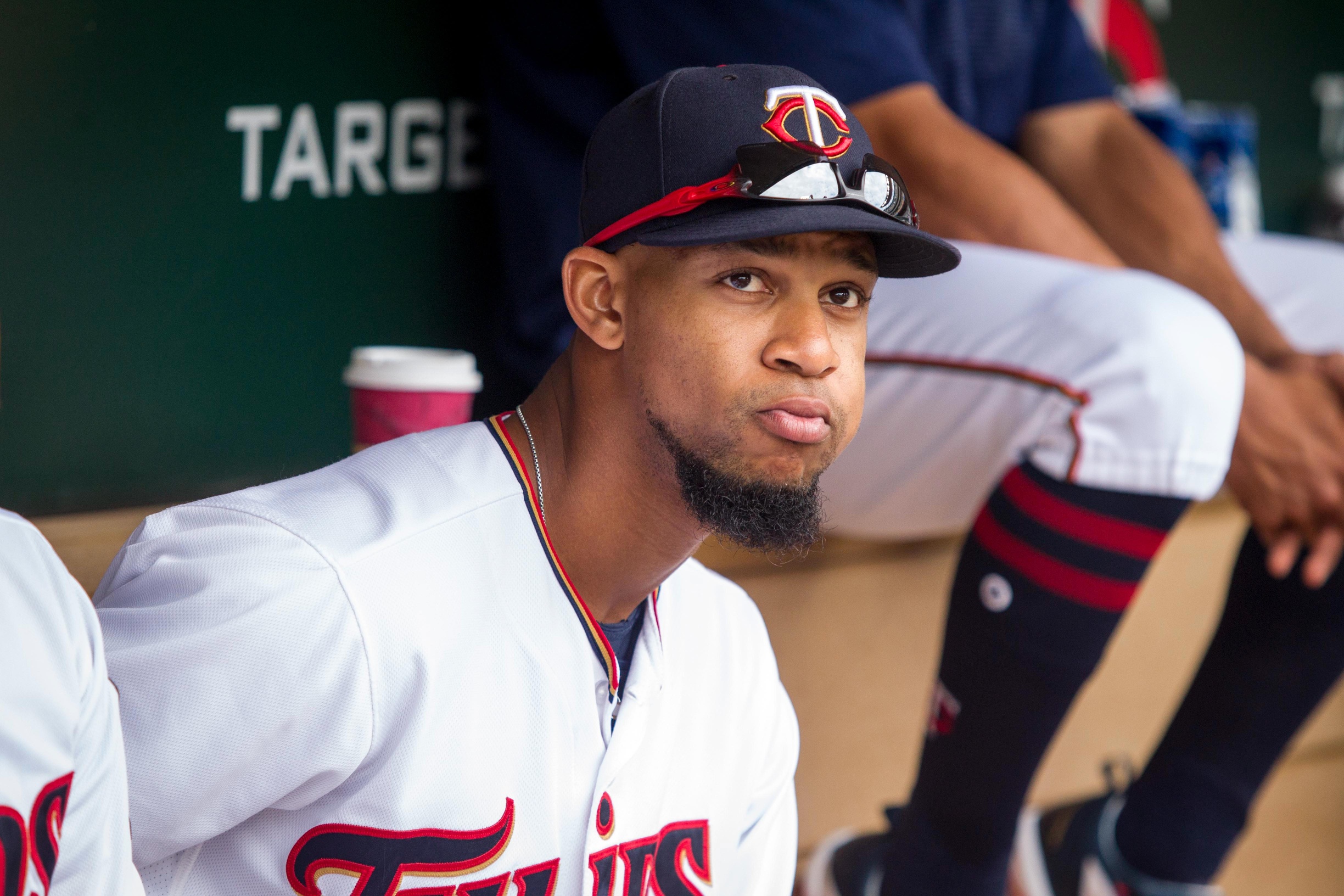 As far as Buxton injury goes, it would appear that he was growing more comfortable with his new swing mechanics, as evidence by his hard drive into the left field corner, but he clearly tweaked something on his way into second base. It is possible that he is able to return to the team by next week but the Twins will likely be cautious with their best defender. In addition to moving Buxton to the disabled list, the Minnesota Twins also announce they have reinstated Joe Mauer, who was placed on the DL on July 7 with a lower back issue. Mauer was having a decent campaign at the plate and was emerging as a high caliber defender at first base this season. Perhaps most interesting, however, is the word that the Twins will have the recently acquired Bartolo Colon start Tuesday’s game against the Yankees. Colon made one start for the Rochester Red Wings last Thursday, working 3.2 innings, strikeout out five but surrendered four runs on four loud hits. Reports were that his outing wasn’t sharp, allowing some solid contact, and that the organization may have opted to keep him in Rochester for at least one more outing. This season Colon has seen more horizontal movement from his two-seam fastball rather than the tilt he has gotten in the past. In short, the pitch has stayed up in the zone instead of darting down. Coincidentally or not Colon’s release point has dropped considerable over the last two years (from 5.9 feet to 5.7 to 5.5 this year) which could explain the difference in movement. If it is mechanical and he is able to regain that same release point, he might be able to piece things back together.
 -
Article: DAAYYAAM. Byron Buxton Is Fast.
Parker Hageman replied to Parker Hageman's topic in Twins Daily Front Page News
I went to Thursday night's game -- the one with Escobar's triple. Watching from the same spot as you, all I could think was "Buxton woulda scored standing up". -
MLB’s StatCast division recently released a new metric - SprintSpeed - which hoped to measure who the fastest runners are in the game. To no one’s surprise, the Minnesota Twins’ Byron Buxton was in the top two. While viewers have come to recognize Buxton as a burner for awhile now, he continues to provide examples of why this weapon is so potent. Such as when he scored from first (!) when a single (!!!) was hit. You've got to see this.First, if you didn’t get a chance to see it live, watch the video for yourself. So here's what you just saw: With two out and Buxton at first, Brian Dozier hits a hard ground ball that skips past Orioles’ shortstop Ruben Tejada into left-center field. Buxton, off on contact with two down, wheels past second and is halfway to third when Baltimore’s center fielder, Adam Jones, cuts it off on his backhand. All normal, all routine. Here’s where it gets interesting: Instead of relaying it to the shortstop out for the cut, Jones tosses it to the second base bag, presumably to keep Dozier from advancing because what normal non-cyborg human is capable of scoring from first? Byron M-F-in’ Buxton, that’s who. And here’s the super impressive part: It’s wasn’t as if Buxton was running on the play. He wasn’t sent in motion. He left first at a normal lead on contact. He just gassed it until he was sliding across home plate at terminal velocity. And here's a little bit of shade: Credit Twins’ third base coach Gene Glynn on reading the play and windmilling him home as he sees the throw sail over the shortstop’s head and toward second base. So, yeah, it wasn’t as if Buxton scored from first completely contested. It did take a mental lapse by Jones to allow for the opportunity. That said, good on both Glynn and Buxton for capitalizing on that play. In short, Byron Buxton is fast everyone. Click here to view the article
-
 First, if you didn’t get a chance to see it live, watch the video for yourself. https://twitter.com/cjzer0/status/883535079171137537/video/1 So here's what you just saw: With two out and Buxton at first, Brian Dozier hits a hard ground ball that skips past Orioles’ shortstop Ruben Tejada into left-center field. Buxton, off on contact with two down, wheels past second and is halfway to third when Baltimore’s center fielder, Adam Jones, cuts it off on his backhand. All normal, all routine. Here’s where it gets interesting: Instead of relaying it to the shortstop out for the cut, Jones tosses it to the second base bag, presumably to keep Dozier from advancing because what normal non-cyborg human is capable of scoring from first? Byron M-F-in’ Buxton, that’s who. And here’s the super impressive part: It’s wasn’t as if Buxton was running on the play. He wasn’t sent in motion. He left first at a normal lead on contact. He just gassed it until he was sliding across home plate at terminal velocity. And here's a little bit of shade: Credit Twins’ third base coach Gene Glynn on reading the play and windmilling him home as he sees the throw sail over the shortstop’s head and toward second base. So, yeah, it wasn’t as if Buxton scored from first completely contested. It did take a mental lapse by Jones to allow for the opportunity. That said, good on both Glynn and Buxton for capitalizing on that play. In short, Byron Buxton is fast everyone.
 -
Let’s all welcome the Big Sexy to the Minnesota Twins organization. On Friday night, the Twins announced they have signed the 44-year-old right-handed pitcher Bartolo Colon to a minor league contract. Colon will report to Rochester over the next few days with the intention of working toward a spot in the starting rotation in Minnesota. What can the oldest pitcher in baseball provide the Twins (if anything)?This offseason Colon signed a one-year, $12.5 million contract with the Atlanta Braves but was released on July 4 after compiling a 2-8 record with a 8.14 ERA. Clearly the results have not been pleasant but Colon is virtually the same pitcher he was in the prior season with the Mets when he finished 15-8 with a 3.43 ERA in 191 innings. According to Fangraphs.com’s hard-hit rate, Colon’s marks stayed nearly the same (35.4% in 2016 and 32.4% in 2017) but his new defense failed to convert balls in play into outs at the same frequency as the previous season, as his BABIP ballooned from .291 to .360. He’s also be unable to keep runners from scoring as his left-on-base rate has fallen from 76.5% in 2016 to 48.2% this season. Why might he be more successful in Minnesota? It may come down to defense. Opponents posted a .314 batting average on ground balls against Colon, well above the MLB average of .239. It stands to reason that with a better infield and a better plan of defense, Colon should be able to keep some of those hits off his ledger. When it comes to infields, the move between Atlanta (-10 runs saved) and Minnesota (-6 runs saved) is basically a wash however the Twins have been implementing more defensive shifts than the Braves. Of course, Colon has also had a noticeable uptick in free passes issued, as his walk rate grew from 4.2% last year to 6.7% this year. A very good mark, yet more baserunners nonetheless. Once someone who was reaching triple digits at a young age, now Colon can barely break glass with his velocity - not even averaging Back To The Future velo on his fastball anymore (under 88). Colon has been using movement and pitch variation to keep major league hitters at bay. When operating correctly, his two-seam fastball is a weapon to behold. You never know what might be left in the tank in a pitcher at this age but with Colon, a lot of his more recent success was based on guile. It is a low-risk maneuver for the Twins and one that could add some instant depth to the rotation at a low cost as they attempt to stay in contention in the season’s second-half. Click here to view the article
-
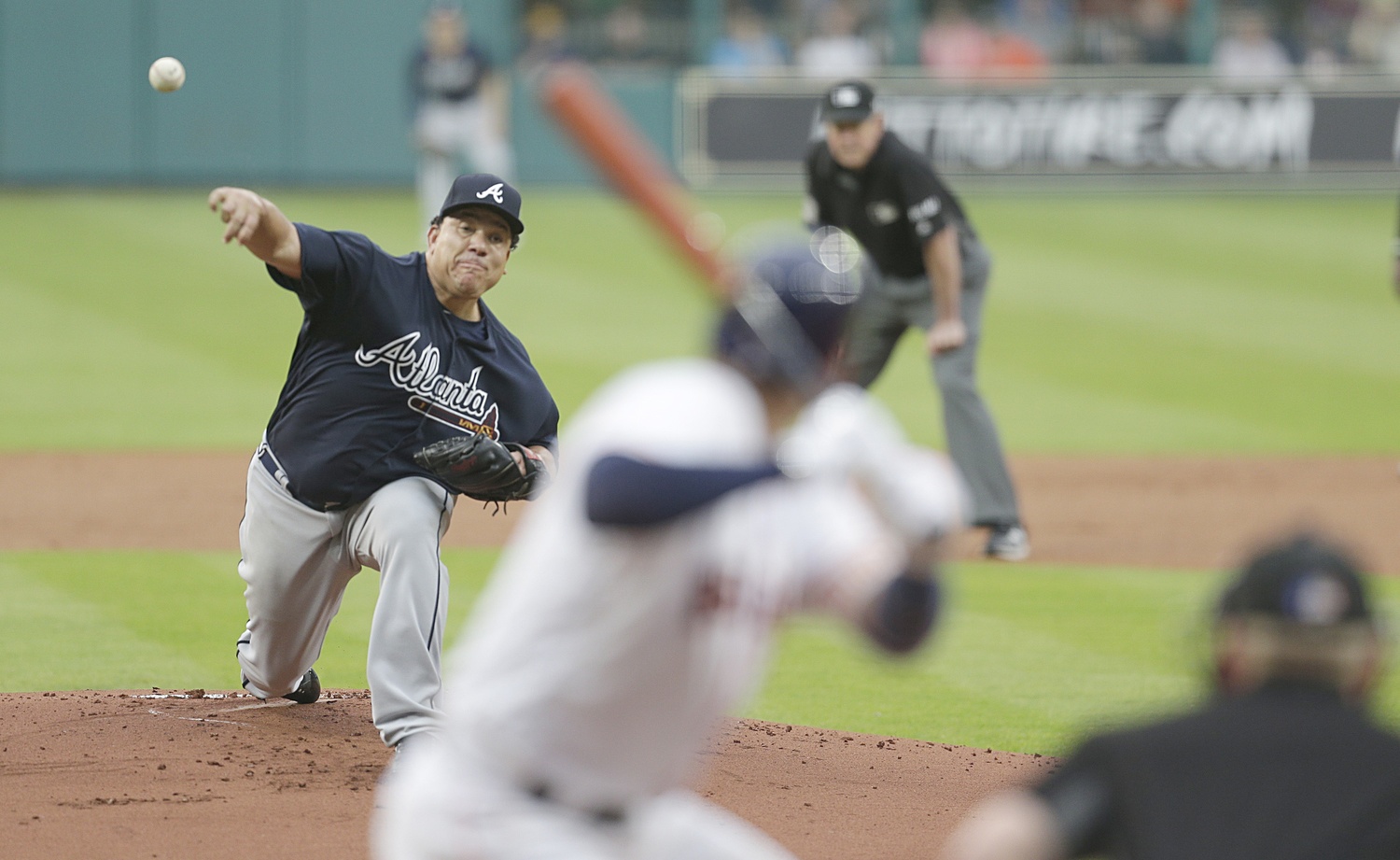 This offseason Colon signed a one-year, $12.5 million contract with the Atlanta Braves but was released on July 4 after compiling a 2-8 record with a 8.14 ERA. Clearly the results have not been pleasant but Colon is virtually the same pitcher he was in the prior season with the Mets when he finished 15-8 with a 3.43 ERA in 191 innings. According to Fangraphs.com’s hard-hit rate, Colon’s marks stayed nearly the same (35.4% in 2016 and 32.4% in 2017) but his new defense failed to convert balls in play into outs at the same frequency as the previous season, as his BABIP ballooned from .291 to .360. He’s also be unable to keep runners from scoring as his left-on-base rate has fallen from 76.5% in 2016 to 48.2% this season. Why might he be more successful in Minnesota? It may come down to defense. Opponents posted a .314 batting average on ground balls against Colon, well above the MLB average of .239. It stands to reason that with a better infield and a better plan of defense, Colon should be able to keep some of those hits off his ledger. When it comes to infields, the move between Atlanta (-10 runs saved) and Minnesota (-6 runs saved) is basically a wash however the Twins have been implementing more defensive shifts than the Braves. Of course, Colon has also had a noticeable uptick in free passes issued, as his walk rate grew from 4.2% last year to 6.7% this year. A very good mark, yet more baserunners nonetheless. Once someone who was reaching triple digits at a young age, now Colon can barely break glass with his velocity - not even averaging Back To The Future velo on his fastball anymore (under 88). Colon has been using movement and pitch variation to keep major league hitters at bay. When operating correctly, his two-seam fastball is a weapon to behold. https://twitter.com/ParkerHageman/status/781609637514612736. Colon reportedly picked up a grip from Greg Maddux which allows for the added movement. Essentially, the right-hander will aim at a left-handed batter’s hip and watch the pitch spin back over the zone as the hitter flinches. https://twitter.com/JohnCurtiss43/status/883547762092068864 You never know what might be left in the tank in a pitcher at this age but with Colon, a lot of his more recent success was based on guile. It is a low-risk maneuver for the Twins and one that could add some instant depth to the rotation at a low cost as they attempt to stay in contention in the season’s second-half.
 -
Article: Breaking Byron Buxton
Parker Hageman replied to Parker Hageman's topic in Twins Daily Front Page News
Just wanted to add something to this: Since the start of July, Buxton has lowered his hands (back to where they were in September of last year, btw) and has far less movement in bringing them back to the load position. It's very efficient compared to where he was just a few weeks ago. Plus, you see him loading more with his upper half (his numbers turning toward the pitcher more are indicative of this). The results have been more solid contact. https://twitter.com/ParkerHageman/status/883382416777326596 Launch angle still needs work. He's not going to hit for power on the ground. I would argue that his "base hit" to third the other night against the Angels was also a gift from the official scorekeeper (a better throw would have gotten him but Pennington threw it away). Nevertheless, exit velocity doesn't lie. He's hitting the ball harder. It is a start. -
Article: Get To Know Felix Jorge
Parker Hageman replied to Cody Christie's topic in Twins Daily Front Page News
Jorge has a nice lull in his mechanics. Makes the fastball sneaky and jump on a hitter despite the so-so velo. http://i.imgur.com/m7LPdAw.gif Bert really likes to talk about how pitchers should really *PUUUUSH* off that rubber. Places like Driveline Baseball have collected data that proves the push off isn't a key factor in a pitcher's velocity, the hip turn is. Jorge is so free and easy. I'm sure at some point that will be commented on from the booth (although it's Morris not Blyleven this series). http://i.imgur.com/e9dXEXw.gif There's some more great footage that Twins Daily regular Bob Sacamento grabbed of Felix Jorge on YouTube. Be sure to check it out. -
“The leg kick is me now. I’m going to stick with what I do.” Byron Buxton, March 2017. There is a stand-up bit Jerry Seinfeld had about pilots and their insistence on telling passengers just exactly what they are doing in-flight. I’m taking the plane up to whatever altitude. We’re going to head south around the Great Lakes. We’re descending to whatever feet. We’re passing over Las Vegas now. The paraphrased punchline was [seinfeld voice]: Yeah, that’s great. Just get us to where it says on the ticket. I don’t care what you are doing in the cockpit, land at the place we all agreed upon before boarding. In many respects, this is how a large number of Twins fans react to the offensive struggles of Byron Buxton. Toe tap? Leg kick? Focused on hitting ground balls? Who cares. Replace the strikeouts with hits. Just get him to where he needs to go. While that is fine, there are times when you have to talk about the methods behind the madness. If you are a person that cares about the process as well as results, this post is for you.Despite the emphatic statement he made in spring training, by the end of May Buxton did an about-face and decided that the leg kick wasn’t him anymore. The early season struggles and unsightly lack of contact sent him scrambling for an alternative. For a stretch, Buxton retained his open stance set-up (something he had in high school but the Twins eliminated in the minors) but refrained from lifting his front leg. Everything about that swing screamed out that it was an unnatural abomination. His body looked like it wanted to lift the front leg but the foot was cemented to its spot in the batters’ box. His numbers in this stretch certainly don’t reflect success -- he is still striking out a ton and not reaching base -- but he’s starting to see positives from this approach. Second, it should be known that the Twins’ coaches are not actively trying to change their hitters into ground ball machines wholesale. For example, earlier this month the Star Tribune’s Phil Miller detailed that the Twins coaching staff was encouraging utility infielder Ehire Adrianza to switch to a leg kick from a double-toe tap: “I’m seeing the ball better, I’m recognizing pitches better. I don’t have to rush my swing like I was before,” he said. “Rudy [Hernandez] and James [Rowson] said, ‘Don’t be afraid. You can be a better hitter. You can hit doubles and homers.’ ” So, no, the Minnesota Twins do not have an evil plan to convert every hitter into Ben Revere. That said, it is frustrating to see a hitter with promise who has had previous success with one type of swing to have it reduced to such a level where they are hoping to beat out infield hits or incite errors. Buxton was once a five-tool player and there is an on-going effort to strip him of one. Baseball swing mechanics are not like ballroom dancing where if you follow step-by-step instructions, you can master the practice. With a swing, there’s a mental side of the game, a level of comfort each hitter needs in order to execute. And when it came to the toe tap mechanics the Twins outfitted him with in the minor leagues, Buxton acknowledged he was never truly comfortable with the motions. When he reflected back this spring on his success at the end last year, Buxton said he drew upon his carefree high school playing days as a motivating factor: “In high school, you just go up there and say, ‘All right, I’m about to see how far I can hit it.’ I knew high school was where I had fun. That’s where most kids start to realize what they want to do. I just went back to the moment when I was in high school.” That is a far superior mindset to have compared to just looking to get on base. Step into the box trying to see how far or how hard you can hit it. It shouldn’t matter what timing mechanism Buxton ultimately uses. There are players who have success with a leg kick, toe tap, no stride, leg glide, etc, etc. The endgame for Buxton should be getting him comfortable again in his own body and that does not seem to be happening with the current version. Click here to view the article
-
 Despite the emphatic statement he made in spring training, by the end of May Buxton did an about-face and decided that the leg kick wasn’t him anymore. The early season struggles and unsightly lack of contact sent him scrambling for an alternative. For a stretch, Buxton retained his open stance set-up (something he had in high school but the Twins eliminated in the minors) but refrained from lifting his front leg. Everything about that swing screamed out that it was an unnatural abomination. His body looked like it wanted to lift the front leg but the foot was cemented to its spot in the batters’ box. https://twitter.com/ParkerHageman/status/869746714663628800 Not long after that, Buxton modified his set-up to close his front side, allowing him some ability to cover the entire zone, and made the swing look a tad more natural in the process but with the same glued front foot. What was surprising is that no one from the media nor the Twins seemed to address this. Perhaps it goes back to not caring what the pilot is doing. Either way, it took almost a month of watching on a daily basis before the Twins made a public acknowledgement of what was happening. https://twitter.com/ParkerHageman/status/877701904763043840 The goal, as explained on the Fox Sports North broadcast, was to make more and better contact. By stripping away the excess movements, the Twins believed he could be a more productive hitter. And this isn’t the first time the organization attempted to do so. “I’m going to be honest with you,” Bert Blyleven said. “It’s the same thing Tom Brunansky tried to get Buxton to do but when Buxton was sent down he went back to the high leg kick and hit well.” Blyleven went on to suggest that Buxton should look to his manager, Paul Molitor, and his swing for inspiration. To Blyleven, Molitor’s minimalist, handsy swing should be the template for Buxton going forward. Here’s the thing: I thought I sort of, kind of get what the Twins are doing. They need Buxton’s defense in center. He’s a lifesaver for the pitching staff. You can’t replace one of the game’s best defenders that easily and you also can’t keep having an automatic out in the lineup either. You have to make concessions. They would temporarily reduce his movements in order to try to get something salvageable out of his bat and bridge him until the offseason where he can work on perfecting his swing. However, the more it is discussed, the more it sounds like the Twins’ long-term vision is to keep Buxton grounded. On Wednesday, 1500ESPN.com’s Jake Depue spoke to the center fielder who elaborated on what he was trying to accomplish with the swing: “[The goal is] putting the ball in play more,” Buxton said. “Putting it on the ground more to get it out of the air. With the leg kick I was more fly ball oriented. It didn’t give me a chance to get on base. Now putting it on the ground I at least have the chance of beating it out or them rushing the throw and making an error.” Muh gawd. As we have come to learn about baseball, extra base hits are in the air and ground balls are simply long bunts. That is reason enough to focus on elevating the ball but now data shows that MLB’s ball -- intentionally or not -- is juiced. Hitters should take advantage of the added distance the balls provides. What’s more, the fact that Buxton is in the batter’s box looking to make enough contact that an infielder makes an error is beyond the pale. For starters, the fielding percentage (a dubious stat in its own right but that’s for another time) is over 98%. While the odds may increase based on his speed, the notion that the upside of your plate appearance is maybe the shortstop will bobble this one is absurd. Second, there are five bodies in the infield looking to knock down any grounder that comes their way. Teams use computing power to set up shifts which increase their odds of stopping those worm-burners from scooting through the infield. Why in the name of all that is holy would you want to construct your game around ground balls? Before readers start getting upset and bringing their pitchforks out at the Twins’ staff, two things: First, Buxton has actually shown signs of improvements when it comes to contact rate and the type of contact. The ground ball rate, which spiked dramatically the first two weeks with the new swing, has started to drop as well. https://twitter.com/ParkerHageman/status/880083120132956161 His numbers in this stretch certainly don’t reflect success -- he is still striking out a ton and not reaching base -- but he’s starting to see positives from this approach. Second, it should be known that the Twins’ coaches are not actively trying to change their hitters into ground ball machines wholesale. For example, earlier this month the Star Tribune’s Phil Miller detailed that the Twins coaching staff was encouraging utility infielder Ehire Adrianza to switch to a leg kick from a double-toe tap: “I’m seeing the ball better, I’m recognizing pitches better. I don’t have to rush my swing like I was before,” he said. “Rudy [Hernandez] and James [Rowson] said, ‘Don’t be afraid. You can be a better hitter. You can hit doubles and homers.’ ” So, no, the Minnesota Twins do not have an evil plan to convert every hitter into Ben Revere. That said, it is frustrating to see a hitter with promise who has had previous success with one type of swing to have it reduced to such a level where they are hoping to beat out infield hits or incite errors. Buxton was once a five-tool player and there is an on-going effort to strip him of one. Baseball swing mechanics are not like ballroom dancing where if you follow step-by-step instructions, you can master the practice. With a swing, there’s a mental side of the game, a level of comfort each hitter needs in order to execute. And when it came to the toe tap mechanics the Twins outfitted him with in the minor leagues, Buxton acknowledged he was never truly comfortable with the motions. When he reflected back this spring on his success at the end last year, Buxton said he drew upon his carefree high school playing days as a motivating factor: “In high school, you just go up there and say, ‘All right, I’m about to see how far I can hit it.’ I knew high school was where I had fun. That’s where most kids start to realize what they want to do. I just went back to the moment when I was in high school.” That is a far superior mindset to have compared to just looking to get on base. Step into the box trying to see how far or how hard you can hit it. It shouldn’t matter what timing mechanism Buxton ultimately uses. There are players who have success with a leg kick, toe tap, no stride, leg glide, etc, etc. The endgame for Buxton should be getting him comfortable again in his own body and that does not seem to be happening with the current version.
 -
Article: How Fast Is Byron Buxton?
Parker Hageman replied to Parker Hageman's topic in Twins Daily Front Page News
Acceleration is another data point StatCast can measure but doesn't allow for public consumption. -
Article: How Fast Is Byron Buxton?
Parker Hageman replied to Parker Hageman's topic in Twins Daily Front Page News
This seems to be arguing the semantics about what the word "sprint" means. I say it is a cellphone carrier and I cannot believe Tom Tango would sign off on that. But in all seriousness, the metric is flawed to some degree. -
Article: How Fast Is Byron Buxton?
Parker Hageman replied to Parker Hageman's topic in Twins Daily Front Page News
I will say, they did hire the right people to dig into it. Tom Tango and Daren Willman are v good at what they do. -
Major League Baseball’s Advanced Media arm released a new set of data to the public on Tuesday: the Sprint Speed metric. Sprint Speed was introduced in April but was limited, showing the speed of outfielders and defense only at that time. After some modifications and additions, the group has added baserunning and has created a leaderboard for consumption at BaseballSavant.com. As Minnesota Twins fans have seen with their eyes, like when he beats out bunts back to the pitcher, and through various other StatCast metrics like Max Speed, Distance Covered and Viscosity*, Byron Buxton is fast. Thanks to the data captured by MLB, we now know just how fast he is and where he stands among the game’s speediest speedsters.Byron Buxton is the second fastest in baseball. Sorry to disappoint the speed enthusiasts. When it comes to the fastest man in the game, the Reds’ Billy Hamilton has the bragging rights, covering a 30.1 feet per second, while Buxton checks in right behind him at 29.9 feet per second. On the complete opposite end of the spectrum is someone Twins fans might recall seeing move at a snail’s pace in a recent series: Albert Pujols. Pujols’ running abilities are obviously hampered by injuries but nevertheless at 23.3 feet per second, he is the slowest man in baseball. In case you wanted to know who the slowest man in a Twins uniform is, that honor is shared by two men: Jason Castro and Kennys Vargas. If you are wondering how the sausage is made, MLB’s Mike Petriello explains how it all works: As we discussed in April, we're measuring speed in terms of "feet per second in a player's fastest one-second window," because feet and seconds make a lot more sense in the context of baseball than miles and hours. While three feet per second may not sound like much, if you were to maintain that speed for four or five seconds, suddenly you're talking 12-15 feet. It can be the difference between being safe or out or not even trying. While Hamilton averages about 30 feet per second, Olympian Usain Bolt, by comparison, has reached up to 37 feet per second in his first 40 meters. The sausage-makers also did you a favor by removing the instances when a runner was jogging to first or pulled up to trot home on an uncontested play. Sprint Speed is only interested in maximum effort plays. Considering that when I first started writing about baseball before the advent of Pitch FX and I had to chart my own swing-and-misses and pitch types during games, this is a substantial innovation. It is novel, to be sure, but I still am left thinking about the applicable use of this specific metric. It will help settle some bar bets and I certainly can see this number splayed on a broadcast after someone like Buxton covers a ton of territory in the outfield or rips a triple, but in terms of the analysis of the game? Part of me just wants StatCast to release a generic baseball skill leaderboard. I want to sort through the rankings of guys’ home-to-first times, catcher’s POP times and a pitcher’s delivery time -- things of that nature so I won’t have to bring a stopwatch to a game (note: I do not bring a stopwatch to a game). MLB probably won’t do this because sites like Fangraphs or Baseball Prospectus could use that data to create their own metrics, so we have to be satisfied with the morsels that MLBAM provides us. While this data may be a surface-scratcher, there are some things of interest when you parse the list. Take note of the fastball Minnesota Twins: Eduardo Escobar happens to be the fourth-fastest member of the Twins with an above average speed of 28 feet per second. That would be considered swift. Yet over his seven year career, he is just 8-for-17 in stole base attempts, averaging just five attempts per year. How is it that he is such a bad base-stealer? Are his leads inferior? Does his jumps suck? What is it about Escobar that makes a fleet-footed individual below-average at stealing bases? StatCast’s data leads to more questions which, unfortunately, have to be addressed through more StatCast data that isn’t available. Oh well. At least we now know Byron Buxton is very fast. *Not a real thing but you bought it for a brief second which just goes to show how little you pay attention to StatCast. Click here to view the article
-
 Byron Buxton is the second fastest in baseball. Sorry to disappoint the speed enthusiasts. When it comes to the fastest man in the game, the Reds’ Billy Hamilton has the bragging rights, covering a 30.1 feet per second, while Buxton checks in right behind him at 29.9 feet per second. On the complete opposite end of the spectrum is someone Twins fans might recall seeing move at a snail’s pace in a recent series: Albert Pujols. Pujols’ running abilities are obviously hampered by injuries but nevertheless at 23.3 feet per second, he is the slowest man in baseball. In case you wanted to know who the slowest man in a Twins uniform is, that honor is shared by two men: Jason Castro and Kennys Vargas. If you are wondering how the sausage is made, MLB’s Mike Petriello explains how it all works: As we discussed in April, we're measuring speed in terms of "feet per second in a player's fastest one-second window," because feet and seconds make a lot more sense in the context of baseball than miles and hours. While three feet per second may not sound like much, if you were to maintain that speed for four or five seconds, suddenly you're talking 12-15 feet. It can be the difference between being safe or out or not even trying. While Hamilton averages about 30 feet per second, Olympian Usain Bolt, by comparison, has reached up to 37 feet per second in his first 40 meters. The sausage-makers also did you a favor by removing the instances when a runner was jogging to first or pulled up to trot home on an uncontested play. Sprint Speed is only interested in maximum effort plays. Considering that when I first started writing about baseball before the advent of Pitch FX and I had to chart my own swing-and-misses and pitch types during games, this is a substantial innovation. It is novel, to be sure, but I still am left thinking about the applicable use of this specific metric. It will help settle some bar bets and I certainly can see this number splayed on a broadcast after someone like Buxton covers a ton of territory in the outfield or rips a triple, but in terms of the analysis of the game? Part of me just wants StatCast to release a generic baseball skill leaderboard. I want to sort through the rankings of guys’ home-to-first times, catcher’s POP times and a pitcher’s delivery time -- things of that nature so I won’t have to bring a stopwatch to a game (note: I do not bring a stopwatch to a game). MLB probably won’t do this because sites like Fangraphs or Baseball Prospectus could use that data to create their own metrics, so we have to be satisfied with the morsels that MLBAM provides us. While this data may be a surface-scratcher, there are some things of interest when you parse the list. Take note of the fastball Minnesota Twins: Eduardo Escobar happens to be the fourth-fastest member of the Twins with an above average speed of 28 feet per second. That would be considered swift. Yet over his seven year career, he is just 8-for-17 in stole base attempts, averaging just five attempts per year. How is it that he is such a bad base-stealer? Are his leads inferior? Does his jumps suck? What is it about Escobar that makes a fleet-footed individual below-average at stealing bases? StatCast’s data leads to more questions which, unfortunately, have to be addressed through more StatCast data that isn’t available. Oh well. At least we now know Byron Buxton is very fast. *Not a real thing but you bought it for a brief second which just goes to show how little you pay attention to StatCast.
 -
Should have asked him about crashing on the Morneau/Mauer couch in St Paul.
- 6 replies
-
- 1
-

-
- josh rabe
- torii hunter
- (and 3 more)
-
Article: How Long Is Eddie Rosario's Leash?
Parker Hageman replied to Nick Nelson's topic in Twins Daily Front Page News
Since I missed this play the first go 'round, I searched it up at Baseball Savant (video). The remark about Castro running over to field it made me think that it was a terrible offline throw. It was actually Sano, who was set up for the relay, who nabbed it, albeit offline as well. (You can see Sano throw his arms up to call for it as Rosario reaches it so that may have influenced Rosario's decision-making.) The baseball play is that the throw should have gone into second to keep the double play in order with just one out. Plain and simple. Or, if Abreu insisted on continuing to second, he would have been toast (but it appears he only went ahead once Rosario committed to throwing to Sano). I will add there is a benefit for the decision-making to throw home in that situation. There run expectancy difference between a runner on 2B with one out and an runner on first with one out is .665 vs .509 (so a reduction of .155 runs to the defense's favor). Meanwhile, had Rosario cut Cabrera down at home, with Abreu on 2B with two outs would have a run expectancy of .319. I'm guessing none of that was going through Rosario's head as he tried to get behind the baseball. With a two-run lead, you have to be positive you can get a throw to nail the runner. Again, I think the throw should have gone into second but there's some logic behind the attempt to throw a runner out at home in that situation. -
Article: Spinning For Success
Parker Hageman replied to Cody Christie's topic in Twins Daily Front Page News
I don't think this is entirely true. You look at the guys with really good curveballs, they get into two strike counts and toss the hammer all the time. Hitters KNOW that it is coming and are still swinging out of their shoes. Now, you could argue that hitters who know a curveball is coming in hitter's counts or first pitch may be less inclined to chase. -
Article: Spinning For Success
Parker Hageman replied to Cody Christie's topic in Twins Daily Front Page News
Right. Look no further than Ryan Pressly who has struggled to locate his curveball -- one of the league's highest spin rates -- in the strike zone. -
I was referring to his curveball. I should have been more specific.
-
I was happy to ready tonight that the Twins were using their Trackman radar to capture data on Greene during his bullpen session at Target Field. From Lavelle's recent article: ' Among other things, that should help them establish a pretty good baseline of where his curveball is at. Very refreshing to read that.
- 34 replies
-
- 3
-
-
- hunter greene
- mlb draft
- (and 3 more)
-
No disrespect meant for Gore. I just haven't seen strong ties to him like I had Greene, Wright or McKay.
- 34 replies
-
- 1
-
-
- hunter greene
- mlb draft
- (and 3 more)
-
I think it matters to an organization like the Twins because it could affect his development timeline. Look no further than Kohl Stewart as an example of someone with a plus-fastball and lack of quality secondary pitches. The question for me becomes, OK, where is his breaking stuff at right now. That video was a flash of a good pitch, imo. Is that someone that happens once in a blue moon when he throws it? What are evaluators not liking specifically? As far as innings thrown goes, he likely threw around 80-100 innings in a given calendar year between HS and club baseball. That is comparable to most college starters. All amateur arms need to build in the system.
- 34 replies
-
- 2
-
-
- hunter greene
- mlb draft
- (and 3 more)
