



Nick Nelson
-
Posts
8,322 -
Joined
-
Last visited
-
Days Won
56
Content Type
Profiles
News
Minnesota Twins Videos
2026 Minnesota Twins Top Prospects Ranking
2022 Minnesota Twins Draft Picks
Minnesota Twins Free Agent & Trade Rumors, Notes, & Tidbits
Guides & Resources
2023 Minnesota Twins Draft Picks
The Minnesota Twins Players Project
2024 Minnesota Twins Draft Picks
2025 Minnesota Twins Draft Pick Tracker
2026 Minnesota Twins Draft Tracker: Picks & Bonuses
Forums
Blogs
Events
Store
Downloads
Gallery
Everything posted by Nick Nelson
-
Download attachment: miguelsano.jpg The Twins dropped two of three in Washington over the weekend, widening their deficit in the AL Central to 7.5 games. For the big-league club, things are looking rather grim. That was to be expected, however, and fortunately things are considerably brighter down on the farm, which is where fans should be focusing their attention for signs of positivity this year. Immediately after slugging his 15th and 16th homers of the season for Ft. Myers on Sunday, Miguel Sano received his much anticipated promotion to New Britain. [PRBREAK][/PRBREAK]The top prospect had made a mockery of the Florida State League, and will now take his talents to Double-A, where at age 20 he'll become one of the level's youngest players. If he continues to excel, there's a reasonable chance that Sano could join the Twins as a September call-up later this year. Headed to New Britain along with Sano are Eddie Rosario and Angel Morales. Rosario was ranked by Twins Daily as the organization's No. 7 prospect prior to the season and was hitting .329 for the Miracle while flashing solid defense at second base. Morales, a once highly regarded outfield prospect who's been derailed by injuries and other issues, was enjoying a productive season in Ft. Myers and now has a chance to put himself back on the major-league track at age 23. Another advancement that didn't generate quite the same amount of buzz was James Beresford's promotion to Triple-A. The 24-year-old infielder had been batting .323 for New Britain and now joins a Rochester club hurting for production at second base. By no means is Beresford a great prospect, but he's got a good glove and has shown the ability to get on base at a solid clip. The Australian is now just one step away from the Twins, who have gotten an abysmal .610 OPS from their second basemen this year. Just another reminder that, even though things have looked plenty ugly at times for the Twins, help is on the way. What are your thoughts on these promotions? And who would you like to see moved up next? (I think I can guess one name...) Click here to view the article
-
Download attachment: Kevin Correia2.jpg Terry Ryan has seemed exasperated when discussing his efforts on the free agent market this offseason. In an interview on MLB Network shortly after the Ben Revere trade took place, the Twins' general manager reacted incredulously to Ken Rosenthal's suggestion that it might behoove him to get on his horse and sign a pitcher. "We've tried," Ryan chuckled. "Sometimes you just can't give your money away." Well, Terry, you have finally managed to accomplish that much. The pitching-starved Twins finally made their first foray into free agency on Monday night, inking right-hander Kevin Correia to a two-year, $10 million deal. [PRBREAK][/PRBREAK] Here's what we had to say about Correia in the Offseason Handbook: The final parenthetical sums it up nicely. We predicted he'd land a one-year, $2.5 million contract – similar to what Jason Marquis got last year – and that's probably around where the Twins started. But in this inflated market, there is apparently no such thing as a one-year deal. Not even for a 32-year-old who has only once topped 171 innings, has one of the worst strikeout rates in baseball, and hasn't posted an ERA+ above 100 since 2007. Correia was a fourth-round pick out of college who reached the majors quickly and had some early success. But as he's aged, the quality of his stuff has diminished. When he was 26, he struck out 18.3 percent of the batters he faced. Last year, 12.2 percent. As the Handbook blurb mentions, he was bumped from the Pirates rotation midway through this past season. And he gets $10 million. This is depressing because it means one of two things. Either that Ryan actually believes a player with these attributes is worth jumping on when there are plenty of other names on the board, or that he is having so little luck attracting free agents of any caliber that he felt the need to lock up the first offer that someone – anyone – finally accepted. The GM may have feared that if he didn't act on an opportunity, he might be left with nothing. Then again, nothing probably would have been preferable to Correia. He's been a bad pitcher in the National League over the past three years and he's aging into his mid-30s. It's not clear that he's a significantly better option than Liam Hendriks or Sam Deduno, particularly if you're building toward a future contender. And he gets $10 million. This is one of the most outrageous contracts in an offseason that's been full of them. It's too bad the Twins had to be the ones to sign it. They'd have been better off adding that $10 million on top of an offer to a pitcher who could actually make a difference. Maybe not even that would be enough to entice a legitimate starter to join this club. If that's the case, then the 2013 Twins truly are hopeless. Click here to view the article
-
Download attachment: diamond.jpg The hits have just kept on coming for the Twins over the past two seasons, leaving those who believe in karmic balance to wonder just when a spell of good fortune would come along for a change. Apparently we're still not there yet, as La Velle E. Neal III indicated on Friday that reigning No. 1 starter Scott Diamond is "really iffy" to be ready for Opening Day after undergoing offseason elbow surgery. Diamond is a prime regression candidate, but he's the only player in the rotation mix who put together a full, successful season last year, making him the club's most reliable starting pitching commodity by default. Now he'll have a lingering injury concern on top of the question marks about his ability to sustain a breakout performance. As if Twins fans needed more bad news when it comes to the starting corps. [PRBREAK][/PRBREAK] Diamond underwent the elbow scope to remove a bone chip in December, after late-season soreness (which may or may not have contributed to his September struggles) carried into the winter months. At the time of the surgery, Darren Wolfson was informed that "Diamond will be ready for Spring Training 2013." It would seem that the lefty has fallen behind schedule if he's now being deemed "iffy" to be at full tilt in seven weeks. And as much as I'd like to believe that this revised timetable is based on some minor setback or a conservative overall approach, the last time we saw a player wait until December to undergo a purportedly minor offseason surgery was Joe Mauer two years ago. Like with Diamond, the club began to express some reservations about Mauer's status in the early stages of spring training, and we all know how the rest of that story played out. The thought of reliving anything similar with a young pitcher that the Twins absolutely need to get solid production from this year is a bit nauseating. But the past does not dictate the future. This is a different situation from Mauer's, and hopefully one that will carry a vastly different outcome. We're about due for that, right? Click here to view the article
-
Every year around this time the talk is about how hope springs eternal; how the slate is wiped clean and every team is 0-0; how every club is tied for first place. For these 2013 Twins, optimism is noticeably subdued. For most people, a realistic form of “hope” involves approaching a .500 record and avoiding the cellar for a third straight year. The Twins have more question marks dotting their roster than perhaps any other team in the American League. [PRBREAK][/PRBREAK] The odds are against them this season. Literally. Vegas set the over/under for Minnesota at 64.5 wins. Ouch. There's too much talent on the roster to call this team hopeless, but in order to be true contenders in the AL Central, the Twins will need several core players to put forth optimal seasons. They’ll need prospects to emerge and make an impact. They’ll need multiple injury flyers to pan out. Likely? Not especially. There's not much margin for error. But this is spring, so we can hope. Grapefruit League results and reports from Ft. Myers will give fans a window to the early progress of some players who could prove pivotal to this year's effort. Here are some of the key storylines worth following over the next six weeks leading up to Opening Day: 1) Center field Fittingly it will be the center of attention in the coming month, as three contenders vie for the billing as starting center fielder and, in all likelihood, leadoff man. These are big cleats to fill. Nearly each man who has spent significant time roaming center field in Minnesota over the past decade – be it Torii Hunter, Carlos Gomez, Denard Span or Ben Revere – has gained notoriety with highlight reel catches and a dynamic offensive game. It seems clear that ultimately the next in that line will be Aaron Hicks, who has all the skills necessary to generate excitement in the same way as those listed above. The only question is whether he’s ready, with no experience above Double-A. As such, he’ll be under a microscope in camp. He’s likely the leading candidate right now, but if he falters the door will be wide open for Darin Mastroianni or Joe Benson. It will be interesting to see how Hicks responds to this pressure in what could be a defining point in his young career. 2) Who rounds out the rotation? The new-comers are all but locked in. Kevin Correia and Vance Worley are sure bets to claim spots, and all reports indicate that Mike Pelfrey will surprisingly be at full tilt by the start of April. That leaves two rotation slots up for grabs, with organizational incumbents largely comprising the candidates. Scott Diamond would have probably been Opening Day starter if recovery from elbow surgery hadn’t pushed back his timeline, leaving his status for the start of the season in doubt. Kyle Gibson and Liam Hendriks, the Twins’ best MLB-ready pitching prospects, are the leading contenders for the final two spots if Diamond can’t go, but Hendriks’ struggles last year and Gibson’s surgically repaired arm could come into play. Beyond these three, there are a number of fringe contenders – such as Brian Duensing, Nick Blackburn, Rich Harden, Sam Deduno and Cole DeVries – that cannot be discounted. 3) Keystone questions We find four players in the middle infielder mix: Brian Dozier, Pedro Florimon, Jamey Carroll and Eduardo Escobar. It’s not a particularly intimidating assembly but the Twins seem comfortable with what they’ve got. At this point it appears that Ron Gardenhire favors Dozier and Florimon as starters, with Carroll and possibly Escobar serving in utility roles, but you’d have to assume that’s subject to change, based on the fact that neither Dozier nor Florimon has accomplished anything to earn the honor. No scholarships, right? 4) Pen pals Every year there are a few spots at the end of the bullpen up for grabs and this year is no different. Beyond Glen Perkins, Jared Burton, Duensing and maybe Anthony Swarzak, this unit appears to be wide open. Last month, I ran through all the candidates to fill those remaining spots. 5) Rehab central The Twins gambled on several pitchers recovering from major injuries during the offseason. Pelfrey is the headliner, and while all signs have been positive that's almost always the case in February. Still, he remains a far safer bet than Rich Harden, whose shoulder woes have limited him to 174 innings over the past three seasons, or Rafael Perez, a formerly dominant left-handed reliever who underwent his own shoulder surgery in September and will apparently be tried as a starter. The chances of either Harden or Perez sticking in the rotation are extremely low, but both carry intriguing upside, even as potential bullpen options. The way they're throwing this spring should give us a good idea of what can realistically be expected. 6) How will the Opening Day roster shake out? This will be dictated by health, performance and circumstance over the coming weeks. Here's my mid-February guess at how the roster and batting order will shake out on April 1: LINEUP CF: Aaron Hicks C: Joe Mauer LF: Josh Willingham 1B: Justin Morneau DH: Ryan Doumit 3B: Trevor Plouffe RF: Chris Parmelee 2B: Brian Dozier SS: Pedro Florimon BENCH C: Drew Butera IF: Jamey Carroll IF: Eduardo Escobar OF: Darin Mastroianni ROTATION SP: Vance Worley SP: Kevin Correia SP: Mike Pelfrey SP: Liam Hendriks SP: Kyle Gibson BULLPEN RP: Glen Perkins RP: Jared Burton RP: Brian Duensing RP: Casey Fien RP: Alex Burnett RP: Anthony Swarzak RP: Rafael Perez Download attachment: fridaygame.jpg Click here to view the article
-
 Download attachment: zumaya injury.jpg For Twins fans, the image is tough to forget. Joel Zumaya was pitching to Delmon Young in the eighth inning of a late June game at Target Field. On a full count, the right-hander reared back and unleashed a 99 mph fastball, which Young fouled off. It was immediately obvious that something went very wrong with Zumaya on the pitch, as he quickly clutched his right elbow and collapsed to the ground in extreme pain. His right hand was shaking violently as his coaches and teammates huddled around him near the pitcher's mound. Download attachment: 215px-Gray212.jpg As it would turn out, Zumaya suffered an elbow fracture on the delivery, specifically to the olecranon, which is the top-most point of the ulna (shown to the right). It was the latest in a long line of arm injuries for the righty – is the nature of the beast when your game is built around hurling triple-digit heaters – and it's kept him off the field for the last year and a half. Zumaya can't have fond memories of Target Field, but it looks like he'll return to pitch at the site of his most gruesome injury, as he's reportedly agreed to terms with the Twins on a one-year deal. Pending a physical – which is no simple formality in this case – the reliever will earn a base salary of $800,000 plus incentives to serve as a much-needed right-handed power arm at the back end of the bullpen. While auditioning in front of an army of scouts back in December, Zumaya was reportedly registering between 93-96 mph with decent command. That's a step back from his previous elite heat (his fastball was averaging 99.3 mph in 2010 before he went down) but it would still qualify him as the hardest thrower on the Twins' staff, and he'll likely add some ticks in spring training if he can stay healthy. That's a big "if," obviously, as the newly added setup man will join a lengthy list of health question marks in Ft. Myers. Still, Zumaya is only 27, and broken bones tend to heal more reliably than torn ligaments. If the fireballer can finally make his way through a full season with good health – something he hasn't done since his rookie year in 2006 – he could provide a huge boost from the right side in the late innings. And if things don't work out, the Twins won't be out much money, as his deal is non-guaranteed and his base salary is barely more than the club would've paid to keep Jose Mijares around. This is the kind of low-risk, high-upside signing that Terry Ryan should be looking to make whenever he can, especially with the payroll restrictions that have been imposed upon him. The fact remains, though, that if Zumaya's arm fails him as it has in five straight seasons, Alex Burnett stands to be the top fallback option. We'll see if Ryan is done shopping for relief help. Click here to view the article
 -
Download attachment: radio_microphone.jpg With Mr. Bonnes still out of town, I stood in as the geek of the week with Aaron Gleeman for the latest GATG podcast. We spent about 100 minutes babbling about baseball and the Twins, discussing our favorite free agent pitching deals thus far and talking big picture for the local nine. Check out the latest episode via any of these channels: the podcaststhe rss feed if you want to subscribe and the podcast on iTunes. Click here to view the article
-
Likely Starter: Justin Morneau 2011 Stats: .227/.285/.333, 4 HR, 30 RBI, 19 R, 0/0 SB Download attachment: justin-morneau.jpg Potential Backups: Joe Mauer, Luke Hughes, Ryan Doumit, Chris Parmelee, Sean Burroughs, Steve Pearce, Aaron Bates Through a couple weeks of camp, this much can be said for Justin Morneau: he hasn't raised any warning flags yet. He's been able to get through all his workouts, he's participated in a few exhibition contests and he laced a hard double in yesterday's 'B' game that impressed spectators. But we've been through this song and dance before. A year ago Morneau made it through spring training without issue, then endured a nightmare season that was marred by numerous injuries and cut short in August by persisting concussion complications, the effects of which lingered deep into the offseason. All of this has fans wondering: will we soon reach a point where Morneau can play no more? [PRBREAK][/PRBREAK] The first baseman has come to terms with the reality of his situation, and candidly admitted to reporters recently that if concussion symptoms are a problem again this year, he'll probably have to call it quits. He's not going to be doing himself or the team any favors by going through a repeat of that 2011 campaign. In a best-case scenario, Morneau will shrug off his multitude of ailments and begin to once again resemble the elite slugger that anchored the middle of the Twins' lineup prior to his 2010 concussion. From 2006 to 2009, Morneau averaged 30 homers, 118 RBI and an .880 OPS. He was on pace for a career year in 2010 prior to the incident in Toronto. It really wasn't that long ago that he was among the best hitters in the league and a perennial MVP candidate. If Morneau could hold down first base and provide even league-average production at the position (last year that equated to .271/.340/.452), it would be a huge relief. Given his various maladies, though, it's tough to envision him playing 140-plus games, and even if he does there's a good chance that he'll spend a good chunk of time at designated hitter. So who fills in at first base? If Morneau's able to play there a majority of the time, Ron Gardenhire will probably be able to fill in the gaps with Joe Mauer, who will hopefully see an alleviated workload at catcher this year, and Luke Hughes, who has the advantage of being a righty that can be plugged in situationally. If Morneau moves to DH full-time or simply can't play, the situation becomes more complicated. Chris Parmelee has shown some promising signs recently and currently looks like the organization's best long-term option at first, but he still hasn't had a single at-bat in Triple-A yet. If the Twins need a regular first baseman and want to give Parmelee more time to develop, they'll probably look to one of the several minor-league veterans they have on hand. Newcomers Sean Burroughs and Steve Pearce have reasonably strong track records in the minors, as does Aaron Bates, who posted an .847 OPS in Rochester last season. Chances are that someone from this group could emerge as a palatable, if not ideal, option in Morneau's absence. Whatever happens, the focus should be on getting reasonably solid offensive production from first base this season. Last year the Twins got 18 homers and .809 OPS from the position, thanks largely to Michael Cuddyer playing there frequently and hitting extremely well when he did, but with him gone they'll need to develop a new fallback plan behind Morneau. Fortunately, like with catcher, there's enough depth to inspire some confidence. Predicted 2012 Hitting Line for Morneau: .270/.325/.425, 10 HR, 50 RBI Click here to view the article
-
A year ago, the Twins went into the regular season with a bench consisting of Drew Butera, Jason Repko, Matt Tolbert and Jim Thome. In other words: three guys who possessed only defensive value, and one who possessed only offensive value. It was a pretty limiting group, and the lack of flexibility caused headaches for Ron Gardenhire with starters shuttling in and out of the lineup all summer. Repko, Tolbert and Thome won't be back this year, and that's probably no coincidence. Nor is it coincidence that catcher J.R. Towles was signed during the offseason to give Butera some competition for the third catcher spot. The Twins will be hoping to boast a more well rounded bench this year, and that's definitely the right idea. [PRBREAK][/PRBREAK] The two candidates who could be considered locks, presuming they're healthy, would be Trevor Plouffe and Luke Hughes. Neither is a stand-out defender at any spot, but both can play multiple positions and have the potential to provide legitimate value with the bat. That's what you look for in a solid backup. If all goes to plan, Plouffe will draw occasion starts in the outfield and perhaps at DH, while Hughes will fill a Brendan Harris type role, subbing in against left-handers at various infield positions. Butera is probably close to a lock, as the Twins are almost guaranteed to carry a third catcher and they're familiar with him, but team officials have been reluctant to anoint him. It would seem that the door is open for Towles to swoop in with a big spring, and while he's been a Butera-esque hitter in his big-league career up to this point, he's certainly got more offensive potential. The end of the bench will be dictated by how many pitchers Gardenhire wants to carry, and by how comfortable he is with using Plouffe or Hughes at shortstop in a pinch. My assumption is that 12 pitchers will come north, since that's how they Twins have generally operated in the past and they've got a whopping 33 hurlers in camp this year (several of whom are out of options and one of whom is a Rule 5 draftee). If that's indeed the route they go, there's only room for one more bench player beyond the three mentioned above. Who will it be? That brings us to the matter of shortstop security. Jamey Carroll will need days off and could obviously get hurt, but I'd argue that the presence of Alexi Casilla along with Plouffe and Hughes – who both can play the position in an emergency – should be enough to offset any concerns. With that said, if Gardy is committed to having a true backup shortstop on his roster, he'll likely insist on carrying Tsuyoshi Nishioka, who started 59 games there as a rookie last year. Does it really make sense to carry Nishioka as a utility man, though? He's not an asset as a pinch hitter, or pinch runner, or defensive replacement. And relegating him to a bench spot would seemingly indicate that the Twins have given up on developing him into a starter despite their $15 million investment. Unless he shows significant advancement in his skills this spring, I think the Twins would be wise to start Nishioka in Rochester. That would leave an opening for the final bench slot, which could be used in a number of different ways. Sean Burroughs looks interesting as a potential platoon partner for Danny Valencia at third base and occasion fill-in at first and DH. Darin Mastroianni could fill the same fifth outfielder/pinch runner role that Jason Repko has in the past. Guys like Steven Pearce and Aaron Bates have the potential to provide some right-handed pop off the bench while serving as Justin Morneau insurance. The composition of the bench may seem like an afterthought, but those four players that opened the season there last year wound up totaling 866 plate appearances. It's important to round out the roster with players that can be assets in a variety of ways. Fortunately, there are a number of candidates to do so this time around. Download attachment: dugout.jpg Click here to view the article
-
On the morning of Thursday's trade deadline, the Twins announced that they've acquired left-hander Tommy Milone from the Oakland Athletics in exchange for outfielder Sam Fuld. There's really no room for criticizing this move. Although Milone isn't likely to be quite as good as his 3.84 ERA in four big-league seasons might suggest, any time you can get a 27-year-old proven MLB starter with multiple years of team control in return for an expendable fourth outfielder, you've done well.Understandably, Milone asked for a trade after being bumped down to Triple-A with a 3.55 ERA in early July after the A's acquired Jeff Samardzija and Jason Hammel as part of their all-out World Series push. He has been sent to Rochester initially but is likely to be up in a Twins uniform soon. What can we expect from the new acquisition? Here are five facts that will help you familiarize yourself. 1) He doesn't throw hard but can get some strikeouts Over the course of his career, Milone's fastball has averaged 87 MPH, and he's been right around that mark on a consistent basis. For comparison, Andrew Albers last year averaged 86 MPH with the heater. As a big-leaguer, Milone has averaged 6.5 strikeouts per nine innings, which is below average but still a step above many of the soft-tossing, pitch-to-contact hurlers who have populated Minnesota's rotation in recent years. His 7.3 K/9 rate in 2013 would have led all Twins starters. 2) He's an extreme fly ball pitcher There are only a dozen pitchers in baseball with a fly ball rate above 40 percent right now; Milone's career rate is 41 percent. His grounder rate consistently ranks among the lowest in baseball. This isn't necessarily a terrible thing -- there are plenty of successful fly ball pitchers -- but it means he'll give up his fair share of homers, and puts added emphasis on the necessity of a quality defensive outfield. It also plays into this next fact: 3) His success has been largely dependent on his home park With its spacious foul territory and favorable dimensions, Oakland's o.Co Coliseum is among the most pitcher-friendly ballparks in baseball. Unsurprisingly, Milone has thrived in that yard, where he owns a 2.96 ERA and 1.13 WHIP in his career. In all other stadiums, he has a 4.59 ERA and 1.36 WHIP. He will no longer have the luxury of pitching his home games in Oakland, but fortunately, Target Field is also considered a workable environment for fly ball pitchers. 4) He's better against righties than lefties As a southpaw who hits his spots and lacks great velocity, you'd think Milone might be particularly vulnerable to lineups stacked with right-handed hitters (think Brian Duensing), but that's not actually the case. Milone leans heavily on a strong changeup that helps neutralize opposite-sided hitters, and in his career he has actually held righties to a lower OPS (.719) than lefties (.775). 5) He's under team control for at least three more years. This is the main reason I was surprised that the A's couldn't get back more than Sam Fuld. Assuming he comes up soon enough to hit Super 2 status, Milone will be arbitration eligible for the first time in 2015. From there, the Twins can go year-to-year for three seasons. If he implodes, he can be non-tendered. If he succeeds, he can be brought back on affordable one-year deals through 2017, or the Twins can seek an extension at some point. That's a good situation to be in with a young pitcher. Click here to view the article
-
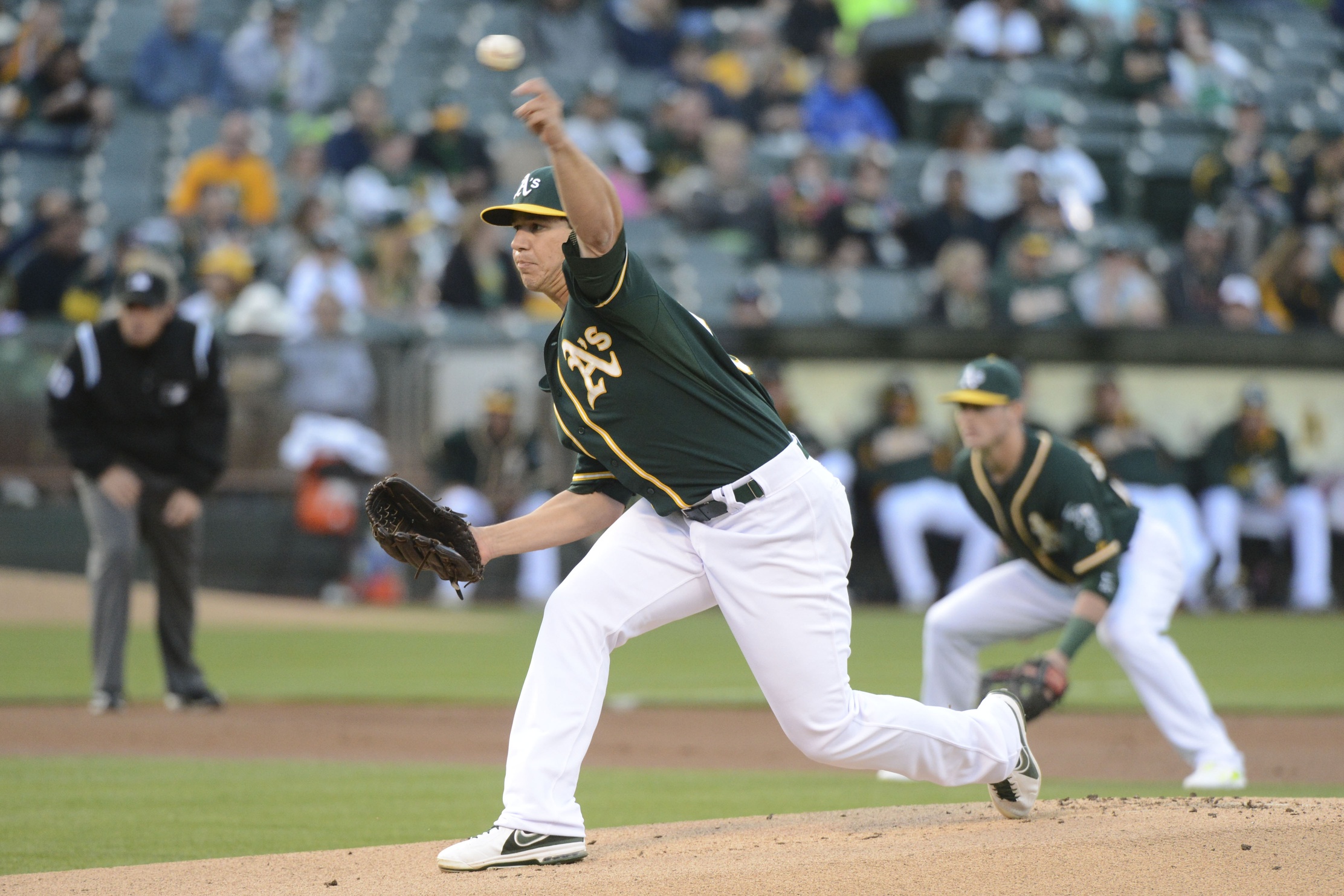 Understandably, Milone asked for a trade after being bumped down to Triple-A with a 3.55 ERA in early July after the A's acquired Jeff Samardzija and Jason Hammel as part of their all-out World Series push. He has been sent to Rochester initially but is likely to be up in a Twins uniform soon. What can we expect from the new acquisition? Here are five facts that will help you familiarize yourself. 1) He doesn't throw hard but can get some strikeouts Over the course of his career, Milone's fastball has averaged 87 MPH, and he's been right around that mark on a consistent basis. For comparison, Andrew Albers last year averaged 86 MPH with the heater. As a big-leaguer, Milone has averaged 6.5 strikeouts per nine innings, which is below average but still a step above many of the soft-tossing, pitch-to-contact hurlers who have populated Minnesota's rotation in recent years. His 7.3 K/9 rate in 2013 would have led all Twins starters. 2) He's an extreme fly ball pitcher There are only a dozen pitchers in baseball with a fly ball rate above 40 percent right now; Milone's career rate is 41 percent. His grounder rate consistently ranks among the lowest in baseball. This isn't necessarily a terrible thing -- there are plenty of successful fly ball pitchers -- but it means he'll give up his fair share of homers, and puts added emphasis on the necessity of a quality defensive outfield. It also plays into this next fact: 3) His success has been largely dependent on his home park With its spacious foul territory and favorable dimensions, Oakland's o.Co Coliseum is among the most pitcher-friendly ballparks in baseball. Unsurprisingly, Milone has thrived in that yard, where he owns a 2.96 ERA and 1.13 WHIP in his career. In all other stadiums, he has a 4.59 ERA and 1.36 WHIP. He will no longer have the luxury of pitching his home games in Oakland, but fortunately, Target Field is also considered a workable environment for fly ball pitchers. 4) He's better against righties than lefties As a southpaw who hits his spots and lacks great velocity, you'd think Milone might be particularly vulnerable to lineups stacked with right-handed hitters (think Brian Duensing), but that's not actually the case. Milone leans heavily on a strong changeup that helps neutralize opposite-sided hitters, and in his career he has actually held righties to a lower OPS (.719) than lefties (.775). 5) He's under team control for at least three more years. This is the main reason I was surprised that the A's couldn't get back more than Sam Fuld. Assuming he comes up soon enough to hit Super 2 status, Milone will be arbitration eligible for the first time in 2015. From there, the Twins can go year-to-year for three seasons. If he implodes, he can be non-tendered. If he succeeds, he can be brought back on affordable one-year deals through 2017, or the Twins can seek an extension at some point. That's a good situation to be in with a young pitcher.
 -
With John Bonnes out of town, Aaron Gleeman once again tapped into the Twins Daily well, calling upon his good friend Nick Nelson for a podcast that covered various subjects, including Jamey Carroll's move to KC, Oswaldo Arcia's continued improvement, Justin Morneau's post-deadline trade value, Samuel Deduno's true colors, the rotation's ongoing outlook and much more. You can listen by clicking below, download from iTunes or find it at GleemanAndTheGeek.com. [PRBREAK][/PRBREAK] Download attachment: vanillaice.jpg Click here to view the article
-
Download attachment: florimon.jpg Likely Starter: Pedro Florimon 2012 Stats: .219/.272/.307, 1 HR, 10 RBI, 16 R Potential Backups: Eduardo Escobar, Jamie Carroll [PRBREAK][/PRBREAK] On April 1, Pedro Florimon will become the Twins' ninth Opening Day starter at shortstop in 10 years. Will he be able to become the first player since Cristian Guzman to hold the title for consecutive seasons? Magic 8-ball says: outlook not so good. The path that brought Florimon to the Twins is brushed with a hint of irony. He had been drafted and raised by the Orioles, who watched him rise through their minor-league system and even sip a cup of coffee in the majors before removing him from their 40-man roster after the 2011 campaign. Shortstop had been a problem for the Birds in past years, much like with the Twins, but luckily Baltimore had found its answer at the position in one J.J. Hardy. The Twins claimed Florimon, and subsequently outrighted him from their own 40-man roster, exposing him to waivers and giving every organization a shot at him. Twenty-nine teams passed. It seemed clear that at this point in time Florimon was considered a marginal talent, but the Twins continued to see something in him. And last year, others started to see it as well. Playing in Class-AAA Rochester, the shortstop was voted onto the International League All-Star team in July as folks took notice of his flashy glove work. His bat remained typically unimpressive, but Florimon’s glowing defensive reviews earned him his first extended big-league stint the following month. His 43 games with the Twins in 2012 were a mixed bag. Unsurprisingly, he was a mess at the plate, as evidenced by a .219 batting average and .579 OPS. His defensive contributions are a bit trickier to judge; no metric could be trusted in such a small sample and the eye test registered plenty of good and bad moments. Team brass liked what they saw enough to ignore the shortstop position during the offseason and appoint Florimon starter without any real competition, so there’s that. Clearly, the guy has the athleticism and tools to be a quality defensive shortstop. But he’ll need to be well above average -- and perhaps even elite -- to offer meaningful value as a regular starter, because he’s simply not going to hit. Over the past two years, between Double-A, Triple-A and the majors, he has struck out in 23 percent of his plate appearances. Such drastic contact issues are alarming, especially for a guy who offers little in the way of power or patience to make up for them. Odds are he’ll have a tough time maintaining even a .600 OPS, which would make him a liability in the lineup even at the No. 9 spot. If he plays great defense and the rest of the lineup carries weight, it’s probably a liability the Twins can afford. And that seems to be what they’re counting on. If Florimon can’t hack it, they’ll likely rely on his backup Eduardo Escobar – who carries a similar profile – in the same way. While it’s a bit frustrating to see such a blatantly bad hitter inked into the lineup, I can understand the team’s thinking. Shortstop has been a miserable pain point for the Twins in recent years, and while they stand little chance of extracting much offensive production there from any viable candidate, they can at least hope to shore the position up defensively. Plenty important, in light of the pitching staff’s ground ball tendencies. Florimon is as good a bet as any to fulfill that expectation, but he’s not a long-term answer. Identifying a player with a chance of becoming a lasting asset at the infield’s most important position should sit right next to starting pitching atop this organization’s list of ongoing priorities. Click here to view the article
-
Download attachment: parmelee1.jpg Likely Starter: Chris Parmelee 2012 Stats: .229/.290/.380, 5 HR, 20 RBI, 18 R Potential Backups: Darin Mastroianni, Wilkin Ramirez, Ryan Doumit One of the big storylines for the Twins this year will be the trio of former first-round draft picks getting opportunities to prove their worth in the majors.[PRBREAK][/PRBREAK] Aaron Hicks is the headliner, and Trevor Plouffe has plenty of fanfare after launching 24 homers last season, but Chris Parmelee has slipped under the radar to some extent. Unlike Plouffe and Hicks, Parmelee has had a heck of a time finding a place to stick. The Twins cleared out two center fielders to make room for their prized prospect, and Plouffe has been handed the reins at multiple positions. Conversely, Parmelee has spent much of his time in the majors buried on the depth chart. His overall numbers in the big leagues thus far haven’t been impressive, but he’s never had a sustained chance to settle in. Now, that’s about to change. Clearly right field isn’t the ideal position for Parmelee. He’s slow-footed and will have to rely on quick reactions and smart routes to provide competent defense in the outfield. He’s better suited for first base and it’s possible he’ll land there before season’s end. But defense won’t be the measuring stick for this 25-year-old. Regardless of where he ends up – whether it’s right field, or first base, or DH – Parmelee is not going to be a defensive asset, so he needs to hit in order to last as a major-league regular. Fortunately, he’s shown plenty with the bat over the past couple seasons to inspire hope that he can be a long-term fixture in the lineup. In the earlier portion of his minor-league career, Parmelee was more serviceable than spectacular at the plate, which largely prevented him from gaining prominence as a prospect, but somewhere along the line at New Britain in 2011 he seemingly turned a corner. Late in the year, he joined the Twins as a September call-up and went on an obscene tear, posting a 1.035 OPS with four homers and six doubles in 21 games to instantly push himself into the team’s plans. He followed up the brilliant MLB debut with a 2012 season that was spent shuttling back and forth between Minnesota and Rochester. In the majors, he showed occasional flashes of promise but was largely ineffective, undoubtedly hampered by sporadic playing time. In Triple-A he was outright brilliant, raking to the tune of .338/.457/.645 with 17 homers in 64 games while walking as he often as he struck out. Among players who accumulated 250 or more plate appearances in the International League, he ranked first in batting average, OBP and slugging. It was the type of performance we’d never seen from Parmelee over a lengthy stretch: complete and utter dominance at the dish. Granted, that was Triple-A, and the majors are another matter entirely. But those kinds of numbers – from a 24-year-old who entered the season with only a smattering of at-bats above Double-A – can’t be overlooked. While it's probably best to remain cautious in our optimism, there are plenty of signs that Parmelee has begun realize the potential that the Twins saw when they drafted him 20th overall in 2006. The polished approach the plate. The sweet lefty swing. The ability to spray line drives to all fields. His next step will be transferring it to the big leagues. He’ll have the opportunity to do so in right field this season, but it’s a good bet he won’t remain there for too long. Either he’ll scuffle and be pushed aside for another of the organization’s numerous rising young outfielders (Joe Benson and Oswaldo Arcia are the leading short-term candidates) or he’ll handle the challenge and establish himself as Justin Morneau’s successor at first base. Wherever he's standing in the field, it is at the plate that Parmelee commands attention, and that's where he'll seek to make his mark this year. I, for one, am excited to see what he can do. Click here to view the article
-
Download attachment: deduno.jpg Even before his three-hit shutout on Sunday, I felt that the time had come to promote Kyle Gibson to the major leagues. The Twins seemingly positioned themselves to do so Monday when they announced the removal of Pedro Hernandez from the rotation, opening up Friday's start. But on Tuesday the club ended any such speculation by informing us that Samuel Deduno will be the one to get the nod. Even as a confirmed Gibsonite, I can't feign to be overly upset with this move. Because more than I wanted to see the top prospect get a chance, I wanted to simply see the Twins make some sort of change to their stagnating formula. Deduno qualifies in a major way; a step in the exact opposite direction. [PRBREAK][/PRBREAK] The trademark of Minnesota's rotation was obvious before the season began. This was a group that was going to throw the ball over the plate and allow tons of contact. Certainly the starting corps has lived up that expectation, as they've allowed fewer walks than all but one AL team and they rank last in strikeouts by a country mile. Unsurprisingly, this staff makeup has yielded terrible results, as Twins starters have recorded the second-worst ERA in the majors at 5.42. Last year the rotation finished with a 5.40 ERA. The bar was set incredibly low and they've still come up short. For the first six weeks of the season, the Twins managed to stay afloat in spite of their shortcomings, thanks in large part to some timely hitting and sterling efforts from the bullpen. But recently, with other units beginning to falter, the rotation's warts have become more exposed as the season has quickly begun to spiral out of control. The Twins have lost seven straight and are in the early stages of their toughest stretch to date; 15 of 20 games on the road, including trips to Atlanta, Detroit and Washington. Change was long overdue, and Hernandez in the rotation was a logical starting point given that he probably shouldn't have been starting in the majors to begin with. While Gibson would have been my first choice, Deduno was the next one on my list. The 29-year-old Dominican has intrigued me since last season, when he came up and enjoyed a run of success for the Twins. Since then, he has made a name for himself by helping carry his native country to an impressive title run in the World Baseball Classic. I'll admit that perhaps I overrate the significance of this event because I was watching it live and was riveted, but in my mind Deduno's performance in that tournament's championship game earned him an extended shot. Pitching against a potent lineup, in the pouring rain, in a game that mattered immensely to him and his teammates, the erratic yet effective righty delivered five dominant innings, standing out in a 3-0 victory. A groin injury suffered while toughing out those conditions sidelined Deduno and cost him his chance at an Opening Day roster spot with the Twins, but since returning to the field he's been back to his old tricks. In three starts at Rochester, he's posted a 2.70 ERA despite issuing 10 walks in a 16 2/3 innings. In the past I've likened Deduno, whose pitches dart to different locations seemingly at random, to knuckleballer R.A. Dickey. Both are unconventional pitchers with unique styles. Dickey didn't hit his stride until his mid-30's, so I like the decision to try Deduno, who turns 30 in a month, and see if he might prove to be a late bloomer. Certainly there have been positive signs to that end over the past year. And in any case, it's nice to see the Twins take such a hard turn from their previous path. The pitchers that have comprised their rotation up to this point – Vance Worley, Mike Pelfrey, Kevin Correia, Scott Diamond, Liam Hendriks and Pedro Hernandez – have obviously enjoyed varying levels of success but have been virtually indistinguishable in approach. Change speeds, try to hit your spots, hope for the best. Deduno couldn't be farther on the other end of the spectrum. He unleashes electric heaters and breaking balls that essentially have minds of their own and end up who-knows-where. The result is very many walks and very little hard contact. When he's going good, he can be nearly unhittable. Even if that "unhittable" comes with a considerable caveat, it's still a welcome term for this starting staff. Click here to view the article
-
Article: Trade Talk: Philadelphia Phillies
Nick Nelson posted a topic in Twins Daily Front Page News
Download attachment: philadelphia-phillies.jpg Buyers or Sellers In July of 2012, the Phillies found themselves in a position to sell for the first time in a decade. Running on a string of nine straight 85-plus win seasons, the Phils were 12 games out of first place in the NL East at this time last year, and they ended up unloading Shane Victorino, Joe Blanton and Hunter Pence in the days leading up to the deadline. By comparison, Philadelphia's current 9-game deficit in the standings doesn't look quite as daunting, but with the clearly superior Braves and Nationals well out front in the East, it looks like it is once again time to sell, sell, sell. [PRBREAK][/PRBREAK] What They Need Well, salary relief would probably be welcome. The Phillies are currently going nowhere with a $165 million payroll that ranks as the third-highest in the majors. They are saddled by the hefty price tags of aging vets like Cliff Lee ($25M), Ryan Howard ($25M), Roy Halladay ($20M), Michael Young ($16M), Chase Utley ($15M), Jonathan Papelbon ($13M) and Jimmy Rollins ($11M). Cole Hamels was signed to a $144 million extension last summer, so he'll be a centerpiece as they move forward, but you have to imagine that general manager Ruben Amaro would be open to moving pretty much any of the names listed above in return for younger talents that might be able to factor into the next wave. Papelbon, in particular, is likely to be a hot commodity; since the Twins aren't expected to make Glen Perkins available, Paps figures to be the premier closer on the market. What Might Work Since both teams are pretty well locked into "Sell Mode," there really isn't a great match here. The Twins have plenty of payroll flexibility but they're not necessarily close enough to contention to justify taking on one of Philly's bloated contracts, particularly one that is set to expire like Utley or Young. If the Phils were to take an interest in any player in Minnesota's organization, it would probably be a young, somewhat established player that could become a long-term staple, a la Ben Revere. With the veteran Young ready to hit free agency at year's end, and no clear replacement at the hot corner, Trevor Plouffe comes to mind. As was the case with Revere, Terry Ryan's price will likely be young pitching. Sleeper Targets John Sickels of SB Nation's Minor League Ball blog ranked Philadelphia's system No. 20 in baseball before this season, and the top prospects by and large haven't had very good years, so this isn't a premium group to rummage through. Then again, that might increase the likelihood that some players could be pried away. Adam Morgan - LHP - Triple-A - 23 years old After raising his stock with a fine 2012 campaign, the southpaw has struggled in his first turn at Triple-A. He was 1-4 with a 4.97 ERA before being shut down with shoulder discomfort in mid-May. If he's able to return before the deadline, he could emerge as an intriguing buy-low candidate, but do the Twins really want to take on another iffy shoulder when they've already got one in Alex Meyer? Roman Quinn - SS - High A - 21 years old Another one of Philly's top prospects who is having a down year, Quinn has seen his OPS drop from .778 in Low-A last season to .669 in High-A this season. He has also committed a whopping 31 errors in 66 games, so his future at shortstop is very much in question. Nevertheless, the kid has some legit wheels. He stole 30 bases on 36 attempts last year and is already 32-for-41 in Lakewood. Ethan Martin - RHP - Triple-A - 24 years old Much like Trevor May, whom the Twins acquired from the Phillies in the Revere trade, Martin is a right-handed pitcher with good stuff that comes coupled with significant command problems. This year at Triple-A, he has averaged 5.4 BB/9 and his mediocre overall numbers make it tough to overlook the shoddy walk rate. Still, he was ranked by Baseball America prior to the season as the No. 80 prospect in baseball. Darin Ruf - 1B - Triple-A - 26 years old Ruf had never been much of a prospect until last year's power explosion in Double-A, where the right-handed slugger launched 38 homers and drove in 104 runs in 139 games, posting a 1.028 OPS. Even for a 25-year-old former 20th-round pick without much of a track record, those numbers cannot be ignored. He hasn't enjoyed nearly the same kind of success in Triple-A this year, with a .266/.343/.408 line to go along with seven homers in 77 games, but he has also reportedly been dealing with a sore hand. Dream Target Cliff Lee - LHP - MLB - 34 years old Normally we'll use this space to highlight a premier prospect who would be a tantalizing addition to Minnesota's system, but I'm going a different route. Lee's contract has become a major burden on the Phillies; he's set to make $25 million in each of the next two seasons and he has a $27.5 million option in 2016 that will become guaranteed as long as he stays healthy. Seeing as how the lefty has logged 200-plus innings in seven of the past eight years, that's a pretty safe bet (even if the option doesn't become guaranteed, it would cost a whopping $12.5 million to decline). The Twins, of course, have no major salary commitments beyond this year outside of Joe Mauer. With young, low-cost players likely to fill the majority of the roles in the next few years, the Twins could take on Lee's enormous contract and still probably fall below their recent payroll caps. Even though he's aging into his mid-30s, Lee is showing no signs of slowing down, as he's currently one of the National League's finest starters with a 9-2 record, 2.59 ERA and 0.97 WHIP. Because he's pitching so well, the Phillies won't give Lee away for nothing, even with the massive salary attached. But if the Twins were willing to stomach the cost, he would add an elite veteran ace to the front of a young rotation, putting the club in position to be an instant contender in 2014. Of course, there is nothing in the history of the Twins or Terry Ryan to suggest that this kind of deal has any chance of materializing, and Lee's partial no-trade clause would probably rule out Minnesota anyway. Still, it's fun to dream on... Click here to view the article -
When the Twins acquired Carl Pavano in August of 2009, his fastball was averaging almost 91 miles per hour and he was striking out 16 percent of the batters he faced. In two seasons since, his velocity has dropped by two miles per hour and his K-rate has descended steadily, to 13 percent in 2010 and 11 percent in 2011. Download attachment: carlpavano.jpg Among qualifying major-league starters, only Brad Penny had a lower K/9 mark last year than Pavano's 4.1. A lack of whiffs isn't necessarily a death knell, especially when you can limit walks and homers, and Pavano's propensity for pitching to contact has helped him efficiently rack up 220 innings in consecutive years, but in order to succeed with this style a pitcher needs help from his defense and a certain measure of luck. [PRBREAK][/PRBREAK]Last year Pavano didn't benefit much in those areas; nor did his staff mates, as the Twins finished with the worst defensive efficiency (converting batted balls into outs) in all of baseball. While the club's fielding is expected to improve this season, it would take a rather drastic turnaround for it to be considered a strength. Pavano has been a fairly extreme ground ball pitcher in each of the past two years, so infield defense will likely be a key factor in his success. Around the diamond, the Twins will be relying on a third baseman who was repeatedly scolded for his passive defensive approach last year, a shortstop who's 38 and spent much of his career as a utility man, a mistake-prone second baseman with a reputation for losing focus, and a first baseman who's looked foggy in the field since being concussed. In other words, if Pavano's strikeout rate continues to slide, it's a good bet that he'll once again rank among the most hittable pitchers in all of baseball. He may be able to overcome that and hold value as a serviceable innings eater, but it's not a label you want attached to your Opening Day starter and de facto No. 1. The Twins have plenty of uncertainty in their 2012 rotation, so more than ever they'll be counting on Pavano -- whose 443 innings over the past two years lead all Twins pitchers by more than 100 -- to be that veteran rock. In order to to excel, it is essential that he take matters into his own hands and find a way to start missing a few more bats. Click here to view the article
-
Download attachment: justin-morneau1.jpg The Twins needed a big year from Justin Morneau. Not because it was going to help push them over the top, but because a productive Morneau may have yielded a prospect or two at the trade deadline that would prove helpful toward the rebuilding effort. Unfortunately, Morneau has done very little this year to make himself an appealing trade chip. While many (including myself) were expecting a return to form of sorts since the former MVP had seemingly shaken all his injury woes, his performance has only reinforced the fact that he is not the player he once was. Not even close. [PRBREAK][/PRBREAK] After going 0-for-4 in Tuesday night's loss to the Marlins, Morneau is hitting .282/.331/.383 on the season. His .714 OPS ranks him 22nd out of 27 qualifying MLB first basemen. That he has managed to hit only three home runs is almost hard to believe. That total ranks him ninth on a Twins team that is second-to-last in the AL in homers. I wouldn't say Morneau has been terrible; after all, he's gotten his hits and has driven in 42 runs, albeit mostly due to hitting behind Joe Mauer. While it makes every bit of sense for the Twins to heavily shop Morneau at the deadline in order to shed his salary and create playing time for Chris Parmelee, would a contending team have any interest in acquiring him? Right now, it's tough to see, even if it meant only taking on Morneau's ~$5 million in remaining salary and giving up a non-prospect. No team that is within range of first place in its respective division has gotten worse production from first base than Morneau has given the Twins. Although a few (such as Baltimore and Cleveland) could have some level of interest in adding him as a DH, there will undoubtedly be several better hitters on the market. At this rate, the only way the Twins are going to be able to unload Morneau is by assuming the majority of his remaining salary and accepting very little in return. It still might be best course of action, all things considered, but it's a heck of an unfortunate turn of events for a 32 year-old who spent many years of his career among baseball's true elite. Click here to view the article
-
Love 'em or hate 'em, the Yankees are headed to town in the beginning of July. This year marks the 10th anniversary of the first of four Twins postseason defeats at the hands of the Bronx Bombers, so we thought we'd take the opportunity to look back at what has been a lopsided -- but always entertaining and memorable -- rivalry between the two franchises. Over the next couple weeks leading up to the Yankees series at Target Field, various writers here at Twins Daily will look back at some of the Yankee moments that stick out in our minds. [PRBREAK][/PRBREAK] ~~~ It was a game filled with heartbreak. You can point to many culprits in Minnesota's 4-3, 11-inning loss to the New York Yankees in Game 2 of the 2009 American League Division Series: Carlos Gomez slipping on the bases in the fourth and getting tagged for the third out, preventing a run from scoring, the Twins offense stranding a whopping 17 base runners, Joe Nathan blowing a two-run lead in the ninth by leaving one up for Alex Rodriguez… Still, inevitably, it all comes back to Phil Cuzzi and The Call. Even with all their missteps, the Twins had been able to play neck-and-neck with the Yanks, threatening to level the series at a game apiece heading back to the Metrodome. In a best-of-five first-round series, the difference between heading home tied 1-1 and down 2-0 is monumental, so this was a pivotal contest for the Twins, who had sneaked into the postseason with an absurd September run. Joe Mauer, reigning MVP and key cog in Minnesota's miraculous late-season comeback, kicked off the top of the 11th by driving a pitch from Damaso Marte down the right field line. The ball hit off the glove of left fielder Melky Cabrera, then landed in fair territory by about a foot and bounced over the wall. A lead-off ground-rule double… except not. Phil Cuzzi, umping down the left field line as part of a six-man postseason crew, was staring directly at the play from about 10 feet away, and yet somehow still managed to completely botch the call, declaring it a foul ball. Download attachment: cuzzicall.jpg An incredulous Mauer returned to the batter's box and ended up hitting a single. The Twins followed with two more singles, which should have given them the lead but instead loaded the bases with no outs before reliever David Robertson wriggled out of the jam unscathed. Download attachment: cuzzicostume.jpg The popular response was to label Cuzzi a bum who's terrible at his job, and I had my own fun with my Halloween costume later that month (see the picture on the right), but the truth is that he's a major-league umpire and has been for 13 years running, so clearly that's not the case. Cuzzi isn't even generally ranked among the worst umps in MLB; that's Angel Hernandez and Joe West territory. No, what happened was an otherwise competent umpire apparently suffering a moment of temporary blindness that completely screwed the Twins in a crucial moment at Yankee Stadium. It couldn't have fit the narrative more perfectly if it were conjured up by some hack sportswriter for the New York Post. Over the past 10 years, the Twins have gone 23-61 against the Yankees. A record that horrible goes beyond what would be expected with even the most lopsided talent differentials. No, there's something else at play here, as if the universe were conspiring to keep the poor little Midwestern Twins under the thumb the Evil Empire. Cuzzi's famously bad call serves as a perfect example. Click here to view the article
-
While many, like me, are holding out hope that the Twins can find a way to compete in a 2012 season where the odds are stacked pretty heavily against them, we must acknowledge that there's a good chance the big-league club won't catch the number of breaks it needs, and that by the mid-season point fans will be looking elsewhere for signs of hope. Those signs will hopefully come from some of the players listed below in my annual preseason ranking of the organization's top ten prospects. Last year's crop fared about as well as the major-league roster, with nearly every player experiencing injury or performance setbacks, so several members of that list have dropped down or off this year's board. With that being said, there's a lot of promise to be found below, and the Twins should be stocking their farm system with plenty more high-end talent in June when they select five times in the top 75 picks (including No. 2 overall). Here's a look at the Top 10 Prospects, as I currently see them: 10. Brian Dozier, SS Age: 24 (DOB: 5/15/87) 2011 Stats (A+/AA): .320/.399/.491, 9 HR, 56 RBI, 92 R Acquired in the eighth round of the 2009 draft, Dozier established himself as an intriguing prospect while showing strong on-base skills over his first two seasons. Last year, he really put himself on the map with an excellent campaign split between Ft. Myers and New Britain, as he continued to display outstanding plate discipline (66/55 K/BB ratio) while sprinkling in some pop (33 doubles, 12 triples, nine homers). Ultimately, the biggest questions about Dozier revolve around his defense. Folks in the organization question whether he can stick at short in the bigs. If he can, and if his well rounded offensive skill set holds up, he could prove to be a godsend for a system that is extremely light on middle-infield (and especially shortstop) talent in the upper levels. 9. Alex Wimmers, SP Age: 23 (DOB: 11/1/88) 2011 Stats (GCL/A+): 41.2 IP, 4.10 ERA, 40/23 K/BB, 1.22 WHIP In his first start of the 2011 season, Wimmers threw nearly as many wild pitches (three) as strikes (four) in a 28-pitch outing that was cut short after he walked the first six batters he faced. The 2010 first-round pick was immediately placed on the disabled list with "flu-like symptoms" as Twins fans drew inevitable comparisons to Shooter Hunt, a promising hurler whose career went off the tracks after he lost the ability to throw strikes. Fortunately, Wimmers was able to regain his control in the second half, as he returned to the Miracle in July and posted a 3.32 ERA and 39/16 K/BB ratio over 40 2/3 innings the rest of the way. He ended his season with a seven-inning no-hitter that included only two free passes. His walk rate will definitely be worth monitoring going forward, but for now it appears that disaster has been averted, and if he puts together a full season Wimmers has the potential to shoot up this list. 8. Adrian Salcedo, SP Age: 20 (DOB: 4/24/91) 2011 Stats (A): 135 IP, 2.93 ERA, 92/27 K/BB, 1.17 WHIP In 355 1/3 innings as a pro, Salcedo has allowed only 12 home runs and 56 walks. Those are extremely impressive numbers, particularly when you consider that he's been on the young side for every level he's played at. His low strikeout rate (6.1 K/9IP) suggests limited upside, but scouts speak highly of his raw stuff and as a 6-foot-4 20-year-old, he's projectable and could ramp up the whiffs as he fills out his lanky 175-pound frame. 7. Oswaldo Arcia, OF Age: 20 (DOB: 9/9/91) 2011 Stats (A/A+): .291/.335/.531, 13 HR, 51 RBI, 46 R, 3/6 SB After he put together a monster season in the Appalachian League in 2010, many wondered whether Arcia's breakout performance was for real, given that it was somewhat out of line with his good-not-great previous efforts in rookie ball. The slugging outfielder made a statement right out of the gates last year, raking to the tune of .352/.420/.704 over his first 20 games at Beloit. Unfortunately, elbow problems that limited him mostly to DH duties over the first month required surgery in early May, shelving him for a good chunk of the season. When he returned, he was promoted to Ft. Myers, where he rounded out the campaign by hitting .263/.300/.463 with eight homers over 227 plate appearances. Those numbers aren't amazing and he struggled a bit with his plate approach, drawing only nine walks during that span, but his power remained intact and the performance was plenty encouraging for a 20-year-old in High-A ball. 6. Liam Hendriks, SP Age: 22 (DOB: 2/10/89) 2011 Stats (AA/AAA): 139.1 IP, 3.36 ERA, 111/21 K/BB, 1.13 WHIP After a spectacular 2010 season that saw him register a 1.74 ERA between Beloit and Ft. Myers as a 21-year-old, Hendriks kept the mojo going last year when he jumped out to an 8-2 start in New Britain, posting a 2.70 ERA and 81/18 K/BB ratio in 90 innings. The continued excellence earned him a promotion to Rochester, where his impeccable command held up (three walks in 49 1/3 innings) but the rest of his numbers came back to earth. The Aussie eventually made four starts for the Twins as a September call-up, and looked predictably overmatched. This isn't entirely discouraging, considering his age, and doesn't change the right-hander's outlook as a potentially effective mid-rotation strike-thrower. 5. Joe Benson, OF Age: 23 (DOB: 3/5/88) 2011 Stats (GCL/AA): .284/.387/.491, 16 HR, 67 RBI, 71 R, 14/24 SB Taking his second shot at Double-A pitching, Benson showed significant improvement in some key areas last year, raising his batting average by 25 points and his on-base percentage by 44 points. He didn't approach his home run total of 27 from the prior season, but his power showing was respectable. Benson has some notable flaws in his game, the most alarming of which is a bulky strikeout rate (27 percent over the last two years) that will limit his ability to hit for average in the majors. He's also been successful on less than 60 percent of his steal attempts in the minors, which is odd in light of his exceptional speed. Still, even if Benson doesn't live up to the considerable offensive promise he's shown in New Britain over the past two years, he'll maintain value as a strong defensive outfielder who can work the count and hit for power. 4. Kyle Gibson, SP Age: 24 (DOB: 10/23/87) 2011 Stats (AAA): 95.1 IP, 4.81 ERA, 91/27 K/BB, 1.43 WHIP Gibson put together one of the best 2010 campaigns of any prospect in baseball, and impressed coaches in big-league camp last year to the extent that certain members of the organization wanted to see him head north out of spring training. Instead, the 23-year-old was assigned to Rochester, where he got off to a solid start before seeing his performance deteriorate until eventually it came to light that he had a torn ligament in his elbow. He'll miss the entire 2012 season and will return in 2013 as a 25-year-old learning to throw with a surgically repaired arm. Certainly it's a major bump in the road, and many boards are going to have him even lower than I do, but I'm still a big believer in his talent and upside. His timetable may be pushed back by a year (or more), but I think we'll see Gibson become a staple at the front of the Twins' rotation down the line. 3. Eddie Rosario, OF Age: 20 (DOB: 9/28/91) 2011 Stats (Adv-Rk): .337/.397/.670, 21 HR, 60 RBI, 71 R, 17/23 SB A year ago, Rosario was a little-known prospect who had put together a solid yet unspectacular debut in the Gulf Coast rookie league after being drafted 135th overall in 2010. That has all changed now. Rosario moved up to Elizabethon last year and absolutely obliterated the pitching there as a 19-year-old, smashing 21 homers to lead all hitters in the Appy League. Rosario doesn't have the pedigree of his similarly transcendent teammate (who you'll find two spaces below) so it's wise to remain cautious of a drop-off as moves up to full-season leagues, but this incredible performance cannot be ignored. Additionally, the Twins have announced that they'll try moving him from the outfield to second base next year. If that transition takes and his offense continues to shine, he could find himself at the top of this list next year. 2. Aaron Hicks, OF Age: 22 (DOB: 10/2/89) 2011 Stats (A+): .242/.354/.368, 5 HR, 38 RBI, 79 R, 17/26 SB In the first two years after he was drafted 14th overall, Hicks was the Twins' consensus No. 1 prospect. At this point, however, I'm taking a leap of faith by keeping him in the second spot. The switch-hitting outfielder has all the tools to develop into a big-league star, but his on-field performance simply hasn't progressed as anyone would hope. His power numbers remain substandard, he strikes out too much, he doesn't hit from the left side of the plate and last year he put up the worst batting average of his career. I remain bullish on Hicks because his raw tools are just too impressive to give up on, and he's consistently displayed two uncommon skills in spite of his disappointing overall output: exceptional plate patience and stellar defense in center field. He raked in the Arizona Fall League recently (.294/.400/.559) and I'm hoping he can build on that and turn the corner in 2012. If not, his tremendous athletic prowess won't save him from sliding down this list next year. 1. Miguel Sano, 3B Age: 18 (DOB: 5/11/93) 2011 Stats (Adv-Rk): .292/.352/.637, 20 HR, 59 RBI, 58 R, 5/9 SB When the Twins signed Sano out of the Dominican Republic with a hefty bonus back in 2009, the 16-year-old drew some lofty offensive comparisons. His performance across three levels of rookie ball has left no reason to doubt the high praise. Sano's second pro season was more impressive than his first, which had already established him as one of the game's better up-and-coming power hitters. Despite being only 18 years old, he finished third in the Appy League in OPS, second in homers and first in total extra-base hits. His strikeout rate was a bit high and his walk rate a bit low – both understandable given his age and degree of dominance – but otherwise it's tough to find much fault with his production. He's still got a long way to go before reaching the majors, and much can happen between now and then, but at this point Sano is on a path to become the best pure power hitter to come through Minnesota in decades. Download attachment: sano.jpg Click here to view the article
-
Download attachment: pelfrey.jpg In less than four weeks, a sizable contingent of pitchers will report to Ft. Myers for spring training, with eyes on claiming a spot in Minnesota's rebuilt rotation. Rarely has it been so unclear at this point in the offseason who would comprise this vital unit. We can safely assume that, barring injury, three of the five spots will be occupied by Scott Diamond, Vance Worley and Kevin Correia. Beyond them, the situation becomes much murkier. [PRBREAK][/PRBREAK] I'll go ahead and surmise that as long he holds his own in exhibition play, Liam Hendriks will claim one of the slots. He got some major-league experience last year, he seemingly has little to prove in Triple-A and we've seen plenty of quotes from Twins brass this winter indicating that he'll have every chance to earn a job. If that proves true, we've still got one final spot that is very much up in the air. Since team officials have expressed that they're done making additions unless someone – as they put it – falls into their lap, it will likely be a spring competition between players already in the mix. Certainly the Twins will expect Mike Pelfrey to be in their rotation at some point, given that they paid him $4 million, but he'll be just over nine months removed from Tommy John surgery when he shows up in Florida. He'll undoubtedly be limited early on and it's hard to imagine he can do enough to prove he's ready for an MLB job at the start of April. I got the sense that the Twins would have loved to see Nick Blackburn step up and claim one of the spots, which makes sense since they'll be paying him $5.5 million, but he'll be going under the knife for yet another arm surgery on Wednesday and will be in a cast for six weeks, pushing him out of the equation. The name I keep coming back to is Kyle Gibson. He hasn't pitched in the majors and has yet to experience sustained success at Triple-A, but the Twins are very high on him and after following up a rehab stint last year by pitching in the Arizona Fall League, he should be physically prepared. But the Twins have emphasized their desire to take it slow with Gibson, leaving one to believe he might require at least a few weeks in Triple-A to prove his readiness. Once you get past these names, the crop becomes pretty inspiring with a bunch of pitchers who should clearly be in the bullpen (Brian Duensing) or in Triple-A (Cole DeVries, Sam Deduno), and a good performance in a handful of spring outings should hardly convince anyone otherwise. Quite simply, the Twins need to hope that Gibson or Pelfrey (or both) provides overwhelming evidence that he should be there. Based on early scheduling, the team could choose to go with four starters for the first couple weeks of the season, which might increase their odds by giving them more time to prepare. Who do you feel should be the frontrunner for that fifth spot? Click here to view the article
-
If you were surprised in any way by return in the Denard Span trade, you shouldn't have been. Terry Ryan told us this was coming four months ago. Back in July, with the trade deadline approaching, Ryan spoke about his approach: [PRBREAK][/PRBREAK] The general manager's recent quotes after trading Span to the Nationals for Alex Meyer reflect the same mindset: This is what I love about Terry Ryan, particularly in contrast to his tight-lipped predecessor, whose initials were fittingly "B.S." With TR, you know what you're getting. While I don't necessarily always agree with his methods, I trust the man. That's why I feel good about this trade. Given that the Twins were known to be talking to the Nationals back in July, when Ryan was describing a "high-ceiling guy" who might be in A-ball, there's a good chance he was targeting Meyer who fits that bill exactly. (Worth noting that Meyer could not technically be traded then as he was less than a year removed from signing, but could have been shipped as a PTBNL.) Download attachment: span.jpg Back around the deadline, a source (from the Nats?) told Jon Heyman that the Twins were "asking a ton" for Span, who didn't end up getting moved. Many people seem disappointed – or at best unenthused – about the return for Span. But it seems clear that one side finally relinquished in this long-time haggling over the center fielder, and the timing would suggest it was Washington's Mike Rizzo. After all, just days earlier he'd watched division rival Atlanta sign center fielder B.J. Upton to a huge five-year deal. That's pressure. My take is that Ryan coveted Meyer highly and the Nationals were very reluctant to give him up, even in a one-for-one swap that brought back a very valuable established player. And why not? Meyer has a first-round pedigree, a fastball that registers in the high-90s and a physical build that could portend dominance. Legitimate top-of-the-rotation potential. No prospect is a sure thing, which is the scary part of all this, but if Meyer develops even into a quality No. 3, six cost-controlled seasons of his service at a time where the price of free agent pitching is escalating will make this a knockout victory. If he turns into a true front line guy, Ryan's trade will be a success of franchise-altering proportions. Span was a largely underrated player and the Twins will miss him, but their long-term outfield depth made him relatively expendable. Ryan could have probably flipped Span for multiple lesser prospects or an ordinary major-league talent, but instead turned in his chip for the high-upside play. Just as he's said he would all along. Click here to view the article
-
Article: Pressure Is On For Twins Starters
Nick Nelson posted a topic in Twins Daily Front Page News
Download attachment: gibsonredwings.jpg Kyle Gibson is anxious to finally reach the big leagues, and he's currently making a strong case in Triple-A with a 3.32 ERA and 1.16 WHIP through seven starts. His most recent outing was his most impressive: a complete game shutout with eight strikeouts, two walks and four hits. Gibson is on an innings limit this year and has already logged 40 innings in Rochester, increasing the urgency to call him up soon so he can spend time adjusting to the majors, thus preparing himself for a full, successful season in 2014. But space is limited in the Twins' rotation and Gibson is not the only one vying for a spot. [PRBREAK][/PRBREAK] Unlike Gibson, Cole De Vries was actually in line to land in the major-league rotation this spring before suffering a forearm injury that set him back about a month. De Vries made his second rehab start in New Britain on Friday night, allowing two runs over five innings and prompting Rob Antony to say De Vries is "getting close." Then there's Samuel Deduno. After starring in the World Baseball Classic, he also had his chance to make the Twins sabotaged by injury. He's now back and pitching in Rochester, where he has a 0.87 ERA through two starts. Deduno's control has been characteristically bad, as he's issued eight walks (against nine strikeouts) in his 10 1/3 innings of work, but he's shown the ability to succeed in spite of the walks before, and the Twins owe him a look based on the results he's gotten. All three of these hurlers deserve a chance with the Twins, who rank 26th in the majors with a 5.04 starting pitchers' ERA. That's not even mentioning prospects Alex Meyer and Trevor May, who are excelling in Double-A. But where will the club find room? Scott Diamond and Kevin Correia are entrenched. Mike Pelfrey seems safe after showing signs of improvement in his past few starts. Vance Worley might be getting into dangerous territory as his bad results -- and bad luck -- have persisted through eight starts. Pedro Hernandez is probably one more dud away from getting bumped, so it's unsurprising that the left-hander declined to go on the bereavement list after the death of his cousin last week. His career is on the line right now. The presence of legitimate options in the minors creates a dynamic that has been lacking in Minnesota's rotation over the past couple years. Pitchers are feeling pressure to get the job done because there are players ready to take their jobs, for good. Turnover in this unit will be looked at mostly as a positive. We've grown accustomed to injuries and performance issues leaving the starting corps decimated; when was the last time that finding enough room for all their starters was a challenge for the Twins? Click here to view the article -
Download attachment: mauerandmorneau.jpg Pat Borzi of MinnPost wrote a column last week suggesting that the current iteration of the Twins lacks heart. He drew a comparison to the 2002 team, which was being celebrated during the opening series at Target Field, stating that it's "hard to imagine this roster, especially the younger players, clawing and scrapping like their counterparts from 10 years ago." I don't know about all that, but I would say this team has been suffering from the absence of the heart of its lineup, as the No. 3 and 4 hitters have been largely invisible early in the season. [PRBREAK][/PRBREAK] Last Thursday's game was one that harkened back to the good old days, with Joe Mauer and Justin Morneau both homering and carrying the team to victory. Not coincidentally, it was by far the best day the Twins have had offensively. Outside of that game, however, Mauer and Morneau are a combined 12-for-57 (.211) with two extra-base hits in eight contests. There are a number of reasons that the Twins have scored three or fewer runs in seven of their nine games, but the silence from the M&M boys stands out distinctly. The lineup needs those two producing in order to function, and thus far neither player has done much of anything (other than staying on the field) to quell the concerns that surrounded them entering the campaign. Mauer's plate approach has been fine, as he's been taking good at-bats and drawing walks, but that was also true last year. Outside of his home run last Thursday he hasn't been hitting the ball with authority. One of the most troubling underlying trends in his disappointing 2011 campaign was a career-high 55.4 percent grounder rate (and an accompanying career-low 21.5 percent fly ball rate); he's now put over 60 percent of balls in play in the dirt this year after grounding out in both of his non-walk plate appearances Sunday (including his league-leading fourth GIDP). It's too early to draw definitive conclusions but thus far Mauer is exhibiting the same flaws that principally contributed to a .355 slugging percentage last season. This raises concern that he either: A) isn't as strong and healthy as we'd like to believe, or has fundamentally changed as a hitter. I don't know which would be worse. Mauer could still be a decent hitter with the elevated grounder rate but he won't be a game-changing offensive force and he'll continue to kill rallies with frequent twin killings. Hopefully as the season progresses he can start lifting the ball more frequently. Morneau's issues at the plate have been more worrisome, because unlike Mauer he's looked flat-out overmatched. After fanning in three of his four at-bats on Sunday, the designated hitter has 10 strikeouts against two walks in 37 plate appearances. That's a whiff rate of 27 percent -- a sizable uptick from his 15 percent career rate. The main problem is that Morneau has been far too aggressive. He's swinging at 41.5 percent of pitches outside of the zone (career rate: 33.6 percent) and 55.4 percent of all pitches (career rate: 47.5 percent). When he's going good, Morneau patiently works the count to his favor and capitalizes on mistakes. Too often this year he's been falling into holes and chasing pitchers' pitches. The Canadian can still crush the ball when he makes good contact, as demonstrated by his two doubles in Baltimore and his prodigious blast to right field on Thursday, but his pitch recognition and reactions are not up to snuff. These were noticeable deficiencies for him last April as well, and unfortunately injuries cropped up and took a toll before he had much chance to prove that he could overcome them. The hope is that Morneau's lack of sharpness at the plate is more attributable to rust – due to playing irregularly since his July 2010 concussion – rather than the injury itself. If he can stay healthy and on the field we'll see how the quality of his at-bats improves. Personally, I get the sense that Morneau tends to get in his own head and that bad swings are stewing while he sits on the bench, causing him to press. I'll be interested to see if playing in the field, which he'll apparently start doing this week, helps his approach. It's too early to panic with either of these players, but up to this point they haven't really shown signs that they're ready to reverse course after dismal 2011 campaigns. It would be awfully nice if they could begin doing so this week in New York. The Twins aren't going to win many games if they're not scoring runs in bunches, and this offense is going to have a tough time finding a pulse with the two players who comprise the heart of the lineup flatlining. Click here to view the article
-
Download attachment: money.jpg There is a widespread assumption among Twins fans that the team will maintain its conservative approach this offseason and avoid making any big financial splashes. One could hardly be blamed for holding such a belief; that expectation has been engrained throughout the history of a franchise that has fostered a well deserved reputation for being extremely risk-averse. But when you take a look at the landscape of the organization and the circumstances being faced this coming winter, it's pretty tough to make a case that the Twins will not take at least one or two significant plunges, unless you have completely lost faith in the desire of this front office to compete. [PRBREAK][/PRBREAK] The key question is this: What makes this coming offseason different from the last one, in which the Twins took a very Twins-like approach, signing cheap low-upside veterans to plug gaping holes in the rotation while relying on internal reinforcements in a number of other areas? The answer is, well, a lot of things. For one, there is going to be much more money available. It's well established at this point that Terry Ryan came in far below that budget that was made available to him last offseason, perhaps by as much as $10-20 million. This year, the spending limit set by ownership would figure to rise, considering that that Ryan left plenty of money unspent this season and -- although the Twins probably won't see any rise in their own revenues with attendance dropping again -- they will be receiving a cash windfall as part of the league's new cable deal. Plus, with Justin Morneau's $14 million, Nick Blackburn's $5.5 million and Mike Pelfrey's $4 million coming off the books, the Twins have very few notable payroll commitments going forward. In 2014, they will owe a combined $46 million to Joe Mauer, Josh Willingham, Kevin Correia, Glen Perkins, Ryan Doumit and Jared Burton. Beyond that, it's all league-minimum salaries and modest arbitration raises, none of which are likely to exceed one or two million tops. That gives the club immense room to add payroll, even if they are just aiming to get back to this year's $82 million mark. Since their needs are relatively focused -- the bullpen is fairly set and the offense is already beginning to receive help from a robust pipeline of minor-league talent -- the Twins can fully direct any funds toward improving their shoddy rotation. Of course, many of us were saying the same thing a year ago, when the starting pitching corps was in similarly dire straits with ample financial flexibility available. It is possible that Ryan and Co. will follow the same path, further frustrating those of us who have grown skeptical of the organization's willingness to do what's necessary to dig out of this deep hole. But I don't think so. Three straight years of steady losing creates more urgency than two straight years. The fan base is growing more and more apathetic and season ticket sales are declining as the new-stadium grace period wears off. As I mentioned last week, the Twins don't have much of anything to tout from a pitching standpoint, given that essentially every guy they've trotted out this season has failed. Granted, the free agent market is far from a surefire method of drastically improving the rotation, even if you're willing to open the wallet, but as Parker pointed out last week there will be some intriguing names out there that could shake up the composition of this absurdly contact-heavy staff. Spending on a high-profile name would at least create some buzz and reassure fans that an earnest effort is being made. The All-Star Game is coming to Minneapolis next year, leading some to believe that the Twins will keep their foot off the pedal, relying on this national attraction -- rather than improvement on the field -- to drive ticket sales and interest. I tend to think the opposite is true. This is an opportunity, and the club will seek to take advantage. Don't forget that leading up to Target Field's inaugural season, the Twins could have stayed the course, having reached the playoffs in their final year at the Metrodome. Instead, they attacked the offseason as aggressively as ever before. In addition to signing Mauer to his historic contract extension, they paid to keep Carl Pavano, traded for J.J. Hardy, and signed Orlando Hudson and Jim Thome. Obviously, it's a different situation when you're adding the final pieces to a proven contender. But if the Twins ever want to return to being a proven contender, they need to start taking some more purposeful steps than we've seen recently. That means acquiring established talent that can actually make an impact. With so much money begging to be spent this offseason, they almost have no choice. Click here to view the article
-
The headliner on Thursday was Aaron Hicks, who blasted three homers in a game against the Phillies in Clearwater. I didn't make the three-hour trip, opting to stay back in Ft. Myers for the home half of the split-squad set, and thus missed out on my favorite prospect's banner day. I can hardly complain. While hanging around the Lee County Sports Complex, [PRBREAK][/PRBREAK] had the opportunity to check out plenty of intriguing prospects, and while the home game against Boston wasn't anywhere near as thrilling as The Hicks Show there were plenty of noteworthy sights. Here's a run-down: Download attachment: battingpracticepan.jpg * I've had my doubts about Joe Benson and he did nothing to alleviate them Thursday, striking out four times against the Red Sox. He also let a routine fly ball drop in center after losing it in the sun, costing the team a run. Suffice to say that he's lagging behind in the center field competition. * I expect big things this year from Trevor Plouffe, who seems to be maturing as a hitter before our eyes. He tallied a pair of singles against the Red Sox, both line drives to right-center field over the second baseman's head. We know Plouffe can turn on a pitch and plant it in the left field seats, but if he continues to show a propensity for going the other way when the offering dictates, he'll have a chance to become a more complete hitter and take his offensive game to the next level. He also had a fine play defensively at third, barehanding a slow roller up the line and converting, although his throw pulled Jeff Clement off the bag at first and forced him to swipe the runner as he passed. * Kevin Correia started for the Twins against Boston, and he did not pitch well. He lasted only 2 1/3 innings before reaching his pitch limit, and seemed to struggle locating his off speed stuff. If he threw a breaking ball for a strike at any point, I didn't see it. In the outing, he allowed six hits and a walk, and overthrew first base on a pick-off attempt. His fastball registered in the upper 80s. The Twins' pitching staff in general had a bad day, coughing up 12 runs on 16 hits in a contest that dragged at times. I did enjoy the opportunity to see prospects Trevor May and B.J. Hermsen, who entered later in the game, but neither blew me away. * On Wednesday, when I made my first trip down to the park, minor-league players were going through their physical exams and there wasn't a whole lot of action on the side fields. Thursday was another story, as the kids were out in full force, going through drills and working with instructors. I spent a few hours roaming the minor-league fields, spectating as young players went through such exciting tasks as completing PFP drills, playing catch and running sprints. Obviously one can't take a whole lot away from these activities, but it was good to see some of the organization's more noteworthy prospects in the flesh, some for the first time. Download attachment: sanogrounder.jpg Miguel Sano has grown quite a bit since the last time I saw him two years ago. He's very thick in the lower half, with powerful thighs that undoubtedly help him generate torque. As his measurements would suggest, his build looks quite similar to Miguel Cabrera. However, Sano's prodigious frame paled in comparison to fellow bopper Kennys Vargas, who is an inch or two taller and has a sizable weight advantage on the Twins' top prospect. Vargas slugged .610 in Beloit last year. * I've gotta say, as a long-time Twins fan it was pretty fun watching Doug Mientkiewicz hit grounders to Sano at third base. Quite the "past and future" dynamic in play there. Mechanically, Sano looked pretty smooth leaning down to corral the ball and unleashing wicked throws with his outstanding arm. But I continue to believe that his size gives him very little chance of sticking at the hot corner, especially if he keeps growing. * Speaking of Mientkiewicz, it was awesome to see him back in a Twins uniform. He returns to the Twins organization this year as manager of the Ft. Myers Miracle, and he was all over the place on the minor-league fields, barking instructions and cracking jokes. You can tell he's a popular figure among Twins fans by the way people gravitated to him. Download attachment: mientkiewiczfan.jpg * While watching some outfield prospects haul in fungoes from a machine on one field, I saw Max Kepler turn on the wheels to chase down a distant fly ball and came away very impressed by the way he runs. He's a big kid but he moves gracefully, gliding around the outfield grass with great speed. I guess that's how it goes when both of your parents are renowned ballet dancers. * I didn't see Byron Buxton do much, other than running a few sprints and playing some catch, but he's certainly a tremendous athlete as advertised. He also struck me as being very good-natured, a sentiment that was echoed by several observers I chatted with. * One guy who has really filled out since the last time I saw him is Niko Goodrum, a shortstop prospect with a reputable tool set. I remembered him being a particularly skinny and lanky ballplayer but he's really grown into an imposing figure. Whether that will affect his ability to remain at short remains to be seen, but I wouldn't be surprised if he posts some impressive power numbers in Cedar Rapids this season. With his athleticism, he's got a chance to be special if he can put it all together. * That's all for today. I'll be attending one last game on Friday night at JetBlue Stadium, the newly furnished spring training home of the Red Sox, then I'll be returning to Minnesota on Sunday. Boo. I'll report back with some finals thoughts after the weekend, and then it will be time to get my annual Position Analysis series underway. Cheers! Click here to view the article
