



70charger
-
Posts
4,789 -
Joined
-
Last visited
-
Days Won
2
Content Type
Profiles
News
Minnesota Twins Videos
2026 Minnesota Twins Top Prospects Ranking
2022 Minnesota Twins Draft Picks
Minnesota Twins Free Agent & Trade Rumors, Notes, & Tidbits
Guides & Resources
2023 Minnesota Twins Draft Picks
The Minnesota Twins Players Project
2024 Minnesota Twins Draft Picks
2025 Minnesota Twins Draft Pick Tracker
2026 Minnesota Twins Draft Tracker: Picks & Bonuses
Forums
Blogs
Events
Store
Downloads
Gallery
Everything posted by 70charger
-

Wall Street Journal: How biased are your announcers?
70charger replied to Parker Hageman's topic in Minnesota Twins Talk
I think the Dickbert strikes a pretty good balance, actually. After having watched the Reds' broadcasts more than a few times (used to live in Ohio), I'm surprised they're not higher. -
Article: Year in Review: Twins Hitters In The Clutch
70charger replied to John Bonnes's topic in Twins Daily Front Page News
One final thing, apropos of nothing here. Since this is a measurement of how well the hitters have done in the clutch, should the Mauer haters really be complaining about Joe taking a ninth inning walk when the guy who comes up next is Willingham? -
Article: Year in Review: Twins Hitters In The Clutch
70charger replied to John Bonnes's topic in Twins Daily Front Page News
Eyes lie and data don't. If people can't accept that this is what happened, then they're creating a narrative that doesn't fit the data. What I think people probably have a hard time understanding is why "good" baseball players end up lower than "bad" ones. Ultimately, it isn't a function of whether they're good or bad, it's a function of how they performed in certain situations. It's an ex post measurement. But ex ante, I'm absolutely running Ryan Doumit out there as a pinch hitter before Erik Komatsu. After all, past performance is no indicator of future results. -
Twins vs Yankees, 09-24-2012, 7:10pm
70charger replied to Brock Beauchamp's topic in Archived Game Threads
Btw, if you click the first link, it goes to Indians - White Sox. Apparently, we're interchangeable now... -
Twins vs Yankees, 09-24-2012, 7:10pm
70charger replied to Brock Beauchamp's topic in Archived Game Threads
Amidst all the confusion (ha ha, suck it Packers!) Sports Illustrated apparently figured that the Twins lost twice today. Forgive me if I'm wrong, but the doubleheader was yesterday. Right?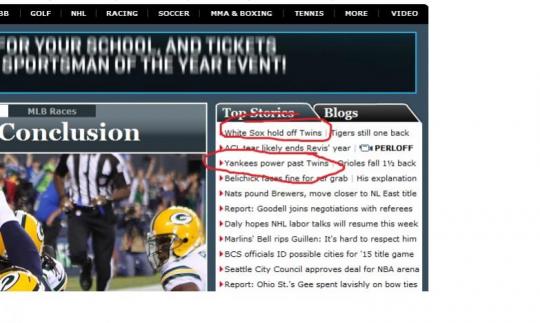
-
Article: Where Does Carroll Fit In?
70charger replied to Nick Nelson's topic in Twins Daily Front Page News
It's ironic, isn't it, that UZR requires a large sample size, but when it gets too large it's useless again. But it is. Looking at Carroll's career numbers when he's 39 years old tells us nothing about what he is now. I'm happy for him that he's been a good fielder for a decade or so, but he can't be coasting on his numbers from when he was 31. -
Terry Ryan's "Thin" SP Market Quote
70charger replied to Nick Nelson's topic in Minnesota Twins Talk
Can we put this "bring back Liriano" talk to bed right now? He's not a good pitcher, and we should be glad he went to Chicago. He's like our Trojan horse. -
I can't say as though I'm that familiar with St. Paul. I hardly ever get out to the Eastern suburbs. HA! That's a good one. I'll have to tell my friends from the west side of the river so they can use it when I'm sarcastically pointing out that St. Paul is the capital. So is Albany, New York. Same deal.
-
I can't say as though I'm that familiar with St. Paul. I hardly ever get out to the Eastern suburbs.
-
Think he was channeling Sgt. Murtagh in Lethal Weapon? "Riggs! I'm too old for this ****!" Dry humor doesn't play well without inflection.
-
Let's talk about this for a second. What are the positive differences? Carroll hits about the same, is usually in the .650-.700 OPS range, and while generally more consistent than Casilla, is certainly not so much better that we think of him as much of an offensive upgrade. Then there's the defensive side. Casilla's got better range, isn't 93 years old, and makes the slick play. Give me a choice, and I think I might take Casilla. Alternate opinions welcome.
-
Also, he drives a 1969 Chevelle. How can you not like that? (I mean, if it were a 1970 Charger, it would be better, but I'm not complaining...)
-
<cap off> Well said, sir. </cap off>
-
-
No thanks. It does seem rather inconsistent of you, though, to cite WAR in this thread and then pooh-pooh it in another--when it shows data you discount--all within the space of a few hours. I was using it purely as a hypothetical in that post. Showing that if you subtract from one position and add more at another, you see a net improvement in team play. WAR is a nice easy way to compare pitchers and positional players, even if it's not terribly accurate in partial seasons. Can you tell us why--if it's not terribly accurate in partial seasons--we should believe its accurate in full seasons? When someone hits .400 for a month, everyone understands the player most likely isn't going to keep that up. Nobody, however, says "but he didn't really hit .400 for that month...that's not what happened." Yet with WAR, that's exactly what people say. "Well, yeah, I know WAR says Denard Span is the 13th best player in the AL, but that's not accurate. What we need to do is take lots of these innacurate chunks and add them together, and presto change, they become accurate." Thats like saying "I'm pretty sure one plus one doesn't equal three, but if I add together enough one plus one equals three samples, it becomes good math." Logically, the sum is quite often more than the mathematical total of its parts. Fallacy of composition = assuming that what is true of the parts must therefore be true of the whole. In this case, the parts do not encompass the total picture; putting them together does.
-
Article: Span's Last Hurrah?
70charger replied to Nick Nelson's topic in Twins Daily Front Page News
Sorry, but the Span for Verlander scenario is inane and pointless. To the point - no team would be foolish enough to offer a good pitcher for Span. It'll be a Matt Capps for Ramos bonanza redux. Is J.C. Romero still in the league? That's the kind of offer they'll get. See if you can luck out and get somebody potentially good for Parmalee. Maybe shop Willingham as terrific as he's been this year. But, there'll be no decent offers for Morneau and certainly none for Span. Span for Verlander was an extraordinary hypothetical. Of course it's not going to happen; it was supposed to illustrate a point. As to your point, why not tell us why you think Span is so valueless? He's relatively cheap, he's under team control, he's an above-average defender, and he's a leadoff hitter. You really think that's worth nothing better than a Matt Capps type? Why? -
Article: Span's Last Hurrah?
70charger replied to Nick Nelson's topic in Twins Daily Front Page News
These types of threads tend to devolve into trade him vs. don't trade him, but there's so much assumed that there really isn't any information there. I bet that even the hard core don't trade him types would swap him straight up for Verlander. Right? My position is that we should be fielding offers, asking for good pitchers, and just seeing what happens. If nothing worthwhile is on offer, keep him. (And I say that even though I think we could very well get some pretty good pitching in return.) We have to be agnostic about whether he gets traded, because we don't know what's out there. Generally we know what we need, but whether it's available - that's a different story. -
Doesn't seem like it's really the point. It's comparative advantage. Is it worth it to give up .74 OPS in exchange for the potentially far more impactful starting pitching we could get in return for Span? Yup. Don't compare the wrong things. We're not talking about giving up Span because we don't like him.
-
Article: Should Scott Diamond Be Shutdown?
70charger replied to Cody Christie's topic in Twins Daily Front Page News
This part. And get me another beer. -
John Shipley: Florimon has team weighing move for Dozier
70charger replied to East Coast Twin's topic in Minnesota Twins Talk
Maybe, maybe not. Yes, it's important to have good up the middle defense. But starting pitching is our sine qua non. I'm not sure that spending money on pitching as opposed to a shortstop in this situation wouldn't be the better choice. Also, is it possible that there are fewer top-level shortstops than there are major league teams? I'm sure every single team in the league would love a great shortstop, and I'm sure that most teams in the league would consider the hypothetical "somebody else" to be an upgrade, but that doesn't mean that that person is attainable. I'd love to have Jurickson Profar, but are we ever going to get him? No. This may be making the best of a bad situation. -
Minnesotans want Ron Gardenhire to keep his job
70charger replied to Parker Hageman's topic in Minnesota Twins Talk
Apples and oranges are pretty comparable. Baseball and football is more like apples and battleships. -
Minnesotans want Ron Gardenhire to keep his job
70charger replied to Parker Hageman's topic in Minnesota Twins Talk
--- You need starting pitching to win in the posteason. I think the lack of playoff success is a lot more attributable to the fact that we were running out the likes of Brian Duensing and Nick Blackburn to face stacked Yankee lineups in October than it is to Gardy's "failure to build and learn." (When Brucy Bochy won his first World Series in 15 years of managing with the Giants in 2010, was that because of his ability to "build and learn" from his previous failures? Or you think maybe that pitching staff had a little something to do with it.) And I think you're point about ownership is a fair one. At least in the '00s, before Target field, they were content with having a team that competes but never truly contends. Those teams were built to beat the Royals in July. They were not built to beat the Yankees in October. But that's more a reflection of ownership than of Gardy. You do remember the #2 ranked in pitching 2006 team with Santana, Radke, Nathan, Garza, Reyes, Rincon and Liriano, right? You've confused the necessary with the merely sufficient. Think about it for a second. If you win the world series, you have to have had good pitching. But if you have good pitching, you don't necessarily win the world series. -
Article: SP Depth Chart - 9/14
70charger replied to Nick Nelson's topic in Twins Daily Front Page News
I'd like to know a bit more about Pedro Hernandez. I assume they'll bring him in to compete in ST, but does he have a shot to pull out a spot? -
Minnesotans want Ron Gardenhire to keep his job
70charger replied to Parker Hageman's topic in Minnesota Twins Talk
johnnydakota: 6 posts in a row, 0 useful information. Congrats. -
Does De Vries Deserve 2013 Rotation Spot?
70charger replied to John Bonnes's topic in Minnesota Twins Talk
You know what they say; trade from organizational strength. Anyone need a good AAAA pitcher?

