ashbury
-
Posts
42,456 -
Joined
-
Last visited
-
Days Won
470
Content Type
Profiles
News
Minnesota Twins Videos
2026 Minnesota Twins Top Prospects Ranking
2022 Minnesota Twins Draft Picks
Minnesota Twins Free Agent & Trade Rumors, Notes, & Tidbits
Guides & Resources
2023 Minnesota Twins Draft Picks
The Minnesota Twins Players Project
2024 Minnesota Twins Draft Picks
2025 Minnesota Twins Draft Pick Tracker
2026 Minnesota Twins Draft Tracker: Picks & Bonuses
Forums
Blogs
Events
Store
Downloads
Gallery
Everything posted by ashbury
-
 At least you're up to four now. If you still see 18 "terrible" starts as you originally stated, then we two sabermetrically-minded people are going to have a difficult time communicating. This is very much a tangent to the thread's purpose so I don't plan to pursue this further.
 -
"Wait, all these pity-saves ... are, are, are you telling me I should retire?"
-
Season to season, Larnach's stats have been remarkably consistent. Within a season there's naturally going to be some variability. Across his career Larnach has maintained a slightly higher than league-average BA when he puts the ball in play, but in his very good first half of 2026 it was even higher than usual (.337) suggesting that regression to his career norms was in his future. And sure enough, in the second half an abnormally low BABIP (.269) has done damage to the overall stats, offset to a degree by a sudden uptick in HR power that arguably is just a blip too. No one can predict the future - I find it hard enough to predict the present - but I would not bet on a return of First-Half Larnach. His established career norms at bat would be a definite asset if he could play center field. Alas, he can not, and even in LF he's somewhere between "adequate" and "serviceable" only. And the hitting stats we see are (to repeat myself) protected by his manager platooning him aggressively. Like most here, I see the money Larnach can command next season through arbitration being better applied elsewhere on the roster.
- 81 replies
-
- 1
-

-
- ryan jeffers
- matt wallner
- (and 4 more)
-
I'm not sure if this was meant in contrast to what I said, but I see very little daylight between our two posts. 😁
-
I'm a little sorry you invested the time to construct this argument, because it has nothing to with the point I was making. Sometimes this site requires an extreme amount of self-discipline to avoid going down a series of rabbit holes, and often that is not my strong suit but right now I'm going to try. I gave you a baker's dozen, not a couple, of good major league starts. You have stopped defending that particularly bad take, so I feel like I accomplished what I set out to do.
-
Forget the Bill James angle; it's just a convenient starting point for analysis by separating bad games from good games. Look at the game logs. Those 13 games at the top of the list are very competent major league outings. You're still looking at averages. Every number/stat you mentioned is an average. That's a mistake when the data is irregular. Look at the GAMES.
- 138 replies
-
- 5
-
-
- byron buxton
- joe ryan
- (and 5 more)
-
One thing to remember is that his stats benefit from the care his manager takes to shield him from lefty pitchers. Fellow left-hander Kody Clemens has faced LHP in 28% of his plate appearances this season, which drags down his overall numbers. Larnach has faced LHP in 13% of his PA - much less of a drag. This is due greatly to how unplayable Larnach is when facing a lefty - OPS this season is .572 and this is not an outlier compared to past seasons. Shelton does it for the good of the team, not to "pad" Larnach's numbers. (Clemens by contrast is merely mediocre at .689 against lefties.) Different splits of opportunity (an extreme R/L 378/55 PA for Larnach and a much more modest 396/152 for Clemens) almost gets us into one of those mathematical paradoxes where both splits favor one player while the totals favor the other. Do you really want a DH who has to be platooned, and even then can still be neutralized by the opposing manager at will?
- 81 replies
-
- 1
-
-
- ryan jeffers
- matt wallner
- (and 4 more)
-
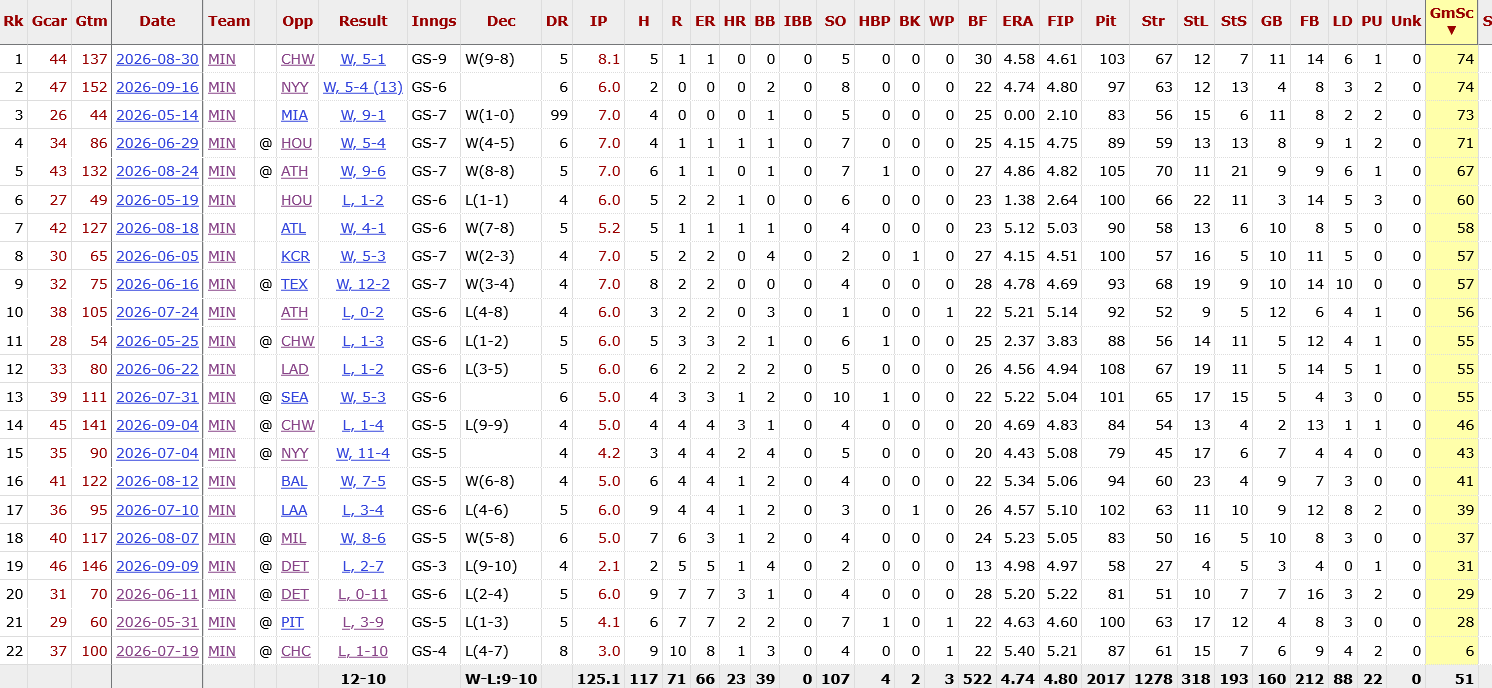
I'm not a Zebby woofer, but this is a really unfair take. He's had 22 starts this season. b-r.com provides a version of Bill James's old "game score" that provides a quick-and-dirty guide to how a starting pitcher did in a game. Sorting Matthews's starts by this tool, he had 13 starts that are solidly above average. You can look at the game logs of them below. You'll see that the Twins won 9 and lost 4 of those games - the losses were 2-1, 2-0, 3-1 and 2-1 - his team's offense let him down completely in those 4 well-pitched losses. In the other 9 games, at the bottom of the list in the display, the team managed to go 3-6 because the offense bailed him out three times. When Zebby is bad, he can be REALLY bad. But the three absolute worst games look very odd in the one-line summary, as if the manager was hanging him out to dry. I don't actually think there was malicious intent - in those games, the Twins offense was contributing little (4 runs total by the end of those 3 games) so the braintrust in the dugout may have judged that the game was not likely to be won so the starter might as well eat some more innings if he can (if so, this blew up in their faces all three times), and/or the bullpen was stressed so they didn't want to turn the game over to them any sooner than necessary in a lost cause (5+ innings of shutout relief wouldn't have salvaged these games). Sometimes a pitcher "wears one" for the team, and I see three such games that dragged his ERA down more than if the manager had come and got him like might be expected on those days his team wasn't hitting. All in all, he's had more good games than bad, 13-9, That's not easy to do at the major league level, and you certainly don't do it with no talent. His team has gone 12-10 in his starts, representing a little bad luck, and his official W-L record of 9-10 is even less lucky. Again, I'm not apologizing for Zebby - I' m trying to make sense of his season. In my view, if the coaching staff can unlock something more - something new he can do when a game starts to go bad for him - there's cause for optimism. If not, then he remains a .500 pitcher, which is not "terrible." I like averages, but sometimes it pays to look deeper at the underlying data.
- 138 replies
-
- 7
-
-
- byron buxton
- joe ryan
- (and 5 more)
-
The '27 Twins are gonna need hitters! But who?
ashbury replied to TNtwins85's topic in Minnesota Twins Talk

-
Yankees (Rodón) vs Twins (Matthews): 09/16/26, 12:40 PM
ashbury replied to Brock Beauchamp's topic in Archived Game Threads
Is this ERod's first major league walk? The a-hole ump wanted to ring him up, but fortunately ABS challenge was available and he was confident enough to call for it. Considering his reputation for watching pitches go by, he seems to have taken a smart approach and crossed up the book on him these first few games. But eventually everyone needs to take the walk when the pitcher won't go after him. The upshot may be that the umps will just redouble their efforts to haze the rookie, just like they seem to do to every new guy who comes up. Maybe it's just selective memory on my part, or maybe umps really do have an agenda (not an anti-Twins one, particularly, except to the extent our team tries a lot of rookies). -
How Poor Is the Twins’ Core?
ashbury replied to Cody Christie's topic in Twins Daily Front Page News
They tried that approach in 2023, DHing him the whole time, and he still went on the IL two separate times.- 69 replies
-
- 4
-
-
- byron buxton
- walker jenkins
- (and 3 more)
-
When Luis Arraez was on the Giants this season they scored an average of 4.16 runs per game. Since trading him to the Phillies, SF has scored 4.29 runs a game. * I'm not saying Arraez is a bad baseball player. But he's not some magic run-scoring machine, himself; and he's not some magic catalyst in teammates scoring runs either. One of his magical talents, though, is inducing fans to think that he is. * Okay, to be fair, Philly's run scoring has gone up too.
-
I dislike DH'ing Buxton on a regular basis, for at least three reasons. One, we tried it in 2023 and he had his worst season at bat since establishing himself. Two, he gets injured even when not on defense - 2023 again being an example since he landed on the IL twice. And third, it's waving a white flag of surrender in advance of battle - when he's healthy enough to play CF he's one of the more valuable players in the majors and I'm unwilling to give up on that potential even after this many years. "Injured" gets treated like some kind of on-off or yes-no switch on a game console. The reality is that anyone's injury is on some scale of severity (and of course injuries to different body parts affect the parts of a players game in different ways). A step up from yes-no would be a percent of capability (still a vast oversimplification), and that's where the calculus for Buxton differs from most players. If Ryan Kreidler is banged up so that he's, say, at 85% effectiveness, you just IL him - he's not a major league player in any sense if he's reduced at all. Buxton, OTOH, might be better at 85% than, say, the OutMan at 100%. But in addition to the points in the above paragraph, the other flaw in most analyses is that the actual effect of many injuries, on a player's game effectiveness, is simply unknowable. 85% like I alluded to above is BS (I picked those digits for the similarity 😄). The player himself can't tell you, the medical staff or trainer can't tell you, nobody can with any certainty unless there is a bone fragment sticking up through a guy's shin area. Buxton will tell the manager or physical therapist, "I'm hurting, but I can play." He's not a liar and he's not stupid - he simply doesn't know, in a lot of cases, exactly how the way he feels will affect things in the heat of battle. Sometimes he'll say, "I can't go today. But I've been through this before and maybe tomorrow?" Again, he's not a liar and he's not stupid - he's trying to make sense of what his body is telling him, and the trainer can't help him achieve certainty. Sure, if the trainer can respond, "I've seen these before, it'll take two weeks," that's useful - but a lot of times it won't be black and white like that. So, in sum, I don't want to designate (heh) Buxton as DH. Sure, DH him if it makes sense to give him a day or three to recuperate. But I keep having flashbacks to 2023, when the lesson seemed to be, if Buxton's not good to go in the field, the bat may not be "all that" either.
-
The '27 Twins are gonna need hitters! But who?
ashbury replied to TNtwins85's topic in Minnesota Twins Talk
None of this matters. The '27 Twins will have the '27 Yankees standing in their way. Ruth, Gehrig, Combs, Lazzeri, Meusel - a real murderer's row and there's no way to compete with that. -
You could have knocked me over with a feather, when the article stated that Luis Arraez moved around that much, and (in particular) 2B wasn't his home at all. I thought I pay attention to this team! 😁
-
Yankees (Warren) vs Twins (Kremer): 09/14/26, 6:40 PM
ashbury replied to Brock Beauchamp's topic in Archived Game Threads
Welp. Judge gonna Judge. -
The '27 Twins are gonna need hitters! But who?
ashbury replied to TNtwins85's topic in Minnesota Twins Talk
None of his managers have so far. 😄 -
The '27 Twins are gonna need hitters! But who?
ashbury replied to TNtwins85's topic in Minnesota Twins Talk
This season the MLB average number of pitches per plate appearance is 3.88. Arraez is at 3.72. There's no disputing his fabulous, low strikeout rate. I don't know of stats for moving runners, but driving in runners has never been his forte. You don't mention run scoring. This season Twins leadoff batters have scored 98 runs so far. #2, #3, #4 batters have scored 86, 87, and 86 respectively. Arraez this season has blended his time in these four spots, and is on a pace to score about 72 runs. He's never scored more than 88 in his career, and his 162-game projection for his career is 83 runs. Where is the improvement supposed to come from? -
I'm only up to page 3 but what a disaster. Will anyone still have their job a week from now?
-
Guardians (Bibee) vs Twins (Ryan): 09/13/26, 1:10 PM
ashbury replied to Brock Beauchamp's topic in Archived Game Threads
This last RBI was only on a double. Baby steps. -
Guardians (Bibee) vs Twins (Ryan): 09/13/26, 1:10 PM
ashbury replied to Brock Beauchamp's topic in Archived Game Threads
Joe Ryan's not bringing back much in trade this coming off-season. -
Guardians (Bibee) vs Twins (Ryan): 09/13/26, 1:10 PM
ashbury replied to Brock Beauchamp's topic in Archived Game Threads
After striking out only once in his first 5 games in the majors, Jenkins has now struck out 12 times in his last 27 plate appearances, a 44% pace. He's gonna have to figure something out, because the league sure did. -
Guardians (Bibee) vs Twins (Ryan): 09/13/26, 1:10 PM
ashbury replied to Brock Beauchamp's topic in Archived Game Threads
Gameday changed its mind, apparently. I'll try to restrain my enthusiasm next time.