


Twins Video
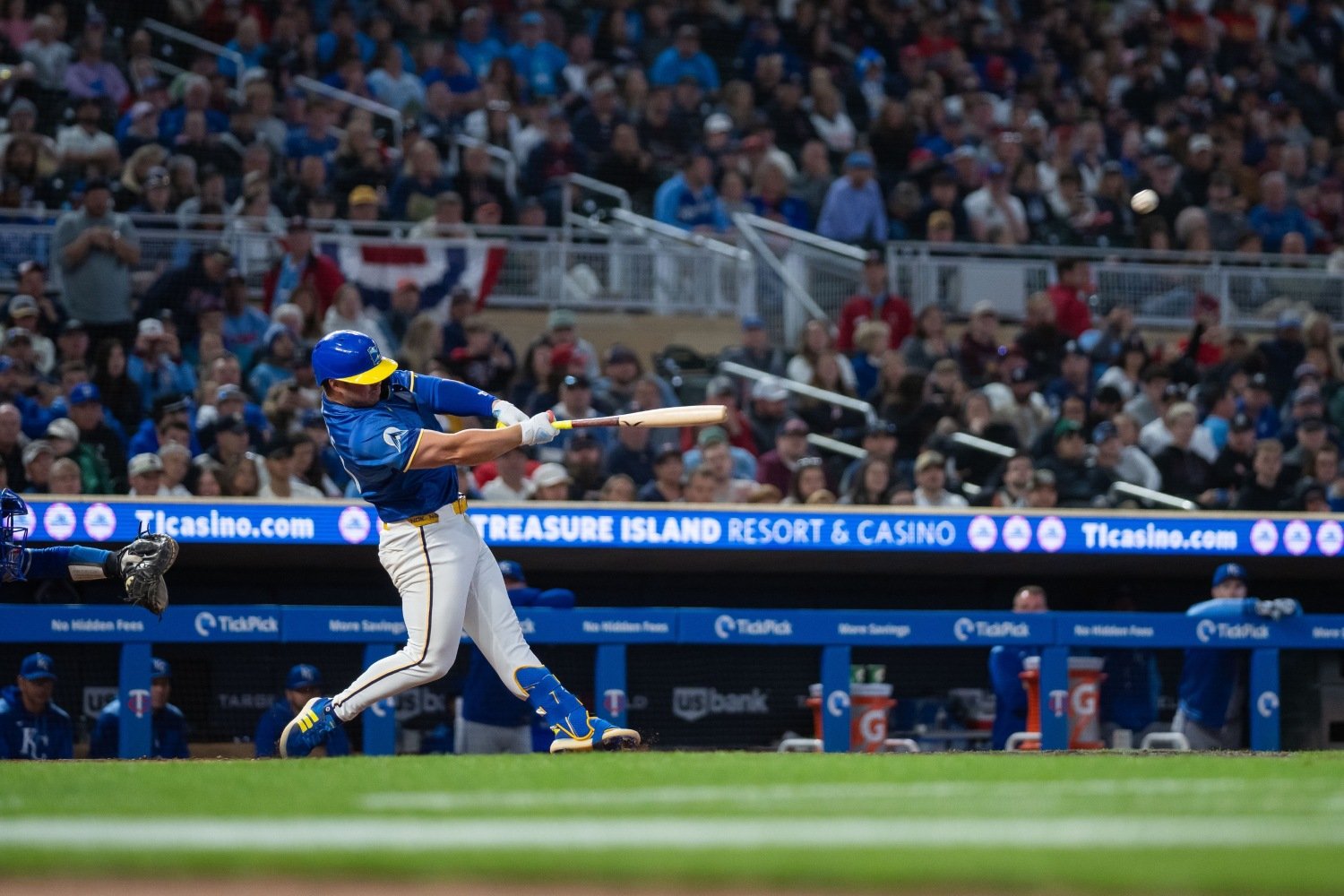
Memorial Day weekend turned out very well for the Twins. They couldn't quite eke out a third win and complete a sweep of the division-rival Royals, but their back-to-back walkoff victories on Friday night and Saturday afternoon showed their mettle, their well-roundedness, and their slight but clear superiority to the visitors from Kansas City. At the heart of it all was Ty France, clutch hitter extraordinaire.
France's two-run home run to win Friday night's game was arguably the high point of a Twins hot streak that has wholly inverted the narrative of their season. France didn't rest on the laurels that came with that homer for even a day, though. On Saturday, he had a crucial two-run, opposite-field single to facilitate an eventual comeback win, and on Sunday, he started the scoring by flipping a single into right-center field to score Ryan Jeffers in the first inning.
Last fall, I documented the fact that hitters swing faster in the postseason. Big crowds and big situations will speed up the reflexes and the muscles. France knows how to avail himself of that natural speed boost: keep things slow.
"As far as the big moments and the adrenaline kicking in, I was fortunate enough to play in the playoffs in [2022], and it's a real thing," he said Sunday. "The more you can slow your heart rate down in those moments, just be under control—I'm at a point in my career now where I've been in those situations a good bit, and I'm able to control my emotions."
France emphasized the importance of staying under control, and resisting the temptation to get "carried away" when the hum of the game rises to more of a roar. He's a subject matter expert, in this regard. For his career, France is a .243/.316/.391 hitter with the bases empty. Put a runner in scoring position, and those numbers leap to .310/.377/.450. In low-leverage situations, he's batted .255/.323/.400. Crank it up to high leverage, and he's at .290/.368/.434. It's against old-fashioned sabermetric orthodoxy to suggest that a hitter can be consistently clutch, but with well over 500 plate appearances in both of the samples producing such impressive numbers, France is right that he's been in that spot too many times to dismiss his success there as meaningless.
Over the decades, some wise voices have even questioned the nobility of being a clutch hitter. Way back in 1960, in his moving paean to Ted Williams after his final game in Fenway Park, author John Updike rebuked that archetype.
"Insofar as the clutch hitter is not a sportswriter’s myth, he is a vulgarity," Updike wrote, "like a writer who writes only for money."
There's truth in that sentiment. If a hitter isn't giving their full concentration or best effort until there's a chance to cash in for some RBIs or the glory that comes with hits in the heat of the spotlight, they're not serving their team. But Updike had an ax to grind—or, more to the point, an infamously non-clutch hitter to defend. More importantly, he overlooked the reasonable hypothesis that some hitters might be well-suited to the way pitches prefer to do their business when the chips are down—and less so to the way they'll be attacked at other, lower-pressure moments.
"I think when I'm at my best, I'm covering that pitch away, hitting that fastball to the right side," France said, acknowledging that pitchers often feel more comfortable working in locations they perceive as less dangerous or vulnerable to power when the pressure rises.
Twins manager Rocco Baldelli echoed that basic conception of the art of clutch hitting, at which the Twins seem to be excelling over this three-week run of torrid play.
"I think guys are going up there with a good plan, more than anything else," the skipper said. "We’re not trying to beat the world with one swing. Ty had a big homer for us, but most of the time we’re doing it with just hitting the ball hard, spraying the ball around the field, trying to hit line drives. But we’re taking pitches, we’re putting ourselves in good positions to hit. That’s really what it’s all about. It doesn’t mean you’re always gonna have success, but it’s the only way you can have success, to have at-bats like that."
None of this quite answers the question of how France came to hammer that game-winner Friday night, though. If he's focused on going the other way, which he's done so well, where did a pulled home run come from in that moment? It was, in truth, the confluence of having a good plan and the body going faster than it otherwise might.
"[Royals relief ace Lucas Erceg] throws a sinker at 98, and guy on first, one out, my thought process is, 'Ok, he's gonna try and bury me in with a sinker, get a double play ball,'" France said. "So for me, it was, 'Ok, I need to get on time for 98, get the foot down, ready to hit.' 0-0, he hung a slider, but because I was on time for the fastball, I was able to see it, react, gave me some room to work with out front, and I was able to pull a slider for a homer."
Sitting on a heater and getting a slider is, in general, a bad thing for a hitter. If that hitter is dedicated to the idea of taking that fastball to the opposite field, however, they have a chance to be early in a good way, rather than a bad one, when the breaking ball comes instead. The wrinkle—the big trick, here—is that the bat is going to be moving fast, no matter what. So the hitter has to be thinking clearly enough to stay in that mindset, to studiously focus on going the other way—to trust himself.
France's average bat speed this season is 70.6 miles per hour. On that first pitch from Erceg, it was 74.0 mph. His average attack angle (the vertical angle of movement, relative to the ground, of the barrel of the bat at contact) is 11°. On this swing, it was 21°, which tells us he was a bit early. His average attack direction (the horizontal angle of movement of that same portion of the bat at the contact point) is 6° toward the opposite field; it was 8° to the pull field on the fateful pitch Friday night. He typically tilts his bat 35° downward as he moves it through the hitting zone, on pitches in that vertical location range. Friday night's swing was at 32°. Expecting the fastball, thus, a flatter swing. On time for the fastball, thus, early. But, because he'd been trying to go to right field with it, early in a good way.
Clutch hitting isn't solved. France won't come through every time, as Baldelli noted. This remains a game of failure. As successes in pivotal moments pile up for France, though, it's hard not to both trust and admire the way he matches his skill set and his approach to situations—or even how situations simply compel pitchers to pitch right into his strengths.
Are you optimistic about the Twins right now?

Follow Twins Daily For Minnesota Twins News & Analysis



- Patzky, SD happy, Hrbeks Divot and 1 other
-
 4
4



Recommended Comments
Create an account or sign in to comment
You need to be a member in order to leave a comment
Create an account
Sign up for a new account in our community. It's easy!
Register a new accountSign in
Already have an account? Sign in here.
Sign In Now