


Twins Video
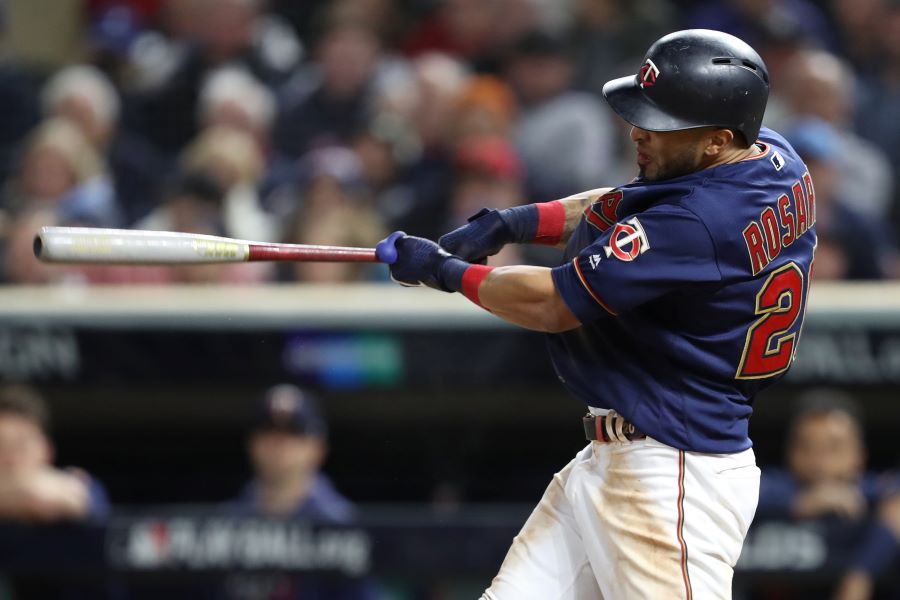
The RBI is often seen as problematic because it’s an opportunity stat. The more times a batter comes to the plate with runners on base, the better his chances to collect an RBI. Eddie Rosario led the Twins with 109 RBIs, but is it because he’s good at knocking in runs or is he just fortunate to frequently come to the plate with runners on base? Thanks to Bill James, we’ll be able to answer that question.
James created RBI percentage, which he explains in detail in The Bill James 2020 Handbook (This is a great way to get your baseball fix, it’s full of captivating essays and statistical analysis and I can’t recommend it enough). Basically, runners are penalized when they fail to drive in a run by making an out (a missed RBI opportunity). The “charge” of making an out varies based on the situation, meaning failing to knock in a runner on third with less than two outs is a bigger penalty than making an out with the bases empty (where a home run would be the only way to obtain an RBI). Multiple baserunners count as multiple opportunities, weighted accordingly. You end up with a percentage that fits nicely into the range of on base percentage but has a slightly higher standard deviation, meaning more variation (Seriously, read James’ essay! He explains this much better than I have).
So, how did Twins hitters perform? As you’d expect from the team that led the MLB with 906 RBIs, there were some efficient RBI producers on the team. In fact, Nelson Cruz led all of baseball with a .486 RBI percentage (finished with 108 RBIs). He was not alone. Although Mitch Garver didn’t put up gaudy RBI totals (67 total RBIs) due to limited playing time, he made the most of his opportunities with a .464 RBI percentage, which was fourth in the MLB! In total, the 2020 Minnesota Twins will have seven players who finished in the top-100, including Max Kepler (24th – .432, 90 RBI), Eddie Rosario (31st – .421, 109 RBI), Miguel Sano (46th – .410, 79 RBI), Josh Donaldson (67th – .394, 94 RBI), and Byron Buxton (90th – .380, 46 RBI). In case you were wondering, Billy Hamilton had the MLB’s worst RBI percentage at .159, while Willians Astudillo was the worst on the Twins at .285. The 2019 MLB average was .326.
That brings us back to the ever-polarizing Rosario. While teammate Nelson Cruz was the most efficient RBI producer, Rosario undeniably earned his 109 RBIs with his well above average .421 RBI percentage. And while some of us clamored for Jake Cave to get his cut of Rosario’s playing time (after all, Rosario was playing hurt) with Cave outperforming Rosario in wRC+ (113 to 103), Rosario easily topped Cave (.302 RBI percentage) in run production. So yes, in batting cleanup Rosario was afforded plenty of RBI opportunities, but he was also really good at coming through when it mattered.
This naturally leads to the question of how sticky a stat like RBI percentage is from season to season. For that I don’t have an answer, but a hitter with high RBI totals year in and year out is probably doing something right. According to James, “Generally speaking, the best RBI men almost always get the most chances to drive in runs.” This makes sense as you want your best hitters hitting behind the guys who get on base. He goes on to point out that there are exceptions like 2018 Mike Trout and Mookie Betts (hitting at or near the top of the order), but in 2019 all of the 22 hitters with over 100 RBI had high RBI percentages.
With the shortened season we don’t know how many RBI to expect, but if the Twins can approach their 2019 efficiency they should be near the top of baseball in runs scored. And while the debate around RBI can continue, James’ RBI percentage at least injects some context into an “old-school” stat.





Recommended Comments
Create an account or sign in to comment
You need to be a member in order to leave a comment
Create an account
Sign up for a new account in our community. It's easy!
Register a new accountSign in
Already have an account? Sign in here.
Sign In Now