


Twins Video
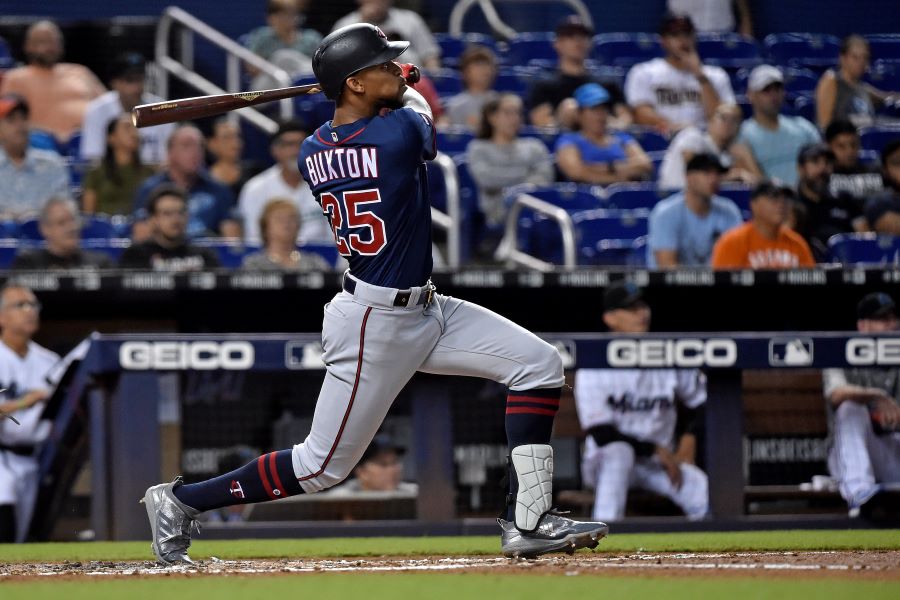
Though Byron Buxton has had a long, uneven, complex development curve, it’s clear that he turned a new corner in 2019. After going back to the setup and swing mechanics he had trusted in high school late in the 2018 season, Buxton blossomed into the kind of multi-dimensional, dangerous hitter on which Twins fans had dreamed for years. He not only set a new career high in average exit velocity and hard-hit rate, but did so by wide margins, while slashing his strikeout rate. There were many adjustments and improvements involved, but the one that might have been most important seems trivial at first: he whiffed on many fewer fastballs.
Over the last five years, there have been 1,666 player-seasons in which a batter swung at least 250 times at fastballs. That’s an average of about 350 per season, and equates to a threshold of coming to bat about 200 times. Buxton has only surpassed that threshold three times, because of his prolonged slumps and (more importantly) many injuries. Here are his whiff rates when swinging at fastballs in those three campaigns, along with their rankings on the list of 1,666.

This could seem like a small change, especially if one studies the list of all those player-seasons. Ronald Acuña, Jr., who was a contender for the NL MVP last season, whiffed as much during that season as Buxton did in 2017. Giancarlo Stanton’s 2017 MVP season saw a similar whiff rate on heat as Buxton had in those two troubled seasons. Meanwhile, the names and seasons around Buxton’s 2019 entry on the list are less inspiring.
Buxton, however, isn’t a normal hitter, and he can’t be defined, nor his performance predicted, by analogy. He’s a unique athlete. Though he had a career-low ground-ball rate last season, he posted a .314 BABIP and a .348 batting average on contact (BACON). He did even better than that on contact in 2016 and 2017, but of course, he struck out so much in each season that his production was hampered. Buxton shouldn’t be focused on hitting ground balls, but to the extent that he can get on plane with an incoming pitch and increase his contact rate, he should always do so. His speed and his strength make him a potentially lethal hitter, if he does so.
The change itself might feel small, too, but in the context of pitchers and teams trying to gameplan against Buxton, it’s not. Going from the 12th to the 28th percentile in vulnerability to whiffing on fastballs, while continuing to hit the ball hard when one makes contact, represents the elimination of a catastrophic weakness. Buxton might never have an average contact rate on fastballs, but if he’s merely below-average, rather than dwelling near the very bottom of the league, then he’s a tough at-bat and a tough out.
It shouldn’t be controversial to say this: Buxton is the most important player on the 2020 Twins. When he’s healthy and functioning at full capacity, he turns the Twins into a juggernaut, closing the only prospective hole in their lineup and fundamentally transforming them from a subpar defensive team to one that catches almost everything in the air. When he’s absent or compromised, the team is still good, but their flaws become much more apparent. If Buxton can continue to hammer fastballs while minimizing his empty swings against them, he adds a dynamism to their lineup that is somewhat wanting otherwise.
MORE FROM TWINS DAILY
— Latest Twins coverage from our writers
— Recent Twins discussion in our forums
— Follow Twins Daily via Twitter, Facebook or email





Recommended Comments
Create an account or sign in to comment
You need to be a member in order to leave a comment
Create an account
Sign up for a new account in our community. It's easy!
Register a new accountSign in
Already have an account? Sign in here.
Sign In Now