


Twins Video
Evaluationally, managers are a bit of a black box. So many of a manager’s important habits and interactions are hidden from the public, which leaves onlookers in a tough spot. What methods do we have to determine whether a manager is good or bad, other than simply seeing if the team wins or loses? We sometimes get glimpses, or little bits of helpful information, to assist us in our never-ending quest to figure out if we should love or hate the guy running our favorite team. Unfortunately, most of what we do hear skews positive, but it’s nonetheless helpful in painting a picture of the manager’s profile.
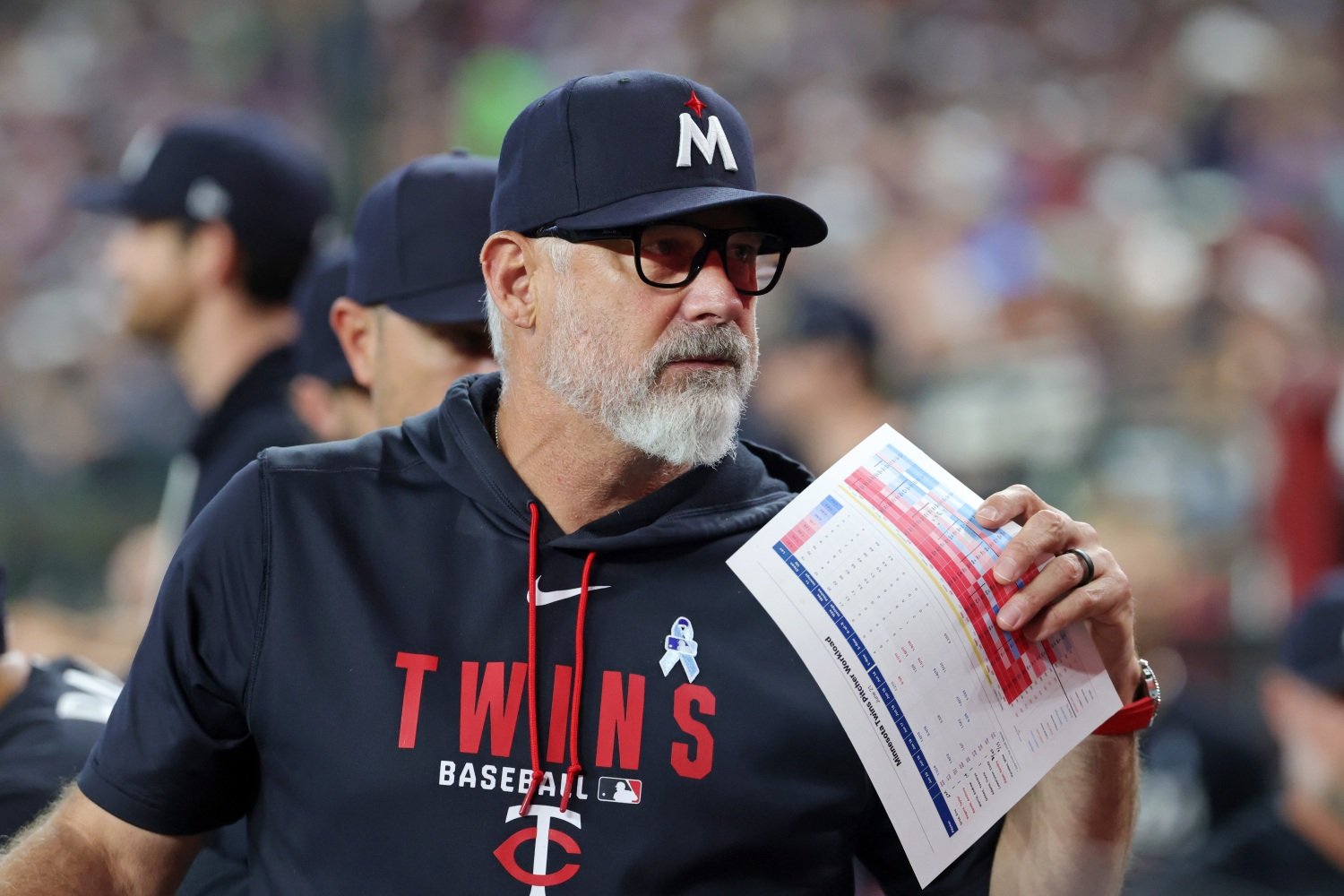
One of the predominant traits we hear about with Derek Shelton is his communication style. Shelton has said, for the entirety of his stint as the Twins’ manager, that communication is important to him. There have been similar reports as the season has gone on that the players appreciate his communication.
Specifically, Shelton has been lauded for being upfront and proactive in his communication. On a recent episode of Gleeman and the Geek with guest Bobby Nightengale of the Star Tribune, it was noted that Shelton does his best to communicate with players as soon as he knows something that they ought also to know—even if a decision had not been made yet. It was also noted that this tendency was something of a change from Shelton’s predecessor, Rocco Baldelli, who managed the club from 2019 to 2025.
Examples of this habit named on the podcast included personnel decisions like communicating with third catcher Alex Jackson that he would not be waived upon Ryan Jeffers’s return and on-field decisions like communicating ahead of moving Brooks Lee to third base. This habit would seemingly carry over into decisions like moving a player up or down in the lineup or optioning a player to Triple-A.
It’s somewhat obvious why that tendency toward transparency would be preferred by players, but there’s been extensive research into just these topics in the social sciences, as well. I want to break down Shelton’s communication in light of two topics: role ambiguity and organizational justice.
Role Ambiguity
This topic is the most straightforward in its relationship to managerial communication. People don’t like it when they don’t know what’s asked of them. Traditionally, role ambiguity has been understood as uncertainty related to four topics: scope of one’s role; behavior necessary to fulfill one’s role; how one will be evaluated; and the consequences of meeting or failing to meet those expectations (Kahn et al., 1964). In baseball, this could look like some combination of a player not knowing how often they’ll play (or at which position); not knowing how to play that position well or improve; whether they’ll be evaluated on process or result; or what will happen if they go 0-for-20.
Active, direct communication alleviates this. As examples, you might think of the aforementioned Lee moving off of shortstop, Royce Lewis bouncing between first, second, and third base upon his return from Triple-A, Luke Keaschall moving to right field for the first time in his career, Andrew Morris transitioning from starter to long reliever to setup man, or Kendry Rojas spot starting. Shelton’s willingness to communicate through these changing expectations surely benefitted his players.
Lewis began playing first base for the first time in his life down in St. Paul, and he’s rarely played third base—the spot he had played nearly every day (when healthy) from 2023 to the beginning of this season. That’s a big change by itself, but he’s also played some second base, a position that he’s been wary of playing in past seasons, especially when things were changing on the fly.
Now? We’ve heard no peep from Lewis. He’s filled in serviceably at both positions that he’s largely unaccustomed to, even though he’s bouncing around daily. We can never say for certain, but it’s easy to believe that Shelton’s willingness to communicate about where Lewis will play each day would be beneficial.
The Role Episode Model (Katz & Kahn, 1978) suggests that role ambiguity manifests as a series of failed communications. The role giver and the role filler are not on the same page, and both get frustrated as failed communication stacks on failed communication. There’s evidence that communicating expectations affects athletes, specifically, which is important to this conversation, because a lot of this type of research is conducted in non-sports scenarios (Beauchamp (not Brock) et al., 2002).
Organizational Justice
Justice is a different topic, but it carries over to this conversation. Justice can be understood as the level of fairness that an employee (in this case, a baseball player) perceives within their workplace (or baseball club, here). It’s subjective, because everyone’s perception of what is “fair” is going to differ. Technically, there’s probably a way to calculate “fair” objectively, but that’s beyond most of us. What’s important is whether the people in question think that they’re getting a good shake (Colquitt et al., 2001).
When we think of “fair,” we often think some form of the question “are we getting what we deserve?” We’d call that distributive justice. Distributive justice has to do with how resources are allocated within an organization. Am I getting paid what I’m worth? Do I have the tools necessary to do my job well?
In baseball, that’s going to extend into questions a player might ask like “Am I getting enough playing time?” or “Am I being given a chance to prove myself?” Undoubtedly, players are constantly asking themselves those questions. But communication doesn’t really bleed into that discussion, outside of things like receiving adequate attention from the coaching staff (a resource).
Instead, a second form of justice, procedural justice, is more prominent here. Instead of whether a player is getting what he deserves, procedural justice has more to do with whether decision-making is fair. To some extent, these are two sides of the same coin (fair decision-making is related to the outcomes of those decisions), but it’s interesting how they interact with each other.
One pattern that sticks out when considering these two types of justice together is that sometimes the actual outcomes are less powerful than how those outcomes were decided upon. For instance, a player who loses playing time but understands why the decision was made might be more satisfied than a player who receives more playing time but doesn’t think that they earned it through fair processes (maybe they think a coach is obviously playing favorites).
Similarly, informational justice is especially concerned with the topic of this article, communication. A bad outcome, like being moved off of shortstop or being optioned to the minor leagues, isn’t going to make a player happy. But any negative reaction or feeling can be mitigated by a little communication—explaining to the player why the decision was made, what the player can do in their new role, or how they might be able to reverse the decision (e.g., improving in some facet of their game).
Whether we’re talking about procedural or informational justice, the message (no pun intended) is clear: communication helps. Even if a player is getting bad news, that communication can serve as a buffer and can help a player work through whatever negative news is on the way (and even if it’s positive news, they’d rather not be left in the dark!). People who see fairness in their organization are going to feel more supported by their organization (or team), and that will lead to a whole host of benefits, such as performance, commitment to the organization, positive emotions, and reduced stress (Kurtessis et al., 2017).
As I said, a lot of this is kind of obvious. But it’s important to understand that these positive habits practiced by Shelton aren’t some rule of thumb. They exemplify positive behaviors that have been validated by decades of social science data. And I think that’s pretty cool.
Beauchamp, M. R., Bray, S. R., Eys, M. A., & Carron, A. V. (2002). Role ambiguity, role efficacy, and role performance: Multidimensional and mediational relationships within interdependent sport teams. Group Dynamics: Theory, Research, and Practice, 6(3), 229–242. doi:10.1037/1089-2699.6.3.229
Colquitt, J. A., Conlon, D. E., Wesson, M. J., Porter, C. O. L. H., & Ng, K. Y. (2001). Justice at the millennium: A meta-analytic review of 25 years of organizational justice research. Journal of Applied Psychology, 86(3), 425–445.
Kahn, R. L., Wolfe, D. M., Quinn, R. P., Snoek, J. D., & Rosenthal, R. A. (1964). Organizational stress: Studies in role conflict and ambiguity. John Wiley.
Katz, D., & Kahn, R. L. (1978). The social psychology of organizations. New York: Wiley.
Kurtessis, J. N., Eisenberger, R., Ford, M. T., Buffardi, L. C., Stewart, K. A., & Adis, C. S. (2017). Perceived organizational support: A meta-analytic evaluation of organizational support theory. Journal of Management, 43(6), 1854-1884.








Recommended Comments
Create an account or sign in to comment
You need to be a member in order to leave a comment
Create an account
Sign up for a new account in our community. It's easy!
Register a new accountSign in
Already have an account? Sign in here.
Sign In Now