
Jump to content
Twins Daily
  • Create Account
  • Twins News & Analysis

    From Worst to Best: The Twins Have Slain Their Strikeout Demons


    Nick Nelson

    If you were hoping the Twins could overcome the most irksome aspect of their offensive game, then you've got to be pleased with what you're seeing this year.

    Amazingly, they've transformed into one of the least strikeout-prone teams in the majors.

    Image courtesy of John Froschauer-USA TODAY Sports

    Twins Video

    As you are surely aware, the Minnesota Twins offense set the major-league record for strikeouts in 2023. Around this time last year, as the team hurtled toward their dubious distinction, Rocco Baldelli acknowledged, "The strikeouts, they are an issue, and there’s no way around that." 

    Concerns around the stylistic tendencies of the Twins offense were arguably validated when the team crumpled at home against Houston in the ALDS, amid a flurry of nonstop strikeouts. Minnesota hitters piled up 28 of them in Games 3 and 4 while scoring three total runs, in front of packed houses at Target Field. It felt frustratingly fitting that the final game of the 2023 season -- a 3-2 series-clinching loss to the Astros -- ended with the last four Twins batters (and eight of the last 10) going down on strikeouts. 

    This year, we all hoped to see some positive regression in the contact department, even as the Twins showed no inclination to shy away from their general approach of prioritizing power over contact. Early on, the signs were not good. Through their first 20 games, while slumping to a 7-13 start behind an offense that couldn't kick into gear, Minnesota posted the fourth-highest strikeout rate in the majors (26.5%), batting .195 as a team.

    Their turnaround since that point has been astonishing. In 65 games since Apr. 22, the Twins have the fifth-lowest strikeout rate in all of baseball, at 19.5 percent. In the month of June, the Minnesota Twins had the lowest strikeout rate in the American League, and second-lowest in baseball.

    It's remarkable, especially because they haven't sacrificed anything in the way of power or potency of contact. Over these past 65 games, the Twins rank fourth in the majors in Isolated Power (ISO), behind only the formidable Orioles, Yankees and Dodgers. Minnesota has struck out the least of any of these teams.

    How far we've come! It's almost impossible to comprehend how quickly the Twins went from being one of the most strikeout-prone teams in baseball to one of the least, and how impactful this has been for their offensive production. (Entering play on Wednesday, the Twins led MLB in batting average, wOBA and runs scored since Apr. 22. They also have the best record in the AL during that span.)

    Just what are the factors driving this stunning turn of events? There are three primary developments that help tell the story:

    Offseason Roster Changes
    This is the fairly obvious explanation. Last year, Joey Gallo and Michael A. Taylor combined to strike out 272 times in 770 plate appearances (37.8%), ranking first and eighth in the AL in strikeout rate, respectively. Merely removing them from the lineup was bound to at least help the Twins gravitate back toward the pack following a historic year for whiffs, especially when the players brought in to functionally replace them (Carlos Santana and Manuel Margot) are contact-oriented hitters.

    Demotions of Strikeout-Prone Batters
    Over the course of the first half, the Twins sequentially demoted Matt Wallner, Edouard Julien and Alex Kirilloff. Those three combined to strike out 130 times in 405 plate appearances (32.1%) during their time in the majors, holding three of the four highest strikeout rates on the team. 

    And here again: It's not just removal of K-prone players from the mix -- it's replacing them with players who carry the opposite profile, like José Miranda (15th-lowest K-rate in MLB) and Austin Martin.

    Substantial Improvement and Adjustments from Within
    This is the most encouraging factor behind Minnesota's huge strides in mitigating the strikeouts: much of it is simply coming from players still on the roster who are striking out far less than they did previously. The two other players among the top five on the team in strikeout rate, alongside Wallner, Julien and Kirilloff, are Willi Castro and Byron Buxton, who perfectly exemplify this trend.

    It's easy to forget now, but Castro got off to a really rough start at the plate this year. He struck out in 21 of his first 47 plate appearances, and halfway through April he led the majors, with his 43.8% mark edging Gallo's 40.6%. Since Apr. 16, Castro has struck out in a mere 21.4% of his plate appearances.

    Buxton's struggles at the plate persisted a bit longer than Castro's, but he, too, has completely flipped the narrative on his strikeout tendencies. Buck has played 64 games this year, posting a 31.9% punchout rate in the first 32 and a 22.6% K-rate in the next 32.

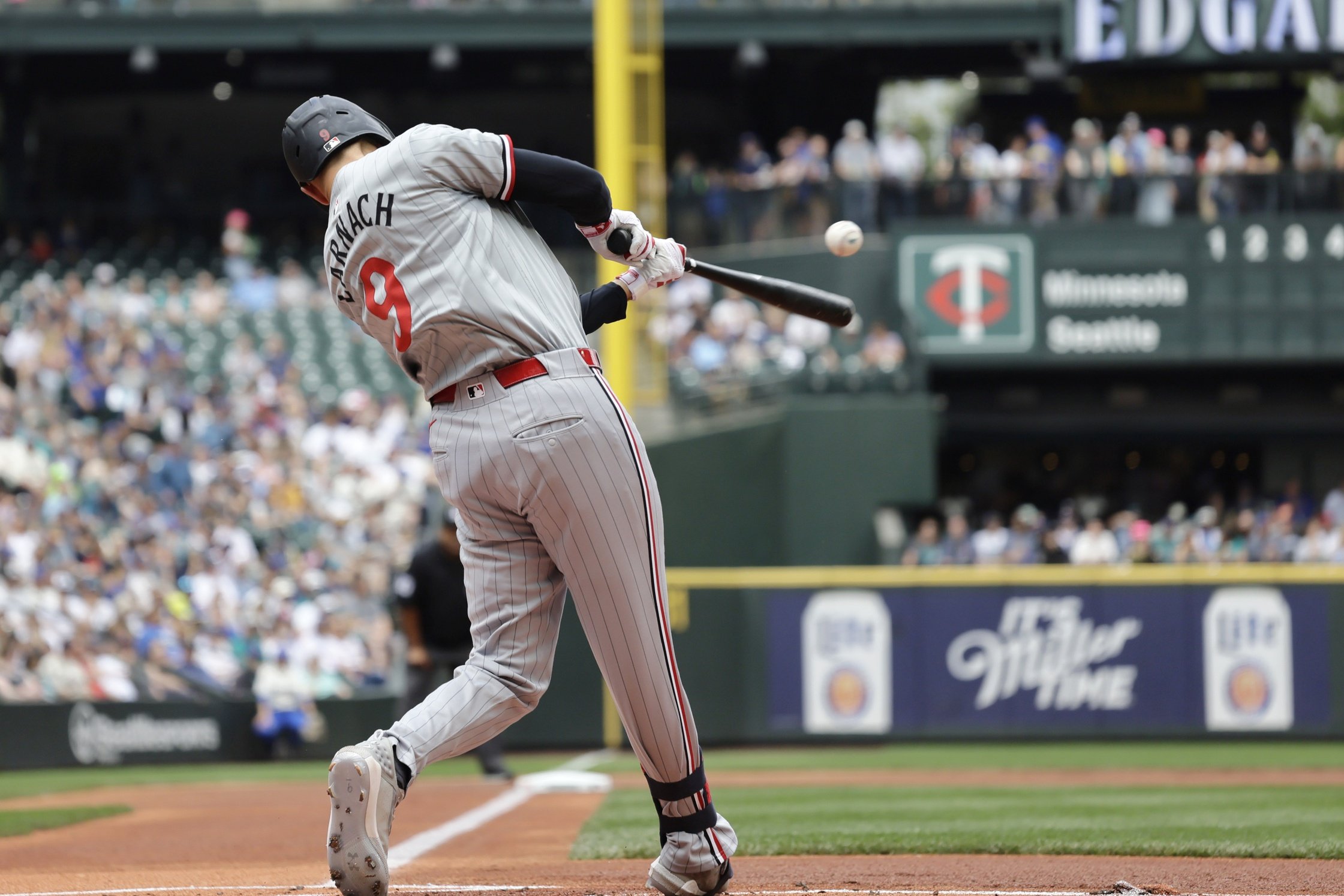
    Trevor Larnach is another example of a player who has reinvented himself when it comes to making contact. He entered this season with a 32.6% career strikeout rate in the majors; his inability to get the bat on the ball consistently stood as a prime barrier to success. In 2024 Larnach has struck out just 33 times in 183 plate appearances (18.0%), and uncoincidentally, it's all coming together, as he finds himself batting second or third against righties.

    Every team, naturally, swings more often with two strikes than before they get to that point in the count. You have to protect the plate in those situations. For all of 2023 and much of the first month this year, though, the Twins were one of the worst teams in the league at making those adjustments and covering the zone once failing to do so meant going down looking.

    image.png

    Since Apr. 22, though, they've made the switch. Some of that is sending down overly passive players like Julien. Some of it is guys like Castro and Buxton tweaking their approach. No matter the reasons, though, they're now a tougher set of at-bats for opposing pitchers.

    image.png

    The strikeout demons that notoriously come to haunt the Twins have evidently been slain, through a combination of strategic roster moves, hitter adjustments and effective coaching support. That bodes very well for the offense's outlook in the second half and beyond, and very badly for opposing pitchers who are tasked with facing the best lineup in baseball.
    Follow Twins Daily For Minnesota Twins News & Analysis

    Recent Twins Articles

    Recent Twins Videos


    User Feedback

    Recommended Comments


    Featured Comments

    6 hours ago, Major League Ready said:

    That's ironic given you were asked to provide a basis for your opinion.  You are making a claim while providing no evidence.  It seems perfectly reasonable to ask you to support your position with a few names.  

    How fast did pitchers throw in the 1960s?
     
     
    The estimates I've seen indicate that most successful pitchers fastball ranged from the high 80s to mid 90s. Steve Dalkowski was the hardest thrower in the 60s. He threw a fastball at 100 mph or better in his prime.
    ----
    How fast did Sandy Koufax throw?
     
     
    100-mph
     
    Koufax was an American baseball legend. He possessed a 100-mph fastball and what announcer Vin Scully called “a twelve-to-six curveball” that started at 12 o'clock then dropped to 6 o'clock. From 1963–1966, he had the best four-year span of any pitcher in baseball history.
    --------
    How fast was Bob Feller's fastball?
     
     
    Bob Feller - Wikipedia
     
    Best estimates are at least 98 mph and quite possibly several miles an hour over 100 mph. Among them is footage of a Feller fastball being clocked by Army ordnance equipment (used to measure artillery shell velocity) and registering at 98.6 mph (158.7 km/h).
    ------------------

    It’s impossible to know, so when you hear someone making pronouncements like, “They threw 85 mph,” you can be sure they are full of ****. They cannot possibly know at all.

    What we do know is that Bob Feller’s fastball was timed at a widely reported 98.6 mph when tested against a speeding motorcycle. People who have seen the film of that demonstration unanimously agree that the speeding cycle had a head start on Feller’s delivery, yet Bob’s fastball still beat the cycle to the target. (See John Finn’s post to this question.) Some people claim that Feller’s fastball may have reached 107 mph. Additionally, Feller threw that pitch in street clothes and from a flat surface, not a mound. It’s certainly reasonable to say that his fastball easily exceeded 100 mph.

    Now Babe Ruth played his last game in 1935. Bob Feller pitched his first game one year later, 1936. In fact, Lou Gehrig played his last game in 1939, three years after Feller started. That’s all the confirmation you need that there were pitchers in Ruth’s day who could throw at speeds equal to today’s pitchers. So we know that there was a pitcher in Ruth and Gehrig’s time who was at least as fast as Koufax and Gibson in the 1960s, and at least as fast as Clemens in the 1980s, and at least as fast as Aroldis Chapman today. And all Aroldis ever pitches is one, occasionally two, innings.

    But Feller wasn’t the only one. There were hitters who said that Lefty Grove was faster than Bob Feller, guys who’d batted against both. And Grove was at his peak during the same time that Ruth was at his peak. He led the league in strikeouts seven years in a row.

    In the National League, Dazzy Vance may have been as fast as Grove. Dazzy led the league in Ks seven years in a row, as well. Also in the 1930s was Dizzy Dean with the Cardinals. Diz was known for his speed and for two great phrases: “I’m gonna fog it in there,” and the phrase he used for firing his fastball, “Let’s play some good old country hard ball.” He was the last 30-game winner in the NL.

    So that’s four guys that come quickly to mind when I think of past pitchers who threw 100 mph. But there are more. People like Ty Cobb and Tris Speaker who saw all these pitchers up through about the 1960s say none of them could throw as hard as Walter Johnson. All I had to see was a photo of Johnson in a baggy uniform to tell how powerfully built and how immensely strong he was. Also, watching film of his easy windup and almost sidearm throw you can see how smooth his delivery was and how easily he zipped the ball. Similar delivery to the fire-balling Don Drysdale of the 1960s, but obviously smoother and faster.

    And yet there are others, including Rube Waddell, who had the most incredible strikeout records of anyone ever, considering the time he played in when all batters choked up on the bat and despised striking out. It took 60 years for someone (Koufax) to finally beat Rube’s single-season record of 349 Ks in one year. How many other major seasonal records can you think of that lasted 60 years?

    So, for old-time pitchers who were as fast as anyone today, there’s Feller, Grove, Vance, Dean, W. Johnson, and Waddell, just for starters. There were others, not as great as these six but maybe just as fast, like Rex Barney and Van Lingle Mungo (both of the Dodgers), and Herb Score (1950s) of the Indians. And I’m sure other guys I don’t even know about. These men didn’t lift weights. They got strong the old-fashioned way, through hard work. Many were rawboned farm boys, like Feller and Johnson, some worked in factories or mines. And they could throw the hell out of a baseball.

    ------------------
    There is no way to prove it was not possible but without the radar guns used now you believe it or you do not for ones reason, no proof it is not true.    Some where in this menagerie of baseball posts last year I pasted a site that listed all the pitcher from the get-go that were fireball pitchers, look it up .
     
    16 hours ago, CCHOF5yearstoolate said:

    Nolan Ryan was the only guy who definitely threw 100 before the steroid era. Maybe Bob Feller did, but that's pretty much it.

    I'd guarantee it's fewer than you think. There's a reason Bob Feller's fastball is legendary - he was one of extremely few guys who could throw that before the recent pitching revolution. 

    Agreed.

    Fastball's in the 100's with movement, breaking pitches in the 90's. Babe Ruth didn't have to face this stuff from the 5th guy in a bullpen. They would have sang songs about Ben Joyce if he was doing what he is doing today in 1984. It's a whole new world. Hitters need to be better because the pitching is better. 

    I'm not going to spend a lot of research time on it because... C'mon... no one should have to because what you are saying is obvious.

    I'll just attach the link to an article that states:

    69 Pitches total were thrown over 100 MPH in 2008

    8 Years later

    1,419 Pitches thrown over 100 MPH in 2016  

    I don't have numbers for 2024 but I'm going to assume it's higher than 2016. 

    Here's the link in need of a fresher link

    https://medium.com/@douns2/mlb-100-mph-plus-pitches-from-2008-2016-40354616024e

    None of this really gives any info why Ks are down beyond roster changes. Buxton and Castro “tweaked” their approach. What does that mean? I am not sure Bucks changes are meaningful, he’s just streaky. 2 whiffs again last night. Larnach is still getting more experience. Beyond that, I don’t understand what they are doing differently. 

    On 7/5/2024 at 1:23 PM, RpR said:
    How fast did pitchers throw in the 1960s?
     
    The estimates I've seen indicate that most successful pitchers fastball ranged from the high 80s to mid 90s. Steve Dalkowski was the hardest thrower in the 60s. He threw a fastball at 100 mph or better in his prime.
    ----
    How fast did Sandy Koufax throw?
     
    100-mph
     
    Koufax was an American baseball legend. He possessed a 100-mph fastball and what announcer Vin Scully called “a twelve-to-six curveball” that started at 12 o'clock then dropped to 6 o'clock. From 1963–1966, he had the best four-year span of any pitcher in baseball history.
    --------
    How fast was Bob Feller's fastball?
     
    Best estimates are at least 98 mph and quite possibly several miles an hour over 100 mph. Among them is footage of a Feller fastball being clocked by Army ordnance equipment (used to measure artillery shell velocity) and registering at 98.6 mph (158.7 km/h).
    ------------------

    It’s impossible to know, so when you hear someone making pronouncements like, “They threw 85 mph,” you can be sure they are full of ****. They cannot possibly know at all.

    ------------------
    There is no way to prove it was not possible but without the radar guns used now you believe it or you do not for ones reason, no proof it is not true. Some where in this menagerie of baseball posts last year I pasted a site that listed all the pitcher from the get-go that were fireball pitchers, look it up.

    Using apocryphal tales such as the Feller motorcycle experiment (just watch the clip, you can clearly see that the video is spliced together - and the motorcycle is "going" 86 mph) to say that he threw 107 is extraordinarily silly.

    There is zero proof that any of these guys threw 100. They threw hard for their day, that's not in question. Buy saying "they threw as fast as anyone today" without even a smidgen of actual proof is laughable, honestly, when the "proof" you're citing estimates that Feller was throwing 107.

    There's a zero percent chance Bob Feller threw harder than Aroldis Chapman as a starter. It's just obvious.

    Koufax did not throw 100, he was never timed above 93.


    Like I said before, there have been pitchers throughout baseball history with legendary fastballs. Johnson, Feller, Paige, Dalkowski, Ryan, etc etc. Absolutely legendary fastballs. But save for Ryan, none of them were ever timed at 100 mph or higher. We don't have to fabricate numbers out of thin air for them to be legends of the game. 

    2 hours ago, CCHOF5yearstoolate said:

    Using apocryphal tales such as the Feller motorcycle experiment (just watch the clip, you can clearly see that the video is spliced together - and the motorcycle is "going" 86 mph) to say that he threw 107 is extraordinarily silly.

    There is zero proof that any of these guys threw 100. They threw hard for their day, that's not in question. Buy saying "they threw as fast as anyone today" without even a smidgen of actual proof is laughable, honestly, when the "proof" you're citing estimates that Feller was throwing 107.

    There's a zero percent chance Bob Feller threw harder than Aroldis Chapman as a starter. It's just obvious.

    Koufax did not throw 100, he was never timed above 93.


    Like I said before, there have been pitchers throughout baseball history with legendary fastballs. Johnson, Feller, Paige, Dalkowski, Ryan, etc etc. Absolutely legendary fastballs. But save for Ryan, none of them were ever timed at 100 mph or higher. We don't have to fabricate numbers out of thin air for them to be legends of the game. 

    Gents who wrote this know more about baseball than either of us so I take their words at face value.

    53 minutes ago, RpR said:

    Gents who wrote this know more about baseball than either of us so I take their words at face value.

    Knowing the game, again, is not any kind of proof that those guys threw 100 mph. There has been zero such proof, just like I stated a couple days ago. 


    Create an account or sign in to comment

    You need to be a member in order to leave a comment

    Create an account

    Sign up for a new account in our community. It's easy!

    Register a new account

    Sign in

    Already have an account? Sign in here.

    Sign In Now

×
×
  • Create New...