



jorgenswest
-
Posts
8,284 -
Joined
-
Last visited
-
Days Won
9
Content Type
Profiles
Minnesota Twins News, Rumors & Analysis
Minnesota Twins Videos
2026 Minnesota Twins Top Prospect Rankings
2022 Minnesota Twins Draft Picks & Signing Bonuses
Minnesota Twins Trade & Free Agent Rumors
Minnesota Twins Fan Guides & Resources
2023 Minnesota Twins Draft Picks & Signing Bonuses
The Minnesota Twins Players Project
2024 Minnesota Twins Draft Picks & Signing Bonuses
2025 Minnesota Twins Draft Picks & Signing Bonuses
2026 Minnesota Twins Draft Picks & Signing Bonuses
Forums
Blogs
Events
Store
Downloads
Gallery
Everything posted by jorgenswest
-
I see OBP projections of 294-315 Steamer 246/309/328 Oliver 247/294/314 ZIPS 258/315/339 Source: fangraphs
-
Based on reading through blogs and reports about Bonafacio's fielding, I don't think he is even average at any position. At best, may play a below average 2B and possibly LF. He would be a poor 3B, SS, CF and RF with his weak arm. The last two years he has played only 2B, CF and LF with any significant innings. He hasn't started at SS since 2011. That is not a utility player. The only reason to sign him is if he is seen as a clear upgrade to Dozier and the a Twins see a Dozier as a utility player or a clear upgrade to Presley. The Twins have several below average to poor fielders on the team already in Plouffe, Willingham, Arcia, Kubel, Suzuki, Parmelee, Presley(in CF) and Pinto. They don't need to add another.
-
Article: Kurt Suzuki - Signed to be the starter?
jorgenswest replied to jorgenswest's topic in Twins Daily Front Page News
If a catcher suppressed a pitchers strikeouts and increased a pitchers walks, would that have an effect on runs scored? Is there a reason that the k/bb ratio while Suzuki is catching is lower than when a teammate is catching? Is it possible that his poor pitch framing numbers are driving some of that difference? The data presented was about strike outs and walks. I should have not distracted the thread by bringing in the possible connection to pitch framing. -
Article: Kurt Suzuki - Signed to be the starter?
jorgenswest replied to jorgenswest's topic in Twins Daily Front Page News
[TABLE=width: 284] [/TD][TD]Suzuki Others Colon 3.80 4.17 Detwiler 2.43 2.00 Gonzalez 2.44 2.77 Griffen 2.50 3.60 Haren 3.77 5.67 Jackson 1.80 3.13 McCarthy 2.74 4.20 Miline 4.27 3.48 Parker 1.63 2.46 Straily 1.90 2.23 Strasburg 2.30 4.39 Zimmerman 4.19 3.46 [/TABLE] The data above is k/bb data by individual pitcher in 2012-2013. I collected this data, but I did not share it originally because each split of a pitcher does not have enough data to draw any conclusions. It would not be accurate to state that Suzuki was better or worse for any given pitcher based on the splits. There simply aren't enough starts for an individual. I post it now because it is reasonable to wonder if Suzuki's numbers were biased by not catching Strasburg or the other better pitchers. I think it may be possible to go to the pitch level data from pitchf/x and identify the types of pitches or zones where a catcher has not done well. Two positives might result. - The catcher may see through video study how he needs to change a technique with a certain type of pitch or location. It should be possible with hard work and attention to improve this skill. - Certain catchers may match certain pitchers based on their strength. For example, Mauer does much better getting extra high strikes than low strikes All of that would be learned at the pitch level and not the plate appearance result level. For progress, the Twins would need to trust in the data from pitchf/x and then use it to inform roster and line up decisions as well as using it to improve the individual skill of each receiver. My assumption, based on their roster decisions since Mike Fast's study came out in 2011, is that they are not among the teams that trust this data yet. Let's hope they have taken the correct direction with the catcher position. -
Article: Kurt Suzuki - Signed to be the starter?
jorgenswest replied to jorgenswest's topic in Twins Daily Front Page News
I could have compared other data. One could compare runs given up or OPS against. It is there for anyone to assemble and comb through. Strike outs and walks are thought to be defense independent. It seemed the place to start. If they did not show a difference, I don't think anything else could have meaning. -
Twins Sign Matt Guerrier to Minor League Deal
jorgenswest replied to Seth Stohs's topic in Minnesota Twins Talk
Many players struggle when entering the majors. It will take an investment of many plate appearances or innings. The pay off is a useful, inexpensive player 2 years down the road. Every inning or at plate appearance given to Kubel, Guerrier or Bartlett is also a lost opportunity to invest in a younger struggling player. Is Tonkin the 2016 closer? Who knows? It will be less likely if he is in AAA and Guerrier is pitching in the 7th inning. Where would would Parmelee be if he had 1000 plate appearances at this point in his career? No one knows. He sat while Doumit played for two 90+ loss teams. I am certain that the Twins would know whether to invest any more at bats in him had he received consistent playing time. -
Article: Kurt Suzuki - Signed to be the starter?
jorgenswest replied to jorgenswest's topic in Twins Daily Front Page News
FIP is based on strike outs, walks and home runs. I am not sure how much a catcher has an influence on home runs or whether there would be enough home runs to distinguish between the catchers. Suzuki does not compare well when comparing strike outs and walks with the other catchers on his 5 previous teams. He would not compare well according to FIP either. It might be possible to use the actual home runs or normalize the home runs and come up with a FIP number, but I don't think that is necessary. The strike outs and walks are self explanatory. No one would argue that fewer strike outs and more walks is better. In fact, if pitch framing has any meaning at all it would have to show up in those defense independent numbers. You would expect a catcher with below average pitch framing numbers to have a negative effect on a pitcher's k/bb ratio. ... as I write this I do wonder about home runs which I ignored. Are more home runs given up when a pitcher is behind in the count? If so, catchers may have an effect on home run rate. There is still no way to do it with just Suzuki's three seasons. Too few home runs are it in that sample. -
You can view the page at http://twinsdaily.com/content.php/2635-Kurt-Suzuki-Signed-to-be-the-starter
-
Great way to start day. Thanks Seth.
-
Mike Berardino reported this weekend that Terry Ryan expected Kurt Suzuki to start this year for the Minnesota Twins at catcher. At the time of the signing, it appeared that Suzuki was signed to give the Twins a veteran backup. On this site, there were certainly questions about his defense and concern about the workload he carried early in his career. At the time, the best available options other than Suzuki were John Buck or retaining Doumit. While Suzuki has been a poor pitch framer, Doumit and Buck are at the bottom. Does it matter that Suzuki is a poor at framing pitches? Perhaps he makes up for it in working with pitchers and pitch selection. If a catcher has an impact on pitcher performance, how might it show up in the stats? FIP uses the defense independent stats of strikeouts, walks and home runs. I am not sure how much a catcher might impact home runs, but if he impacts anything it will be strikeouts and walks. Suzuki's has worked for two clubs in each of the last two years. Add 2011 and there is a sample of over 12000 batters faced. How does he compare to the 12 other catchers who caught for Oakland or Washington in the last three years? [TABLE=width: 576] Year Team Suzuki Others Suzuki Others Suzuki Others [/TD] k/bb k/bb K% K% BB% BB% BF 2013 OAK 1.86 2.84 17.06% 19.66% 9.19% 6.91% 381 2013 WSN 2.78 3.31 19.68% 21.15% 7.08% 6.38% 2795 2012 WSN 2.6 2.69 20.88% 21.80% 8.02% 8.13% 1547 2012 OAK 2.15 2.75 17.54% 19.32% 8.16% 7.04% 2720 2011 OAK 2.13 2.67 18.46% 20.18% 8.67% 7.51% 4811 [TD]3yr TOT 2.31 2.84 18.79% 20.45% 8.13% 7.20% 12254 [/TABLE] Over the last three years, the other 12 catchers have a 23% better strikeout walk ratio, a strikeout rate that is 9% better and a walk rate that is 11% lower. Every year over the last three and on every team, pitchers who happen to be throwing to Suzuki strike out fewer batters and walk more batters. Small sample size? It is over 12000 batters. Maybe he has had teammates who are very good catchers? It was 12 different guys on two different teams. The Twins needed a backup catcher. The free agent and trade market for catchers dried up quickly and only the catchers with poor framing numbers remained. Suzuki appears to be the best of what was left. Signing a veteran catcher to start in 40-50 games seemed a good move. Before spring training, Ryan has said he expects him to start. It seems the plan all along was to seek a starter. If that is the case, is Suzuki the right guy?
-
Mike Berardino reported yesterday that Terry Ryan expected Kurt Suzuki to start at catcher. At the time of the signing, it appeared that Suzuki was signed to gibe the Twins a veteran backup. On this site, there were certainly questions about his defense and concern about the workload he carried early in his career. At the time, the best available options other than Suzuki were John Buck or retaining Doumit. While Suzuki has shown to be a poor pitch framer, Doumit and Buck are at the bottom. Pitch Framing Data Does it matter that Suzuki is a poor at framing pitches? Perhaps he makes it up in working with pitchers and pitch selection. If a catcher has an impact on pitcher performance, how might it show up in the stats. FIP uses the defense independent stats of strikeouts, walks and home runs. I am not sure how much a catcher might impact home runs, but if he impacts anything it will be strikeouts and walks. Suzuki's has worked for two clubs in each of the last two years. Add 2011 and there is a sample of over 12000 batters faced. How does he compare to the 12 other catchers who caught for Oakland or Washington in the last three years? [TABLE=width: 576] Year Team Suzuki Others Suzuki Others Suzuki Others k/bb k/bb K% K% BB% BB% BF 2013 OAK 1.86 2.84 17.06% 19.66% 9.19% 6.91% 381 2013 WSN 2.78 3.31 19.68% 21.15% 7.08% 6.38% 2795 2012 WSN 2.6 2.69 20.88% 21.80% 8.02% 8.13% 1547 2012 OAK 2.15 2.75 17.54% 19.32% 8.16% 7.04% 2720 2011 OAK 2.13 2.67 18.46% 20.18% 8.67% 7.51% 4811 3yr TOT 2.31 2.84 18.79% 20.45% 8.13% 7.20% 12254 [/TABLE] Over three years, the other 12 catchers have a 23% better strikeout walk ratio, a strikeout rate that is 9% better and a walk rate that is 11% lower. Every year over the last three and on every team, pitchers who happen to be throwing to Suzuki strike out fewer batters and walk more batters. Small sample size? It is over 12000 batters. Maybe he has had teammates that are very good catchers? It was 12 different guys on two different teams. The Twins needed a back up catcher. The free agent and trade market for catchers dried up quickly and only the catchers with poor framing numbers remained. Suzuki appears to be the best of what was left. Signing a veteran catcher to start in 40-50 games seemed a good move. Before spring training, Ryan has said he expects him to start. It seems the plan all along was to seek a starter. If that is the case, is Suzuki the right guy? [TABLE=width: 576] [/TABLE]
-
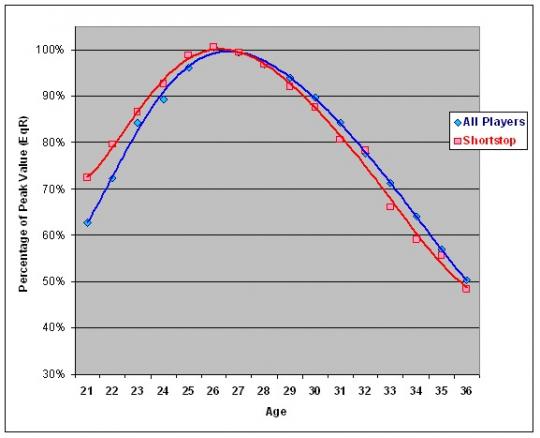
A graph from an aging study done by Baseball Prospectus in 2005. Shortstops peak earlier and decline earlier. Overall, all players should be expected to decline significantly from ages 31 to 34. Drew is not an exception.
-
As Sano, Buxton, Arcia and Rosario get to their mid 20s, the Twins need to position themselves to be competitive, they need the payroll flexibility to sign players to fill in the gaps. I don't think the window for that group opens before 2016. There is a reasonable likelihood that Drew will be a liability at SS at that time. The is a chance that Santana will be an asset. He won't get that chance if Drew has a long term contract. I think most teams that are interested in Drew don't want to go beyond two years. The Twins should be in a similar position.
-
All teams should consider the following as they measure Drew's value over time. I am assuming all teams interested are concerned about the third or fourth year. They must not use last year's data to project next year's data. The sample size necessary for projection needs to be larger. They certainly can't use any split of season or playoff data. Most projection systems use 3-4 years of data depending on player'sage. They must study a large group of previous 30 year old shortstops and pay attention to the defensive decline over time. They should plan for the offense to decline, but will the decline in defense at SS be greater? What is the likelihood that he will have to move away from SS in year 2,3 or 4? How much can they can expect an OPS+ projected for the low 90s next year to decline? How have other players aged with similar health issues? Have they had any impact or recurrence? Will the team be in a better position to compete in 2014 or 2016? If it is 2014, they might go for it now and suffer the decline later. Of course there are no guarantees. There are only likelihoods. A healthy average SS with an OPS of 90 and average defense will not be a liability to the team in 2016. Is that a reasonable projection? I think there are several teams that don't think so.
-
The Red Sox will likely find someone to make a deal. They may only get offers of other players in the similar position of being out of options on the fringe of a roster. Should the a Twins offer Worley, Diamond or Deduno? Escobar? I wouldn't. They have enough depth at reliever. As teams make roster moves in the spring getting to the 25 man roster, I can envision one of the pitchers going for an out of options 4th OF/CF.
-
Radcliffe is probably the only scout to make a mistake on a player. Certainly worth distracting from the BAA article. 2wins87- Thanks for the link. It will be interesting following him. The Twins don't appear to have many great defenders at SS in the system. Goodrum? Santana?
-
Viola and Radke didn't produce for two years. They kept getting opportunities and paid off. If the Twins believe in their talent, Gibson and Meyer must get a long look. They need them to be part of a core they can count on by 2016. It might take 50 starts.
-
Meyer and Gibson need significant starts this year. The key to sustained success will bed eloping their own team control pitching. Those two are the best bets to be significant mid or even top of the rotation pitchers in 2016. May, Worley and Diamond might also contribute from the back end. The Twins need to develop three pitchers to hopefully join Nolasco and Hughes. The best hope for Correia is to trade him early in the year or before the season. If he pitches poorly, they should not hesitate to release him. The twins won't release Pelfrey. The absolute worst case is that he pitches at a mediocre back of the rotation level for two years taking starts away from pitchers with upside. The best case is that he has the luck of BABIP and had good numbers to make him appear more valuable in a trade is summer. If Meyer and Gibson combine for more starts than Pelfrey and Correia, it will be the first step taken in the transition.
-
At some point the Twins need to stick with young players who have shown success in AAA and give them a long extended shot in spite of struggle. It is the only way to develop team control talent. Without that talent they will be stuck in a cycle of mediocrity. The signing of Pelfrey and Kubel point to a team trying to a team trying to squeeze out as man wins this year as possible at the cost of developing the future. Trading Doumit and replacing him with Kubel is a wash. It can take two full seasons of consistent regular playing time (1000 plate appearances, 50 starts) to start to realize he potential as players adjust to the major leagues. Will a Gibson get that chance or will he bounce back and forth like Hendriks? Will Arcia get that chance or will Kubel eat into his at bats as Doumit did Parmelee? It is easy to see the transition the a Twins made in their last two successful runs. You can see it in the roster turn over of 1999-2000 and the early 80s. They gave playing time to young players and let them struggle. Maybe the a Twins can do both. Compete and develop a core of young players. That wasn't the road they took developing the core for their previous two runs of successful season.
-
The Twins should not be concerned about the pick or the money. They should be concerned about the years. A liability at this key position in 2016 with a large contract must be avoided. For the Twins whose key talent will be approaching mid 20s in 2016, a two year deal for Drew is necessary. Teams with a real shot at 90+ wins this year absolutely should risk the liability at the end of the contract. Florimon's defense is a reasonable stop gap until they find a long term solution.
-
None of these guys have salaries that will prevent the Twins from releasing them when a clearly better solution presents itself. It is on them to play well or be pushed out.
-
Santana needs to be in AAA. There isn't a great fit at AA but that should not hold back Santana.
-
The Twins Considering a Shift in Strategy
jorgenswest commented on Parker Hageman's blog entry in Over the Baggy
Great stuff Parker -
I think Gagne had an OPS+ of 52 through the time given time frame and 74 through his first 876 plate appearances. Ozzie had a 48 his second season. His comparisons seem fair, but the difference in age will make it difficult for Florimon to grow his bat over time. As the Twins try to develop young hitters, it is critical they give them a long sustained opportunity through their struggle. Two years of regular consistent at bats (or starts for a pitcher) is necessary. Very few hitters come up to the majors ready to hit major league pitching. Plus defenders can grow towards an adequate hitter over time. It reall takes good scouting to see the potential and patience to wait out the struggle. I am not confident the Twins have either. They certainly have not had patience with Parmelee, but maybe their scouting led them to believe he does not have the potential. They had patience with Casilla over several years, but he never played full time. There investment did not pay off. Did they choose correctly between Florimon and Escobar? Will they have patience?
-

