SportsGuyDalton
-
Posts
13 -
Joined
-
Last visited
2 Followers


SportsGuyDalton's Achievements






-
 Fatbat reacted to a comment on a blog entry:
Not-So-Lucky Nick Gordon
Fatbat reacted to a comment on a blog entry:
Not-So-Lucky Nick Gordon
-
Minny505 reacted to a blog entry:
Not-So-Lucky Nick Gordon
-
 wornsmooth reacted to a blog entry:
Not-So-Lucky Nick Gordon
wornsmooth reacted to a blog entry:
Not-So-Lucky Nick Gordon
-
MGX reacted to a blog entry:
Not-So-Lucky Nick Gordon
-
Rik19753 reacted to a comment on a blog entry:
Not-So-Lucky Nick Gordon
-
Not-So-Lucky Nick Gordon
SportsGuyDalton commented on SportsGuyDalton's blog entry in SportsGuyDalton's Blog
Totally agree. All the stats you cite reinforce the case that demoting Gordon would be extremely short-sighted. I think it's important to separate process from results. It's easy to focus on the results because those are what show up in the daily box scores, but the team/fans need to realize that Gordon's process--low K rate, low swinging strike rate, continuing to hit the ball hard--is one of a good MLB player. I like to think the Twins' front office is smart enough to continue giving Gordon opportunities despite 1.5 unlucky months. -
SportsGuyDalton reacted to a comment on a blog entry:
Not-So-Lucky Nick Gordon
-
Rik19753 reacted to a blog entry:
Not-So-Lucky Nick Gordon
-
ashbury reacted to a comment on a blog entry:
Not-So-Lucky Nick Gordon
-
Not-So-Lucky Nick Gordon
SportsGuyDalton commented on SportsGuyDalton's blog entry in SportsGuyDalton's Blog
It's a Statcast metric! From MLB.com: Expected Batting Average (xBA) is a Statcast metric that measures the likelihood that a batted ball will become a hit. Each batted ball is assigned an xBA based on how often comparable balls — in terms of exit velocity, launch angle and, on certain types of batted balls, and sprint speed. For example, a line drive to the outfield with an xBA of .700 is given that figure because balls with a similar exit velocity and launch angle have become hits seven out of 10 times. -
SportsGuyDalton reacted to a post in a topic:
Is Bailey Ober Sustainable?
-
You probably tuned out of the second half of the 2022 Twins season. Given the team's terribly underwhelming results and the Bally Sports North TV debacle, there were better things to do than watch Twins baseball. While you were enjoying your summer, you missed Nick Gordon carrying the Twins’ offense, drilling line drives as a middle-of-the-order slugger. From July 1 onward, Gordon batted .281 with an OPS that was about 20% better than league average. In a disappointing season, Gordon’s offensive outburst was an exciting surprise. Unfortunately, Gordon’s hot bat went cold during the Minnesota winter. He enters Friday batting a measly .161 this season and has seen his OPS decline more than 200 points from last season. Why has Gordon struggled? Well, actually, he hasn’t. He has just been supremely unlucky. Gordon’s expected batting average (xBA) is .260 this year, nearly identical to his .261 xBA from a season ago. Among Twins hitters, Gordon’s season is a clear outlier in terms of luck. There’s a Metrodome-sized gap between his batting average and what you would expect based on his quality of contact. He has the lowest batting average on the team, but the second highest expected batting average! The -.099 differential is by far the widest among Twins position players with at least 20 at-bats. In fact, in terms of BA-xBA differential, Gordon is the second unluckiest batter in all of MLB (min. 50 PA). How do you break a curse of bad luck? The internet says to throw a pinch of salt over your left shoulder, burn some incense, or find a lucky charm. To be safe, Nick Gordon should toss a few handfuls of salt, invite all his friends to an incense bonfire, and drive to the nearest Amazon warehouse to buy out their lucky rabbit feet. Thankfully for Gordon and Twins fans, Gordon might have turned a corner in Chicago. He collected hits in all three games of the series, including his first two homeruns of the year (hard to get unlucky if you hit the ball over the fence!). Gordon continuing to barrel the ball will go a long way in helping a Twins offense that has been inconsistent this season. The numbers say it’s very likely that Gordon will begin to see the ball bounce his way. Over the course of a season, batting average and xBA almost always converge. Once a player reaches 100 at-bats in a season, their batting average and expected batting average are typically within .020 of one another. Nick Gordon’s -.099 differential won’t last forever. If you’d like to do your part as a fan, the Twins’ mailing address is 1 Twins Way Minneapolis, MN 55403. Send Nick Gordon your good luck charms.
-
Heiny reacted to a blog entry:
It's Now or Never for Rocco Baldelli
-
Karbo reacted to a blog entry:
It's Now or Never for Rocco Baldelli
-
SportsGuyDalton reacted to a comment on a blog entry:
A Look at Depth: First Base
-
SportsGuyDalton reacted to a comment on a blog entry:
A Look at Depth: First Base
-
NotAboutWinning reacted to a blog entry:
It's Now or Never for Rocco Baldelli
-
SportsGuyDalton reacted to a comment on a blog entry:
It's Now or Never for Rocco Baldelli
-
SportsGuyDalton reacted to a comment on a blog entry:
It's Now or Never for Rocco Baldelli
-
SportsGuyDalton reacted to a comment on a blog entry:
It's Now or Never for Rocco Baldelli
-
SportsGuyDalton reacted to a blog entry:
My bags are packed, I'm ready to go...
-
Rocco Baldelli has been a polarizing figure in Twins Territory since his 2019 managerial debut. His new-school, analytics-forward approach led the Twins to back-to-back AL Central crowns in Baldelli’s first two seasons at the helm. Since then, the Twins have disappointed with consecutive sub-.500 seasons, including a last place finish in the 2021 AL Central. Entering his fifth season as manager, Baldelli needs to demonstrate that he is a source of success, not an obstacle that Twins players need to overcome. Why is the jury still out on Rocco? Let’s argue both sides of his case. (Rah-Rah Rocco) Supporters might say… Baldelli debuted in 2019 by taking over a team that went 78-84 a year earlier and immediately winning 101 games, overseeing the franchise’s first 100-win season since 1965. This feat won him AL Manager of the Year. For his second act, Rocco skillfully handled the extreme roster flux of the Covid-shortened 2020 season to repeat as AL Central champs. Modern baseball favors data-savvy franchises, and Baldelli is the quintessential modern manager. He began his coaching career with the Tampa Bay Rays, getting an inside look at the small-market franchise best at using analytics to squeeze extra wins out of every dollar they spend. The Twins’ payroll will always be middling; they need a manager who knows how to leverage the troves of data at their disposal. Baldelli embraces data and uses analytics to optimize his players’ probabilities of success, even if that sometimes means pulling his starting pitcher after four or five effective innings. Next point: Twins players like playing for Rocco. He’s a relatable 41-year-old former player who keeps things light in the clubhouse. Manager-player chemistry isn’t insignificant. Last year’s White Sox showed how a rift between manager and players can create an on-field disaster. Byron Buxton has blossomed under Rocco, who lets Buck swing freely and tap into his extraordinary athleticism. Meanwhile, after one year under Baldelli, Carlos Correa re-signed with the club knowing Baldelli would be leading the team going forward. During his two losing seasons, Baldelli was tormented by injuries. In 2021, Twins players missed more games due to injury than any other team in the AL Central (see the data here). And last season, the Twins were the most injury-plagued team in MLB, missing out on 10.06 wins due to injury, according to this analysis. Rocco was forced to regularly trot out lineups featuring the likes of Rob Refsnyder, Jake Cave, Gilberto Celestino, and other backups while his team sputtered. It’s not the manager’s fault when they don’t have any good buttons to press. Rocco Baldelli ranks 10th in managerial wins in Twins/Senators franchise history. If he wins 91 games this season, Baldelli would vault himself up to 6th place all time. (Boo Baldelli) Haters might say… Ah yes, 2019, the glorious year of the hyperbouncy baseball and the Bomba Squad. If you hired a squirrel to be an MLB manager and its team set an MLB record by hitting 307 homeruns in 162 games, the squirrel would probably have a division championship on its managerial resume. Baldelli deserves little credit for the Twins’ 2019 AL Central crown. Sure, Rocco followed up 2019 with another division title in 2020, but are we certain that a 60-game MLB season packed with Covid-list absences means anything in the big picture? And Baldelli is 0-5 in the playoffs, after all! In the post-2020 world, Baldelli’s teams have consistently underperformed. Twins ownership is spending more money than ever before, only to be rewarded with two losing seasons. Baldelli’s offenses never bunt or steal to stimulate run-scoring, despite mediocre offensive numbers. The Twins ranked 14th and 17th in runs scored in 2021 and 2022, respectively. And Baldelli’s knack for prematurely pulling starting pitchers hasn’t paid off either, with his pitching staffs finishing 26th and 19th in ERA during those two seasons. His overreliance on underperforming veteran relievers has cost the team wins. It’s impossible to forget Alex Colomé blowing save after save to start the 2021 season. More recently, Emilio Pagán has filled the role of overused bullpen punching bag. Baldelli’s in-game pitching management clearly rubs some players the wrong way. Earlier this week Sonny Gray effectively called out Baldelli, saying this year’s starting staff won’t take kindly to being yanked early. An MLB manager should subtly complement their roster like a fine wine accents a good meal. Instead, Baldelli is a pungent sauce that smothers everything on its plate. It’s time for a verdict. Personally, I’m conflicted about Baldelli. I support using analytics to supplement decision making and I value his management style. He’s data-savvy with good vibes, but his in-game tactics seem to consistently backfire. Barring a World Series title, Baldelli will continue to have his detractors; however, a successful 2023 season would do a lot to lend him legitimacy as Twins manager. If the Twins instead miss the playoffs for a third straight season, Baldelli’s tenure in Minnesota will probably come to an end. Bottom line, Baldelli is out of excuses. The Twins have two bona fide stars in Buxton and Correa. The front office built a pitching rotation that is at least six deep, and the Twins’ bench is full of starting-caliber position players. Heading into the 2023 season, Baldelli’s control panel has more buttons, levers, and switches than ever before. If he is indeed the man for the job, Baldelli needs to prove that he can press the buttons, pull the levers, and flip the switches that spur his team to a postseason berth (and a freaking playoff win!!). It’s go time, Rocco.
-
SportsGuyDalton reacted to a comment on a blog entry:
Spring Training Winners and Losers
-
SportsGuyDalton reacted to a comment on a blog entry:
Spring Training Winners and Losers
-
After a long, harsh Minnesota winter, Spring Training offers and a glimpse of green grass and the hope of a successful Twins season. The Twins’ time in Florida is like any trip to the Sunshine State—some visitors leave with a golden tan, others depart with bad sunburn. As the team prepares to head north, here are my winners and losers from the Twins’ Spring Training. Let’s start with the guys who got burned. Losers 1. Kenta Maeda Spring Training stats should never weigh heavily in player evaluations, but when a veteran pitcher like Maeda returns from 19 months of Tommy John rehab, his performance will be scrutinized. Despite a solid outing today, Maeda’s spring has been mediocre. He has posted a 4.91 ERA in 14.2 innings, issuing 10 walks, striking out 14 batters, and showing inconsistent fastball velocity. These numbers aren’t awful, yet with Bailey Ober, Louie Varland, and Simeon Woods-Richardson all seeking a spot in the rotation, Maeda’s grasp of the fifth starter role grows looser. King Kenta will need to regain his pre-injury form quickly or risk being relegated to a diminished role. 2. Trevor Megill Megill’s arm talent is undeniable. His fastball consistently touches 100 MPH and advanced metrics show that his breaking pitches are competent. Unfortunately, the on-field results never seem to match the underlying metrics (much like his bullpen mate Emilio Pagán). Megill entered the spring with a shot at a bullpen role with the Twins, then struggled to a 10.80 ERA and 2.10 WHIP before being demoted to Triple-A on March 19. Twins fans will probably see Megill again this season as he will be one of top relief options available in St. Paul, yet it’s fair to wonder how many second chances Megill will receive. 3. Gilberto Celestino 2023 is the most important season of Gilberto Celestino’s career. That is a strange statement considering Celestino played 122 games with the Twins last season and will likely spend most of 2023 in Triple-A. However, given Celestino’s limited minor league experience (only 75 career games above High-A), this season at Triple-A is critical for his maturation as a player. The thumb injury Celestino suffered early in camp required surgery, putting his development plan on hold while he is out until late April. Missing one month isn’t catastrophic, but finger injuries can linger. If Celestino rushes back or suffers a setback, his long-term development will pay the price. Winners 1. Edouard Julien Despite all the praise that top prospect Brooks Lee garnered in Fort Myers, Julien is undoubtedly the Twins prospect whose stock has risen the most this spring. Across seven games with the Twins and four games with Team Canada in the World Baseball Classic, Julien is hitting .394 (13 for 33) with five homeruns and six walks. His advanced approach at the plate looks MLB-ready, mixing patience with power. The Twins’ infield depth and questions about Julien’s defensive home created a roster crunch that resulted in Julien being optioned to Triple-A on March 14, but Julien’s performance this spring shows that he is ready to contribute at Target Field. 2. Kyle Farmer Farmer’s solid Spring Training—an OPS of 1.052 and four homeruns—has flown under the radar as health questions about Alex Kiriloff, Jorge Polanco, and Jose Miranda have dominated Twins infield storylines. The 31-year-old Farmer is a six-year veteran, so a good month of March doesn’t change his projected upside, but he is a “winner” here because he will leave Fort Myers poised to parlay his hot bat into important at-bats for the Twins. His infield counterparts Polanco and Kirilloff are starting the season on the Injured List, meaning Farmer will play a critical role in the Twins’ early-season success. If Farmer keeps hitting, the Twins offense will get a massive boost and Farmer could become a valuable trade chip to fill an everyday role on another team. 3. The Twins Front Office There are plenty of valid questions about the Twins’ offseason moves. Will Joey Gallo rebound from his terrible 2022 season? And did the team need another left-handed hitting outfielder? How will the offense replace the bat-to-ball skills of Luis Arraez? etc. Regardless, one thing is clear this spring: this Twins roster is deep. Yes, Jorge Polanco and Alex Kiriloff are starting the season on the IL, however the Twins have starting-caliber replacements in Kyle Farmer, Donovan Solano, and Nick Gordon. Typically, exclusively DH-ing a Platinum Glove winner like Byron Buxton would wreck a team’s defense, but the Twins adding recent Gold Glove winners in Michael A. Taylor and Joey Gallo minimizes the defensive decline. And Bailey Ober, probably the odd man out of the Twins’ early-season starting rotation, has yet to allow a run this spring and continues to look like a fourth starter in a competent MLB rotation. Not to mention the prospect reinforcements waiting at Triple-A. All said, Spring Training has shown that this front office deserves credit for building the deepest Twins roster in recent memory. ... Thanks for reading! I'm interested to hear your thoughts and your winners/losers of the spring.
- 23 comments
-
- 18
-
-
Twins Tidbit: Luis Arraez is a Unicorn
SportsGuyDalton replied to TwinsData's topic in Twins Daily Front Page News
Arraez' bat control is next level. Even when he swings at a pitch outside the zone, he makes contact 90.2% of the time. Best in MLB by a 5% margin. What a joy to watch. -
What Would it Take to be Average?
SportsGuyDalton commented on SportsGuyDalton's blog entry in SportsGuyDalton's Blog
Yes this is good to point out! Thanks! Buxton kind of screws up the rest of season projections because he already has so many more HRs than the "average" season. I didn't explicitly make sure OPS matched at the end of the season. Instead, I had each player end the season with as many at-bats, walks/HBP, singles, doubles, triples, and HRs as their "average" season (I only showed some of the projected stats in the table to keep the table size reasonable), then calculated AVG, SLG, and OPS from those numbers. If a player ends the season with the exact statline of the "average" season, the OPS calculations work out. In Buxton's case, he is going to have a better season than the "average" because he would finish the season with as many singles, doubles, and triples as the average season but more HRs because he can't hit -10 HRs the rest of the way, so his final OPS would be higher. So you're totally right, the Buxton OPS number is not exactly what he needs for reach the "average" season (I think Arraez' remaining OPS might be slightly off too, since he has more than 4 HRs). The .907 OPS could be interpreted as the OPS Buxton needs to reach the number of singles/doubles/triples for his "average" season, assuming he hits 0 HRs the rest of the way. -
As we near the final quarter of the MLB season, it’s a good time to take stock of Twins hitters’ performance this season. To gauge which Twins hitters are having good seasons, I will compare each hitter’s 2022 numbers to their "average" season, then calculate how each player needs to perform for the remainder of 2022 to reach their average statline. In other words, what would it take for each player to have their average season? This approach has its flaws and doesn’t work for rookies, but it’s a fun thought exercise. This post is a little math-heavy -- I'll lay out some simple examples along the way. Let’s give it a go. First, I calculate what an "average" 2022 season would be for each player. I start by estimating the number of games each player will play this season based on the share of games they have played to this point. For example, if a player has played 2/3 of all games so far, I estimate they will play 2/3 of the remaining games for a total of 108 games played (2/3 of 162) . Then, using this final 2022 games-played number, I calculate how Twins batters would perform in the full 2022 season based only on their 162-game career averages from before this season. For example, if a player hit 30 doubles per 162 games before 2022 and is projected to play 2/3 of all games in 2022, their "average" 2022 season would include 108 games played and 20 doubles (2/3 of 30). To assess whether a player is performing well or poorly in 2022, I compare their “average” season (above) to their real 2022 statistics, and calculate how each player would need to perform for the rest of the season in order to finish with their average season statline. For example, Gio Urshela's average projections estimate he will hit 14 homeruns in 2022; he currently has 11 homeruns, meaning he needs to hit 3 more before the season ends to have an average season. This helps us gauge performance because, if a player needs to finish the year hitting like prime Barry Bonds to have their average season, that’s an indication they have had a rough season so far. Conversely, a player is probably having a good season if they can reach their career averages by hitting like a slumping Nick Punto for the final month and a half. The table below shows how each batter would need to perform in the final quarter of the season to finish 2022 with their "average" statline. The red boxes highlight areas where players have a lot of work left to do. Green highlights areas where players are in good shape. It’s immediately clear that Gary Sanchez and Max Kepler are unlikely to reach their career averages. I'm not holding my breath for them to combine for 33 homeruns and an OPS around 1.000 in the team's final 46 games. Carlos Correa has been mildly underwhelming across the board in 2022, which is reflected by the hot stretch needed to achieve his average season. It’s not entirely out of the question for Correa to heat up and hit .290/.372/.626 with 9 homeruns the rest of the way, but it’s getting less likely by the day. Polanco and Buxton are interesting cases, posting homerun and walk numbers that blow away their career averages, but both players have sacrificed their batting averages to do so. I think Twins fans have mixed feelings about their approaches to hitting. Urshela has been solid all season, which shows in the mediocre numbers he needs to reach his career averages. And finally, clearly, Luis Arraez has been outstanding in 2022. He could probably hit .237 down the stretch with one arm tied behind his back. Thanks for reading!
-
Un-Clutch Correa (with a side of Garlick)
SportsGuyDalton posted a blog entry in SportsGuyDalton's Blog
Twins fans recently suffered through the offense’s 0-19 stretch with runners in scoring position (RISP) during the team’s road trip to Los Angeles. Such struggles have plagued Twins hitters all season, as their .712 OPS with RISP rank 22nd in MLB and their .249 batting average with RISP ranks 20th. Carlos Correa has been the primary underperformer in these big moments this year. His .618 OPS with RISP ranks 11th among Twins hitters with 30+ at-bats with RISP. This lack of production has contributed to his -0.02 Win Probability Added this season, an abysmal (negative!) statistic for a multi-time All-Star earning $30 million. Stunningly, Correa has hit zero of his 14 homeruns this season with RISP. In fact, Correa’s 14 homeruns this season lead MLB among players yet to hit a homerun with RISP, with a comfortable cushion between Correa and his unfortunate peers (including teammate Kyle Garlick). MLB HR Leaders, Players with Zero HR with RISP: 1) Carlos Correa – 14 2) Darick Hall (PHI) – 9 T3) Kyle Garlick – 8 T3) Frank Schwindel (CHC) – 8 T3) Kolten Wong (MIL) – 8 T3) Brandon Belt (SF) – 8 Bad luck certainly plays a role in such a prolonged dry spell for a player of Correa’s caliber. Coming into this season, Correa had hit 33 of his 133 career homeruns with RISP, including 7 of his 26 homeruns last season. Given Correa’s reputation as a clutch performer and career .812 OPS with RISP—nearly 200 points better than his 2022 number—it’s only a matter of time before he hits a homerun with RISP and removes himself from the leaderboard. Even so, Correa will need to get red-hot down the stretch to finish the season with offensive numbers worth his hefty price tag. Here's to hoping Correa heats up soon and helps the Twins clinch another AL Central crown. -
In another sparkling outing last night, Jhoan Duran showcased everything that makes him special. Most notably, his triple-digits fastball. Duran threw only ten pitches last night, including five fastballs. All five exceeded 100 MPH. It’s becoming easy to take Duran’s electric fastball for granted. His delivery looks effortless, yet his average fastball velocity leads the majors at 100.6 MPH. Here are a few charts to remind us exactly how extraordinary Duran’s velocity is. First, Duran is clearly the hardest thrower in Minnesota Twins history. His average fastball velocity is nearly two MPH faster than any other Twins pitcher since 2008 (which is the farthest back I could get data from Baseball Savant), and I can't remember any pre-2008 Twins pitchers lighting up radar guns like Duran. In terms of the sheer number of 100+ MPH pitches thrown, the gap between Duran and the field of Twins pitchers is comical. After last night, Duran has thrown 245 pitches over 100 MPH in his career. The next closest Twins pitcher (since 2008) is Jorge Alcala with just 15. Duran's smokes the rest of MLB too. This season alone, Duran gives most MLB Divisions a run for their money in terms of 100 MPH volume. If Jhoan Duran was his own MLB Division, that division would have thrown more 100+ MPH pitches than the AL East, AL West, and AL Central (minus Duran). The AL Duran pumps heat. The most impressive part of Duran’s velocity is that it doesn’t come at the expense of control. Among the 40 MLB pitchers this season with an average fastball velocity of at least 97 MPH and at least 10 innings pitched, Jhoan Duran’s 5.6% walk rate is fourth lowest. All hail Jhoan Duran.
-
3 Options for Josh Winder in the Second Half
SportsGuyDalton replied to Cody Christie's topic in Twins Daily Front Page News
I think Winder is due for some regression as teams get more opportunities to scout him. He's already had some good luck--his expected ERA(4.14) is a full run higher than his actual ERA (3.12)--and he doesn't have great stuff. I'd be ok if the Twins moved him to the bullpen to protect him. Help him succeed by only facing hitters once or twice per game, then let him be a full-time rotation piece next year. -
It's amazing to me that MLB teams repeatedly draft pitchers who spent 3+ years at a big D1 program and immediately add 5+ MPH to their fastballs just from some mechanical tweaks. With all the analytic/biomechanical information available these days, I'd think D1 programs would be closer to MLB teams in terms of maximizing a player's potential. Good for the Twins though -- I'm excited to follow Povich.
-
Game Thread: Twins @ White Sox, 7/6/22 @ 1:10PM CT
SportsGuyDalton replied to twinssporto's topic in Archived Game Threads
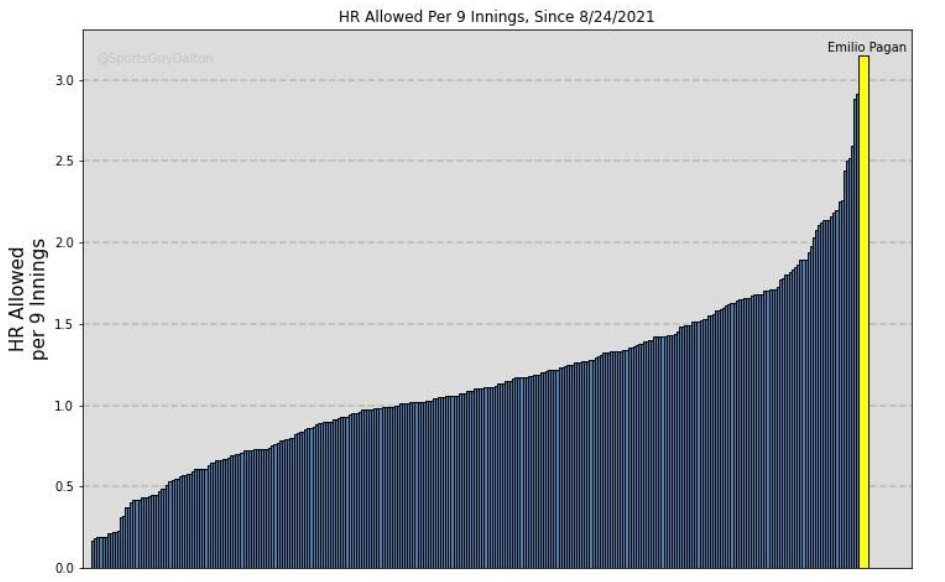
And Pagan keeps getting crushed. He has given up HRs at a higher rate than any pitcher in MLB since last August (minimum 40 IP.). I've lost all hope that he will right the ship this season.