



Otto von Ballpark
-
Posts
20,669 -
Joined
-
Last visited
-
Days Won
74
Content Type
Profiles
Minnesota Twins News, Rumors & Analysis
Minnesota Twins Videos
2026 Minnesota Twins Top Prospect Rankings
2022 Minnesota Twins Draft Picks & Signing Bonuses
Minnesota Twins Trade & Free Agent Rumors
Minnesota Twins Fan Guides & Resources
2023 Minnesota Twins Draft Picks & Signing Bonuses
The Minnesota Twins Players Project
2024 Minnesota Twins Draft Picks & Signing Bonuses
2025 Minnesota Twins Draft Picks & Signing Bonuses
2026 Minnesota Twins Draft Picks & Signing Bonuses
Forums
Blogs
Events
Store
Downloads
Gallery
Everything posted by Otto von Ballpark
-
 I'm just saying, it might be a more accurate comparison than just Maeda vs Ryu and their contracts alone.
-
What others are saying about the trade
Otto von Ballpark replied to gunnarthor's topic in Minnesota Twins Talk
ZiPS doesn't really have Maeda as "MUCH better this year", though. The difference seems to be almost entirely in their role. And while the Twins were looking to begin Graterol's season in the pen, they didn't necessarily have to (or have to keep him there all season). And a rounding error after this year would seem to favor the younger, cheaper, more controlled player, correct? Again, I'm not opposed to the deal. And it should be interesting to watch unfold! -
What others are saying about the trade
Otto von Ballpark replied to gunnarthor's topic in Minnesota Twins Talk
True, but ZiPS has Graterol ahead of Maeda as early as next year. (And this year, he's only behind because it has him in a pen role -- which might happen, although 45 innings could be a conservative estimate!) -
What others are saying about the trade
Otto von Ballpark replied to gunnarthor's topic in Minnesota Twins Talk
That was only after some Twins fans jumped on their boards and said, "How do you like THEM apples?!" -
What others are saying about the trade
Otto von Ballpark replied to gunnarthor's topic in Minnesota Twins Talk
Maeda's career PPFp is only 97.3, which is lower than average but not nearly as extreme as Lynn and Minor in 2019 (both in 109-110 range). The Mets starters all had lower PPFp marks in 2019 than Maeda, as did Bumgarner, as did Kershaw, etc. It might be equal parts park factor and defense which held back Maeda's bWAR compared to fWAR. (And both might be valid questions about Maeda coming over to the Twins.) Average per season in his career: 1.3 bWAR, 2.4 fWAR. Definitely a difference, although both could be in a similar class of pitcher. (FWIW, those bWAR/fWAR averages, on a per-inning basis, are pretty close to Ricky Nolasco's in the 4 years leading up to his Twins contract...) Edit to add: some evidence that Maeda is a bigger beneficiary of Dodger Stadium than most, he has the largest home/road ERA differential of any Dodger starter from 2016-2019 (min. 50 innings in each split) Home: https://www.fangraphs.com/leaders/splits-leaderboards?splitArr=9,184&splitArrPitch=&position=P&autoPt=true&splitTeams=false&statType=player&statgroup=1&startDate=2016-03-01&endDate=2019-11-01&players=&filter=&sort=5,-1 Road: https://www.fangraphs.com/leaders/splits-leaderboards?splitArr=184,10&splitArrPitch=&position=P&autoPt=true&splitTeams=false&statType=player&statgroup=1&startDate=2016-03-01&endDate=2019-11-01&players=&filter=&sort=5,-1 -
What others are saying about the trade
Otto von Ballpark replied to gunnarthor's topic in Minnesota Twins Talk
I wouldn't say that, in modern MLB. A single option isn't necessarily tied to performance at all. (Especially in an innings control situation like Graterol.) Boston could option Graterol out of spring training to limit his innings, and call him up on May 9th (around the same time Pineda is activated) and he only misses a quarter of the season and they get an entire extra year of control. (Admittedly it's more valuable for a young position players, as pitchers are harder to project.) -
Twins are 3rd team in Betts trade
Otto von Ballpark replied to Andrew610i3's topic in Minnesota Twins Talk
Graterol seems more likely to be the De Leon in this equation, though. -
Twins are 3rd team in Betts trade
Otto von Ballpark replied to Andrew610i3's topic in Minnesota Twins Talk
Sure, but I also think it's fair for fans to question whether we should be sacrificing upside for less worst-case financial risk. (And it's not like the financial risk of Ryu is that great -- it's not much more than we gave Nolasco, Ervin, or Hughes if you account for baseball salary inflation.) And of course, the player with the absolute lowest financial risk in this discussion is the player we just sent away (Graterol). Keeping him, alongside Ryu, and on balance your risk may be no worse than having Maeda alone. (Although it's more complicated than that of course, with Donaldson's contract etc.) -
He did say "sustained" ERA which seems to imply he was looking for more than just random 1 year "aces". (A 3.48 ERA in Dodger Stadium for one year isn't particularly ace-like -- Alex Wood and Ross Stripling have achieved better than that in recent years too.) Also, in that 2016 postseason -- Maeda's only postseason as a starter -- he gave up 12 hits, 9 walks + HBP, and 8 runs in 10.2 innings across 3 starts. Which sort of diminishes his regular season, and likely contributed to why the Dodgers were willing to shift him from the rotation in 2017-2019.
-
Verlander has won 14 playoff games. (He hasn't won any World Series games, although his team has won 1 and he's pitched well enough to win a few times, even if he did have a pair of clunkers with Detroit.) 8-1 in the division series which the Twins could sorely use!
-
Couldn't that just as well be used as an argument against trading Graterol for Maeda? Did we have to give up Graterol for another above-average player who may or may not get hot at the right time? And of course, Garza was 24 years old and Freese 28, both basically in their second MLB seasons, when they achieved their primary postseason success. Does that suggest Maeda has the greater chance at postseason glory going forward?
-
I know park factors aren't exact science, but they do contain adjustments for these factors. Don't get me wrong -- the Dodgers have had good pitching staffs, better than those of the Twins. But the point of these park factors wasn't to suggest they are equal -- it's just that the stadiums are likely stretching the difference further.
- 298 replies
-
- 1
-

-
- kenta maeda
- brusdar graterol
- (and 2 more)
-
I'm not so sure. Above average starter is, what, 2-2.5 WAR? That's about where Maeda is now. Do we discount that for age? And he'll probably be getting ~$10 mil salary to do that, after incentives. Seems like we've been seeing that kind of cost/performance in modest trade and FA moves (Odorizzi, Pineda, potentially Gibson?) without giving up a ~$20 mil asset like Graterol for the privilege. And a quality, well-leveraged reliever, even a 1-inning one, can put up 1-2 WAR without too much trouble. Relievers are generally more replaceable than starters, but there's good value in that kind of relief performance at league minimum salary.
- 298 replies
-
- 1
-
-
- kenta maeda
- brusdar graterol
- (and 2 more)
-
What others are saying about the trade
Otto von Ballpark replied to gunnarthor's topic in Minnesota Twins Talk
FWIW, it could be more like 6.5 years for Graterol, if they use his minor league options. (And every pre-arb player is effectively on an even more extreme "incentive" type contract than Maeda.) And as you are probably alluding to, Maeda's projected performance at age 35 may not be that much more "known" today than Graterol's next few years. -
What others are saying about the trade
Otto von Ballpark replied to gunnarthor's topic in Minnesota Twins Talk
Dan Szymborski at Fangraphs with what sounds like a tepid endorsement: But his multi-year ZiPS projections at the bottom of the article don't look too favorably upon the Twins in this deal (although multi-year ZiPS projections are probably more fun than accurate, especially with a wild card like Graterol). https://blogs.fangraphs.com/instagraphs/dodgers-snag-betts-in-three-way-blockbuster/ -
What others are saying about the trade
Otto von Ballpark replied to gunnarthor's topic in Minnesota Twins Talk
Worth noting that Keith Law was notoriously down on Graterol even prior to 2019: http://twinsdaily.com/topic/32158-keith-law-top-100-no-love-for-graterol/ -
Also, in regards to Maeda's contract and bullpen usage -- keep in mind why he was on that unusual contract to begin with: He was projected to get a 5/60 deal that winter by MLBTR, and only ended up with a 8/25 guarantee! His usage by the Dodgers is pretty consistent with both his performance and that health concern, it seems.
-
Maeda's a good pitcher, but this might be exaggerated a bit by park factors and defense. Per ESPN, Dodger stadium has averaged in the bottom third for "hits" park factors the past 4 years (as compared to Target Field, which has averaged top third over that time). http://www.espn.com/mlb/stats/parkfactor/_/year/2016/sort/hitsFactor And B-Ref has given Dodgers pitchers a boost from RA9def ("support from defense") over that time too (as compared to Twins pitchers who have been more neutral or negative in that mark).
- 298 replies
-
- 1
-
-
- kenta maeda
- brusdar graterol
- (and 2 more)
-
I think his postseason usage is the clincher here. They used him exclusively as a reliever (and primarily a 1-inning reliever) in the 2017-2019 postseasons, when his contract incentives were 100% irrelevant. That tells me it was far more of a baseball decision than a financial one. Keep in mind, while you or I may think "money is money, why not save it", money alone is of very little concern for the Dodgers -- their revenues can support all kinds of player spending. What's more important is 1) winning a World Series, and 2) what luxury tax bracket they end up in. And they had a lot more ways to address their luxury tax bracket than holding back Maeda, especially if they felt it compromised their World Series goal at all.
-
Twins are 3rd team in Betts trade
Otto von Ballpark replied to Andrew610i3's topic in Minnesota Twins Talk
Maeda will get enough of a leash, especially the first year or two, that he's virtually guaranteed some of those incentives, so the cash difference is less than that. And of course, we lose Graterol's current value, which essentially adds ~$20+ mil to Maeda's overall cost even if Graterol doesn't pan out. (Ryu didn't even cost a draft pick.) There's also the upside element. Ryu just completed a 4.8/5.1 fWAR/bWAR season, while Maeda's best so far is 2.9. Maeda's definitely cheaper, but it's because he seems to come with less upside. Edit to add: not that I'm arguing for Ryu over Maeda, but the cost difference between them seems fair. We essentially used a prospect to save money, and further perhaps traded some upside for less financial risk. -
Twins are 3rd team in Betts trade
Otto von Ballpark replied to Andrew610i3's topic in Minnesota Twins Talk
I'm not so sure. Maeda ranked last in ERA among the Dodgers top 7-9 starters (by GS) each year from 2017-2019. And his potential incentives were irrelevant to their tax bracket in 2017, at least (not so sure in 2018-2019, although there are a lot of other factors involved too). The fact that they kept him in the pen for the postseason those 3 years, when his contract incentives no longer mattered, suggests it was a baseball decision much more than a financial one. -
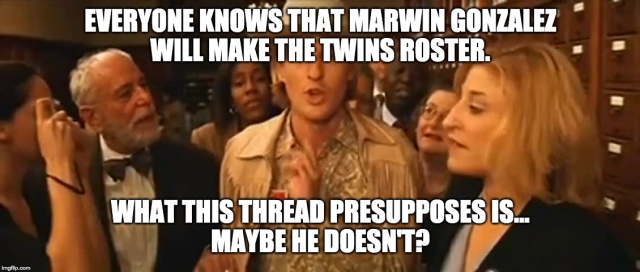
Is Marwin Gonzalez a lock to make the roster?
Otto von Ballpark replied to jorgenswest's topic in Minnesota Twins Talk
-
He's speechless!
-
I'm not sure I understand. You say it was absolutely due to money, but then you cite depth -- it appears the Dodgers absolutely had a depth reason for holding back Maeda. He ranked last in ERA among their top 7-9 starters (by GS) each season from 2017-2019, the 3 years they have shifted him to the pen. Seems like depth was a much bigger reason than money (especially considering Maeda's incentives would have been irrelevant to their luxury tax bracket for 2017, at least).
