



Nick Nelson
-
Posts
8,326 -
Joined
-
Last visited
-
Days Won
56
Content Type
Profiles
News
Minnesota Twins Videos
2026 Minnesota Twins Top Prospects Ranking
2022 Minnesota Twins Draft Picks
Minnesota Twins Free Agent & Trade Rumors, Notes, & Tidbits
Guides & Resources
2023 Minnesota Twins Draft Picks
The Minnesota Twins Players Project
2024 Minnesota Twins Draft Picks
2025 Minnesota Twins Draft Pick Tracker
2026 Minnesota Twins Draft Tracker: Picks & Bonuses
Forums
Blogs
Events
Store
Downloads
Gallery
Everything posted by Nick Nelson
-
Earlier this week, we published reviews of all the position players on the 2016 Minnesota Twins. Even on a 103-loss club, numerous individuals received above-average grades, and that felt fitting for a respectable offensive unit that scored the most runs of any Minnesota team since 2010. Today we'll break down the rotation, where things were significantly less rosy.For our position player rundown, you can find infielders here and outfielders here. As we turn our gaze to starting pitching, the criteria will be at least five starts, and still in the organization. Off we go... Jose Berrios, RHP 2016 Stats: 58.1 IP, 3-7, 8.02 ERA, 49 K, 35 BB, 1.87 WHIP, 6.20 FIP Contract Status: Pre-arbitration, under team control for ~$550K in 2017 The stuff was there. You can say that much for Berrios in his rookie season. The overpowering potential of his pitches was on full display as he whipped lively 94 MPH fastballs and broke off diving offspeeds. That's the extent of positivity, though, and it's not even all that positive because the 22-year-old's electric arsenal was useless to him in practical terms. Whether it was nerves, mechanical issues, highly selective hitters, or some combination of all those things... he simply could not command any of his offerings. Berrios constantly fell behind in the count, leading to an endless barrage of walks, hits and home runs. He recorded only one quality start in 14 tries, and it met the lowest possible standard for the statistic (6 IP, 3 ER). Berrios has dominated every level of the minor leagues – including some eye-popping numbers at Triple-A – and was among the youngest players to throw a pitch in the majors this year. In the big picture, there isn't much reason for alarm. But there's no way around it: his rookie campaign was an unrelenting disaster. 2016 Grade: F 2017 Outlook: Berrios is certainly a wild-card in Minnesota's rotation plans. They need to at least tentatively carve out a rotation spot for him, because it makes little sense to send him back to Rochester unless he has a crummy spring. But given how he finished – completely out of sorts and bewildered – that's not exactly an unthinkable scenario. Tyler Duffey, RHP 2016 Stats: 133 IP, 9-12, 6.43 ERA, 114 K, 32 BB, 1.50 WHIP, 4.73 FIP Contract Status: Pre-arbitration, under team control for ~$550K in 2017 Arriving with gusto in the second half of 2015, Duffey was a huge bright spot down the stretch, delivering consistently sterling outings following a clunker debut in Toronto. Enthusiasm was tempered, though, as we wondered how long he could survive as a starter with a two-pitch repertoire. Opposing lineups, now more familiar with his limited attack plan, came better prepared this time around. Hitters increasingly laid off his curve and keyed on a completely unexceptional fastball. He spent most of the year in the big leagues but rarely strung together consecutive decent starts. His strikeout and walks rates weren't bad, but at the end of the day Duffey was simply too hittable. 2016 Grade: D- 2017 Outlook: Given his enduring ineffectiveness as a starter throughout the summer, it's inexplicable that the Twins didn't take a look at the former collegiate closer in the bullpen late in the year. Perhaps the new regime will have a different take on Duffey, who can undoubtedly be a weapon in some form. Kyle Gibson, RHP 2016 Stats: 147.1 IP, 11-11, 5.07 ERA, 104 K, 55 BB, 1.56 WHIP, 4.70 FIP Contract Status: Under contract for 2017 for ~$2.5M (arbitration estimate) The model for a competitive Twins team in 2016 was, in large part, reliant on Gibson and Ervin Santana being steady staples atop the rotation. One didn't hold up his end of the bargain. Gibson got off to a sluggish start, missed the entire month of May with a shoulder strain, and never put together any particularly strong stretches after returning. Did that injury, along with back and leg ailments he reported at various points, affect the righty on the mound? It sure looks that way. Gibson took a major step backward after steadily improving during his first three big-league seasons. He flashed diminished velocity on each of his pitches. His signature sinker lacked the requisite movement, contributing to a career-low 48.8 percent grounder rate and a career-high 20 home runs allowed. When he's on his game Gibson has the formula for reliably solid, if unspectacular pitching results. But his game was amiss this year. Like so many others on the Twins and around the world, the 29-year-old is no doubt eager to put 2016 behind him. 2016 Grade: D 2017 Outlook: He's earned enough cred within this organization that he'll have a fairly secure hold on a rotation spot even coming off a lackluster campaign. Unless his health continues to deteriorate, Gibson will surely be better next year. But how much better? Phil Hughes, RHP 2016 Stats: 59 IP, 1-7, 5.95 ERA, 34 K, 13 BB, 1.51 WHIP, 5.08 FIP Contract Status: Signed through 2019 for $39.6 million Gibson's 2016 campaign might have been sabotaged to some degree by physical setbacks, but he's got nothing on Hughes. It was evident during the previous season that Hughes' arm strength was dwindling, and unfortunately his focused winter regimen did nothing to stem the tide. Hughes was an elite control artist during his first two years in Minnesota, with an MLB-best 0.79 BB/9 rate. His ability to locate and stay in the zone has remained intact more or less, but this year, as the quality of his pitches continued to decline, his results followed suit. Batters teed off on lukewarm heaters and flat cutters. Many days, it was clear that a laboring Hughes was attempting to get by on nothing but guile and luck. In mid-May he pulled himself from his best performance of the season at 75 pitches, complaining of fatigue. It wasn't long afterward that the right-hander was shut down, subsequently undergoing thoracic outlet surgery. I do admire Hughes for toughing it out and taking the ball while his body betrayed him. It's just a shame that the coaching staff didn't take the decision out of his hands sooner, amidst the obvious reality that his bum shoulder was preventing him from being able to compete. Grade: F 2017 Outlook: By the time he reports for spring training in February. Hughes will be nearly eight months removed from his operation, which typically has a 4-6 month recovery timetable. He should be back to full strength; it's just unclear what full strength means for him at this point. The 30-year-old is in an ambiguous spot with a range of possible outcomes that spans from front-end starter (as he was in 2014) to relief pitcher to total non-factor. Ervin Santana, RHP 2016 Stats: 181.1 IP, 7-11, 3.38 ERA, 149 K, 53 BB, 1.22 WHIP, 3.81 FIP Contract Status: Signed through 2018 for $28 million Santana is a breath of fresh air on this list, and he certainly was that for the Twins rotation. It's difficult to imagine how unsightly this unit would have been if not for the welcome respite of Big Erv going every fifth day. While the pitching staff collapsed around him, Santana enjoyed one of the better seasons of his career, gobbling up quality innings from start to finish with a brief disabled stint in late April representing his only absence. The veteran righty was particularly excellent during the second half, posting a 2.43 ERA in the final three months while the club faded into oblivion. During that span, he allowed more than three earned runs only once in 16 starts. In a year where every other Twins starter brought his worst, Santana brought his best. Grade: B+ 2017 Outlook: He'll be the Opening Day starter without a doubt, barring an unlikely trade. We probably shouldn't expect a repeat of his peak 2016 performance but Santana can certainly be a mid-rotation stalwart on a good team. Hector Santiago, LHP 2016 Stats (w/ Twins): 61.1 IP, 5.58 ERA, 37 K, 22 BB, 1.42 WHIP, 5.82 FIP Contract Status: Under contract for 2017 for ~$8.0 million (arbitration estimate) While Santana was able to avoid the contagious ineptitude that struck the Twins rotation in 2016, another former Angel was not so lucky. Santiago was enjoying a solid season, and a highly impressive hot streak, when he was traded to Minnesota at the deadline. But when he went north, his numbers went south. Santiago's poor overall numbers with the Twins were largely the result of an outrageously bad first four starts, as he settled in with a 3.19 ERA over his final seven turns. But even then, his K/BB ratio was unimpressive and his success hardly convincing. Grade: D- 2017 Outlook: The Twins appear poised to run with Santiago in his final year of arbitration, even though the price tag will be quite high following such a poor showing. His track record merits another look and there's little reason to think the southpaw can't return to being a serviceable starter. Perhaps a good first half would generate trade interest at the deadline. Click here to view the article
- 39 replies
-
- 2
-

-
- ervin santana
- kyle gibson
- (and 3 more)
-
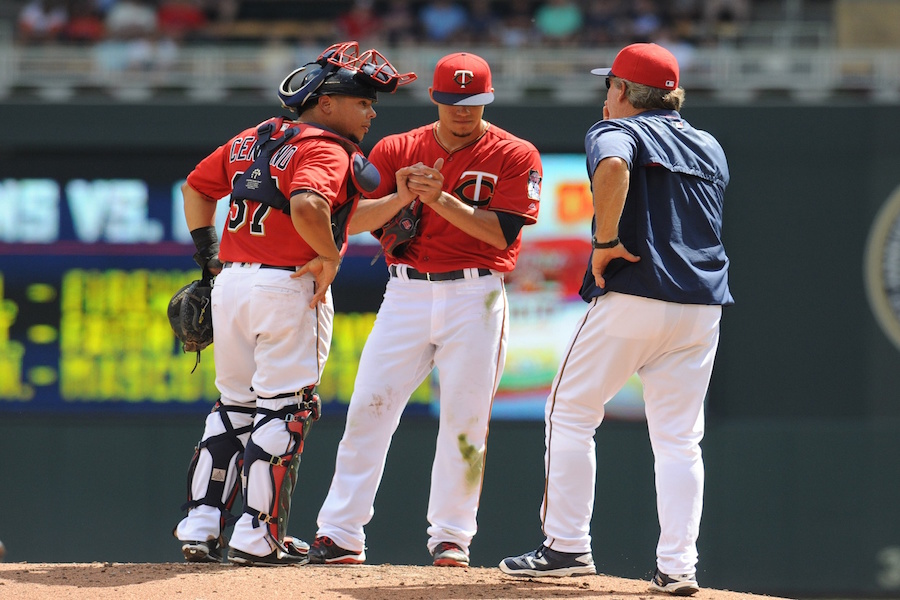 For our position player rundown, you can find infielders here and outfielders here. As we turn our gaze to starting pitching, the criteria will be at least five starts, and still in the organization. Off we go... Jose Berrios, RHP 2016 Stats: 58.1 IP, 3-7, 8.02 ERA, 49 K, 35 BB, 1.87 WHIP, 6.20 FIP Contract Status: Pre-arbitration, under team control for ~$550K in 2017 The stuff was there. You can say that much for Berrios in his rookie season. The overpowering potential of his pitches was on full display as he whipped lively 94 MPH fastballs and broke off diving offspeeds. That's the extent of positivity, though, and it's not even all that positive because the 22-year-old's electric arsenal was useless to him in practical terms. Whether it was nerves, mechanical issues, highly selective hitters, or some combination of all those things... he simply could not command any of his offerings. Berrios constantly fell behind in the count, leading to an endless barrage of walks, hits and home runs. He recorded only one quality start in 14 tries, and it met the lowest possible standard for the statistic (6 IP, 3 ER). Berrios has dominated every level of the minor leagues – including some eye-popping numbers at Triple-A – and was among the youngest players to throw a pitch in the majors this year. In the big picture, there isn't much reason for alarm. But there's no way around it: his rookie campaign was an unrelenting disaster. 2016 Grade: F 2017 Outlook: Berrios is certainly a wild-card in Minnesota's rotation plans. They need to at least tentatively carve out a rotation spot for him, because it makes little sense to send him back to Rochester unless he has a crummy spring. But given how he finished – completely out of sorts and bewildered – that's not exactly an unthinkable scenario. Tyler Duffey, RHP 2016 Stats: 133 IP, 9-12, 6.43 ERA, 114 K, 32 BB, 1.50 WHIP, 4.73 FIP Contract Status: Pre-arbitration, under team control for ~$550K in 2017 Arriving with gusto in the second half of 2015, Duffey was a huge bright spot down the stretch, delivering consistently sterling outings following a clunker debut in Toronto. Enthusiasm was tempered, though, as we wondered how long he could survive as a starter with a two-pitch repertoire. Opposing lineups, now more familiar with his limited attack plan, came better prepared this time around. Hitters increasingly laid off his curve and keyed on a completely unexceptional fastball. He spent most of the year in the big leagues but rarely strung together consecutive decent starts. His strikeout and walks rates weren't bad, but at the end of the day Duffey was simply too hittable. 2016 Grade: D- 2017 Outlook: Given his enduring ineffectiveness as a starter throughout the summer, it's inexplicable that the Twins didn't take a look at the former collegiate closer in the bullpen late in the year. Perhaps the new regime will have a different take on Duffey, who can undoubtedly be a weapon in some form. Kyle Gibson, RHP 2016 Stats: 147.1 IP, 11-11, 5.07 ERA, 104 K, 55 BB, 1.56 WHIP, 4.70 FIP Contract Status: Under contract for 2017 for ~$2.5M (arbitration estimate) The model for a competitive Twins team in 2016 was, in large part, reliant on Gibson and Ervin Santana being steady staples atop the rotation. One didn't hold up his end of the bargain. Gibson got off to a sluggish start, missed the entire month of May with a shoulder strain, and never put together any particularly strong stretches after returning. Did that injury, along with back and leg ailments he reported at various points, affect the righty on the mound? It sure looks that way. Gibson took a major step backward after steadily improving during his first three big-league seasons. He flashed diminished velocity on each of his pitches. His signature sinker lacked the requisite movement, contributing to a career-low 48.8 percent grounder rate and a career-high 20 home runs allowed. When he's on his game Gibson has the formula for reliably solid, if unspectacular pitching results. But his game was amiss this year. Like so many others on the Twins and around the world, the 29-year-old is no doubt eager to put 2016 behind him. 2016 Grade: D 2017 Outlook: He's earned enough cred within this organization that he'll have a fairly secure hold on a rotation spot even coming off a lackluster campaign. Unless his health continues to deteriorate, Gibson will surely be better next year. But how much better? Phil Hughes, RHP 2016 Stats: 59 IP, 1-7, 5.95 ERA, 34 K, 13 BB, 1.51 WHIP, 5.08 FIP Contract Status: Signed through 2019 for $39.6 million Gibson's 2016 campaign might have been sabotaged to some degree by physical setbacks, but he's got nothing on Hughes. It was evident during the previous season that Hughes' arm strength was dwindling, and unfortunately his focused winter regimen did nothing to stem the tide. Hughes was an elite control artist during his first two years in Minnesota, with an MLB-best 0.79 BB/9 rate. His ability to locate and stay in the zone has remained intact more or less, but this year, as the quality of his pitches continued to decline, his results followed suit. Batters teed off on lukewarm heaters and flat cutters. Many days, it was clear that a laboring Hughes was attempting to get by on nothing but guile and luck. In mid-May he pulled himself from his best performance of the season at 75 pitches, complaining of fatigue. It wasn't long afterward that the right-hander was shut down, subsequently undergoing thoracic outlet surgery. I do admire Hughes for toughing it out and taking the ball while his body betrayed him. It's just a shame that the coaching staff didn't take the decision out of his hands sooner, amidst the obvious reality that his bum shoulder was preventing him from being able to compete. Grade: F 2017 Outlook: By the time he reports for spring training in February. Hughes will be nearly eight months removed from his operation, which typically has a 4-6 month recovery timetable. He should be back to full strength; it's just unclear what full strength means for him at this point. The 30-year-old is in an ambiguous spot with a range of possible outcomes that spans from front-end starter (as he was in 2014) to relief pitcher to total non-factor. Ervin Santana, RHP 2016 Stats: 181.1 IP, 7-11, 3.38 ERA, 149 K, 53 BB, 1.22 WHIP, 3.81 FIP Contract Status: Signed through 2018 for $28 million Santana is a breath of fresh air on this list, and he certainly was that for the Twins rotation. It's difficult to imagine how unsightly this unit would have been if not for the welcome respite of Big Erv going every fifth day. While the pitching staff collapsed around him, Santana enjoyed one of the better seasons of his career, gobbling up quality innings from start to finish with a brief disabled stint in late April representing his only absence. The veteran righty was particularly excellent during the second half, posting a 2.43 ERA in the final three months while the club faded into oblivion. During that span, he allowed more than three earned runs only once in 16 starts. In a year where every other Twins starter brought his worst, Santana brought his best. Grade: B+ 2017 Outlook: He'll be the Opening Day starter without a doubt, barring an unlikely trade. We probably shouldn't expect a repeat of his peak 2016 performance but Santana can certainly be a mid-rotation stalwart on a good team. Hector Santiago, LHP 2016 Stats (w/ Twins): 61.1 IP, 5.58 ERA, 37 K, 22 BB, 1.42 WHIP, 5.82 FIP Contract Status: Under contract for 2017 for ~$8.0 million (arbitration estimate) While Santana was able to avoid the contagious ineptitude that struck the Twins rotation in 2016, another former Angel was not so lucky. Santiago was enjoying a solid season, and a highly impressive hot streak, when he was traded to Minnesota at the deadline. But when he went north, his numbers went south. Santiago's poor overall numbers with the Twins were largely the result of an outrageously bad first four starts, as he settled in with a 3.19 ERA over his final seven turns. But even then, his K/BB ratio was unimpressive and his success hardly convincing. Grade: D- 2017 Outlook: The Twins appear poised to run with Santiago in his final year of arbitration, even though the price tag will be quite high following such a poor showing. His track record merits another look and there's little reason to think the southpaw can't return to being a serviceable starter. Perhaps a good first half would generate trade interest at the deadline.
 -

Article: 2016 Report Cards: Outfield
Nick Nelson replied to Nick Nelson's topic in Twins Daily Front Page News
haha, hey I'm not denying it. I still confident it'll happen with Sano at some point. We'll treat the timetable on that prediction like Dave's 24-hour window for the Dozier trade...- 65 replies
-
- 2
-
-
- byron buxton
- eddie rosario
- (and 3 more)
-
Article: 2016 Report Cards: Outfield
Nick Nelson replied to Nick Nelson's topic in Twins Daily Front Page News
I'm less interested in what the overly optimistic local expectations were, and more concerned with what the objective outside expectations were. For instance, look at the ZiPS projections before this year. They pegged Buxton at .266/.310/.405. He met that .715 OPS almost exactly. I gave him a bump to the low B range because his defense was truly tremendous and his final month was off the charts. ZiPS had Kepler at .252/.310/.396. He exceeded his OPS projection by a healthy margin. I gave him bonus points for delivering some unforgettable single-game performances, and for the fact that he was able to accumulate 450 PA at all. The kid hadn't played a game above Double-A in the minors entering this year. -
Article: 2016 Report Cards: Outfield
Nick Nelson replied to Nick Nelson's topic in Twins Daily Front Page News
Well, expectations and context come into play to some extent. The standards are a little different here. Not a guy in this bunch had a season with 500 MLB plate appearances before this year. I don't think it'd be a very interesting exercise if I gave everyone D's because they fall very short of being Mike Trout.- 65 replies
-
- 4
-
-
- byron buxton
- eddie rosario
- (and 3 more)
-
Article: 2016 Report Cards: Infield
Nick Nelson replied to Nick Nelson's topic in Twins Daily Front Page News
It's mostly intended an assessment of the players' MLB performance, but also a review of their seasons as a whole. For instance, Buxton gets a slight boost for responding so well in Rochester when demoted (.927 OPS in two stints). Meanwhile, the reason Murphy only got 82 PA with the Twins is because he couldn't hit his way out of Triple-A all summer. So that factors into the bad grade and I don't know why it wouldn't.- 45 replies
-
- 2
-
-
- brian dozier
- joe mauer
- (and 3 more)
-
Article: 2016 Report Cards: Infield
Nick Nelson replied to Nick Nelson's topic in Twins Daily Front Page News
The cumulative GPA for outfielders and infielders equates to 2.08, which is slightly above a C. Seems about right to me for an offense that was roughly average and scored the most runs of any Twins team since 2010. Don't expect the pitching grades to be so kind- 45 replies
-
- 3
-
-
- brian dozier
- joe mauer
- (and 3 more)
-
Article: 2016 Report Cards: Outfield
Nick Nelson replied to Nick Nelson's topic in Twins Daily Front Page News
I'm just not sure why you're dubious over Buxton "performing well in a short period of time," but in the next breath you express zero concern over Kepler doing the same thing. Difference is that Buxton did so at a younger age while playing fantastic defense in center field, as opposed to so-so defense in RF. They graded out the same but if you're arguing that Kepler should have a higher mark I don't see it.- 65 replies
-
- 5
-
-
- byron buxton
- eddie rosario
- (and 3 more)
-
Yesterday, we graded out the 2016 Minnesota Twins infield. Today, we'll continue our player-by-player review with a breakdown of the outfield. This unit saw many significant developments this year, especially with young talents experiencing breakthroughs and setbacks.As with the infielders, our criteria for inclusion on this list are that the player made at least 50 plate appearances and remains on the roster as of now. Let's dig in. Byron Buxton, CF 2016 Stats: 331 PA, .225/.284/.430, 10 HR, 38 RBI, 44 R, 1.7 WAR Contract Status: Pre-arbitration, under team control for ~$550K in 2017 It took Buxton a little longer than we hoped to turn the corner, but he did so quite definitively late in the year. Following months of struggles, and multiple demotions to Triple-A, the 22-year-old caught fire upon returning in September, posting a .287/.357/.653 line with nine homers and 24 runs scored in 29 games. The torrid streak was profound enough to raise his overall numbers back to respectability by year's end. His final OPS of .714 – up more than 150 points from when he was recalled with five weeks to go – wasn't far off the league average for center fielders (.730) and came attached to elite, game-changing defense at a vital position. His contributions in the field were deemed valuable enough by FanGraphs that his 1.7 WAR ranked second on the team among position players, behind Brian Dozier. The prolonged slumps that forced him to spend stretches in Rochester (where he dominated) and the ghastly 36 percent strikeout rate cannot be ignored, so Buxton's grade gets dinged, but in the end it's hard to come away from his season with a negative view. 2016 Grade: B- 2017 Outlook: Buxton will be locked in as center fielder and seems likely to bat leadoff if he displays a good plate approach in spring training. Should he come anywhere close to picking up where he left off at the plate, he's a strong bet to be the best player on the team and one of the most valuable in the league. Robbie Grossman, LF 2016 Stats: 389 PA, .280/.386/.443, 11 HR, 37 RBI, 49 R, 0.7 WAR Contract Status: Pre-arbitration, under team control for ~$550K in 2017 In a generally tough year for the front office under Terry Ryan, uncovering Grossman goes down easily as one of the club's best strokes. To some extent it was just fortuitous circumstance; the outfielder had opted out of his minor-league deal with Cleveland in mid-May, around the same time Minnesota was desperately seeking outfield help with its youthful alignment scuffling badly. Still, Grossman was a good find and enjoyed a breakout year after joining up with the Twins. His production tailed off considerably following an initial tear, but he continued to draw walks and get on base even while his bat sagged, and he finished strong. Grossman ended the year with a .386 on-base percentage, which ranked 14th in the majors among players with 350-plus PA. His proclivity in this regard was much needed in a lineup that generally struggled to get aboard consistently. On the downside, Grossman's defense was not good. He made several misplays and showed stunningly little range for a guy who moves reasonably well. 2016 Grade: B 2017 Outlook: Grossman certainly has a strong case for a starting job. He was the best hitter on the team outside of Dozier, and his patience is a handy changeup within an aggressive, power-hitting lineup. However, his extremely poor defensive ratings will work against him with an analytically inclined front office that is emphasizing run prevention. Could he be a darkhorse for DH? Max Kepler, RF 2016 Stats: 447 PA, .235/.309/.424, 17 HR, 63 RBI, 52 R, 1.1 WAR Contract Status: Pre-arbitration, under team control for ~$550K in 2017 Recalled on June 1st after a scalding hot streak in Triple-A, it didn't take Kepler long to heat up again in the majors. During a dominant run that stretched from mid-June through mid-August, Kepler looked like a premier middle-of-the-order run producer, racking up extra-base hits and averaging nearly an RBI per contest. In one game he homered twice and drove in seven runs; in another he launched three bombs with six RBIs. They were among the most spectacular offensive performances we've seen from a Minnesota rookie. But the once red-hot 23-year-old finished his season encased in ice. Over his last 40 games he hit .197/.263/.276 as the quality of his at-bats deteriorated and his power dried up. In contrast to Buxton, it appeared that pitchers were figuring Kepler out rather than the other way around. The slide led to overall numbers that, while solid, were not special. 2016 Grade: B- 2017 Outlook: He's penciled in for right field, although one wonders how firm his hold is. Kepler blasted through Rochester in 30 games but the back half of his stint with the Twins leaves open the possibility that he needs a little more seasoning at Triple-A. The long-term view remains very optimistic. Eddie Rosario, LF 2016 Stats: 354 PA, .269/.295/.421, 10 HR, 32 RBI, 52 R, 0.9 WAR Contract Status: Pre-arbitration, under team control for ~$550K in 2017 An exciting rookie year led to speculation about what kind of impact Rosario might be capable of if he evolved and matured. Unfortunately, in his sophomore campaign, he did no such thing. Rosario was much the same player in 2016, with some frustrating habits lingering if not worsening. Whether in the batter's box, on the base paths or in the outfield, his aggressiveness often crossed into recklessness, much to the manager's aggravation. Along with the bad – blasting through stops signs, sailing throws aimlessly, striking out four times in several games – we saw the good. When he came back from his demotion he was mashing everything that came his way for two months. And aside from the all-too-frequent miscues he was a clear asset in left, combining center field range with right field arm strength. But the negatives were enough to offset the positives in an ultimately vexing year. 2016 Grade: C 2017 Outlook: He will be a corner outfield starter, unless he's a complete mess in camp. There's little hope for Rosario to develop any sort of meaningful selectiveness at the plate, so it's imperative that he lay off pitches nowhere near the zone while cutting down defensive mistakes. If he can do so, the 25-year-old certainly has plenty to offer. Danny Santana, CF 2016 Stats: 248 PA, .240/.279/.326, 2 HR, 14 RBI, 29 R, -0.7 WAR Contract Status: Pre-arbitration, under team control for ~$550K in 2017 Among 353 players with 200 plate appearances, Santana ranked 334th in OPS. He was thrown out nine times on 21 steal attempts. He played six different positions, but wasn't particularly sharp at any of them. As an athletic and versatile switch-hitter, Santana is theoretically a nice bench piece. But in reality, he's been one of the worst players in the league over the last two years. 2016 Grade: F 2017 Outlook: The signing of J.B Shuck to a minor-league contract – whose defensive prowess actually makes up for his light hitting – earlier this month puts Santana, who is out of options, on notice. It's unlikely Derek Falvey and Thad Levine will see much they like but apparently they're inclined to let Santana compete for a job in spring training since they kept him on the 40-man roster through the Rule 5 draft. Click here to view the article
- 65 replies
-
- 3
-
-
- byron buxton
- eddie rosario
- (and 3 more)
-
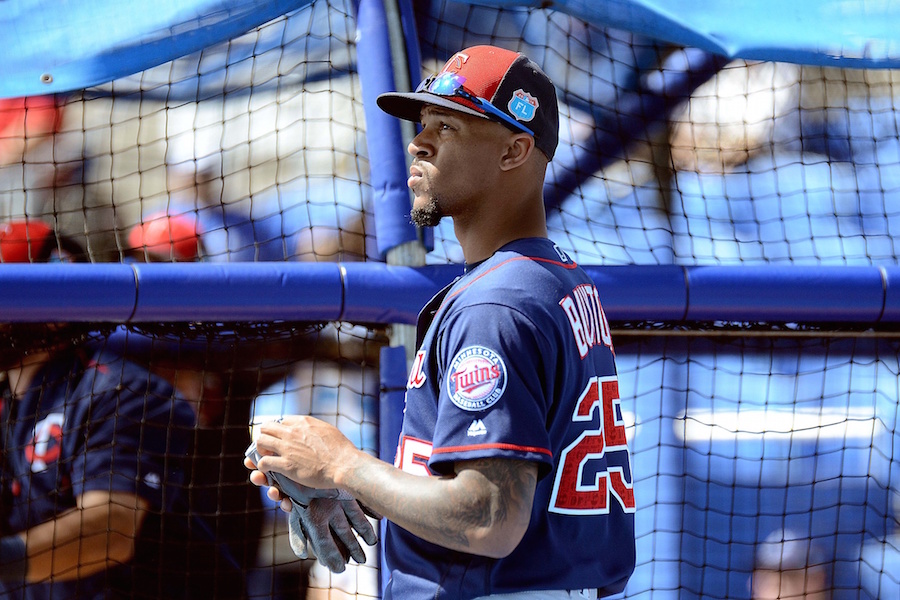 As with the infielders, our criteria for inclusion on this list are that the player made at least 50 plate appearances and remains on the roster as of now. Let's dig in. Byron Buxton, CF 2016 Stats: 331 PA, .225/.284/.430, 10 HR, 38 RBI, 44 R, 1.7 WAR Contract Status: Pre-arbitration, under team control for ~$550K in 2017 It took Buxton a little longer than we hoped to turn the corner, but he did so quite definitively late in the year. Following months of struggles, and multiple demotions to Triple-A, the 22-year-old caught fire upon returning in September, posting a .287/.357/.653 line with nine homers and 24 runs scored in 29 games. The torrid streak was profound enough to raise his overall numbers back to respectability by year's end. His final OPS of .714 – up more than 150 points from when he was recalled with five weeks to go – wasn't far off the league average for center fielders (.730) and came attached to elite, game-changing defense at a vital position. His contributions in the field were deemed valuable enough by FanGraphs that his 1.7 WAR ranked second on the team among position players, behind Brian Dozier. The prolonged slumps that forced him to spend stretches in Rochester (where he dominated) and the ghastly 36 percent strikeout rate cannot be ignored, so Buxton's grade gets dinged, but in the end it's hard to come away from his season with a negative view. 2016 Grade: B- 2017 Outlook: Buxton will be locked in as center fielder and seems likely to bat leadoff if he displays a good plate approach in spring training. Should he come anywhere close to picking up where he left off at the plate, he's a strong bet to be the best player on the team and one of the most valuable in the league. Robbie Grossman, LF 2016 Stats: 389 PA, .280/.386/.443, 11 HR, 37 RBI, 49 R, 0.7 WAR Contract Status: Pre-arbitration, under team control for ~$550K in 2017 In a generally tough year for the front office under Terry Ryan, uncovering Grossman goes down easily as one of the club's best strokes. To some extent it was just fortuitous circumstance; the outfielder had opted out of his minor-league deal with Cleveland in mid-May, around the same time Minnesota was desperately seeking outfield help with its youthful alignment scuffling badly. Still, Grossman was a good find and enjoyed a breakout year after joining up with the Twins. His production tailed off considerably following an initial tear, but he continued to draw walks and get on base even while his bat sagged, and he finished strong. Grossman ended the year with a .386 on-base percentage, which ranked 14th in the majors among players with 350-plus PA. His proclivity in this regard was much needed in a lineup that generally struggled to get aboard consistently. On the downside, Grossman's defense was not good. He made several misplays and showed stunningly little range for a guy who moves reasonably well. 2016 Grade: B 2017 Outlook: Grossman certainly has a strong case for a starting job. He was the best hitter on the team outside of Dozier, and his patience is a handy changeup within an aggressive, power-hitting lineup. However, his extremely poor defensive ratings will work against him with an analytically inclined front office that is emphasizing run prevention. Could he be a darkhorse for DH? Max Kepler, RF 2016 Stats: 447 PA, .235/.309/.424, 17 HR, 63 RBI, 52 R, 1.1 WAR Contract Status: Pre-arbitration, under team control for ~$550K in 2017 Recalled on June 1st after a scalding hot streak in Triple-A, it didn't take Kepler long to heat up again in the majors. During a dominant run that stretched from mid-June through mid-August, Kepler looked like a premier middle-of-the-order run producer, racking up extra-base hits and averaging nearly an RBI per contest. In one game he homered twice and drove in seven runs; in another he launched three bombs with six RBIs. They were among the most spectacular offensive performances we've seen from a Minnesota rookie. But the once red-hot 23-year-old finished his season encased in ice. Over his last 40 games he hit .197/.263/.276 as the quality of his at-bats deteriorated and his power dried up. In contrast to Buxton, it appeared that pitchers were figuring Kepler out rather than the other way around. The slide led to overall numbers that, while solid, were not special. 2016 Grade: B- 2017 Outlook: He's penciled in for right field, although one wonders how firm his hold is. Kepler blasted through Rochester in 30 games but the back half of his stint with the Twins leaves open the possibility that he needs a little more seasoning at Triple-A. The long-term view remains very optimistic. Eddie Rosario, LF 2016 Stats: 354 PA, .269/.295/.421, 10 HR, 32 RBI, 52 R, 0.9 WAR Contract Status: Pre-arbitration, under team control for ~$550K in 2017 An exciting rookie year led to speculation about what kind of impact Rosario might be capable of if he evolved and matured. Unfortunately, in his sophomore campaign, he did no such thing. Rosario was much the same player in 2016, with some frustrating habits lingering if not worsening. Whether in the batter's box, on the base paths or in the outfield, his aggressiveness often crossed into recklessness, much to the manager's aggravation. Along with the bad – blasting through stops signs, sailing throws aimlessly, striking out four times in several games – we saw the good. When he came back from his demotion he was mashing everything that came his way for two months. And aside from the all-too-frequent miscues he was a clear asset in left, combining center field range with right field arm strength. But the negatives were enough to offset the positives in an ultimately vexing year. 2016 Grade: C 2017 Outlook: He will be a corner outfield starter, unless he's a complete mess in camp. There's little hope for Rosario to develop any sort of meaningful selectiveness at the plate, so it's imperative that he lay off pitches nowhere near the zone while cutting down defensive mistakes. If he can do so, the 25-year-old certainly has plenty to offer. Danny Santana, CF 2016 Stats: 248 PA, .240/.279/.326, 2 HR, 14 RBI, 29 R, -0.7 WAR Contract Status: Pre-arbitration, under team control for ~$550K in 2017 Among 353 players with 200 plate appearances, Santana ranked 334th in OPS. He was thrown out nine times on 21 steal attempts. He played six different positions, but wasn't particularly sharp at any of them. As an athletic and versatile switch-hitter, Santana is theoretically a nice bench piece. But in reality, he's been one of the worst players in the league over the last two years. 2016 Grade: F 2017 Outlook: The signing of J.B Shuck to a minor-league contract – whose defensive prowess actually makes up for his light hitting – earlier this month puts Santana, who is out of options, on notice. It's unlikely Derek Falvey and Thad Levine will see much they like but apparently they're inclined to let Santana compete for a job in spring training since they kept him on the 40-man roster through the Rule 5 draft.
 -
Article: 2016 Report Cards: Infield
Nick Nelson replied to Nick Nelson's topic in Twins Daily Front Page News
For what it's worth, in his report about Vargas getting a fourth option last month, Berardino also mentioned that Vargas "was drawing some trade interest." I tend to think that the strengths mentioned in his write-up (switch-hitter sporting patience and power from an intimidating physique) would catch the eyes of a team, but obviously no one is giving up much of consequence for him at this point. I too wonder about this. I haven't heard any explanation. There doesn't seem to be anything all that unique about his situation. He was added to the 40-man after 2013, was optioned in each of the next three years. I guess he must have met both criteria here? http://screencast.com/t/fQXjIBcU -
As the newly installed Minnesota Twins leadership navigates its first offseason, the challenge is twofold: evaluating the personnel already in place, while supplementing and improving the existing core. As we await more movement on the latter front, let's review the roster that Derek Falvey and Thad Levine are inheriting, and how it fared in the most recent season.We'll start our case-by-case review of the 2016 Twins with a look at the infield. Each player who accrued at least 50 plate appearances, and remains in the organization currently, gets a write-up below. Brian Dozier, 2B 2016 Stats: 691 PA, .268/.340/.546, 42 HR, 99 RBI, 104 R, 5.9 WAR Contract Status: Signed through 2018 for $15 million Dozier easily had the best season of any Twin, and in fact his performance measures as one of the best in franchise history. He was a one-man wrecking crew, piling up 82 extra-base hits (tied with Colorado's Nolan Arenado for third-most in the majors) while swiping 18 bases on 20 attempts. He filled the stat sheet and single-handedly produced offense in a way we've rarely seen. For this elite power to come from a middle infield position, along with steady and occasionally spectacular glove work at second base, only increases the relative value of Dozier's output. In a sea of disappointing performances, the veteran clubhouse leader delivered one for the ages – which sadly would do little to stem the tide for an historically inept team. 2016 Grade: A+ 2017 Outlook: If he's still here, Dozier will enter 2017 as the featured centerpiece in a powerful lineup. Will he continue to bat leadoff, as he did for every game in August and September, or move to a more traditional run-producing spot at the heart of the order? Eduardo Escobar, SS 2016 Stats: 377 PA, .236/.280/.338, 6 HR, 37 RBI, 32 R, -0.6 WAR Contract Status: Signed through 2017 for $2.6 million It was a rough year for Escobar. Just when it appeared he had found a home at shortstop, overtaking the position in 2015 and earning an Opening Day nod this past spring, he was derailed by middling production, injuries, and the emergence of an exciting rookie who captured the manager's favor. By season's end, he had fallen back into his familiar old utility role. In September and October, only two of his 19 starts came at shortstop, and he dragged across the finish line offensively with a brutal .348 OPS. The 27-year-old bottomed out at the exact wrong time, reflected by a meager $500,000 raise this offseason. 2016 Grade: D- 2017 Outlook: Escobar is undoubtedly as motivated as ever to bounce back and prove himself next year, but as things stand he will be heading to camp as a backup, capable of filling in around the diamond. Joe Mauer, 1B 2016 Stats: 576 PA, .261/.363/.389, 11 HR, 49 RBI, 68 R, 1.0 WAR Contract Status: Signed through 2018 for $46 million In some ways, Mauer revived hope in his ability to be a solid contributor. Following a 2015 season that was the worst of his career, he raised his OPS back to a respectable level while matching his highest home run total (11) since the MVP campaign in 2009. His walk rate rebounded to 13.7 percent, placing him among the league leaders, and as a result he led all Twins regulars with a .363 OBP. In other ways, though, 2016 was a reaffirmation of Mauer's diminished ability. The three-time batting champion saw his batting average drop for a third straight year, sinking to a career-low .261. His characteristically pedestrian home run total was accompanied by only 22 doubles, his fewest in a full season. Defensively he was nothing special. 2016 Grade: C 2017 Outlook: Turning 34 next March, Mauer remains entrenched at first base by virtue of his contract and reputation, but reduced playing time will be a very real possibility if his bat shows little life in the early part of the season. John Ryan Murphy, C 2016 Stats: 82 PA, .146/.193/.220, 1 HR, 3 RBI, 4 R, -0.5 WAR Contract Status: Pre-arbitration, under team control for ~$550K in 2017 With Kurt Suzuki and Juan Centeno moving on, Murphy is the only member of the 2016 Minnesota catching group set to return. Unfortunately, he was also the worst performer. After starting his Twins career with a 3-for-40 slump, Murphy was demoted to Triple-A, where he continued to hit poorly. He posted a .609 OPS in Rochester, then returned to the majors as a September call-up, collecting three hits in his triumphant return and then finishing out 6-for-38. It was, from any perspective, a disastrous first year for a player whose offensive capabilities were always more hypothetical than material. Defensively he is above-average, with strong athleticism behind the plate, but he doesn't shine enough there to offset the staggering lack of production we've seen since his acquisition. Not even close. 2016 Grade: F 2017 Outlook: Barring further moves, Murphy figures to slot in as the backup to Jason Castro. Most of his starts will hopefully come against lefties. If the bat doesn't turn around quickly, then I'd expect Falvey and Levine (who of course played no part in trading for Murphy) to move on quickly. Byung Ho Park, 1B 2016 Stats: 244 PA, .191/.275/.409, 12 HR, 24 RBI, 28 R, 0.1 WAR Contract Status: Signed through 2019 for $9.25 million Along with Murphy, Park was Minnesota's biggest offseason splash a year ago. The fact that both players spent large chunks of the season in Triple-A certainly glares as an indictment of Terry Ryan and his efforts to bolster an 83-win team. Park, though, was not quite as discouraging a case. The vaunted power was there, clearly. There were some memorable, mammoth shots among the dozen that the South Korean slugger sent over the fence during his time with the Twins. But he was generally overmatched by MLB pitching, and his average sagged until it dropped below .200 and he was demoted in early July. In Triple-A, the story was much the same – great power accompanied by little else – until he underwent season-ending hand surgery. The ailment that placed him under the knife – a damaged tendon in his right hand – bothered him in addition to wrist tendinitis, and certainly might help explain his difficulties swinging the stick. He was also acclimating to a new league, a new country and a new culture. And consider this: if Park exchanged 10 strikeouts for 10 singles during his time in Minnesota, his line turns to .237/.316/.456. That's the kind of production you can live with from a DH. 2016 Grade: D 2017 Outlook: Park will likely be ticketed for Triple-A initially next spring, but it would be no shock if a big showing earns him the DH job with Minnesota. Generating more contact will be the decisive factor. Jorge Polanco, SS 2016 Stats: 270 PA, .282/.332/.424, 4 HR, 27 RBI, 24 R, -0.1 WAR Contract Status: Pre-arbitration, under team control for ~$550K in 2017 Finally breaking through after cups of coffee in 2014 and 2015, Polanco enjoyed a very successful rookie season. He consistently made contact, put up strong numbers, and operated as the everyday shortstop in the final months. There is plenty to like about the 23-year-old's offensive profile. He swings from both sides, makes plenty of contact and sprays line drives. But his ceiling at the plate is limited, and his proper home in the infield is very much in question. Polanco's aptitude at shortstop, a position he had mostly stopped playing in the minors, was iffy at best. 2016 Grade: B 2017 Outlook: He has arrived, no doubt about that. Based on the demonstrated preferences of Paul Molitor, Polanco is the favorite to start at shortstop for now. But with the team focusing intensely on run prevention, the wisdom of plugging in a blatant defensive liability at the infield's most important position is suspect. Of course, a Dozier trade would open up Polanco's ideal spot. Miguel Sano, RF/3B 2016 Stats: 495 PA, .236/.319/.462, 25 HR, 66 RBI, 57 R, 1.3 WAR Contract Status: Pre-arbitration, under team control for ~$550K in 2017 It was a disappointing sophomore season for Sano, but only in the shadow of his prodigious talent and the incredibly high bar he set as a rookie. Without that context, a .781 OPS and 25 jacks from a 23-year-old who fell just short of 500 plate appearances due to injury ain't bad at all. Sano started the year miscast as an outfielder, and spent the second half alternating between DH and third base, where he managed to commit 15 errors in 42 starts. Cleaning up his defense, and lowering his egregious 36 percent K-rate, will be critical in taking the step to stardom. 2016 Grade: B- 2017 Outlook: The decision to release Trevor Plouffe was an indication that the Twins are ready to move forward with Sano at the hot corner, despite his mistake-prone showing in 2016. Lessons learned from the trials he faced should lead to greater resolve and focus moving forward. He remains an MVP-caliber talent at the dish. Kennys Vargas, 1B 2016 Stats: 177 PA, .230/.333/.500, 10 HR, 20 RBI, 27 R, 0.6 WAR Contract Status: Pre-arbitration, under team control for ~$550K in 2017 It's been quite the rollercoaster ride for Vargas. He burst onto the scene with a prolific MLB debut as a September call-up in 2014, then opened as designated hitter the following season. He nearly played his way out of the team's plans during the ensuing summer, with an embarrassing demotion to Double-A speaking loudly. He opened 2016 in Rochester and started slow, then heated up in May and June, earning his way back to the majors. Upon returning, he tore it up for six weeks, got demoted due to a roster crunch, then came back in September and slumped. With all the ups and downs, it's tough to know what to make of Vargas. But this much is evident: he's a big switch-hitter with immense raw power, whose walk rate (13.6%) and Isolated Power (.270) would have both ranked near the top of the league if had he qualified. His uneven performance carried many positive signs, but time is running out for the 26-year-old. As a guy whose sole value proposition is mashing the ball, he needs to start doing so with a lot more consistency. 2016 Grade: B 2017 Outlook: Having been optioned to the minors three times already, Vargas would typically be in a position next spring where he'd need to head north with the Twins or be exposed to waivers. But the club successfully petitioned for a fourth option year (per Mike Berardino) so sending him back to Triple-A is on the table. The door is open for signing a plug-in at DH; otherwise, it might come down to a Grapefruit League competition between Vargas and Park. Click here to view the article
- 45 replies
-
- 4
-
-
- brian dozier
- joe mauer
- (and 3 more)
-
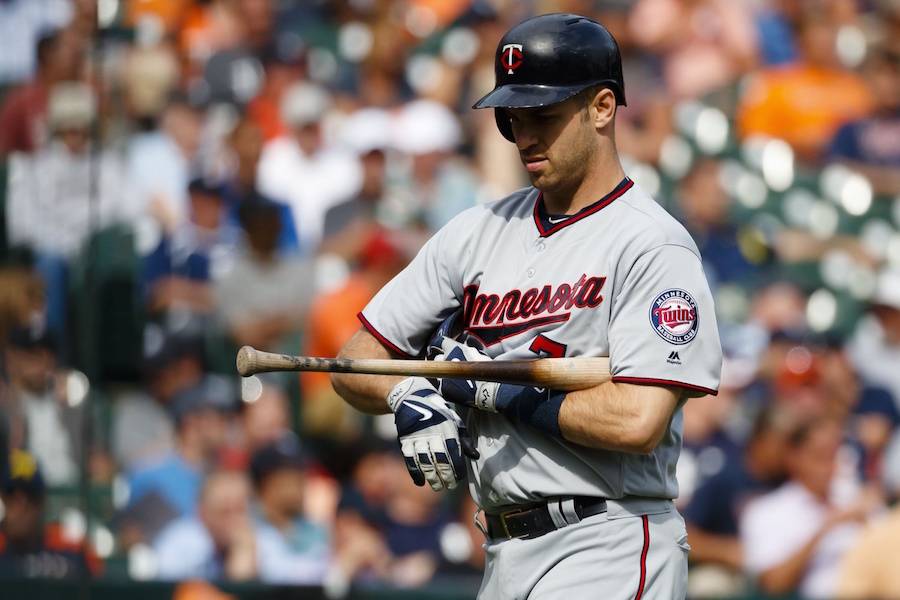 We'll start our case-by-case review of the 2016 Twins with a look at the infield. Each player who accrued at least 50 plate appearances, and remains in the organization currently, gets a write-up below. Brian Dozier, 2B 2016 Stats: 691 PA, .268/.340/.546, 42 HR, 99 RBI, 104 R, 5.9 WAR Contract Status: Signed through 2018 for $15 million Dozier easily had the best season of any Twin, and in fact his performance measures as one of the best in franchise history. He was a one-man wrecking crew, piling up 82 extra-base hits (tied with Colorado's Nolan Arenado for third-most in the majors) while swiping 18 bases on 20 attempts. He filled the stat sheet and single-handedly produced offense in a way we've rarely seen. For this elite power to come from a middle infield position, along with steady and occasionally spectacular glove work at second base, only increases the relative value of Dozier's output. In a sea of disappointing performances, the veteran clubhouse leader delivered one for the ages – which sadly would do little to stem the tide for an historically inept team. 2016 Grade: A+ 2017 Outlook: If he's still here, Dozier will enter 2017 as the featured centerpiece in a powerful lineup. Will he continue to bat leadoff, as he did for every game in August and September, or move to a more traditional run-producing spot at the heart of the order? Eduardo Escobar, SS 2016 Stats: 377 PA, .236/.280/.338, 6 HR, 37 RBI, 32 R, -0.6 WAR Contract Status: Signed through 2017 for $2.6 million It was a rough year for Escobar. Just when it appeared he had found a home at shortstop, overtaking the position in 2015 and earning an Opening Day nod this past spring, he was derailed by middling production, injuries, and the emergence of an exciting rookie who captured the manager's favor. By season's end, he had fallen back into his familiar old utility role. In September and October, only two of his 19 starts came at shortstop, and he dragged across the finish line offensively with a brutal .348 OPS. The 27-year-old bottomed out at the exact wrong time, reflected by a meager $500,000 raise this offseason. 2016 Grade: D- 2017 Outlook: Escobar is undoubtedly as motivated as ever to bounce back and prove himself next year, but as things stand he will be heading to camp as a backup, capable of filling in around the diamond. Joe Mauer, 1B 2016 Stats: 576 PA, .261/.363/.389, 11 HR, 49 RBI, 68 R, 1.0 WAR Contract Status: Signed through 2018 for $46 million In some ways, Mauer revived hope in his ability to be a solid contributor. Following a 2015 season that was the worst of his career, he raised his OPS back to a respectable level while matching his highest home run total (11) since the MVP campaign in 2009. His walk rate rebounded to 13.7 percent, placing him among the league leaders, and as a result he led all Twins regulars with a .363 OBP. In other ways, though, 2016 was a reaffirmation of Mauer's diminished ability. The three-time batting champion saw his batting average drop for a third straight year, sinking to a career-low .261. His characteristically pedestrian home run total was accompanied by only 22 doubles, his fewest in a full season. Defensively he was nothing special. 2016 Grade: C 2017 Outlook: Turning 34 next March, Mauer remains entrenched at first base by virtue of his contract and reputation, but reduced playing time will be a very real possibility if his bat shows little life in the early part of the season. John Ryan Murphy, C 2016 Stats: 82 PA, .146/.193/.220, 1 HR, 3 RBI, 4 R, -0.5 WAR Contract Status: Pre-arbitration, under team control for ~$550K in 2017 With Kurt Suzuki and Juan Centeno moving on, Murphy is the only member of the 2016 Minnesota catching group set to return. Unfortunately, he was also the worst performer. After starting his Twins career with a 3-for-40 slump, Murphy was demoted to Triple-A, where he continued to hit poorly. He posted a .609 OPS in Rochester, then returned to the majors as a September call-up, collecting three hits in his triumphant return and then finishing out 6-for-38. It was, from any perspective, a disastrous first year for a player whose offensive capabilities were always more hypothetical than material. Defensively he is above-average, with strong athleticism behind the plate, but he doesn't shine enough there to offset the staggering lack of production we've seen since his acquisition. Not even close. 2016 Grade: F 2017 Outlook: Barring further moves, Murphy figures to slot in as the backup to Jason Castro. Most of his starts will hopefully come against lefties. If the bat doesn't turn around quickly, then I'd expect Falvey and Levine (who of course played no part in trading for Murphy) to move on quickly. Byung Ho Park, 1B 2016 Stats: 244 PA, .191/.275/.409, 12 HR, 24 RBI, 28 R, 0.1 WAR Contract Status: Signed through 2019 for $9.25 million Along with Murphy, Park was Minnesota's biggest offseason splash a year ago. The fact that both players spent large chunks of the season in Triple-A certainly glares as an indictment of Terry Ryan and his efforts to bolster an 83-win team. Park, though, was not quite as discouraging a case. The vaunted power was there, clearly. There were some memorable, mammoth shots among the dozen that the South Korean slugger sent over the fence during his time with the Twins. But he was generally overmatched by MLB pitching, and his average sagged until it dropped below .200 and he was demoted in early July. In Triple-A, the story was much the same – great power accompanied by little else – until he underwent season-ending hand surgery. The ailment that placed him under the knife – a damaged tendon in his right hand – bothered him in addition to wrist tendinitis, and certainly might help explain his difficulties swinging the stick. He was also acclimating to a new league, a new country and a new culture. And consider this: if Park exchanged 10 strikeouts for 10 singles during his time in Minnesota, his line turns to .237/.316/.456. That's the kind of production you can live with from a DH. 2016 Grade: D 2017 Outlook: Park will likely be ticketed for Triple-A initially next spring, but it would be no shock if a big showing earns him the DH job with Minnesota. Generating more contact will be the decisive factor. Jorge Polanco, SS 2016 Stats: 270 PA, .282/.332/.424, 4 HR, 27 RBI, 24 R, -0.1 WAR Contract Status: Pre-arbitration, under team control for ~$550K in 2017 Finally breaking through after cups of coffee in 2014 and 2015, Polanco enjoyed a very successful rookie season. He consistently made contact, put up strong numbers, and operated as the everyday shortstop in the final months. There is plenty to like about the 23-year-old's offensive profile. He swings from both sides, makes plenty of contact and sprays line drives. But his ceiling at the plate is limited, and his proper home in the infield is very much in question. Polanco's aptitude at shortstop, a position he had mostly stopped playing in the minors, was iffy at best. 2016 Grade: B 2017 Outlook: He has arrived, no doubt about that. Based on the demonstrated preferences of Paul Molitor, Polanco is the favorite to start at shortstop for now. But with the team focusing intensely on run prevention, the wisdom of plugging in a blatant defensive liability at the infield's most important position is suspect. Of course, a Dozier trade would open up Polanco's ideal spot. Miguel Sano, RF/3B 2016 Stats: 495 PA, .236/.319/.462, 25 HR, 66 RBI, 57 R, 1.3 WAR Contract Status: Pre-arbitration, under team control for ~$550K in 2017 It was a disappointing sophomore season for Sano, but only in the shadow of his prodigious talent and the incredibly high bar he set as a rookie. Without that context, a .781 OPS and 25 jacks from a 23-year-old who fell just short of 500 plate appearances due to injury ain't bad at all. Sano started the year miscast as an outfielder, and spent the second half alternating between DH and third base, where he managed to commit 15 errors in 42 starts. Cleaning up his defense, and lowering his egregious 36 percent K-rate, will be critical in taking the step to stardom. 2016 Grade: B- 2017 Outlook: The decision to release Trevor Plouffe was an indication that the Twins are ready to move forward with Sano at the hot corner, despite his mistake-prone showing in 2016. Lessons learned from the trials he faced should lead to greater resolve and focus moving forward. He remains an MVP-caliber talent at the dish. Kennys Vargas, 1B 2016 Stats: 177 PA, .230/.333/.500, 10 HR, 20 RBI, 27 R, 0.6 WAR Contract Status: Pre-arbitration, under team control for ~$550K in 2017 It's been quite the rollercoaster ride for Vargas. He burst onto the scene with a prolific MLB debut as a September call-up in 2014, then opened as designated hitter the following season. He nearly played his way out of the team's plans during the ensuing summer, with an embarrassing demotion to Double-A speaking loudly. He opened 2016 in Rochester and started slow, then heated up in May and June, earning his way back to the majors. Upon returning, he tore it up for six weeks, got demoted due to a roster crunch, then came back in September and slumped. With all the ups and downs, it's tough to know what to make of Vargas. But this much is evident: he's a big switch-hitter with immense raw power, whose walk rate (13.6%) and Isolated Power (.270) would have both ranked near the top of the league if had he qualified. His uneven performance carried many positive signs, but time is running out for the 26-year-old. As a guy whose sole value proposition is mashing the ball, he needs to start doing so with a lot more consistency. 2016 Grade: B 2017 Outlook: Having been optioned to the minors three times already, Vargas would typically be in a position next spring where he'd need to head north with the Twins or be exposed to waivers. But the club successfully petitioned for a fourth option year (per Mike Berardino) so sending him back to Triple-A is on the table. The door is open for signing a plug-in at DH; otherwise, it might come down to a Grapefruit League competition between Vargas and Park.
 -
It's a fair way to look at it. Perhaps a good idea for a future article would be comparing the top five Twins pitching prospects to the top five for other teams in the division. I tend to think Minnesota has more quality depth than most, but without De Leon they are lacking that guy with a true ace profile.
-
Article: All About Jose De Leon
Nick Nelson replied to Nick Nelson's topic in Twins Daily Front Page News
Update here on stalling Dozier trade talks from Jon Heyman: http://www.fanragsports.com/mlb/heyman-dodgers-twins-standstill-dozier-trade-talks/ Sounds like the two sides are agreed on De Leon as the main piece, but reaching an impasse on the rest of the package. Twins pushing for Alvarez or Buehler and getting rebuked (unsurprisingly). Hopefully the deal doesn't fall apart because disagreement over the secondary pieces. -
Article: All About Jose De Leon
Nick Nelson replied to Nick Nelson's topic in Twins Daily Front Page News
Not to veer too far into this subject and away from the one at hand, but as an enormous Lin Manuel Miranda fan, I absolutely loved this bit he did about the Puerto Rican situation on John Oliver's show earlier this year: -
Article: All About Jose De Leon
Nick Nelson replied to Nick Nelson's topic in Twins Daily Front Page News
Fair point! Tweaked. -
We live in an unpredictable world, but some things aren't that hard to foresee. When a batter steps into the box with a 3-0 count and the bases loaded, he can safely assume a fastball is on the way. The Dodgers emerging as the leading suitors for Brian Dozier, and dangling Jose De Leon as their primary negotiating chip, falls in the same category.Back in early October, while the Los Angeles was still mounting its postseason push, I noted via tweet that a Dozier-for-De Leon swap "makes too much sense." In the Offseason Handbook (still available for free download!), the Dodgers were the first team we listed as a fit for Dozier, and our Offseason Blueprint suggested trading the second baseman for a return led by De Leon. Now, the Twins are consistently being connected to Los Angeles in trade rumors. Last week Aaron Gleeman relayed, per league sources, a feeling that the two teams are haggling over what would come along with De Leon in a deal. Days later, Yahoo Sports columnist Jeff Passan reinforced that notion, reporting that the "Dodgers have shown willingless" to include the top prospect in a package for Dozier. It's all coming together pretty much exactly like we predicted and hoped. My intention here isn't to pat myself on the back. Anticipating this scenario didn't require some divine prescience – only an ability to connect the dots. The Twins are coming off a 103-loss season and could use a major shakeup, with a roster featuring a surplus of power hitting and an extreme dearth of high-caliber pitching. Meanwhile, the Dodgers are as motivated as any team in the league to get over the hump and win a title, with young arms to spare. The top prize amongst that group, Julio Urias, was never a particularly realistic target. After successfully transitioning to the majors at age 19 and subsequently becoming the youngest pitcher ever to start a postseason game, he's not the kind of asset that was going to be made available. De Leon, though? Far more plausible. He is four years older than Urias and doesn't carry quite the same level of luster. He also struggled a bit in his MLB debut this year and has dealt with some shoulder issues. He's not a perfect prospect. But that doesn't mean he's leftover scraps. Far from it. In the majority of systems De Leon would be the No. 1 prospect, and if he comes over he will immediately leapfrog every pitcher on the farm for the Twins. Let's familiarize ourselves with De Leon as we prepare for the possibility that he headlines an upcoming Dozier blockbuster. Meteoric Riser After finishing up high school in his native Puerto Rico, De Leon headed to the mainland to attend college in Baton Rouge. His career with Southern University featured solid numbers, including a 17-8 record and 3.50 ERA over three seasons, but he didn't catch the eyes of many pro scouts. As a result, the slender righty dropped all the way to the 24th round. He was the 724th player selected in 2013. Earlier in that round, the Twins took Brandon Easton, a pitcher who lasted two years in rookie ball before fizzling out of the system. For players selected this late, the odds of reaching the majors – or even hanging on in the affiliated pro ranks for long – are not good. Against this backdrop, De Leon's ascension is all the more impressive. His numbers began to rapidly improve and remained strong as he climbed the ladder. He impressed enough at each level that he never stayed anywhere for long. De Leon made four starts at Low-A, seven at High-A, 16 at Double-A and then 16 at Triple-A before getting his call to the big leagues. Everywhere he pitched, it took him no more than half a season to convince the front office that he was too good for the competition. Prospect pubs quickly took notice. Prior to the 2016 campaign, three major lists (Baseball America, Baseball Prospectus, MLB.com) had De Leon somewhere between 23 and 28, after never ranking him before. The website Minor League Ball, run by longtime prospect guru John Sickels, had De Leon ranked as the game's 14th-best upcoming talent in their preseason release. In the updated end-of-year rankings, published in late September, he was fifth. Sickels placed only Yoan Moncada, Dansby Swanson, Tyler Glasnow and Lucas Giolito ahead of De Leon. The 24-year-old owes his escalating profile to a number of skills and strengths, but none stand out more than this one: He's A Strikeout Machine De Leon's ability to throw the ball past helpless opposing hitters is truly something to behold. During his time in the minors, he has struck out 446 of the 1,371 men he has faced over 330 innings. That's a 12.1 K/9 average and 33 percent rate. For perspective, Jose Berrios – a fellow Puerto Rican and vaunted strikeout artist in his own right – has a 26 percent K-rate in the minors. De Leon would have easily led both the Texas League (AA) and Pacific Coast League (AAA) this year if he had stuck around long enough to qualify. It's been somewhat rare for the Twins to boast starting pitching prospects who can even average one strikeout per inning. De Leon has 100 more strikeouts than innings pitched during his relatively short time in the Dodgers system. When so few balls are put into play, it's tough to scratch out many hits. So it's no surprise that in those 330 innings of work, De Leon has allowed only 273 hits. Twins pitchers have allowed the most hits of any American League team in five straight seasons. De Leon's Changeup Is A Devastating Weapon In the tradition of Johan Santana, De Leon relies on his changeup as an out pitch. He's comfortable throwing it in any count, and uses it often. The arm action effectively mimics his fastball to create deception, but he takes about 10 MPH off it with significant vertical movement. (Scroll down to the changeup section here for some good looks at it.) Twins pitching coach Neil Allen, who is staying on for 2017, is known to be "big on changeups." He would undoubtedly welcome the chance to work with a starter who has developed the offering into a centerpiece of his repertoire. The Shoulder Is A Concern Or at least, it was. De Leon spent the first month this year in extended spring while recovering from an ankle injury, then made just one start before sitting out another five weeks due to shoulder inflammation. It's not the greatest sign for a guy who is just getting his season started. The Dodgers proceeded very cautiously when the hurler returned from the disabled list, removing him before the fifth inning in each of his first four starts. But by the time he graduated from Triple-A those restrictions were a distant memory. In his final 10 turns with Oklahoma City prior to a September promotion to the majors, De Leon completed seven-plus innings six times and exceeded 100 pitches four times. He also went 6-1 with a 2.43 ERA. At this point there isn't much reason to think he's got a bad wing, but it's something to keep an eye on. He hasn't thrown more than 114 total innings in a season, so he needs to prove he can hold up to a starter's workload. He appeared to wear down in his final starts for the Dodgers. Perhaps this is the main factor compelling the Twins to a hold out for a bit more in addition to De Leon. That's reasonable enough. But even with some minor health concerns, the highly touted late bloomer appears to be a worthy top prize in exchange for Dozier. He would also provide a dramatic boost to an already encouraging pipeline of impending arrivals. Hopefully Derek Falvey and Thad Levine can get this thing done. Click here to view the article
-
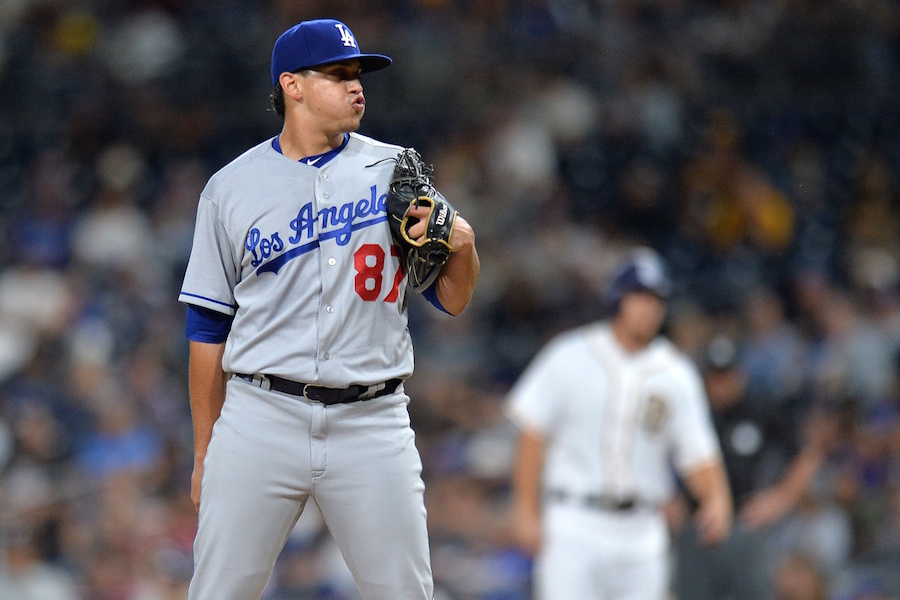 Back in early October, while the Los Angeles was still mounting its postseason push, I noted via tweet that a Dozier-for-De Leon swap "makes too much sense." In the Offseason Handbook (still available for free download!), the Dodgers were the first team we listed as a fit for Dozier, and our Offseason Blueprint suggested trading the second baseman for a return led by De Leon. Now, the Twins are consistently being connected to Los Angeles in trade rumors. Last week Aaron Gleeman relayed, per league sources, a feeling that the two teams are haggling over what would come along with De Leon in a deal. Days later, Yahoo Sports columnist Jeff Passan reinforced that notion, reporting that the "Dodgers have shown willingless" to include the top prospect in a package for Dozier. It's all coming together pretty much exactly like we predicted and hoped. My intention here isn't to pat myself on the back. Anticipating this scenario didn't require some divine prescience – only an ability to connect the dots. The Twins are coming off a 103-loss season and could use a major shakeup, with a roster featuring a surplus of power hitting and an extreme dearth of high-caliber pitching. Meanwhile, the Dodgers are as motivated as any team in the league to get over the hump and win a title, with young arms to spare. The top prize amongst that group, Julio Urias, was never a particularly realistic target. After successfully transitioning to the majors at age 19 and subsequently becoming the youngest pitcher ever to start a postseason game, he's not the kind of asset that was going to be made available. De Leon, though? Far more plausible. He is four years older than Urias and doesn't carry quite the same level of luster. He also struggled a bit in his MLB debut this year and has dealt with some shoulder issues. He's not a perfect prospect. But that doesn't mean he's leftover scraps. Far from it. In the majority of systems De Leon would be the No. 1 prospect, and if he comes over he will immediately leapfrog every pitcher on the farm for the Twins. Let's familiarize ourselves with De Leon as we prepare for the possibility that he headlines an upcoming Dozier blockbuster. Meteoric Riser After finishing up high school in his native Puerto Rico, De Leon headed to the mainland to attend college in Baton Rouge. His career with Southern University featured solid numbers, including a 17-8 record and 3.50 ERA over three seasons, but he didn't catch the eyes of many pro scouts. As a result, the slender righty dropped all the way to the 24th round. He was the 724th player selected in 2013. Earlier in that round, the Twins took Brandon Easton, a pitcher who lasted two years in rookie ball before fizzling out of the system. For players selected this late, the odds of reaching the majors – or even hanging on in the affiliated pro ranks for long – are not good. Against this backdrop, De Leon's ascension is all the more impressive. His numbers began to rapidly improve and remained strong as he climbed the ladder. He impressed enough at each level that he never stayed anywhere for long. De Leon made four starts at Low-A, seven at High-A, 16 at Double-A and then 16 at Triple-A before getting his call to the big leagues. Everywhere he pitched, it took him no more than half a season to convince the front office that he was too good for the competition. Prospect pubs quickly took notice. Prior to the 2016 campaign, three major lists (Baseball America, Baseball Prospectus, MLB.com) had De Leon somewhere between 23 and 28, after never ranking him before. The website Minor League Ball, run by longtime prospect guru John Sickels, had De Leon ranked as the game's 14th-best upcoming talent in their preseason release. In the updated end-of-year rankings, published in late September, he was fifth. Sickels placed only Yoan Moncada, Dansby Swanson, Tyler Glasnow and Lucas Giolito ahead of De Leon. The 24-year-old owes his escalating profile to a number of skills and strengths, but none stand out more than this one: He's A Strikeout Machine De Leon's ability to throw the ball past helpless opposing hitters is truly something to behold. During his time in the minors, he has struck out 446 of the 1,371 men he has faced over 330 innings. That's a 12.1 K/9 average and 33 percent rate. For perspective, Jose Berrios – a fellow Puerto Rican and vaunted strikeout artist in his own right – has a 26 percent K-rate in the minors. De Leon would have easily led both the Texas League (AA) and Pacific Coast League (AAA) this year if he had stuck around long enough to qualify. It's been somewhat rare for the Twins to boast starting pitching prospects who can even average one strikeout per inning. De Leon has 100 more strikeouts than innings pitched during his relatively short time in the Dodgers system. When so few balls are put into play, it's tough to scratch out many hits. So it's no surprise that in those 330 innings of work, De Leon has allowed only 273 hits. Twins pitchers have allowed the most hits of any American League team in five straight seasons. De Leon's Changeup Is A Devastating Weapon In the tradition of Johan Santana, De Leon relies on his changeup as an out pitch. He's comfortable throwing it in any count, and uses it often. The arm action effectively mimics his fastball to create deception, but he takes about 10 MPH off it with significant vertical movement. (Scroll down to the changeup section here for some good looks at it.) Twins pitching coach Neil Allen, who is staying on for 2017, is known to be "big on changeups." He would undoubtedly welcome the chance to work with a starter who has developed the offering into a centerpiece of his repertoire. The Shoulder Is A Concern Or at least, it was. De Leon spent the first month this year in extended spring while recovering from an ankle injury, then made just one start before sitting out another five weeks due to shoulder inflammation. It's not the greatest sign for a guy who is just getting his season started. The Dodgers proceeded very cautiously when the hurler returned from the disabled list, removing him before the fifth inning in each of his first four starts. But by the time he graduated from Triple-A those restrictions were a distant memory. In his final 10 turns with Oklahoma City prior to a September promotion to the majors, De Leon completed seven-plus innings six times and exceeded 100 pitches four times. He also went 6-1 with a 2.43 ERA. At this point there isn't much reason to think he's got a bad wing, but it's something to keep an eye on. He hasn't thrown more than 114 total innings in a season, so he needs to prove he can hold up to a starter's workload. He appeared to wear down in his final starts for the Dodgers. Perhaps this is the main factor compelling the Twins to a hold out for a bit more in addition to De Leon. That's reasonable enough. But even with some minor health concerns, the highly touted late bloomer appears to be a worthy top prize in exchange for Dozier. He would also provide a dramatic boost to an already encouraging pipeline of impending arrivals. Hopefully Derek Falvey and Thad Levine can get this thing done.
 -
It was a nerve issue in his neck and shoulder. His diagnosis of neuropraxia is considered the least severe peripheral nerve injury but it's just not a great sign for a pitcher who is just getting his career started and already faced questions about handling a starter workload.
- 71 replies
-
- 1
-
-
- jose berrios
- stephen gonsalves
- (and 2 more)
-
I'm trying to recall: when is the last time the Twins have had this much pitching quality in the upper minors? It's been a while, for sure.
- 71 replies
-
- 1
-
-
- jose berrios
- stephen gonsalves
- (and 2 more)
-
Each of these four will probably appear in preseason Top 100 lists (with the exception of JO, who would if he qualified) and all could/should start in Double-A or above next year. So I'm not quite sure what you're getting at.
-
Obviously Romero has much to prove in terms of taking on a full workload but his injury problems are (hopefully) behind him. And everything he brings to the table is more impressive to me at this point than Jay.
- 71 replies
-
- 3
-
-
- jose berrios
- stephen gonsalves
- (and 2 more)
-
I was highly skeptical of the decision to use a top 6 draft pick on a pitcher who threw almost exclusively out of the bullpen in college. The success rate of converting these guys to starters has not been particularly strong. So I guess seeing him break down before August (despite never throwing 100 pitches in a game, or posting particularly dominant numbers) was sort of a reinforcement of my doubts. But a good strong full season next year would obviously go a long way toward alleviating that.
- 71 replies
-
- 1
-
-
- jose berrios
- stephen gonsalves
- (and 2 more)
-
I'm as big of a Mejia fan as you'll find, and I'd certainly agree he's more MLB-ready than anyone listed other than Berrios. But this grouping was meant to illustrate the prospects with true top-of-rotation potential, and Mejia doesn't have that... at least not yet. His statistical profile and prospect rep don't stack up to these four. As I said, if he gets off to a strong start in Triple-A this year he might make a case for himself.
- 71 replies
-
- 1
-
-
- jose berrios
- stephen gonsalves
- (and 2 more)
