


Brock Beauchamp
-
Posts
32,673 -
Joined
-
Last visited
-
Days Won
328
Content Type
Profiles
Minnesota Twins News, Rumors & Analysis
Minnesota Twins Videos
2026 Minnesota Twins Top Prospect Rankings
2022 Minnesota Twins Draft Picks & Signing Bonuses
Minnesota Twins Trade & Free Agent Rumors
Minnesota Twins Fan Guides & Resources
2023 Minnesota Twins Draft Picks & Signing Bonuses
2024 Minnesota Twins Draft Picks & Signing Bonuses
2025 Minnesota Twins Draft Picks & Signing Bonuses
2026 Minnesota Twins Draft Picks & Signing Bonuses
Forums
Blogs
Events
Store
Downloads
Gallery
Everything posted by Brock Beauchamp
-

Why isn't Johan Santana in the Hall of Fame?
Brock Beauchamp replied to Zach Hartford's topic in Minnesota Twins Talk
For the record, I wouldn't vote any of them in, I just think Nathan has a strong-ish case due to his dominance in comparison to other relievers of his era (and baseball history, frankly). -
Why isn't Johan Santana in the Hall of Fame?
Brock Beauchamp replied to Zach Hartford's topic in Minnesota Twins Talk
It's weird how WPA is a junk stat that doesn't measure performance but the career WPA for pitchers looks like this. For the record, I don't use WPA for anyone except relievers for the explicit reason that it's literally the job of a reliever to come in and give their team the best chance of winning possible when the game will be decided. Over the course of a career, WPA begins to align very closely with the quality and performance of a pitcher, as you can see from the following list. Rank Player (yrs, age) Win Probability Added (WPA) IP Throws 1. Lefty Grove+ (17) 82.99 3940.2 L 2. Roger Clemens (24) 77.75 4916.2 R 3. Greg Maddux+ (23) 59.46 5008.1 R 4. Warren Spahn+ (21) 57.56 5243.2 L 5. Mariano Rivera+ (19) 56.59 1283.2 R 6. Tom Seaver+ (20) 56.43 4783.0 R 7. Pedro Martinez+ (18) 53.75 2827.1 R 8. Randy Johnson+ (22) 53.20 4135.1 L 9. Carl Hubbell+ (16) 46.50 3590.1 L 10. Clayton Kershaw (14, 33) 45.68 2454.2 L 11. Jim Palmer+ (19) 45.45 3948.0 R 12. Bob Feller+ (18) 42.81 3827.0 R 13. Mike Mussina+ (18) 40.61 3562.2 R 14. John Smoltz+ (21) 40.51 3473.0 R 15. Pete Alexander+ (20) 40.10 5190.0 R 16. Bob Gibson+ (17) 39.06 3884.1 R 17. Roy Halladay+ (16) 38.03 2749.1 R 18. Whitey Ford+ (16) 37.04 3170.1 L 19. Gaylord Perry+ (22) 35.94 5350.0 R 20. Justin Verlander (16, 38) 35.91 2988.0 R 21. Zack Greinke (18, 37) 35.65 3110.0 R 22. Tom Glavine+ (22) 35.52 4413.1 L 23. Curt Schilling (20) 35.27 3261.0 R 24. Dazzy Vance+ (16) 34.67 2966.2 R 25. Ted Lyons+ (21) 34.52 4161.0 R 26. Stan Coveleski+ (14) 34.27 3082.0 R 27. Billy Pierce (18) 34.21 3306.2 L 28. Trevor Hoffman+ (18) 34.15 1089.1 R 29. Nolan Ryan+ (27) 34.04 5386.0 R 30. Juan Marichal+ (16) 34.03 3507.0 R 31. Sandy Koufax+ (12) 34.02 2324.1 L 32. Robin Roberts+ (19) 33.86 4688.2 R 33. Kevin Brown (19) 33.55 3256.1 R 34. Don Sutton+ (23) 33.44 5282.1 R 35. Max Scherzer (14, 36) 33.35 2536.2 R 36. Rich Gossage+ (22) 32.51 1809.1 R 37. Walter Johnson+ (21) 32.04 5914.1 R 38. Wilbur Cooper (15) 31.27 3480.0 L 39. Dennis Eckersley+ (24) 30.85 3285.2 R 40. Joe Nathan (16) 30.60 923.1 R -
Why isn't Johan Santana in the Hall of Fame?
Brock Beauchamp replied to Zach Hartford's topic in Minnesota Twins Talk
That's not really true, though, especially over a career. If a guy has the fourth highest WPA in the history of relievers and did it under 1,000 career innings pitched, he's a damned good reliever, one of the best in baseball history. Nathan, at 40th career WPA in history, is actually the first pitcher on the list under 1,000 IP. Next on the list under 1,000 IP is... you guessed it, Billy Wagner. A guy can luck into a season of high WPA (Tyler Duffey in 2021, for example) but not over a 10+ year career. A WPA that high requires sheer dominance over a career and Nathan's stats back up that dominance (career ERA+ of 151, IIRC). -
Why isn't Johan Santana in the Hall of Fame?
Brock Beauchamp replied to Zach Hartford's topic in Minnesota Twins Talk
Fun fact: Joe Nathan, in those meager innings that apparently didn't matter, had a much higher career WPA than Andy Pettitte (Nathan is 40th in MLB history in pitcher WPA and 4th in reliever WPA, actually). People underrate just how effing good Joe Nathan was in his career. The guy had an ERA+ just over 150. -
What Player Made You Fall in Love With the Twins?
Brock Beauchamp replied to Andrew Mahlke's topic in Minnesota Twins Talk
Love this so much. I didn't hear Herb often - I was a kid that lived in northern Minnesota and later moved to Utah - but I understand the sentiment. While I now love the Twins first and foremost, I grew up in a world where I loved baseball and just listened to whatever I could get, and that was often Jack Buck's voice until I moved to Utah and ESPN took over and made me ignore the airwaves. But I heard Jack Buck far more than I ever heard Herb and I lived in Minnesota and northern Wisconsin as a child. The world was a weird place in the 70s and 80s. -
What Player Made You Fall in Love With the Twins?
Brock Beauchamp replied to Andrew Mahlke's topic in Minnesota Twins Talk
Is it really, though? -
Why isn't Johan Santana in the Hall of Fame?
Brock Beauchamp replied to Zach Hartford's topic in Minnesota Twins Talk
To touch on another recent subject about DHs being in the HoF, I ask "why?" Why do we look so down at one position of baseball history and so eagerly promote another? Joe Nathan is a better Hall of Fame candidate than Petitte, as is probably Wagner. Are we just recording counting stats or are we looking at legendary performance? Stop using WAR as worthiness and start looking at peer performance. -
Why isn't Johan Santana in the Hall of Fame?
Brock Beauchamp replied to Zach Hartford's topic in Minnesota Twins Talk
This aged… weirdly. -
Why isn't Johan Santana in the Hall of Fame?
Brock Beauchamp replied to Zach Hartford's topic in Minnesota Twins Talk
I consider Cone a borderline case and I wouldn't vote for him any more than I'd vote for Santana. But using a seven year peak for both undervalues Santana's utter dominance over a smaller stretch of time. Johan wasn't that good for seven seasons but he was purely dominant for five seasons. In five seasons, he had one 8+ rWAR season, three 7-8 rWAR seasons, and one 5 rWAR season. Cone can't even touch those numbers through any stretch of his career, as he only posted a 7+ rWAR season once and no 8+ rWAR seasons. It should be noted that had the Twins not wasted Johan for so long in 2002-2003, we’d probably be having a fairly different conversation about him. -
Why isn't Johan Santana in the Hall of Fame?
Brock Beauchamp replied to Zach Hartford's topic in Minnesota Twins Talk
If you think those three should be in the hall, the size of the HoF would nearly double in pitchers, I suspect. That would take Cooperstown from the Hall of Fame to the Hall of Very Good. If that's the standard, then players like Cole Hamels, Mark Buerle, and Andy Pettite also deserve entry to Cooperstown. Johan Santana is a step (or more) above the three you listed in pretty much every regard except longevity... but none of the three had particularly long careers so they don't have even that going for them, either. Guys like Kevin Brown (who was considerably better than the three you listed) should first sail into the Hall before those guys get in so the list starts becoming *really* long if the bar for entry is lowered that much. For the record, I think Johan is a borderline case but I wouldn't vote for him if I had a ballot. -
At the end of the day, this is the correct answer.
-
A giant waste of a truly awesome baseball name.
-
I don't ding Ortiz for being a DH nearly as much as some others do. At the end of the day, I just ask "was this player one of the best in baseball for most of their career?" And the answer is a resounding yes with Ortiz. And then there are the postseason heroics to consider, which absolutely push him well over the line into HoF territory. His WAR is lacking but that's just a metric like any other and as a DH it's almost impossible to reach the 70 win threshold many consider the HoF standard (same with catcher but that's a different conversation). Even Edgar fell short of 70 rWAR. If Ortiz isn't a Hall of Fame DH, it's pretty hard to argue there should be *any* Hall of Fame DHs. And if we're excluding entire classes of players from the Hall, that's not great and it's yet another way the Hall is not representative of baseball history.
-
What Player Made You Fall in Love With the Twins?
Brock Beauchamp replied to Andrew Mahlke's topic in Minnesota Twins Talk
No need to be coy. We all know the real answer is Walter Johnson.- 100 replies
-
- 10
-

-

-
What Player Made You Fall in Love With the Twins?
Brock Beauchamp replied to Andrew Mahlke's topic in Minnesota Twins Talk
Like pretty much everyone my age, Kirby. Hrbek was a not-too-distant second. -
Where are you currently with this FO?
Brock Beauchamp replied to cHawk's topic in Minnesota Twins Talk
For a guy with natural baseball instincts, Griffith didn't have a lot of sustained success through the second half of his ownership tenure. The 60s were certainly great but from 1971 to the team's sale in 1984, the Twins never won more than 85 games in a season. That's nearly a decade and a half of mediocre to bad baseball. -
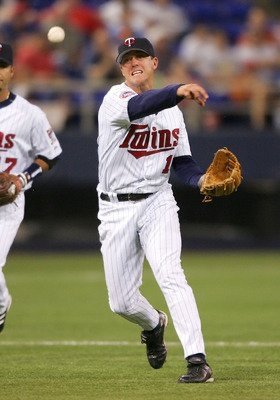
The man, the myth, the legend. Glenn Williams. Thirteen games played, 141 OPS+.
-
Where are you currently with this FO?
Brock Beauchamp replied to cHawk's topic in Minnesota Twins Talk
That is 20% under market value, if history carries forward. -
Where are you currently with this FO?
Brock Beauchamp replied to cHawk's topic in Minnesota Twins Talk
The first part of this sentence, sure, and they're not necessarily in the wrong for wanting the prospects more than Berríos. While I disagree with that approach, it's not obviously wrong and it comes down to opinion at that point. The second part of this sentence, I just can't buy that at all. They didn't spend ace money after 2017. They didn't spend ace money after 2019 when the team won literally over 100 games. They didn't spend ace money after 2020 and back-to-back division titles. This offseason, the need couldn't be higher and the quantity of available arms greater, yet again they... didn't spend ace money. At some point, we need to just admit they're not going to spend ace money. The "time has been right" at minimum three times in the past five years and they haven't spent more than $10m on a free agent pitcher during that time.- 70 replies
-
- 13
-
-
Overall, conversations like this are why I no longer care about the hall of fame. The fact that Harold Baines is in Cooperstown and Barry Bonds is not is absurd and turns the Hall into a sideshow of moral superiority and back-slapping. Either put the best players in or the entire thing has no meaning and the BBWAA’s soapbox righteous indignation over PEDs is nauseating. Yeah, PEDs sucked. They did damage to the game. Bonds is still one of the 50 best players to ever play the game and a bunch of writers who vote in wife beaters and the like don’t get to pull the “integrity of the game” card.
-
Exactly.
-
Closer or no closer, that is the question!
Brock Beauchamp replied to wsnydes's topic in Minnesota Twins Talk
Shaddup, sconnie. -
Closer or no closer, that is the question!
Brock Beauchamp replied to wsnydes's topic in Minnesota Twins Talk
Possibly, but I think traditionally it has been more out of habit than actual game strategy. After LaRussa revamped bullpen usage in the 80s, managers "strategized" around the save stat. If it was a save opportunity, the dedicated closer went into the game. Look at Gardy's years with the Twins, particularly with Joe Nathan. If Nathan was rested and a save would be awarded for the game, Joe took the mound basically 100% of the time. And while I actually think Gardy was a good bullpen manager, managing around a stat is always wrong. -
I'm of the opinion they let it ride with Kirilloff with Larnach behind him in case of failure. If they acquire an OF, it needs to be a defensive-minded CF to back up Buxton.
- 63 replies
-
- 11
-
