Jump to content
Twins Daily
  • Create Account
  • Twins Minor League Coverage

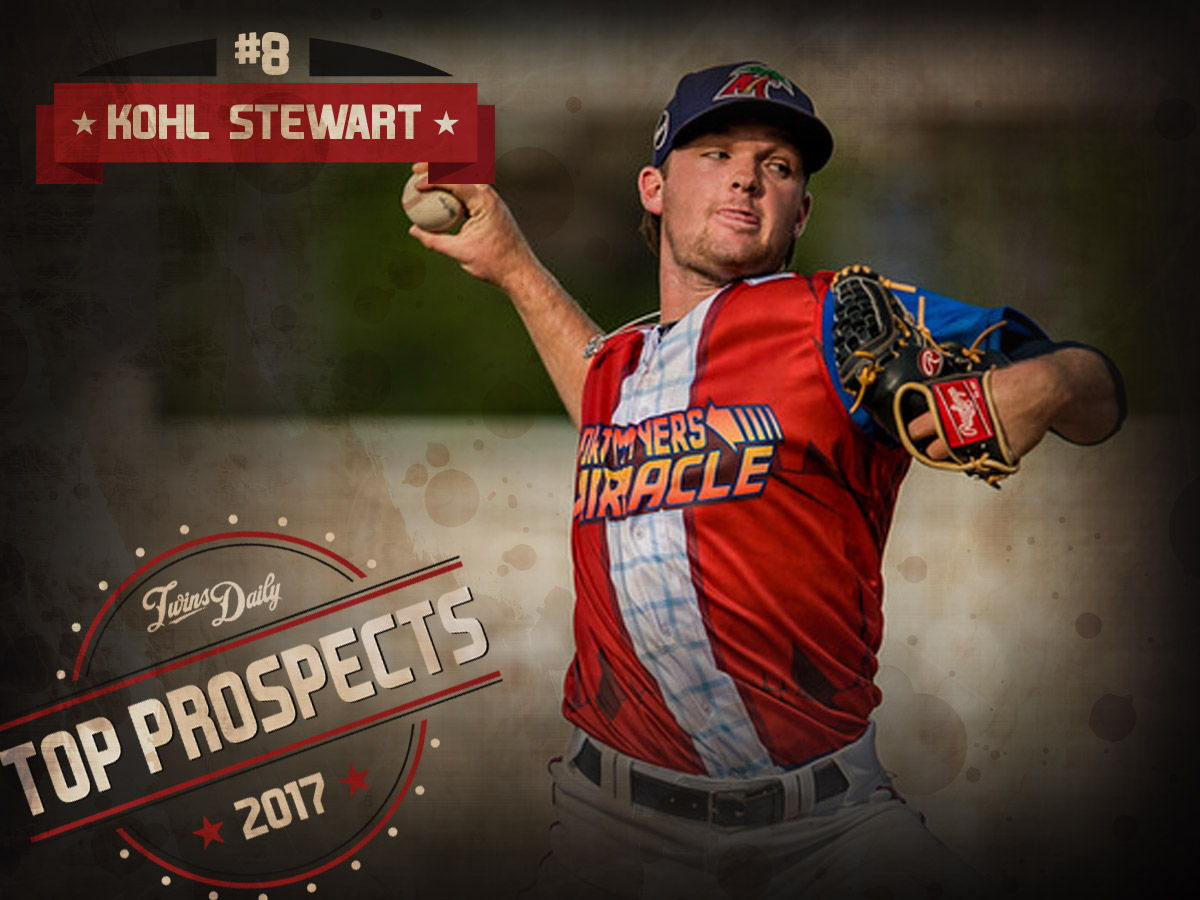
    TD Top Prospects: #8 Kohl Stewart


    Nick Nelson

    In June of 2013, the Minnesota Twins made perhaps their most important draft pick of the past decade and beyond. With the No. 4 selection in hand after a dreadful 2012 season that reinforced the organization's desperate need for pitching talent, they gambled on a Texas high school hurler named Kohl Stewart.

    Nearly four years later, the jury is still out.

    Twins Video

    Age: 22 (DOB: 10/7/94)

    2016 Stats (A+/AA): 143.2 IP, 2.88 ERA, 91/63 K/BB, 1.34 WHIP

    ETA: 2018

    2016 Ranking: 9

    National Top 100 Rankings

    BA: NR | MLB: NR | ESPN: 87 | BP: NR

    At St. Pius X High School in Houston, Stewart was a legendary athlete. A star quarterback, he was widely recruited before signing a letter of intent with Texas A&M. Calling signals on Saturday for the Aggies was undoubtedly a dream of his while growing up 90 minutes away from campus, but ultimately he decided to follow his golden right arm in another direction.

    When the Twins drafted Stewart fourth overall, the allure of a $4.5 million signing bonus was too much to pass up. It was a major leap of faith for Minnesota's draft department, which had long had its sights set on the prized pitching talent. Much has been made of the fact that Hunter Greene, a teenage phenom out of California, could be the first prep right-hander to ever be selected with the first overall pick this June. There's a reason for that; such players bring a relatively higher level of risk and uncertainty.

    But Stewart had all the requisites. A football player's build. A hard-moving fastball to go along with a potentially dominant slider. The prototypical bulldog demeanor on the mound. Ace upside.

    What's To Like

    Those aforementioned traits remain intact. Stewart has checked one very important box off the list by staying healthy and on the field. That is hardly a given for young kids who throw in mid-90s or above. Tyler Kolek, the fireballing righty selected second overall by the Marlins a year after Stewart's draft, just lost his entire 2016 campaign to Tommy John surgery. It's a major setback in a budding career.

    Stewart has avoided such pitfalls and thus has progressed about exactly as one would hope. Since starting full-season ball in 2014 he has ascended to a new level each year, finishing last season as a 21-year-old in the Class-AA Southern League, where the average player was about three years his elder.

    From year to year, the right-hander has increased his inning totals from 87 to 129 to 143, prepping his arm to be ready for 200 frames once he reaches the majors. You compare that to a guy like Jose De Leon, who at 24 still hasn't thrown even 120 innings in a season, and it's easy to see the value.

    While reliably taking his rotation turns, Stewart has produced. He has a shiny 2.84 ERA as a pro and hasn't finished above 3.20 at any level. Opponents have struggled to square him up, with only 12 home runs in 1,600 plate appearances. Last year he made what many consider the toughest jump in the minors, but hardly looked overmatched in Double-A, picking up wins in nine of his 16 starts while posting a 3.03 ERA.

    What's Left To Work On

    In the entirety of his minor-league career, Stewart has struck out 15.4 percent of the batters he has faced, and walked 8.4 percent. I couldn't figure out an efficient way to do the definitive research, but I can say with confidence that there are very few, if any, successful starting pitchers in the majors who registered such low rates in both categories as prospects.

    For a more manageable exercise, let's compare Stewart's established K and BB rates in the minors with those of each pitcher who made a start for the Twins last year.

    Kohl Stewart: 15.4% K / 8.4% BB

    Ervin Santana: 23.4% / 8.4% BB

    Kyle Gibson: 21.7% K / 6.7% BB

    Tyler Duffey: 20.2% K / 5.2% BB

    Ricky Nolasco: 23.3% K / 7.0% BB

    Tommy Milone: 22.7% K / 4.0% BB

    Jose Berrios: 25.3% K / 7.6% BB

    Pat Dean: 14.0% K / 4.8% BB

    Hector Santiago: 24.3% K / 10.7% BB

    Phil Hughes: 28.8% K / 6.4% BB

    Andrew Albers: 18.4% K / 5.3% BB

    Alex Meyer: 27.3% K / 10.0 % BB

    So, on an historically poor starting unit, only three players had minor-league walk rates worse than Stewart has (Santana, Santiago, Meyer) and each made up for it with plenty of missed bats. The only one with a lesser K-rate in the minors was soft-tossing lefty Pat Dean, who balanced the heavy contact with pinpoint control.

    Of course, this is an incomplete picture. Stewart is still a 22-year-old with, perhaps, multiple full minor-league seasons ahead of him yet. But up to this point he has logged 380 professional innings with a K/BB ratio below two. You just don't see effective big-league starters with that in their track record. The core tenet of pitching, in modern analysis, is that there are two things a guy can directly control, with no luck or external factors involved: how many he strikes out, and how many he walks. If you can't do either particularly well, it almost always ends up biting you.

    What's Next

    Stewart will likely start the season in Chattanooga, where he must prove that his sterling ERA was more legit than his underwhelming peripherals. It's not unthinkable he could continue to plow through lineups with pedestrian strikeout and walk numbers, given that his sharp bending pitches always seem to to miss the sweet spot. Perhaps he earns another midseason promotion and reaches Triple-A. But as you climb the ladder, eventually inducing weak contact stops being enough on its own.

    What he needs to do is start missing more bats. It isn't a huge stretch to believe he will. ESPN's prospect guru Keith Law suggested that Stewart could easily increase whiffs by leaning more heavily on his four-seamer and slider. The righty has mostly been a pitch-to-contact sinkerballer, and given the results it's hard to complain.

    So what if this has all been part of some ingenious plan by the organization to preserve his arm, and Stewart is getting ready to unleash the true extent of his arsenal as he approaches the majors? It sounds far-fetched, and I'll believe it when I see it.

    But the fact is this: many analysts – even those who emphasize statistics and recognize the red flag his K/BB ratio represents – still see Stewart as an eventual mid-rotation starter or better. Until someone actually starts hitting him, it's hard to disagree with that notion, in spite of the dubious underlying indicators.

    ~~~

    Read up on our previous installments in the Twins Daily top prospects series:

    TD Top Prospects: #20-16

    TD Top Prospects: #15-11

    TD Top Prospects: #10 Lewin Diaz

    TD Top Prospects: #9 Travis Blankenhorn


    Interested in learning more about the Minnesota Twins' top prospects? Check out our comprehensive top prospects list that includes up-to-date stats, articles and videos about every prospect, scouting reports, and more!

    View Twins Top Prospects

    Follow Twins Daily For Minnesota Twins News & Analysis

    Recent Twins Articles

    Recent Twins Videos

    Twins Top Prospects

    Marek Houston

    Cedar Rapids Kernels - A+, SS
    The 22-year-old went 2-for-5 on Friday night, his fourth straight multi-hit game. Heading into the week, he was hitting .246/.328/.404 (.732). Four games later, he is hitting .303/.361/.447 (.808).

    User Feedback

    Recommended Comments


    Featured Comments

    My explanation for why he has struggled is that his stuff has backed up.

    One of the major reasons that he was a consensus top-10 pick is that he not only had very good stuff going into the draft, but he also had the build, mechanics and athleticism that allowed scouts to project that his stuff would improve in pro-ball. Take this quote from BP: "Stewart's raw stuff, combined with the room for growth in that stuff, might make him the highest upside arm in the entire draft. He checks all the boxes for a future potential #1, including a big body, four-pitch mix, two potential plus-plus offerings, good athleticism, and repeatable mechanic that should improve as he continues to refine." Instead, every indication is that over the past 3+ years there has been zero grown. His stuff has stagnated at best, and backed up at worst. Looking at his velocity, the spring before his draft he was said to have a fastball that worked 91-96, but was inconsistent inning-to-inning and game-to-game. Today, you can basically copy-paste the same scouting report, though depending on who you talk to he is more in the low-90s than mid-90s. I think the exact same argument could be made for his command-and-control. And I'm not aware of anyone suggesting that his slider has improved in the past 3 years.


    Now, obviously this is a hard assertion to prove, and impossible to quantify without access to consistent PitchFX data. But that is my suspicion.


    I don't think it is completely fair to blame the Twins development for this - some HS kids develop better stuff; a lot don't. Stewart wouldn't be the first kid to have his stuff take a step back. But at the same time, the previous regime does not have many (if any?) positive results when it comes to guiding young power pitchers to the majors. So I guess that is why I'm holding onto some optimism for Stewart. Last year I was basically ready to write off Stewart as a non-prospect, but lots of prospect analysts were and are still bullish on Stewart's tools. Keith Law still has him ranked as a top-100 guy. The 2080 guys said he is still an arm that they really like. There is still upside there. A new regime with a better development program could work wonders for him.

    I don't think it is completely fair to blame the Twins development for this - some HS kids develop better stuff; a lot don't. Stewart wouldn't be the first kid to have his stuff take a step back. But at the same time, the previous regime does not have many (if any?) positive results when it comes to guiding young power pitchers to the majors. So I guess that is why I'm holding onto some optimism for Stewart. Last year I was basically ready to write off Stewart as a non-prospect, but lots of prospect analysts were and are still bullish on Stewart's tools. Keith Law still has him ranked as a top-100 guy. The 2080 guys said he is still an arm that they really like. There is still upside there. A new regime with a better development program could work wonders for him.

    Your last paragraph hits the nail on the head where I'm at with Stewart. We probably don't have enough info to blame Stewart's lack of progression entirely on the past regime. But, as you pointed out, the past regime didn't have many, if any, success stories developing power arms. From our view 1,000 miles away, it sure sounds like they were still preaching pitch to contact and making him a sinker ball pitcher.


    I also believe a new regime and new philosophy could work wonders for him. Looking forward to reading his progress in the minor league reports this year!

    Kohl Stewart.......... 51.2 innings in A+ ball in 2016....7.7 SO/9....1.123 WHIP upon repeating that level.

    Fernando Romero....62.1 innings in A+ ball in 2016.. .9.4 SO/9....0.930 WHIP upon his introduction to that level.


    The 22 year old I'm betting on is named Romero.

    I think your research says it all. He's Pat Dean, but without the control. If he wasn't a high draft pick, he'd be looked at as organizational depth.


    As to "be patient, he's 21", every milb player who never made it was once 21. I was once 21, and I never pitched in the majors either. Simply being young alone means next to nothing.

    I was off the Stewart bandwagon before 2016, to be honest. But the weak contact, the solid ERA, the number of solid starts and bump in K's the first half of last season at Ft Myers, plus his young age, got me re-thinking about him. Call it a hunch I guess, but those positives, with his build and frame and athleticism, tweaks and consistency to his delivery...which will hopefully happen with experience and some fresh approaches implemented by the new regime...have me encouraged and thinking he'said just one of those guys who is going to bloom later than originally expected/hoped for. Keep in mind, "later", in this case, means knocking on the ML door as a 23 or 24yother. Not exactly old by any means.

    I am going to repeat some of the observations I have made on Stewart.


    1.  The comment about being competitive made above is very true, but he might be too emotional.  IF something goes wrong out on the field he comes back to the dugout angry.  I remember one time Stewart coming off the mound, talking to Gonsalves and Smith, just totally emotional.  Stewart walks away and Smith and Gonslalves were laughing.  


    2.  The problem with his K-rate is his slider.  His command of his fastball is excellent, and he has 92-94 velocity.  His slider could be a very good out pitch but right now it does not have enough vertical (it doesnt have any) movement so batters are able to get their bats on it. 


    3.  Because of his command of his fast ball and change, hitters do have a very hard time making good contact on him at the A+ level.  He can put the ball inside and out, and hit all the zones. A+ hitters struggle to get good timing and the hardest contact these guys make against him are change ups they are way out in front of.


    4.  His curveball is a secondary pitch in his arsenal and I think it can one day be a plus pitch.  Right now it is a flux pitch and he doesnt throw it often.  When he is on, the hitters are frozen.  The problem is that his mispitch rate on the curve is 50+%.


    Stewart's upside in a MLB rotation depend on the slider.  AS someone above noted, I think a lot of it is his arm slot on delivering the slider. I think he can adjust a bit to give his slider more bite.  I also wonder if the Twins are delaying this to try to prevent injury to his elbow in throwing these tighter sliders.


    If he gets command of his slider to the level of his fastball/change, he can be a #2 pitcher in the majors.  If he figures out his curve, he has a chance at a 3-4 spot.  His ERA and total production show the command of the basic pitches, but without the slider or even a curve, major league hitters will be able to get much better contact than the low minor league guys he has faced.


    I think some of you are confusing COMMAND and CONTROL.  They are two distinct entities.  CONTROL of one's pitches is the ability to throw strikes and get the ball across the plate, Stewart has that. COMMAND is the ability to throw the pitch where the catcher sets up, Stewart lacks that.  


    Stewart's still young and can still grow and learn but he's looking more like a #4/5 starter in the mold of a Carlos Silva type.


    Create an account or sign in to comment

    You need to be a member in order to leave a comment

    Create an account

    Sign up for a new account in our community. It's easy!

    Register a new account

    Sign in

    Already have an account? Sign in here.

    Sign In Now

×
×
  • Create New...