Jump to content
Twins Daily
  • Create Account
  • Twins News & Analysis

    Revisiting the Final Inning of the 2023 Season


    Nick Nelson

    I'm finally ready to go back. Let's review the ninth inning of Game 4 of the ALDS, to relive the final moments of the 2023 Twins season and see what valuable lessons we might take away from analyzing it.

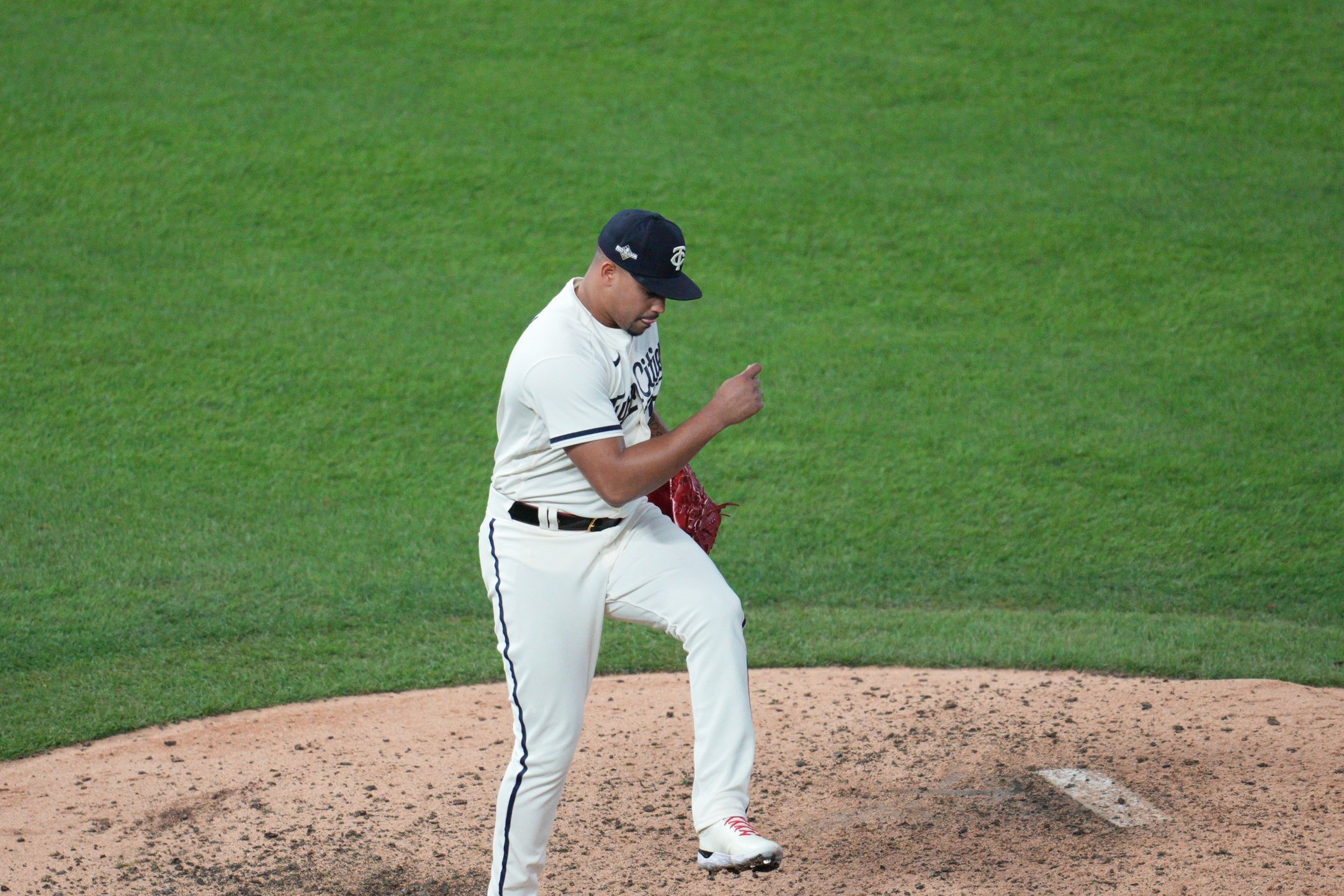
    Image courtesy of Matt Blewett-USA TODAY Sports

    Twins Video

    The date is October 11th. The Twins are facing the Houston Astros at Target Field, hoping to stay alive in the ALDS after falling behind two games to one the previous day. Heading into the ninth inning of Game 4, Minnesota trails Houston by one. It all comes down to this.

    Thinking back to my experience as a fan in the stands, memories of these final moments of the season are a bit hazy, and not only because I'd had a few hazy IPAs over the course of the day. Like many others in attendance, I was in a state of emotional turmoil, frustrated by the team's performance over the past two days and coming to grips with the inescapable feeling this fun ride was about to reach an end.

    Sadly, that ninth inning played out pretty much exactly according to our worst expectation. As such, I haven't had much desire to think about it since. But now that enough time has passed, I'm ready to dive back into this last gasp for the 2023 Minnesota Twins. What does the manner in which this team was eliminated tell us about them as a whole, and how they can take the next step?

    First, to set the stage: After suffering a painful blowout loss behind Sonny Gray in Game 3, the Twins decided to go all-out and empty their bullpen bench. They started Joe Ryan, but he only threw two innings before giving way to the reliever parade. Brock Stewart, Caleb Thielbar, Chris Paddack and Griffin Jax combined for five innings, and they were nearly perfect, outside of a two-run homer allowed by Thielbar.

    That home run was enough to put the Astros ahead by one through seven innings. With Houston set to turn over the order in the eighth, the Twins turned to their bullpen ace, Jhoan Durán. He retired the side in order, but Bryan Abreu did the same in the bottom half. It all came down to the final six outs.

    Top of the Ninth: Durán Keeps Dominating
    In the previous inning, Durán quickly dispatched Martín Maldonado, José Altuve and Alex Bregman on a groundout and a pair of fly balls. Bringing Durán back out for another inning, given the stakes, was likely an easy decision for Rocco Baldelli. The flame-throwing righty had been Minnesota's workhorse in the bullpen all year long, and they needed him now more than ever, to keep this game within range.

    Durán opened the frame with an excruciatingly tough assignment: Yordan Álvarez had terrorized the Twins all series long. Unfazed, Durán made quick work of him, striking out Álvarez on three pitches. He started by freezing the Astros slugger with a curveball, then got a whiff on a low splitter at 98 MPH before spiking a curveball that Alvarez chased. Beauty. 

    alvarezduranmatchup.png

    One enjoyable thing about going back to this last game of the Twins' season was rediscovering a few genuinely cool highlights that I'd sort of forgotten. The quality of Paddack's outing (2.1 IP, 1 H, 0 BB, 4 K) is one of them. This dismantling of Álvarez by Durán was another. One titan overpowering another.

    Durán followed up by inducing a weak groundout from Kyle Tucker. He then gave up a single to José Abreu, before retiring Michael Brantley on a lineout to complete his two clean innings. It was an emphatic finish to a spectacular first postseason for Durán. In five innings across four appearances between the ALWC and ALDS, Durán allowed no runs on two hits and one walk. He struck out six and induced a 23% swinging strike rate.

    The 25-year-old has already established himself as one of the best relievers in franchise history. Regardless of what's been going on around him, he's dependably done his part since arriving in the majors. It's fitting that Durán was on the mound when they ended their postseason losing streak, and when they clinched their ALWC victory over Toronto. It's also fitting he was the last man standing on the hill when it all came to an end, doing his part, still giving them a fighting chance.

    Bottom of the Ninth: Twins Whiff Their Way to Elimination
    Naturally, the Astros sent out their closer, Ryan Pressly, to try and extinguish Minnesota's remaining life. Pressly and Durán have an interesting relationship in Twins history; Pressly was shipped out to Houston ahead of the 2018 deadline, on the very same day (July 27th) that the Twins acquired Durán from the Diamondbacks.

    If the vision at that time was for Durán to eventually fill the same role for the rebuilding Twins as a late-inning dominator capable of shutting down any opponent, then the front office was quite prescient. Still, I think they'd like to take back the Pressly trade if they could. Instead of having him available to their division-winning team in 2019 (and maybe beyond), they've watched Pressly do what Durán just did in October, pretty much every year. In exchange for Gilberto Celestino and Jorge Alcalá, Minnesota gave up one of the best postseason relievers since Mariano Rivera–and sent him to the powerhouse they were trying to overcome in their own league, no less.

    In 46 postseason appearances, Pressly has a 2.22 ERA and an 11.7 K/9 rate. He's never been tagged with a playoff loss and, perhaps most staggeringly, has allowed one (1) home run, while facing 181 batters in (mostly) game-deciding moments.  

    That's what the Twins were up against. Their identity all year long had basically boiled down to "strike out or home run"--they tied for the AL lead in homers while setting the all-time major-league ounchout record--and so it probably shouldn't have been hard to guess how this was going to go down.

    First up, Jorge Polanco. He presented a solid matchup from Minnesota's perspective; a switch-hitter who takes good at-bats and doesn't strike out a ton. Polanco had demonstrated his ability to jolt the Twins offense earlier in this series. But here, as he led off the ninth inning of Game 4, it wasn't meant to be.

    Pressly got ahead with a called strike on a curveball, then kept feeding breaking balls, but Polanco didn't bite. He watched a slider, then two curveballs drop out of the zone, moving ahead 3-1. Pressly was in danger of a leadoff walk in front of the heart of Minnesota's lineup.

    Instead, he found the zone with a backdoor slider for a called strike, and then came with another slider down and in, striking out the veteran infielder on a foul tip. Polanco, who slugged .636 against fastballs in 2023, never saw one in this at-bat.

    presslypolancomatchup.png

    That brought up Royce Lewis, who offered his own sense of fleeting optimism for Twins fans. Lewis gave us a spectacular postseason breakout, with four home runs through his first six games, including a first-inning bomb to open the scoring in this one. But the experienced and battle-tested Pressly knew exactly how to approach the excitable rookie, hunting for another big moment.

    Like Polanco, Lewis feasted on fastballs all year, except to an even greater extent: he slugged .821 against four-seamers, with a .461 wOBA against all heaters. So what does Pressly do? Starts him out with a four-seam fastball at the top of the zone, right at elbow level. It was technically the kind of pitch Lewis wanted, but he couldn't catch up to the 95-MPH offering and swung through it. 

    Having raised the hitter's eye level, Pressly did the classic pitcher thing, dropping a curveball over the plate at the knees for strike two. At this point, Pressly had Lewis on the ropes, setting the stage for another of those nice little subplots that had kind of slipped my mind: Lewis really battled here.

    Knowing that he's an aggressive hitter to begin with, and emotionally primed to intensify that tendency in this moment, it'd be easy to see him chasing with a heroic cut as Pressly attempted to lure him out of the zone. I think that's what most of us in the stands were apprehensively bracing for. But Lewis held strong.

    Granted, Pressly didn't quite execute in this spot. He bounced a couple breaking balls and then threw a fastball well outside the zone. But Lewis watched three straight pitches, to work the count full, at which point the Astros closer unleashed a devastating 83-MPH curveball that dropped to the very bottom edge of the zone. A perfect pitch. Lewis swung over it.

    Up came Max Kepler, the longest-tenured Twin and last hope for the 2023 team. Following a resurgent second half, Kepler had reverted to familiar form in the postseason, with just five hits (three singles and two doubles) in 23 at-bats. Here, in his 49th career playoff plate appearance, Kepler was still looking for his first RBI.

    He wouldn't get it. Like Polanco and Lewis, Kepler put forth a good AB but came up empty. After fouling off a curveball and then taking three chase-me changeups to get ahead in the count 3-1, Kepler fouled off a hittable slider and then took a fastball on the outside corner, ending the at-bat and the Twins' season.

    Kepler erupted in anger as the home plate umpire punched him out, but the pitch was a strike, and I suspect Max knew it. His frustration surely stemmed from the overall situation–a big opportunity at home fumbled, a season brought to an end–as well as an earlier at-bat where he and the Twins truly WERE robbed, in pivotal fashion.

    In the sixth inning, Kepler was called out an egregiously inside pitch from Hector Neris, leaving the crowd confused after seemingly watching Lewis steal second to move into scoring position as the tying run with a full count. That's what should have happened. But the mounting threat was foiled by this brutal strike call on a pitch several inches off the plate. Everyone gets bitten by bad calls, but through the annals of Twins postseason misery, highly consequential blown calls like these really are persistently glaring.

    In this sense, Kepler's frustration was understandable. The fact remains: he stood with the bat on his shoulder as the Twins were eliminated, leaving Carlos Correa in the on-deck circle and extending his lifetime postseason record to 6-for-41 with a .505 OPS. Will that be our final memory of Kepler in a Twins uniform? It would be a bummer.

    So, What Have We Learned?
    A few things strike me as I revisit this last inning of Minnesota Twins action in 2023. One is that we probably don't talk enough about the Pressly trade, and how dramatically it helped shift the balance between Minnesota and Houston over the past five years. On the flip side, thank goodness for Durán.

    Another is a reaction that many reading this probably share: MAN, this offense was on-script, with all the strikeouts that drowned out any chance of a rally or comeback. It wasn't just the ninth inning; Byron Buxton's meager popout to first as a pinch-hitter in the eighth inning was the only plate appearance out of the last eight for the Twins that didn't result in a strikeout. Here's how they closed things out: 

    • Jeffers: K swinging
    • Castro: K swinging
    • Solano: K swinging
    • Buxton: Pop fly to 1B
    • Julien: K swinging
    • Polanco: K swinging
    • Lewis: K swinging
    • Kepler: K looking

    The strikeouts were completely out of control this year. The Twins have got to find a way to rein them in and lessen their susceptibility to these momentum-stifling stretches of fruitless at-bats. At the same time, the front office understandably remains focused on prioritizing power, even at the expense of contact.

    "It would obviously be ideal if Minnesota had stacked lineups of superstar hitters who hit for power and don’t strike out, like those big-market teams," wrote Do Hyoung Park. "But here’s what the Twins do really well: They hit the ball hard and in the air, and they take their walks. And the way they see it, if that comes with a tradeoff of more strikeouts, they’re willing to make that trade."

    The value of this general offensive philosophy is hard to quibble with; every run scored in Game 4 came on a home run, and the long ball played an outsized role throughout the playoffs. At the same time, there has to be some kind of balance. There comes a point where too many strikeouts is too many, and I believe we've seen it, throughout the latest Twins season and especially at its conclusion.

    I'd love to hear from readers and other fans about what stands out to them as they think back to the final game (and inning) of the Twins season. How can the front office best make sure it comes later next year?

    Follow Twins Daily For Minnesota Twins News & Analysis

    Recent Twins Articles

    Recent Twins Videos

    Twins Top Prospects

    Marek Houston

    Cedar Rapids Kernels - A+, SS
    The 22-year-old went 2-for-5 on Friday night, his fourth straight multi-hit game. Heading into the week, he was hitting .246/.328/.404 (.732). Four games later, he is hitting .303/.361/.447 (.808).

    User Feedback

    Recommended Comments


    Featured Comments

    48 minutes ago, Schmoeman5 said:

    The Twins won 86 games. They were top 5 in homers. Why only 86 wins? When you find yourself in a close ball game against better pitching do you change your approach?  They did against Gausman. By laying off the splitter out of the strike zone which allowed them some good swings on fastballs. You're arguing just to argue about out homering your opponent.  When you limit yourself to only 1 option to score regardless of the situation is crazy. And it's also why they got bounced. Hey look! They won their games when they out homered their opponents but they lost when they didn't. They need to double down. They might stike out 2000 times this year but they hit more homers. So it must be working. 2019. Another perfect example of all or nothing. The recipe is getting guys on base. Then homer. Solo shots look good on the highlight reel. 

    You added a whole bunch to this comment while/after I replied. They didn't change their approach against Gausman. Chasing splitters out of the strike zone was never part of their strategy. Getting good pitches to drive (like fastballs in the zone) is their strategy. If they don't get those good pitches then they don't swing. That's the strategy.

    You realize that the opposite side of out homering your opponent is to be the team that had to score in other ways, right? I hit 3 home runs and you hit 1. The only way for you to win that game is for you to either have hit a grand slam to my 3 solo home runs, or to have scored more runs doing things a different way. And, in the playoffs, the teams that have to score runs without hitting as many home runs win the game 14.5% of the time. If you want it to be the reason the Twins got bounced, cool. It was the reason the Rangers won the World Series so you can take that however you want.

    Yes, getting on base is another important part. Nobody has said it isn't. What you guys have complained about is the strike outs vs the home runs. The home runs are more important as is easily proven by looking at the stats. That doesn't mean they shouldn't be concerned about their extreme K rates last year. It doesn't mean that taking walks or getting singles or anything else simply doesn't matter. It means that home runs are more important than any of those other stats. All the best offenses have the same strategy as the Twins. Know what pitches you handle well and look for them. If you get them look to do maximum damage. The question comes down to who's able to execute on those maximum damage attempts the most. Which comes down to talent. If I can only do damage on fastballs middle middle, but you can do damage on multiple types of pitches in multiple locations because you're more talented than me it's likely you're going to do much better than me at being able to do maximum damage. Doesn't seem like too crazy of an idea.

    2 minutes ago, chpettit19 said:

    I don't understand the argument here. The obvious idea behind that stat is that hitting for power is the best way to score runs. The teams that didn't hit as many home runs (the teams that win 14.5% of the time) were scoring their runs (or failing to score any runs) in a different manner. You first sentence is literally agreeing with the idea that hitting for power should be their strategy since you're equating hitting more home runs to scoring more runs. Really confused by what you're trying to spin this into.

    Your stat basically says "teams who score more are more likely to win".  Do you find that insightful?  I don't.  Again, I'm guessing teams who score more non HR runs are equally as successful - why aren't you focusing on that as a strategy?  


    3 minutes ago, chpettit19 said:

    Yes, getting on base is another important part. Nobody has said it isn't. What you guys have complained about is the strike outs vs the home runs. The home runs are more important as is easily proven by looking at the stats.

    There are 3 outcomes for a plate appearance:  putting the ball in play, walking, or striking out.  Eliminating a strikeout can only result in putting the ball in play (reaching base 30% of the time) or walking (100% of the time).  There is a direct correlation between less strikeouts and more guys on base.  

    1 minute ago, Woof Bronzer said:

    Your stat basically says "teams who score more are more likely to win".  Do you find that insightful?  I don't.  Again, I'm guessing teams who score more non HR runs are equally as successful - why aren't you focusing on that as a strategy?  


    The stat is showing that teams who score via routes other than HRs win less. Teams who hit fewer HRs than their opponents have to score more non-HR runs to win the game. So the stat is showing that teams that are forced to score more non-HR runs win 14.5% of the time. That's why I'm not focusing on that as a strategy. 

    2 minutes ago, Woof Bronzer said:

    There are 3 outcomes for a plate appearance:  putting the ball in play, walking, or striking out.  Eliminating a strikeout can only result in putting the ball in play (reaching base 30% of the time) or walking (100% of the time).  There is a direct correlation between less strikeouts and more guys on base.  

    And just getting on base doesn't help unless you come around to score. In the playoffs (this thread is about the final inning in the playoffs) it's a lot harder to come all the way around to score without hitting for power because the pitching is better. There's 1 way to guarantee yourself a run while hitting: hitting a homerun.

    I've said numerous times that the Twins struck out too much last year. They need to lower that number. But it's not as bad as people are making it out to be (unless you're strictly speaking about enjoyment watching. I think it's terribly boring watching 3 true outcome offenses). There's a balance that needs to be struck, but striking out is acceptable as long as you can balance it with enough power.

    1 hour ago, Schmoeman5 said:

    The Twins won 86 games. They were top 5 in homers. Why only 86 wins

    It’s all about trying to be efficient - K’s are up everywhere in baseball & have been for years and nearly in every instance, power guys strike out much more. The Twins problem in ‘23 was an imbalance in HR’s per K with certain individuals.

    OBP

    .301 - Gallo - 21 HR  - 142 K’s - 6.76K per HR

    .369 - Jeffers - 14 HR - 93 K’s - 6.64K per HR

    .370 - Wallner - 14 HR - 80 K’s - 5.72K per HR

    .280 - Vazquez - 6 HR - 82 K’s - 13.66K per HR

    .381 - Julien - 16 HR - 128 K’s - 8.00K per HR

    .332 - Kepler - 24 HR - 106 K’s - 4.42 per HR

    .335 - Polanco - 14 HR - 88 K’s - 6.29 per HR

    .294 - Buxton - 17 HR - 108 K’s - 6.41 per HR

    .312 - Correa - 18 HR - 131 K’s - 7.28 per HR

    .278 - Taylor - 21 HR - 130 K’s - 6.19 per HR

    .372 - Lewis - 15 HR - 55 K’s - 3.67 per HR

    .369 - Solano - 5 HR - 100 K’s - 20.00 per HR

    .339 - Castro - 9 HR - 99 K’s - 10.00 per HR

    .348 - Kirilloff - 11 HR - 80 K’s - 7.27 per HR

    .317 - Farmer - 11 HR - 86 K’s - 7.82 per HR

    Threshold (the floor) for these levels are arbitrary……I think a minimum acceptable level for a good player is an OBP of .330.

    With no defense involved, it’s interesting that it seems Taylor, despite 21 HR should not be pursued at all! Obviously, Gallo should not be pursued. If there’s a possibility to move Vazquez, even at $3-$4M/yr cost he’s not someone to be carried on a roster, offensively.

    Farmer has reasonable strikeout/HR ratio & his defense keeps him in play. OBP is subpar.

    Correa needed 2-3 more HR & 10 more hits/walks and he would have had an acceptable regular season.

    Julien strikes out too much. His OBP saves him……his defense does not add to his value.

    Wallner is a bright spot in OBP & power!

    Lewis jumps off the page as a budding star!!

    Should not consider trading Kepler, even if he didn’t play sound defense!!!

    Solano has to be scrutinized due to zero power and limited defense. Inexpensive & solid OBP. Borderline.

    Castro’s defensive flexibility lifts him off the borderline status.

    Just a different view that picked up momentum as I went - interesting to ponder?

    1 hour ago, chpettit19 said:

    You added a whole bunch to this comment while/after I replied. They didn't change their approach against Gausman. Chasing splitters out of the strike zone was never part of their strategy. Getting good pitches to drive (like fastballs in the zone) is their strategy. If they don't get those good pitches then they don't swing. That's the strategy.

    You realize that the opposite side of out homering your opponent is to be the team that had to score in other ways, right? I hit 3 home runs and you hit 1. The only way for you to win that game is for you to either have hit a grand slam to my 3 solo home runs, or to have scored more runs doing things a different way. And, in the playoffs, the teams that have to score runs without hitting as many home runs win the game 14.5% of the time. If you want it to be the reason the Twins got bounced, cool. It was the reason the Rangers won the World Series so you can take that however you want.

    Yes, getting on base is another important part. Nobody has said it isn't. What you guys have complained about is the strike outs vs the home runs. The home runs are more important as is easily proven by looking at the stats. That doesn't mean they shouldn't be concerned about their extreme K rates last year. It doesn't mean that taking walks or getting singles or anything else simply doesn't matter. It means that home runs are more important than any of those other stats. All the best offenses have the same strategy as the Twins. Know what pitches you handle well and look for them. If you get them look to do maximum damage. The question comes down to who's able to execute on those maximum damage attempts the most. Which comes down to talent. If I can only do damage on fastballs middle middle, but you can do damage on multiple types of pitches in multiple locations because you're more talented than me it's likely you're going to do much better than me at being able to do maximum damage. Doesn't seem like too crazy of an idea.

    You're going all over just to try and make the Park quote work. So I was off by 1 on the Twins win. 87. Why does it seem to be such a drastic difference in the playoffs and regular season? The Twins didn't win at a 60% clip all year let alone the 85% and that's with a top 5 statistic wise pitching staff. And I stated that usually playoff games are tighter scoring wise yet this doesn't seem the case for 2023 playoffs. So I really can't explain the difference.It's kind of like the old basketball analogy of win by the jump shot die by the jump shot. But now it's throw up as many 3s as possible. You'll score more points even with a lower %. 

    3 minutes ago, Schmoeman5 said:

    You're going all over just to try and make the Park quote work. So I was off by 1 on the Twins win. 87. Why does it seem to be such a drastic difference in the playoffs and regular season? The Twins didn't win at a 60% clip all year let alone the 85% and that's with a top 5 statistic wise pitching staff. And I stated that usually playoff games are tighter scoring wise yet this doesn't seem the case for 2023 playoffs. So I really can't explain the difference.It's kind of like the old basketball analogy of win by the jump shot die by the jump shot. But now it's throw up as many 3s as possible. You'll score more points even with a lower %. 

    It's a drastic difference in the playoffs because the pitching is better in the playoffs. It's a lot harder to string together multiple walks and hits in an inning against big time pitchers than it is to hit one over the fence here and there.

    What is the average difference in scores in the regular season and playoffs? I honestly don't know so I don't know if playoff games are usually tighter scoring or not. Wouldn't be shocked by that, but there are also plenty of blowouts every year.

    And, yes, it is like basketball and 3 pointers. It's the mathematically most efficient way to score and thus give yourself the best chance to win. I don't think these things are good for baseball or basketball in an entertainment sense. I've hated 3 true outcome approaches since they started popping up. But I want the Twins to win. In the playoffs. And the best way to win in the playoffs is to bash. If you can provide me another stat that has a higher winning % than out homering your opponent I'll jump on that bandwagon instead. But the numbers have been this way for years and years. Hitting HRs wins in the playoffs. And I want the Twins to win in the playoffs. Hitting HRs is actually one of the "stickier" stats from the regular season to the postseason as well. As in there's not a large drop off in the number of HRs hit per game in the regular season and the postseason. It's the best strategy I've seen yet. Even if all the Ks are horribly frustrating to watch.

    On 12/19/2023 at 9:54 AM, Nick Nelson said:

    I'd love to hear from readers and other fans about what stands out to them as they think back to the final game (and inning) of the Twins season. How can the front office best make sure it comes later next year?

    I really appreciate how you broke down those final plate appearances, pitch by pitch. That is often how pitchers and catchers see it—when to waste a pitch, when to try to steal a strike, what to throw on the first pitch, what to follow after a fastball or curve, etc.

    Now the trigger warning. Even aside from the strikeout debate, there is too much magical thinking going on. The best example is Buxton. The whole Buxton saga was a disaster, all the way back from the start of spring training not playing in any games, to that final at bat in the 8th when he hit a fly ball to the first baseman at a 51mph exit velocity off a 98mph fastball. And everything in between. Remember everyone lauded and took credit for the plan to have Buxton DH when wit was working through April and early May. In September they gave Toby Gardenhire the go-ahead to play Buxton for 7 full innings in the field in his first rehab appearance, when so many of us were expecting them to ease in Buxton an inning at a time.

    I didn’t even realize Buxton’s plate appearance in Game 4 was the last one a Twin put a ball in play. None of us on the outside knew it at the time, but Buxton was completely unprepared to take that at bat in the 8th when they only had six outs left give. I’d love to know if there have been private conversations about this in the front office or owner’s suite, or owner’s supper table. 

    That said, there were a lot of highlights and fun moments to go along with the long stretches of badness. Beating Toronto. There was an exciting Julien pinch hit homer at a game I was at. Royce Lewis. The pitching staff. The bullpen was fine but the rotation was great, and healthy, and that will be the key again in 2024. 


    Create an account or sign in to comment

    You need to be a member in order to leave a comment

    Create an account

    Sign up for a new account in our community. It's easy!

    Register a new account

    Sign in

    Already have an account? Sign in here.

    Sign In Now

×
×
  • Create New...