


Twins Video
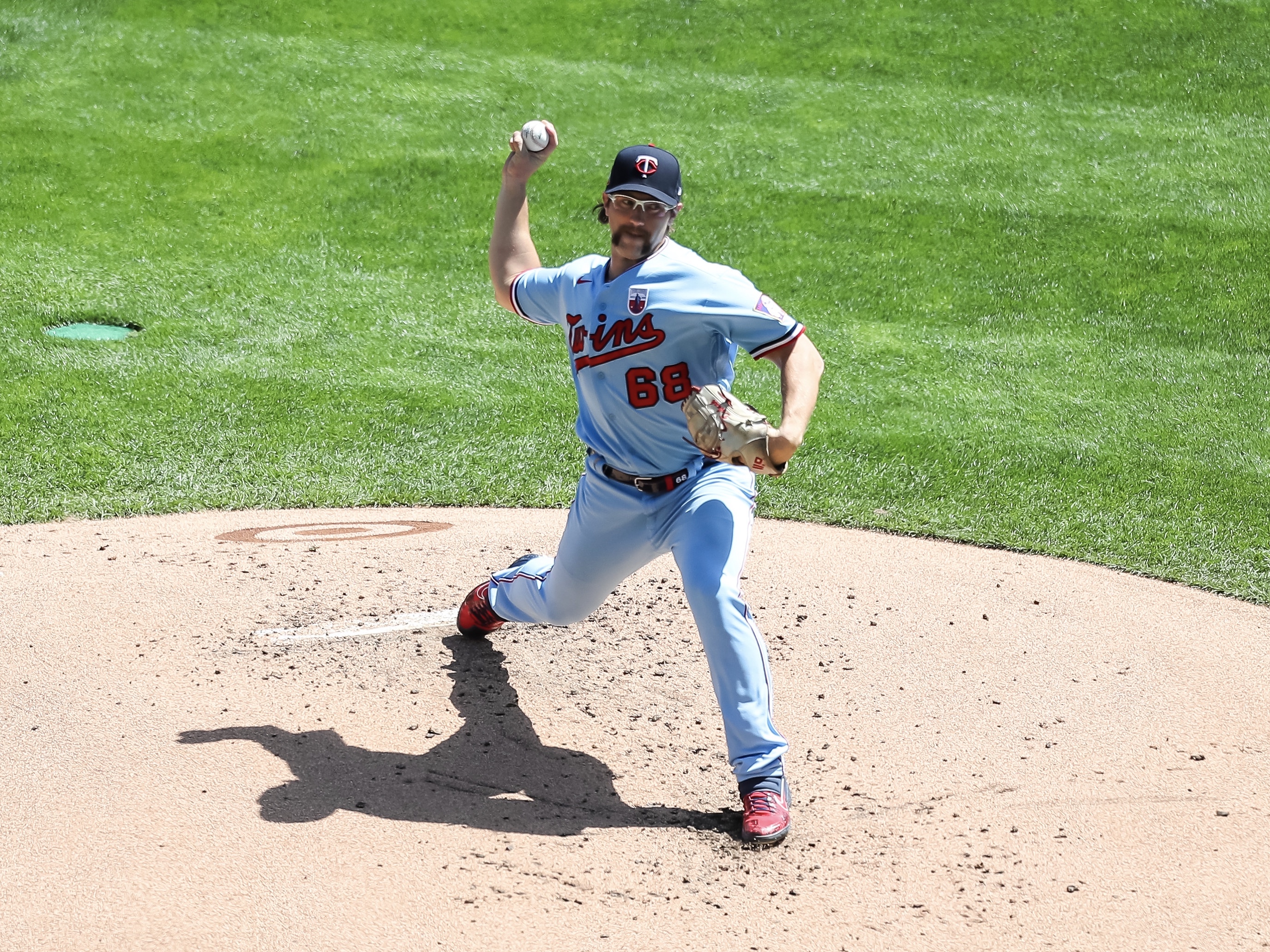
After several very strong starts to begin this strange season, Dobnak has hit a rough patch over his last two outings, and as a result, he was chewed up in the roster churn of the season’s final fortnight Wednesday. While he’s at the Alternate Site in St. Paul, the Twins should prepare Dobnak for a versatile and two-pronged but highly specialized place in the team’s relief corps for the postseason. Dobnak’s sinker is a major weapon, but it needs to be deployed strategically.
As he’s made mechanical and technical adjustments this season, Dobnak has turned a sinker that already had exceptional depth into the single heaviest pitch of its kind in the majors. With his low-three-quarter arm slot, Dobnak gets good sink, but he’s become more efficient this year, maintaining better posture and tilting his spine less as he drives through release. That’s pushed his release point down, and a minor change to his grip of the pitch has also helped increase the drop on the offering.
His 85 sinkers in September, prior to being optioned, averaged -1.72 inches of vertical movement. That number is meaningless without context, so here’s some context. Since 2015, here are the only pitchers to average more sink on their sinkers in any season than Dobnak has this month.

Note the right-hand column. The only other hurlers who get the same kind of dive on their sinkers that Dobnak achieves are sidearmers and submariners. Meanwhile, Dobnak pitches from a low but distinctly upright, non-sidearm slot. The kind of movement he generates with that pitch is so unusual as to be impossible to truly handle. That’s why Dobnak has a 62.5-percent groundball rate this season, and why his sinker has a career-best 75-percent ground ball rate this month.
Alas, that movement doesn’t translate into very many swings and misses. Batters make contact on 89 percent of their swings against the sinker. They whiff on 34 percent of their swings at his slider, but because the sinker is still his primary pitch, they rarely get as far as seeing that pitch in two-strike counts—and even when they do, they can often spoil it to extend the at-bat. Dobnak has been less pitch-efficient of late, as teams learn to handle him that way. Opposing batters are also chasing less when he tries to expand the zone—about 31 percent of the time, down from almost 39 percent in 2019. When they swing within the zone, they make contact 93.5 percent of the time. Since he mostly avoids the barrel of the bat, this isn’t a death knell, but it makes Dobnak very vulnerable as a starter.
That goes double as the lineup turns over, because Dobnak is essentially a two-pitch pitcher against right-handed batters. Most of them see his full repertoire in their first plate appearance. Lefties get roughly equal shares of changeups and sliders, to go with the sinker, but lefties aren’t fooled by Dobnak even the first time. This season, in 91 plate appearances, left-handed batters have four doubles, two home runs, seven walks, two times being hit by pitch, and just 10 strikeouts against Dobnak. He’s not strictly a matchup arm, but his numbers and skill set suggest he’ll continue to run a wide platoon split.
These are all reasons, though, why Dobnak could become a full-fledged secret weapon with a move to relief. If he could be deployed against a predominantly right-handed segment of an opposing batting order, he’d be in a position to succeed. If he were brought in with runners on base, he would be in prime position to get a ground ball and get the team out of the inning, with minimal risk that he would instead yield a game-breaking home run. He also has the durability of a fully stretched-out starter, and the tenacity that made Tyler Duffey such a good candidate for the transition from starting to relieving, temperamentally. He needn’t be in the playoff rotation to give the Twins a significant number of innings, and by shuttling him to the bullpen, the team could better take advantage of his greatest strengths while shielding themselves from his biggest vulnerabilities.
There’s one more thing that makes Dobnak an especially good fit for the Twins’ bullpen: He’s very different from most of the other pitchers on the staff, stylistically. A 2013 study centered on R.A. Dickey showed that both relievers entering the game after the notable knuckleballer and pitchers who started the next day benefited from simply following Dickey. Hitters couldn’t switch gears, mentally or physiologically, well enough to give their best at-bat against an orthodox, hard-throwing reliever after seeing Dickey for several innings. Since then, broader research has affirmed that the principle applies beyond purveyors of the butterfly ball. There’s a small but tangible benefit to giving a hitter a very different look than they’ve had in the game up to that point.
All the things listed above, from the movement on his sinker to his mechanical signature, make Dobnak just that kind of change for opposing batters. Among Twins starters, his pitch profile most resembles that of Michael Pineda, but Pineda releases the ball about a foot and a half higher than Dobnak and uses a four-seam fastball. Dobnak is a fair physical comp for José Berríos, but their pitch mixes and approaches are wildly different. Rich Hill is a southpaw famous for his verticality, with a riding fastball and whip of a curve. Kenta Maeda uses a very different arm slot than Dobnak, and attacks the zone very differently. Nor are relievers Trevor May, Taylor Rogers, or Duffey anything like Dobnak.
Even in this bizarre October, devoid of the usual days off and demanding a bit more careful management of the pitching staff than in years past, a pitcher who can so consistently induce ground balls; go multiple innings when needed; and force opposing hitters to adjust to a radical change in styles is hugely valuable. Dobnak doesn’t miss enough bats to keep starting, especially against good offenses, which is what the Twins will see. That doesn’t mean he can’t help them make a deep and successful playoff run.
MORE FROM TWINS DAILY
— Latest Twins coverage from our writers
— Recent Twins discussion in our forums
— Follow Twins Daily via Twitter, Facebook or email





Recommended Comments
Create an account or sign in to comment
You need to be a member in order to leave a comment
Create an account
Sign up for a new account in our community. It's easy!
Register a new accountSign in
Already have an account? Sign in here.
Sign In Now