


Twins Video
In each of the last three seasons, Eddie Rosario has hit like a star for about half a year, then been average (or considerably worse) for about as long. That, more than his somewhat old-fashioned approach or his lack of fielding or baserunning value, is why he’s broadly seen more as a trade candidate than as a likely mainstay for the Twins. Yet, the dichotomy in his half-season splits speaks to the impact potential he still has. One key question underpins any effort to tell whether he can sustain more consistent success in the future: Can Rosario go the other way?
Everywhere one turns (including here at Twins Daily!), there’s a simulation of the 2020 season happening, in one form or another and through one vendor or another. Visit Rosario’s Baseball Reference page, and the news is grim: his (real) brutal spring training has carried over into his (non-real) regular season, and he’s no longer a Twins regular. This imagined Rosario has a .404 OPS in 41 plate appearances.
That feels dauntingly plausible, because when one watches Rosario at the plate during one of his slumps, it’s little stretch to say that he appears to have forgotten how to hit. An exceptionally aggressive hitter at the best of times, he seems to swipe hopelessly at the ball when going badly, missing some pitches badly and weakly mis-hitting others.
Still, the primary problem isn’t how Rosario looks when going badly, just as evaluating him can’t be boiled down to how he looks (usually, great) when going well. The main issue, in forecasting Rosario’s near and medium-term future, is whether he can get himself going well more frequently, and going badly less often. To do so, he’s going to have to solve the shift.
Last year, only seven batters saw more shifts than did Rosario, according to Baseball Info Solutions. Freddie Freeman, Anthony Rizzo, Cody Bellinger, Kyle Schwarber, Brandon Belt, Kole Calhoun, and Charlie Blackmon were those seven hitters, and the two immediately behind Rosario were Carlos Santana and Bryce Harper.
It’s no surprise that all of those are left-handed batters (save Santana, who is a slow-footed switch hitter), but interestingly, most of the group is similar in other ways, especially in terms of approach. These are, by and large, patient hitters. Certainly, their patience correlates strongly with their success. It’s very hard to be a shift-prone (pull-happy) left-handed hitter and succeed, without being patient at the plate.
That’s been true since long before the shift became widely used, though. It’s part of the design of baseball. Thus, the real question isn’t whether Rosario can conquer the shift (he actually hit better against it than against non-shifted defenses last year), but whether he can change the thing that led to all those shifts in the first place: his pull rate.
Rosario hasn’t always been such a pull-conscious hitter. According to Baseball Savant, he pulled just 32.1 percent of his batted balls in 2017, but that number rose to 40.6 percent in 2018, and in 2019, it soared all the way to 44.4 percent. He’s becoming more one-dimensional, and given his ability to consistently make contact on such a wide array of pitches, that seems like the kind of concession he could avoid making if he rearranged his approach.
Worse news: on pitches on the inner part of the plate (and just off it), Rosario has gotten steadily less productive over the last three years. In 2017, his wOBA on such pitches was .447. In 2018, it rose to .477. In 2019, though, it plunged to .391. A would-be left-handed slugger, especially one without the discipline to draw walks consistently, needs to do more damage than that on the inside pitch. Rosario hit those pitches harder than ever, on average, in 2019, but elevated it less, and the result was considerably less production—and more groundouts into the shift.
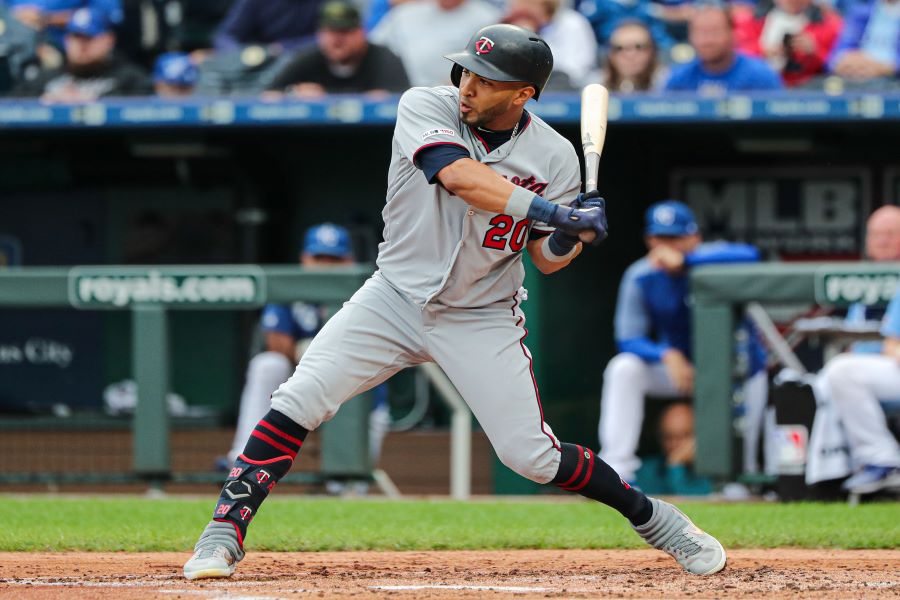
Rosario hasn’t been hit by a pitch since July 29, 2016. That’s a little surprising, initially, because he has that familiar, closed stance, with his front foot near the inner line of the batter's box. To begin his swing, though, Rosario uses a toe tap, then strides forward and opens his front hip. In watching video of him, it sure looks like he’s become increasingly prone to letting the transition from his toe tap to his real stride carry him away from home plate, opening him up too much. As a result, he’s not hammering pitches on the inner half of the plate, and he’s not reaching pitches on the outer portion as cleanly.
Opening up this way occasionally allows Rosario to yank a pitch on the outer part of the plate out of the park, but for that rare gain, he’s given away his ability to drive the ball to the opposite field. The effects on his handling of inside pitches help illustrate the problem, but it’s pitches down the middle and away from him that he could handle much better, and to do so, he’s going to need to clean up his stride pattern. If he does so, he can get a better look at the ball, keep opposing defenses honest, and give himself more chances to reach base. If he doesn’t, he’s going to end up on some other team soon after baseball resumes.
MORE FROM TWINS DAILY
— Latest Twins coverage from our writers
— Recent Twins discussion in our forums
— Follow Twins Daily via Twitter, Facebook or email






Recommended Comments
Create an account or sign in to comment
You need to be a member in order to leave a comment
Create an account
Sign up for a new account in our community. It's easy!
Register a new accountSign in
Already have an account? Sign in here.
Sign In Now