

Jump to content
Twins Daily
  • Create Account
  • Twins News & Analysis

    Barreling Up: Quantifying the Power Potential of the 2020 Minnesota Twins Via Statcast


    Patrick Wozniak

    It’s no secret that the 2019 Minnesota Twins were very good at hitting home runs. Predicting just how many the Bomba Squad will hit in 2020 is tricky due to the ambiguity surrounding the ball (Twins Daily’s Andrew Thares gives his predictions here), but by looking at MLB Statcast’s Barrel Percentages we can get a good idea of what kind of power potential the Twins have.

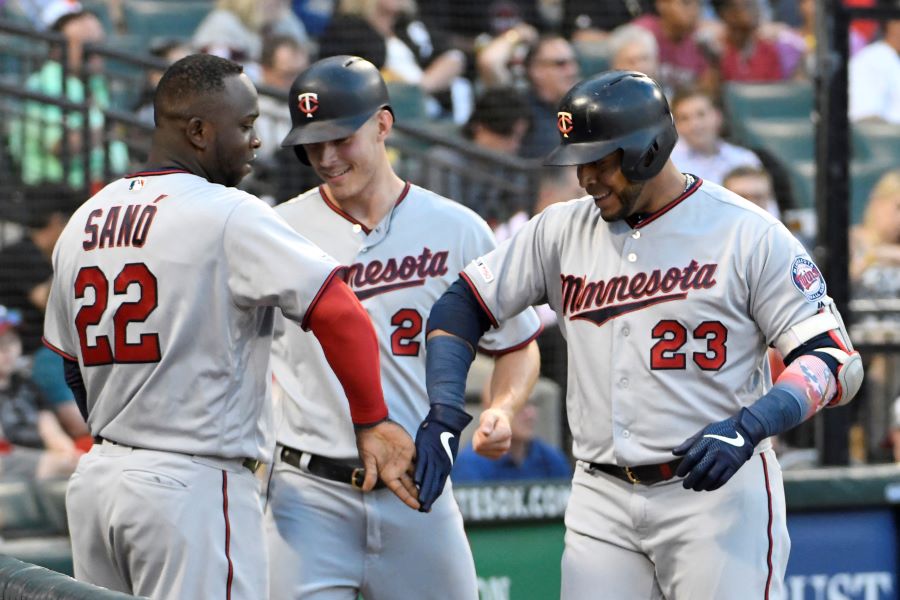
    Image courtesy of © David Banks - USA TODAY Sports

    Twins Video

    According to MLB Statcast, “The Barrel classification is assigned to batted-ball events whose comparable hit types (in terms of exit velocity and launch angle) have led to a minimum .500 batting average and 1.500 slugging percentage since Statcast was implemented Major League wide in 2015.” Keep in mind that those batting average and slugging percentage results are the minimum, so barreling the ball is a very good thing to do if you are hitter.

    ccs-11737-0-98009400-1580269377_thumb.png

    Barrels are essentially balls that are hit very hard (minimum of 98 mph) in combination with good angles (26-30 mph on balls hit 98 mph, but the angle range increases with velocity). Intuitively, it makes sense that hitting the ball hard at optimal angles would lead to good power, and that has been the case, as barrels correlate well with power numbers such as HR/FB%.

    With this in mind, it’s not surprising to find some of Minnesota’s 2019 sluggers atop the barrels (Brls/PA) leaderboard, but we also find a few new Twins among the leaders. Let’s take a look at the Twins and see who are good bets to slug Minnesota through 2020.

    The Sluggers

    1) Nelson Cruz – 12.5% Brls/PA, 93.7 mph EV, 13.1° LA, 51.5% Hard Hit

    It’s really no surprise to find Nelson Cruz leading the Twins in barrels, but it is quite impressive that the 39-year-old led all of baseball. The results were there for all to see, as Cruz hit a team-leading 41 home runs in 2019. He was also third in average exit velocity and fifth in hard hit percentage (95 mph+) so Cruz has a lot going for him. If Cruz’s wrist holds up, he seems a good bet to continue in his defiance of Father Time.

    6) Miguel Sano – 10.7% Brls/PA, 94.4 mph EV, 15.9° LA, 57.2% Hard Hit

    While it’s not all that surprising to see Cruz at number one, some may be taken aback at just how high his understudy, Miguel Sano, comes in. Sano trailed only Aaron Judge in average exit velocity and led the league in hard hit percentage. Sano was no stranger to the long ball in 2019 as he hit 34 in just 439 plate appearances. A healthy Sano should put up big power numbers in 2020.

    12) Mitch Garver – 9.7% Brls/PA, 91.1 mph EV, 15.3° LA, 50.0% Hard Hit

    Mitch Garver’s short and compact swing brought loads of power into his breakout season. After putting up a .995 OPS as a catcher in 2019, it is only natural to expect some regression from Garver. However, his ability to hit the ball hard with a good launch angle bodes well for Garver’s future as a slugger. Hitting 31 home runs in 359 plate appearances was absurd, but his Statcast numbers show that his power should continue to play this season.

    17) Josh Donaldson – 9.4% Brls/PA, 92.9 mph EV, 13.3° LA, 50.0% Hard Hit

    A healthy Josh Donaldson showed what he can do in 2019, as he hit 37 dingers for the Atlanta Braves while his exit velocity ranked seventh in the MLB. His great glove at third will undoubtably improve the infield defense, but his patience and power at the plate will be an invaluable asset as well. Signed for the next four seasons and already 34-years-old, the Twins hope Donaldson will age as gracefully as his new teammate, Nelson Cruz. His Statcast numbers suggest his bat isn’t going away anytime soon.

    The Next Tier

    The 2020 Minnesota Twins will feature four additional hitters who were above average in barrels (Brls) last season.

    24) Alex Avila – 9.0% Brls/PA, 91.4 mph EV, 9.4° LA, 49.0% Hard Hit

    90) Jake Cave – 7.4% Brls/PA, 90.5 mph EV, 7.4° LA, 43.8% Hard Hit

    92) Eddie Rosario – 6.9% Brls/PA, 89.1 mph EV, 16.7° LA, 36.0% Hard Hit

    122) Max Kepler – 6.4% Brls/PA, 89.7 mph EV, 18.2° LA, 41.7% Hard Hit

    It’s surprising to see newly-acquired backup catcher, Alex Avila ranked so high. While his exit velocity and hard-hit percentage are really good, his launch angle is below where it needs to be to hit loads of homers. Nonetheless, coupled with his ability to take walks he’s just fine for a backup catcher. Fourth outfielder Jake Cave is in a similar boat, as he hits the ball hard with an even lower launch angle. If he gets under the ball a bit more, he could see an uptick in home runs, but his playing time will likely be limited.

    The final pairing of outfielders Eddie Rosario and Max Kepler don’t quite bring the punch of Avila or Cave, but their ability to launch the ball is what fuels their power numbers. The duo combined for 68 dingers in 2019 with Kepler adding 16 long balls to his 2018 total. Both Rosario and Kepler’s average home run distance is below the first group of sluggers, so they may be more affected by potential ball changes, but should still be good bets to hit for plenty of power in 2020.

    So, there you have it. While repeating 307 home runs is probably overly optimistic, Twins hitters do have the underlying skills to expect big power numbers this season. Regardless of ball changes, Cruz, Sano, Garver, and Donaldson should continue to crush the ball and their supporting cast isn’t too shabby either. Brace yourselves for another bomba-filled thrill ride!

    MORE FROM TWINS DAILY

    — Latest Twins coverage from our writers

    — Recent Twins discussion in our forums

    — Follow Twins Daily via Twitter, Facebook or email

    Follow Twins Daily For Minnesota Twins News & Analysis

    Recent Twins Articles

    Recent Twins Videos

    Twins Top Prospects

    Marek Houston

    Cedar Rapids Kernels - A+, SS
    The 22-year-old went 2-for-5 on Friday night, his fourth straight multi-hit game. Heading into the week, he was hitting .246/.328/.404 (.732). Four games later, he is hitting .303/.361/.447 (.808).

    User Feedback

    Recommended Comments

    Featured Comments

    So this year expect 3 30+ HR hitters. (Donaldson, Sano, and Cruz). Garver can make it with enough ABs. And we will have atleast 7 hitters with 20+ HRs. Polanco and possibly Buxton can do it too but best not to bank on it. That is what I am taking away from this

    But let's dump Jake Cave from the 26-man roster...because...well, pretty much any free agent we could pick up would be better than him...not to mention about a half dozen guys within our own organization who have options. Right? :)


    Also, wouldn't read too much into the Avila number. 2019 was an extremely small sample size for him (only 200 or so PA). Although his bat will play up...as long as Garver is healthy...Avila can basically avoid left-handed pitching entirely, as was the case last year for him with the Diamondbacks.


    Nice article. Interesting. What has never made sense to me is how a guy like Sano can be among the league leaders in swings-and-misses (I presume this to be true)...and also right at the top of barrel percentage. How does that work? You frequently miss the ball entirely, but when you make contact, your contact is more precise than everyone else? I suspect that what's closer to the truth is that 'ordinary' players often put the barrel on the ball, but don't get the results to qualify under this metric. Meanwhile, Sano probably leads the universe in not getting the middle of the barrel to the ball...and having the result still meet the mph and launch angle criteria.


    I would guess that there are two types of hitters than fit at the top of this chart. Great hitters (like Cruz), and ridiculously strong hitters, like Sano. In other words...this could get even better for Sano.

    Nice article. Interesting. What has never made sense to me is how a guy like Sano can be among the league leaders in swings-and-misses (I presume this to be true)...and also right at the top of barrel percentage. How does that work? You frequently miss the ball entirely, but when you make contact, your contact is more precise than everyone else? I suspect that what's closer to the truth is that 'ordinary' players often put the barrel on the ball, but don't get the results to qualify under this metric. Meanwhile, Sano probably leads the universe in not getting the middle of the barrel to the ball...and having the result still meet the mph and launch angle criteria.

    His numbers are what they are because he swings the bat really damn hard. He’s not getting cheated when he’s ahead in the count. Thus, a lot of swings and misses. He doesn’t have some inherent flaw relative to other MLBers that cause him to swing and miss more. The nature of swing is all or nothing. The numbers make total sense. I’d wager that the same pattern would hold for guys like Killebrew, McGuire, and various other prolific power hitters throughout history.


    His barrel percentage is high when making contact because he’s also a really damn good hitter, which many seem to refuse to believe. It’s possible to swing and miss a lot and still be a great hitter when you’re taking a certain approach. He’s not just getting by on his strength, which seems to be a prevailing assumption (there are a lot of incredibly strong people in Major League Baseball, newsflash, and nobody hits the ball harder).


    Case in point, your conclusion of, “the opposite of what the numbers say is true, and he sucks at barreling the ball.....but somehow still hits it harder than everyone in the planet.” That’s not really how a baseball bat works, no matter how strong you are.


    His numbers are what they are because he swings the bat really damn hard. He’s not getting cheated when he’s ahead in the count. Thus, a lot of swings and misses. He doesn’t have some inherent flaw relative to other MLBers that cause him to swing and miss more. The nature of swing is all or nothing. The numbers make total sense. I’d wager that the same pattern would hold for guys like Killebrew, McGuire, and various other prolific power hitters throughout history.

    His barrel percentage is high when making contact because he’s also a really damn good hitter, which many seem to refuse to believe. It’s possible to swing and miss a lot and still be a great hitter when you’re taking a certain approach. He’s not just getting by on his strength, which seems to be a prevailing assumption (there are a lot of incredibly strong people in Major League Baseball, newsflash, and nobody hits the ball harder).

    Case in point, your conclusion of, “the opposite of what the numbers say is true, and he sucks at barreling the ball.....but somehow still hits it harder than everyone in the planet.” That’s not really how a baseball bat works, no matter how strong you are.

    Is that what I said? Not even in the universe of what I said.


    If I don't call Sano a great hitter...yet...it's not quite the same as saying I don't think he has value, is it? He does. Quit a bit. Meanwhile, he still has his pitch recognition issues and he still cheats at times to protect the inner half....those challenges contribute to the swings and misses...not just "swinging hard" (Sano's a lower-half guy in terms of generating the power).


    The puchline to my post was that Sano's results can get even better.  It's a function of the immense power combined with material opportunities for improvement. It's the opposite of a bad thing to say about Sano.


    Create an account or sign in to comment

    You need to be a member in order to leave a comment

    Create an account

    Sign up for a new account in our community. It's easy!

    Register a new account

    Sign in

    Already have an account? Sign in here.

    Sign In Now

×
×
  • Create New...
