
Jump to content
Twins Daily
  • Create Account
  • Twins News & Analysis

    Arizona's Cautionary Tale


    Nick Nelson

    In efforts to build a championship-caliber club, the Arizona Diamondbacks took just about every step that many Twins fans would like to see from their own hometown team.

    It, uh... hasn't worked out.

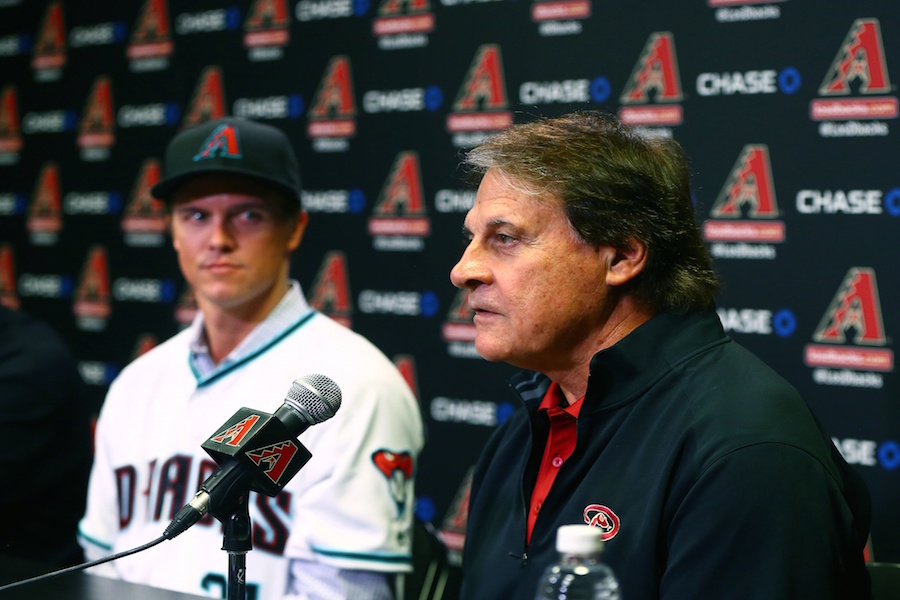
    Image courtesy of Mark J. Rebilas, USA Today

    Twins Video

    In 2014, Arizona hired a baseball legend in Tony La Russa to oversee their baseball ops department as chief officer. Creating this position, rather than simply hiring a new general manager, is the same route that Minnesota reportedly plans to take.

    Later that year, La Russa hired Dave Stewart to become the new D-backs GM. Stewart was an against-the-grain hiring with no meaningful previous connections to the franchise. As a former All-Star hurler who went on to work as a pitching coach (among other things) following his retirement, Stewart looked like a fine choice to overhaul the roster and rebuild the pitching staff.

    The Diamondbacks went 79-83 in 2015, their first year under the Stewart/La Russa regime. Their high-powered offense ranked second in the NL in scoring but was held back by a sub-par rotation, so Arizona decided to go all-in on pitching during the offseason.

    And I mean all-in.

    In December, the D-backs stunned the baseball world by signing free agent Zack Greinke to a massive contract approaching $200 million in total value. The very next day, they pulled the trigger on a blockbuster trade, acquiring 25-year-old Shelby Miller in exchange for a gaudy prospect package headlined by last June's No. 1 overall draft pick Dansby Swanson.

    In theory, Arizona had just picked up two starting pitchers to slot at the very top of their rotation, expending massive resources in order to do so. And the results?

    Well, you're probably aware. Greinke owns a 4.54 ERA, which would be his worst since 2005 if it sticks, and Miller has gone 2-10 with a 6.81 ERA in 15 starts sandwiching a two-month demotion to Triple-A.

    Despite enlisting a brand new front office structure, despite drafting arms heavily for years (seven of Arizona's last eight first-round selections prior to Swanson were pitchers), and despite making perhaps the most aggressive series of moves to acquire high-end pitching ever... the Diamondbacks find themselves in fourth place. They've somehow allowed as many runs as the Twins.

    Local fans can surely see some staggered parallels between the two franchises. Obviously the Twins aren't going to enter the offseason with a mindset that they're a couple arms away from being a World Series contender, but their need to upgrade the rotation is equally urgent if not more so.

    Arizona's postseason drought does not extend as far Minnesota's, nor does their record of consistently terrible pitching results. While the Twins' new head of baseball ops will not come in facing the kind of win-now directive that La Russa evidently felt, there will be pressure to orchestrate a big move or two and give fans some reason to believe that a vastly better product is in store for 2017.

    But as the D-backs and their new front office have illustrated, big moves aren't always a good thing. What's important is making the right moves. The Twins, under Terry Ryan, didn't do that often enough to dig out of their lengthy era of horrendous play.

    Here's hoping the new crew can do it, and that they can look ahead to better outcomes than the embattled bunch down in the desert.

    Follow Twins Daily For Minnesota Twins News & Analysis

    Recent Twins Articles

    Recent Twins Videos

    Twins Top Prospects

    Riley Quick

    Fort Myers Mighty Mussels - A, RHP
    Start #3 for the 21-year-old went well again. He tossed three scoreless innings with no walks. He gave up one hit and had three strikeouts. In 8 IP through 3 starts, he's given up 0 runs, 1 hit, 3 walks, and 13 strikeouts.

    User Feedback

    Recommended Comments


    Featured Comments

    I'm actually not understanding this article.  A cautionary tale that the Twins should not follow the path of the Diamondbacks?  Isn't that what the Twins have done?  Like the Diamondbacks, the Twins have expensive pitching contracts that did not work out.  The problems for both teams, as they stand today, are the same problems:  starting pitching.


    In spite of Greinke's stellar 2015 numbers, the dude is 32 years old.  No respectable GM would have given him the contract he was given unless his specialty is a knuckle or curve, which isn't the case here.  No sensible team gives Zack Greinke, at his age, a 6-year contract.  Other offers on the table were probably all for three years.  


    So you have the Diamondbacks who gave one guy who was about to start his decline a huge contract.  You have the Twins who gave four guys with questionable track records market-to-above market contracts.  As for which was worse, I would call it a tie.  Both teams spent a lot of money on garbage.  At least the Diamondbacks didn't block better pitchers from coming in by filling the staff with, well, filler, like the Twins did.

    Edited by Doomtints


    I'm actually not understanding this article.  A cautionary tale that the Twins should not follow the path of the Diamondbacks?  Isn't that what the Twins have done?  Like the Diamondbacks, the Twins have expensive pitching contracts that did not work out.  The problems for both teams, as they stand today, are the same problems:  starting pitching.


    In spite of Greinke's stellar 2015 numbers, the dude is 32 years old.  No respectable GM would have given him the contract he was given unless his specialty is a knuckle or curve, which isn't the case here.  No sensible team gives Zack Greinke, at his age, a 6-year contract.  Other offers on the table were probably all for three years.  


    So you have the Diamondbacks who gave one guy who was about to start his decline a huge contract.  You have the Twins who gave four guys with questionable track records market-to-above market contracts.  As for which was worse, I would call it a tie.  Both teams spent a lot of money on garbage.


    if you won't give Grienke that contract....you won't give any 32 YO FA that contract. I think you are not in line with the current market, frankly. That is the market.


    if you won't give Grienke that contract....you won't give any 32 YO FA that contract. I think you are not in line with the current market, frankly. That is the market.


    It's not.  How often does a 31/32 year old get a 6-year contract, at any position?  Contracts like that happen for people on pace for the hall of fame, sure.  Is that Zack Greinke?


    The $/yr makes sense.  The length does not.  6/8 year contracts are for players entering their peak years, not players exiting them.  

    Edited by Doomtints


    The only time Arizona had sustained success and won a World Series is when they went crazy and paid big bucks for Randy Johnson in free agency, and then traded for Curt Schilling.  I don't actually know any D-Backs fans, but I would assume they were okay with that strategy.


    Every year teams do this, there are more teams that don't achieve a World Series than do.  By and large all-in moves fail.  


    That doesn't mean there aren't times to try them.  Even if your odds are always more on the side of failure, there are times to try anyway.  But there are also times when you try and you shouldn't have and then you fail (as was pretty much inevitable) and you've possibly done serious damage to your long term chances.


    The $/yr makes sense.  The length does not.  6/8 year contracts are for players entering their peak years, not players exiting them.  

    Players "entering their peak years" barely exist in free agency. The length of Greinke's contract was not that unusual and will become even less unusual in this era of big revenue. 


    If we could go back in time and trade Hughes, Nolasco, Pelfrey and Milone for Miller and Greinke before the 2016 season, would we be better off right now, and going into 2017?  Aren't the Twins the cautionary tale here?


    You realize the vast difference between the two sides of the trade you're proposing right?  It's not like that it's a straight swap.  You'd have to add Buxton, 100+ million at least over the next few years, and several other prospects (like Berrios or Gonsalves and more) before that swap would be equivalent.


    So....I'm not sure what you're trying to say.


    You realize the vast difference between the two sides of the trade you're proposing right?  It's not like that it's a straight swap.  You'd have to add Buxton, 100+ million at least over the next few years, and several other prospects (like Berrios or Gonsalves and more) before that swap would be equivalent.


    So....I'm not sure what you're trying to say.

    He's saying that instead of 4/5 of the starting staff being inadequate, only 2/5 would be!   :)


    Except those two would still have quite a bit more upside.

    Edited by wsnydes


    It's not.  How often does a 31/32 year old get a 6-year contract, at any position?  Contracts like that happen for people on pace for the hall of fame, sure.  Is that Zack Greinke?


    The $/yr makes sense.  The length does not.  6/8 year contracts are for players entering their peak years, not players exiting them.  

    David Price - 6 / $217 million signed at age 31
    Max Scherzer - 7 / $210 million signed at age 31
    Steven Stasburg - 6 / $175 million signed at age 28
    CC Sabathia - 6 / $161 million signed at age 28 in 2008

    Justin Verlander - 6 / $180 million signed at age 30
    Felix Hernandez - 6 / $175 million signed at age 27

    5-7 years has been the going rate for upper echelon pitchers for a long time now.  


    He's saying that instead of 4/5 of the starting staff being inadequate, only two would be!   :)


    Except those two would still have quite a bit more upside.


    Except we'd have only a few more wins, no Buxton and Berrios and more, and be committed to Grienke for boatloads of money.


    Those few extra wins don't seem worth it.


    Except we'd have only a few more wins, no Buxton and Berrios and more, and be committed to Grienke for boatloads of money.


    Those few extra wins don't seem worth it.

    I was being sarcastic...my apologies for a lack of sarcasm tag or font.


    I was also only going with the players he mentioned in a trade.  On the serious side though, I agree with what you said completely.


    if you won't give Grienke that contract....you won't give any 32 YO FA that contract. I think you are not in line with the current market, frankly. That is the market.

    Yes. And the contract length has been nearly industry standard for the last 10+ years of free agency. I'd be shocked to find examples of upper echelon pitchers NOT receiving 5-7 year deals. 

    You realize the vast difference between the two sides of the trade you're proposing right? It's not like that it's a straight swap. You'd have to add Buxton, 100+ million at least over the next few years, and several other prospects (like Berrios or Gonsalves and more) before that swap would be equivalent.


    So....I'm not sure what you're trying to say.

    Good point. I'm just frustrated by the mentality that the Twins should only ever build their team through the farm system and not spend any money. Obviously, the Miller trade was a steep price. But I would be much happier about this team right now if we had signed Greinke.


    Good point. I'm just frustrated by the mentality that the Twins should only ever build their team through the farm system and not spend any money. Obviously, the Miller trade was a steep price. But I would be much happier about this team right now if we had signed Greinke.


    I would like to see more FA spending when appropriate.  I'd like the next time we're contending to pull that Cliff Lee type of trade from years ago.  So I'm with you, but the timing and the context are important.  I don't think the Twins are in a spot where making moves like that would be prudent.  They need to be aggressive adding pitching this offseason, but that price is likely going to have to be paid via trade rather than cash.  At least this year.


    David Price - 6 / $217 million signed at age 31
    Max Scherzer - 7 / $210 million signed at age 31
    Steven Stasburg - 6 / $175 million signed at age 28
    CC Sabathia - 6 / $161 million signed at age 28 in 2008

    Justin Verlander - 6 / $180 million signed at age 30
    Felix Hernandez - 6 / $175 million signed at age 27

    5-7 years has been the going rate for upper echelon pitchers for a long time now.  


    Many of those examples are entering their peak years (27/28), so those make sense.


    Scherzer is a bit of a late bloomer so his signing I can understand (though I would not have done it).  David Price is the one true exception on your list who I also would have chased after.


    Look, there is always going to be a team dumb enough to give an older pitcher a long contract based on a guy performing very well in his contract year.  This doesn't mean it's smart to do.  It doesn't even really mean it's the market rate.  Very likely other teams were offering, as I said, something close to 3 years considering his age, which is why he ended up on a small market team and not a team expected to compete.  Just because there are a couple of teams willing to extend contracts to get the guy they really want doesn't change what I said.  


    Edited by Doomtints


    Many of those examples are entering their peak years (27/28), so those make sense.


    Scherzer is a bit of a late bloomer so his signing I can understand (though I would not have done it).  David Price is the one true exception on your list who I also would have chased after.


    Look, there is always going to be a team dumb enough to give an older pitcher a long contract based on a guy performing very well in his contract year.  This doesn't mean it's smart to do.  It doesn't even really mean it's the market rate.  Very likely other teams were offering, as I said, something close to 3 years considering his age, which is why he ended up on a small market team and not a team expected to compete.  Just because there are a couple of teams willing to extend contracts to get the guy they really want doesn't change what I said.  

    There were 8 pitchers in FA alone last year that received 5 or more years for a contract. The youngest was Mike Leake at age 28. Everyone else (Price, Grienke, Cueto, Zimmerman, Shark, Wei-Yen Chen) were 30 and older... 

    2015 we saw Lester and Scherzer receive 6+ year deals... And a few 4 year deals for pitchers who were 33 and older. 

    You could go back year after year and see countless examples of pitchers well beyond their peak years receiving multi-year deals. 

    They overpaid badly for two pitchers. They sent too many prospects to Atlanta for Shelby Miller and signed Greinke to a contract that was far too big for a 32-year-old pitcher.


    Worse, the team could have traded Miller for prospects at the deadline and didn't to save face, and could have traded Greinke back to the Dodgers. They didn't. 


    Not saying they deserve this. But they sort of deserve this.


    There were 8 pitchers in FA alone last year that received 5 or more years for a contract. The youngest was Mike Leake at age 28. Everyone else (Price, Grienke, Cueto, Zimmerman, Shark, Wei-Yen Chen) were 30 and older... 

    2015 we saw Lester and Scherzer receive 6+ year deals... And a few 4 year deals for pitchers who were 33 and older. 

    You could go back year after year and see countless examples of pitchers well beyond their peak years receiving multi-year deals. 

    This is one aspect I would agree with "the Twins way."  That's too many contracted years for that age.  Let the other teams do that.

    However, the Twins would have been smart to grab the top tier 28 year olds for the same price.  

    Edited by Doomtints


    'Between 1988 and 2013 there were a total of 537 seasons pitched by pitchers who were 22, and the total fWAR was 327.9. In this time span pitchers join major league rosters around age 23-24, peak around 26 with a sustained decrease in numbers from 27 on that gradually flattens out a bit around age 35.'


    http://www.beyondtheboxscore.com/2014/2/25/5437902/pitching-aging-curves


    They overpaid badly for two pitchers. They sent too many prospects to Atlanta for Shelby Miller and signed Greinke to a contract that was far too big for a 32-year-old pitcher.


    Worse, the team could have traded Miller for prospects at the deadline and didn't to save face, and could have traded Greinke back to the Dodgers. They didn't. 


    Not saying they deserve this. But they sort of deserve this.

    It's all about perception, right? Since Greinke struggled a bit in his first season with the Diamondbacks it appears to be a bad contract. Meanwhile, Max Scherzer has been Cy Young caliber since arriving in Washington at $30 million a season. For players like Greinke, I'm willing to bet he bounces back to top of the rotation stats next season. 


    'Between 1988 and 2013 there were a total of 537 seasons pitched by pitchers who were 22, and the total fWAR was 327.9. In this time span pitchers join major league rosters around age 23-24, peak around 26 with a sustained decrease in numbers from 27 on that gradually flattens out a bit around age 35.'


    http://www.beyondtheboxscore.com/2014/2/25/5437902/pitching-aging-curves


    Yep.  Don't give 6 year contracts to 31/32 year olds.  I would have worded that a bit differently, instead of a "sustained decrease in numbers" I would have said that, by age 32, a player's WAR would expected to be around half of their peak WAR ... and it gets worse from there.


    There is a flaw in the data but I don't fault the person who compiled it.  He should have excluded pitchers who are out of the league early.  A big reason the age 26-28 pitching WAR is so high is because there are more pitchers in the league at those ages.  We are only concerned with top tier pitchers who have long careers.  Having the shorter career guys in the mix skews the younger years higher.  Still, it's a nice effort.  


    Unfortunately it's difficult to give long contracts to pitchers under 28/29, as that's the age they tend to first hit free agency.  Scherzer, the noted late bloomer, is an exception.  (His contract is exceptional anyway as much of his salary is deferred until he is in his upper 40s).  It's a reasonable risk to give a long contract to a 28 year old and expect a decent return.  

    Edited by Doomtints


    This is one aspect I would agree with "the Twins way."  That's too many contracted years for that age.  Let the other teams do that.

    However, the Twins would have been smart to grab the top tier 28 year olds for the same price.  

    We'll have to agree to disagree. Personally I'd rather they swing for the fences by signing a Greinke/Scherzer type FA over giving contracts to middle of the rotation guys at a cheaper rate. 


    It's all about perception, right? Since Greinke struggled a bit in his first season with the Diamondbacks it appears to be a bad contract. Meanwhile, Max Scherzer has been Cy Young caliber since arriving in Washington at $30 million a season. For players like Greinke, I'm willing to bet he bounces back to top of the rotation stats next season. 


    I agree Greinke probably comes back. But I don't like either his or Scherzer's contract. Those are $200 million deals for 30-something pitchers. No way those deals are worth it at the end ...


    I agree Greinke probably comes back. But I don't like either his or Scherzer's contract. Those are $200 million deals for 30-something pitchers. No way those deals are worth it at the end ...

    Of course not. But most free agent contracts aren't worth it at the end... We'll see that shortly with Erv Santana if they don't get out of that contract soon. 


    The only time Arizona had sustained success and won a World Series is when they went crazy and paid big bucks for Randy Johnson in free agency, and then traded for Curt Schilling.  I don't actually know any D-Backs fans, but I would assume they were okay with that strategy.

    Interestingly, the Dodgers likely bid more for Johnson, but he chose Arizona instead:


    http://www.mlbtraderumors.com/2013/03/free-agent-retrospective-randy-johnson.html


    As compared to Greinke, where it sounds like Arizona had to over-bid to get him.


    Also, looking back, the Diamondbacks got Schilling pretty cheaply in trade (I don't recall his contract situation, though).  Travis Lee was busting, Omar Daal had a 7.22 ERA at the time, and Nelson Figueroa was a journeyman in the making.  Vicente Padilla turned out to be an OK rotation piece for a few seasons but was hardly anything worth losing sleep over.


    Nothing like the Shelby Miller deal, really.  (Additionally, although Schilling was older, he had a much better track record than Miller.  Johnson was older but better than Greinke too.)

    Edited by spycake


    Of course not. But most free agent contracts aren't worth it at the end... We'll see that shortly with Erv Santana if they don't get out of that contract soon. 


    Agree, which is why big free agent deals should be reserved for when you KNOW you'll be in contention. But there's a big difference between the $55 million Santana got and the $200 million for those guys. 


    I would like to see more FA spending when appropriate.  I'd like the next time we're contending to pull that Cliff Lee type of trade from years ago.  So I'm with you, but the timing and the context are important.  I don't think the Twins are in a spot where making moves like that would be prudent.  They need to be aggressive adding pitching this offseason, but that price is likely going to have to be paid via trade rather than cash.  At least this year.

    I understand your point.  However, I think they should have gone after free agents when they were available, and now that they are not, I doubt they'll be able to get much value from trades either.  We'll probably have to wait to improve the pitching staff until 2018.


    Agree, which is why big free agent deals should be reserved for when you KNOW you'll be in contention. But there's a big difference between the $55 million Santana got and the $200 million for those guys. 

    I disagree.  I think you go after top free agents when they are available, and you assume that you can put together a contending team around them.  Again, the D-Backs went out and got the Big Unit, and then put together a contending team.  There are no great free agent pitchers available this offseason, so we don't have to worry about this part of the discussion for another year or two.  I guess the Twins will try to trade for pitching.  But with no free agents on the market, I'm not sure who is going to be trading away the quality of pitchers we would want.


    Interestingly, the Dodgers likely bid more for Johnson, but he chose Arizona instead:


    http://www.mlbtraderumors.com/2013/03/free-agent-retrospective-randy-johnson.html


    As compared to Greinke, where it sounds like Arizona had to over-bid to get him.


    Also, looking back, the Diamondbacks got Schilling pretty cheaply in trade (I don't recall his contract situation, though).  Travis Lee was busting, Omar Daal had a 7.22 ERA at the time, and Nelson Figueroa was a journeyman in the making.  Vicente Padilla turned out to be an OK rotation piece for a few seasons but was hardly anything worth losing sleep over.


    Nothing like the Shelby Miller deal, really.  (Additionally, although Schilling was older, he had a much better track record than Miller.  Johnson was older but better than Greinke too.)

    Johnson was among the highest paid players with the D-Backs, for six years, starting at 35-yrs-old.  That was a risk.  Schilling had been good for a few years, had a wasteland for a few years, and then was good again for a few years.  Nobody could have anticipated how well he did for the D-Backs.  He was paid $6.5 million 2001, then $10 million the next two years.  Schill was 34 when they signed him.  Both were big risks and huge rewards. 


    Create an account or sign in to comment

    You need to be a member in order to leave a comment

    Create an account

    Sign up for a new account in our community. It's easy!

    Register a new account

    Sign in

    Already have an account? Sign in here.

    Sign In Now

×
×
  • Create New...