Jump to content
Twins Daily
  • Create Account

Recommended Posts

Posted

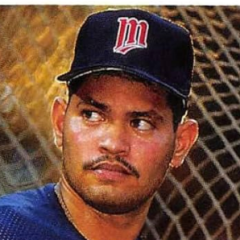
Mickey Hatcher could be described as a goofball, a gamer, a fan favorite, and colorful, but above all else he was a decent major league hitter.

Michael Vaughn Hatcher was born on March 15, 1955, in Ohio. An article at The Oklahoman states that he chose the nickname Mickey after his idol, another player you might have heard of—Mickey Mantle. At some point, his family moved west, and he graduated from high school in Mesa, AZ. After high school, he attended Mesa Community College, where he was selected as an All-American twice in both baseball and football. 

Mickey Hatcher attended the University of Oklahoma, playing football and baseball. On the gridiron, he was a punter and a wide receiver. He punted 64 times in 1976 with an average length of 38.5 yards and was part of a Fiesta Bowl squad where Oklahoma won 41-7 over Wyoming. They finished the year ranked #5 in the AP Poll. I could not locate any statistics on his capabilities as a wide receiver. On the baseball field, he hit .356 and slugged .586 in 1977.

The Dodgers drafted Hatcher in the 5th round of the 1977 draft. He worked his way up the minor leagues and debuted with the Dodgers on August 3, 1979. He got little opportunity in his first two seasons in Los Angeles. 

After the 1980 season, Hatcher was the centerpiece of a trade with the Twins, which included minor leaguers Matthew Reeves and Kelly Snider for Ken Landreaux, the lone Twins All-Star representative for the 1980 season. I’m guessing the trade was a circumstance of old Calvin Griffith not wanting to pay Landreaux. The Dodgers got the best of that trade. Reeves and Snider never made it to Major League Baseball. Hatcher played six seasons for the Twins, accumulating a 3.7 WAR. During his tenure, he hit .284/.315/.383. Landreaux played to 8.5 WAR in seven seasons for the Dodgers. 

Hatcher seemed like a decent player on the bad Twins teams of the early 80s. He was a one-tool player – he could hit for average but had limited power and was not fast. He was also not a great fielder; at least one fan thought he would hurt himself one day by running into a fence. Despite his lack of speed, he surprisingly played 99 games in center field in 1981, but he eventually settled in as the primary left fielder for the next few years. He had 37 RBI in 1981, which somehow led the team. We all know the 81 team was bad, and the strike limited the Twins to 110 games, but wow! Prorated to a 162-game season, 37 RBI only equates to 54. Yep, that was a bad team. His most extensive action came in 1984 when he batted .302/.342/.406 with 69 RBI. In 1985, Hatcher had a hit in nine consecutive plate appearances (including three doubles), which is still a Twins record.

Before the 1987 season, the young Twins seemed to be growing into a better team. Unfortunately for Hatcher, during the offseason, the Twins sought a leadoff hitter with some speed and traded for Dan Gladden near the end of Spring Training. Kirby Puckett had hit primarily first in the lineup in 1986, but the Gladden trade allowed Puckett to slide permanently into the number three spot in the lineup. It was a sound plan to the detriment of Hatcher’s time in Minnesota. The Twins released Hatcher, but his old Dodgers team called and signed him shortly after.

Hatcher’s release prevented him from participating in the Twins’ 1987 World Series victory, and his prior trade to the Twins had caused him to narrowly miss the Dodgers’ 1981 championship. Things did not seem to go his way.

If he was disappointed about missing the ’81 and ’87 World Series championships, circumstances started to turn in his favor in the 1988 season. He won a World Series with the Dodgers in 1988, beating the heavily favored Oakland A’s. Jose Canseco hit a grand slam off the center field camera in the 2nd inning of game one to put the A’s up 4-2 and seemingly send the favored Oakland squad to victory. Still, the Dodgers came back and capped it off with the epic Kirk Gibson pinch-hit home run off Dennis Eckersley. (Earlier in 1988, the term “walk-off” was coined by Mr. Eckersley to mean any home run that wins a game and is hit so far, all you can do as a pitcher is walk off the mound.) It seemed like that Gibson home run catapulted the Dodgers to the championship – the A’s won only game three. Hatcher had played minimally during the season, but manager Tommy Lasorda inserted him during the series, which paid off. Hatcher’s World Series was great, hitting .368/.400/.737 with huge first-inning home runs in games 1 and 5. If not for Orel Hershiser’s magical season and postseason in 1988, maybe Hatcher would have been the World Series MVP. I’d say things worked out well for Mr. Hatcher.


View full player

  • 5 months later...
Posted

I was at the dome for the beginning and end of the 9 consecutive hits.
I didn't get to the dome much since I lived in Nebraska but I had clients that worked in Minneapolis. When I told them my wife and I were coming to for a short vacation they gave me their season tickets for Friday and Sunday. Sixth row between Home and Third, end of an aisle.
Hatcher started the streak Friday and ended Sunday. It drew a lot of excitement in the crowd and they ended up being the two best games I ever saw anywhere.
Twins won both. Friday was a home run fest I think 11-10 in extra innings.
Sunday a pitchers duel 1-0 or something like that.
I'll never forget that.

Create an account or sign in to comment

You need to be a member in order to leave a comment

Create an account

Sign up for a new account in our community. It's easy!

Register a new account

Sign in

Already have an account? Sign in here.

Sign In Now
The Twins Daily Caretaker Fund

You all care about this site. The next step is caring for it. We’re asking you to caretake this site so it can remain the premier Twins community on the internet.

×
×
  • Create New...