



Thiéres Rabelo
-
Posts
569 -
Joined
-
Last visited
Content Type
Profiles
News
Minnesota Twins Videos
2026 Minnesota Twins Top Prospects Ranking
2022 Minnesota Twins Draft Picks
Minnesota Twins Free Agent & Trade Rumors, Notes, & Tidbits
Guides & Resources
2023 Minnesota Twins Draft Picks
The Minnesota Twins Players Project
2024 Minnesota Twins Draft Picks
2025 Minnesota Twins Draft Pick Tracker
2026 Minnesota Twins Draft Tracker: Picks & Bonuses
Forums
Blogs
Events
Store
Downloads
Gallery
Everything posted by Thiéres Rabelo
-
 For a decade, the Twins had the best catcher in baseball. Then 2011 came and Joe Mauer was forced to move away from catching. Should the Twins consider protecting Mitch Garver from the risks that ultimately forced Mauer to switch positions?During his first three seasons as a full-time first baseman, from 2014-16, Mauer went from an MVP-caliber player to an average hitter. Most of that was due to lingering issues caused by his previous injuries, especially the repeated concussions. A lot of people thought he was done. Back in May of this year, Twins fans had a terrifying flashback of that situation, when Shohei Ohtani slid into home plate trying to score from second and hit Garver’s ankle on the base path. Garver went on to miss 16 games because of that play. That was when many Twins fans started to think about the possibility of removing Garver from behind the plate. After all, he was hitting .329/.418/.747 (1.164) with a 198 wRC+. It’s obvious that Garver himself wants to keep catching, but should the Twins try to change his mind? Increasing danger MLB catchers are constantly at risk and some people argue that the league hasn’t done much to protect them. In 2015, a study showed that almost nine out of 10 times a catcher gets injured, it’s due to a foul ball or a bat to the head. There have been rule changes regarding home plate collisions, but that doesn’t seem to be working all that well. Just this year, some catchers have suffered hard hits at home, including this gruesome crash that nearly ended Jonathan Lucroy’s season. We’re talking about human beings under constant danger and MLB should try to come up with a solution to protect all of them. Other catchers to change positions Hall of Famer Joe Torre gave up the catching after the 1970 season at age 29 after 11 full seasons behind the plate. His productivity barely changed. He won his one and only MVP award in 1971 as a full-time third baseman. Yogi Berra, another member of Cooperstown, also had a considerable drop in his playing time as a catcher. He averaged more than 572 PA per season as a catcher between 1950 and 1957. From 1958 until the end of his career in 1965, he averaged only 199 PA per season behind the plate. There are lots of other examples, which you can check here and here. How and why the Twins could do it Earlier this week, we discussed whether or not Minnesota should tender a contract to C.J. Cron. If they don’t, it’s hard to imagine a player that would be a better fit for first base. Some would argue that Miguel Sanó should be the first option, but then you would have to go after a replacement for him at third, like we discussed here. Also, in this scenario, The Twins may not need to replace Jason Castro. Having the role of primary catcher available may increase the Twins chances of resigning Castro. You would have a very good catcher who is familiar with the organization and can contribute immensely to the team in every aspect. Please share your thoughts in the comments below. Not registered? Click here to create an account. To stay up to date, follow Twins Daily on Twitter and Facebook. MORE FROM TWINS DAILY — Report: Twins Lose James Rowson to Marlins — Handbook Preview: Dan Hayes on Recharging the Batterymate — Miguel Sano Finally Met Expectations in 2019 Click here to view the article
 -
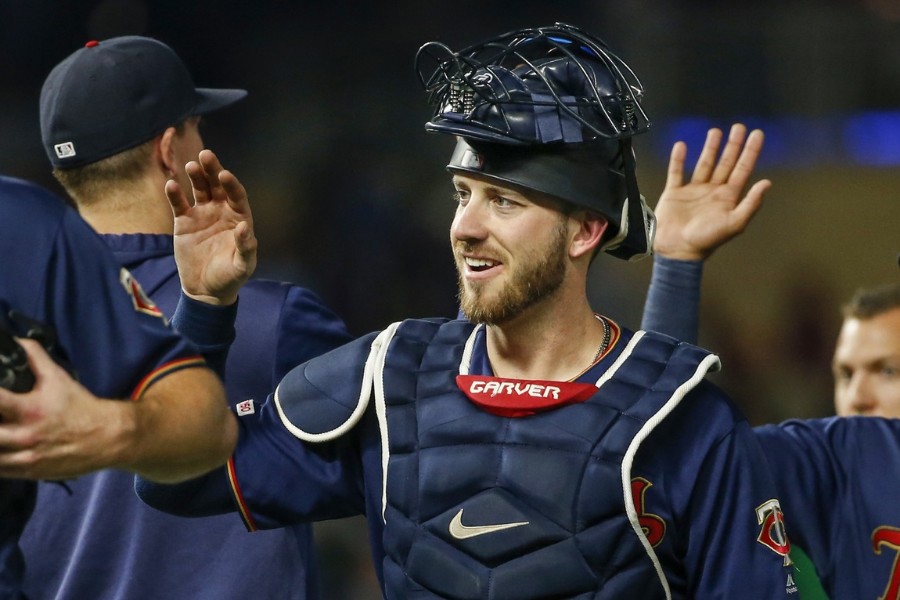 During his first three seasons as a full-time first baseman, from 2014-16, Mauer went from an MVP-caliber player to an average hitter. Most of that was due to lingering issues caused by his previous injuries, especially the repeated concussions. A lot of people thought he was done. Back in May of this year, Twins fans had a terrifying flashback of that situation, when Shohei Ohtani slid into home plate trying to score from second and hit Garver’s ankle on the base path. Garver went on to miss 16 games because of that play. https://twitter.com/AnaheimSports1/status/1128500188866211840 That was when many Twins fans started to think about the possibility of removing Garver from behind the plate. After all, he was hitting .329/.418/.747 (1.164) with a 198 wRC+. It’s obvious that Garver himself wants to keep catching, but should the Twins try to change his mind? Increasing danger MLB catchers are constantly at risk and some people argue that the league hasn’t done much to protect them. In 2015, a study showed that almost nine out of 10 times a catcher gets injured, it’s due to a foul ball or a bat to the head. There have been rule changes regarding home plate collisions, but that doesn’t seem to be working all that well. Just this year, some catchers have suffered hard hits at home, including this gruesome crash that nearly ended Jonathan Lucroy’s season. https://twitter.com/MarkBermanFox26/status/1148008064697675777 We’re talking about human beings under constant danger and MLB should try to come up with a solution to protect all of them. Other catchers to change positions Hall of Famer Joe Torre gave up the catching after the 1970 season at age 29 after 11 full seasons behind the plate. His productivity barely changed. He won his one and only MVP award in 1971 as a full-time third baseman. Yogi Berra, another member of Cooperstown, also had a considerable drop in his playing time as a catcher. He averaged more than 572 PA per season as a catcher between 1950 and 1957. From 1958 until the end of his career in 1965, he averaged only 199 PA per season behind the plate. There are lots of other examples, which you can check here and here. How and why the Twins could do it Earlier this week, we discussed whether or not Minnesota should tender a contract to C.J. Cron. If they don’t, it’s hard to imagine a player that would be a better fit for first base. Some would argue that Miguel Sanó should be the first option, but then you would have to go after a replacement for him at third, like we discussed here. Also, in this scenario, The Twins may not need to replace Jason Castro. Having the role of primary catcher available may increase the Twins chances of resigning Castro. You would have a very good catcher who is familiar with the organization and can contribute immensely to the team in every aspect. Please share your thoughts in the comments below. Not registered? Click here to create an account. To stay up to date, follow Twins Daily on Twitter and Facebook. MORE FROM TWINS DAILY — Report: Twins Lose James Rowson to Marlins — Handbook Preview: Dan Hayes on Recharging the Batterymate — Miguel Sano Finally Met Expectations in 2019
 -
Absolutely nothing worked out for the Twins in Game 2 of the ALDS in the Bronx and Minnesota got crushed by the Yankees, 8-2. The offense was completely dominated, while starting pitcher Randy Dobnak couldn’t pitch past the third inning. The Twins get closer to a negative postseason milestone.Box Score Dobnak: 2.0 IP, 6 H, 4 ER, 2 BB, 0 K, 53.4% strikes (23 of 43 pitches) Bullpen: 6.0 IP, 5 H, 4 ER, 6 BB, 6 K Home Runs: None Multi-Hit Games: Garver (2-for-4, RBI), Arráez (2-for-4, RBI) Bottom 3 WPA: Duffey -.165, Dobnak -.141, Rosario -.077 Download attachment: WinChart1005.png With yet another loss to the Yankees in the postseason, Minnesota has now been defeated in its last 15 postseason games. The last time the Twins won in the playoffs was exactly fifteen years ago, Game 1 of the 2004 ALDS against the Yankees. If they can’t win Game 3 at Target Field Monday, they will match the worst playoff win drought in professional sports, now held by the NHL’s Chicago Blackhawks. Between 1975 and 1979, they lost sixteen consecutive playoff games. Dobnak done after two innings I can’t even begin to understand what was going through Dobnak’s mind when he took over the mound at Yankee Stadium this afternoon. I don’t think you can get a more nerve-wrecking situation than starting a postseason game less than a year after signing you first $2,000-dollar minor league contract. Judging by his first inning, you can tell how nervous he might have been. Yankees hitters cornered him early. DJ LeMahieu and Aaron Judge, the top two men in the Yankee lineup, both reached safely to begin the game. Edwin Encarnación would later hit a one-out RBI single to left. Immediately afterwards, Dobnak induced an inning-ending ground ball double play against Giancarlo Stanton, finishing a 22-pitch effort from him in the bottom of the first. Dobnak actually had a rather smooth second inning, which he concluded with only 12 pitches, nine being strikes. Then his command started to elude him during the third inning and he loaded the bases before recording an out. Rocco Baldelli decided to pull the plug on him after only nine pitches in the inning. Bullpen can’t put out the fire Tyler Duffey took over in relief and he couldn’t get the job done. Two runs scored right away on a sac-fly by Stanton, followed by an RBI-single by Gleyber Torres. Duffey then hit Gary Sánchez after getting ahead on the count, 0-2, reloading the bases. After getting ahead 0-2 against Didi Gregorius, he gave up a grand slam. It was Gregorius' third career grand slam against Minnesota. Duffey was lifted from the game after getting two outs and was replaced by Devin Smeltzer. The rookie was also ambushed, giving up a couple of hits while allowing his inherited runner to score. That made for a seven-run inning for New York. Bats get completely dominated After hitting three home runs on seven hits on Friday night, the Twins couldn’t find the power in Game 2. Yankee starter Masahiro Tanaka held the Minnesota lineup to one hit in the first four innings he pitched. It was only after staying out during the long bottom of the third that he started to give Twins batters a chance. After Jorge Polanco flied out to start the fourth inning, Nelson Cruz drew a walk and was later scored after back-to-back singles, coming off the bats of Eddie Rosario and Mitch Garver. Tanaka and the Yankee bullpen went on to retire sixteen of the seventeen batters that stepped up to the box after Garver’s RBI. They managed to manufacture another run late in the ninth, when the same Garver hit a two-out single and was scored by a Luís Arráez RBI double. Postgame With Baldelli Pitching Staff Spreadsheet Here's a look at the pitching staff usage: Download attachment: PitchingStaff1005.png Click here to view the article
- 157 replies
-
- 5
-

-
- randy dobnak
- tyler duffey
- (and 1 more)
-
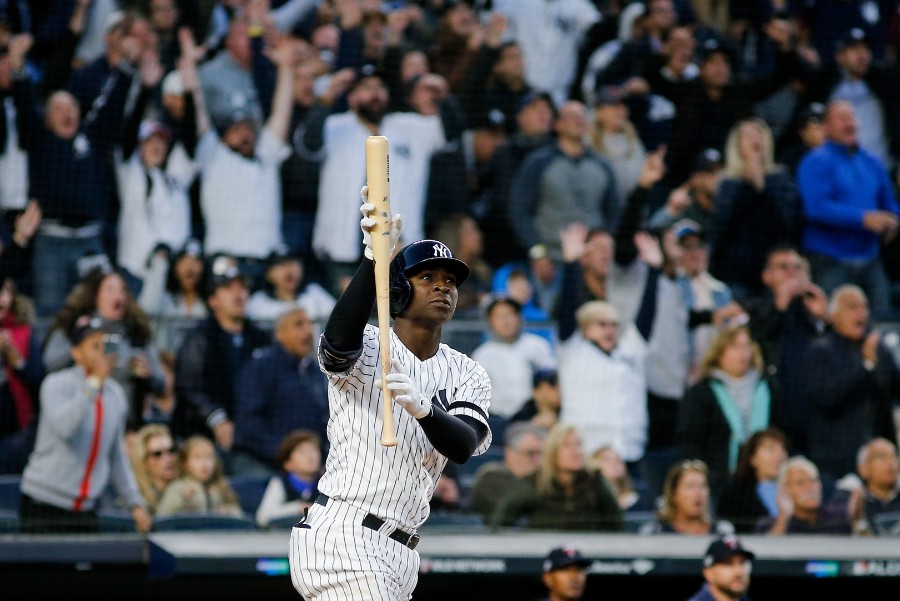 Box Score Dobnak: 2.0 IP, 6 H, 4 ER, 2 BB, 0 K, 53.4% strikes (23 of 43 pitches) Bullpen: 6.0 IP, 5 H, 4 ER, 6 BB, 6 K Home Runs: None Multi-Hit Games: Garver (2-for-4, RBI), Arráez (2-for-4, RBI) Bottom 3 WPA: Duffey -.165, Dobnak -.141, Rosario -.077 With yet another loss to the Yankees in the postseason, Minnesota has now been defeated in its last 15 postseason games. The last time the Twins won in the playoffs was exactly fifteen years ago, Game 1 of the 2004 ALDS against the Yankees. If they can’t win Game 3 at Target Field Monday, they will match the worst playoff win drought in professional sports, now held by the NHL’s Chicago Blackhawks. Between 1975 and 1979, they lost sixteen consecutive playoff games. Dobnak done after two innings I can’t even begin to understand what was going through Dobnak’s mind when he took over the mound at Yankee Stadium this afternoon. I don’t think you can get a more nerve-wrecking situation than starting a postseason game less than a year after signing you first $2,000-dollar minor league contract. Judging by his first inning, you can tell how nervous he might have been. Yankees hitters cornered him early. DJ LeMahieu and Aaron Judge, the top two men in the Yankee lineup, both reached safely to begin the game. Edwin Encarnación would later hit a one-out RBI single to left. Immediately afterwards, Dobnak induced an inning-ending ground ball double play against Giancarlo Stanton, finishing a 22-pitch effort from him in the bottom of the first. Dobnak actually had a rather smooth second inning, which he concluded with only 12 pitches, nine being strikes. Then his command started to elude him during the third inning and he loaded the bases before recording an out. Rocco Baldelli decided to pull the plug on him after only nine pitches in the inning. Bullpen can’t put out the fire Tyler Duffey took over in relief and he couldn’t get the job done. Two runs scored right away on a sac-fly by Stanton, followed by an RBI-single by Gleyber Torres. Duffey then hit Gary Sánchez after getting ahead on the count, 0-2, reloading the bases. After getting ahead 0-2 against Didi Gregorius, he gave up a grand slam. It was Gregorius' third career grand slam against Minnesota. Duffey was lifted from the game after getting two outs and was replaced by Devin Smeltzer. The rookie was also ambushed, giving up a couple of hits while allowing his inherited runner to score. That made for a seven-run inning for New York. Bats get completely dominated After hitting three home runs on seven hits on Friday night, the Twins couldn’t find the power in Game 2. Yankee starter Masahiro Tanaka held the Minnesota lineup to one hit in the first four innings he pitched. It was only after staying out during the long bottom of the third that he started to give Twins batters a chance. After Jorge Polanco flied out to start the fourth inning, Nelson Cruz drew a walk and was later scored after back-to-back singles, coming off the bats of Eddie Rosario and Mitch Garver. Tanaka and the Yankee bullpen went on to retire sixteen of the seventeen batters that stepped up to the box after Garver’s RBI. They managed to manufacture another run late in the ninth, when the same Garver hit a two-out single and was scored by a Luís Arráez RBI double. Postgame With Baldelli Pitching Staff Spreadsheet Here's a look at the pitching staff usage:
 -
I studied at UNM exactly when Garver was playing there. I wrote about that briefly here: http://twinsdaily.com/_/minnesota-twins-news/minnesota-twins/march-madness-a-look-back-at-the-collegiate-careers-of-current-twins-r7585
- 16 replies
-
- 4
-
-
- mitch garver
- ray birmingham
- (and 3 more)
-
Here's a great video about Garver's time at UNM.
- 16 replies
-
- 6
-
-
- mitch garver
- ray birmingham
- (and 3 more)
-
In a rain-shortened game, the Twins didn’t have much trouble beating the Royals by 6-2 in Kansas City, opening their final series of the regular season. The AL Central champs won their fifth consecutive game and also made history tonight, as they have reached, only for the second time in club history, the 100-win mark.Box Score Berríos: 6.0 IP, 6 H, 2 ER, 2 BB, 9 K, 61.6% strikes (61 of 99 pitches) Home Runs: Sanó (34), LaMarre (2) Multi-Hit Games: Sanó (2-for-4, HR), Cruz (3-for-4, RBI), LaMarre (2-for-3, HR) Top 3 WPA: Sanó .193, Cruz .117, Berríos .100 Bottom 3 WPA: Astudillo -.063, Cron -.059, Torreyes -.056 The Twins 100th win is not only remarkable for the club itself, but even more for Rocco Baldelli. The rookie manager has now become only the seventh manager in baseball history to win at least 100 games in their first season as a manager. Baldelli is a top candidate to win the AL Manager of the Year award, two years after Paul Molitor did the same with Minnesota. With two games left, the Twins can still match the club record, held by the 1965 Twins, who won 102 games. They made it all the way to the World Season that year. Bats take care of business early Off to a great start, the Twins were able to put runs on the board very quickly. Before the Royals could record an out in the game, Minnesota’s top four batters reached on three singles and a walk. Nelson Cruz drove in his 107th RBI of the year, followed by and RBI-single by Eddie Rosario, driving in his 109th, giving the Twins a quick 2-0 lead. After the Royals put their first run on the board, it was time for the Twins top of the order to be back in the box and they did more damage. Miguel Sanó got his second hit of the night, jumping on the second pitch of his at-bat, blasting a two-run home run into the fountains. This home run gave Sanó a new career high in RBI (79), breaking his former personal record (77) of 2017. Ryan LaMarre made his contribution too. Royals starter Eric Skoglund had retired two batters, in what would have been his first scoreless inning of the night. But The Sire had other plans and took him deep with a two-run shot, making it 6-1 Twins. LaMarre’s dinger helped put an end to Skoglund’s night after only three innings. Berríos achieves personal milestone There was talk about José Berríos having his pitch count limited in this game. But that possibility vanished once he finished the fifth inning two outs away from reaching the 200-inning mark for the first time in his career. All it took him was five pitches, when he nearly induced a double play. He went on to strike out his last regular season batter and to display a lot of emotion by doing so. Berríos’ final line could have been even better, if it wasn’t for a couple of errors in the outfield, which allowed the Royals to score twice. The rain interrupted the game in the middle of the seventh inning and therefore it was suspended, giving Berríos a complete game. “La Makina” concludes his 2019 season going 14-8, with 200 1/3 innings pitched and a career best 3.68 ERA, while striking out 195 batters. Berríos became only the fourth Twins pitcher this decade to reach 200 innings in a season. Carl Pavano did it twice (2010 and 2011) and Phil Hughes (2014) and Ervin Santana (2017) each did it once. Yankees ahead in the HR count Sanó and LaMarre hit home runs numbers 302 and 303 on the year for the Twins, but the New York Yankees hit five dingers in their game against the Rangers and now have 304. Both teams still have two games to decide who will keep the record. Postgame With Baldelli Bullpen Usage Spreadsheet Click here for a review of the number of pitches thrown by each member of the bullpen over the past five days. Click here to view the article
- 13 replies
-
- 2
-
-
- jose berrios
- miguel sano
- (and 2 more)
-
Twins Game Recap (9/27): Twins Cruise Past Royals to Earn 100th win
Thiéres Rabelo posted an article in Twins
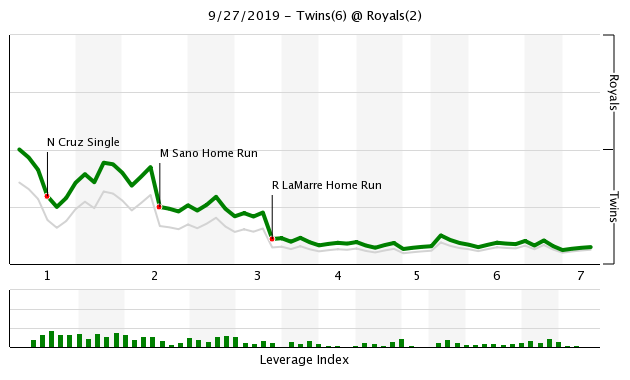 Box Score Berríos: 6.0 IP, 6 H, 2 ER, 2 BB, 9 K, 61.6% strikes (61 of 99 pitches) Home Runs: Sanó (34), LaMarre (2) Multi-Hit Games: Sanó (2-for-4, HR), Cruz (3-for-4, RBI), LaMarre (2-for-3, HR) Top 3 WPA: Sanó .193, Cruz .117, Berríos .100 Bottom 3 WPA: Astudillo -.063, Cron -.059, Torreyes -.056 The Twins 100th win is not only remarkable for the club itself, but even more for Rocco Baldelli. The rookie manager has now become only the seventh manager in baseball history to win at least 100 games in their first season as a manager. Baldelli is a top candidate to win the AL Manager of the Year award, two years after Paul Molitor did the same with Minnesota. https://twitter.com/morsecode/status/1177783182869090304 With two games left, the Twins can still match the club record, held by the 1965 Twins, who won 102 games. They made it all the way to the World Season that year. Bats take care of business early Off to a great start, the Twins were able to put runs on the board very quickly. Before the Royals could record an out in the game, Minnesota’s top four batters reached on three singles and a walk. Nelson Cruz drove in his 107th RBI of the year, followed by and RBI-single by Eddie Rosario, driving in his 109th, giving the Twins a quick 2-0 lead. After the Royals put their first run on the board, it was time for the Twins top of the order to be back in the box and they did more damage. Miguel Sanó got his second hit of the night, jumping on the second pitch of his at-bat, blasting a two-run home run into the fountains. This home run gave Sanó a new career high in RBI (79), breaking his former personal record (77) of 2017. https://twitter.com/Twins/status/1177750813210529793 Ryan LaMarre made his contribution too. Royals starter Eric Skoglund had retired two batters, in what would have been his first scoreless inning of the night. But The Sire had other plans and took him deep with a two-run shot, making it 6-1 Twins. LaMarre’s dinger helped put an end to Skoglund’s night after only three innings. https://twitter.com/Twins/status/1177756787237359616 Berríos achieves personal milestone There was talk about José Berríos having his pitch count limited in this game. But that possibility vanished once he finished the fifth inning two outs away from reaching the 200-inning mark for the first time in his career. All it took him was five pitches, when he nearly induced a double play. He went on to strike out his last regular season batter and to display a lot of emotion by doing so. https://twitter.com/dohyoungpark/status/1177769409739403264 Berríos’ final line could have been even better, if it wasn’t for a couple of errors in the outfield, which allowed the Royals to score twice. The rain interrupted the game in the middle of the seventh inning and therefore it was suspended, giving Berríos a complete game. “La Makina” concludes his 2019 season going 14-8, with 200 1/3 innings pitched and a career best 3.68 ERA, while striking out 195 batters. Berríos became only the fourth Twins pitcher this decade to reach 200 innings in a season. Carl Pavano did it twice (2010 and 2011) and Phil Hughes (2014) and Ervin Santana (2017) each did it once. Yankees ahead in the HR count Sanó and LaMarre hit home runs numbers 302 and 303 on the year for the Twins, but the New York Yankees hit five dingers in their game against the Rangers and now have 304. Both teams still have two games to decide who will keep the record. Postgame With Baldelli https://twitter.com/fsnorth/status/1177789120963211264 Bullpen Usage Spreadsheet Click here for a review of the number of pitches thrown by each member of the bullpen over the past five days.
 -
The Twins dropped game one of the pivotal three-game series against the Cleveland Indians, 6-2 at Target Field. The loss came in heart-breaking fashion, as the Twins pitchers managed to limit Cleveland offense to only two runs in regulation, but Minnesota itself couldn’t score enough either. In extra innings, Graterol had his first big league rough outing.Box Score Pineda: 6.0 IP, 4 H, 1 ER, 2 BB, 10 K, 66.3% strikes (71 of 107 pitches) Bullpen: 5.0 IP, 6 H, 5 ER, 4 BB, 3 K Home Runs: None Multi-Hit Games: Kepler (2-for-5), Polanco (2-for-, RBI) Top 3 WPA: Pineda .244, Littell .144, May .098 Bottom 3 WPA: Graterol -.447, Sanó -.155, Romo -.129 Pineda is lights-out again We’re barely one week into September. It’s too early to jump to any conclusions, but I don’t see why we can’t be excited by some good signs. Take the rotation, for instance. Twins starters were among the ten least productive units in all baseball during August. Now, they’re starting (OK, maybe timidly) to get back on track. Tonight’s outing from Michael Pineda was another indication of this. To provide some context, the Twins rotation was among the bottom ten worst in the league in ERA (5.48), WPA (-1.40), WHIP (1.59) and AVG (.294) last month. Coming into tonight’s game, those numbers had improved to 4.70 ERA, 0.09 WPA, 1.17 WHIP and .227 AVG. All of those numbers are going to look even better after Pineda kept the Indians’ offense on a leash, going six innings and allowing only one run on four hits, while striking out ten Cleveland batters. The only run came off a Francisco Lindor solo homer in the third. That’s definitely not a fluke for Big Mike. After a rocky start of the season in April, he’s been the Twins best starter since the start of May, posting a team-best 3.46 ERA since then. And that was true even before tonight’s game, as he had a 1.31 WPA (also a team-best) on that same period, more than twice as much as the second starter on that list (Jake Odorizzi, 0.65). Pineda has been great fuel for Minnesota’s playoff push, in the midst of chaos caused by the José Berríos struggles, the Kyle Gibson injuries and the lack of consistency from Odorizzi and Martín Pérez. Bullpen does its part in regulation This is how amazing the Twins bullpen has turned out to be in the past weeks: After their performance against the Red Sox in the three-game series in Boston, they earned even more credit, as they took care of business all by themselves in the series opener and shut down the world champions in the following two games. Tonight, they had to work under pressure, as the offense couldn’t provide them with enough run support. Sergio Romo gave up a leadoff triple in the eighth to Oscar Mercado and went on to retire all the remaining batters he faced. However, one of them, Yasiel Puig, managed to score Mercado on a sacrifice fly, which tied the game. Trevor May and Zack Littell both had scoreless innings, with Littell picking off the runner at first to help end the ninth. Quiet night from the offense leads to extras For the third consecutive game, Twins bats were held back. They couldn’t score more than a couple of runs to back up Pineda and the bullpen. C.J. Cron and Jorge Polanco each batted in a run. They weren’t able to respond after the Indians tied it in the ninth, but they threatened. LaMonte Wade Jr. drew a walk, to bring his OBP to .385, in spite of still not having a hit in the majors. Graterol can’t handle first big challenge After Cody Stashak and Lewis Thorpe alternated to pitch through the tenth inning, rookie Brusdar Graterol was handed a two-out, one man on situation in the eleventh. He faced four batters, but couldn’t retire any of them. A couple of singles from Roberto Pérez and Lindor gave the Indians a two-run lead. With Trevor Hildenberger pitching, Mercado hit a two-run single to put this one away, doubling their lead. Postgame with Baldelli Bullpen Usage Spreadsheet Click here for a review of the number of pitches thrown by each member of the bullpen over the past five days. Click here to view the article
- 35 replies
-
- 2
-
-
- michael pineda
- zack littell
- (and 3 more)
-
Twins Game Recap (9/6): Offense Dominated as Twins Fall in Extras
Thiéres Rabelo posted an article in Twins
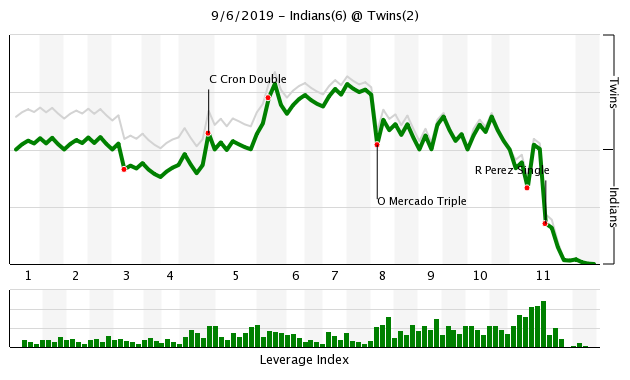 Box Score Pineda: 6.0 IP, 4 H, 1 ER, 2 BB, 10 K, 66.3% strikes (71 of 107 pitches) Bullpen: 5.0 IP, 6 H, 5 ER, 4 BB, 3 K Home Runs: None Multi-Hit Games: Kepler (2-for-5), Polanco (2-for-, RBI) Top 3 WPA: Pineda .244, Littell .144, May .098 Bottom 3 WPA: Graterol -.447, Sanó -.155, Romo -.129 Pineda is lights-out again We’re barely one week into September. It’s too early to jump to any conclusions, but I don’t see why we can’t be excited by some good signs. Take the rotation, for instance. Twins starters were among the ten least productive units in all baseball during August. Now, they’re starting (OK, maybe timidly) to get back on track. Tonight’s outing from Michael Pineda was another indication of this. To provide some context, the Twins rotation was among the bottom ten worst in the league in ERA (5.48), WPA (-1.40), WHIP (1.59) and AVG (.294) last month. Coming into tonight’s game, those numbers had improved to 4.70 ERA, 0.09 WPA, 1.17 WHIP and .227 AVG. All of those numbers are going to look even better after Pineda kept the Indians’ offense on a leash, going six innings and allowing only one run on four hits, while striking out ten Cleveland batters. The only run came off a Francisco Lindor solo homer in the third. That’s definitely not a fluke for Big Mike. After a rocky start of the season in April, he’s been the Twins best starter since the start of May, posting a team-best 3.46 ERA since then. And that was true even before tonight’s game, as he had a 1.31 WPA (also a team-best) on that same period, more than twice as much as the second starter on that list (Jake Odorizzi, 0.65). Pineda has been great fuel for Minnesota’s playoff push, in the midst of chaos caused by the José Berríos struggles, the Kyle Gibson injuries and the lack of consistency from Odorizzi and Martín Pérez. Bullpen does its part in regulation This is how amazing the Twins bullpen has turned out to be in the past weeks: https://twitter.com/TwinsBrasil/status/1170133089948962816 After their performance against the Red Sox in the three-game series in Boston, they earned even more credit, as they took care of business all by themselves in the series opener and shut down the world champions in the following two games. Tonight, they had to work under pressure, as the offense couldn’t provide them with enough run support. Sergio Romo gave up a leadoff triple in the eighth to Oscar Mercado and went on to retire all the remaining batters he faced. However, one of them, Yasiel Puig, managed to score Mercado on a sacrifice fly, which tied the game. Trevor May and Zack Littell both had scoreless innings, with Littell picking off the runner at first to help end the ninth. Quiet night from the offense leads to extras For the third consecutive game, Twins bats were held back. They couldn’t score more than a couple of runs to back up Pineda and the bullpen. C.J. Cron and Jorge Polanco each batted in a run. They weren’t able to respond after the Indians tied it in the ninth, but they threatened. LaMonte Wade Jr. drew a walk, to bring his OBP to .385, in spite of still not having a hit in the majors. Graterol can’t handle first big challenge After Cody Stashak and Lewis Thorpe alternated to pitch through the tenth inning, rookie Brusdar Graterol was handed a two-out, one man on situation in the eleventh. He faced four batters, but couldn’t retire any of them. A couple of singles from Roberto Pérez and Lindor gave the Indians a two-run lead. With Trevor Hildenberger pitching, Mercado hit a two-run single to put this one away, doubling their lead. Postgame with Baldelli https://twitter.com/fsnorth/status/1170199619013206016 Bullpen Usage Spreadsheet Click here for a review of the number of pitches thrown by each member of the bullpen over the past five days.
 -
They hit only one home run, but the Twins offense erupted to score 13 runs on 14 hits and secure their sixth consecutive win (matching a season-high), beating the Tigers 13-5. Kyle Gibson wasn’t sharp to start the game and couldn’t take advantage of the early run support, but he eventually did get back on his feet.Box Score Gibson: 5.0 IP, 10 H, 4 ER, 0 BB, 5 K, 69.1% strikes (74 of 107 pitches) Bullpen: 4.0 IP, 2 H, 1 ER, 0 BB, 8 K Home Runs: Cron (23) Multi-Hit Games: Kepler (2-for-5, RBI), Polanco (3-for-4), Cruz (3-for-4, 2 RBI), Rosario (2-for-5, 3 RBI), Cron (2-for-5, HR, 3 RBI) Top 3 WPA: Polanco .125, Kepler .113, Cron .104 The Tigers put up a fight early, as Gibson got off to a slow start, but the Twins scored in four of the first five innings. Despite not being as sharp as he’s been during the first half of the season, Gibby was the winning pitcher for the second consecutive start, which happened for only the second time since June 1. August was the month he posted his worst ERA of the season, 6.11. He finished his outing on a positive note, however, retiring 11 of the last 13 men he faced. This was the eighth consecutive win for the Twins on the road, matching a club record set in 2006. At 83-51, the Twins are 32 games above .500 for the first time since September 22, 2010. That’s also the third time in the past nine years that Minnesota reached that many wins in a season. The club is now on pace to win 100 games, something that happened only one other time in Minnesota Twins history (1965, 102 wins). With the Cleveland loss in Tampa, the Twins now have a four-and-a-half game lead over the Indians, their largest since July 16. Offense bails Gibson slippery beginning Gibson was given a 4-0 lead before he took the mound. The Twins started out aggressively and hitting three straight singles after getting a leadoff walk. They had a three-run lead before the Tigers recorded an out. Nelson Cruz, Eddie Rosario and Luis Arráez each batted in a run, while Miguel Sanó reached on a fielder’s choice. Gibby allowed two runs on five hits in a 35-pitch first inning. Three of the seven batters he faced produced at-bats of at least six pitches. Fortunately, small ball kept working for the Twins, as Max Kepler doubled to bring home another leadoff walk in Jason Castro and he later scored on a Cruz sacrifice fly. Minnesota regained a four-run lead, winning 6-2 after two. But again, the Tigers gained some ground in the third. Gibson allowed three straight hits to start the inning, two of those being doubles, and Detroit scored another run. With runners on the corners, he managed to catch a break, inducing an inning-ending ground ball double play. Twins take advantage of sloppy Tiger defense Minnesota scored two more runs in the third, with a little help from the Detroit defense. The Twins loaded the bases with one out after outfielders Victor Reyes and Harold Castro got under a C.J. Cron pop up but couldn’t make the catch. That was when Ron Gardenhire pulled the plug on starter Edwin Jackson. Reliever Matt Hall couldn’t take care of the inherited runners. Jake Cave grounded out to score Arráez and Castro scored on a passed ball to make it 8-3. Meanwhile, Gibson picked up the pace a little bit and pitched his first 1-2-3 inning. To make things easier, he got more run support, as the offense slugged its way to a four-run fourth highlighted by a three-run homer from Cron to make it 12-3 Minnesota. Bullpen cools things down The Tigers responded in the bottom of the fourth inning with a solo home run from John Hicks. Gibby handed over the game to the bullpen in the sixth inning and it couldn’t have been in better hands. Coming into this game with the most fWAR in baseball in the previous seven days (0.8), the Twins relievers took care of business. Tyler Duffey and Trevor May were simply lights-out, with Duffey coming up just short of an immaculate inning (nine strikes on ten pitches). Sam Dyson allowed a solo homer to Ronny Rodriguez in the eighth inning before Sergio Romo closed the books in the ninth. Twins relievers combined for eight strikeouts, one more than the entire Tigers team. Eddie Rosario helped the cause with an RBI single in the eighth. Postgame With Baldelli Bullpen Usage Spreadsheet Click here for a review of the number of pitches thrown by each member of the bullpen over the past five days. Click here to view the article
- 29 replies
-
- 2
-
-
- kyle gibson
- jorge polanco
- (and 3 more)
-
Twins Game Recap (8/30): Bats Back Up Gibson, Twins Win 6th Straight
Thiéres Rabelo posted an article in Twins
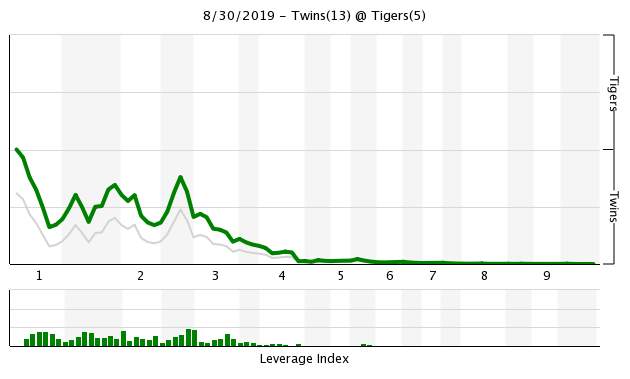 Box Score Gibson: 5.0 IP, 10 H, 4 ER, 0 BB, 5 K, 69.1% strikes (74 of 107 pitches) Bullpen: 4.0 IP, 2 H, 1 ER, 0 BB, 8 K Home Runs: Cron (23) Multi-Hit Games: Kepler (2-for-5, RBI), Polanco (3-for-4), Cruz (3-for-4, 2 RBI), Rosario (2-for-5, 3 RBI), Cron (2-for-5, HR, 3 RBI) Top 3 WPA: Polanco .125, Kepler .113, Cron .104 The Tigers put up a fight early, as Gibson got off to a slow start, but the Twins scored in four of the first five innings. Despite not being as sharp as he’s been during the first half of the season, Gibby was the winning pitcher for the second consecutive start, which happened for only the second time since June 1. August was the month he posted his worst ERA of the season, 6.11. He finished his outing on a positive note, however, retiring 11 of the last 13 men he faced. This was the eighth consecutive win for the Twins on the road, matching a club record set in 2006. At 83-51, the Twins are 32 games above .500 for the first time since September 22, 2010. That’s also the third time in the past nine years that Minnesota reached that many wins in a season. The club is now on pace to win 100 games, something that happened only one other time in Minnesota Twins history (1965, 102 wins). With the Cleveland loss in Tampa, the Twins now have a four-and-a-half game lead over the Indians, their largest since July 16. Offense bails Gibson slippery beginning Gibson was given a 4-0 lead before he took the mound. The Twins started out aggressively and hitting three straight singles after getting a leadoff walk. They had a three-run lead before the Tigers recorded an out. Nelson Cruz, Eddie Rosario and Luis Arráez each batted in a run, while Miguel Sanó reached on a fielder’s choice. Gibby allowed two runs on five hits in a 35-pitch first inning. Three of the seven batters he faced produced at-bats of at least six pitches. Fortunately, small ball kept working for the Twins, as Max Kepler doubled to bring home another leadoff walk in Jason Castro and he later scored on a Cruz sacrifice fly. Minnesota regained a four-run lead, winning 6-2 after two. But again, the Tigers gained some ground in the third. Gibson allowed three straight hits to start the inning, two of those being doubles, and Detroit scored another run. With runners on the corners, he managed to catch a break, inducing an inning-ending ground ball double play. Twins take advantage of sloppy Tiger defense Minnesota scored two more runs in the third, with a little help from the Detroit defense. The Twins loaded the bases with one out after outfielders Victor Reyes and Harold Castro got under a C.J. Cron pop up but couldn’t make the catch. That was when Ron Gardenhire pulled the plug on starter Edwin Jackson. Reliever Matt Hall couldn’t take care of the inherited runners. Jake Cave grounded out to score Arráez and Castro scored on a passed ball to make it 8-3. Meanwhile, Gibson picked up the pace a little bit and pitched his first 1-2-3 inning. To make things easier, he got more run support, as the offense slugged its way to a four-run fourth highlighted by a three-run homer from Cron to make it 12-3 Minnesota. https://twitter.com/Twins/status/1167604446752362498 Bullpen cools things down The Tigers responded in the bottom of the fourth inning with a solo home run from John Hicks. Gibby handed over the game to the bullpen in the sixth inning and it couldn’t have been in better hands. Coming into this game with the most fWAR in baseball in the previous seven days (0.8), the Twins relievers took care of business. Tyler Duffey and Trevor May were simply lights-out, with Duffey coming up just short of an immaculate inning (nine strikes on ten pitches). Sam Dyson allowed a solo homer to Ronny Rodriguez in the eighth inning before Sergio Romo closed the books in the ninth. Twins relievers combined for eight strikeouts, one more than the entire Tigers team. Eddie Rosario helped the cause with an RBI single in the eighth. Postgame With Baldelli https://twitter.com/fsnorth/status/1167639593652371459 Bullpen Usage Spreadsheet Click here for a review of the number of pitches thrown by each member of the bullpen over the past five days.
 -
Things are starting to heat up and the postseason is getting closer. Today, among Baseball Prospectus, Fangraphs and Baseball Reference, the lowest odds of the Twins making the playoffs is 97.8% and the lowest of them winning the division is 86.1%. So, one way or the other, only a tragedy would keep Minnesota out. With that in mind and with the September roster expansions coming up, here are four questions we should be asking ourselves, regarding the roster that they’re taking to October.First, we have to look at the Twins and figure out what are their needs and what they can do about it. At this moment, ten pitchers and ten position players (provided Byron Buxton is healthy) are considered by most as locks for the postseason. Those 20 players don't include the players below, so when the time comes for the Twins to set a final playoff roster, some very productive position players could not be included. Do you leave off Luis Arráez, Jonathan Schoop or Ehire Adrianza? To me that’s the toughest and potentially most dangerous problem to solve. Luis Arráez leads all AL rookies in batting average (.335) and is at the top five in fWAR (1.4), WPA (1.34), OPS (.836) and wRC+ (123). How can you realistically not want this guy in the playoffs? The problem is that you don’t have other very clear options. One could argue that Jonathan Schoop has a considerably lower offensive production than him, with .254 AVG, 0.9 fWAR, -1.19 WPA (dead last on the team), .769 OPS and 97 wRC+. Or that, statistically, his defense isn’t much better than that of Arráez, since the rookie has better UZR and DEF, while Schoop has produced only one DRS more than him. But that’s not even the main point here. Schoop was the clear starting second baseman acquisition in the offseason. He’s being paid good money to do so. Usually, that would mean there’s virtually zero chance he’s not part of a playoff roster. Schoop is a vital part of the “Bomba Squad” spirit. With 18 home runs on the year, he’s very likely to become the seventh or eighth Twin with 20 dingers this season. Other than the Bombas, experience counts a lot during playoffs and Schoop can provide that. Adrianza becomes the second realistic option to be excluded, which would be a huge bummer. Not because I think he’s an Eduardo Escobar-type bench player. He’s not. But he is so hard-working, so patient and has made such a good contribution to this organization in the past three years that it would be heartbreaking to see him out of the playoff roster. He did make the cut for the 2017 Wild Card team, but still, there’s no guarantee that he will be included this time. He’s also producing at the highest he’s ever produced in a Twin uniform. This season he is slashing .287/.371/.431 (.802), with a 112 wRC+. He also represents a statistically better defender than Schoop, for example, when he played second base. But the latter still holds the same upper-hand mentioned in the last paragraph. And you’re definitely not leaving out Marwin Gonzalez to include Adrianza. So tell us, reader, what would you do here in this infield puzzle? But before you make a decision here, let me say that in the next paragraph you may find a solution, if you feel like all three deserve to make the roster. But it’s not any easier. Do you leave off Jake Cave and use Gonzalez as the fourth outfielder? When Buxton is back, the Twins will have four primary outfielders, with Jake Cave being on the bench. Now, if the Twins want, they can keep extra infielder by deploying Gonzalez as their fourth outfielder, when necessary. The question here is: do you exclude Cave on their behalf? Cave has already done a pretty good job when he was called to fill in for Buxton lass season. But this year? Hoo, boy. Fine, his overall numbers in 2019 are not extremely better than 2018, but he's currently having an out-of-the-earth month of August. Since being recalled on Aug. 3, he’s slashing .442/.500/.767 (1.267) with a 232 wRC+ and a .696 BABIP. He leads the Twins in all those metrics this month, except SLG, OPS and wRC+, losing to Nelson Cruz in them by very little. So, what would you do here? As much as we might like Adrianza and as well as Arráez might be playing offensively, how can you turn your back on this? Granted, Cave’s numbers could very well come down to earth after a whole month of September, which would make this decision much easier. If they don’t, what a tough decision to make. However, let’s not forget that when we talk about Cave, we’re talking about a much smaller sample size. So far, he’s got only 148 plate appearances, against 205 from Adrianza and 249 from Arráez. What do you do with Willians Astudillo? Since coming back from his oblique strain injury, “La Tortuga” is slashing .368/.368/.421 (.789) in four Triple-A games and .353/.421/.765 (1.186) in five Double-A games, striking out only once overall. If he comes back and maintain that level, do you have a spot for him on your postseason roster? Over who? Personally, I can’t see it happening and I can’t see anyone I would choose him over. But you never know what’s going to happen. Which pitchers make the postseason staff? Assuming that all the position players questions are answered when October comes. There are 10 pitchers who are considered locked in for a playoff spot: José Berríos, Michael Pineda, Jake Odorizzi and Kyle Gibson as starters. Martín Pérez, Tyler Duffey, Trevor May, Sam Dyson, Sergio Romo and Taylor Rogers as relievers. You need to add two or three more. Who do you have? Here are four names. 1. Zack Littell What a great job this kid has been doing this year. He had one bad outing in late May, in which he gave up eight of his ten earned runs in the year. So, if you removed that one outing, you find out that he would have a 0.87 ERA the whole year. Granted, he’s pitched only 25 innings this season, but that’s still impressive. Since June 18, when he got called up for the second time, he’s posting a 0.96 ERA, which is good for the fifth best in baseball. I was honestly very confused when he was the chosen one to be optioned last week. Can he handle high leverage situations in the postseason? I wouldn’t want to test that -- although in the very few moments (three and one third innings) he’s been put under pressure, he hasn’t allowed a single run and has held opposing batters to a ridiculous .091/.167/.091 slash line. 2. Trevor Hildenberger Hildy had an amazing start to the year, followed by a horrendous month of May, which resulted in him being sent down. Then, he started dealing with injuries and was sidelined for nearly two months. Now, he’s back and, apparently, he’s back to his old self. Before the start of May, Hildenberger was one of the team’s best relievers, posting a 1.92 ERA. Now, since coming back from injury, he’s pitched five games (seven innings) and is posting a 1.28 ERA, while striking out nine batters per nine and with a 7.03 K/BB ratio. He’s had some serious ups and downs in his short major league career, which can make us a bit suspicious, but he’s definitely earned the right to be looked at in September. 3. Devin Smeltzer Smeltzer didn’t shy away when he got his chance. He impressed everyone when he shutout the Yankees for five innings of relief in late July, so you can tell the kid is ready for the big stage. As a reliever this year, he has a 3.38 ERA for the Twins. In medium or high leverage situations, that goes down to 3.09. But that’s not even his spot. Along with Pérez, he could be the best option if a starter can’t get deep into a game and you need a long man. Besides, you absolutely need another lefty over there. 4. Brusdar Graterol The organization’s top pitching prospect doesn’t even need introductions. You can read a more in depth analysis of him in two of our latest articles, one by Jeremy Nygaard here and one by Andrew Thares here, as well as our daily Minor League reports. He’s pitched 59 innings in three different minor league levels this year and is holding opponent batters to a .180 AVG, striking out 8.84 times per nine. His ERA this year is 1.53 overall and 0.00 in 8 1/3 innings of relief. It would be a longshot if he actually made the playoff team after a callup in September. But, who knows? Other callups that are going to be looked at during September and maybe could earn a spot include Ryne Harper, Jorge Alcala, Randy Dobnak, Fernando Romero and Kohl Stewart. Harper was a regular on the Twins bullpen all year, but got out of track lately. He should get another chance, because he’s shown good stuff before. So who is on your final roster? Click here to view the article
- 50 replies
-
- 2
-
-
- luis arraez
- ehire adrianza
- (and 3 more)
-
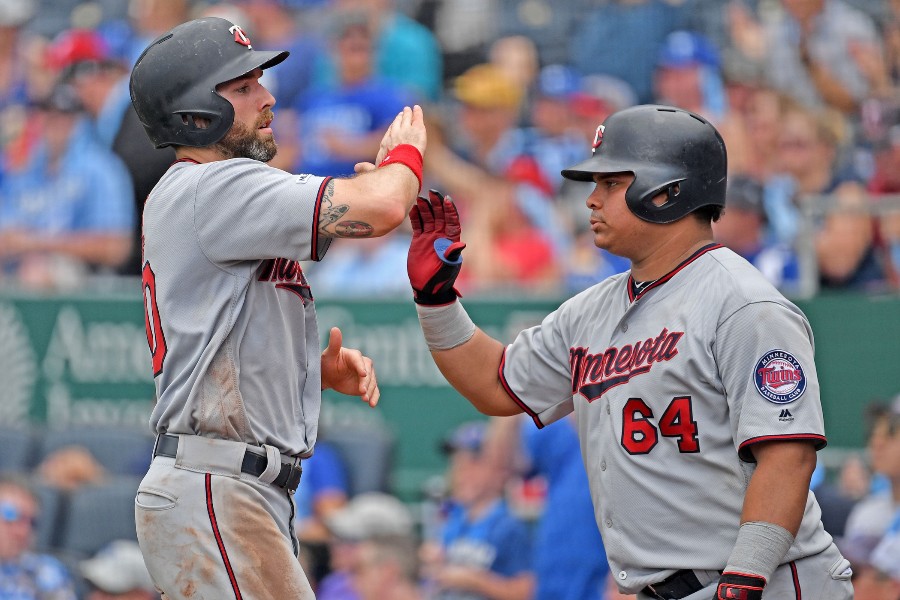 First, we have to look at the Twins and figure out what are their needs and what they can do about it. At this moment, ten pitchers and ten position players (provided Byron Buxton is healthy) are considered by most as locks for the postseason. Those 20 players don't include the players below, so when the time comes for the Twins to set a final playoff roster, some very productive position players could not be included. Do you leave off Luis Arráez, Jonathan Schoop or Ehire Adrianza? To me that’s the toughest and potentially most dangerous problem to solve. Luis Arráez leads all AL rookies in batting average (.335) and is at the top five in fWAR (1.4), WPA (1.34), OPS (.836) and wRC+ (123). How can you realistically not want this guy in the playoffs? The problem is that you don’t have other very clear options. One could argue that Jonathan Schoop has a considerably lower offensive production than him, with .254 AVG, 0.9 fWAR, -1.19 WPA (dead last on the team), .769 OPS and 97 wRC+. Or that, statistically, his defense isn’t much better than that of Arráez, since the rookie has better UZR and DEF, while Schoop has produced only one DRS more than him. But that’s not even the main point here. Schoop was the clear starting second baseman acquisition in the offseason. He’s being paid good money to do so. Usually, that would mean there’s virtually zero chance he’s not part of a playoff roster. Schoop is a vital part of the “Bomba Squad” spirit. With 18 home runs on the year, he’s very likely to become the seventh or eighth Twin with 20 dingers this season. Other than the Bombas, experience counts a lot during playoffs and Schoop can provide that. Adrianza becomes the second realistic option to be excluded, which would be a huge bummer. Not because I think he’s an Eduardo Escobar-type bench player. He’s not. But he is so hard-working, so patient and has made such a good contribution to this organization in the past three years that it would be heartbreaking to see him out of the playoff roster. He did make the cut for the 2017 Wild Card team, but still, there’s no guarantee that he will be included this time. He’s also producing at the highest he’s ever produced in a Twin uniform. This season he is slashing .287/.371/.431 (.802), with a 112 wRC+. He also represents a statistically better defender than Schoop, for example, when he played second base. But the latter still holds the same upper-hand mentioned in the last paragraph. And you’re definitely not leaving out Marwin Gonzalez to include Adrianza. So tell us, reader, what would you do here in this infield puzzle? But before you make a decision here, let me say that in the next paragraph you may find a solution, if you feel like all three deserve to make the roster. But it’s not any easier. Do you leave off Jake Cave and use Gonzalez as the fourth outfielder? When Buxton is back, the Twins will have four primary outfielders, with Jake Cave being on the bench. Now, if the Twins want, they can keep extra infielder by deploying Gonzalez as their fourth outfielder, when necessary. The question here is: do you exclude Cave on their behalf? Cave has already done a pretty good job when he was called to fill in for Buxton lass season. But this year? Hoo, boy. Fine, his overall numbers in 2019 are not extremely better than 2018, but he's currently having an out-of-the-earth month of August. Since being recalled on Aug. 3, he’s slashing .442/.500/.767 (1.267) with a 232 wRC+ and a .696 BABIP. He leads the Twins in all those metrics this month, except SLG, OPS and wRC+, losing to Nelson Cruz in them by very little. So, what would you do here? As much as we might like Adrianza and as well as Arráez might be playing offensively, how can you turn your back on this? Granted, Cave’s numbers could very well come down to earth after a whole month of September, which would make this decision much easier. If they don’t, what a tough decision to make. However, let’s not forget that when we talk about Cave, we’re talking about a much smaller sample size. So far, he’s got only 148 plate appearances, against 205 from Adrianza and 249 from Arráez. What do you do with Willians Astudillo? Since coming back from his oblique strain injury, “La Tortuga” is slashing .368/.368/.421 (.789) in four Triple-A games and .353/.421/.765 (1.186) in five Double-A games, striking out only once overall. If he comes back and maintain that level, do you have a spot for him on your postseason roster? Over who? Personally, I can’t see it happening and I can’t see anyone I would choose him over. But you never know what’s going to happen. Which pitchers make the postseason staff? Assuming that all the position players questions are answered when October comes. There are 10 pitchers who are considered locked in for a playoff spot: José Berríos, Michael Pineda, Jake Odorizzi and Kyle Gibson as starters. Martín Pérez, Tyler Duffey, Trevor May, Sam Dyson, Sergio Romo and Taylor Rogers as relievers. You need to add two or three more. Who do you have? Here are four names. 1. Zack Littell What a great job this kid has been doing this year. He had one bad outing in late May, in which he gave up eight of his ten earned runs in the year. So, if you removed that one outing, you find out that he would have a 0.87 ERA the whole year. Granted, he’s pitched only 25 innings this season, but that’s still impressive. Since June 18, when he got called up for the second time, he’s posting a 0.96 ERA, which is good for the fifth best in baseball. I was honestly very confused when he was the chosen one to be optioned last week. Can he handle high leverage situations in the postseason? I wouldn’t want to test that -- although in the very few moments (three and one third innings) he’s been put under pressure, he hasn’t allowed a single run and has held opposing batters to a ridiculous .091/.167/.091 slash line. 2. Trevor Hildenberger Hildy had an amazing start to the year, followed by a horrendous month of May, which resulted in him being sent down. Then, he started dealing with injuries and was sidelined for nearly two months. Now, he’s back and, apparently, he’s back to his old self. Before the start of May, Hildenberger was one of the team’s best relievers, posting a 1.92 ERA. Now, since coming back from injury, he’s pitched five games (seven innings) and is posting a 1.28 ERA, while striking out nine batters per nine and with a 7.03 K/BB ratio. He’s had some serious ups and downs in his short major league career, which can make us a bit suspicious, but he’s definitely earned the right to be looked at in September. 3. Devin Smeltzer Smeltzer didn’t shy away when he got his chance. He impressed everyone when he shutout the Yankees for five innings of relief in late July, so you can tell the kid is ready for the big stage. As a reliever this year, he has a 3.38 ERA for the Twins. In medium or high leverage situations, that goes down to 3.09. But that’s not even his spot. Along with Pérez, he could be the best option if a starter can’t get deep into a game and you need a long man. Besides, you absolutely need another lefty over there. 4. Brusdar Graterol The organization’s top pitching prospect doesn’t even need introductions. You can read a more in depth analysis of him in two of our latest articles, one by Jeremy Nygaard here and one by Andrew Thares here, as well as our daily Minor League reports. He’s pitched 59 innings in three different minor league levels this year and is holding opponent batters to a .180 AVG, striking out 8.84 times per nine. His ERA this year is 1.53 overall and 0.00 in 8 1/3 innings of relief. It would be a longshot if he actually made the playoff team after a callup in September. But, who knows? Other callups that are going to be looked at during September and maybe could earn a spot include Ryne Harper, Jorge Alcala, Randy Dobnak, Fernando Romero and Kohl Stewart. Harper was a regular on the Twins bullpen all year, but got out of track lately. He should get another chance, because he’s shown good stuff before. So who is on your final roster?
 -
Kicking off the Players Weekend, the Twins hosted the first of a three-game series against the team with the worst record and offense in baseball, while sending their ace, to the mound. But La Makina's August struggles persisted, allowing the Tigers to win the opener, 9-6.Box Score Berríos: 5.1 IP, 10 H, 5 ER, 2 BB, 5 K, 70.9% strikes (66 of 93 pitches) Bullpen: 3.2 IP, 7 H, 4 ER, 1 BB, 3 K Home Runs: Sanó, 2 (25), Cave, 2 (4) Multi-Hit Games: Sanó (2-for-4, 2 HR, 3 RBI), Cave (2-for-2, 2 HR, 2 RBI, BB), Castro (2-for-4) Top 3 WPA: Cave .134, Sanó .106, May .042 Bottom 3 WPA: Berríos -.357, Kepler -.122, Romo -.101 The Twins missed out on a great opportunity. They were facing the league’s least productive offense and somehow they were out-hit 17 to 9. The Tigers are also the seventh worst pitching staff in baseball in total strikeouts, but they managed to strike out Twins batters 14 times, including 11 for the starter Drew VerHagen. With the loss and the Cleveland win, the Twins lead atop of the Central now shrinks to two and a half games. All Eyes on La Makina Everybody is still looking for answers as to why José Berríos (La Makina, "The Machine") is having such an abysmal month of August. Earlier this week Ted Schwerzler put together a list of some weird numbers from his season, to help us investigate. The fact is, the version of Berríos we have witnessed in his previous three starts of the month just wasn't the real him. Tonight, he had the chance to shake off the worst month of his career since his rookie season. However, things didn’t start as smoothly as one would think they would against the team with the worst record in baseball. In the first two innings of action, he gave up three hits and walked former Twin Niko Goodrum. He managed to strand all runners, though. In support of their ace, the bats started working early. They manufactured the game’s first run in the first, after a single by Jorge Polanco (Chulo, “Pretty Boy”), followed by a Nelson Cruz (Boomstick) double, which was absolutely crushed: the ball left his bat at 115.1 mph--only his fifth hardest-hit ball of the season. On the second pitch of the home half of the second, the ball was smoked again. Miguel Sanó (Boquetón, “Large Mouth”) clobbered a hanging slider from VerHagen, good for 109.9 mph. That was his 24th of the season. Stay hot, Caveman! While Berríos stabilized a bit, allowing only a couple of runners to reach in the following three innings, he got some more run support. Since being called up for the fourth time this year, to replace an injured Byron Buxton, Jake Cave (Caveman) is making the most of it. This month, he’s the only Twin not named Nelson Cruz to be hitting above .400. Before this game, he was averaging .405 since August 3, when he got called up. He crushed his third dinger of the year in the fifth, to make it 3-0 Twins. Cave would also make his presence felt on defense later in the game, when he robbed Miguel Cabrera of an RBI-extra base hit in the eighth, with a beautiful leaping grab near the warning track. ‘August Berríos’ strikes again Five shutout innings, which weren’t brilliant, of course, and we all thought José was finally getting rid of the funk. We were wrong. Three straight hits to open the sixth put Detroit on the board. After Berríos gave up a one-out walk that loaded the bases, Ronny Rodriguez made him pay, hitting a grand slam to give the Tigers their first lead of the night, 5-3. With that home run, Berríos has now allowed 20 earned runs this August, which is already the second most he’s allowed in any month of his career. The only time he’s given up more than that, 21, was in (surprise, surprise) August 2016. It’s not time to jump to any conclusions, but if Wes Johnson and the coaching staff don’t figure out in the next few weeks what’s wrong with Berríos, this version of him is bound to be crushed in October. Bullpen can’t stop the bleeding either Detroit never actually stopped hitting and scoring. Tyler Duffey (The Doof) and Trevor May (IAMTREVORMAY) managed to keep the game within reach after taking over from Berríos in the sixth and the seventh. But the same thing didn’t happen in the final two innings. Sergio Romo (El Mechón, “The Frosted Tips” or “The Padlock”) and Ryne Harper (Harp) allowed three hits and two earned runs each. Harper’s outing was even more harmful to the Twins, because Miguel Sanó hit a two-run homer in the bottom of the eighth, making it a two-run game, 7-5. But Detroit responded immediately and made it a four-run game in the ninth. Just like Sanó, Cave also went on to record his first multi-HR game of the season, hitting a solo shot in the bottom of the ninth. With the four homers, the Twins now have 248 on the year, 20 short of the MLB record. Postgame With Baldelli Bullpen Usage Spreadsheet Click here for a review of the number of pitches thrown by each member of the bullpen over the past five days. Click here to view the article
- 87 replies
-
- 2
-
-
- jose berrios
- jake cave
- (and 3 more)
-
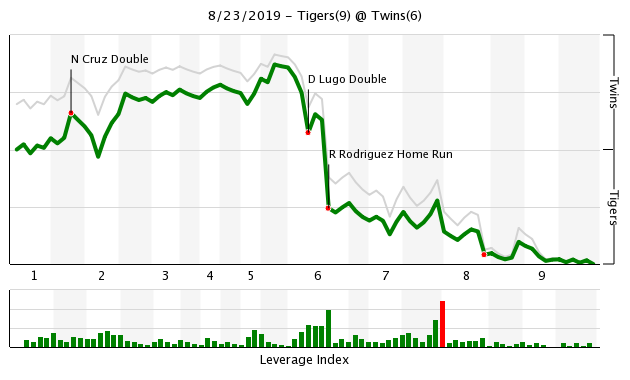 Box Score Berríos: 5.1 IP, 10 H, 5 ER, 2 BB, 5 K, 70.9% strikes (66 of 93 pitches) Bullpen: 3.2 IP, 7 H, 4 ER, 1 BB, 3 K Home Runs: Sanó, 2 (25), Cave, 2 (4) Multi-Hit Games: Sanó (2-for-4, 2 HR, 3 RBI), Cave (2-for-2, 2 HR, 2 RBI, BB), Castro (2-for-4) Top 3 WPA: Cave .134, Sanó .106, May .042 Bottom 3 WPA: Berríos -.357, Kepler -.122, Romo -.101 The Twins missed out on a great opportunity. They were facing the league’s least productive offense and somehow they were out-hit 17 to 9. The Tigers are also the seventh worst pitching staff in baseball in total strikeouts, but they managed to strike out Twins batters 14 times, including 11 for the starter Drew VerHagen. With the loss and the Cleveland win, the Twins lead atop of the Central now shrinks to two and a half games. All Eyes on La Makina Everybody is still looking for answers as to why José Berríos (La Makina, "The Machine") is having such an abysmal month of August. Earlier this week Ted Schwerzler put together a list of some weird numbers from his season, to help us investigate. The fact is, the version of Berríos we have witnessed in his previous three starts of the month just wasn't the real him. Tonight, he had the chance to shake off the worst month of his career since his rookie season. However, things didn’t start as smoothly as one would think they would against the team with the worst record in baseball. In the first two innings of action, he gave up three hits and walked former Twin Niko Goodrum. He managed to strand all runners, though. In support of their ace, the bats started working early. They manufactured the game’s first run in the first, after a single by Jorge Polanco (Chulo, “Pretty Boy”), followed by a Nelson Cruz (Boomstick) double, which was absolutely crushed: the ball left his bat at 115.1 mph--only his fifth hardest-hit ball of the season. On the second pitch of the home half of the second, the ball was smoked again. Miguel Sanó (Boquetón, “Large Mouth”) clobbered a hanging slider from VerHagen, good for 109.9 mph. That was his 24th of the season. https://twitter.com/fsnorth/status/1165063800560578560 Stay hot, Caveman! While Berríos stabilized a bit, allowing only a couple of runners to reach in the following three innings, he got some more run support. Since being called up for the fourth time this year, to replace an injured Byron Buxton, Jake Cave (Caveman) is making the most of it. This month, he’s the only Twin not named Nelson Cruz to be hitting above .400. Before this game, he was averaging .405 since August 3, when he got called up. He crushed his third dinger of the year in the fifth, to make it 3-0 Twins. https://twitter.com/Twins/status/1165076666244304897 Cave would also make his presence felt on defense later in the game, when he robbed Miguel Cabrera of an RBI-extra base hit in the eighth, with a beautiful leaping grab near the warning track. ‘August Berríos’ strikes again Five shutout innings, which weren’t brilliant, of course, and we all thought José was finally getting rid of the funk. We were wrong. Three straight hits to open the sixth put Detroit on the board. After Berríos gave up a one-out walk that loaded the bases, Ronny Rodriguez made him pay, hitting a grand slam to give the Tigers their first lead of the night, 5-3. With that home run, Berríos has now allowed 20 earned runs this August, which is already the second most he’s allowed in any month of his career. The only time he’s given up more than that, 21, was in (surprise, surprise) August 2016. It’s not time to jump to any conclusions, but if Wes Johnson and the coaching staff don’t figure out in the next few weeks what’s wrong with Berríos, this version of him is bound to be crushed in October. Bullpen can’t stop the bleeding either Detroit never actually stopped hitting and scoring. Tyler Duffey (The Doof) and Trevor May (IAMTREVORMAY) managed to keep the game within reach after taking over from Berríos in the sixth and the seventh. But the same thing didn’t happen in the final two innings. Sergio Romo (El Mechón, “The Frosted Tips” or “The Padlock”) and Ryne Harper (Harp) allowed three hits and two earned runs each. Harper’s outing was even more harmful to the Twins, because Miguel Sanó hit a two-run homer in the bottom of the eighth, making it a two-run game, 7-5. But Detroit responded immediately and made it a four-run game in the ninth. Just like Sanó, Cave also went on to record his first multi-HR game of the season, hitting a solo shot in the bottom of the ninth. With the four homers, the Twins now have 248 on the year, 20 short of the MLB record. Postgame With Baldelli Bullpen Usage Spreadsheet Click here for a review of the number of pitches thrown by each member of the bullpen over the past five days.
 -
Rocco Baldelli has been great. That’s indisputable. The Twins are still on pace to win the most games since 1970 and maybe win the division for the first time in nine years. I don’t believe many Twins fans are anything but satisfied with that. But recent struggles may have disappointed a number of fans. So we put together a letter to future Rocco, to help him avoid his rookie managing season mistakes.Dear future Rocco, Twins Territory is grateful and maybe surprised by how good our team has been with you behind the wheel. We thank you for such a fun season, for putting together, alongside your coaching staff, the best offense in baseball and maybe one of the best of all time. So many smiles after each record-breaking Bomba are priceless. At this point, we’re really hoping you can pull an Alex Cora-type rookie season as a manager. Some of us have believed that for awhile now. But even if that doesn’t happen, it’s OK. This young core is here for the long haul and we’re looking forward to the next decade as Twins fans. In the past couple of months, though, the Twins have slowed down a lot, at some points struggling to remain above .500 since the first week of June. At the same time, Cleveland has reached the Twins, coming back from an eleven and a half game deficit, which made things even more bitter. So, every mistake has been blown out of proportion, whether that’s fair or not. So here’s a short list of obstacles you could work on avoiding in the years to come. Fix the infield defense As of late, the Twins fielding hasn’t been the best. As a team, they’ve committed 86 errors, the sixth-most in MLB. Among those, 43 were throwing errors, which is the fourth-highest in baseball. Earlier this week Twins Daily’s Parker Hageman tweeted an ugly fact about Minnesota’s infielders: Basically, all the Twins everyday infielders can be held accountable for that. Jonathan Schoop is tied for most errors in the league among second basemen with 12. Jorge Polanco is tied at third among shortstops with 15 errors. Miguel Sanó is tied for sixth among third basemen with 12. Even C.J. Cron, who has had some very good defensive plays throughout the year, makes this list. He is the fourth among first basemen with nine. Overall, the Twins defense isn’t one of the league’s worst. For instance, they rank 10th in Defensive Runs Saved (DRS), according to FanGraphs, with 24. But that’s mostly because of their outfield. FanGraphs briefly breaks down how they calculate DRS here and when you look at the fielding calculations, you find that it uses rARM (Outfield Arms Runs Saved). The Twins outfielders are responsible for 11 (highest in baseball!) of those 24 runs saved. In other words, the infield defense has been bringing the defensive numbers down. You were able to put together such a good team of coaches to help transform this team in such an exciting unit. We trust you to find professionals who will help fix this infield defense. Of course, there’s always the option of replacing a player here or there as well. But, I’m sure you’ll figure that out. Give the bullpen a rest The Twins bullpen has suffered a lot this season when relievers were used with no days of rest. It’s not that Minnesota is one of the teams who’s done that the most frequently (they’re only 14th in the league at 73 games). But, even so, they have one of the worst outcomes. When pitching in back-to-back days, Twins relievers have allowed the fourth-most runs in MLB, 50, and have the second-highest OPS against, with .926. That is simply unbelievable. Not even Taylor Rogers, Minnesota’s best reliever, escapes this pattern. After he gave up a grand slam against Cleveland last Sunday, Aaron Gleeman posted how much worse his numbers are when pitching with no rest: Other pitchers who have suffered because of this include Ryne Harper and Tyler Duffey, as well as trade deadline acquisitions Sergio Romo and Sam Dyson. Since this is your first year with these players, you’re still getting to know them. It’s understandable. Maybe you and the front office should work next offseason on adding arms you trust as much as you trust Rogers. Maybe do something about the injuries Injuries have been one of the smallest problems for the Twins as a team this year, at least if compared to last year. And, let’s face it, what can a manager do to prevent them from happening? Very little, we assume. But, if there’s anything in your power to change the frequency with which they happen to this team, we ask you, please do it. Almost every position has suffered from the consequences of injuries this year. Position players who hit the IL include Willians Astudillo (67 days), Mitch Garver (19 days), Cron, Marwin Gonzalez, Ehire Adrianza (each one of them 11 days) and Eddie Rosario (19 days). Jake Odorizzi and Michael Pineda (11 days each) were sidelined starters and José Berríos has shown signs that possibly something is not quite right with him in the past few weeks. No injuries have had more impact than those to Byron Buxton and Nelson Cruz. They have both had multiple IL stints and are currently combined for 49 IL days on the year. Not only is that a very long time, but they are maybe the most impactful players on this team. When Nelly was sent down last week, he was raking, hitting home runs left and right. Thankfully, earlier this week it was reported that his injury wasn’t serious and that he would be back in action shortly. But, should we be worried for the future? Maybe he should seek a specific treatment for his wrist problems during the offseason. Buxton’s absence was felt even more. While the Twins have a 53-25 (.679) record when he’s on the field, they have a 21-23 (.477) without him. Although it’s very hard to prove, I can’t believe that’s a simple coincidence. A lot of people have been discussing for years now whether or not he should change his approach to the game, maybe being less aggressive when chasing after warning track fly balls. As a former outfielder, maybe you could guide him through those changes, if they’re really the way to go. Or maybe just better conditioning would do the trick. Something must be done to change the fact that injuries are becoming the greatest obstacle in Buxton’s career success. The Twins can’t afford to lose a player that maybe represents 20 percent more wins in a season multiple times a year. Like I wrote before, there’s maybe very little a manager can do about that, but we ask you, whatever is in your jurisdiction to do, please do it. We all hope these tips can help you maintain this team on the right track for years to come. Love, Twins fans. Click here to view the article
-
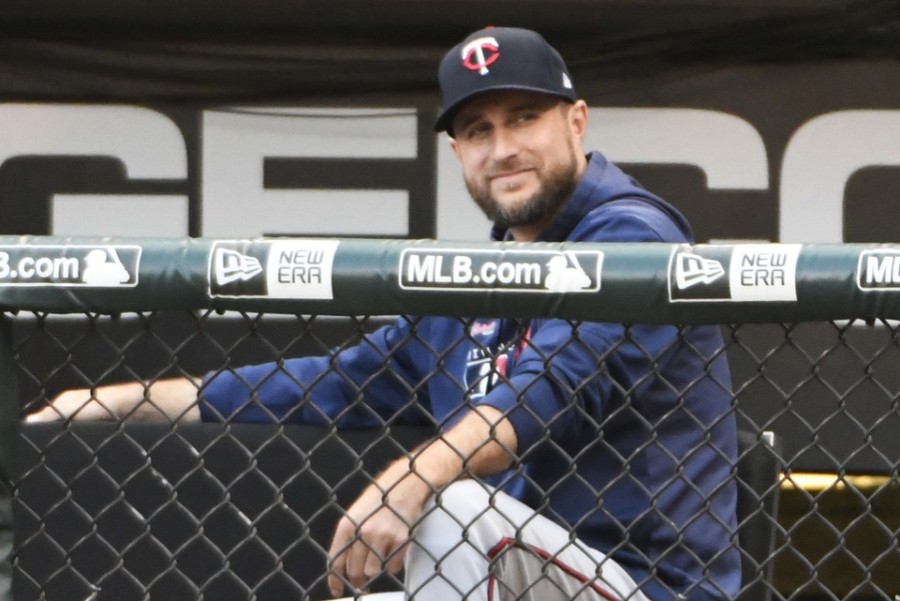 Dear future Rocco, Twins Territory is grateful and maybe surprised by how good our team has been with you behind the wheel. We thank you for such a fun season, for putting together, alongside your coaching staff, the best offense in baseball and maybe one of the best of all time. So many smiles after each record-breaking Bomba are priceless. At this point, we’re really hoping you can pull an Alex Cora-type rookie season as a manager. Some of us have believed that for awhile now. But even if that doesn’t happen, it’s OK. This young core is here for the long haul and we’re looking forward to the next decade as Twins fans. In the past couple of months, though, the Twins have slowed down a lot, at some points struggling to remain above .500 since the first week of June. At the same time, Cleveland has reached the Twins, coming back from an eleven and a half game deficit, which made things even more bitter. So, every mistake has been blown out of proportion, whether that’s fair or not. So here’s a short list of obstacles you could work on avoiding in the years to come. Fix the infield defense As of late, the Twins fielding hasn’t been the best. As a team, they’ve committed 86 errors, the sixth-most in MLB. Among those, 43 were throwing errors, which is the fourth-highest in baseball. Earlier this week Twins Daily’s Parker Hageman tweeted an ugly fact about Minnesota’s infielders: https://twitter.com/ParkerHageman/status/1161825462890504192 Basically, all the Twins everyday infielders can be held accountable for that. Jonathan Schoop is tied for most errors in the league among second basemen with 12. Jorge Polanco is tied at third among shortstops with 15 errors. Miguel Sanó is tied for sixth among third basemen with 12. Even C.J. Cron, who has had some very good defensive plays throughout the year, makes this list. He is the fourth among first basemen with nine. Overall, the Twins defense isn’t one of the league’s worst. For instance, they rank 10th in Defensive Runs Saved (DRS), according to FanGraphs, with 24. But that’s mostly because of their outfield. FanGraphs briefly breaks down how they calculate DRS here and when you look at the fielding calculations, you find that it uses rARM (Outfield Arms Runs Saved). The Twins outfielders are responsible for 11 (highest in baseball!) of those 24 runs saved. In other words, the infield defense has been bringing the defensive numbers down. You were able to put together such a good team of coaches to help transform this team in such an exciting unit. We trust you to find professionals who will help fix this infield defense. Of course, there’s always the option of replacing a player here or there as well. But, I’m sure you’ll figure that out. Give the bullpen a rest The Twins bullpen has suffered a lot this season when relievers were used with no days of rest. It’s not that Minnesota is one of the teams who’s done that the most frequently (they’re only 14th in the league at 73 games). But, even so, they have one of the worst outcomes. When pitching in back-to-back days, Twins relievers have allowed the fourth-most runs in MLB, 50, and have the second-highest OPS against, with .926. That is simply unbelievable. Not even Taylor Rogers, Minnesota’s best reliever, escapes this pattern. After he gave up a grand slam against Cleveland last Sunday, Aaron Gleeman posted how much worse his numbers are when pitching with no rest: https://twitter.com/AaronGleeman/status/1160928760255746048 Other pitchers who have suffered because of this include Ryne Harper and Tyler Duffey, as well as trade deadline acquisitions Sergio Romo and Sam Dyson. Since this is your first year with these players, you’re still getting to know them. It’s understandable. Maybe you and the front office should work next offseason on adding arms you trust as much as you trust Rogers. Maybe do something about the injuries Injuries have been one of the smallest problems for the Twins as a team this year, at least if compared to last year. And, let’s face it, what can a manager do to prevent them from happening? Very little, we assume. But, if there’s anything in your power to change the frequency with which they happen to this team, we ask you, please do it. Almost every position has suffered from the consequences of injuries this year. Position players who hit the IL include Willians Astudillo (67 days), Mitch Garver (19 days), Cron, Marwin Gonzalez, Ehire Adrianza (each one of them 11 days) and Eddie Rosario (19 days). Jake Odorizzi and Michael Pineda (11 days each) were sidelined starters and José Berríos has shown signs that possibly something is not quite right with him in the past few weeks. No injuries have had more impact than those to Byron Buxton and Nelson Cruz. They have both had multiple IL stints and are currently combined for 49 IL days on the year. Not only is that a very long time, but they are maybe the most impactful players on this team. When Nelly was sent down last week, he was raking, hitting home runs left and right. Thankfully, earlier this week it was reported that his injury wasn’t serious and that he would be back in action shortly. But, should we be worried for the future? Maybe he should seek a specific treatment for his wrist problems during the offseason. Buxton’s absence was felt even more. While the Twins have a 53-25 (.679) record when he’s on the field, they have a 21-23 (.477) without him. Although it’s very hard to prove, I can’t believe that’s a simple coincidence. A lot of people have been discussing for years now whether or not he should change his approach to the game, maybe being less aggressive when chasing after warning track fly balls. As a former outfielder, maybe you could guide him through those changes, if they’re really the way to go. Or maybe just better conditioning would do the trick. Something must be done to change the fact that injuries are becoming the greatest obstacle in Buxton’s career success. The Twins can’t afford to lose a player that maybe represents 20 percent more wins in a season multiple times a year. Like I wrote before, there’s maybe very little a manager can do about that, but we ask you, whatever is in your jurisdiction to do, please do it. We all hope these tips can help you maintain this team on the right track for years to come. Love, Twins fans.
 -
It wasn’t an easy one, but the Twins managed to defeat All-Star lefty Mike Minor and the Rangers in the second game of the series in Arlington, 4-3. Jonathan Schoop hit a clutch game-winning two-run dinger and the bullpen combined to throw 3 1/3 innings of shutout ball.Box Score Odorizzi: 5.2 IP, 5 H, 3 ER, 2 BB, 5 K, 59.6% strikes (59 of 99 pitches) Bullpen: 3.1 IP, 4 H, 0 ER, 2 BB, 3 K Home Runs: Kepler (33), Schoop (17) Multi-Hit Games: Gonzalez (3-for-4), Adrianza (2-for-4) Top 3 WPA: Schoop .288, Romo .230, Rogers .155 Bottom 3 WPA: Cron -.115, Polanco -.113, Garver -.098 Cleveland dropped the second game of their series against the Yankees in New York, which brings the Twins lead to a game and a half atop of the AL Central. That’s the highest advantage the Twins have since Aug. 7, as they now own a 74-48 record, still the fourth best in baseball. Unlike the series opener, it took Minnesota a bit longer to get on the board. After throwing a 26-pitch, but scoreless, first inning, Mike Minor managed to keep the Twins scoreless until the fourth, but they took advantage of a Rougned Odor error, who dropped a Miguel Sanó routine pop-up. Right on the first pitch after that, Max Kepler homered to right field, to give Minnesota a two-run lead. Wunderboy keeps adding accomplishments to his career year. This was his 33rd home run of the season, which moved him closer to the single season record for a Twins outfielder, as informed by our Twins Daily own Ted Schwerzler. He also moved the Twins a bit closer to the all-time single season home run record. All with this bomb: Odorizzi continues to bounce back After the worst month of his career after his rookie season (7.43 ERA this July), Jake Odorizzi continues to show signs of recovery. He couldn’t hold on to the one-run lead he took into the sixth, but he was one out short of a quality start. After tonight, he is now posting a 2.07 ERA in three August starts and 1.95 if you count his last July start, against the Marlins. His improvement brings Twins fans a little more optimism for a playoff run, since he’s starting to look much more like the All-Star he was during the first half of the season--in a much needed time. Other than a rare wild pitch during the fourth inning (only his second as a Twin), he basically didn’t have big problems in his first five innings of the game, allowing the Rangers to score only one run on three hits. But Texas got to him during the sixth and made him pay after he allowed a leadoff double and a two-out walk. Nomar Mazara became the last batter he faced, as he hit a two-out double to deep center field, giving the home team its first lead in the series. But that wouldn’t last very long. The unlikely hero Batting only .217 in his previous 15 games coming into tonight and having hit his last homer in Jul. 28,, I guess it’s hard to say many people envisioned Jonathan Schoop being the one to push Minnesota toward the win. But that’s the magic with this year’s Twins. The Bombas simply won’t stop. He crushed a 2-2 changeup over the plate, following a Marwin Gonzalez single and the Twins retook the lead. Other than hopefully providing Schoop’s season with a sparkle he’s been looking for in the past two months, that home run was the 238th for the Twins this year and they now need 30 to break the Yankees single-season record established last year. Minnesota is on pace to hit 316 this year. The bullpen takes care of business When Odorizzi gave up that lead-blowing double in the sixth, Tyler Duffey was called to put out the fire. He struck out Odor to end the inning and started a very efficient night for the Twins ‘pen. Sam Dyson recorded his third consecutive scoreless outing for Minnesota. He did get some help from the defense, which turned an inning- ending double play after he allowed two runners to reach. In his first appearance since giving up a tenth inning grand slam on Sunday, Taylor Rogers came into the game in the eighth and also held the Rangers scoreless. When most people thought he would come back to record another six-out save, Baldelli decided to bring in Sergio Romo and he also got the job done, earning his 20th save of the year. Hats off to Margo Despite the colder than usual night from the offense, Marwin Gonzalez simply refuses to cool down. After a four-hit night on Thursday, Margo led Minnesota with three hits on the night and he’s now batting .404 since the start of the Atlanta series. Postgame With Baldelli Bullpen Usage Spreadsheet Click here for a review of the number of pitches thrown by each member of the bullpen over the past five days. Click here to view the article
- 38 replies
-
- 3
-
-
- jake odorizzi
- jonathan schoop
- (and 3 more)
-
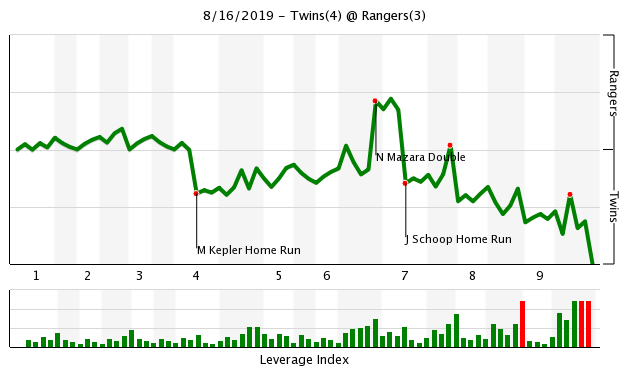 Box Score Odorizzi: 5.2 IP, 5 H, 3 ER, 2 BB, 5 K, 59.6% strikes (59 of 99 pitches) Bullpen: 3.1 IP, 4 H, 0 ER, 2 BB, 3 K Home Runs: Kepler (33), Schoop (17) Multi-Hit Games: Gonzalez (3-for-4), Adrianza (2-for-4) Top 3 WPA: Schoop .288, Romo .230, Rogers .155 Bottom 3 WPA: Cron -.115, Polanco -.113, Garver -.098 Cleveland dropped the second game of their series against the Yankees in New York, which brings the Twins lead to a game and a half atop of the AL Central. That’s the highest advantage the Twins have since Aug. 7, as they now own a 74-48 record, still the fourth best in baseball. Unlike the series opener, it took Minnesota a bit longer to get on the board. After throwing a 26-pitch, but scoreless, first inning, Mike Minor managed to keep the Twins scoreless until the fourth, but they took advantage of a Rougned Odor error, who dropped a Miguel Sanó routine pop-up. Right on the first pitch after that, Max Kepler homered to right field, to give Minnesota a two-run lead. Wunderboy keeps adding accomplishments to his career year. This was his 33rd home run of the season, which moved him closer to the single season record for a Twins outfielder, as informed by our Twins Daily own Ted Schwerzler. He also moved the Twins a bit closer to the all-time single season home run record. All with this bomb: https://twitter.com/Twins/status/1162533095498833920 Odorizzi continues to bounce back After the worst month of his career after his rookie season (7.43 ERA this July), Jake Odorizzi continues to show signs of recovery. He couldn’t hold on to the one-run lead he took into the sixth, but he was one out short of a quality start. After tonight, he is now posting a 2.07 ERA in three August starts and 1.95 if you count his last July start, against the Marlins. His improvement brings Twins fans a little more optimism for a playoff run, since he’s starting to look much more like the All-Star he was during the first half of the season--in a much needed time. Other than a rare wild pitch during the fourth inning (only his second as a Twin), he basically didn’t have big problems in his first five innings of the game, allowing the Rangers to score only one run on three hits. But Texas got to him during the sixth and made him pay after he allowed a leadoff double and a two-out walk. Nomar Mazara became the last batter he faced, as he hit a two-out double to deep center field, giving the home team its first lead in the series. But that wouldn’t last very long. The unlikely hero Batting only .217 in his previous 15 games coming into tonight and having hit his last homer in Jul. 28,, I guess it’s hard to say many people envisioned Jonathan Schoop being the one to push Minnesota toward the win. But that’s the magic with this year’s Twins. The Bombas simply won’t stop. He crushed a 2-2 changeup over the plate, following a Marwin Gonzalez single and the Twins retook the lead. https://twitter.com/Twins/status/1162550418288893953 Other than hopefully providing Schoop’s season with a sparkle he’s been looking for in the past two months, that home run was the 238th for the Twins this year and they now need 30 to break the Yankees single-season record established last year. Minnesota is on pace to hit 316 this year. The bullpen takes care of business When Odorizzi gave up that lead-blowing double in the sixth, Tyler Duffey was called to put out the fire. He struck out Odor to end the inning and started a very efficient night for the Twins ‘pen. Sam Dyson recorded his third consecutive scoreless outing for Minnesota. He did get some help from the defense, which turned an inning- ending double play after he allowed two runners to reach. In his first appearance since giving up a tenth inning grand slam on Sunday, Taylor Rogers came into the game in the eighth and also held the Rangers scoreless. When most people thought he would come back to record another six-out save, Baldelli decided to bring in Sergio Romo and he also got the job done, earning his 20th save of the year. Hats off to Margo Despite the colder than usual night from the offense, Marwin Gonzalez simply refuses to cool down. After a four-hit night on Thursday, Margo led Minnesota with three hits on the night and he’s now batting .404 since the start of the Atlanta series. Postgame With Baldelli Bullpen Usage Spreadsheet Click here for a review of the number of pitches thrown by each member of the bullpen over the past five days.
 -
Once again the Twins didn't get enough from their starter and couldn't sustain a rally and they fall to the Indians at Target Field, 6-2. Minnesota loses their fourth straight game for the first time in the year and are now tied with Cleveland for first place in the division, with a 70-46 record.Box Score Smeltzer: 4.1 IP, 7 H, 6 ER, 3 BB, 4 K, 60.4% strikes (49 of 81 pitches) Bullpen: 4.2 IP, 7 H, 0 ER, 0 BB, 4 K Home Runs: Castro (12), Rosario (25) Multi-Hit Games: Polanco (2-for-4), Cave (2-for-4) Bottom 3 WPA: Smeltzer -.191, Arráez -.085, Cron -.063 For the fourth consecutive game, the Twins didn’t get a good outing from their starting pitcher. Since Jake Odorizzi allowed only one run on Monday against the Braves, Twins starters have allowed a total of 28 runs, two of them unearned. Devin Smeltzer was off to a very good start, but he couldn’t get past Cleveland’s top of the order in the fifth. Before the fifth inning meltdown, in which he gave up five earned runs on five hits, Smeltzer was able to hold Cleveland batters to just a one-run lead. With the exception of the second, he threw sixteen pitches or less in all other innings. He had also allowed only two hits before the fifth. Tyler Duffey took over, but couldn’t take care of the two inherited runners. The Indians, on the other hand, were able to lock their second win of the series behind a fantastic start from All-Star Game MVP Shane Bieber. Like Clevinger on Thursday, Bieber went into distance, nearly reaching 110 pitches. He delivered seven innings, striking out a total of eleven Minnesota batters. Twins set new single season home run record Exactly like in the previous three games, the Twins offense had to catch up and tried to start a rally. And they did it in record-breaking fashion. Jason Castro homered off Bieber to lead off the fifth, tying the club’s single season home run record, at 225. In the sixth, Eddie Rosario jumped on the first pitch of the inning to hit the milestone dinger, break the club record and put the Twins back in the game. It was Eddie’s 25th of the year. for a review of the number of pitches thrown by each member of the bullpen over the past five days. Click here to view the article
- 55 replies
-
- 1
-
-
- randy dobnak
- jason castro
- (and 2 more)
-
Twins Game Recap (8/9): Twins Set Home Run Record, Lose to Cleveland
Thiéres Rabelo posted an article in Twins
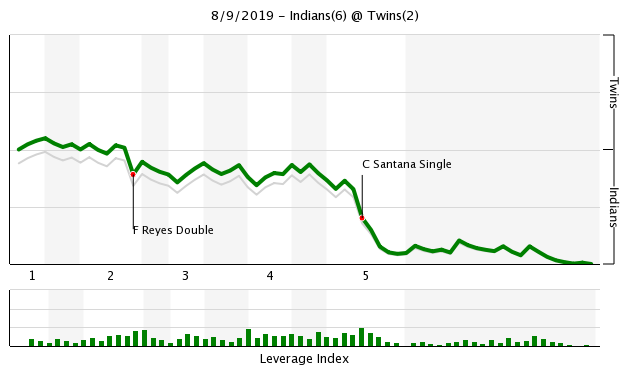 Box Score Smeltzer: 4.1 IP, 7 H, 6 ER, 3 BB, 4 K, 60.4% strikes (49 of 81 pitches) Bullpen: 4.2 IP, 7 H, 0 ER, 0 BB, 4 K Home Runs: Castro (12), Rosario (25) Multi-Hit Games: Polanco (2-for-4), Cave (2-for-4) Bottom 3 WPA: Smeltzer -.191, Arráez -.085, Cron -.063 For the fourth consecutive game, the Twins didn’t get a good outing from their starting pitcher. Since Jake Odorizzi allowed only one run on Monday against the Braves, Twins starters have allowed a total of 28 runs, two of them unearned. Devin Smeltzer was off to a very good start, but he couldn’t get past Cleveland’s top of the order in the fifth. Before the fifth inning meltdown, in which he gave up five earned runs on five hits, Smeltzer was able to hold Cleveland batters to just a one-run lead. With the exception of the second, he threw sixteen pitches or less in all other innings. He had also allowed only two hits before the fifth. Tyler Duffey took over, but couldn’t take care of the two inherited runners. The Indians, on the other hand, were able to lock their second win of the series behind a fantastic start from All-Star Game MVP Shane Bieber. Like Clevinger on Thursday, Bieber went into distance, nearly reaching 110 pitches. He delivered seven innings, striking out a total of eleven Minnesota batters. Twins set new single season home run record Exactly like in the previous three games, the Twins offense had to catch up and tried to start a rally. And they did it in record-breaking fashion. Jason Castro homered off Bieber to lead off the fifth, tying the club’s single season home run record, at 225. In the sixth, Eddie Rosario jumped on the first pitch of the inning to hit the milestone dinger, break the club record and put the Twins back in the game. It was Eddie’s 25th of the year. https://twitter.com/Twins/status/1160010490409639938?s=19 Welcome to the show, Dobnak! A dream came true for former Uber driver Randy Dobnak tonight, as he made his major league debut. He couldn’t have asked for a better one too. The Pennsylvania native pitched four scoreless innings on 68 pitches, keeping the Twins within a swing of a bat. He did get a huge help from the defense too, when C.J. Cron threw home to get Yasiel Puig in the seventh and Luis Arráez started a double play in the eighth. Tied atop of the division for the first time since April 20, these two times play again tomorrow, with Odorizzi taking on the mound to face Adam Plutko. First pitch scheduled to 6:10 C.T. Postgame With Baldelli Coming soon. Bullpen Usage Spreadsheet Click here for a review of the number of pitches thrown by each member of the bullpen over the past five days.
 -
Like usual, the Royals didn’t sell this one cheap, but also like usual, the Twins prevailed and took the series opener at Target Field, 11-9. Nelson Cruz raked, with his third five-RBI game of the season and Sergio Romo earned his first save in a Twins uniform. This was the seventh win for Minnesota in ten games against Kansas City this year. The Twins have now won six of their last eight games and keep a three-game lead over the Indians, atop of the Central.Box Score Pérez: 5.0 IP, 7 H, 5 ER, 0 BB, 3 K, 60.2% strikes (41 of 68 pitches) Bullpen: 4.0 IP, 8 H, 4 ER, 0 BB, 4 K Home Runs: Cruz (27) Multi-Hit Games: Cruz (3-for-4, HR, 5 RBI, BB), Kepler (2-for-3, 2 BB, RBI), Polanco (2-for-5), Rosario (2-for-5, RBI) Top 3 WPA: Cruz .394, Kepler .231, Polanco .211 Bottom 3 WPA: Pérez -.289, Dyson -.081, Gonzalez -.066 The Twins got five innings out of starting pitcher Martín Pérez, who also had a very low pitch count. But he couldn’t keep the Royals off the scoreboard, giving up three home runs and a total of five earned runs. That was the sixth time he allowed five or more runs in his last eleven starts. The bats continue their recent out-of-this-world run, as they have now scored an MLB-best 79 runs since the start of the Yankees series, on July 22. This offense has no chill Both teams exchanged punches early in this game. The Royals manufactured a run after All-Star outfielder Whit Merrifield singled on the third pitch he saw, stole second and was brought home by a two-out single by Jorge Soler. I’m sure you know that didn’t last long. Minnesota responded immediately, with identical aggressiveness - but more power. Max Kepler jumped on the second pitch he saw and hustled for a double. One batter later, Nelson Cruz made it clear that not starting during the Marlins series made no difference whatsoever. He blasted his 27th home run of the year into the second deck of left field. The bats kept pounding and pounding. A couple more runs scored in the second, but, this time, with a more scarce resource. The destructive Twins offense has the 22nd walk rate in the majors, walking only 8% of the time. But Luis Arráez and Jason Castro drew two of them and both of them ended up haunting Royal starter Glenn Sparkman. The wonderkid scored on a sac fly from Ehire Adrianza, while Castro took advantage of a rare mistake by Alex Gordon, who couldn’t hold on to the ball after a sliding charge. Royals strike back Pérez’ first time through the order couldn’t have gone more smoothly. Second and third could hardly have been rougher. Kansas City had back-to-back two-run innings in the fourth and fifth. Hunter Dozier hit a leadoff home run and then the visitors started their own small-ball party, hitting two consecutive singles, a sac bunt and Soler scored on a balk. The Twins starter couldn’t regroup properly and gave up two solo home runs in the fifth (Cam Gallagher and Dozier, with his second), giving the Royals their second lead of the game. That was enough to end Pérez’ night at only 68 pitches. With yet another poor start, he now has a 5.53 ERA since the beginning of June, after posting 3.10 as a starter in April and May. Is there a reason to worry? Possibly, we’re not going to see much from him as a starter in October. The seesaw continues Once again it was time for the offense to rescue this game. And they got their end of the job done. After Kepler walked and Jorge Polanco singled, mighty Cruz doubled to center field (inches short of a homer!), scoring Max. On the following at-bat, Eddie Rosario scored Jorge on a sac fly, regaining the lead for the Twins. Lewis Thorpe came in to pitch the sixth and he didn’t have the best of starts. He gave up a leadoff double to Cheslor Cuthbert, who was brought home by a Humberto Arteaga double, tying the game. But the Aussie managed to cool down and finished pitching 1 2/3 innings. As a reliever in the majors this year, he’s now posting a 2.84 ERA, making his case for a playoff spot each day stronger. Is Cruz ever going to come back to Earth? Being named the AL Player of the Week on Monday might have inspired Cruz. Kepler and Polanco (who else?) reached safely on back-to-back plate appearances again and the Boomstick took care of business yet one more time. He doubled off the center field wall for his third hit of the night and fifth run batted in. There aren’t many more words left to describe what this man has been doing for the Twins this year. It’s astonishing. Miguel Sanó (single), Arráez (groundout) and Castro (single) also joined the party, each of them driving in a run, making it a five-run seventh. Dyson still not sharp, Romo saves it Sam Dyson made his second game in a Twins uniform, one day after his debut. Just like the game in Miami, he wasn’t even close to what he was in San Francisco and gave up three earned runs. Obviously that’s not ideal, but he did retired two batters (as opposed to none on Thursday) and threw 75% strikes (as opposed to 42.8% the day before). Rocco Baldelli brought in Sergio Romo to get the last out of the eighth in relief of Dyson, his third game of the week, and he earned his first save as a Twin, his eighteenth of the year. Romo, as usual, was fired up, displaying a lot of emotion every out he got. He struck out two batters in 1 1/3 inning of work, but also had the help of an amazing leaping grab by Polanco at short in the ninth. Postgame With Baldelli Bullpen Usage Spreadsheet Click here for a review of the number of pitches thrown by each member of the bullpen over the past five days. Click here to view the article
- 54 replies
-
- 3
-
-
- nelson cruz
- max kepler
- (and 3 more)
-
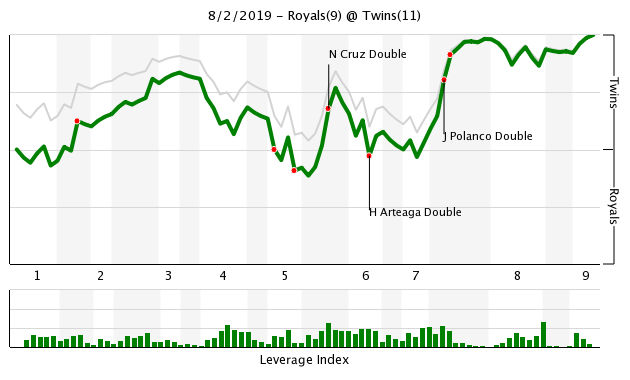 Box Score Pérez: 5.0 IP, 7 H, 5 ER, 0 BB, 3 K, 60.2% strikes (41 of 68 pitches) Bullpen: 4.0 IP, 8 H, 4 ER, 0 BB, 4 K Home Runs: Cruz (27) Multi-Hit Games: Cruz (3-for-4, HR, 5 RBI, BB), Kepler (2-for-3, 2 BB, RBI), Polanco (2-for-5), Rosario (2-for-5, RBI) Top 3 WPA: Cruz .394, Kepler .231, Polanco .211 Bottom 3 WPA: Pérez -.289, Dyson -.081, Gonzalez -.066 The Twins got five innings out of starting pitcher Martín Pérez, who also had a very low pitch count. But he couldn’t keep the Royals off the scoreboard, giving up three home runs and a total of five earned runs. That was the sixth time he allowed five or more runs in his last eleven starts. The bats continue their recent out-of-this-world run, as they have now scored an MLB-best 79 runs since the start of the Yankees series, on July 22. This offense has no chill Both teams exchanged punches early in this game. The Royals manufactured a run after All-Star outfielder Whit Merrifield singled on the third pitch he saw, stole second and was brought home by a two-out single by Jorge Soler. I’m sure you know that didn’t last long. Minnesota responded immediately, with identical aggressiveness - but more power. Max Kepler jumped on the second pitch he saw and hustled for a double. One batter later, Nelson Cruz made it clear that not starting during the Marlins series made no difference whatsoever. He blasted his 27th home run of the year into the second deck of left field. https://twitter.com/Twins/status/1157448553557569538 The bats kept pounding and pounding. A couple more runs scored in the second, but, this time, with a more scarce resource. The destructive Twins offense has the 22nd walk rate in the majors, walking only 8% of the time. But Luis Arráez and Jason Castro drew two of them and both of them ended up haunting Royal starter Glenn Sparkman. The wonderkid scored on a sac fly from Ehire Adrianza, while Castro took advantage of a rare mistake by Alex Gordon, who couldn’t hold on to the ball after a sliding charge. Royals strike back Pérez’ first time through the order couldn’t have gone more smoothly. Second and third could hardly have been rougher. Kansas City had back-to-back two-run innings in the fourth and fifth. Hunter Dozier hit a leadoff home run and then the visitors started their own small-ball party, hitting two consecutive singles, a sac bunt and Soler scored on a balk. The Twins starter couldn’t regroup properly and gave up two solo home runs in the fifth (Cam Gallagher and Dozier, with his second), giving the Royals their second lead of the game. That was enough to end Pérez’ night at only 68 pitches. With yet another poor start, he now has a 5.53 ERA since the beginning of June, after posting 3.10 as a starter in April and May. Is there a reason to worry? Possibly, we’re not going to see much from him as a starter in October. The seesaw continues Once again it was time for the offense to rescue this game. And they got their end of the job done. After Kepler walked and Jorge Polanco singled, mighty Cruz doubled to center field (inches short of a homer!), scoring Max. On the following at-bat, Eddie Rosario scored Jorge on a sac fly, regaining the lead for the Twins. Lewis Thorpe came in to pitch the sixth and he didn’t have the best of starts. He gave up a leadoff double to Cheslor Cuthbert, who was brought home by a Humberto Arteaga double, tying the game. But the Aussie managed to cool down and finished pitching 1 2/3 innings. As a reliever in the majors this year, he’s now posting a 2.84 ERA, making his case for a playoff spot each day stronger. Is Cruz ever going to come back to Earth? Being named the AL Player of the Week on Monday might have inspired Cruz. Kepler and Polanco (who else?) reached safely on back-to-back plate appearances again and the Boomstick took care of business yet one more time. He doubled off the center field wall for his third hit of the night and fifth run batted in. There aren’t many more words left to describe what this man has been doing for the Twins this year. It’s astonishing. Miguel Sanó (single), Arráez (groundout) and Castro (single) also joined the party, each of them driving in a run, making it a five-run seventh. Dyson still not sharp, Romo saves it Sam Dyson made his second game in a Twins uniform, one day after his debut. Just like the game in Miami, he wasn’t even close to what he was in San Francisco and gave up three earned runs. Obviously that’s not ideal, but he did retired two batters (as opposed to none on Thursday) and threw 75% strikes (as opposed to 42.8% the day before). Rocco Baldelli brought in Sergio Romo to get the last out of the eighth in relief of Dyson, his third game of the week, and he earned his first save as a Twin, his eighteenth of the year. Romo, as usual, was fired up, displaying a lot of emotion every out he got. He struck out two batters in 1 1/3 inning of work, but also had the help of an amazing leaping grab by Polanco at short in the ninth. Postgame With Baldelli Bullpen Usage Spreadsheet Click here for a review of the number of pitches thrown by each member of the bullpen over the past five days.
 -
What If The Twins Don't Go Big This Year?
Thiéres Rabelo commented on Thiéres Rabelo's blog entry in Brazilian Twins Territory
Hi, DocBauer! Thank you very much for reading it and also for the kind words. They mean a lot to me! God bless you!
