



Thiéres Rabelo
-
Posts
569 -
Joined
-
Last visited
Content Type
Profiles
News
Minnesota Twins Videos
2026 Minnesota Twins Top Prospects Ranking
2022 Minnesota Twins Draft Picks
Minnesota Twins Free Agent & Trade Rumors, Notes, & Tidbits
Guides & Resources
2023 Minnesota Twins Draft Picks
The Minnesota Twins Players Project
2024 Minnesota Twins Draft Picks
2025 Minnesota Twins Draft Pick Tracker
2026 Minnesota Twins Draft Tracker: Picks & Bonuses
Forums
Blogs
Events
Store
Downloads
Gallery
Everything posted by Thiéres Rabelo
-

What If The Twins Don't Go Big This Year?
Thiéres Rabelo commented on Thiéres Rabelo's blog entry in Brazilian Twins Territory
Hi. Thanks for the read! Yes, I agree that they have to do something about pitching, but why not do it over the offseason, when they can simply sign a free agent? There's no hurry. The Twins title window is open for at least four more years. -
What If The Twins Don't Go Big This Year?
Thiéres Rabelo commented on Thiéres Rabelo's blog entry in Brazilian Twins Territory
Hi, Brandon. Thanks for the read. That is a simple math comparison. It shows how well the Twins have been playing agains above .500 teams and nothing more. -
What If The Twins Don't Go Big This Year?
Thiéres Rabelo posted a blog entry in Brazilian Twins Territory
We are within the last 24 hours before the trade deadline and the market has been quiet for basically every non-Mets team in MLB. Apparently, this has become a pattern around major league GM’s in recent memory, whether it’s the deadline or offseason free agency. The fact is, none of the contenders has done much so far. What if they don’t? First of all, this is not what I assume is going to happen. I believe that, eventually, teams willing to win will make their moves. But I’m curious to see what’s going to happen if none of them actually pulls the trigger until tomorrow. Granted, 2019 has one particularity. Most teams are considerably indecisive about being sellers or buyers, as USA Today columnist Bob Nightengale tweeted on Monday: https://twitter.com/BNightengale/status/1155904273567211521 Like I said, I strongly believe that contending teams will pull the trigger. But I have to say that I’m starting to be a little bit concerned if the Twins are among those teams. Don’t get me wrong, I really hope this suspicion is completely wrong. But if Derek Falvey and Thad Levine don’t bring in the stars Twins fans are hoping for, it wouldn’t be something never seen before in their regime. The biggest example that comes to my mind is the last offseason. After bringing in key veterans to power the already good offense in C.J. Cron, Nelson Cruz, Jonathan Schoop and Marwin Gonzalez, the Twins had basically one urgent matter to address: the bullpen. For us fans, it sounded crazy to think they wouldn’t sign big names in the beginning of the year, especially because they had plenty of payroll room for that. We all know what happened. The Twins decided to wait and made Blake Parker their one and only big free agent signing for the bullpen. Six months later, they still have the same urgent matter to be addressed. What if they choose to approach it the same way? Chances are very little, but here are three questions I ask about this current deadline for the Twins. Is this their “all in year”? This is an important matter. Is 2019 the ultimate contending year for the Twins? Should they spend top prospects to make the team stronger for this playoff run? One can argue that it isn’t. The Twins already have one of the best young cores in baseball. And that’s talking about MLB-talent, not only about prospects. The best offense in the league has an average age of 27.7. If it wasn’t for Nelson Cruz, it would be 26.9. That’s unbelievably young. Also, Fangraphs currently ranks the Twins’ farm system as the sixth best in MLB and Minnesota has five players in the Top 100 Prospects in the game. So, would it really be the worst thing in the world if they didn’t commit to winning this year’s World Series? Maybe not. Maybe trusting this young core and let them get post-season experience at this point could make a huge difference in the years to come. Is this team good enough to win? I’ll be straight here and say that I don’t think so. But some people do. In several moments, Minnesota had the best record in baseball and have solidly stayed put within the top four teams in the league. Is it crazy to assume they can pull this? Perhaps no. Fangraphs’ Dan Szymborski tweeted yesterday an interesting rank of how many Wins Above Replacement (WAR) each team has outside their top four players. Guess who’s on top? https://twitter.com/DSzymborski/status/1155913288179441666 Bottom line, Minnesota has a damn good team. They have taken the season series against the Astros earlier in the year and made the Yankees sweat to defeat them. Also, they currently have a 29-24 record against teams with .500 or above. That’s an 88-win pace on a 162-game season. It’s hard to believe, but such inconsistent pitching staff as the Twins’ has been currently has the seventh best ERA and FIP in the game, as well as the fourth most WAR. Like I said, I don’t think this team has what it takes to win it all the way its roster is right now, but I don’t think those who believe that are being unreasonable. Are there really good options? Maybe the biggest concern for all teams considering buying in this deadline is the lack of clear options. One of the Twins main targets, Marcus Stroman, was traded to the Mets during the weekend for an unbelievably cheap price. The Mets also kind of ruled out trading Noah Syndergaard to Minnesota when they asked for Byron Buxton in return, as reported by Star Tribune’s La Velle E. Neal III. In his opinion, “the Twins seem comfortable with their rotation”. And that probably adds up. I mean - and this is an honest question - who do you see in the league now that would represent a considerable leap in quality for the Twins rotation? Should they spend quality prospects to get players who would produce the same as their current starters? When talking about the bullpen, things are clearly different when we talk about the club’s needs, but no so different when we talk about availability of options. In my opinion, the best option for Minnesota and for any team, for that matter, would be the Pirates’ Felipe Vásquez. But rumors have it that Pittsburgh is asking too much. Is he worth giving two or three top prospects for you? Besides, the Dodgers seem like frontrunners to acquire him. Kirby Yates also looks like a great fit, but the Padres appear to be in buyers mode, as they have inquired the Mets about bringing in “Thor”. There are other names who could be pursuited. So far, Sergio Romo is the only addition and Cody Allen is doing work in the minors to try to earn a spot. Neither of them cost the Twins much. Maybe we should be expecting cheap signings like these two instead of big splashes. Maybe they will work. What would you do? By this time tomorrow we will have our answers. Minnesota has to choose between shopping big and try to win it all this year or just modestly improve an already good team, patiently waiting for years to come and not compromising the long-term future. -
Things aren’t looking good for the Twins bullpen overall in 2019. Of course, there were some bright moments along the way, more specifically since the middle of June, and those pitchers should get credit for that. But I don’t think there’s even a soul who thinks this bullpen is playoff-ready. The situation is identical in Rochester, as the Red Wings are having a nightmarish season regarding pitching, and haven’t been able to help the Twins as much as one would expect. Can the Red Wing arms be trusted at all?Right now, the Red Wings have the third worst ERA in the International League, with 5.34. They are also among the five pitching staffs who have allowed the most hits (900 in 840 2/3 innings) and have the fifth worst WHIP of the league, at 1.49. Most importantly, in several moments of the season in which the Twins needed to call somebody up to maybe put out a fire, the on call pitcher would kind of pour a bit more of gasoline in it, instead. During the first weeks of April, a couple of relief pitchers were called up to make their season debut in the majors and they were absolutely awful. I’m talking about Chase De Jong and Andrew Vasquez, who joined the team in New York for the Mets two-game series. They combined for only one inning pitched, with seven earned runs on three hits, five walks and one hit batter. That was a terrible first impression and none of them got called up again. De Jong is not even part of the organization anymore. From there, not many pitchers coming up from Rochester actually accomplished a very effective contribution to the Twins. The only exceptions that come to mind are Tyler Duffey, who’s a major presence in the current bullpen, and Matt Magill, who also helped a lot during his 28 games for the team, before allowing six unearned runs on four two-out hits against the Mets July 17. He was designated for assignment and then traded after that outing. Other than these two, the Rochester-to-Minnesota bullpen shuttle has been going back and forth. Fernando Romero, Kohl Stewart and Zack Littell are examples of pitchers who have come and gone after some disappointing outings in the majors. Romero, who made the transition between the rotation and the bullpen this year, has been called up three times, but didn’t manage to bring his ERA to lower than 5.63, currently parked at 7.88. Down in Rochester, it’s not looking phenomenal either, as it stands at 4.23 in 21 games. Stewart got called up four times and has done a decent job since migrating to the bullpen, holding a 2.45 ERA as a reliever, but he got sent back this week after allowing two earned runs on three hits against the Yankees on Tuesday. Littell also got called up three times and even though he had a great stretch of ten consecutive scoreless outings, he was optioned a couple of days after he blew a lead in the 5-4 loss against Oakland last Saturday. After that list of negative examples, one would think that there’s no way the Twins could rely on the arms coming from their New York affiliate. Then, four players came up and had their big chances to pitch out of the Twins bullpen this week, performing brilliantly. After Minnesota got rid of four relief pitchers in less than 10 days (Adalberto Mejía, Mike Morin, Matt Magill and Blake Parker), they saw no other option but to try and find the solution in Rochester. Even though virtually all fans hated that choice, wanting them to actually make trades to reinforce the bullpen, it actually worked. Before and during the Yankees series in Target Field, the Twins recalled Lewis Thorpe, Devin Smeltzer and Cody Stashak, the last one making his MLB debut. Sean Poppen got the call to pitch in the opener of the White Sox series on Thursday. The four young bloods performed incredibly, combining for 11 2/3 innings of work, allowing only two earned runs, one walk and striking out twelve batters. More importantly, they helped to take the burden off the seven remaining pitchers on the Twins bullpen, who were being overused in the days before. Other than Smeltzer and Poppen, no other reliever has pitched in the last two games. Which makes me wonder. Can the Twins realistically count on one of these arms for this year? Of course, all of us want the Twins front office to go out and acquire at least two new relievers via trade, but even if they did so, there would be two other spots to fill. Can one of those four aforementioned pitchers make the cut? Only four bullpen arms have been there for a long time now: Taylor Rogers, Trevor May, Ryne Harper and Tyler Duffey. It’s reasonable to assume the Twins won’t trade for four relievers, but, instead, will consider giving someone in the house a chance. If they acquire a starting pitcher via trade, then you could count one among Michael Pineda and Martín Pérez to transition to the pen, most likely Pérez, who has already done that in the beginning of the season. Still, who gets the last spot? Everything points out to former Indians great Cody Allen, who had an awful stint with the Angels early this year, got designated for assignment, and signed with the Twins on a minor league deal. So far in the minors for the Twins (Fort Myers and Rochester), he’s pitched nine innings and has a 2.00 ERA, with a .226 batting average against and striking out eight batters per nine. He has at least earned himself the right to be looked at before the deadline. If he can go back to his old self (and, so far, Wes Johnson and the coaching staff have done wonders on recovering pitchers), he could be a major lift for the bullpen. Last year the Twins pulled five trades after July 27, so we can expect a lot of action this year. But maybe someone from within could be a surprising help. What do you think? Is there anyone in Rochester who would make your team? Comment and let us know. Click here to view the article
-
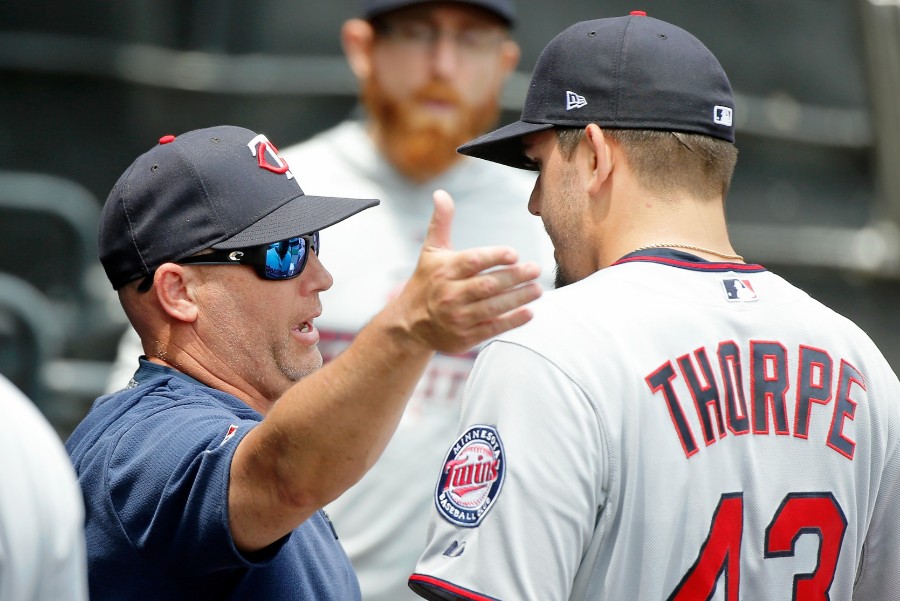 Right now, the Red Wings have the third worst ERA in the International League, with 5.34. They are also among the five pitching staffs who have allowed the most hits (900 in 840 2/3 innings) and have the fifth worst WHIP of the league, at 1.49. Most importantly, in several moments of the season in which the Twins needed to call somebody up to maybe put out a fire, the on call pitcher would kind of pour a bit more of gasoline in it, instead. During the first weeks of April, a couple of relief pitchers were called up to make their season debut in the majors and they were absolutely awful. I’m talking about Chase De Jong and Andrew Vasquez, who joined the team in New York for the Mets two-game series. They combined for only one inning pitched, with seven earned runs on three hits, five walks and one hit batter. That was a terrible first impression and none of them got called up again. De Jong is not even part of the organization anymore. From there, not many pitchers coming up from Rochester actually accomplished a very effective contribution to the Twins. The only exceptions that come to mind are Tyler Duffey, who’s a major presence in the current bullpen, and Matt Magill, who also helped a lot during his 28 games for the team, before allowing six unearned runs on four two-out hits against the Mets July 17. He was designated for assignment and then traded after that outing. Other than these two, the Rochester-to-Minnesota bullpen shuttle has been going back and forth. Fernando Romero, Kohl Stewart and Zack Littell are examples of pitchers who have come and gone after some disappointing outings in the majors. Romero, who made the transition between the rotation and the bullpen this year, has been called up three times, but didn’t manage to bring his ERA to lower than 5.63, currently parked at 7.88. Down in Rochester, it’s not looking phenomenal either, as it stands at 4.23 in 21 games. Stewart got called up four times and has done a decent job since migrating to the bullpen, holding a 2.45 ERA as a reliever, but he got sent back this week after allowing two earned runs on three hits against the Yankees on Tuesday. Littell also got called up three times and even though he had a great stretch of ten consecutive scoreless outings, he was optioned a couple of days after he blew a lead in the 5-4 loss against Oakland last Saturday. After that list of negative examples, one would think that there’s no way the Twins could rely on the arms coming from their New York affiliate. Then, four players came up and had their big chances to pitch out of the Twins bullpen this week, performing brilliantly. After Minnesota got rid of four relief pitchers in less than 10 days (Adalberto Mejía, Mike Morin, Matt Magill and Blake Parker), they saw no other option but to try and find the solution in Rochester. Even though virtually all fans hated that choice, wanting them to actually make trades to reinforce the bullpen, it actually worked. Before and during the Yankees series in Target Field, the Twins recalled Lewis Thorpe, Devin Smeltzer and Cody Stashak, the last one making his MLB debut. Sean Poppen got the call to pitch in the opener of the White Sox series on Thursday. The four young bloods performed incredibly, combining for 11 2/3 innings of work, allowing only two earned runs, one walk and striking out twelve batters. More importantly, they helped to take the burden off the seven remaining pitchers on the Twins bullpen, who were being overused in the days before. Other than Smeltzer and Poppen, no other reliever has pitched in the last two games. Which makes me wonder. Can the Twins realistically count on one of these arms for this year? Of course, all of us want the Twins front office to go out and acquire at least two new relievers via trade, but even if they did so, there would be two other spots to fill. Can one of those four aforementioned pitchers make the cut? Only four bullpen arms have been there for a long time now: Taylor Rogers, Trevor May, Ryne Harper and Tyler Duffey. It’s reasonable to assume the Twins won’t trade for four relievers, but, instead, will consider giving someone in the house a chance. If they acquire a starting pitcher via trade, then you could count one among Michael Pineda and Martín Pérez to transition to the pen, most likely Pérez, who has already done that in the beginning of the season. Still, who gets the last spot? Everything points out to former Indians great Cody Allen, who had an awful stint with the Angels early this year, got designated for assignment, and signed with the Twins on a minor league deal. So far in the minors for the Twins (Fort Myers and Rochester), he’s pitched nine innings and has a 2.00 ERA, with a .226 batting average against and striking out eight batters per nine. He has at least earned himself the right to be looked at before the deadline. If he can go back to his old self (and, so far, Wes Johnson and the coaching staff have done wonders on recovering pitchers), he could be a major lift for the bullpen. Last year the Twins pulled five trades after July 27, so we can expect a lot of action this year. But maybe someone from within could be a surprising help. What do you think? Is there anyone in Rochester who would make your team? Comment and let us know.
 -
Behind another great performance from Michael Pineda, who continues an amazing stretch since the All-Star break, the Twins got another easy win against the White Sox in Chicago, 6-2. The bats weren’t as productive as they were last night, but they came up big early on, providing plenty of run support for Pineda.Box Score Pineda: 7.0 IP, 6 H, 2 ER, 1 BB, 5 K, 64.5% strikes (62 of 96 pitches) Bullpen (Thorpe): 2.0 IP, 2 H, 0 ER, 0 BB, 0 K Home Runs: Kepler (27), Cruz (26) Multi-Hit Games: Cruz (3-for-4, HR, BB, 2 RBI), Sanó (2-for-4) Top 3 WPA: Pineda .192, Kepler .188, Cruz .122 A record-breaking 200th home run The best offense in baseball continues to destroy records. Max Kepler hit a three-run home run in the second inning, the 200th for the Twins in the season, which makes them the fastest team to reach that many dingers (103 games). The previous record belonged to the 2005 Texas Rangers, who hit their bicentennial homer in their 122nd game. Minnesota is now on pace to hit 316 homers in the year. Kepler also extended his home run leadership among German born players, now with 83 career bombas, five more than former Mariners infielder Mike Blowers. That homer was part of yet another relentless effort by Minnesota bats, who were able to score five runs in one inning. Young White Sox starter Dylan Cease gave up six hits in the second, including an RBI-single to Nelson Cruz, as well as a sac fly to Byron Buxton with the bases loaded. Curiously enough, such productive offense has the second worst batting average in the majors with the bases loaded, now with .193, and is one out of five teams in the league with one or no grand slams this season. Pineda continues to rise Twins starter Michael Pineda once again had an outstanding outing, delivering the third quality start in his last four starts. For the first time since June 28, the Twins had two back-to-back seven inning outings from their starters. Overall it was an uneventful start for him, who only had issues during the third inning, in which he gave up a walk and three hits, one of which was a two-run homer to Adam Engel. In his last eight starts, Pineda’s now posted a 2.87 ERA, 9.0 K/9 and 2.1 BB/9. He’s come up big for the Twins when they needed the most and is making a strong case to lock his rotation spot in an eventual post-season run, even if the club trade for rotation help. The bullpen also thanked Pineda for his outing, as the Twins were able to use only one reliever for the third straight game. Lewis Thorpe had yet another very good outing, pitching two scoreless innings. In that three-game span, the Twins relievers gave up only one earned run. Nelson Cruz still hot Nelson Cruz refuses to cool down. In the seventh inning he hit his 26th home run of the year, his tenth since the All-Star break. This was also the fifth consecutive game in which he homered, making him the first 39-year-old to do so since Barry Bonds, in 2004. The Boomstick is now on pace to hit over 40 home runs in the season. The Twins are now 63-40 and maintain a two-game lead over Cleveland in the AL Central. The Indians beat the Royals. Minnesota goes for its first series win in two weeks tomorrow, as Martín Pérez faces Ivan Nova. Postgame With Baldelli Bullpen Usage Spreadsheet Click here for a review of the number of pitches thrown by each member of the bullpen over the past five days. Click here to view the article
- 28 replies
-
- 3
-

-
- michael pineda
- max kepler
- (and 3 more)
-
Twins Game Recap (7/26): Pineda Fuels Twins Easy Win In Chicago
Thiéres Rabelo posted an article in Twins
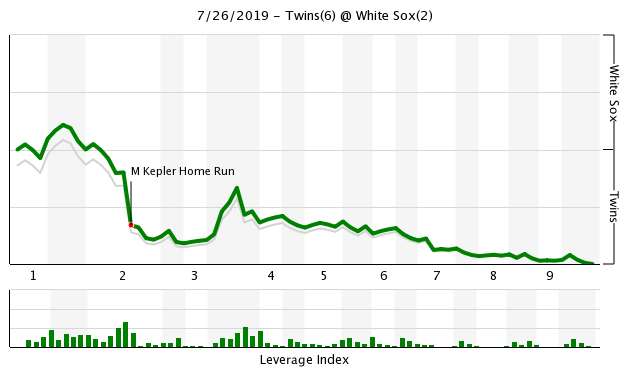 Box Score Pineda: 7.0 IP, 6 H, 2 ER, 1 BB, 5 K, 64.5% strikes (62 of 96 pitches) Bullpen (Thorpe): 2.0 IP, 2 H, 0 ER, 0 BB, 0 K Home Runs: Kepler (27), Cruz (26) Multi-Hit Games: Cruz (3-for-4, HR, BB, 2 RBI), Sanó (2-for-4) Top 3 WPA: Pineda .192, Kepler .188, Cruz .122 A record-breaking 200th home run The best offense in baseball continues to destroy records. Max Kepler hit a three-run home run in the second inning, the 200th for the Twins in the season, which makes them the fastest team to reach that many dingers (103 games). The previous record belonged to the 2005 Texas Rangers, who hit their bicentennial homer in their 122nd game. Minnesota is now on pace to hit 316 homers in the year. Kepler also extended his home run leadership among German born players, now with 83 career bombas, five more than former Mariners infielder Mike Blowers. That homer was part of yet another relentless effort by Minnesota bats, who were able to score five runs in one inning. Young White Sox starter Dylan Cease gave up six hits in the second, including an RBI-single to Nelson Cruz, as well as a sac fly to Byron Buxton with the bases loaded. Curiously enough, such productive offense has the second worst batting average in the majors with the bases loaded, now with .193, and is one out of five teams in the league with one or no grand slams this season. https://twitter.com/Twins/status/1154918261873610753 Pineda continues to rise Twins starter Michael Pineda once again had an outstanding outing, delivering the third quality start in his last four starts. For the first time since June 28, the Twins had two back-to-back seven inning outings from their starters. Overall it was an uneventful start for him, who only had issues during the third inning, in which he gave up a walk and three hits, one of which was a two-run homer to Adam Engel. In his last eight starts, Pineda’s now posted a 2.87 ERA, 9.0 K/9 and 2.1 BB/9. He’s come up big for the Twins when they needed the most and is making a strong case to lock his rotation spot in an eventual post-season run, even if the club trade for rotation help. The bullpen also thanked Pineda for his outing, as the Twins were able to use only one reliever for the third straight game. Lewis Thorpe had yet another very good outing, pitching two scoreless innings. In that three-game span, the Twins relievers gave up only one earned run. Nelson Cruz still hot Nelson Cruz refuses to cool down. In the seventh inning he hit his 26th home run of the year, his tenth since the All-Star break. This was also the fifth consecutive game in which he homered, making him the first 39-year-old to do so since Barry Bonds, in 2004. The Boomstick is now on pace to hit over 40 home runs in the season. https://twitter.com/Twins/status/1154941661224558592 The Twins are now 63-40 and maintain a two-game lead over Cleveland in the AL Central. The Indians beat the Royals. Minnesota goes for its first series win in two weeks tomorrow, as Martín Pérez faces Ivan Nova. Postgame With Baldelli https://twitter.com/fsnorth/status/1154961304026664960 Bullpen Usage Spreadsheet Click here for a review of the number of pitches thrown by each member of the bullpen over the past five days.
 -
The Twins are living their worst moment of the season. A shorthanded bullpen and a few bats slumping in the past two months could explain why the team who was playing nearly .700 ball, has now won less than half of its games in July. For us fans it’s not always easy to listen to reason, but it’s a fact that every single team, even the ones who end up winning it all, go through moments like this.Right now, Minnesota has a 7-8 record in July (.467) and a 22-20 record (.523) since the start of June. This could be explained, among many other things, by the toughening of the schedule. Four of the five teams the Twins faced this month are above .500, but still, they are 7-6 in those games (.538). So, even though they aren’t playing as well as before, they are doing their homework against contenders. But, have other great teams gone through similar storms? Yes, they have. The 2018 Red Sox, who won 108 games during the regular season, had their worst monthly record in September, when they had a 15-11 record (.577). Besides, they had four three-game losing streaks, three of them in August and September. So far this year, the Twins have only had one of those and in spite of the terrible month they’re having, they are still on pace to win 99 games on the season, which would be a record 5% worse than the 2018 Boston’s. July isn’t over yet and the Twins have a season worst .467 record. But the 2017 Astros had a nightmarish month of August that was even worse than that. In that month, they had an 11-17 record (.393) that was very difficult to explain. The pitching staff who had the MLB’s 10th-best ERA (4.18) had an even better ERA during that month (4.00), which also ranked 10th in the majors. Their offense, which until that point had been the most run-producing one in the majors, scored the fourth least runs during that month. What’s odd here is that four of the position players who played at least 25 games during that month had at least .290 AVG and .719 OPS. That didn’t stop them from getting swept by struggling the Chicago White Sox and going 2-4 against division rival Texas Rangers, who ended the season below the .500 mark. Similarly, the 2016 Cubs faced a major drop in production during the regular season. Exactly like this year’s Twins, they struggled in the two middle months of the season. During the month of June, they had a 16-12 record (.571), only slightly better than the Twins last month (15-12, .556). On the following month, Chicago had an even worse result, as they had a record of 12-14 (.462), even worse than the current July for the Twins. Those Cubs offense scored the third most runs in the majors until June to 12 in July and went from an MLB-best ERA until June to the league’s seventh worst in July during 2016. All three former World Series champions made critical moves before the deadlines (non-waivers and waivers). Last year the Red Sox brought in Steve Pearce, Nathan Eovaldi and Ian Kinsler. The Astros in 2017 got superstar starter Justin Verlander in the end of August through waivers and also brought in Francisco Liriano earlier. Chicago strengthened their pitching staff before their 2016 post-season run by bringing in relievers Aroldis Chapman and Mike Montgomery. The Twins are facing their most critical stretch of the season and there’s no doubt that the outcome of their season will be decided now. So far, most fans are frustrated with how long it’s taking for the front office to make moves to improve the team. But just like the aforementioned teams, the simple fact that they’ve had bad stretches doesn’t mean much. Make the right moves now, take advantage of the easier schedule during the final two months of the season and you have yourself a shot. Click here to view the article
-
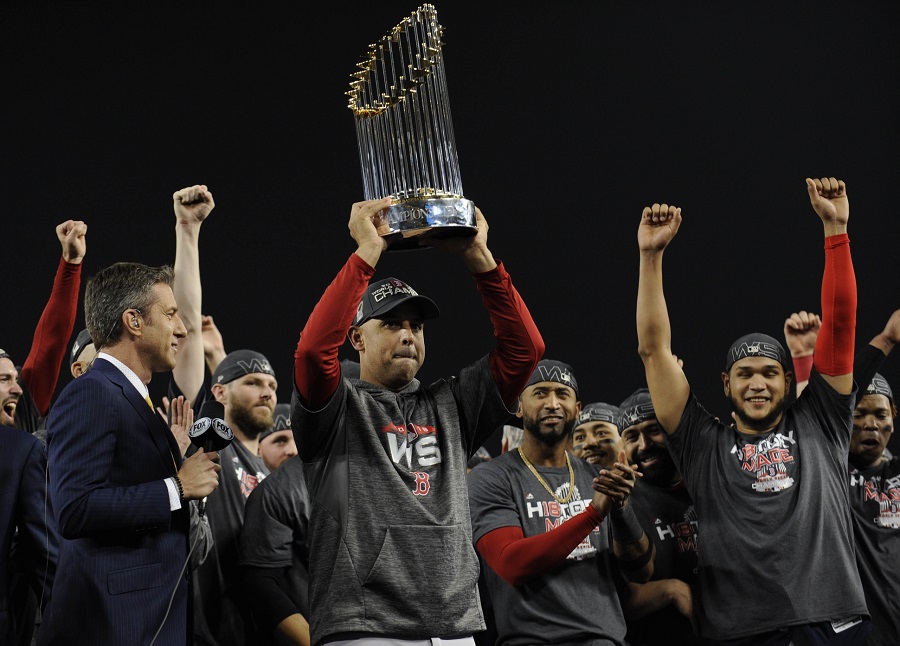 Right now, Minnesota has a 7-8 record in July (.467) and a 22-20 record (.523) since the start of June. This could be explained, among many other things, by the toughening of the schedule. Four of the five teams the Twins faced this month are above .500, but still, they are 7-6 in those games (.538). So, even though they aren’t playing as well as before, they are doing their homework against contenders. But, have other great teams gone through similar storms? Yes, they have. The 2018 Red Sox, who won 108 games during the regular season, had their worst monthly record in September, when they had a 15-11 record (.577). Besides, they had four three-game losing streaks, three of them in August and September. So far this year, the Twins have only had one of those and in spite of the terrible month they’re having, they are still on pace to win 99 games on the season, which would be a record 5% worse than the 2018 Boston’s. July isn’t over yet and the Twins have a season worst .467 record. But the 2017 Astros had a nightmarish month of August that was even worse than that. In that month, they had an 11-17 record (.393) that was very difficult to explain. The pitching staff who had the MLB’s 10th-best ERA (4.18) had an even better ERA during that month (4.00), which also ranked 10th in the majors. Their offense, which until that point had been the most run-producing one in the majors, scored the fourth least runs during that month. What’s odd here is that four of the position players who played at least 25 games during that month had at least .290 AVG and .719 OPS. That didn’t stop them from getting swept by struggling the Chicago White Sox and going 2-4 against division rival Texas Rangers, who ended the season below the .500 mark. Similarly, the 2016 Cubs faced a major drop in production during the regular season. Exactly like this year’s Twins, they struggled in the two middle months of the season. During the month of June, they had a 16-12 record (.571), only slightly better than the Twins last month (15-12, .556). On the following month, Chicago had an even worse result, as they had a record of 12-14 (.462), even worse than the current July for the Twins. Those Cubs offense scored the third most runs in the majors until June to 12 in July and went from an MLB-best ERA until June to the league’s seventh worst in July during 2016. All three former World Series champions made critical moves before the deadlines (non-waivers and waivers). Last year the Red Sox brought in Steve Pearce, Nathan Eovaldi and Ian Kinsler. The Astros in 2017 got superstar starter Justin Verlander in the end of August through waivers and also brought in Francisco Liriano earlier. Chicago strengthened their pitching staff before their 2016 post-season run by bringing in relievers Aroldis Chapman and Mike Montgomery. The Twins are facing their most critical stretch of the season and there’s no doubt that the outcome of their season will be decided now. So far, most fans are frustrated with how long it’s taking for the front office to make moves to improve the team. But just like the aforementioned teams, the simple fact that they’ve had bad stretches doesn’t mean much. Make the right moves now, take advantage of the easier schedule during the final two months of the season and you have yourself a shot.
 -
The Twins took the lead early, couldn’t hold on to it and were shut out by Oakland pitchers for six straight innings, losing 5-3 at the end. Jake Odorizzi wasn't as sharp as he’s usually been and Ryne Harper suffered a rare loss, only his second of the year. With the Cleveland win against Kansas City, the Twins lead in the AL Central now drops to three games.Box Score Odorizzi: 5.0 IP, 5 H, 3 ER, 2 BB, 3 K, 63.6% strikes (56 of 88 pitches) Bullpen: 4.0 IP, 6 H, 2 ER, 0 BB, 4 K Home Runs: Gonzalez (11) Multi-Hit Games: Castro (2-for-2) Top 3 WPA: Gonzalez .136, Cruz .090, Castro .054 Bottom 3 WPA: Harper -.234, Cron -.217, Rosario -.093 The Twins offense once again shows signs of irregularity. After scoring the three runs early, they were dominated by A’s starter Chris Bassitt and the bullpen. Former Twin Liam Hendriks came in to pitch a five-out save, including a six-pitch eighth. The only highlight for Minnesota bats in the night was Luis Arraez’ hitting streak remaining alive, as he hit an infield single in his last at-bat. He’s now had a hit in 12 consecutive games, the second longest streak in baseball. Odorizzi had some unfinished business against the A’s. Last time he faced them, a blister on his right middle finger cut his start short, after only three innings. He gave up a season high five earned runs, four of which came off a grand slam. He was then put in the 10-day injured list, incidentally missing the first All-Star game of his career. The A's jumped on Odorizzi early. Marcus Semien hit a leadoff home run on the third pitch of the game, a bullet to left field. A couple of batters later Khris Davis grounded to center to score Mark Canha, giving Oakland a two-run lead. After that, Odo went on to pitch three shutout innings, despite not being as sharp as he has usually been this season, striking out only one batter. The offense made a good effort to back up their starter. Miguel Sanó drew a two-out walk in the second and on a Matt Olson fielding error near first base, after a Max Kepler ground ball, he was brought home to cut Oakland’s lead in half. On the following inning, Marwin Gonzalez hit a two-run bomb to give Minnesota the lead. Odorizzi gave up a game-tying single in the fifth, which gave him a no-decision, as he didn’t come back to pitch the sixth. He remains unbeaten at home, where he is 6-0 in the year, now with a 2.56 ERA. He hasn’t lost a game at home since Aug. 24 of last year, against this same Oakland team. The Sire is down Uncharacteristically, Ryne Harper was punished by righties in his relief appearance. Before tonight’s game, right-handed hitters were being held by him to only .203 batting average. Facing the middle part of the A’s lineup, he gave up three hits, all against righties, that were enough to score a couple of runs. This was Harper’s 42nd game of the year, but only the third time he allowed more than one run in an outing. In his relief, the rest of the bullpen did a fine job, pitching three scoreless innings, with Tyler Duffey, Blake Parker and Zack Littell. The latter managed to pitch his tenth consecutive scoreless outing, despite giving up a one-out triple to Semien. He had a little help from a 3-2-3, inning-ending double play. Postgame With Baldelli Bullpen Usage Spreadsheet Click here for a review of the number of pitches thrown by each member of the bullpen over the past five days. Click here to view the article
- 41 replies
-
- 1
-
-
- jake odorizzi
- ryne harper
- (and 3 more)
-
Twins Game Recap (7/19): Twins Have No Answer To A’s pitching
Thiéres Rabelo posted an article in Twins
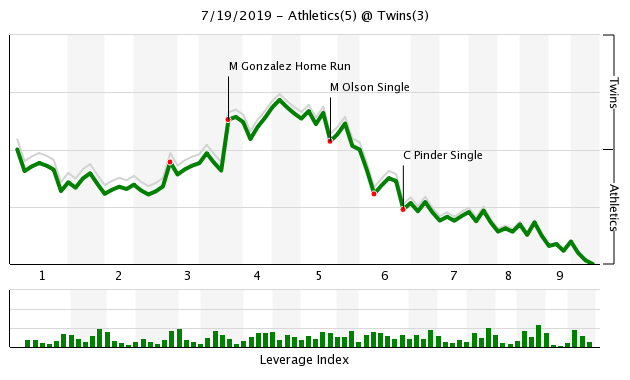 Box Score Odorizzi: 5.0 IP, 5 H, 3 ER, 2 BB, 3 K, 63.6% strikes (56 of 88 pitches) Bullpen: 4.0 IP, 6 H, 2 ER, 0 BB, 4 K Home Runs: Gonzalez (11) Multi-Hit Games: Castro (2-for-2) Top 3 WPA: Gonzalez .136, Cruz .090, Castro .054 Bottom 3 WPA: Harper -.234, Cron -.217, Rosario -.093 The Twins offense once again shows signs of irregularity. After scoring the three runs early, they were dominated by A’s starter Chris Bassitt and the bullpen. Former Twin Liam Hendriks came in to pitch a five-out save, including a six-pitch eighth. The only highlight for Minnesota bats in the night was Luis Arraez’ hitting streak remaining alive, as he hit an infield single in his last at-bat. He’s now had a hit in 12 consecutive games, the second longest streak in baseball. Odorizzi had some unfinished business against the A’s. Last time he faced them, a blister on his right middle finger cut his start short, after only three innings. He gave up a season high five earned runs, four of which came off a grand slam. He was then put in the 10-day injured list, incidentally missing the first All-Star game of his career. The A's jumped on Odorizzi early. Marcus Semien hit a leadoff home run on the third pitch of the game, a bullet to left field. A couple of batters later Khris Davis grounded to center to score Mark Canha, giving Oakland a two-run lead. After that, Odo went on to pitch three shutout innings, despite not being as sharp as he has usually been this season, striking out only one batter. The offense made a good effort to back up their starter. Miguel Sanó drew a two-out walk in the second and on a Matt Olson fielding error near first base, after a Max Kepler ground ball, he was brought home to cut Oakland’s lead in half. On the following inning, Marwin Gonzalez hit a two-run bomb to give Minnesota the lead. https://twitter.com/Twins/status/1152389720980230150 Odorizzi gave up a game-tying single in the fifth, which gave him a no-decision, as he didn’t come back to pitch the sixth. He remains unbeaten at home, where he is 6-0 in the year, now with a 2.56 ERA. He hasn’t lost a game at home since Aug. 24 of last year, against this same Oakland team. The Sire is down Uncharacteristically, Ryne Harper was punished by righties in his relief appearance. Before tonight’s game, right-handed hitters were being held by him to only .203 batting average. Facing the middle part of the A’s lineup, he gave up three hits, all against righties, that were enough to score a couple of runs. This was Harper’s 42nd game of the year, but only the third time he allowed more than one run in an outing. In his relief, the rest of the bullpen did a fine job, pitching three scoreless innings, with Tyler Duffey, Blake Parker and Zack Littell. The latter managed to pitch his tenth consecutive scoreless outing, despite giving up a one-out triple to Semien. He had a little help from a 3-2-3, inning-ending double play. Postgame With Baldelli Bullpen Usage Spreadsheet Click here for a review of the number of pitches thrown by each member of the bullpen over the past five days.
 -
Things started out great for the Twins, who had the lead until the sixth inning, after yet another quality start by Martín Pérez. But terrible pitching by the bullpen and a horror show by the defense allowed the Mets to erupt late and complete the sweep of the Twins with a 14-4 blowout.Box Score Pérez: 6.0 IP, 5 H, 1 ER, 1 BB, 4 K, 72.2% strikes (60 of 83 pitches) Bullpen: 3.0 IP, 12 H, 6 ER, 1 BB, 4 K Home Runs: Cruz (18), Garver (15) Multi-Hit Games: Garver (2-for-3, HR) Top 3 WPA: Garver .144, Pérez .140, Cruz .070 Bottom 3 WPA: May -.461, Magill -.139, Arraez -.105 The Twins still have never beaten the Mets at Target Field. The only other time they have visited the Twins since the ballpark debut was in 2013, when the Mets also got the sweep. The last time Minnesota has won a home game against the Mets dates back to Jun. 2004. Of the 14 runs scored by New York in the afternoon, only half of them were earned. The Twins defense was a mess all over the place. The one error that sparkled the Mets late came off the hands of Eddie Rosario in the eighth inning. He dropped a routine fly ball that would have ended the inning with no runs scored. Instead, two runs scored on that play and the Mets went on to score four other times. Jake Cave also made a diving mistake with Ehire Adrianza pitching in the ninth. For the first time in the season, the Twins lost three consecutive games. They now own a 58-36 record, four and a half games ahead of the Indians. If Cleveland beats Detroit later today, that advantage will drop to four games, which would be their smallest lead since May 14th. Offense shows signs of improvement early The Twins offense was so good and dominant in the first portion of the season that a recent drop to no lower than tenth best in several metrics was enough to cause some overreaction among fans. For the first time this year, Twins bats started to be target of criticism by a few of them. That is especially true when the subject is runners in scoring position. Despite still being one of the best teams in the majors with RISP, the Twins productivity has fallen considerably in that area in the past month and a half. Whereas they have the sixth highest OPS with RISP overall in the season (.824), they came into this game with the ninth worst in the majors (.734) since the start of June. In last night’s game, the Twins struggled again, going 1-for-9 with RISP, with a total of ten men left on base. Things started to change a little bit when Max Kepler doubled off Jason Vargas in the second and was scored by Miguel Sanó on a single to left a couple of batters later. The Mets responded right away, with a one-out, solo home run by Amed Rosario in the top of the third, but the tied score didn’t last long. Nelson Cruz put the Twins back on top with his 18th homer of the year, a hanging one to the corner of the left field. He continued to make Vargas pay, hitting his sixth home run against him, the most he has against any MLB pitcher. Pérez sharp in long-awaited start With the All-Star break, Pérez didn’t pitch for eleven days, but that wasn’t a problem at all. Very economical and with a very sharp command, Pérez cruised through the first three innings, doing so with only 30 pitches, 25 of which were strikes. He also punched out four batters and gave up the one home run to Rosario. He started to slip a little bit in the fourth, as he loaded the bases with no outs, including a hit-by-pitch against Robinson Canó. Pete Alonso reached to lead off the inning on a throwing error by Miguel Sanó. He scored when Todd Frazier grounded into a double play later on, so the run was unearned. Pérez sort of pitched himself into another jam in the fifth, eventually allowing two runners to reach, but he got out of it. Pérez concluded his seventh quality start of the year, the first since Jun. 27th. Be careful, the Sauce is scorching Mitch Garver continues hot. Already leading all MLB catchers in SLG (.653), OPS (1,037) and wRC+ (168) before this game, the “GarvSauce” went deep for the 15th time in the bottom of the fifth inning to break the tie once again. He becomes the sixth Twin to reach that many home runs this season, putting Minnesota very near the MLB record for most players with at least 15 home runs in a season (nine). He also doubled in the eighth and scored afterwards. Garver continues to have one of the best seasons by a Twins catcher in club history. He’s now got higher SLG and ISO than 2009 Joe Mauer and is on pace to surpass his 23 home runs of that season, the most by any Twins catcher in history. Mets erupt against bullpen, sloppy defense Pérez was pulled after the sixth inning, even with a low pitch count. Trevor May took over and just like that, the Mets offense erupted. He gave up a couple of hits to start the inning and then, on a 0-2 count, he pitched an 81mph curve that was crushed for a three-run homer, giving New York the lead back. Things, then seemed under control in the eighth, as Matt Magill struck out two batters after giving up a leadoff walk. On a routine fly to left, Eddie Rosario made a rare mistake, dropping the ball after catching it, allowing two runs to score. Then Magill gave up three hits in a row, including an Alonso two-run bomb to the second deck, to make it 11-3. Adrianza took over the mound to finish the game and gave up three more runs in the last inning. Postgame With Baldelli Bullpen Usage Spreadsheet Click here for a review of the number of pitches thrown by each member of the bullpen over the past five days. Click here to view the article
- 73 replies
-
- 2
-
-
- martin perez
- nelson cruz
- (and 3 more)
-
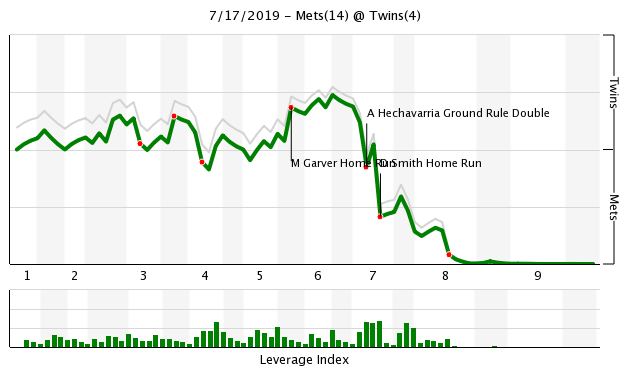 Box Score Pérez: 6.0 IP, 5 H, 1 ER, 1 BB, 4 K, 72.2% strikes (60 of 83 pitches) Bullpen: 3.0 IP, 12 H, 6 ER, 1 BB, 4 K Home Runs: Cruz (18), Garver (15) Multi-Hit Games: Garver (2-for-3, HR) Top 3 WPA: Garver .144, Pérez .140, Cruz .070 Bottom 3 WPA: May -.461, Magill -.139, Arraez -.105 The Twins still have never beaten the Mets at Target Field. The only other time they have visited the Twins since the ballpark debut was in 2013, when the Mets also got the sweep. The last time Minnesota has won a home game against the Mets dates back to Jun. 2004. Of the 14 runs scored by New York in the afternoon, only half of them were earned. The Twins defense was a mess all over the place. The one error that sparkled the Mets late came off the hands of Eddie Rosario in the eighth inning. He dropped a routine fly ball that would have ended the inning with no runs scored. Instead, two runs scored on that play and the Mets went on to score four other times. Jake Cave also made a diving mistake with Ehire Adrianza pitching in the ninth. For the first time in the season, the Twins lost three consecutive games. They now own a 58-36 record, four and a half games ahead of the Indians. If Cleveland beats Detroit later today, that advantage will drop to four games, which would be their smallest lead since May 14th. Offense shows signs of improvement early The Twins offense was so good and dominant in the first portion of the season that a recent drop to no lower than tenth best in several metrics was enough to cause some overreaction among fans. For the first time this year, Twins bats started to be target of criticism by a few of them. That is especially true when the subject is runners in scoring position. Despite still being one of the best teams in the majors with RISP, the Twins productivity has fallen considerably in that area in the past month and a half. Whereas they have the sixth highest OPS with RISP overall in the season (.824), they came into this game with the ninth worst in the majors (.734) since the start of June. In last night’s game, the Twins struggled again, going 1-for-9 with RISP, with a total of ten men left on base. Things started to change a little bit when Max Kepler doubled off Jason Vargas in the second and was scored by Miguel Sanó on a single to left a couple of batters later. The Mets responded right away, with a one-out, solo home run by Amed Rosario in the top of the third, but the tied score didn’t last long. Nelson Cruz put the Twins back on top with his 18th homer of the year, a hanging one to the corner of the left field. He continued to make Vargas pay, hitting his sixth home run against him, the most he has against any MLB pitcher. https://twitter.com/Twins/status/1151564077195567105 Pérez sharp in long-awaited start With the All-Star break, Pérez didn’t pitch for eleven days, but that wasn’t a problem at all. Very economical and with a very sharp command, Pérez cruised through the first three innings, doing so with only 30 pitches, 25 of which were strikes. He also punched out four batters and gave up the one home run to Rosario. He started to slip a little bit in the fourth, as he loaded the bases with no outs, including a hit-by-pitch against Robinson Canó. Pete Alonso reached to lead off the inning on a throwing error by Miguel Sanó. He scored when Todd Frazier grounded into a double play later on, so the run was unearned. Pérez sort of pitched himself into another jam in the fifth, eventually allowing two runners to reach, but he got out of it. Pérez concluded his seventh quality start of the year, the first since Jun. 27th. Be careful, the Sauce is scorching Mitch Garver continues hot. Already leading all MLB catchers in SLG (.653), OPS (1,037) and wRC+ (168) before this game, the “GarvSauce” went deep for the 15th time in the bottom of the fifth inning to break the tie once again. He becomes the sixth Twin to reach that many home runs this season, putting Minnesota very near the MLB record for most players with at least 15 home runs in a season (nine). https://twitter.com/Twins/status/1151574483452514306 He also doubled in the eighth and scored afterwards. Garver continues to have one of the best seasons by a Twins catcher in club history. He’s now got higher SLG and ISO than 2009 Joe Mauer and is on pace to surpass his 23 home runs of that season, the most by any Twins catcher in history. Mets erupt against bullpen, sloppy defense Pérez was pulled after the sixth inning, even with a low pitch count. Trevor May took over and just like that, the Mets offense erupted. He gave up a couple of hits to start the inning and then, on a 0-2 count, he pitched an 81mph curve that was crushed for a three-run homer, giving New York the lead back. Things, then seemed under control in the eighth, as Matt Magill struck out two batters after giving up a leadoff walk. On a routine fly to left, Eddie Rosario made a rare mistake, dropping the ball after catching it, allowing two runs to score. Then Magill gave up three hits in a row, including an Alonso two-run bomb to the second deck, to make it 11-3. Adrianza took over the mound to finish the game and gave up three more runs in the last inning. Postgame With Baldelli https://twitter.com/fsnorth/status/1151605989361115136 Bullpen Usage Spreadsheet Click here for a review of the number of pitches thrown by each member of the bullpen over the past five days.
 -
The first of four remaining series against current three-time AL Central champions Cleveland Indians began this Friday at Progressive Field and the Twins prevailed with a late rally and took the first game, 5-3. Minnesota maintains recent success playing in Cleveland and overcome Kyle Gibson’s shortest start in almost two years.Box Score Gibson: 3.2 IP, 4 H, 1 ER, 1 BB, 5 K, 57.5% strikes (46 of 80 pitches) Bullpen: 5.1 IP, 2 H, 0 ER, 1 BB, 7 K Home Runs: Cruz (17), Garver (14) Multi-Hit Games: none Top 3 WPA: Polanco .363, Rogers .200, Sanó .150 Bottom 3 WPA: Buxton -.176, Gibson -.166, Kepler -.055 Despite ruling the division in recent years, Cleveland hasn't quite dominated the Twins. Since the start of 2015, they have a 45-44 record overall against Minnesota. When it comes down to games played in Ohio during that period, the Twins actually have the advantage, holding a 23-21 record after this game. Gibson was removed from the game early, but the bullpen shut out the Indians in over five innings of work. For nearly a month now (since Jun. 14), Minnesota relievers are having an impressive run and now hold a 2.91 ERA in that span. They were again led by Taylor Rogers, who once again pitched a six-out save and is still having a historical season. This was also the first time since 1990 that a Twins reliever pitches back-to-back six-out or more saves. Starters off to a rough start Mike Clevinger was on his way to a 1-2-3 inning in the top of the first, but Nelson Cruz had other plans. He smashed a two-out solo home run to center field, on a low four-seamer, to put the Twins on the board. Although he allowed only the one run in the first half of the game, the Tribe starter had a hard time getting outs. The Twins lineup rode him to nearly 70 pitches to complete the first four innings. Gibson also had to work up a sweat early. He actually cruised through the Indians lineup the first time through the order, retiring eight of them, only giving up a single in the first to Oscar Mercado. The trouble came the second time through, when he gave up a game-tying home run to lead off the fourth and then pitched himself into a jam. Cleveland claimed its first lead with a two-out, two-run single by Roberto Pérez. Both those runs scored were unearned, because of a throwing error by Ehire Adrianza. After hitting number nine hitter Greg Allen, reaching 80 pitches, Gibson was done for the night one out shy of four innings pitched. Not counting his “opener” start against the Rangers last Sunday nor his relief appearance against the Rays on June 27th, this was Gibson’s shortest start since September 29th of 2017. Clevinger pitched around a leadoff single by Luis Arráez, followed by a double from Miguel Sanó. Even though the Twins didn’t score, the long fifth inning was sufficient to get the Indians starter out of the game before he could record an out in the sixth. Offense snaps its struggles with a rally With those runners stranded by Clevinger in the fifth, the Twins fell to .233 with men in scoring position since the start of July, which would rank seventh worst in the majors. The numbers didn’t get any better after Cruz and Marwin Gonzalez reached safely in the sixth with one out and then Mitch Garver grounded into a double play against reliever Adam Cimber. But Max Kepler started the Twins rally in the seventh in exciting fashion. With two men on and two outs, the greatest German in the world hit a grounder towards right field and was originally called out at first. But Rocco Baldelli challenged it and the call was overruled, allowing Sanó to score from third. Immediately after that at-bat, Jorge Polanco hit a clutch, bases-clearing double and the Twins retook the lead. It didn’t stop there. Cleveland bullpen couldn’t stop the Bomba Squad... Garver hit his 14th of the year to leadoff the eighth, adding one more insurance run and giving the game its final numbers. With the win, the Twins improve to 57-33 and are now six and a half game ahead of the Indians on top of the division. They will bring Jake Odorizzi to face Jake Bauers tomorrow. Postgame With Baldelli Bullpen Usage Spreadsheet Click here for a review of the number of pitches thrown by each member of the bullpen over the past five days. Click here to view the article
- 54 replies
-
- 4
-
-
- taylor rogers
- nelson cruz
- (and 3 more)
-
Twins Game Recap (7/12): Late Rally, Bullpen Power Stunning Comeback Win
Thiéres Rabelo posted an article in Twins
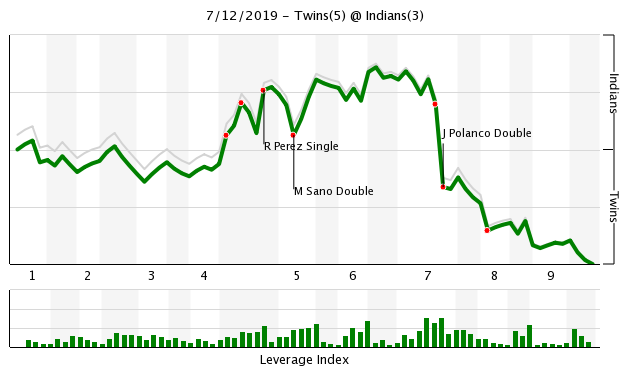 Box Score Gibson: 3.2 IP, 4 H, 1 ER, 1 BB, 5 K, 57.5% strikes (46 of 80 pitches) Bullpen: 5.1 IP, 2 H, 0 ER, 1 BB, 7 K Home Runs: Cruz (17), Garver (14) Multi-Hit Games: none Top 3 WPA: Polanco .363, Rogers .200, Sanó .150 Bottom 3 WPA: Buxton -.176, Gibson -.166, Kepler -.055 Despite ruling the division in recent years, Cleveland hasn't quite dominated the Twins. Since the start of 2015, they have a 45-44 record overall against Minnesota. When it comes down to games played in Ohio during that period, the Twins actually have the advantage, holding a 23-21 record after this game. Gibson was removed from the game early, but the bullpen shut out the Indians in over five innings of work. For nearly a month now (since Jun. 14), Minnesota relievers are having an impressive run and now hold a 2.91 ERA in that span. They were again led by Taylor Rogers, who once again pitched a six-out save and is still having a historical season. This was also the first time since 1990 that a Twins reliever pitches back-to-back six-out or more saves. Starters off to a rough start Mike Clevinger was on his way to a 1-2-3 inning in the top of the first, but Nelson Cruz had other plans. He smashed a two-out solo home run to center field, on a low four-seamer, to put the Twins on the board. Although he allowed only the one run in the first half of the game, the Tribe starter had a hard time getting outs. The Twins lineup rode him to nearly 70 pitches to complete the first four innings. https://twitter.com/Twins/status/1149822117610958848 Gibson also had to work up a sweat early. He actually cruised through the Indians lineup the first time through the order, retiring eight of them, only giving up a single in the first to Oscar Mercado. The trouble came the second time through, when he gave up a game-tying home run to lead off the fourth and then pitched himself into a jam. Cleveland claimed its first lead with a two-out, two-run single by Roberto Pérez. Both those runs scored were unearned, because of a throwing error by Ehire Adrianza. After hitting number nine hitter Greg Allen, reaching 80 pitches, Gibson was done for the night one out shy of four innings pitched. Not counting his “opener” start against the Rangers last Sunday nor his relief appearance against the Rays on June 27th, this was Gibson’s shortest start since September 29th of 2017. Clevinger pitched around a leadoff single by Luis Arráez, followed by a double from Miguel Sanó. Even though the Twins didn’t score, the long fifth inning was sufficient to get the Indians starter out of the game before he could record an out in the sixth. Offense snaps its struggles with a rally With those runners stranded by Clevinger in the fifth, the Twins fell to .233 with men in scoring position since the start of July, which would rank seventh worst in the majors. The numbers didn’t get any better after Cruz and Marwin Gonzalez reached safely in the sixth with one out and then Mitch Garver grounded into a double play against reliever Adam Cimber. But Max Kepler started the Twins rally in the seventh in exciting fashion. With two men on and two outs, the greatest German in the world hit a grounder towards right field and was originally called out at first. But Rocco Baldelli challenged it and the call was overruled, allowing Sanó to score from third. Immediately after that at-bat, Jorge Polanco hit a clutch, bases-clearing double and the Twins retook the lead. https://twitter.com/Twins/status/1149861155504119809 It didn’t stop there. Cleveland bullpen couldn’t stop the Bomba Squad... Garver hit his 14th of the year to leadoff the eighth, adding one more insurance run and giving the game its final numbers. https://twitter.com/Twins/status/1149866794896809984 With the win, the Twins improve to 57-33 and are now six and a half game ahead of the Indians on top of the division. They will bring Jake Odorizzi to face Jake Bauers tomorrow. Postgame With Baldelli https://twitter.com/fsnorth/status/1149884510114209792 Bullpen Usage Spreadsheet Click here for a review of the number of pitches thrown by each member of the bullpen over the past five days.
 -
A stellar pitching performance - which included using Kyle Gibson as the opener - was derailed by an unusual off game by the offense. After holding Texas offense to only one run through ten innings, Twins bats never showed up and a three-run homer off the bat of Rougned Odor in the 11th prevented the Twins from sweeping the Rangers.Box Score Smeltzer: 4.1 IP, 5 H, 1 ER, 1 BB, 4 K, 64.6% strikes (42 of 59 pitches) Rest of Staff: 6.2 IP, 5 H, 3 ER, 4 BB, 12 K Home Runs: None Multi-Hit Games: Garver (2-5), Sanó (2-3, R) Top 3 WPA: May .288, Harper .170, Smeltzer .117 Bottom 3 WPA: Mejia -.462, Kepler -.194, Gonzalez -.169 After scoring a total of 23 runs in the first two games of this series, the Twins really struggled to put runs on the board Sunday, before a crowd of 35,495. They were unable to score more than one run against a Ranger pitching staff which didn’t have a single pitcher with more than three innings of work in the game. Texas out-hit Minnesota 10-8 and the Twins went 0-for-9 with runners in scoring position. The Openers and Smeltzer Gibson pitched only one inning and didn't have the smoothest of starts. He had a long, 26-pitch inning (only 14 strikes), struggling with his command. He pitched to the top five Rangers batters, as Shin-Soo Choo and Joey Gallo reached safely, but he managed to strand both. José Leclerc, the Rangers opener, also allowed to men to reach, but he managed to close the inning with 15 pitches. He came back to pitch the second, but didn’t last long. Smeltzer took advantage of Gibson’s outing and cruised past the bottom half of the Texas lineup in the second with only twelve pitches. He went on to have an uneventful game, pitching into the sixth. He never pitched himself into any jams, as the Rangers never had more than one man on at any point of his outing. They did tie the game in the fourth, with Joey Gallo leading off the inning with a double and then being scored by former Twin Danny Santana a couple of batters later. Sanó, Buxton Definitely Back on Track Not too long ago we were all discussing what was wrong with Miguel Sanó, as he was slumping really hard. He then he decided he was through with that and decided to catch on fire. He came into this game slashing .348/.423/.739 (1.162) in the past seven games and he did not slow down. After smacking a single in the second inning he scored the first run of the game, crossing the plate on a Byron Buxtton triple Similar to Miggy, Buxton went through a rough funk since coming back from the IL. In the first five games back he went 1-for-16. But he started to regain confidence in the first game of this Texas series and came into the game hitting 3-for-9 with three runs batted in. He started this game reaching safely twice, once with the RBI-triple in the second and one on a fielder’s choice in the fourth. On that play, he nearly scored Sanó again after Miggy had walked to reach for the second time, but he (Sano) was thrown out at home. The Twins bullpen continued its impressive recent stretch, in spite of the loss. Adalberto Mejía gave up the winning home run to Odor in the 11th, but Minnesota relievers still hold a 3.08 ERA since June 14, which ranks third best in the majors. That is, of course, considering that technically all innings pitched after Gibson’s departure will count as bullpen stats. The Twins get to the All-Star break with a 56-33 record. That’s the most wins the Twins have gotten before the All-Star break since 1969. They now hold a five-and-a- half game lead over Cleveland in the AL Central, but the Indians won their sixth in a row today, as they swept the Reds, reaching the 50-win mark. Postgame With Baldelli Bullpen Usage Spreadsheet Click here for a review of the number of pitches thrown by each member of the bullpen over the past five days. Click here to view the article
- 52 replies
-
- 2
-
-
- devin smeltzer
- trevor may
- (and 3 more)
-
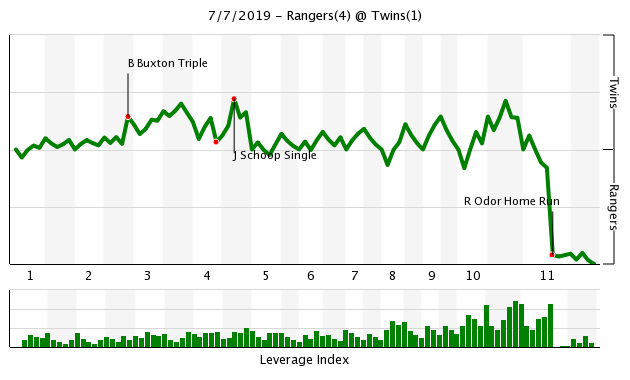 Box Score Smeltzer: 4.1 IP, 5 H, 1 ER, 1 BB, 4 K, 64.6% strikes (42 of 59 pitches) Rest of Staff: 6.2 IP, 5 H, 3 ER, 4 BB, 12 K Home Runs: None Multi-Hit Games: Garver (2-5), Sanó (2-3, R) Top 3 WPA: May .288, Harper .170, Smeltzer .117 Bottom 3 WPA: Mejia -.462, Kepler -.194, Gonzalez -.169 After scoring a total of 23 runs in the first two games of this series, the Twins really struggled to put runs on the board Sunday, before a crowd of 35,495. They were unable to score more than one run against a Ranger pitching staff which didn’t have a single pitcher with more than three innings of work in the game. Texas out-hit Minnesota 10-8 and the Twins went 0-for-9 with runners in scoring position. The Openers and Smeltzer Gibson pitched only one inning and didn't have the smoothest of starts. He had a long, 26-pitch inning (only 14 strikes), struggling with his command. He pitched to the top five Rangers batters, as Shin-Soo Choo and Joey Gallo reached safely, but he managed to strand both. José Leclerc, the Rangers opener, also allowed to men to reach, but he managed to close the inning with 15 pitches. He came back to pitch the second, but didn’t last long. Smeltzer took advantage of Gibson’s outing and cruised past the bottom half of the Texas lineup in the second with only twelve pitches. He went on to have an uneventful game, pitching into the sixth. He never pitched himself into any jams, as the Rangers never had more than one man on at any point of his outing. They did tie the game in the fourth, with Joey Gallo leading off the inning with a double and then being scored by former Twin Danny Santana a couple of batters later. Sanó, Buxton Definitely Back on Track Not too long ago we were all discussing what was wrong with Miguel Sanó, as he was slumping really hard. He then he decided he was through with that and decided to catch on fire. He came into this game slashing .348/.423/.739 (1.162) in the past seven games and he did not slow down. After smacking a single in the second inning he scored the first run of the game, crossing the plate on a Byron Buxtton triple https://twitter.com/Twins/status/1147950527810015232 Similar to Miggy, Buxton went through a rough funk since coming back from the IL. In the first five games back he went 1-for-16. But he started to regain confidence in the first game of this Texas series and came into the game hitting 3-for-9 with three runs batted in. He started this game reaching safely twice, once with the RBI-triple in the second and one on a fielder’s choice in the fourth. On that play, he nearly scored Sanó again after Miggy had walked to reach for the second time, but he (Sano) was thrown out at home. The Twins bullpen continued its impressive recent stretch, in spite of the loss. Adalberto Mejía gave up the winning home run to Odor in the 11th, but Minnesota relievers still hold a 3.08 ERA since June 14, which ranks third best in the majors. That is, of course, considering that technically all innings pitched after Gibson’s departure will count as bullpen stats. The Twins get to the All-Star break with a 56-33 record. That’s the most wins the Twins have gotten before the All-Star break since 1969. They now hold a five-and-a- half game lead over Cleveland in the AL Central, but the Indians won their sixth in a row today, as they swept the Reds, reaching the 50-win mark. Postgame With Baldelli https://twitter.com/fsnorth/status/1148003874877276160 Bullpen Usage Spreadsheet Click here for a review of the number of pitches thrown by each member of the bullpen over the past five days.
 -
Taylor Rogers Deserves to Be an All-Star
Thiéres Rabelo posted a blog entry in Brazilian Twins Territory
I think Taylor Rogers may have been the greatest Twin to be snubbed from anything since Joe Mauer didn’t get the 2017 Gold Glove. After earning the longest save from any Twins pitcher since 2000 yesterday against the Rangers (he retired all seven batters he faced) and becoming the pitcher with the most saves of three or more outs for the club this century, he made it clear once again that he’s definitely one of the best relievers in the game. If you look at the group of relievers that were invited to take part in the Midsummer Classic playing for the American League, it doesn’t seem so absurd that Rogers wasn’t there. Aroldis Chapman, Shane Greene, Brad Hand, Liam Hendriks and Ryan Pressly all have very similar stats, with most of them being better than Rogers’. The only one of them who has a worse ERA than the Twins star (now at 1.82) is Hand (with 2.17). Only Chapman (12.98) and Hand (13.26) are striking out more batters than him (11.57). So, if you think about it, it’s not absurd that he didn’t make the team. But it wouldn’t be absurd if he did either. He’s being at least as effective as the five of them. But Rogers has one difference which could give him the upperhand in a closer comparison with those pitchers. And I don’t think this angle would ever (or even should) be used to decide who an All Star will be. But it’s nice to look at it and have fun with the realization that the Twins have one of the best arms in the game. Going straight to the point: Rogers is used in more important situations than those guys and he is more responsible for his team’s wins than any reliever in the AL. Like we saw before, his overall numbers are very similar or even slightly worse than the All Star relievers. But when you look at high leverage situations, none of them are a match for Rogers. Talking about quantity, none of them was used in those situations as much as him. He pitched a total of 14 2/3 innings of high leverage, which currently ranks third in the AL. The AL All Star reliever who comes closest is Hand, who pitched 11 2/3. But the Indians pitcher posts a 6.17, whereas Rogers has a 3.07 ERA. The only AL pitcher who has pitched as many innings (15 1/3) and has a better ERA (2.35) than him is Houston’s Roberto Osuna. No other pitcher in the AL has been more responsible for his team’s wins than Rogers has. Currently, he leads all of them in Win Probability Added (WPA), with 2.56. The second AL pitcher in that rank is Chicago’s Álex Colomé, at 1.86, which is still better than the first of the 2019 All Star relievers, Hendriks, at 1.82. Superstar Yankee closer, Chapman doesn’t have even one third of Rogers’ WPA, standing at 0.62. So, it’s safe to say that it would have been absolutely fair if Rogers was chosen over any of the current AL All Star relievers. But now, I have something else to put up for discussion. Taylor is only 28 and, if he continues to pitch like that, I think nobody would have any objection to making him a Twin for the remainder of his career. So I should ask your opinion. Where in Twins history do you think Rogers could end up ranking at the end of his career? Does he have a shot at one day becoming one of the best relievers in club history? Well, to start, I did a quick research, using Fangraphs’ Splits Leaderboard tool. Currently, Taylor has a 1.82 ERA, 0.98 WHIP and is striking out 11.57 batters per nine. The season is only at its midpoint and these numbers could very well get worse. But, if the season ended today, this would be only the second time in Twins history that a reliever has up to 1.82 ERA, over 11 strikeouts per nine and a WHIP of 0.98 or lower. The only other time that happened was in 2006, when Joe Nathan posted 1.58 ERA, 0.79 WHIP and struck out 12.5 batters per nine. Let me repeat myself: that only happened one other time in club history. Nathan is the consensual choice any time someone asks who is the best reliever in Twins history. But interestingly enough, when you compare Rogers’ current career numbers and Nathan’s when he was 28, it gets scary. By the end of the 2002 season, when Nathan was still with the Giants, he had only one career save and -0.52 WPA. Rogers earned against the Rangers this Saturday his 14th career save and holds a 6.69 career WPA, which already ranks fourth in club history. Nathan has the lead with 24.55, but he didn’t throw a single pitch in a Twins uniform before he was 29. Another angle through which we can also speculate that Rogers can surpass Nathan in the competition for best reliever in Twins history are their Fangraphs’ Wins Above Replacement (fWAR). Rogers currently is currently worth 4.2 career fWAR, at age 28, in his fourth year as a Major League pitcher. At age 28, Nathan was worth -0.4 and after his fourth season in the Majors he was worth 0.8. So everytime this Colorado kid comes up to the mound this year, Twins fans should be extra grateful for the opportunity. Chances are we might be witnessing one of the greatest pitchers to ever play for Minnesota. Too bad All Star game won’t have this opportunity this year. -
CHW 6, MIN 4: Sanó Homers Twice, Twins Fall Short in Chicago
Thiéres Rabelo posted an article in Twins
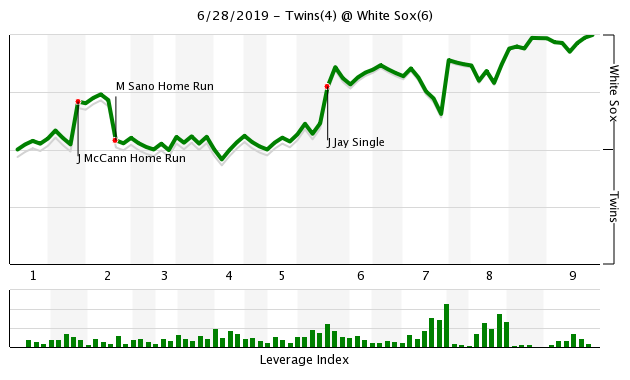 Box Score Berríos: 7.1 IP, 9 H, 6 R, 3 ER, 0 BB, 5 K, 74.3% strikes (78 of 105 pitches) Bullpen: 0.2 IP, 0 H, 0 ER, 0 BB, 0 K Home Runs: Sanó, 2 (11) Multi-Hit Games: Sanó, (2-for-3, 2 HR), Kepler (2-for-5), Adrianza (2-for-3, R) Top 3 WPA: Sano .245, Adrianza .088, Cruz .068 Bottom 3 WPA: Polanco -.289, Berrios -.201, Schoop -.157 The Twins are in the middle of their roughest patch of the season, at least injury wise. Already playing without center fielder Byron Buxton and super utility man Marwin Gonzalez, Minnesota was also forced to place backup catcher Willians Astudillo in the IL yesterday and left fielder Eddie Rosario today. Once again, Rocco Baldelli had to deploy infielder Luis Arraez on the outfield. To make things worse, a number of relief pitchers were not available to pitch tonight, due to all of them being used in Thursday 18-inning marathon against the Rays. A couple of home runs put both teams on the board early. James McCann hit a two-out, two-run shot early off Twins starter José Berríos, to put the White Sox ahead in the first. The Twins responded immediately. After Ehire Adrianza hit a triple in his first trip to the plate, Miguel Sanó tied it up with a bomb to the left field. https://twitter.com/Twins/status/1144767431547785216 Berríos Pitches Deep Into the Game Coming off a shortened start against the Royals, due to a blister on his right ring finger, Berríos pitched into the eighth inning, which was critical for the team, considering the bullpen shortage. But he gave up nine hits (first time since May 24) and allowed a season worst six runs (four earned). Small ball killed him tonight, as seven of the nine hits he gave up were singles. Four of them came in the fifth inning. The White Sox secured the win in the bottom of the eighth, when Berríos saw Eloy Jiménez hit his first pitch up in the zone, making this Berríos’ first multi-homer game since May 13. Sanó Homers Twice, Adrianza Comes Back Hot In spite of the loss, Sanó’s game was the highlight of the night. For the second time this season, first since May 23, the third baseman went yard twice. He helped initiate a late rally in the top of the ninth, bringing the game within reach, but that wasn’t enough. Sanó now holds a .829 OPS and became the eighth Twin to reach double-digits in home runs, making Minnesota the first team to do so this year. https://twitter.com/Twins/status/1144803072796962816 Coming back from the IL, Adrianza finished the night the way he left the team before the injury: red-hot. He had two hits on the night, including a triple, to go with one walk. He did have two crucial errors during the game though, but his return was much needed and hopefully will make things a bit easier for Baldelli now. Minnesota falls to 52-29, but still holds an eight-game lead over the Indians, who were crushed in Baltimore, 13-0. The Twins will try to even the series tomorrow, with Michael Pineda facing Iván Nova. They’ll try to avoid their first three-game losing streak of the season. Postgame With Baldelli https://twitter.com/fsnorth/status/1144817668421083137 Bullpen Usage Spreadsheet Click here for a review of the number of pitches thrown by each member of the bullpen over the past five days.
 -
It's no secret, the Twins will be seeking bullpen help as the trade deadline approaches. The current group of relievers have helped get the Twins where they are, but let's face it, there is plenty of evidence upgrades are required. Today, we'll take a look at Pirates closer Felipe Vázquez.Felipe Vázquez, LHP, 27-years-old Pittsburgh Pirates (36-41, 5th in NL Central) Signed through 2021, 4 yrs/$22M (18-21) & 22-23 team option. 2019: 1.91 ERA, 1.09 WHIP, 13.9 K/9, 2.5 BB/9 in 33.0 IP 2018: 2.70 ERA, 1.24 WHIP, 11.4 K/9, 3.1 BB/9 in 70.0 IP Felipe Vázquez might be the best option for the Twins to pursue. That is, of course, if the Pirates even make him available. As ESPN’s Buster Olney reports, Pittsburgh is going to set his price through the roof to whoever wants to get him. But, as Steve Adams writes at MLB Trade Rumors, the Bucs are also in great need of new arms to their rotation, which makes the Twins a strong contender. Pittsburgh Post-Gazette’s Joe Starkey writes that the Pirates’ only untouchable is Josh Bell, which can bring our hopes up. But, is Vázquez really worth all the effort? What’s to Like? He is young, solves some of the Twins major bullpen problems and is under team control for the next four years, for a very reasonable price. Beyond that, his resumé becomes even more interesting when you notice that he averages 98.1 mph in his four seamer, 88.3 mph in his changeup and 86.4 mph in his slider. He was an All-Star last year, having worse numbers than the ones he’s having right now. That’s a hell of a good candidate. Before the All-Star Game last year, the Venezuelan was posting a 3.05 ERA in 41 1/3 innings of work, with 23 saves in 27 opportunities (85.1%). So far this year, he’s got a 1.91 ERA, with 19 saves in 20 opportunities (95%) in 33 innings. If the Twins were to go after him, they would be getting an improved All-Star closer, who possibly hasn’t reached his prime yet. The Twins have some of the worst numbers in the league when it comes to late in the game situations. In the eighth and ninth innings, Minnesota has the 18th ERA (4.59), the 20th FIP (4.57) and is has the tenth highest hard hit rate, with 39%. When you narrow it down to right handed hitters, those numbers are even worse: 5.29 ERA (27th), 5.07 FIP (24th) and 42.3 hard hit rate (27th). Vázquez represents an improvement in basically all of those metrics. Currently, against righties, he holds a 1.65 ERA and 2.20 FIP, with 31.3% hard hit rate. While the Twins have a .824 OPS against righties late in the game, Vázquez has been posting .558 in the same situation. And the most drastic improvement he could bring to Minnesota’s bullpen lies on the high leverage situations. So far, Twins relievers have posted a 4.57 ERA with .259 AVG and .726 OPS, while Vázquez has, respectively, 1.17 ERA, .130 AVG and .416 OPS. Concerns You will always have to be concerned about the shift between the NL and AL for pitchers. Technically, most of his numbers against AL teams are better than both his numbers against the NL and his career numbers, but that’s based on a very small sample (43 1/3 innings). Perhaps he won’t be the same lights-out pitcher, who had 26 scoreless outings in 31 games so far this year, when pitching to AL lineups on a daily basis. Another reason to be a bit worried is the fact that Vázquez hasn’t had a single postseason appearance, so we can’t know for sure how well he would perform closing games in the playoffs. But, if even superstar closer Craig Kimbrel didn’t pitch well during the Red Sox World Series run last year (5.91 ERA), I think Vázquez could be given the benefit of the doubt. Here’s a look at some highlights from Vázquez’ 2018 season: See Also Will Smith, LHP, Giants Liam Hendriks, RHP, Athletics Ty Buttrey, RHP, Angels Ken Giles, RHP, Blue Jays Sam Dyson, RHP, Giants Brad Hand, LHP, Indians Oliver Perez, LHP Cleveland Robert Stephenson, RHP, Reds John Gant, RHP, Cardinals Alex Colome, RHP, White Sox Seth Lugo, RHP, Mets Greg Holland, RHP, Diamondbacks Sean Doolittle, LHP, Nationals Kirby Yates, RHP, Padres 10 Relievers Minnesota Could Target Click here to view the article
-
Potential Twins Bullpen Target: Felipe Vázquez, LHP, Pirates
Thiéres Rabelo posted an article in Twins
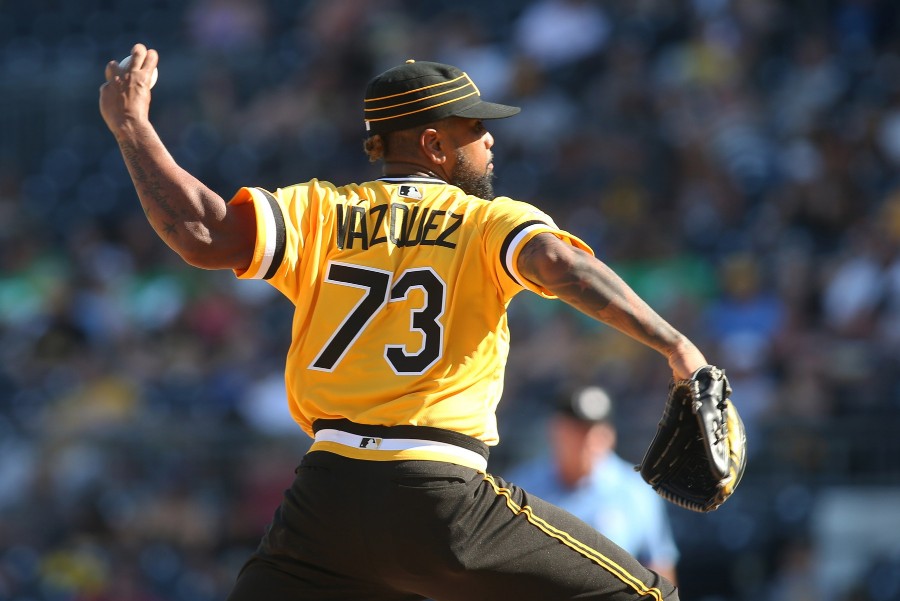 Felipe Vázquez, LHP, 27-years-old Pittsburgh Pirates (36-41, 5th in NL Central) Signed through 2021, 4 yrs/$22M (18-21) & 22-23 team option. 2019: 1.91 ERA, 1.09 WHIP, 13.9 K/9, 2.5 BB/9 in 33.0 IP 2018: 2.70 ERA, 1.24 WHIP, 11.4 K/9, 3.1 BB/9 in 70.0 IP Felipe Vázquez might be the best option for the Twins to pursue. That is, of course, if the Pirates even make him available. As ESPN’s Buster Olney reports, Pittsburgh is going to set his price through the roof to whoever wants to get him. But, as Steve Adams writes at MLB Trade Rumors, the Bucs are also in great need of new arms to their rotation, which makes the Twins a strong contender. Pittsburgh Post-Gazette’s Joe Starkey writes that the Pirates’ only untouchable is Josh Bell, which can bring our hopes up. But, is Vázquez really worth all the effort? What’s to Like? He is young, solves some of the Twins major bullpen problems and is under team control for the next four years, for a very reasonable price. Beyond that, his resumé becomes even more interesting when you notice that he averages 98.1 mph in his four seamer, 88.3 mph in his changeup and 86.4 mph in his slider. He was an All-Star last year, having worse numbers than the ones he’s having right now. That’s a hell of a good candidate. Before the All-Star Game last year, the Venezuelan was posting a 3.05 ERA in 41 1/3 innings of work, with 23 saves in 27 opportunities (85.1%). So far this year, he’s got a 1.91 ERA, with 19 saves in 20 opportunities (95%) in 33 innings. If the Twins were to go after him, they would be getting an improved All-Star closer, who possibly hasn’t reached his prime yet. The Twins have some of the worst numbers in the league when it comes to late in the game situations. In the eighth and ninth innings, Minnesota has the 18th ERA (4.59), the 20th FIP (4.57) and is has the tenth highest hard hit rate, with 39%. When you narrow it down to right handed hitters, those numbers are even worse: 5.29 ERA (27th), 5.07 FIP (24th) and 42.3 hard hit rate (27th). Vázquez represents an improvement in basically all of those metrics. Currently, against righties, he holds a 1.65 ERA and 2.20 FIP, with 31.3% hard hit rate. While the Twins have a .824 OPS against righties late in the game, Vázquez has been posting .558 in the same situation. And the most drastic improvement he could bring to Minnesota’s bullpen lies on the high leverage situations. So far, Twins relievers have posted a 4.57 ERA with .259 AVG and .726 OPS, while Vázquez has, respectively, 1.17 ERA, .130 AVG and .416 OPS. Concerns You will always have to be concerned about the shift between the NL and AL for pitchers. Technically, most of his numbers against AL teams are better than both his numbers against the NL and his career numbers, but that’s based on a very small sample (43 1/3 innings). Perhaps he won’t be the same lights-out pitcher, who had 26 scoreless outings in 31 games so far this year, when pitching to AL lineups on a daily basis. Another reason to be a bit worried is the fact that Vázquez hasn’t had a single postseason appearance, so we can’t know for sure how well he would perform closing games in the playoffs. But, if even superstar closer Craig Kimbrel didn’t pitch well during the Red Sox World Series run last year (5.91 ERA), I think Vázquez could be given the benefit of the doubt. Here’s a look at some highlights from Vázquez’ 2018 season: https://www.youtube.com/watch?v=2p9vh98xzK0 See Also Will Smith, LHP, Giants Liam Hendriks, RHP, Athletics Ty Buttrey, RHP, Angels Ken Giles, RHP, Blue Jays Sam Dyson, RHP, Giants Brad Hand, LHP, Indians Oliver Perez, LHP Cleveland Robert Stephenson, RHP, Reds John Gant, RHP, Cardinals Alex Colome, RHP, White Sox Seth Lugo, RHP, Mets Greg Holland, RHP, Diamondbacks Sean Doolittle, LHP, Nationals Kirby Yates, RHP, Padres 10 Relievers Minnesota Could Target
 -
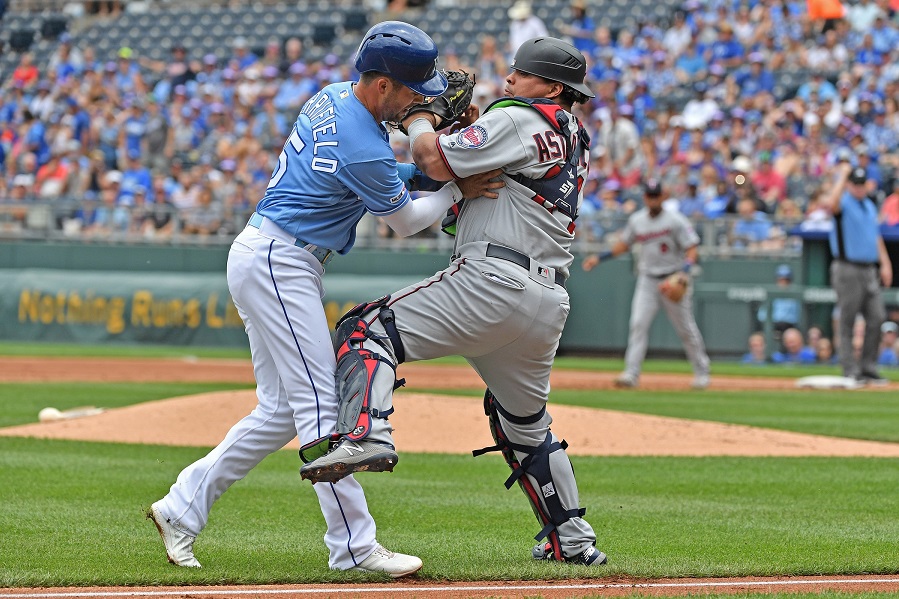 Box Score Berríos: 7.0 IP, 5 H, 2 ER, 3 BB, 3 K, 61.1% strikes (55 of 90 pitches) Bullpen: 3.0 IP, 2 H, 1 ER, 2 BB, 4 K Home Runs: Sanó (9), Cave (1), Cron (17) Multi-Hit Games: Cron (3-for-5, HR, RBI), Cave (2-for-3, HR) WPA of +0.1: Berríos .366, Cron .356, Cave .250, May .142 WPA of -0.1: Kepler -.113, Cruz -.121, Polanco -.155, Astudillo -.161, Rogers -.269 (chart via FanGraphs) Coming into this game, the Twins were having some rather rocky previous few games. After having a winning record in all of its seven, ten-game splits so far in the season, Minnesota had more losses than wins in their current ten-game split, with a 2-3 record. They were able to avoid a three-game losing streak on Friday night, as they have done all year, though. They were able to get a second straight win even though they had to face an, at times, very difficult opposing starter in lefty Danny Duffy. Even though Duffy isn’t having a very good year, coming into this game with a 4.64 ERA, he had posted a 2.61 ERA in his last five starts against the Twins, striking out nine batters per nine innings. It was by no means an easy task. But, José Berríos also came into the game carrying great recent success against the Royals. In his last six starts against them, he’s posted a 2.48 ERA, not once giving up more than three runs or pitching fewer than six innings. Sanó slowly ending his slump Miguel Sanó had a brutal series against the Boston Red Sox earlier in the week, going 0-for-13 with nine strikeouts. He then became the rally sparker late in Friday’s game, hitting a clutch solo home run to tie the game in the eighth inning. That didn’t change the fact that he finished the game in a 1-for-19 sequence. So he was determined to end that slump for good. He homered again on Saturday, in the second inning, to put the Twins ahead. https://twitter.com/Twins/status/1142502957591740421 For the first time in the past ten games, the Twins recorded three home runs in a game. The last time they did so was on June 12th against the Mariners. Minnesota continues on the path to break the single-season home run record, as they are now on pace to hit 311 homers. Here’s a look at how Jake Cave (his first of the year) and C.J. Cron went back-to-back in the eighth. https://twitter.com/Twins/status/1142524336785514496 Berríos leaves and the Royals take advantage Everything was going smoothly until the beginning of the eighth inning. Berríos had completed seven shutout innings with only 83 pitches. But he started suffering from a blister on his right ring finger and gave up a single and a walk to open the inning. Both of those runners ended up scoring as Taylor Rogers couldn’t strand them. Kansas City then tied the game in the inning, as Jorge Soler was hit by a pitch from Rogers and scored later. For the second time this week, the Twins were going to extra innings after Trevor May pitched a scoreless ninth. Patiently, Minnesota was able to score a couple more runs to retake the lead in the tenth. After Luis Arráez and Cave reached on a single and a hit-by-pitch, Cron got his third hit of the day to earn his second RBI. It was followed by Eddie Rosario’s double to add one more insurance run and give Blake Parker some breathing room to earn his tenth save of the year in the bottom of the inning. Bullpen continues good stretch Any compliments given to the Twins bullpen this year will sound weird. Although Minnesota relievers aren’t having a very good year, they’ve had some brilliant stints, the current one included. Before this afternoon game, the Twins bullpen pitched 31 innings in the previous eight games, posting a 2.03 ERA. It also should be said that more than half of those innings - sixteen and two-thirds - were pitched against the current World Series champions. Despite the fact that Rogers couldn’t hold on to the advantage late in regulation and got his third blown save of the year, the Twins bullpen is now posting a 2.11 ERA in the past nine games. May earned his second win of the season. Postgame With Baldelli https://twitter.com/fsnorth/status/1142548859874189312 Bullpen Usage Here’s a quick look at the number of pitches thrown by the bullpen over the past five days:
 -
I'd love to see Gibby getting that 9th, but after reading that interview, I kind of feel happy to see how assertive this coaching staff actually is. Excellent insight, Seth! Thank you!
- 35 replies
-
- 9
-
-
- kyle gibson
- mitch garver
- (and 1 more)
-
It was a special night for Joe Mauer and for the memory of Prince, as both Minnesota legends were honored before a sellout crowd at Target Field. But it sure was also a very special night for Kyle Gibson, as he was dealing, and hopefully regained some momentum in the season.Box Score Gibson: 8.0 IP, 2 H, 0 ER, 0 BB, 6 K, 62.5% strikes (55 of 88 pitches) Bullpen: 1.0 IP, 0 H, 0 ER, 0 BB, 1 K Home Runs: Garver (11) Multi-Hit Games: Adrianza (2-for-3) WPA of +0.1: Gibson .566, Garver .276 WPA of -0.1: Polanco -.133, Rosario -.133, Schoop -.279 Download attachment: Win614.png (chart via FanGraphs) What we witnessed tonight wasn't even new. Gibson has been one of the most solid and trustworthy starters for the Twins in roughly the past two years. However, he was coming off a very rough start in which he gave up five earned runs over five innings against the Tigers last Saturday. That was the fourth time this season he gave up at least four earned runs. Still, he's got plenty of credit. Entering the game, Gibby already led the Twins starters this year in swinging strike rate, at 13.9%, a career high for him. That ranks 14th among all pitchers in baseball. And this was the version of Kyle that led the Twins in this game, as he got 11 swinging strikes. During the sixth inning, Gibby also became the 11th pitcher in history to toss 1,000 innings in a Twins uniform. A nice addition to go with the night of memories and milestones, The offense had a rare bad game, as the Twins' lineup struggled against Royals' starter Brad Keller. He gave up only three hits. The Twins went 0-for-5 with men in scoring position and grounded into two double plays. But this is the 2019 Twins offense we're talking about. They managed to win this game with one swing of the bat late, as Mitch Garver hit a clutch home run in the bottom of the eighth against reliever Jake Diekman. Bullpen Usage Here’s a quick look at the number of pitches thrown by the bullpen over the past five days: Download attachment: Pen614.png Click here to view the article
- 35 replies
-
- 4
-
-
- kyle gibson
- mitch garver
- (and 1 more)
-
MIN 2, KC 0: Gibson Shines on Night Honoring Mauer, Prince
Thiéres Rabelo posted an article in Twins
 Box Score Gibson: 8.0 IP, 2 H, 0 ER, 0 BB, 6 K, 62.5% strikes (55 of 88 pitches) Bullpen: 1.0 IP, 0 H, 0 ER, 0 BB, 1 K Home Runs: Garver (11) Multi-Hit Games: Adrianza (2-for-3) WPA of +0.1: Gibson .566, Garver .276 WPA of -0.1: Polanco -.133, Rosario -.133, Schoop -.279 (chart via FanGraphs) What we witnessed tonight wasn't even new. Gibson has been one of the most solid and trustworthy starters for the Twins in roughly the past two years. However, he was coming off a very rough start in which he gave up five earned runs over five innings against the Tigers last Saturday. That was the fourth time this season he gave up at least four earned runs. Still, he's got plenty of credit. Entering the game, Gibby already led the Twins starters this year in swinging strike rate, at 13.9%, a career high for him. That ranks 14th among all pitchers in baseball. And this was the version of Kyle that led the Twins in this game, as he got 11 swinging strikes. During the sixth inning, Gibby also became the 11th pitcher in history to toss 1,000 innings in a Twins uniform. A nice addition to go with the night of memories and milestones, The offense had a rare bad game, as the Twins' lineup struggled against Royals' starter Brad Keller. He gave up only three hits. The Twins went 0-for-5 with men in scoring position and grounded into two double plays. But this is the 2019 Twins offense we're talking about. They managed to win this game with one swing of the bat late, as Mitch Garver hit a clutch home run in the bottom of the eighth against reliever Jake Diekman. https://twitter.com/Twins/status/1139721143949189121 SETH EDIT/UPDATE: I recorded the interview with Mitch Garver following the game. Check it out here: Taylor Rogers, the sole superstar in the recently unstable Twins bullpen, earned his seventh save of the season with only ten pitches. He came in to the game in the ninth inning even though Gibson had only 88 pitches at that point. It was Roger’s first outing in over a week and he showed he’s still sharp. Minnesota improves to 46-22, which is a season-best 24 games over .500. The Twins also maintained a comfortable lead in the AL Central, now sitting at 11 games ahead of Cleveland, and still have the best record in baseball. You couldn’t ask for a better Mauer/Prince celebration. Postgame With Baldelli https://twitter.com/fsnorth/status/1139730877745790976 Bullpen Usage Here’s a quick look at the number of pitches thrown by the bullpen over the past five days:
