



Jamie Cameron
-
Posts
1,341 -
Joined
-
Last visited
-
Days Won
4
Content Type
Profiles
News
Minnesota Twins Videos
2026 Minnesota Twins Top Prospects Ranking
2022 Minnesota Twins Draft Picks
Minnesota Twins Free Agent & Trade Rumors, Notes, & Tidbits
Guides & Resources
2023 Minnesota Twins Draft Picks
The Minnesota Twins Players Project
2024 Minnesota Twins Draft Picks
2025 Minnesota Twins Draft Pick Tracker
2026 Minnesota Twins Draft Tracker: Picks & Bonuses
Forums
Blogs
Events
Store
Downloads
Gallery
Everything posted by Jamie Cameron
-
Article: Jason Castro and a Cup of Coffee
Jamie Cameron replied to Jamie Cameron's topic in Twins Daily Front Page News
Let's try and get 'Jason Castro out of 10' to stick! Outstanding! -
Article: Jason Castro and a Cup of Coffee
Jamie Cameron replied to Jamie Cameron's topic in Twins Daily Front Page News
I think when the Twins went with Castro, they were in a pretty difficult position, due to: 1) Having Suzuki - who is terrible defensively 2) Not having an in-house option who was major league ready 3) The catcher FA market is always going to be pretty thin. I think Castro just ended up being really good timing for MN Agree that organizations should work hard to develop in-house options. -
Article: Jason Castro and a Cup of Coffee
Jamie Cameron replied to Jamie Cameron's topic in Twins Daily Front Page News
Thanks for taking the time to read it! -
Article: Jason Castro and a Cup of Coffee
Jamie Cameron replied to Jamie Cameron's topic in Twins Daily Front Page News
Thanks for reading! -
Article: Jason Castro and a Cup of Coffee
Jamie Cameron replied to Jamie Cameron's topic in Twins Daily Front Page News
Yeah this is interesting. I don't think it's a crazy question at all. Garver simply hasn't played a ton at the MLB level. While I think he will, time will tell if his bat will play with the big league team. Additionally, he's not known as a strong defender, although there's always room to develop there. Finally, Castro is in the second year of a 3 year $24.5 million contract so he'll be the guy for the foreseeable future. If Garver can rake though, there's no reason to not get his bat in the lineup more. Tons of MLB clubs split catcher time more equitably than the Twins currently do (Dodgers are a good example). -
Article: Jason Castro and a Cup of Coffee
Jamie Cameron replied to Jamie Cameron's topic in Twins Daily Front Page News
Yeah....I guess I felt like the 3 paragraphs I spent explaining my analogy would be enough for folks to differentiate between the two. -
Article: Jason Castro and a Cup of Coffee
Jamie Cameron replied to Jamie Cameron's topic in Twins Daily Front Page News
LOL! -
I was sitting down the third base line at Target Field on April 5th, giving me an excellent view of Mitch Garver’s timely first big league home run. This got me to thinking about Jason Castro, and catching in general. OK. Let’s get weird.When I first moved to the US, I worked in an upscale deli. I had just been given permission to work, and I needed money badly, a stable income for a few months to get up and running and on my feet. At said upscale deli, ownership (I like to pretend I’m part of a baseball franchise at all times), made us do regular tastings and scorings of the deli’s offerings. Folks would bring around a tray with samples and we would all score a given sample out of ten, with some brief words of explanation. I knew I wasn’t long for the food industry when others reeled off complex descriptions of how samples affected their palette, while I typically landed into two categories; ‘delicious’ or ‘not my thing’. What does this have to do with catching? I promise I’m going somewhere with this. Invariably, scores on samples were really high because the deli only sold delicious food. The one exception to this was coffee. Folks typically scored coffees in the 5-7 range, instead of the typical 8-10 range of other samples? Why? Because most (including myself) didn’t know what they were looking for. What differentiates a great coffee from a good coffee? Darned if I know. So what does this have to do with baseball? My contention is, tasting fancy coffee and evaluating catchers are the same. We don’t know what we don’t know, and we can’t always account for the subtle nuances that differentiate good from great. So I set out to try to gain a better understanding of the question; what goes into making a good catcher? Where does Jason Castro fall in these criteria? Hitting Let’s start with some general numbers on Castro. The reason I wanted to acknowledge hitting is it seems to me that there is generally a poor understanding of what an average offensive catcher looks like in MLB. Catchers like Gary Sanchez, Buster Posey and J.T. Realmuto tend to skew overall perception of what typical catcher offensive production looks like. Firstly, it’s important to acknowledge how useful it is to have a catcher who plays as much as Castro. In 2017, only 14 catchers made at least 400 PA. Of these 14, Castro finished 10th in fWAR (1.6). Again, of these 14, Castro finished 6th in OBP (behind only Posey, Contreras, Barnhart, Lucroy and Sanchez) and first in BB% (11.1%). While Castro isn’t a plus hitter, he gets on base enough to be a solid offensive contributor in a small group of elite catchers who play as much as he does throughout the course of the season. Framing This might seem like a weird place to go next. The reason I’m going here is that when Castro signed with the Twins, he came with a reputation as an excellent pitch framer. When Castro was brought in at the beginning of an otherwise quiet first off-season for Derrick Falvey and Thad Levine, his framing prowess was well established. In Castro’s final season in Houston, he got 96 more strikes called than expected, good for fifth in MLB. This, combined with the Twins transitioning from Kurt Suzuki, who got 38 less strikes than expected, had a significant positive swing for a Twins pitching staff expected to be mediocre at best in advance of the 2017 season. Several factors resulted in a slightly improved pitching performance in 2017, none more so than Byron Buxton. Castro certainly had an impact too, but what about the other aspects of catching we might be less familiar with? Regular Fielding ‘Regular fielding’ is an odd term. It simply doesn’t apply to catchers. While defensive metrics like UZR (ultimate zone rating) and DRS (defensive runs saved) give insight into most defensive positions, it’s too general to accurately appropriate to the catcher position. DRS, however, is a useful starting point for analyzing Castro’s fielding. DRS measures the runs saved or cost by a given player compared to a league average player at that position. In 2017 Castro finished ninth among catchers who caught at least 600 innings (34 catchers altogether), with a DRS of 10. Jonathan Lucroy was last at -15. Preventing Base Stealing Another important aspect is how catchers handle base runners. rSB is essentially DRS combined with stolen base runs above average. Castro is right around replacement level (20th in MLB among catchers who caught 600 innings) with a 0 rSB. Tucker Barnhart is first at 7. New Statcast data sheds light on Castro’s performance against base runners. Pop time measures the amount of time from the pitch hitting the catcher’s mitt to the moment the ball reaches the fielder’s receiving point at the center of the base. In 2017, Castro ranked 46th in MLB in pop time at 2.07 (MLB average 2.00). Castro ranked dead middle in MLB in his arm strength and second to last in exchange time. Essentially, he has an averagely strong arm, a slightly below average pop time but a far below average exchange of the ball from mitt to throwing hand. This resulted in Castro throwing out 26% of base runners, still good for a solid ninth in MLB, in a category where there is a large disparity between solid and great (Wellington Castillo, who ranked first, threw out almost 50% of base runners). Blocking Blocking is another element of catcher defensive performance that is difficult to measure. FanGraphs uses RPP (runs on passed pitches) which uses PITCHf/x data to attempt to measure how many runs a catcher saved based on the difficulty of corralling the pitch. PITCHf/x data may not be sufficient to inform this stat as it does not accurately measure whether a pitch should have been controlled by a catcher or not. Statcast may end up providing more accurate data to inform this measurement. FanGraphs’ last metric for Castro was 0.1 with the Astros in 2014, but a lack of data makes comparing him across MLB difficult. Game Management Finally, game management is the most difficult skill to evaluate in catcher performance. Catchers have a massive impact on how a pitcher navigates a lineup, where and what pitches they throw etc. Sports Info Solutions attempts to quantify game calling in its Catcher Pitch Calling Runs Above Average metric, or RerC, which is available at Baseball-Reference. Last season, Castro was seven runs above average per that stat. The only catcher to best that mark was Barnhart, who was 10 runs above average. When it’s all said and done, it’s extremely hard to comprehend how impactful Castro is for the Twins. At catcher, unlike any other position, there exists an intersection between offensive and defensive metrics which impact their contributions to their given team. Castro is a little below average offensively and above average defensively. If we were tasting a coffee named ‘Castro blend’ we might give it a 7 out of 10. That’s a score the Twins would gladly take over the next two years, as there are very few eights, nines and tens. Click here to view the article
-
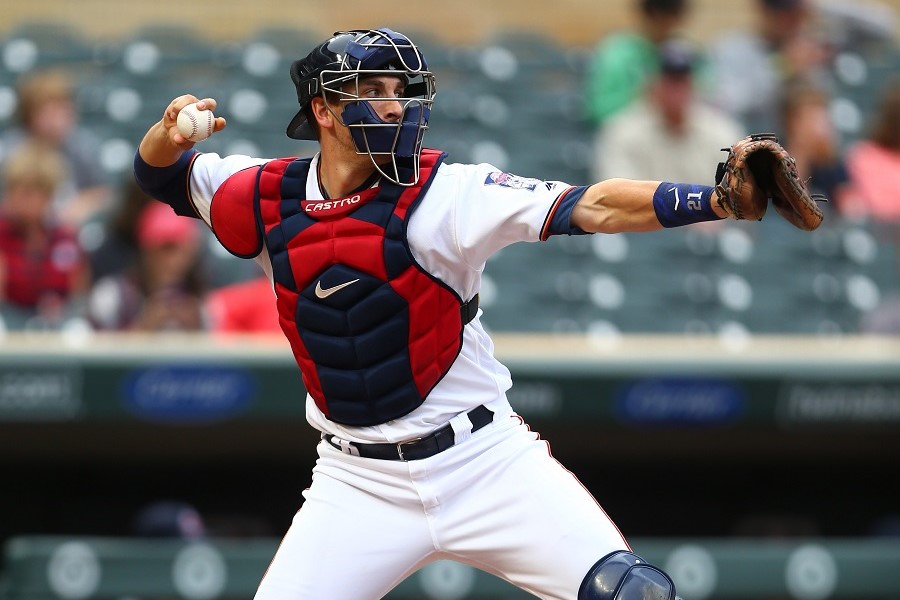 When I first moved to the US, I worked in an upscale deli. I had just been given permission to work, and I needed money badly, a stable income for a few months to get up and running and on my feet. At said upscale deli, ownership (I like to pretend I’m part of a baseball franchise at all times), made us do regular tastings and scorings of the deli’s offerings. Folks would bring around a tray with samples and we would all score a given sample out of ten, with some brief words of explanation. I knew I wasn’t long for the food industry when others reeled off complex descriptions of how samples affected their palette, while I typically landed into two categories; ‘delicious’ or ‘not my thing’. What does this have to do with catching? I promise I’m going somewhere with this. Invariably, scores on samples were really high because the deli only sold delicious food. The one exception to this was coffee. Folks typically scored coffees in the 5-7 range, instead of the typical 8-10 range of other samples? Why? Because most (including myself) didn’t know what they were looking for. What differentiates a great coffee from a good coffee? Darned if I know. So what does this have to do with baseball? My contention is, tasting fancy coffee and evaluating catchers are the same. We don’t know what we don’t know, and we can’t always account for the subtle nuances that differentiate good from great. So I set out to try to gain a better understanding of the question; what goes into making a good catcher? Where does Jason Castro fall in these criteria? Hitting Let’s start with some general numbers on Castro. The reason I wanted to acknowledge hitting is it seems to me that there is generally a poor understanding of what an average offensive catcher looks like in MLB. Catchers like Gary Sanchez, Buster Posey and J.T. Realmuto tend to skew overall perception of what typical catcher offensive production looks like. Firstly, it’s important to acknowledge how useful it is to have a catcher who plays as much as Castro. In 2017, only 14 catchers made at least 400 PA. Of these 14, Castro finished 10th in fWAR (1.6). Again, of these 14, Castro finished 6th in OBP (behind only Posey, Contreras, Barnhart, Lucroy and Sanchez) and first in BB% (11.1%). While Castro isn’t a plus hitter, he gets on base enough to be a solid offensive contributor in a small group of elite catchers who play as much as he does throughout the course of the season. Framing This might seem like a weird place to go next. The reason I’m going here is that when Castro signed with the Twins, he came with a reputation as an excellent pitch framer. When Castro was brought in at the beginning of an otherwise quiet first off-season for Derrick Falvey and Thad Levine, his framing prowess was well established. In Castro’s final season in Houston, he got 96 more strikes called than expected, good for fifth in MLB. This, combined with the Twins transitioning from Kurt Suzuki, who got 38 less strikes than expected, had a significant positive swing for a Twins pitching staff expected to be mediocre at best in advance of the 2017 season. Several factors resulted in a slightly improved pitching performance in 2017, none more so than Byron Buxton. Castro certainly had an impact too, but what about the other aspects of catching we might be less familiar with? Regular Fielding ‘Regular fielding’ is an odd term. It simply doesn’t apply to catchers. While defensive metrics like UZR (ultimate zone rating) and DRS (defensive runs saved) give insight into most defensive positions, it’s too general to accurately appropriate to the catcher position. DRS, however, is a useful starting point for analyzing Castro’s fielding. DRS measures the runs saved or cost by a given player compared to a league average player at that position. In 2017 Castro finished ninth among catchers who caught at least 600 innings (34 catchers altogether), with a DRS of 10. Jonathan Lucroy was last at -15. Preventing Base Stealing Another important aspect is how catchers handle base runners. rSB is essentially DRS combined with stolen base runs above average. Castro is right around replacement level (20th in MLB among catchers who caught 600 innings) with a 0 rSB. Tucker Barnhart is first at 7. New Statcast data sheds light on Castro’s performance against base runners. Pop time measures the amount of time from the pitch hitting the catcher’s mitt to the moment the ball reaches the fielder’s receiving point at the center of the base. In 2017, Castro ranked 46th in MLB in pop time at 2.07 (MLB average 2.00). Castro ranked dead middle in MLB in his arm strength and second to last in exchange time. Essentially, he has an averagely strong arm, a slightly below average pop time but a far below average exchange of the ball from mitt to throwing hand. This resulted in Castro throwing out 26% of base runners, still good for a solid ninth in MLB, in a category where there is a large disparity between solid and great (Wellington Castillo, who ranked first, threw out almost 50% of base runners). Blocking Blocking is another element of catcher defensive performance that is difficult to measure. FanGraphs uses RPP (runs on passed pitches) which uses PITCHf/x data to attempt to measure how many runs a catcher saved based on the difficulty of corralling the pitch. PITCHf/x data may not be sufficient to inform this stat as it does not accurately measure whether a pitch should have been controlled by a catcher or not. Statcast may end up providing more accurate data to inform this measurement. FanGraphs’ last metric for Castro was 0.1 with the Astros in 2014, but a lack of data makes comparing him across MLB difficult. Game Management Finally, game management is the most difficult skill to evaluate in catcher performance. Catchers have a massive impact on how a pitcher navigates a lineup, where and what pitches they throw etc. Sports Info Solutions attempts to quantify game calling in its Catcher Pitch Calling Runs Above Average metric, or RerC, which is available at Baseball-Reference. Last season, Castro was seven runs above average per that stat. The only catcher to best that mark was Barnhart, who was 10 runs above average. When it’s all said and done, it’s extremely hard to comprehend how impactful Castro is for the Twins. At catcher, unlike any other position, there exists an intersection between offensive and defensive metrics which impact their contributions to their given team. Castro is a little below average offensively and above average defensively. If we were tasting a coffee named ‘Castro blend’ we might give it a 7 out of 10. That’s a score the Twins would gladly take over the next two years, as there are very few eights, nines and tens.
 -
If there is one thing we can all agree on regarding the 2018 Minnesota Twins, it’s that they have a higher floor than their 2017 counterparts. Still, established pieces are going to have to maintain or raise the level of their game in order to keep their jobs. Most notably; Taylor Rogers.Rogers was drafted by the Twins in the 11th round in 2012 out of the University of Kentucky. He exceeded rookie limits in the 2016 season and is not eligible for arbitration until 2020. With that amount of team control it's important the Twins know what they have, and what they don’t have, in the 27 year old left-hander. MLB Debut Rogers made his MLB debut in 2016, pitching 61 innings and excelled. He managed a 3.96 ERA on the back of a 9.39 K/9, 2.35 BB/9 and GB% of 51%, all really solid numbers. Rogers’ xFIP of 3.47 was indicative that he might be scratching the surface of being an excellent relief option for the Twins. Perhaps unsurprisingly, Rogers had pretty dramatic splits in 2016. Against lefties, he put together an excellent .202 BAA, .286 SLG and .281 BABIP. Conversely, Rogers struggled against righties, to the tune of a .291 BAA, .462 SLG and .348 BABIP. This led most to the conclusion that Rogers could be a viable long-term option as a LOOGY. The first half of Rogers 2017, however, would call that conclusion into question. 2017: A Tale of two Halves "It was the best of times, it was the worst of times." Words from Charles Dickens which are applicable to Rogers’ 2017. First Half: 1.87 BB/9, 0.80 HR/9, .333 SLG Second Half: 5.73 BB/9, 1.23 HR/9, .434 SLG In the first half of the 2017 season, the Twins bullpen was in flux. Not only did the big league club use a record 16 starting pitchers over the course of the season, a slew of Quadruple-A types saw time in the pen. With a stable bullpen, Rogers would likely have faced predominantly LHH. The Twins were struggling, however, and Rogers began to see RHH with increasing frequency. Surprisingly, he delivered in a big way. Prior to the end of June, Rogers managed an incredible 1.35 ERA against RHH, with a stingy .257 SLG, and .227 BAA. For the Twins, this was a boon of Hildenbergian proportions. In the first half of 2017, Rogers threw to 33% more RHH than LHH. That split evened in the second half of the season, but not significantly enough to prevent a major regression against righties, evidenced by his 5.79 ERA, .355 BAA and .581 SLG the rest of the way against RHH. It’s almost a certainty that Rogers’ first half numbers against RHH were an aberration. A return to dominance against LHH (he had been solid but unspectacular against them in the first half) helped mitigate the damage of an awful second half. All in all Rogers finished the season with numbers which would lead most to consider him a left-handed specialist. Rogers offers more than Buddy Boshers, but not a ton more. Pitch Mix Overview Rogers’ pitch mix is important to understanding why he suddenly fell off a cliff against RHH in the second half of 2017. Rogers relies on a sinker, four seam fastball, and a curveball. Additionally, he mixes in a changeup pretty infrequently (only 4% of the time in 2017). Rogers has above average velocity on most of his pitches, his fastball generating a ton of fly balls, and his changeup generating a decent number of groundballs. Rogers decreased his chageup usage as the 2017 season progressed, ditching the pitch altogether in July. Coincidentally, that was his worst month of the year. He got it to the tune of an ERA of 8.18 and gave up a .614 SLG that month. This makes sense. The changeup is an equalizing pitch to throw to opposite handed hitters (that’s why Johan Santana was so dominant). Despite not having a great changeup to begin with, Rogers was continually being put in tough situations against RHH without a weapon to neutralize them. This, in addition to an uncharacteristically high walk rate, led Rogers to an awful second half. Waiting in the Wings On one hand, there is reason for optimism for Rogers in 2018. Despite having a pretty rough spring training, it’s likely that his elevated walk rate from the second half of the season is a mechanical issue which is now resolved (two walks in 11 IP in spring training suggest as much). On the other hand, his splits are real, Rogers might not be a true LOOGY, but he isn’t a pitcher the Twins should be relying on to get out RHH on a consistent basis. Additionally, the Twins have some interesting arms waiting in the wings. Gabriel Moya (owner of an excellent changeup) is a candidate much more likely to be successful against both LHH and RHH due to his pitch mix and deceptive mechanics. Tyler Jay is another candidate to be a back end bullpen option if he can stay healthy throughout the 2018 season. If either of those pitchers have strong seasons, they may challenge for Rogers’ spot. Zach Duke is already a better iteration of a LHP who can dominate LHH due to his ability to generate ground balls instead of fly-balls. With a minor league option remaining, don’t be surprised if Rogers ends up in Rochester if he doesn’t get off to a strong start. Click here to view the article
- 1 reply
-
- 1
-

-
- taylor rogers
- gabriel moya
- (and 2 more)
-
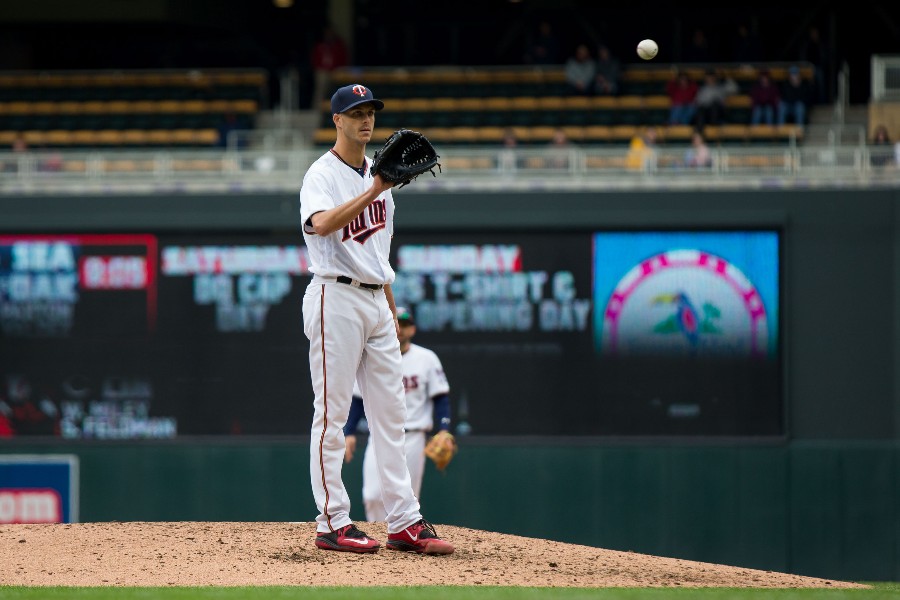 Rogers was drafted by the Twins in the 11th round in 2012 out of the University of Kentucky. He exceeded rookie limits in the 2016 season and is not eligible for arbitration until 2020. With that amount of team control it's important the Twins know what they have, and what they don’t have, in the 27 year old left-hander. MLB Debut Rogers made his MLB debut in 2016, pitching 61 innings and excelled. He managed a 3.96 ERA on the back of a 9.39 K/9, 2.35 BB/9 and GB% of 51%, all really solid numbers. Rogers’ xFIP of 3.47 was indicative that he might be scratching the surface of being an excellent relief option for the Twins. Perhaps unsurprisingly, Rogers had pretty dramatic splits in 2016. Against lefties, he put together an excellent .202 BAA, .286 SLG and .281 BABIP. Conversely, Rogers struggled against righties, to the tune of a .291 BAA, .462 SLG and .348 BABIP. This led most to the conclusion that Rogers could be a viable long-term option as a LOOGY. The first half of Rogers 2017, however, would call that conclusion into question. 2017: A Tale of two Halves "It was the best of times, it was the worst of times." Words from Charles Dickens which are applicable to Rogers’ 2017. First Half: 1.87 BB/9, 0.80 HR/9, .333 SLG Second Half: 5.73 BB/9, 1.23 HR/9, .434 SLG In the first half of the 2017 season, the Twins bullpen was in flux. Not only did the big league club use a record 16 starting pitchers over the course of the season, a slew of Quadruple-A types saw time in the pen. With a stable bullpen, Rogers would likely have faced predominantly LHH. The Twins were struggling, however, and Rogers began to see RHH with increasing frequency. Surprisingly, he delivered in a big way. Prior to the end of June, Rogers managed an incredible 1.35 ERA against RHH, with a stingy .257 SLG, and .227 BAA. For the Twins, this was a boon of Hildenbergian proportions. In the first half of 2017, Rogers threw to 33% more RHH than LHH. That split evened in the second half of the season, but not significantly enough to prevent a major regression against righties, evidenced by his 5.79 ERA, .355 BAA and .581 SLG the rest of the way against RHH. It’s almost a certainty that Rogers’ first half numbers against RHH were an aberration. A return to dominance against LHH (he had been solid but unspectacular against them in the first half) helped mitigate the damage of an awful second half. All in all Rogers finished the season with numbers which would lead most to consider him a left-handed specialist. Rogers offers more than Buddy Boshers, but not a ton more. Pitch Mix Overview Rogers’ pitch mix is important to understanding why he suddenly fell off a cliff against RHH in the second half of 2017. Rogers relies on a sinker, four seam fastball, and a curveball. Additionally, he mixes in a changeup pretty infrequently (only 4% of the time in 2017). Rogers has above average velocity on most of his pitches, his fastball generating a ton of fly balls, and his changeup generating a decent number of groundballs. Rogers decreased his chageup usage as the 2017 season progressed, ditching the pitch altogether in July. Coincidentally, that was his worst month of the year. He got it to the tune of an ERA of 8.18 and gave up a .614 SLG that month. This makes sense. The changeup is an equalizing pitch to throw to opposite handed hitters (that’s why Johan Santana was so dominant). Despite not having a great changeup to begin with, Rogers was continually being put in tough situations against RHH without a weapon to neutralize them. This, in addition to an uncharacteristically high walk rate, led Rogers to an awful second half. Waiting in the Wings On one hand, there is reason for optimism for Rogers in 2018. Despite having a pretty rough spring training, it’s likely that his elevated walk rate from the second half of the season is a mechanical issue which is now resolved (two walks in 11 IP in spring training suggest as much). On the other hand, his splits are real, Rogers might not be a true LOOGY, but he isn’t a pitcher the Twins should be relying on to get out RHH on a consistent basis. Additionally, the Twins have some interesting arms waiting in the wings. Gabriel Moya (owner of an excellent changeup) is a candidate much more likely to be successful against both LHH and RHH due to his pitch mix and deceptive mechanics. Tyler Jay is another candidate to be a back end bullpen option if he can stay healthy throughout the 2018 season. If either of those pitchers have strong seasons, they may challenge for Rogers’ spot. Zach Duke is already a better iteration of a LHP who can dominate LHH due to his ability to generate ground balls instead of fly-balls. With a minor league option remaining, don’t be surprised if Rogers ends up in Rochester if he doesn’t get off to a strong start.
 -
A Tale of Two Halves: Taylor Rogers' Keys to Success
Jamie Cameron posted a blog entry in Curveball Blog
If there is one thing we can all agree on regarding the 2018 Minnesota Twins, it’s that they have a higher floor than their 2017 counterparts. With key additions in the rotation, bullpen, and at DH, Minnesota baseball fans are eagerly anticipating the start of a new season. With a higher floor, established pieces are going to have to maintain, or raise the level of their game in order to keep their jobs. Most notably; Taylor Rogers. Rogers was drafted by the Twins in the 11th round in 2012 out of the University of Kentucky. Rogers exceeded rookie limits in the 2016 season and is not eligible for arbitration until 2020. With that amount of team control its important the Twins what they have, and what they don’t have in the 27 year old left-hander. MLB Debut Rogers made his MLB debut in 2016, pitching 61 innings and excelled. Rogers managed a 3.96 ERA on the back of a 9.39 K/9, 2.35 BB/9, and GB% of 51%, all really solid numbers. Rogers’ xFIP of 3.47 was indicative that he might be scratching the surface of being an excellent relief option for the Twins. Perhaps unsurprisingly, Rogers had pretty dramatic splits in 2016. Against lefties, he put together an excellent .202 BAA, .286 SLG, and .281 BAbip. Conversely, Rogers struggled against righties, to the tune of a .291 BAA, .462 SLG, and .348 BAbip. This led most to the conclusion that Rogers could be a viable long term option as a LOOGY. The first half of Rogers 2017 however, would call that conclusion into question. 2017: A Tale of two Halves ‘It was the best of times, it was the worst of times’. Words from Charles Dickens which are applicable to Rogers’ 2017, which oscillated between impressive, and desolate. First Half: 1.87 BB/9, 0.80 HR/9, .333 SLG Second Half: 5.73 BB/9, 1.23 HR/9, .434 SLG In the first half of the 2017 season, the Twins bullpen was in flux. Not only did the big league club use a record 16 starting pitchers over the course of the season, a slew of quadruple A types saw time in the pen, long before an incredible second half surge propelled the team to the second wild card berth. With a stable bullpen, Rogers would likely faced predominantly LHH. The Twins however, were struggling, and Rogers began to see RHH with increasing frequency. Surprisingly, he delivered in a big way. Prior to the end of June, Rogers managed an incredible 1.35 ERA against RHH, with a stingy .257 SLG, and .227 BAA. For the Twins, this was a boon of Hildenbergian proportions. Overall, in the first half of 2017, Rogers threw to 33% more RHH than LHH, a statistic which evened in the second half of the season, but not significantly enough to prevent a major regression against righties, evidenced by his 5.79 ERA, .355 BAA, and .581 SLG the rest of the way against RHH. It’s almost a certainty that Rogers’ first half numbers against RHH were an aberration. A return to dominance against LHH (he had been solid but unspectacular against them in the first half) helped mitigate the damage of an awful second half. All in all Rogers finished the season with number which would lead most to consider him a left-handed specialist. Rogers offers more than Buddy Boshers, but not a ton more. Pitch Mix Overview Rogers’ pitch mix is important to understanding why he suddenly fell off a cliff against RHH in the second half of 2017. Rogers relies on a sinker, four seam fastball, and a curveball. Additionally, he mixes in a changeup pretty infrequently (only 4% of the time in 2017). Rogers has above average velocity on most of his pitches, his fastball generating a ton of fly balls, and his changeup generating a decent number of groundballs. Rogers threw his changeup minimally to begin with but decreasingly frequently as the 2017 season progressed, ditching the pitch altogether in July. Coincidentally, July was the worst month of the year for Rogers, who put together an ERA of 8.18 and gave up a .614 SLG that month. This makes sense. The changeup is an equalizing pitch to throw to opposite handed hitters (that’s why Johan Santana was so dominant). Despite not having a great changeup to begin with, Rogers was continually being put in tough situations against RHH without a weapon to neutralize them. This, in addition to an uncharacteristically high walk rate, led Rogers to an awful second half. Waiting in the Wings On one hand, there is reason for optimism for Rogers in 2018. Despite having a pretty rough spring training, it’s likely that his elevated walk rate from the second half of the season is a mechanical issue which is now resolved (2 walks in 11 IP in spring training would suggest as much). On the other hand, his splits are real, Rogers might not be a true LOOGY, but he isn’t a pitcher the Twins should be relying on to get out RHH on a consistent basis. Additionally, the Twins have some interesting arms waiting in the wings. Gabriel Moya (owner of an excellent changeup) is a candidate much more likely to be successful against both LHH and RHH due to his pitch mix and deceptive mechanics. Tyler Jay is another candidate to be a backend bullpen option if he can stay healthy throughout the 2018 season. If either of those pitchers have strong seasons, they may challenge for Rogers’ spot. Zach Duke is already a better iteration of a LHP who can dominate LHH due to his ability to generate ground balls instead of fly-balls. With a minor league option remaining, don’t be surprised if Rogers ends up in Rochester if he doesn’t get off to a strong start. -
Article: Can Ryan Pressly Put It All Together?
Jamie Cameron replied to Jamie Cameron's topic in Twins Daily Front Page News
Thank you! I would agree. I think Pressly at his best has all the tools necessary to be a guy the Twins use in pretty high leverage situations. If he struggles with consistency, thankfully they have the bullpen depth to absorb that now. -
Article: Can Ryan Pressly Put It All Together?
Jamie Cameron replied to Jamie Cameron's topic in Twins Daily Front Page News
Thanks for taking the time to read it! -
Article: Can Ryan Pressly Put It All Together?
Jamie Cameron replied to Jamie Cameron's topic in Twins Daily Front Page News
Thank you! I definitely think he has the ability to be a good reliever, mid 3s ERA, lots of Ks. -
Article: Can Ryan Pressly Put It All Together?
Jamie Cameron replied to Jamie Cameron's topic in Twins Daily Front Page News
Thank you for reading. The data is truly amazing. It's really fun looking for patterns and stories in it. That is much more work than the actual writing itself. This took me 1-2 hours, but it was fairly limited in its scope. -
Article: Can Ryan Pressly Put It All Together?
Jamie Cameron replied to Jamie Cameron's topic in Twins Daily Front Page News
Thank you for reading! -
Article: Can Ryan Pressly Put It All Together?
Jamie Cameron replied to Jamie Cameron's topic in Twins Daily Front Page News
They have everything we have access to, plus a factor of at least 10, I'd argue! -
Article: Can Ryan Pressly Put It All Together?
Jamie Cameron replied to Jamie Cameron's topic in Twins Daily Front Page News
This is super interesting. I would offer that Pressly is probably spinning the ball as much as he can whilst containing some level of consistency in the rest of his mechanics. Would have to look at his spin rates on breaking pitches. Some folks just can't generate the same level of spin others can. -
Article: Can Ryan Pressly Put It All Together?
Jamie Cameron replied to Jamie Cameron's topic in Twins Daily Front Page News
Here is 2016. I think the noticeable difference is as you follow the season long adjustments to his delivery, there is consistency (generally) i.e. when the release drops on one pitch, the rest follow suit. The difference in 2018 is that when one went down another went up, that's the type of difference that can result in tipped pitches. I actually don't think Pressly is very far from being a very good and consistent bullpen arm. -
Article: Can Ryan Pressly Put It All Together?
Jamie Cameron replied to Jamie Cameron's topic in Twins Daily Front Page News
Thanks for the kind words!, much appreciated! -
In five seasons since being selected in the Rule 5 Draft by the Twins, Ryan Pressly has oscillated between very good (2016 version), and so-so (2017 version). This will be an especially pivotal year for Pressly. He's out of options, the front office added significant major league talent this offseason and relief talent is also present in the high minors. For a Twins team hoping to challenge for the AL Central, a poor start may mean the end of Pressly's tenure in Minnesota.On paper, Ryan Pressly is everything the Twins want to help anchor a bullpen which has lacked dominant arms in recent years.Stuff-wise, Pressly is the kind of arm the Twins have needed to stick at the major league level. He can throw five pitches (fourseam fastball, cutter, slider, curve and sinker) and has well-above average velocity (his fastball averaged 96 mph in 2017). Pressly also generates a ton of swings and misses, with a 12.4 swinging strike %. For context, this was 38th in MLB for relievers who threw at least 60 innings, sandwiched right around Brad Hand and Bryan Shaw. So why hasn’t Pressly managed to produce more consistently excellent results, given his impressive arsenal? Variable Release Points I’m about to do something extremely unfair to Ryan Pressly; compare him to Clayton Kershaw. That’s not really reasonable. Kershaw is perhaps, the greatest pitcher of his generation, a starter and left-handed. Pressly is none of those things. The comparison is useful, however. In the table below, you’ll see Kershaw’s vertical release points for all his pitches charted throughout the 2017 season. Notice the consistency in release points for his pitches (how clustered together they are). The result of this is all his pitches are coming at hitters from an extremely similar height, increasing the likelihood of deceiving the hitter. Pitchers typically go through subtle variations in their release points throughout the season. When Kershaw’s vertical release dips or increases in one pitch, the rest follow suit. *Data courtesy of BrooksBaseball.net By contrast, Pressly has wide fluctuations in his vertical release, both throughout the season, and in between his pitches. There are two months worth noting in his 2017 season: May, and August. In May, there was a much greater range in the vertical release points of Pressly’s fastball and slider (his primary two pitches). In August, he brought those two release points (although lower) much closer together. Pressly managed an ERA of 11.00 in May with a .324 BAA, and a 1.13 ERA in August with a 0.96 BAA. When he's able to release the ball from consistent vertical coordinates, regardless of the pitch, he has the velocity required to dominate opposing hitters. Slider Command Pressly employs both a curveball and slider as breaking pitches. 2017 saw a significant reduction in the amount Pressly used his slider (dropping from around 25% to around 18%). Both of Pressly’s breaking pitches have fairly minimal vertical break and are both above average in velocity. When throwing breaking pitches without a ton of break, command is everything. Below are two charts mapping Pressly’s slider and curveball location in 2017. *Data courtesy of FanGraphs It’s immediately noticeable that Pressly leaves far too many sliders over the heart of the plate. By comparison, Pressly locates his curveball more consistently down and away to RHH (down and in to LHH). His slider command struggle is reflected in the effectiveness of both pitches in 2017. Pressly’s curveball had a .194 SLG against in 2017 (with around 21% whiffs), compared to .463 SLG for his slider (around 15% whiffs). In other words, when Pressly left his slider over the plate, the break he generates is not enough to save him, and excellent professional hitters tend to have their way with it. For one final comparison, the last chart here shows Pressly’s slider command in 2016, his best full season with the Twins. His ability to cluster slider location down in the zone is noticeable. In 2016, Pressly gave up a .375 SLG on his slider, and .089 ISO, compared with .256 ISO in 2017. *Data courtesy of FanGraphs On looking into Pressly’s numbers more closely, there’s only one conclusion to draw: He’s never established a great enough level of consistency in his mechanics throughout his tenure with the Twins. Variations in his release point and command struggles have diminished the impact of his incredible arm. If Pressly is going to stick in the Twins’ pen long term, mechanical consistency is the key element that needs to improve to capitalize on his excellent arm. Click here to view the article
-
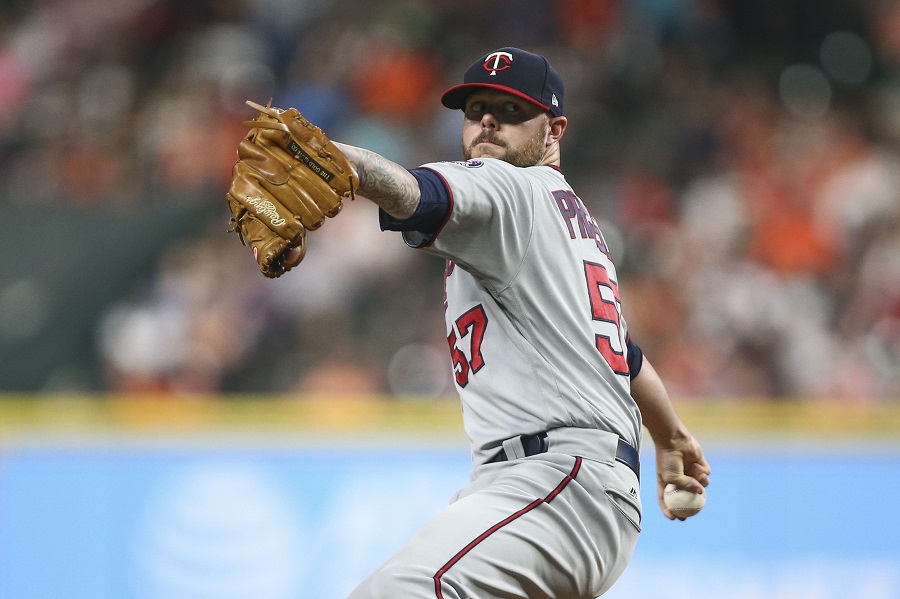 On paper, Ryan Pressly is everything the Twins want to help anchor a bullpen which has lacked dominant arms in recent years.Stuff-wise, Pressly is the kind of arm the Twins have needed to stick at the major league level. He can throw five pitches (fourseam fastball, cutter, slider, curve and sinker) and has well-above average velocity (his fastball averaged 96 mph in 2017). Pressly also generates a ton of swings and misses, with a 12.4 swinging strike %. For context, this was 38th in MLB for relievers who threw at least 60 innings, sandwiched right around Brad Hand and Bryan Shaw. So why hasn’t Pressly managed to produce more consistently excellent results, given his impressive arsenal? Variable Release Points I’m about to do something extremely unfair to Ryan Pressly; compare him to Clayton Kershaw. That’s not really reasonable. Kershaw is perhaps, the greatest pitcher of his generation, a starter and left-handed. Pressly is none of those things. The comparison is useful, however. In the table below, you’ll see Kershaw’s vertical release points for all his pitches charted throughout the 2017 season. Notice the consistency in release points for his pitches (how clustered together they are). The result of this is all his pitches are coming at hitters from an extremely similar height, increasing the likelihood of deceiving the hitter. Pitchers typically go through subtle variations in their release points throughout the season. When Kershaw’s vertical release dips or increases in one pitch, the rest follow suit. *Data courtesy of BrooksBaseball.net By contrast, Pressly has wide fluctuations in his vertical release, both throughout the season, and in between his pitches. There are two months worth noting in his 2017 season: May, and August. In May, there was a much greater range in the vertical release points of Pressly’s fastball and slider (his primary two pitches). In August, he brought those two release points (although lower) much closer together. Pressly managed an ERA of 11.00 in May with a .324 BAA, and a 1.13 ERA in August with a 0.96 BAA. When he's able to release the ball from consistent vertical coordinates, regardless of the pitch, he has the velocity required to dominate opposing hitters. Slider Command Pressly employs both a curveball and slider as breaking pitches. 2017 saw a significant reduction in the amount Pressly used his slider (dropping from around 25% to around 18%). Both of Pressly’s breaking pitches have fairly minimal vertical break and are both above average in velocity. When throwing breaking pitches without a ton of break, command is everything. Below are two charts mapping Pressly’s slider and curveball location in 2017. *Data courtesy of FanGraphs It’s immediately noticeable that Pressly leaves far too many sliders over the heart of the plate. By comparison, Pressly locates his curveball more consistently down and away to RHH (down and in to LHH). His slider command struggle is reflected in the effectiveness of both pitches in 2017. Pressly’s curveball had a .194 SLG against in 2017 (with around 21% whiffs), compared to .463 SLG for his slider (around 15% whiffs). In other words, when Pressly left his slider over the plate, the break he generates is not enough to save him, and excellent professional hitters tend to have their way with it. For one final comparison, the last chart here shows Pressly’s slider command in 2016, his best full season with the Twins. His ability to cluster slider location down in the zone is noticeable. In 2016, Pressly gave up a .375 SLG on his slider, and .089 ISO, compared with .256 ISO in 2017. *Data courtesy of FanGraphs On looking into Pressly’s numbers more closely, there’s only one conclusion to draw: He’s never established a great enough level of consistency in his mechanics throughout his tenure with the Twins. Variations in his release point and command struggles have diminished the impact of his incredible arm. If Pressly is going to stick in the Twins’ pen long term, mechanical consistency is the key element that needs to improve to capitalize on his excellent arm.
 -
*Note: This article has been updated. The previous image of Kershaw's release point was horizontal instead of vertical. This error has since been amended. 2018 is a pivotal year for Ryan Pressly. The Twins originally acquired Pressly from Boston in the 2012 Rule 5 draft. In five season in Minnesota, Pressly has oscillated between very good (2016 version), and so-so, (2017 version). With the front office adding significant major league talent this off-season, and a chunk of organizational relief talent in the high minors (Curtiss, Reed etc.), Pressly is entering a crucial season. He is out of minor league options. For a Twins team hoping to challenge for the AL Central, a poor April-June may mean the end of his tenure with the team. On paper, Ryan Pressly is everything the Twins want to help anchor a bullpen which has lacked dominant arms in recent years. In January, Pressly agreed to a $1.6 million contract with the Twins for 2018, avoiding arbitration. Stuff-wise, Pressly is the kind of arm the Twins have needed to stick at the major league level. He can throw five pitches (fourseam fastball, cutter, slider, curve, and sinker) and has well-above average velocity (his fastball averaged 96mph in 2017). Pressly also generates a ton of swings and misses, with a 12.4% SwStr% (swinging strike %). For context, this was 38th in MLB for relievers who threw at least 60 innings, sandwiched right around Brad Hand and Bryan Shaw. So why hasn’t Pressly managed to produce more consistently excellent results, given his impressive arsenal? Variable Release Points I’m about to do something extremely unfair to Ryan Pressly; compare him to Clayton Kershaw. That’s not really reasonable. Kershaw is perhaps, the greatest pitcher of his generation, a starter, and left-handed. Pressly is none of those things. The comparison is useful however. In the table below, you’ll see Kershaw’s vertical release points for all his pitches charted throughout the 2017 season. Notice the consistency in release points for his pitches (how clustered together they are). The result of this is all his pitches are coming at hitters from an extremely similar height, increasing the likelihood of deceiving the hitter. Pitchers typically go through subtle variations in their release points throughout the season. When Kershaw’s vertical release dips or increases in one pitch, the rest follow suit. By contrast, Pressly has wide fluctuations in his vertical release, both throughout the season, and in between his pitches. There are two months’ worth noting in his 2017 season, May, and August. In May, there was a much greater range in the vertical release points of Pressly’s fastball and slider (his primary two pitches). In August he brought those two release points (although lower) much closer together. Pressly managed an ERA of 11.00 in May with a .324 BAA, and a 1.13 ERA in August with a 0.96 BAA. When Pressly is able to release the ball from consistent vertical coordinates, regardless of the pitch, he has the velocity required to dominate opposing hitters. Slider Command Pressly employs both a curveball and slider as breaking pitches. 2017 saw a significant reduction in the amount Pressly used his slider (dropping from around 25% to around 18%). Both of Pressly’s breaking pitches have fairly minimal vertical break and are both above average in velocity. When throwing breaking pitches without a ton of break, command is everything. Below are two charts mapping Pressly’s slider and curveball location in 2017. It’s immediately noticeable that Pressly leaves far too many sliders over the heart of the plate. By comparison, Pressly locates his curveball more consistently down and away to RHH (down and in to LHH). His slider command struggle is reflected in the effectiveness of both pitches in 2017. Pressly’s curveball had a .194 SLG against in 2017 (with around 21% whiffs), compared to .463 SLG for his slider (around 15% whiffs). In other words, when Pressly left his slider over the plate, the break he generates is not enough to save him, and excellent professional hitters tend to have their way with it. For one final comparison, the last chart here shows Pressly’s slider command in 2016, his best full season with the Twins. His ability to cluster slider location down in the zone is noticeable. In 2016, Pressly gave up a .375 SLG on his slider, and .089 ISO, compared with .256 ISO in 2017. Upon looking into Pressly’s numbers more closely, there’s only one conclusion to draw, he’s never established great enough level of consistency in his mechanics throughout his tenure with the Twins. Variations in his release point and command struggles have diminished the impact of his incredible arm. If Pressly is going to stick in the Twins’ pen long term, mechanical consistency is the key lever that needs to improve to capitalize on his excellent arm
-
Regardless of how good the rest of their roster is, can a team that lacks a true ace pitcher really win a World Series? Jamie Cameron and John Olson take sides and battle to the death! OK, not really, but the question did generate a great conversation. Make sure to add your take on the debate in the comments.Jamie Cameron here. If you haven’t been reading John Olson’s Four-Six-Three Blog at Twins Daily, get on it. He’s been churning out some really great content. John is also a great Twitter follow (@Four_Six_Three). Recently he posted a thread which caught my attention, essentially attempting to answer the question; does a given team need an ace in order to win the World Series? So I did what any Twitter secret admirer would do, and slid into John’s DMs. "John, you don’t know me, but this thread is super interesting, how would you feel about writing a collaborative piece for Twins Daily?," was my smooth pickup line. John, ever the good sport, agreed, so we came up with a premise; let’s have a debate within an article. Let’s go toe to toe and try to answer the question; do the Twins need an ace to win the World Series? John will argue for, I will argue against. We’d love you to weigh in, and your thoughts on the format. Thanks in advance for reading! Ace up your Sleeve: The necessity of a “true” number one by John Olson Throughout the past offseason, I have been adamant about the necessity of an ace. If the Twins truly want to take the next step, they need to have a front-line, No. 1, ace starter. Assembling a decent rotation, something stable enough to win you some games in a weak division, maybe secure the second Wild Card – well, that’s all fine and well, I suppose. If the goal is to win the last game, it may be a near impossible task to do it without having a true No. 1 starter. I think we need to get some semantics out of the way first, before we can make any cogent arguments. There isn’t a good way to, non-subjectively, define an ace pitcher. If you simply define an ace as a teams’ number one pitcher in the rotation, their Opening Day starter, then well, every team in the league already has one. This isn’t true; I think we can all agree. Even with the incredible season Ervin Santana had last season, I don’t think he fits the mold, either. Like Justice Stewart said, in 1964 when asked to define the threshold of obscenity: “I know it when I see it.” All right – Get on with it, already So, what’s the point, right? Laid out plainly, take a look at the last 10 World Series winners. What do all of them, invariably, have in common? They all either had, or acquired at some point during the season, at least one ace in their rotation. This seems like a very “cherry-picked” piece of evidence – not all teams are built the same. Some teams have had the league MVP, others had a league-leading offense, some the best overall pitching staff, others were somewhere in between. What they all did have is the ability to hand the ball, every fifth day, to an established No. 1 starter. Admittedly, having an ace in the rotation doesn’t guarantee any championships – just ask the LA Dodgers – but an ace does seem to be a prerequisite for any team that considers itself a true contender. Plenty of teams, for example the 2014 Oakland A's who added Jon Lester at the deadline, have anted up for the postseason when they felt their window was open. Anything can happen in the MLB Postseason, but... Bats get hot; bats get cold and the same goes for pitching. Clayton Kershaw, one of the greatest left-handed pitchers in MLB history, has had the label of pitching outstandingly in the regular season but falling flat come October. Some of that’s fair – but push comes to shove, ideally, you’re giving the ball to Kershaw. He’s your Ace. He’s your Stopper. He’s” the guy” that will right the ship. That’s why teams pay out the nose for them in trade, that’s why when they come on the free agent market, they’re a unicorn. If we take a look back in recent history, there isn’t a team which has won it all, without having at least one Ace pitcher. The Astros, ’17 Champions, had Dallas Keuchel (who had a 1.67 ERA pre-All Star break), who was hampered with injuries mid-season, felt the need to add another ace-quality pitcher, Justin Verlander, to the rotation. That seemed to work out. Verlander pitched to the tune of a 1.95 ERA in the second half, was the winning pitcher in Games 1 and 4 in the ALDS, Games 2 and 6 in the ALCS. Verlander was a force in the 2017 postseason, and one of the Astros most potent weapons. The 2016 Chicago Cubs had a three-headed monster rotation of Jon Lester, Jake Arrieta and Kyle Hendricks. None of those pitchers had an ERA higher than 3.10 during the season, but Lester in particular led that staff in xFIP, K/9 and IP. He pitched Games 1, 5 AND appeared in 3 innings of relief in Game 7 to break the curse in Chicago. The 2015 Royals, perhaps the weakest case for "necessity of an ace" in the last 10 years, wanted to add to their arsenal prior to heading into the playoffs. The Royals traded for Johnny Cueto, who had a 2.73 ERA and 113K’s with the Reds in the first half. Slotting him alongside rising star Yordano Ventura and Edinson Volquez, the Royals poised themselves for a World Series run. Although Cueto pitched poorly in the second half of the regular season, he started (and won) Game 2 of the World Series, pitching nine innings of one-run baseball. Giants ace Madison Bumgarner had the most impressive overall pitching performance, in my opinion, in World Series history in 2014. Jon Lester (again) led the Red Sox as their number one starter in 2013. Bumgarner (again) pitched the Giants to a World Series win with a 0.00 ERA over 7 IP in their 2012 Series sweep. Chris Carpenter in 2011. Tim Lincecum in 2010. CC Sabathia in 2009. Cole Hamels in 2008. All of these pitchers, all aces at that point in their careers. All of them World Series Champions. In fact, 2005 is the last year in recent memory where a group of pitchers – none of whom is considered a true ace – were part of a World Series winner. So, what does this have to do with the Twins, exactly? In a one game play-in, who do you want to take the ball? Santana was excellent in 2017, but to call him an ace is overselling him. He has a career ERA of 4.02 and a career FIP of 4.24; he has been brilliant in short bursts and he is what he is – a decent No. 2 or 3 starter on a good team. It's wholly unfair to pin last year’s Wild Card loss on Ervin; the entire roster lost that one. I would expect they would say the same. I like Santana; I just don't like him as my No. 1. The Twins are sorely in need of a pitcher who, when handed the ball, can pitch out of a jam reliably. Get the strikeout when you really need it. A starter who knows he can depend on his defense, but can also generate those outs on his own. As I mentioned previously, Santana had a great season, but his Fielding Independent Pitching (FIP) - out of 58 total qualifying pitchers per FanGraphs – was 43rd. That mark lodges him solidly between Ty Blach, Ivan Nova and Dan Straily. His 4.46 FIP, paired next to a 3.28 ERA, gives a 1.18 point discrepancy – or simply put, he depended heavily on the defense behind him. This isn't meant to pick on Erv. He had a good season. He finished seventh in Cy Young voting. But don't be mistaken, he's not an ace. Perhaps the Twins are where the Astros were in 2015. Maybe Jose Berrios will develop into that guy, or Fernando Romero or Stephen Gonsalves or someone else. Maybe our version of Keuchel and Lance McCullers is staring us in the face. Whoever that pitcher is, if we expect to compete in October, we’ll need an established front-line guy. Preferably two. Aces Low: Why You Don’t Need an Ace to be World Champions By Jamie Cameron Do you need an ace to win the World Series? Absolutely not. Can the Twins win the World Series without a true, legitimate No. 1 starting pitcher? Yes they can. For this half of the debate we’re going to use a team as a case study – the 2015 Kansas City Royals. Who needs an ace when you have a super-bullpen? Let’s dig into what most folks remember about the 2015 Royals: their bullpen. The Royals actually didn’t have the best bullpen in MLB during the regular season. What they did have was four guys who could dominate four consecutive innings in Greg Holland, Wade Davis, Kelvin Herrera and Ryan Madson. The Royals bullpen threw the fifth most innings in the majors during the regular season, trailing only the D-Backs, Rockies, Reds and Phillies (who were all average to terrible teams). In other words, no other good team relied on its bullpen the way the 95-win Royals did. The Royals bullpen ranked 17th in K/9 (8.38), 10th in FIP (3.56), and seventh in WAR (4.8). If you isolate these stats just accounting for their top four guys, they tell a more dominant story. Madson, Herrera, Holland and Davis combined for a 9.2 K/9, a 3.02 FIP, and 4.2 of the bullpen’s entire 4.8 WAR, over 243 regular season innings. There’s a recipe for post-season success if I’ve ever seen one. What about their rotation? OK, everyone remembers, the bullpen was good, but what about the rotation? KC’s rotation must have at least been solid to support an outstanding bullpen. Not really. Interestingly, 2015 was a record-breaking season. There were 2,006 occasions where starting pitchers did not make it through the sixth inning (Twins fans know all about that, amirite?) There are only 2,430 MLB games in the regular season, that’s just under 83% of games where starters are not making it through six innings. By 2015, the bullpen revolution was well and truly on with teams like the Yankees stacking the back-end of their bullpen. The Royals just did it better than anyone else. The Royals rotation in the regular season was pretty poor. They ranked 23rd in the league in WAR (7.9), 24th in inning pitched (912.2), 26th in K/9 at 6.49, and 29th in xFIP at 4.48. Hardly intimidating numbers going into the post-season. As a frame of reference, the Twins starters combined for an xFIP of 4.92 in 2017 (using 16 starting pitchers), and an absurd number of sub-par arms. The homegrown, high quality offense The Royals did have a really strong offense in 2015 which was anchored by lots of good hitters and an excellent defense. Looking back, there are some pretty obvious similarities between the 2015 KC offense and the 2017 Twins offense. Both were constructed around a young core of talented players who rose through their teams’ minor league ranks. In the case of KC this group was comprised of Eric Hosmer, Mike Moustakas, Salvador Perez and Lorenzo Cain. KC was seventh in runs scored with 724. They hit 139 HR, well below the MLB average of 164 that year. The Royals did rank third in the league in doubles (300), sixth in triples (42) and 10th in OPS (.734). Their offense, similarly to the Twins, was built around a terrific outfield anchored by Alex Gordon and Cain (combined 10 WAR). For comparison, the Twins offense in 2017 was one of the best in baseball, finishing seventh in runs scored (815), 13th in doubles (286), 10th in triples (31) and 9th in OPS (.768). An ace in the hole and the story of the 2015 post-season Let’s address the elephant in the room. The Royals DID have an ace. On July 26th 2015, the Royals traded for Brandon Finnegan, John Lamb and Cody Reed for Johnny Cueto. Royals’ fans must have been beside themselves at the time. In the first half of the season with the Cincinnati Reds, Cueto had been dominant. In 130 IP, he had a 2.62 ERA, 0.93 WHIP, 2.0 BB/9 and 8.3 K/9. After he was traded to KC, he struggled mightily, amassing a 4.76 ERA and 1.45 WHIP the rest of the way. The Royals may have had an ace, but he certainly didn’t perform like one in that portion of the regular season. Luckily for the Royals, they did have strong performers in their rotation, including Edinson Volquez and the late Yordano Ventura. Conclusion Cueto ultimately played a big role in the Royals postseason. Yet, even in the highest-leverage situations, his results were mixed. In the unbelievable ALDS vs. the Astros he had one excellent start and one awful start. He had another poor start in the ALCS vs. the Blue Jays, and one incredible start in the World Series against a flat New York Mets team. While Cueto was a bonus for Kansas City, he certainly wasn’t the reason they won the World Series. The similarity for me between the '15 Royals and this year's Twins club is their strong offensive lineups and pitching staffs which can keep them in most games. It remains to be seen whether the Twins will have enough depth in their rotation and enough stability in their bullpen to hold as many leads like those '15 Royals. The Royals had an ace by name but not by performance. Their offense and their bullpen was good enough to ameliorate the limitations of their rotation, which was OK, but still better than the Twins rotation. If the Twins want to contend for a World Series, they don’t need an ace, but they absolutely need more depth in their starting rotation. In addition to using the 2015 Royals to argue the case against needing an ace pitcher, for me, they offer the Twins a blueprint. KC's incredible bullpen would be tough to emulate, but the Twins could be on the front end of a trend such as bullpen stacking. The conclusion after the conclusion – from John We’re in the middle of a paradigm shift in baseball. Teams are tanking, racing to the bottom trying to ensure a high draft spot. Young, controllable talent is the currency of a franchise. The Yankees, Dodgers and other high payroll/large market teams are trimming the fat to get under luxury tax thresholds and the penalties associated with repeat offenders. Raise your hand, and be honest, if you knew about terms like exit velocity, launch angle and heat maps even two years ago. The establishment of an ace pitcher as a staple of a rotation isn’t quite as “new age” as some of these things, but it’s there. Who do you give the ball to in a must-win game? That’s a no-brainer in Dodgertown. Maybe it depends on the matchup with the teams that boast having two or more of these guys (looking at you, Chicago Cubs/Houston Astros). Any way you look at it, you've got to like your odds of winning when you have an ace up your sleeve. What are your thoughts? Is having a true number one pitcher necessary or luxury when it comes to winning a World Series? Let us know! Click here to view the article
- 56 replies
-
- 1
-
-
- ervin santana
- jose berrios
- (and 2 more)
