



Major League Ready
-
Posts
7,875 -
Joined
-
Last visited
-
Days Won
26
Content Type
Profiles
News
Minnesota Twins Videos
2026 Minnesota Twins Top Prospects Ranking
2022 Minnesota Twins Draft Picks
Minnesota Twins Free Agent & Trade Rumors, Notes, & Tidbits
Guides & Resources
2023 Minnesota Twins Draft Picks
The Minnesota Twins Players Project
2024 Minnesota Twins Draft Picks
2025 Minnesota Twins Draft Pick Tracker
2026 Minnesota Twins Draft Tracker: Picks & Bonuses
Forums
Blogs
Events
Store
Downloads
Gallery
Everything posted by Major League Ready
-
Kirby was the model of consistency. He averaged 4.25 bWAR for 12 seasons. He had 2 seasons over 7 bWAR. Rosario has 10.3 bWAR over 5 season for an average of 2.06. Rosario has only had 1 season where he exceeded 3 bWAR and that was 2018 when he produced that WAR in the 1st half of the season. Since then, he has barley been above replacement value. Sure, stats don't tell everything but don't compare Rosario has not earned the right to be compared to Puckett. I will be just fine watching Rosario play with no discipline when he can produce like Kirby while doing so.
-
I would think the fact he can play both 1B and OF will get him here quicker. The scouting reports I found are old. How does he compare to Larnach as an OFer? Is Rooker destined for 1B? He does not seem to be an OF solution. I could see him being brought up mid-season if Cron does not produce, assuming Cron is signed.
-
I agree with you conceptually and from a best practices point of view. Hell, I applaud the insight and aptitude. It’s not hard to come up with a plan to improve in the immediate term. Sustaining success is far more difficult. Specifically where Cruz / Cron, and Rosario are concerned, I have to agree with Mike. Cruz is going to be hard to replace no matter what. However, there will be good options in the form of a prospect for that roster spot. Cron is really not hard to replace and I would hope that one of our prospects could be even better. I am not sure about Rosario. He has huge upside but he has produced 1.2 fWAR over the past season and a half. The league has adjusted and he has proven to be incapable of the plate discipline necessary to count the adjustments teams have made. It's likely IMO that Kirilloff or Larnach will produce better than Eddie in his current form at a prearb cost. The key is can they produce impact starting pitching? In this case, I am referring to their financial ability to keep the team together. They have quite a few guys that could step up over the next 2 years and lead the rotation. That would make it possible to replace Odorizzi next year with a prearb contract. It’s a good bet we will have another guy ready in 2 years. That’s why I am an advocate of a Pineada type signing for 2 years. The next would be nearly $30M coming off over at the end of 2021. They are positioned to be very good for several years if they keep the right prospects. Obviously, there are fans who would prefer to present focused approach but that's not going to happen. (see LA Dodgers)
-
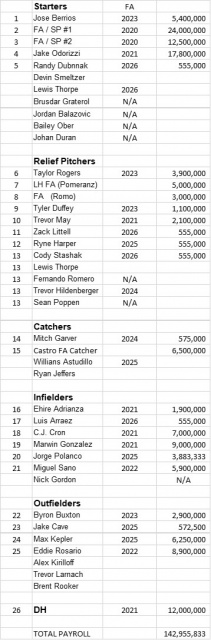
We have seen several teams rebuild because they built the team in a financially unsustainable manner. The spreadsheet below has a projected payroll for 2020 but it also has the year the player hits free agency. This helps take a long-term look at the roster and also provides a view of potential sources of funds. Cruz comes off after 2020 as does Cron if we assume they keep him. The plan I have has a $143M payroll. The departure of Cruz and Cron provides $20M to cover arbitration / other increases. Gonzales comes off after 2021 providing another $9M. Rosario is another possible source if needed or if an advantageous scenario presents itself. Bottom line is that we will have the financial resource to cover increases in 2021 /2022 and keep this team together. Cruz / Cron / Gonzales represent just shy of $40M AAV. This is part of why I would keep Cruz. By next year we should be able to replace him with a prospect. Replacing Cruz will be a tall order but we have some good bats waiting in the wings.
-
It just does not generally work that way with the top guys, especially with so many teams (high revenue teams) looking for SPs. It does not matter what you offer, their agent is going to see if they can get more or get the same amount from a team they prefer.
- 53 replies
-
- 1
-

-
- minnesota twins
- anthony rendon
- (and 3 more)
-
I am thinking it makes them bold going after Wheeler / Bumgarner because it reduces risk. It does make signing both more financially viable. Obviously, it does not make it any easier to attract two top FA starting pitchers when so many team are pursuing SPs but I think it makes them a little bolder.
- 53 replies
-
- 1
-
-
- minnesota twins
- anthony rendon
- (and 3 more)
-
Sorry, I missed that part. Just heard on MLB radio Odorizzi is strongly considering taking the QO so we might have a SP on a 1 year deal by the end of the day.
- 53 replies
-
- 2
-
-
- minnesota twins
- anthony rendon
- (and 3 more)
-
As you have noted since the season ended, the Twins have 4 spots to fill in the rotation and there are numerous teams looking for starting pitching. Many of them with more revenue than the Twins. The difficulty of filling all those spots in a single year has been pointed out by several people here. Adding a solid SP on a 1 year deal has no down side. Put together the best possible team for 2020 and address one spot (hopefully) in the rotation next year.
- 53 replies
-
- 2
-
-
- minnesota twins
- anthony rendon
- (and 3 more)
-
Perhaps I failed to convey it but I was trying to make the exact point you just made.
-
Trading Gray would signify the Rockies are going to rebuild. Why would they trade Grey who has 2 years of control for any position player with 2 years control? Rosario has very little value to a rebuilding team. I would love to see an answer from any of the people who are suggesting similar trades. Teams have adjusted their approach to Rosario. His value is very modest unless he proves he can apply a reasonable degree of plate discipline. Why sell low. Give him a chance to prove he can adjust. I don’t believe he does not know where the ball is going. He gets the bat on balls that are 16 inches off the plate, balls in his eyes and balls in the dirt. The question is why the hell is he swinging at the balls? Eddie would be one of the best hitters in the league if he did what Sano did last year in terms of improved plate discipline. If I were signing an outfielder it would be a RH to platoon w/Cave. Perhaps Garcia. I really like Pomeranz to bolster the BP but it’s going to cost more than 3.5M. Chirinos is fine but why not just resign Castro? There are several high revenue teams shopping for SP. Wheeler is going to cost more than 4/72. My guess is that it takes a 5 year deal to land him. If not it will be something like $4/84 or an Arietta type deal for $3/75.
- 53 replies
-
- 3
-
-
- minnesota twins
- anthony rendon
- (and 3 more)
-
If the Twins really had no better use for their considerable payroll headroom in 2020, instead of Price they could offer to take on shorter-term dead money from the Red Sox, such as Pedroia's remaining contract (I'm unsure what Rusney Castillo's remaining obligations are). But I think there are better uses, so I don't really see how to make an attractive offer. Pedroia has $25M / Castillo $14M
-
Was thinking the exact same thing.
-
I agree their BP was effective but I would not judge their BP investment by what happened in this particular series. A couple things come to mind …. If the point is that investing in RPs is inefficient way to spend in free agency, the fact that the Yankees lead in this category does not mean it’s a good practice. Also, I would not look at a given example (the Yankees) when judging an investment or a practice. They represent a small sample. I would suggest looking at all relievers or all playoff teams to judge player acquisition models. This is a far more reliable practice. Any measure including all RPs of this profile will show them to be a poor investment. Two, the Yankees have literally double the revenue of the Twins. They could pay out 15M each for 6 RPs and still have the Twins budget to spend on 20 players instead of 26. The Twins will almost certainly fail if they follow the same practices as the Yankees. It is a mathematical certainty the Twins have to produce more with less payroll $. For example, The Yankees top RPs acquired by free agency were Chapman / Ottovitto / Britton for a total $39M AAV and they produced 4.2 fWAR. The Twins got 4.3 fWAR from Cruz for $12M. Spend the other $27M on Bumgarner and Pineda. I would allocate roughly $50M to starting pitching if I can attract the players. The other $15-20M between a b/u catcher, 1B, and a LH RP.
-
I like 1-5 and 8. #6) No way am I trading Balazovic for Igelasis. It is incredibly difficult for a mid-market team to acquire an ace via free agency or trade so trading one of the two prospects with a legit shot at being ace is a very bad plan unless it’s for an ace with multiple years of control. RPs are inconsistent and very few sustain success. No thanks. Balazovic is not going anywhere unless the FO sees something that gives them doubt. Rosario is becoming Duensing. He has very modest value and any team interested in him is not going to be a team that will give up starting pitching. That whole scenario has no merit. #7) RPs are the worst investment in MLB. The Twins have $ available for free agents because we don’t have any bad contracts. Take a look at recent history and spending $12M AAV on a RP is not the path that should be taken by a mid-market team. Has there been a mid-market team that has spent $10M+ AAV on a RP ever? Has to be some but it’s rare. You have to believe the AAV for RPs and cost in prospects is going to come down given the failure rate in recent years. Invest FA $ elsewhere until it does.
-
I agree completely except for the part we should move Eddie for a SP. It is very rare ( I can't think of a single example ) where a position player with 2 years of control is moved for good starting pitching. Any team wanting Rosario would be because they the have a hole to close in order to contend. Trading away a good starting pitcher does not fit in that scenario. He will be moved to make room for Larnach or Kirilloff when one of them proves to be ready. He could also be moved if the payroll can be allocated better elsewhere.
-
The players that will increasing significantly over current levels over the next three years are Buxton / Sano / Rosario / Berrios / Rogers and eventually Garver. $12M for Cruz drops off after 2020. Cron also drops off assuming they keep him this year. $9M for Gonzales comes off in 2021. They will replace Rosario with either Larnach or Kiriloff at some point of the next 2 years so Rosario’s current salary and eventual increase is not an issue. It will actually be a source of payroll $. Cruz / Gonzales / Rosario & Cron coming off will provide payroll capacity of a little over $30M AAV from current levels. That should fund all the arbitration increases. Of course, they need to replace them with prospects. What they really need is for a couple guys to emerge and provide low cost. That makes spending on FA pitching now feasible without creating the same issue other teams have faced recently with running out of payroll capacity. This is why prospects are so crucial, especially to teams with modest revenue.
-
I would not be too down on the the Dodgers They have averaged 96 wins over the past 7 seasons and never less than 92. They went through a period times as did the Yankees where they tried to win with FAs and trades for high profile players. They were mediocre during that period. They changed their practices emphasizing prospects and development. This year’s team had 6 position players with a WAR above 2. Five were either drafted or traded for as prospects. The other (Turner) signed a minor league contract. They had 4 pitchers with a WAR above 2. They drafted Kershaw and Buehler. Of course, they resigned Kershaw. Meada was an international signing for $25M over 8 years. Ryu was a one year 17.9M contract. No big free agents and no trades for established players. Interesting they put so much emphasis on prospects when they could outspend the Twins by $100M
-
Rosario was one of the best players in the league the first half of 2018. Then, opposing pitchers started pitching him carefully. They threw him less and less to hit and he just kept swinging. Since 7/1-18, Rosario has had 851 PA and has generated 1.2 WAR. Cave has had 501 Pas and generated 2.3 WAR. Rosario OPS over that period is 752. During this period, 14 different Twins produced a higher OPS using a 275 PA minimum. Cave’s OPS was 804. I still don’t believe Cave is an equivalent player but I am not sure how to justify that position when I look at the hard facts. I guess that’s because Rosario can be so great but he is also providing to be unreliable over an extended period. They should trade him whenever a good return is made available and I seriously doubt the return in ML ready pitching.
-
Verlander is a unicorn. It is very rare that a SP maintains this level of performance at age 36. We all know the normal decline and when it starts so to ignore because one or two guys defy the odds is not a good decision making practice.
-
I failed to quote the post I was responding to that suggested we could acquire a player still under their 1st contract (cheap) with 3 years of control. This is why I said "as described above". The point being large contracts on 34+ y/o SPs. I would prefer to sign 30 y/o free agents.
-
If you look at the rosters of all the playoff teams, you will not find a single SP acquired in a trade as described above. Their are only two SPs of any significance (Cole / Paxton) acquired via trade and they were both for 2 years. IDK if teams just refuse to trade impact SPs with 3 years of control of if the price teams are asking is just so crazy other teams won't do it. I am hoping for 3 of Wheeler / Bumgarner / Odorizzi / Minor / Pineada, in that order. Wheeler over Bumgarner just because he has the best pure stuff. Could Wes Johnson bring out the best of him?
-
I fully believe they are willing to spend $140-150M. However, it’s not a simple as they get the player if they offer the most. Players use other teams to drive the price up. Ultimately, they take the best offer(s) to the team they want to go to and say match it. These teams are not so naive as to agree to match without a commitment that they will accept their offer. I have heard former GMs discuss this on the radio and I had a former GM (NBA GM) tell me the same thing on the golf course. I believe they can resign Odo and Pineada. They need to convince just one of the top guys to come here. Two would be great. I liked the idea of front loading a deal with Wheeler or Bumgarner. I really don’t like the opt out but would go there if it was the difference in getting one of these guys.
-
The only place we differ here is that I don’t think a trade headlined by our 6 or 7th best prospect brings back an impact player. The only thing we are missing is impact pitching. We don’t need any position players and SP has historically been crazy expensive in terms of prospects. You know teams were asking for the moon last deadline based on the pitching that did not get traded. This is not to say we can’t improve the team trading #6-30 but I just don’t see any such trade being a difference maker unless we take on a hefty contract but who would that be? Someone brought up Mike Minor. I really like that idea because I am thinking he can be had without giving up the top 5. I would be curious to see what others think it would take to get him.
-
Rosario – Absolutely not. One of the prospects will be better than him by 2021. The dollars will be more productive spent elsewhere. Rodgers – I think he is great but I would not extend a RP, at least not yet. Buxton – Sure but I don’t know the two sides could agree at this point. Sano – A year ago I would have said absolutely not. He proved something showing up in better shape and getting back the plate discipline that made him very good early in his career. My problem would be that his body type just does not hold up. Berrios – Sure, if the amount is reasonable. He might have an exaggerated sense of his market value. I would do it now if the number is reasonable. This can always be revisited at a later date.
-
Looking back at several Forbes reports, the Twins operating expenses other than player salaries appears to be almost $100M. 170M + payroll taxes is 189.5M for a total in the high 280s. The Twins had 2018 revenue of 269M. https://www.statista.com/statistics/193645/revenue-of-major-league-baseball-teams-in-2010/ 2019 attendance increased by around 340,000 and I am sure they did better on products. Just a guess but revenue should be up by 10-12M. Lets call it $280M. Other teams are averaging over 10% to the bottom line but let's assume they are willing to accept 10%. That would leave max payroll around $152 assuming my makeshift estimate of operating expense is fairly accurate. That would allow for a little over $70M in additional spending even if they keep Cron and Rosario. We are in the best position we have been in a long time given some of the biggest spending teams are cutting back or unwilling to go over the luxury tax. Cole is still a long shot but we should be able to attract and afford some very good talent.
- 31 replies
-
- 1
-
-
- minnesota twins
- madison bumgarner
- (and 3 more)
