



Boone
-
Posts
155 -
Joined
-
Last visited
Boone's Achievements






-
 Oldgoat_MN reacted to a comment on a blog entry:
Solidifying The Twins Up The Middle
-
beckmt reacted to a comment on a blog entry:
Solidifying The Twins Up The Middle
-
Solidifying The Twins Up The Middle
Boone commented on Ted Schwerzler 's blog entry in Off The Baggy
The decision between Polanco and Dozier is an easy one, at least for me. The core of the Twins future--Sano, Buxton, Berrios--are all 22 (and Kepler is 23). If we assume that the prime years of this core (ages 25-30) will be the best years for the Twins, then the Twins should be focusing 3-8 years down the road. Now, onto Polanco and Dozier. Polanco is also 22, whereas Dozier is 29. 3 years from now, Polanco will be 25, entering his prime. Dozier will be 32, certainly post-prime. 8 years from now, Polanco will be 30, at the end of his prime. Dozier will be 37, probably out of the league. Quite simply, Polanco's career timeline lines up much better than Dozier's. There's no guarantee that Polanco's career peak will be quite as good as Dozier's, but he is 22, hitting well in AAA, and has hit well at every level of the minors. So we should expect him to be a productive major leaguer. And if he does, he will be much better than Dozier during the prime years of Minnesota's core. Add in the fact that Dozier probably has more trade value today and Polanco is near MLB-ready and it seems like a no-brainer. Trade Dozier. Insert Polanco as second baseman of the future. -
Monkeypaws reacted to a post in a topic:
2016 Twins Roster Projections: The Catchers
-
Finding 2016's Twins Breakout Prospect
Boone replied to Cody Christie's topic in Twins Daily Front Page News
First of all, I have a hard time considering a guy like Gordon (who was a top draft pick and impressed in his rookie year) a breakout prospect. Same goes for someone like Gonsalves or Walker--it's easy to argue that they've already had their "breakout" year. Someone like Kohl Stewart, on the other hand, could be considered a breakout candidate because he has struggled to date as a professional. I have a couple guys in mind. For older players, Travis Harrison and Levi Michael. I expected Harrison to breakout last year after a strong end to the 2014 season. While he struggled in 2015, his plate discipline improved markedly in the 2nd half (he walked more, struck out less, and saw his BB:K ratio increase from .50 to .87). I'm hoping that he builds off that success and the raw power he displayed in high school finally appears. Levi Michael has fallen off most people's lists due to early struggles and an inability to stay healthy. However, the last few years he's played quite well, albeit in small sample sizes: he posted a 124 wRC+ in A+ in 2014 and a 131 wRC+ in AA in 2015. Plus, he's quietly become a pretty good basestealer: 55 steals in 339 games at an 83% success rate in his career (that's 26 SB per 162 games). If he can stay healthy this season, his performance in AA and AAA could merit an Opening Day gig in 2017 (although he would most likely be blocked by Polanco and Dozier). For younger players, I have my eyes on Lachlan Wells and Engelb Vielma. Wells was pretty dominant in the GCL in 2015 (9.3 K/9, 2.1 BB/9, and 2.09 ERA). 2016 might be a bit premature for his breakout year, as he might not taste full season ball. But I expect him to put up great numbers again and make most top prospect lists following the season. I've written about Vielma before: he showed great improvements in the 2nd half of 2015 and has become an excellent basestealer. If he can carry that success over to 2016 and be a league average hitter in AA as a 22 year old, he should be a top 10 organizational prospect. -
2016 Twins Roster Projections: The Catchers
Boone replied to Seth Stohs's topic in Twins Daily Front Page News
I'm pretty high on Turner. He's always displayed good plate discipline and made significant improvements in the 2nd half of 2015 (BB:K ratio increased from .55 to .77 and his OPS increased from .550 to .704, compared to the 1st half). My hope for him is to be in AAA within a few months and to be challenging for the starting position by mid-season 2017.- 16 replies
-
- 1
-
-
- kurt suzuki
- john ryan murphy
- (and 3 more)
-
The State Of The Lefty Reliever Market
Boone replied to Nick Nelson's topic in Twins Daily Front Page News
Couldn't agree more. O'Rourke wasn't great last year, but he struck out 39% of the lefties he faced. Combine that with the fact that he's only 28, cheap, and has been utterly dominant in the upper levels of the minors and I think he deserves a shot as a LOOGY. Same goes for Rogers, who struck out 28% of lefties he faced last year with an 11:1 K:BB ratio. Yes, if we sign a LHP as a free agent it will be someone with a proven track record. Furthermore, they might be better against righties than either O'Rourke or Rogers. But O'Rourke and Rogers offer plenty of upside, both for this year and in the future, at a fraction of the cost. -
Seth's Preliminary Top 50 Twins Prospects: Part 4 (21-25)
Boone replied to Seth Stohs's topic in Twins Daily Front Page News
This is definitely a little worrisome. That being said, he walked in 15.6% of PA's in 2014 and 8.5% of PA's in the GCL in 2015, so he has displayed that he can be a patient hitter. It would be nice for him to reestablish that patience before advancing to A-ball. He's so young at this point that holding him back for a few months is acceptable. -
diehardtwinsfan reacted to a post in a topic:
Seth's Preliminary Top 50 Twins Prospects: Part 3 (26-30)
-
gunnarthor reacted to a post in a topic:
Seth's Preliminary Top 50 Twins Prospects: Part 3 (26-30)
-
Seth's Preliminary Top 50 Twins Prospects: Part 3 (26-30)
Boone replied to Seth Stohs's topic in Twins Daily Front Page News
I would think Harrison should be a little higher: he has posted a wRC+ noticeably above average in each of his 3 full-season leagues: 124 in A (2013), 112 in A+ (2014), and 111 in AA (2015). I will admit that he has some definite question marks: I doubt he'll ever be more than an average defensive LF and the raw power he was known for when drafted has yet to manifest itself in game action. However, in my opinion a guy who will be 23 all next season who has already posted above average offensive seasons at A, A+, and AA should be higher than 28, even in Minnesota's stacked system.- 18 replies
-
- 2
-
-
- aaron slegers
- yorman landa
- (and 3 more)
-
Baseball America's Top 20 GCL Prospects
Boone replied to Seth Stohs's topic in Twins Minor League Talk
I would have liked to have seen Lachlan Wells make this list. Of the 85 pitchers who threw over 30 innings, Wells had the 7th highest strikeout rate (26.5%) and his of 4.45 was the 13th best (FYI his BB rate was 6.0%). Plus, at 18, he's super young (13th youngest of those 85 with at least 30 IP). Yes, I know he's only 5 foot 8 (although he might not be done growing). But between his numbers and youth, he seems to have a bright future, even if it's out of the bullpen. -
SF Twins Fan reacted to a post in a topic:
What to do with Kepler?
-
d-mac reacted to a post in a topic:
What to do with Kepler?
-
To some extent, you are accurate. However, I would like to point out that Vielma's plate discipline has improved significantly. When you strike out less and walk more, your average and OBP will increase (all else being equal). So an increased BABIP is only part of the story here. Secondly, to your point about his ISO being "stagnant". While the .006 increase from the 1st split to the 3rd appears small, it’s actually fairly sizeable when considered as a percentage (16% to be exact). That's the same as someone with an ISO of .100 increasing to .116, or an ISO of .200 increasing to .232—certainly enough to make you wonder if harder contact is being made. We should do the same with Vielma. Regardless, at this point I think it's safe to say that his .794 OPS the last 2.5 months as well as his .568 OPS during the first 3 are probably inaccurate representations of his ability. What we have seen is that Vielma is capable of making adjustments in the middle of a season, an important ability. So even if his true self is the .650 OPS he posted in the middle split (which is also his year-long number), that is just about average for a FSL shortstop (based on wRC+). Combined this with his youth, defense, baserunning/bastealing, and the aforementioned ability to make midseason adjustments, I think this makes Vielma a legitimate prospect.
-
nicksaviking reacted to a post in a topic:
Engelb Vielma Is Making Noise
-
Halsey Hall reacted to a post in a topic:
What to do with Kepler?
-
brvama reacted to a post in a topic:
What to do with Kepler?
-
About a month ago I made a post arguing that it was time for the Twins to promote Kepler to AAA (http://twinsdaily.com/topic/19339-time-to-promote-kepler/). Clearly this hasn't happened. I don't have Kepler's numbers since that date (too much work), but he's been brilliant in August: .333/.424/.630 (1054 OPS) with 9BB:10K in 54 AB's; his plate discipline has remained stellar, he's hitting for more power than any other month (.297 ISO is the highest of the season). In 14 games, he has 6 2B, 2 3B, 2 HR, and 3 SB, which amounts to these stats over 154 games: 66 2B, 22 3B, 22 HR, and 33 SB. Basically, he's been stupid good in August. At this point, however, the Twins have probably missed the boat promoting Kepler to AAA. He would only be there for only 3 weeks, so expect him to stay in AA and try to bring a Southern League championship to Chattanooga. But the real question is: what do the Twins do with Max Kepler next season? The outfield is deep, with Buxton, Rosario, and Hicks all deserving of being everyday starters. Kepler has experience playing 1B, but that is a waste of his athleticism and is currently occupied by our $184 million man, Joe Mauer. As a result, Kepler will most likely begin the season in AAA, but that is only a short-term solution to a long-term problem (or if we're looking at the glass half-full, this long-term opportunity). The handling of Max Kepler will be one of a number of difficult personnel choices the Twins must make this offseason, and is one I will be watching closely.
-
It’s time people start paying attention to Engelb Vielma. Having turned 21 a month ago, Vielma has been the starting shortstop for the Miracle this season. Always known as a top flight defensive prospect, the diminutive Vielma has done little to discourage that perception in his first two seasons of professional ball. Image courtesy of Linwood Ferguson It’s time people start paying attention to Engelb Vielma. Having turned 21 a month ago, Vielma has been the starting shortstop for the Miracle this season. Always known as a top flight defensive prospect, the diminutive Vielma has done little to discourage that perception in his first two seasons of professional ball. in the Midwest League in 2014, Vielma posted a .636 OPS (a wRC+ of 84) and so far in 2015 his OPS sits at .648 (wRC+ of 99). Certainly, this represents a modest improvement, but it is nothing to get excited about. However, taking a closer look at Vielma’s monthly splits, it becomes clear that he has made some significant in-season improvements as a hitter. The first thing that sticks out is how dreadful Vielma was in April and May—combined his OPS was .463—and how solid he has been since, posting an OPS of over .770 for three straight months. But overall, looking at five straight months of data like this has some flaws: for one, the sample sizes are relatively small; and two, it’s a little more difficult to pick up on trends' patterns. My solution to this is to create three, 3-month splits (April-June, May-July, June-August), similar to rolling periods used in the financial industry. Let’s take a look: As you can see here, Vielma has made some pretty tremendous strides. This is especially true when looking at his plate discipline: his BB% has increased over each of these splits and his K% has fallen, leading to a consistent improvement in his BB/K ratio. Furthermore, while Vielma only improved modestly in these three categories from the 1sfirst split to the second, he has seen a dramatic improvement from the second split to the third split. And while Vielma’s isolated power has improved less consistently, his OPS has also improved by leaps and bounds. Overall, Vielma’s numbers have improved—albeit rather modestly—from a year ago. Once again, he is walking more (6.1% to 6.3%) and striking out less (15.5% to 14.6%), which has certainly contributed to the modest increase in OPS (.636 to .649). And while this increase is small (and his power has decreased), it has been done in the context of a much difficult environment for hitters. Clearly, Vielma has made terrific in-season improvements as a hitter. Combined with his modest overall improvement from a year ago, this suggests that he should be ready to begin 2016 in AA, despite rather mediocre season-long numbers. Another important development for Vielma has been his base-stealing. As a player who has very limited power—and has shown no signs of developing any more—being able to create extra runs on the base paths will be necessary for Vielma to establish himself as a valuable offensive player. While I don’t have any statistics regarding Vielma’s ability to take an extra base after a hit, he has shown dramatic improvements as a base-stealer this year. In 2014, Vielma stole 10 bases on 16 attempts in 112 games. So far in 103 games this year, he has stolen 29 bases in 39 attempts. Not only has he stolen nearly 3 times as many bases as last season, Vielma has also greatly improved his success rate from a dreadful 62.5% (well below the 2014 Midwest League average of 68%) to a respectable 74% (well above the 2015 Florida State League average of 67%). With Nick Gordon on his heels and Jorge Polanco ahead of him (not to mention Brian Dozier), Engelb Vielma will have a hard time becoming a starter for the Twins. But as a player who is stellar defensively, emerging as a base-stealer, and improving as a hitter, he has firmly established himself as a legitimate prospect worth watching. View full article
-
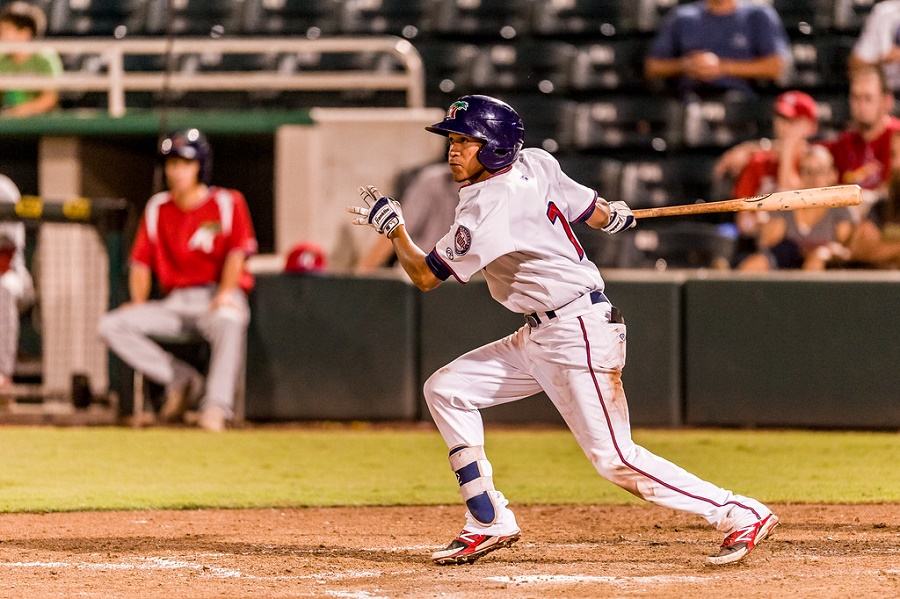 in the Midwest League in 2014, Vielma posted a .636 OPS (a wRC+ of 84) and so far in 2015 his OPS sits at .648 (wRC+ of 99). Certainly, this represents a modest improvement, but it is nothing to get excited about. However, taking a closer look at Vielma’s monthly splits, it becomes clear that he has made some significant in-season improvements as a hitter. The first thing that sticks out is how dreadful Vielma was in April and May—combined his OPS was .463—and how solid he has been since, posting an OPS of over .770 for three straight months. But overall, looking at five straight months of data like this has some flaws: for one, the sample sizes are relatively small; and two, it’s a little more difficult to pick up on trends' patterns. My solution to this is to create three, 3-month splits (April-June, May-July, June-August), similar to rolling periods used in the financial industry. Let’s take a look: As you can see here, Vielma has made some pretty tremendous strides. This is especially true when looking at his plate discipline: his BB% has increased over each of these splits and his K% has fallen, leading to a consistent improvement in his BB/K ratio. Furthermore, while Vielma only improved modestly in these three categories from the 1sfirst split to the second, he has seen a dramatic improvement from the second split to the third split. And while Vielma’s isolated power has improved less consistently, his OPS has also improved by leaps and bounds. Overall, Vielma’s numbers have improved—albeit rather modestly—from a year ago. Once again, he is walking more (6.1% to 6.3%) and striking out less (15.5% to 14.6%), which has certainly contributed to the modest increase in OPS (.636 to .649). And while this increase is small (and his power has decreased), it has been done in the context of a much difficult environment for hitters. Clearly, Vielma has made terrific in-season improvements as a hitter. Combined with his modest overall improvement from a year ago, this suggests that he should be ready to begin 2016 in AA, despite rather mediocre season-long numbers. Another important development for Vielma has been his base-stealing. As a player who has very limited power—and has shown no signs of developing any more—being able to create extra runs on the base paths will be necessary for Vielma to establish himself as a valuable offensive player. While I don’t have any statistics regarding Vielma’s ability to take an extra base after a hit, he has shown dramatic improvements as a base-stealer this year. In 2014, Vielma stole 10 bases on 16 attempts in 112 games. So far in 103 games this year, he has stolen 29 bases in 39 attempts. Not only has he stolen nearly 3 times as many bases as last season, Vielma has also greatly improved his success rate from a dreadful 62.5% (well below the 2014 Midwest League average of 68%) to a respectable 74% (well above the 2015 Florida State League average of 67%). With Nick Gordon on his heels and Jorge Polanco ahead of him (not to mention Brian Dozier), Engelb Vielma will have a hard time becoming a starter for the Twins. But as a player who is stellar defensively, emerging as a base-stealer, and improving as a hitter, he has firmly established himself as a legitimate prospect worth watching.
-
It’s time people start paying attention to Engelb Vielma. Vielma, who turned 21 a month ago, has been the starting shortstop for the Miracle this season. Always known as a top flight defensive prospect, the diminutive Vielma has done little to discourage that perception in his first 2 seasons of professional ball: in the Midwest League in 2014, Vielma posted a .636 OPS (a wRC+ of 84) and so far in 2015 his OPS sits at .648 (wRC+ of 99). Certainly, this represents a modest improvement, but it is nothing to get excited about. However, taking a closer look at Vielma’s monthly splits, it becomes clear that he has made some significant in-season improvements as a hitter. The first thing that sticks out is how dreadful Vielma was in April and May—combined his OPS was .463—and how solid he has been since, posting an OPS of over .770 for 3 straight months. But overall, looking at 5 straight months of data like this has some flaws: for one, the sample sizes are relatively small; and two, it’s a little more difficult to pick up on trends patterns. My solution to this is to create 3, 3-month splits (April-June, May-July, June-August), similar to rolling periods used in the financial industry. Let’s take a look: As you can see here, Vielma has made some pretty tremendous strides. This is especially true when looking at his plate discipline: his BB% has increased over each of these splits and his K% has fallen, leading to a consistent improvement in his BB/K ratio. Furthermore, while Vielma only improved modestly in these 3 categories from the 1st split to the 2nd split, he has seen a dramatic improvement from the 2nd split to the 3rd split. And while Vielma’s isolated power has improved less consistently, his OPS has also improved by leaps and bounds. Overall, Vielma’s numbers have improved—albeit rather modestly—from a year ago. Once again, he is walking more (6.1% to 6.3%) and striking out less (15.5% to 14.6%), which has certainly contributed to the modest increase in OPS (.636 to .649). And while this increase is small (and his power has decreased), it has been done in the context of a much difficult environment for hitters. Clearly, Vielma has made terrific in-season improvements as a hitter. Combined with his modest overall improvement from a year ago, this suggests that he should be ready to begin 2016 in AA, despite rather mediocre season-long number. Another important development for Vielma has been his basestealing. As a player who has very limited power—and has shown no signs of developing any more—being able to create extra runs on the basepaths will be necessary for Vielma to establish himself as a valuable offensive player. While I don’t have any statistics regarding Vielma’s ability to take an extra base after a hit, he has shown dramatic improvements as a basestealer this year. In 2014, Vielma stole 10 bases on 16 attempts in 112 games. So far in 103 games this year, he has stolen 29 bases in 39 attempts. Not only has he stolen nearly 3 times as many bases as last season, Vielma has also greatly improved his success rate from a dreadful 62.5% (well below the 2014 Midwest League average of 68%) to a respectable 74% (well above the 2015 Florida State League average of 67%). With Nick Gordon on his heels and Jorge Polanco ahead of him (not to mention Brian Dozier), Engelb Vielma will have a hard time becoming a starter for the Twins. But as a player who is stellar defensively, emerging as a basestealer, and improving as a hitter, he has firmly established himself as a legitimate prospect worth watching.
-
Palacios displayed a lot of potential last season in the DSL: 15.6% BB, 16.1% K (.95 BB/K), .802 OPS, and 14/17 on stolen bases in 49 games. This makes me think his performance this year is no fluke. His plate discipline translated to the GCL this year--8.5% BB, 10.4% K (.82 BB/K)--and he has displayed much improved power: after 17 XBH last season in 49 games, he has already posted 17 XBH this year in just 34 games. Palacios and Blankenhorn should be two worth watching the rest of the way in Elizabethton.
-
Max Kepler is ready for AAA. He is currently dominating AA pitching, to the tune of a .332/.413/.517 triple-slash line. How good is that? If he had enough AB's to qualify, his OPS (.930 OPS) would be the only in the Eastern League north of .900. Despite an unsustainably high BABIP (.381), Kepler's spectacular plate-discipline suggest that he should be able to maintain this run of success: he has drawn a walk in 11.9% of plate appearances and struck out in just 13.2%, good for a BB/K ratio of .90. In fact, since 6/1, Kepler's BB/K ratio is an even 1.0 All of this screams that Kepler is ready for AAA pitching. Some might argue by claiming that, with just 73 games at AA, he simply needs more experience. However, don't forget that Kepler has now spent 2 offseasons in the Arizona Fall League, logging a combined 36 games. Nor did Kepler dominate in the Florida State League a season ago. While that is true, he did display good plate discipline (8.4% BB: 15.2% K) and his lack of power and low BABIP could be attributed--at least partially--to nagging injuries. A month in AAA now could help put Kepler on track for an early-mid season call-up next year. I've always felt that Kepler has been underrated: the great plate discipline he has shown throughout his career, especially considering his lack of baseball experience relative to his appears, has made me extremely confident in his hit tool. Regardless of whether or not Kepler spends the rest of the season in AA, he should shoot up prospect rankings this offseason. He has appeared on Fangraph.com's weekly "Fringe 5" prospect articles 4 times since mid-June. Take a look: http://www.fangraphs.com/statss.aspx?playerid=sa549507&position=OF.
-
The Twins Most Overlooked Cornerstone
Boone replied to Ted Schwerzler 's topic in Twins Daily Front Page News
Trevor Plouffe has certainly become one of the better--and most underrated--3rd basemen in the league. Great to see that the Twins' patience paid off. However, despite Plouffe's current importance, I have to wonder how he fits into our long-term plans: hopefully Sano will be ready to take over at 3rd base next season, with Arcia or Vargas replacing him at DH. If the above scenario plays out, then Plouffe would have to move to outfield--where the Twins have tons of young talent--or to 1st base, where we have an unmovable asset in Joe Mauer. While Plouffe has been a great Twin for several years, the youth movement could make him expendable as early as this offseason. Therefore, we must ask ourselves this question: should we shop Trevor Plouffe before the deadline? Trading him for longterm assets would certainly rankle many fans--including maybe myself--but could be the smart decision. Or the Twins could work themselves in on a 3 team trade, receiving a shortstop or catcher in return.
