



Parker Hageman
-
Posts
4,152 -
Joined
-
Last visited
-
Days Won
6
Content Type
Profiles
News
Minnesota Twins Videos
2026 Minnesota Twins Top Prospects Ranking
2022 Minnesota Twins Draft Picks
Minnesota Twins Free Agent & Trade Rumors, Notes, & Tidbits
Guides & Resources
2023 Minnesota Twins Draft Picks
The Minnesota Twins Players Project
2024 Minnesota Twins Draft Picks
2025 Minnesota Twins Draft Pick Tracker
2026 Minnesota Twins Draft Tracker: Picks & Bonuses
Forums
Blogs
Events
Store
Downloads
Gallery
Everything posted by Parker Hageman
-
 Download attachment: KG.jpg The Minnesota Twins front office should feel somewhat vindicated by all of the recent draft picks, international signings and savvy trades which have brought the organization closer to sustainable relevancy – at least by MLB.com’s standards. On Tuesday night, MLB.com revealed their Top 100 prospects and six Twins prospects graced the list. Joining front-running Miguel Sano (12th), Minnesota sent 2012 draftee Byron Buxton (19th), recently acquired Alex Meyer (40th), Kyle Gibson (49th), Oswaldo Arcia (93rd) and Aaron Hicks (98th), into the top 100. Only Boston, Miami, St Louis and Texas equaled that total. The Twins added two additional prospects to that list over the prior year – mainly due to the return of Gibson from Tommy John surgery, the acquisition of Meyer, and the rebound of Arcia, who was added after he missed a substantial part of 2011. Both Sano and Buxton moved up in the rankings while Hicks dropped from 59th to 98th Eddie Rosario, who was ranked 80th in 2012 but was injured for a portion of 2012, was bumped off completely. Overall, based on the prospect points rankings (i.e. 100 equals 1 point, 99 equals 2 points, etc) the Twins’ scored 295, good for fourth behind Seattle, St. Louis and Tampa – three very good organizations when it comes to developing in-house talent. Earlier this month, Baseball America’s Jim Callis released their preliminary top ten list for farm systems in baseball. According to Callis, the Twins ranked seventh. Ahead of them included the Cardinals, Mariners, Marlins, Rangers, Red Sox and Rays. Once again, they ranked among the game’s best and – with the exception of the Mariners and Marlins – regular contenders. This was a sizable jump in BA’s standings considering that Baseball America viewed 19 other organizations to be better than the Twins a year ago. The climb was similar at prospect guru John Sickels’s site MinorLeagueBall.com. Last year, he placed them at 17th overall but moved them up to seventh as well this year. Of course, it should be noted how quickly teams can swing from top to bottom of Baseball America’s list. For instance, in 2010, the Cardinals were ranked as 29th, after being rated eighth the previous year. Two years later, they are the number one team. Likewise Cleveland who was in the seventh spot in 2011 dropped to 29th heading into last year. Several trades or solid draft picks can do wonders for an organization. Outside of the aforementioned big-ticket guys on the list, players like Rosario, newly acquired pitcher Trevor May and outfielder Max Kepler are drawing plenty of attention. Arms like J.O. Barrios and Luke Bard are also leaving strong impressions and could contribute quickly in Minnesota. Team president Dave St. Peter’s remarks on the recent Gleeman and the Geek podcast over the TwinsFest weekend revealed the team’s intentions. “We’re trying to do this right,” St. Peter said in regards to the team’s strategy. “We’re trying to do it the only way we know how to do it, which is to build this thing through our farm system and for the long term.” While many fans may be disheartened by the moves (or lack of moves) made at the major league level, building a solid foundation is imperative for the long-term success of any team. Having a strong minor league system does not necessarily mean waiting until 2021 and Hover Board Giveaway Day at the ballpark to be competitive either. Having a strong system also gives teams the luxury of trading for parts to help immediately. This offseason the Toronto Blue Jays, who were rated fourth in 2012, unleashed a flurry of prospects to land starters Josh Johnson, Mark Buerhle and shortstop Jose Reyes. The Royals sent the number three overall prospects Wil Myers to Tampa for starter James Shields (for better or worse). If the 2014 roster – with an aging core of Mauer and Willingham – appear poised to compete, the team could trade from the depth to provide immediate reinforcements if deemed appropriate. Even if the rest of the 2013 season doe not quite go as schedule, rest assured that the team is laying the right groundwork to build upon. Click here to view the article
 -
Download attachment: PC.jpg In yet another Geek-less installment of Gleeman and the Geek, joining Aaron Gleeman on this week’s GATG podcast is Twins Daily’s Parker Hageman -- who fills in for the globetrotting John Bonnes. Podcasting live from Panino Brothers in Eden Prairie, the pair discuss the Twins’ involvement in sabermetrics, projecting the Opening Day roster, why no one wants Kyle Lohse, Shaun Marcum and the best of the remaining free agent pitchers, saying something nice about Samuel Deduno, New Year’s resolutions, and making friends with drunk women (#VoteWashington). [PRBREAK][/PRBREAK]Check out the latest episode via any of these channels: the podcaststhe rss feed if you want to subscribe andthe podcast on iTunes. Click here to view the article
-
Download attachment: hammer.jpg For a significant portion of the year, Josh Willingham fueled the Twins offense and gave the fans something to watch while the team sank deeper in the standings. He proved that Target Field was not resistant to home team home runs. In fact, his 21 home runs at home easily trumped long-standing fan-favorite Michael Cuddyer’s 17 hit in his two years at Target Field (2010-2011). Jim Thome managed to swat 21 home runs as well but needed 14 more plate appearances than him to do so. [PRBREAK][/PRBREAK] Fan looking for a reason to believe in the 2013 team will be interested to know if Willingham will continue his vicious pace set last year. Unfortunately, indications suggest that his home run total is almost certain to decrease in 2013. And here’s why: Stats. [Drops mic; leaves the stage.] But stats kept hometown hero Jack Morris out of the Hall of Fame even though he single-handedly won the World Series for the Minnesota Twins and once saved a baby seal or something. So why should we believe stats? [Walks back on stage. Picks mic back up.] True and I totes agree that we should burn down all stats and calculators and stuff right after I finish this piece but, for now, hear me out. One measurement that suggests the Willinghammer will see a dingers decline in 2013 is because of his home run distributions -- as captured by HitTrackerOnline.com. For those unfamiliar, Hit Tracker charts all home runs hit and, through methods that go beyond my mathematical capabilities, calculates their “true landing spot.” Whereas ballpark present distances that are based mostly on the architecture of the existing facility and projecting where the ball would have landed had it not have been stopped by, say, the batter’s eye in center field, HitTrackerOnline.com factors in atmospheric data and speed off the bat to generate their data. This, in theory, should be a more accurate representation of a player’s true abilities to hit and sustain home runs. With their data, Hit Tracker has made three classifications for home runs. Those which clear the fence by 20 vertical feet and pass it by 50 feet are considered a “No Doubt” home run. Think Giancarlo Stanton’s 494-foot bomb off of new Twins pitcher Josh Roenicke. At the other end of the spectrum are home runs which exit the field by 10 vertical feet or land one fence height past the wall. These are labeled as “Just Enough” home runs. Just Enough home runs are wall-scrapers like Tampa’s B.J. Upton’s 323-foot home run off of Ervin Santana which nearly grazed the foul pole and the left field wall at Tropicana. Finally, everything else in between is considered “Plenty.” Based on their figures, a standard distribution of home runs have been 18% No Doubt, 55% Plenty and 27% Just Enough. If a player is well above the Just Enough 27% threshold, the prevailing assumption is that he had good fortune of having a few additional balls escape the playing surface thanks to weather, ballpark configurations or simply the blessings of the baseball gods. In Willingham’s case, he had a whopping 45% of his home runs fall under the “Just Enough/Lucky” category. What this means, if the Hit Tracker theory holds water, is that Willingham’s home run totals will start to slide back to his career norms – which had been 22 heading into last season. Furthering this idea that he is poised for home run decline is the fact that Willingham is coming off a career year in terms of home runs-to-fly ball ratio. In 2012, 21.2% of his fly balls left the yard - which was well above his career average of 15%. This will almost assuredly regress back to the mean as well. In terms of his home run totals, Willingham is almost a text book case for regression. That said, it does not mean he will drop drastically in value. As I stated prior to his signing, he is almost the ideal hitter for Target Field – a right-handed pull-hitter with power. More than that, Willingham stresses patience in his approach at the plate leading to a healthy walk rate and on-base percentage. Perhaps it went unnoticed because of his power numbers, but he chased after just 21.7% of out-of-zone pitches, the fifth lowest rate in baseball last year. That was lower than such plate discipline luminaries as Denard Span and Joe Mauer. That skill set should ensure that he continues to provide a great deal of value even if a few fly balls fall short on the warning track in 2013. Click here to view the article
-
Download attachment: grand-drunk-railroad.jpg With John Bonnes on vacation in San Francisco (and presumably trapped in an opium den), on this week's "Gleeman and The Geek" episode Parker Hageman of Twins Daily subs in and topics included the Twins finishing the first half by beating the Yankees, Ron Gardenhire on the hot seat, Oswaldo Arcia and Chris Parmelee being demoted back to Triple-A, the upcoming light rail pub crawl/Twins game, Glen Perkins' trade value, mailbag questions from listeners, and my chances of being the new Fox Sports North Girl. [PRBREAK][/PRBREAK] NOTE: For more on the light rail pub crawl/Twins game event on September 14, please see the event page at the Twins Daily Facebook page or purchase tickets here. Click here to view the article
-
Download attachment: Plouffe.jpg When Jack Hannahan signed with the Cincinnati Reds last week, this took yet another potential third base option off the board for the Minnesota Twins. Hannahan, a local product with above-average defensive prowess and a mediocre platoon bat from the left-side, appeared to be a given to land in Minnesota. With Terry Ryan’s statements that the team was going to push their incumbent, Trevor Plouffe, Hannahan’s left-handedness and superior defense felt like the logical fit. Perhaps less realistically, free agent Eric Chavez was also snapped up by a more competitive Diamondbacks team. The Twins also flirted a bit with the Cardinals and utility man Skip Schumaker but the Los Angeles Dodgers ultimately obtained the 32-year-old. Clearly the Twins have been putting forth effort in that market this offseason but will little progress. The focus shifted the past few weeks to acquiring starting pitching -- such as the recent signings of Kevin Correia and Mike Pelfrey -- and the third base position has moved to the back burner. How important is it that either the Twins find a suitable challenger to Plouffe’s position? Very, if you follow the data. Thanks to a collection of pitchers who allows for an exorbitant amount of contact, the Twins infielders were tested regularly this past season. In fact, their left side of the infield led the league in most balls hit into their respective zones in 2012. At third, Minnesota had 402 in-zone balls hit that direction -- the next closest was Boston at 385. Highest In-Zone Balls - Third Base 2012 [TABLE=width: 624] Team In-Zone Balls Twins 402 Red Sox 385 Royals 383 Giants 383 Rockies 370 [/TABLE] (via Fangraphs.com’s BIS data) Plouffe, who handled a shade over 800 innings in the field last year, was marginal at best according to defensive metrics. His own revised zone rated of .691 was 22nd overall among third basemen with a minimum of 500 innings in the field. This was a fairly average mark considering the top third baseman by this metric -- Jack Hannahan -- was at .791. But more that that, Plouffe’s ability to make plays outside a third baseman’s standard universe was also poor in comparison to others. In 804.2 defensive innings, Plouffe was able to convert just 14 balls out of the standard zone into outs. Over ten other third basemen with fewer innings were able to make more outs on balls out of that zone. Another area of the game in which Plouffe needed work is turning double plays. In 2012, the Twins led all of baseball with 158 double plays turned. Part of that is a byproduct of having a high-contact pitching staff with ground ball tendencies combined with opponents who start a hit parade. Furthermore, when you lead baseball with the most batted balls into third and shortstop zones, you can expect a high number of double plays. Here’s the thing: With all the opportunities, with all the plays in zone, with all the base-runners, Plouffe started just 12 double plays all year (24th in baseball). With a high-contact staff, it is almost imperative that double plays are turned to help get the defensive off the field. So, Plouffe was converting on just 69% of plays inside his zone whereas the game’s elite were making outs on nearly 80% of their opportunities. This may not seem like a significant difference however for every ball that is failed to be converted into an out, it allows the opposing team to extend their half of the inning. With a high percentage of contact-oriented pitchers, this spells trouble. With the addition of similar high-contact arms in Vance Worley, Kevin Correia and Mike Pelfrey, these figures are not likely to drop either, making that a fairly vital position for the team. With two months remaining until pitchers and catchers report, the Twins may begin to increase their shopping activity once again - specifically in the third base department. Click here to view the article
-
Download attachment: alexi-casilla-twins.jpg According to Phil Mackey, the Twins and Alexi Casilla have reached a one-year agreement worth $1.38 million. Because of injuries, Casilla played in only 97 games last year and hit .260/.322/.368 with 15 stolen bases while scoring 52 runs. In doses he has proven that he is capable of holding down a starting position and it appears that he will be the team's starting second baseman at the beginning of the year. Please comment on this story here. [PRBREAK][/PRBREAK] Click here to view the article
-
Article: Will Kurt Suzuki's Offense Continue?
Parker Hageman replied to Parker Hageman's topic in Twins Daily Front Page News
First off, thanks. In regards to staying closed a losing the ability to square the ball, I am perfectly fine with that for Suzuki. If he were a different type of hitter (an Arcia or someone with power potential) I would probably have more concern. However with Suzuki's high contact approach, I am OK with sacrificing the occasional extra base hit via a fly ball for additional base hits and the added OBP. He does fire open well when he is hunting for inside pitches too. -
At Twins Daily, the discussion regarding what to do with catcher Kurt Suzuki leading up to the trade deadline was a highly debated topic. On one hand, the Twins have a commodity that is having one of the best years of his career and his trade value might never be greater. For an organization trying to rebuild, capitalizing on this value would be beneficial by potentially bringing in new talent with the option of finding a new catcher in free agency again this winter if need be (though, admittedly, the trade market for Suzuki never seemed to materialize after the Cardinals and Orioles appeared uninterested in the backstop). On the other, you have a player who is well-respected on the team and provides a stable presence in a vital position. While not necessarily a defensive whiz some would like you to believe, pitchers like Phil Hughes, Glen Perkins and Kyle Gibson have all touted and benefited from his abilities. Leaving those elements aside, let us simply focus on the question of whether or not Suzuki can sustain his offensive output over the duration of his extension.As far as catchers go, Suzuki has been an on-base machine as of late. Dating back to August of last year, he has had the third-highest OBP among American League catchers. That figure is buoyed by the best batting average (.306). At the same time, his power numbers have been awful. His isolated slugging percentage (.085) is the second-lowest in all of baseball in that duration. Nevertheless, with a position that places an emphasis on defense, having a handler who can produce those on-base numbers at the expense of power is a net positive. But can it continue? When a player in the middle of his career suddenly has his best offensive season, there is an immediate tendency to consider it an anomaly. The belief is that because of this single-season spike, regression will often follow. For this reason, Suzuki’s 2014 numbers have rightfully been scrutinized. At 30 years old and in his eighth season in the majors, the Minnesota Twins’ catcher has significantly outperformed his numbers -- specifically the batting average and his on-base percentage. Is he suddenly hitting rockets around the field? Absolutely not. According to ESPN/trumedia Suzuki’s Hard Hit Average (an observation-based metric from Inside Edge’s video scouts that measures if a ball was well-struck or not) has been the lowest since his 2009 season. No one watching would be fooled into thinking he is hitting frozen ropes around the yard, but he’s hitting them where they ain’t. While he is in possession of his lowest Hard Hit Average of the past seven years, he has compiled his highest batting average on balls in play -- a gaudy .324 compared to his .274 career average. To summarize, Suzuki's current success if based on the fact that he is hitting pitches softer than ever and is yet somehow finding seams and vacant real estate. That’s not reassuring, is it? Small Changes In spite of these key indicators that would suggest massive regression in his future, Suzuki’s improvement goes beyond luck. At the beginning of the season when Suzuki came out of the gates on fire, I reviewed his video footage and noticed a small yet important change in his swing: He altered his front foot landing. Look at the comparison of the clips below. In the first clip from when he was with the Washington Nationals in 2013, Suzuki swung his leg open slightly and landed toward the pitcher. In the clip from this season, Suzuki’s stride and landing would keep him slightly toward first base. http://i.imgur.com/4jUFOUc.gif http://i.imgur.com/avvL4Bu.gif This has allowed for improved plate coverage for Suzuki. Already a disciplinarian when it comes to the strike zone, he struggled with pitches on the outside portion of the plate. According to ESPN/TruMedia’s data, from 2009 through July 2013, he hit just .230 on pitches away. Since implementing the changes after being traded to Oakland last year, he has batted .297 on pitches outside. No longer would he be pulling away from those pitches but he would be better suited to drive them, as his line drive rate increased with the changes. Also note the position of his hands. Instead of moving them to load, as he is seen doing while with the Nationals, he keeps his hands back at the onset and has little movement when loading. Along with the firm front side, Suzuki shows less head movement which appears to be resulting in improved contact. Because of this, assigning his offensive performance in 2014 to luck does not seem like the right conclusion. Off The Bat Along with the mechanical tweak, Suzuki’s approach has shifted as well. At one time a marginal power producer, he has seen that decline significantly in 2014. Part of the this is the fact that he is no longer hitting fly balls. Instead, he is putting up the highest line drive and ground ball rates of his career -- also a product of his changes as he hits the top-middle of the ball more frequently. This is important because line drives and ground balls become hits more often than fly balls but at the expense of power. If he is able to maintain this batted ball distribution -- which based on his mechanical changes seems plausible -- then Suzuki has a better chance of continuing to hit safely and thereby sustaining his on-base percentage. Conclusion To be sure, Suzuki will likely see some decline in his numbers over the next two seasons because of age and some balls not squeaking through the infield. After all, teams are deploying Tom Verducci's illegal defenses at an alarming rate this year and they may figure out a way to combat Suzuki's ground balls as well. Still, with his mechanical adjustment and his sound approach at the plate, Suzuki has the potential to continue this output at a similar level for the next two years. Click here to view the article
-
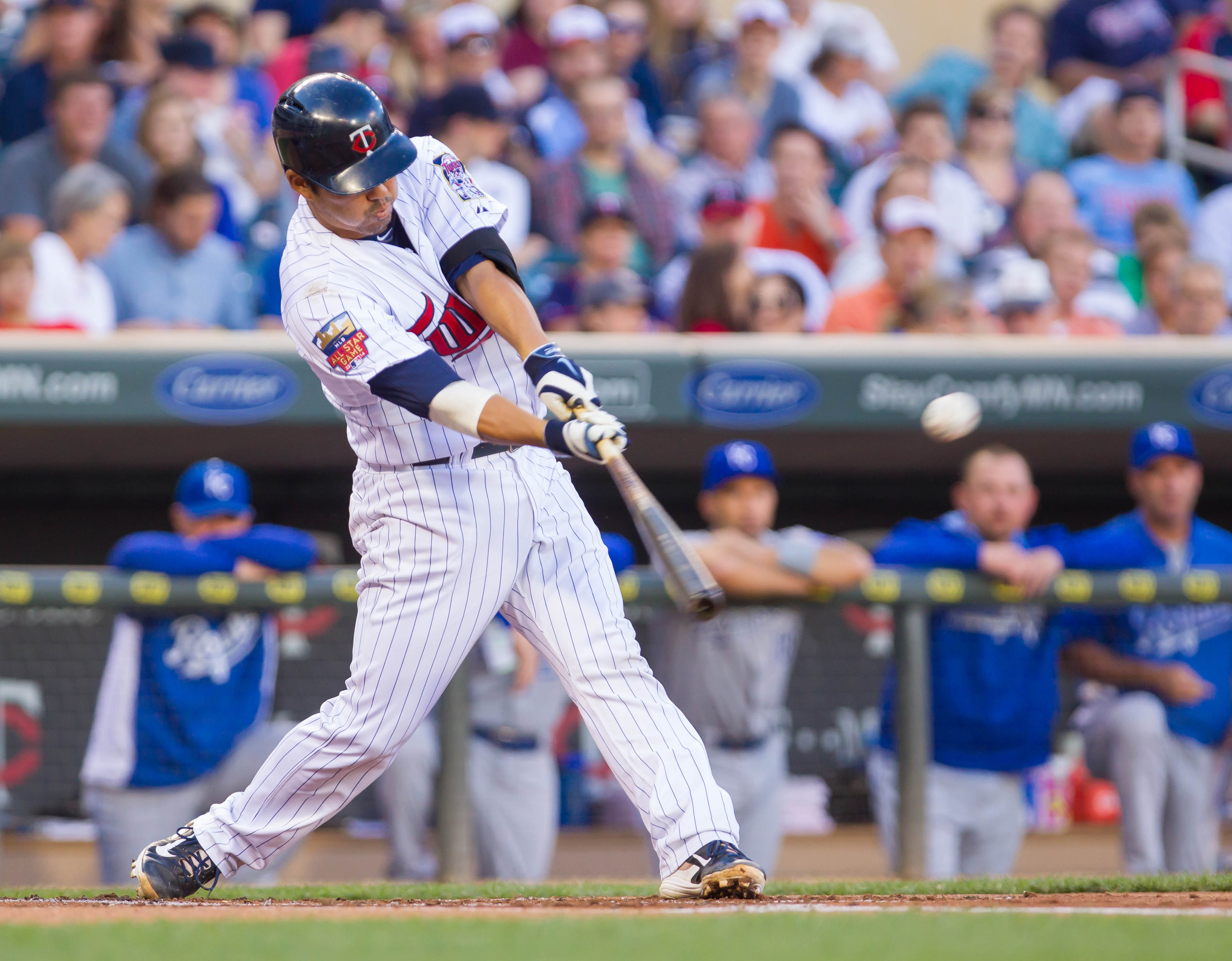 As far as catchers go, Suzuki has been an on-base machine as of late. Dating back to August of last year, he has had the third-highest OBP among American League catchers. That figure is buoyed by the best batting average (.306). At the same time, his power numbers have been awful. His isolated slugging percentage (.085) is the second-lowest in all of baseball in that duration. Nevertheless, with a position that places an emphasis on defense, having a handler who can produce those on-base numbers at the expense of power is a net positive. But can it continue? When a player in the middle of his career suddenly has his best offensive season, there is an immediate tendency to consider it an anomaly. The belief is that because of this single-season spike, regression will often follow. For this reason, Suzuki’s 2014 numbers have rightfully been scrutinized. At 30 years old and in his eighth season in the majors, the Minnesota Twins’ catcher has significantly outperformed his numbers -- specifically the batting average and his on-base percentage. Is he suddenly hitting rockets around the field? Absolutely not. According to ESPN/trumedia Suzuki’s Hard Hit Average (an observation-based metric from Inside Edge’s video scouts that measures if a ball was well-struck or not) has been the lowest since his 2009 season. No one watching would be fooled into thinking he is hitting frozen ropes around the yard, but he’s hitting them where they ain’t. While he is in possession of his lowest Hard Hit Average of the past seven years, he has compiled his highest batting average on balls in play -- a gaudy .324 compared to his .274 career average. To summarize, Suzuki's current success if based on the fact that he is hitting pitches softer than ever and is yet somehow finding seams and vacant real estate. That’s not reassuring, is it? Small Changes In spite of these key indicators that would suggest massive regression in his future, Suzuki’s improvement goes beyond luck. At the beginning of the season when Suzuki came out of the gates on fire, I reviewed his video footage and noticed a small yet important change in his swing: He altered his front foot landing. Look at the comparison of the clips below. In the first clip from when he was with the Washington Nationals in 2013, Suzuki swung his leg open slightly and landed toward the pitcher. In the clip from this season, Suzuki’s stride and landing would keep him slightly toward first base. http://i.imgur.com/4jUFOUc.gifhttp://i.imgur.com/avvL4Bu.gif This has allowed for improved plate coverage for Suzuki. Already a disciplinarian when it comes to the strike zone, he struggled with pitches on the outside portion of the plate. According to ESPN/TruMedia’s data, from 2009 through July 2013, he hit just .230 on pitches away. Since implementing the changes after being traded to Oakland last year, he has batted .297 on pitches outside. No longer would he be pulling away from those pitches but he would be better suited to drive them, as his line drive rate increased with the changes. Also note the position of his hands. Instead of moving them to load, as he is seen doing while with the Nationals, he keeps his hands back at the onset and has little movement when loading. Along with the firm front side, Suzuki shows less head movement which appears to be resulting in improved contact. Because of this, assigning his offensive performance in 2014 to luck does not seem like the right conclusion. Off The Bat Along with the mechanical tweak, Suzuki’s approach has shifted as well. At one time a marginal power producer, he has seen that decline significantly in 2014. Part of the this is the fact that he is no longer hitting fly balls. Instead, he is putting up the highest line drive and ground ball rates of his career -- also a product of his changes as he hits the top-middle of the ball more frequently. This is important because line drives and ground balls become hits more often than fly balls but at the expense of power. If he is able to maintain this batted ball distribution -- which based on his mechanical changes seems plausible -- then Suzuki has a better chance of continuing to hit safely and thereby sustaining his on-base percentage. Conclusion To be sure, Suzuki will likely see some decline in his numbers over the next two seasons because of age and some balls not squeaking through the infield. After all, teams are deploying Tom Verducci's illegal defenses at an alarming rate this year and they may figure out a way to combat Suzuki's ground balls as well. Still, with his mechanical adjustment and his sound approach at the plate, Suzuki has the potential to continue this output at a similar level for the next two years.
 -
Download attachment: Perkins.jpg Since assuming the closer’s role for good, Glen Perkins has been absolutely brilliant, now converting 11 consecutive save opportunities. There was one semi-minor hiccup – allowing a solo home run to Andruw Jones to bring the Yankees within one of the Twins. The pitch was clearly a slider which was intended to be buried at Jones’s feet but rather hung belt high over the plate. It wound up being the third home run Perkins has surrendered on his slider this year. [PRBREAK][/PRBREAK] [/hr] Since June 12, 33 of Jared Burton’s last 36 appearances have been scoreless. As Seth Stohs noted yesterday, he’s been one hell of an acquisition for the Twins front office. In fact, among all pitchers, Burton’s performance in high leverage situation – those in which the game is on the line – have been the best in baseball. Under those circumstances, opponents are hitting just .083 – the lowest in the MLB. Of course, Burton’s performance in those situations should have no bearing on his future performance. For example, the Nationals’ Tyler Clippard led baseball with a .067 average against in high leverage situations in 2011 and ended up with a .230 average against this season. Still, Burton is sound nonetheless. He’s got a high swing-and-miss rate (13.8%) and with a solid changeup, he gets a ton chases out of the zone (37.7%). [/hr] The Yankees’ Phil Hughes had entered last night’s game with the worst numbers when facing right-handed hitting in 2012. In addition to a .307/.343/.595 batting line against, he’s also allowed 23 home runs to righties this year. Naturally, the Twins have two right-handed hitters in the lineup – Trevor Plouffe and Jamey Carroll – who go 1-for- 6 with just a single from Carroll. According to the Twins’ official press release, after Joe Mauer threw out two would-be Yankees base thieves, it marked the first time he had nailed two runners in a game since July 28, 2011 in Texas. This now brings his season total to five runners caught – a trend which may be sourced to improper mechanics. [/hr] Following Liam Hendriks’ three-run first inning on Monday night, the Twins total first inning runs allowed on the year reached 124 or 52 more runs in the first than that of last year. [/hr] Nick Nelson plays the comparison game with Liam Hendriks, likening the start of his career to another homer-happy Twins hurler. In detailing Hendriks’ woes last week, I noted that his inability or reluctance to pitch right-handers inside adversely affected the outcome of his slider. According to Baseball Prospectus’s Pitch F/X leaderboard, it is one of the least effective sliders in 2012. First is the utter destruction of the pitch. While Ervin Santana (13) has outpaced Hendriks (7) and the rest of baseball in terms of home runs allowed on the pitch, keep in mind Santana has thrown many more this year – spinning 948 to Hendriks’ 172 sliders. In fact, among those who have had seven or more home runs hit off of their slider, the minimum amount of had been 630 (Jason Marquis). Second, in addition to being hit hard, he’s simply unable to retire anyone with what should be a put away pitch but Hendriks’ 4.35% put away percentage is currently the lowest in baseball. In his last start, the one thing Hendriks did extremely well was attacking the inner-half of the plate on the right-handed hitting Alex Rodriguez which opened up the outer-half for his slider. [/hr] The Wall Street Journal examines just how biased your hometown announcers are. Where does Dick & Bert rate among all of baseball? Click here to view the article
-
Download attachment: Joe Mauer.jpg The effects of taking several foul tips off his face mask are still lingering for Joe Mauer, Minnesota Twins manager Ron Gardenhire said before Tuesday’s game against the Royals. “He came in today and says he’s feeling pretty decent,” Gardenhire said but later added that Mauer will not be ready to return the lineup any time soon. [PRBREAK][/PRBREAK] “He’s not ready anyway right now. We just have to wait and see; I don’t have a timetable. They got to tell me when to play him. I will discuss it with him once we get the go-go from the doctors. There’s no sense in talking about it until he gets back.” Gardenhire’s recollection of the events leading up to Mauer’s DL visit is something that is becoming more and more commonplace among catchers. “He came to my office earlier in the day and we talked about not catching, I was going to play him at first base and he said that would be a good idea. He took one off his helmet and mask -- a couple of them pretty hard,” Gardenhire recanted. “He said his forehead kind of hurts. That was the first time I heard about that. It was good when we were playing first base but once he got out there in batting practice it wasn’t good at all. He was taking ground balls at first and Joe normally doesn’t miss too many ground balls and he was missing just about everything. You could see he was a little loopy.” What happened to Mauer was innocuous but because of the increasing amount of concussion awareness and preventative measures set up by the league, the frequency of these instances will likely grow, Gardenhire believes. In 2011 MLB instituted a seven-day disabled list specifically to handle these types of injuries. According to medical research cited by the league, the mild variety of concussion injuries typically clears within five-to-seven days and gives the player the opportunity to be evaluated by the team’s medical staff. “I don’t think we even knew they had it,” said Gardenhire. “You didn’t know you had a concussion. It wasn’t something that was talked about. It was just ‘man, I don’t feel good today’ but you just played. And it was because there was nobody ever diagnosing it as a concussion. It just wasn’t there. You know, you get knocked out in a game you get back up and finish the game. Nowadays that just doesn’t happen.” Of course, the player in the most direct line of fire is the team’s catcher. As HardballTalk.com pointed out last week, in the past month five catchers have been place on the seven-day DL. “This is a good thing,” Gardenhire acknowledges of the added attention to concussions. “But you are going to see a lot of this from catchers. They get wacked pretty good. That foul ball off the mask, and I know they are trying all kinds of things, there’s no way to stop. I don’t know what kind of mask they can make that is going to stop that neck from getting whipped back like that after you get a 90-plus mile per hour ball tipped right into the mask like that.” It is hard to foresee MLB making any changes to the way the game operates that would remove the catcher from harm’s way of the foul tip (robot umpires and catchers?). Equipment will be examined by the sport to see if there are any styles that provided added safety. However the current available stock – heavy or titanium or goalie-style – offer little difference in the level of protection, says Gardenhire, especially when trying to stop the whiplash effect of the neck snapping back upon contact. “They all got different masks. You got heavy masks, the really light mask, titanium, you know all that stuff. No matter how light his mask was, you still saw him got hit that time and everything shook. It’s gonna happen. There’s no getting away from it." "It’s just something we are going to have to figure out and deal with it now and go from there. You are going to see that quite a bit, catcher’s getting dinged up.” Click here to view the article
-
Download attachment: Bryant.jpg Who IS This Guy? The legend of the power of six-foot-five, 215-pound Kris Bryant has increased rapidly over his career at the University of San Diego, reaching He-Man-esque proportions in his senior year after he launched 30 bombs. It was not just the number of homers that drew scouts’ attention; it was also the distance that helped him ascend up teams’ draft boards. Reportedly, the corner infielder hit a blast that was estimated over 500 feet when it cleared an 80-foot tall light tower at his university’s home stadium. Some suggest that estimate was low. No matter, the 21-year-old Bryant has smacked 54 dingers in his three year collegiate career and has mashed his way into becoming one of the top draft choices this year. Who Could He Be? An offensive monster, that’s for sure. The right-handed hitting Bryant employs a wide base, a stance that seems to have developed in his more recent collegiate years. He has a minimal swing, keeping his head and lower half still during his weight transfer but creates a substantial amount of torque with his hips and a strong front side. Bryant’s swing was constructed, he said, by his father, a former Boston Red Sox draftee. Citing Ted Williams’ method from his book, The Science of Hitting, Bryant incorporated the upward swing to counter the downward flight of the ball, attempting to achieve a more flush point of contact. The slight uppercut swing – along with a minimalist weight transfer and extremely well-leveraged front side – has created a ton of big fly balls for the University of San Diego infielder. This year, he has jacked 30 in the regular season – a USD school record in addition to making him the NCAA Division I leader. In fact, the next closest total to Bryant’s was 18. Bryant’s home run power is not a mess created by the TING! of the aluminum bat either. College baseball has switched to composite bats which has muted some of the speed at impact – not nearly as much as a wood bat but the change has certainly quelled the home run totals since the bats' introduction. Judging from his big bop potential, it is not surprising that he had an abundance of walks. The 62 he drew led the NCAA in that category as well. Most of those were not necessarily the product of patience but simply that teams refused to pitch to him. Seeing a pitch in the strike zone was such an infrequent occurrence through the first 33 games of the season that Rich Hill, USD’s manager, moved him to the lead-off spot in order to get him a few more pitches to hit. That said, Bryant’s plate coverage is also reported to be thing of beauty. According to an LA Times story, during Bryant’s freshman year, the University of San Francisco’s coach ordered his pitcher to throw out of the zone to the San Diego slugger. After a majestic home run, the coach scolded his pitcher on throwing the ball over the plate. San Francisco’s catcher came to his pitcher’s defense, saying the pitch was at least two-and-a-half balls off of the plate. How Soon Could He Be Playing In Target Field? As a college draftee, Bryant is expected to move up the ranks quickly. One could easily envision him tearing apart Appalachian League pitching so his starting point following the draft is likely at A ball – either Cedar Rapids or Fort Myers. Slowing his development might be the switch to wood bats and facing tougher competition. While with USD teams did not challenge him, which led to a high number of walks. In the minors, he’ll start seeing hard-throwing, big-bending and precision-guided pitching as he moves up the ladder. If The Twins Draft This Guy, They Messed Up Because… The list is short: He’s not a pitcher. And the Twins need more top-tier pitching. Outside of that, there is not much else that would constitute a good reason for not selecting Bryant at number four. Additionally, massive power in college does not necessarily translate to massive major league success. Look at former collegiate slugger Pete Incaviglia. Inky hit 49 home runs in 75 games with Oklahoma State in 1985, setting the college record for home runs in a single season. While he displayed 25-30 home runs power for the Rangers in the mid-to-late 1980s, his inability to make consistent contact led to his move to a role-player position. Bryant obviously has more tools than Incaviglia, including speed and defensive prowess, but there is always the chance his hitting never translates. If The Twins Draft This Guy, They Nailed It Because… Bryant is not expected to be around at the fourth pick. The consensus among the draft experts is that he will be off-the-board by the third pick. If, for some divine reason, the three teams ahead of the Twins (Astros, Cubs and Rockies) decide to go another direction, the organization should be thankful to have a talent like Bryant available. Miguel Sano may be the third baseman for the foreseeable future, but Bryant is skilled enough – and definitely has the power stroke- to plausably move to a corner outfield position. --- Twins Daily MLB Draft Player Profiles: Monday, May 20-- Sean Manaea, SPTuesday, May 21-- Austin Meadows, OFWednesday, May 22-- Trey Ball, OFThursday, May 23-- Ryan Stanek, RHPFriday, May 24-- Clint Frazier, OFTuesday, May 28-- Reese McGuire, CWednesday, May 29—Braden Shipley, RHP Thursday, May 30 -- Kohl Stewart, RHP For MLB Draft Day Coverage, make sure you follow @TwinsDaily on Twitter! Click here to view the article
-
Download attachment: questions.JPG Rather than spew out some analysis based on hot stove rumors and theories (which I've already done on Shaun Marcum and Kevin Youkilis, by the way), I thought I would take the opportunity to field some burning questions from the Twins Daily followers via Twitter. On to your questions: Who will be the Twins starting rotation on Opening Day? [@MichaelRHerman] [PRBREAK][/PRBREAK] As the Twins have said since the season started winding down in September, Scott Diamond is the only pitcher guaranteed a spot in next year’s rotation. Outside of Diamond, here’s what I envision happening at this point: I see the Twins re-signing Scott Baker, signing one mid-to-low free agent and then trading for a starter. Best optimistic guess at this point? Here’s what I would like to see: 1: James Shields 2: Scott Baker 3: Shaun Marcum/Jeremy Guthrie/Joe Blanton 4: Scott Diamond 5: Internal candidate (Liam Hendriks/Kyle Gibson/Samuel Deduno/Brian Duensing) How’s that? Think there’s any real chance of trading for a strong starter like Buehrle or Shields? [@christopherokey] More so this year than in previous years. I believe the front office is under some pressure from ownership to improve the team in order to avoid seeing a historic decline in revenue during the first five seasons of a new ballpark. Now, I do not believe these to be Steinbrenner-esque directives (“Go out and get be the best-damn pitcher available, money is no object.”) from ownership but Terry Ryan will likely wind up trading a long-time Twin (Denard Span, possibly) and/or someone from the farm system in order to get that piece. Of course, it also matters too what the opposing teams thinks their commodities are worth in return. As much as people like to think the Rays need to unload Shields, they are already shaving off a substantial portion of their payroll (upwards of $20 million), so there is not a need to jettison the pitchers who has thrown the third-most innings in the last three seasons. Rays will likely be looking for a solid return for Shields who has a reasonable $10.25 million left on his contract in addition to a $12 million 2014 team option. I personally like the idea of a Shields acquisition (as you can see by my prediction above) but I just don’t know if the Twins have enough or are willing to part with enough to get him. On the other hand, Buehrle, who has been amazingly consistent and durable for his career, could come less of a ransom than Shields. However, the Marlins have him locked in through 2015 and -- while he is owed a reasonable $11 million in 2013 -- he has $18 million and $19 million coming to him in 2014 and 2015, respectively, as he enters his late-30s. I’m not sure the Twins want to trade away a prime asset for those latter years. Why does Mauer hate hitting home runs? [@DanaWessel] Like most real Minnesotans, Joe Mauer would love to put his head down and just go about his business without all the hoopla. Home runs clearly put undue attention on him while circling the bases from all those cheering fans at the game. Real Minnesotans like Mauer would prefer to slap singles and avoid the showboating. In reality, there is a lot that goes why the sudden spike in 2009 and the complete inability to poke a few shots in to the stands every now and then. First is the external factor of the ballparks which played a significant role in both the increase and the decline. At the Metrodome in 2009 Mauer was feasting on the front row of the left field bleacher seats – hitting 16 of his 28 home runs in that direction. When the Twins moved to Target Field, the outdoor elements and dimensions became extremely restrictive for that kind of power. A ball hit to the right-center gap or center field has difficulty leaving the park. Secondly, his on-going knee issues have undoubtedly drained some power, reducing the amount of drive produced from his lower-half. One interesting note: three of Mauer’s home runs this year have been right down the right field line, not far off of the foul pole. Only one of his home runs dating back to 2008 had been in that region. Perhaps he is starting to figure out what needs to be done in order to hit home runs at Target Field. With another offseason to heal and the additional time away from catching could equate to more “dingers” in 2013. That said don’t expect a big jump, maybe 15 at the most next year. That’s not what most fans want to hear, but Mauer still provides plenty of value with his ability to avoid making outs in over 40% of his plate appearances (one of four hitters in the league this year to do so). Why do former Twins do better outside of the Twins system? (Dickey, Hardy, Lohse, etc) [@brandon_mack] I don’t think this is necessarily true. Yes, there are some players who realize their potential after leaving the organization but it is not because of something the team is or is not doing with these players. Most of the time it the improvement is up to the individual not the organization. What’s more is that in the case of the three players you named, other organizations could also claim the same thing. In the case of R.A. Dickey, he was still very much attempting to refine his knuckleball – a pitch he had just picked up two seasons before arriving to the Twins. He did not have his mastery of knuck then, rarely getting opponents to chase the pitch out of the strike zone or induce silly-looking swings. Both the Rangers and the Brewers gave up on Dickey. J.J. Hardy was not completely healthy (which may or may not have been a testament to the training staff) and he did not focus on pulling the ball (which may or may not have been hitting coach related). When he got to Baltimore, he got healthy, got focused on turning on pitches and was in an environment that was more conducive to hitting home runs. With Lohse, both the Reds and the Phillies had Lohse without reaping the same benefits that the Cardinals just had with his 2012 season. In short, I do not believe there is some internal issues that is causing the Twins to fail to identify future performance – at least, no more so than any other team. Who is the best long-term option at 1B? Morneau, Parmelee or other. [@MikeAmundsen12] With Justin Morneau in his early 30’s and teeming with various injuries, it’s not him. Hulking first baseman with injury tendencies do not age well – in fact it typically accelerates. Take Travis Hafner, for example. Until the age of 30, Pronk was having an outstanding career and even receiving MVP votes. After 30, his big body began to breakdown rapidly and frequently, resulting in a significant decline in his numbers: Age 25-30: 112 games per year, .290/.393/.552, 142 HRs Age 31-35: 86 games per year, .259/.353/.436, 59 HRs Because of that, I do not see the Twins retaining Morneau beyond his current contract. Parmelee is still young, intriguing but is unproven over the course of an entire season at the major league level. His 2012 season at Rochester -- one in which he had the league’s second-highest isolated power average (minimum 250 plate appearances) – raising eyebrows that he can develop into a player with some legit power. As Terry Ryan said in the Offseason Handbook, the Twins appear committed to putting Parmelee in the lineup somewhere this year. It may be in right to begin with, but after next season, he could be the team’s first baseman for the next several years. Of course, the real key to the Twins long-term plans at first base will be Mauer. Already seeing some time at first, he has looked comfortable at the defensive-side of the position and could eventually be there for the duration of his contract once squatting is out of the question. Who are the number one suitors for [Denard] Span? Does Gibson start the season with the big league club? [@dropshotbob] It looks like the Rays maybe the top suitors for Span. Tampa has not outright expressed interest, but Span is certainly a logical fit, what with his good defense, good plate discipline and good contract, plus, because B.J. Upton is likely to leave via free agency, Span is almost a natural target. If he doesn’t end up there, Atlanta is another team looking for center field help. Unless something happens to Kyle Gibson between now and spring training, he’s likely on an inside track to start the season with the Twins – probably in the bullpen where the team can limit his innings and monitor his progress as he adapts to major league hitters and wraps his head around pitching in double-decker stadiums. If Buxton doesn’t pan out as a positional player, chance #Twins try him as a pitcher? Reports were mid-hi 90’s in HS. [@Aaron_jenkins] This topic has come up with Aaron Hicks as well, who purportedly threw in the low 90s in high school like Buxton. So far, there are no indications that Buxton is headed for a bust – after all, he was both the Gulf Coast League and Appalachian League’s number one prospect overall as an 18-year-old. However, if for whatever reason, he winds up unable to climb up the system as a hitter, I would definitely want the Twins to consider seeing if he can be converted to a pitcher. In fact, any and all positional prospects who have an arm should be given the opportunity to see if they can throw off a mound before being given their walking papers. In a piece at Deadspin.com, Jack Dickey spoke to St Louis Cardinals’ farm director John Vuch and that organizations methods for dealing with prospects with great arms who end up unable to catch on as a hitter: How are my Red Sox gonna look next year? [@MinnesotaRonin] Much like the Twins, the 2012 Red Sox had extensive troubles with their pitching staff – at least in the earned runs department. Boston allowed 754 earned runs, finishing one behind the Twins in that category and third most in the American League. And, like the Twins, things didn’t quite work out as planned, either. Two of their starters, Jon Lester and Clay Buchholz, had down years. Lester’s season was much more unexpected as the lefty had emerged as the team’s number one-type arm but a decline in strikeouts and an increase in his average on balls in play resulted in more runs. Josh Beckett’s fastball velocity dropped from 93.1 in 2011 to 91.4 in 2012 which opponents made much better contact on. So they wind up dishing out 94 innings to guys like Aaron Cook, who never met a bat he couldn’t hit. In fact, Cook’s 4.9% strikeout rate was the lowest among any starter with a minimum of 90 innings dating since the Mariners’ Glenn Abbott posted the same rate in 1979. But, unlike the Twins, the Red Sox have a ton of financial freedom – and that gives them the ability to fix things quick. In addition to an already high revenue stream, thanks to the unloading of Carl Crawford, Adrian Gonzalez and Josh Beckett (and I suppose Nick Punto too), this has freed up approximately $60 million of payroll to rectify the pitching problem, grab an outfield bat and perhaps bail out the auto industry as well. So far, the Sox have been tied to a bevy of free agent including Dan Haren and Scott Baker among others, who would go along with the existing arms of Lester, Buccholz, Felix Doubront and John Lackey. And rumor is the Sox are looking at former Twin Torii Hunter as well. By the way, if you would like to participate in the next round of questions, follow me on Twitter (@OverTheBaggy) and fire me any or all Twins/baseball-related inquiries. Click here to view the article
-
Download attachment: Pavano.jpg It was revealed a week ago that Carl Pavano’s shoulder was hurting and that the team had him undergo an MRI for precautionary measures. [PRBREAK][/PRBREAK] Fortunately for the already thin pitching staff, the MRI showed nothing more than inflammation and, in preventative efforts, the Twins eased up on their workhorse, limiting his pitches and allowed him to miss the recent series in Detroit to have some soft-tissue therapy on his shoulder. The hopes are that by lightening his load, Pavano will heal and not require a cortisone shot following his next start. Since the beginning of the season, Pavano’s velocity drop has had team officials concerned. While the tests showed no significant injury, the big right-hander admitted that he feels that he cannot get proper extension on his pitches and his results suggest there may be something to that. While his peripheral numbers are actually a slight improvement over his 2011 campaign – his strikeout rate is up, his walk rate is down – his ability to generate ground balls has dissipated over the course of the season. Currently holding a 44.2% ground ball rate, it is his lowest amount of turf-killer since the year he came over to the Twins in ’09. Because hitters are able to elevate the ball, he is allowing home runs at a higher clip – going from 0.93 home runs per nine innings to 1.29. Through his first four starts of the year, Pavano pitched like business-as-usual. He was able to miss bats (8% swinging strikes) and induced more grounders than fly balls (1.18 GB/FB). From his April 22 start against the Royals onward, likely when the Twins began to limit his pitch count, Pavano was a different pitcher. Hitters were making outstanding contact (just a 3% swinging strike rate) and the ground balls dried up (0.65 GB/FB). Outside of his fastball’s velocity, the biggest causality of his sore shoulder has been his second most used pitch, his changeup, and one of the reasons the grounders have become fly balls. In 2010 and 2011, Pavano’s change was one of the game’s best according to Fangraphs.com’s Pitch Value. His 18.1 runs above average on the pitch was tied for ninth-best in that span, placing him with such change artists as Felix Hernandez, James Shields, Shaun Marcum and Ricky Romero. This season, his change-up is now 2.6 runs below average, making it one of the bottom-dwellers in that category. In theory, a change thrown with a good differential and down in the zone should induce plenty of weak contact as hitters find themselves unable to hold up and turn over on the pitch. A year ago, his change-up was able to get a ground ball on 51.6% on all contact (including fouls, home runs, etc) which is a very strong rate. Comparatively, this season, Pavano’s change has only incited grounders just 39.3% - meaning opponents are squaring up on his secondary pitch. What’s more is that in 2011 he was able to get a swing-and-miss on 27% when opponents swung but that has declined to 15% in 2012. As I speculated following his first start, the decrease in his fastball’s velocity was going to adversely affect his change-up as the speed differential closes. Baseball Info Solutions’ pitch charting states that while his fastball is down (from 89 to 86 miles per hour) his change’s top speed has also decreased (from 80 to 78 miles per hour). This means the differential has not been that substantial at all. Pitch F/X, on the other hand, shows that Pavano’s vertical movement on his change is quite different. As I discussed in my analysis of Jason Marquis at Twins Daily on Wednesday, research has shown that the optimal place to get the most ground balls is between 0.0 inches and 3.0. The previous two seasons, his changeup had a vertical finish of 2.0 and 2.7, meaning it was down in the zone. This season it is up to 3.8. In laymen’s terms, Pavano’s changeup has been up in the zone more frequently therefore resulting in fewer grounders and swing-and-misses on that particular pitch. Another factor that might explain the in-season drop in grounders and missed bats is the sudden disappearance of his slider. According to Pitch F/X data, in his first four starts he threw his slider 45 times (11% overall). In his last four starts, he threw it just 8 times (3% overall). His sore shoulder, his inability to get extension and a lack of feel for the pitches may contribute to why he has not spotted his changeup well and why he has ignored his slider as of late. Will the rest and rehab approach prove to be fruitful? Answers will be provided on Saturday when Pavano makes his regularly scheduled start in Milwaukee. Attention should be paid not only to the radar gun readings but also to the performance of his off-speed pitches. Click here to view the article
-
Age: 21 (DOB: 09/28/1991) 2012 Stats (RK/A): .299/.347/.499, 13 HR, 74 RBI, 62 R, 11/22 SB ETA: 2015 So far, Eddie Rosario’s minor league career has been largely overshadowed by Miguel Sano. It’s a common phenomenon with any pairing. One emerges as the fan favorite and the other continues doing valuable if underappreciated work. Maris had Mantle. Oates had Hall. Colmes had Hannity. The guy on the left of Milli Vanilli had the guy on the right of Milli Vanilli. Having been teammates dating back to 2010 when both players joined the organization, it is Sano who has been grabbing the headlines and basking in the attention of the national prospect junkies. It starts physically where, unlike the imposing physique of Sano which casts a big shadow, Rosario’s six-foot-nothing, buck-seventy frame does not garner as much attention. Nevertheless, Rosario has put together an auspicious start to his professional career – thanks to remarkable bat speed and square contact. In 2011, he slammed 21 home runs to lead the Appalachian League as a 19-year-old. It had been eight years since someone had socked more than 20 home runs in the short-season league. “Since I was a kid, I’ve always hit the ball hard,” Rosario told reporters prior to the 2012 season. “Now that I’m a professional player, I realize that it’s because I have a really fast swing; I have quick hands, and usually hit the ball on the barrel. I’m aware of that now. When I was a kid, I just knew I always hit the ball hard.” Evaluators noted that Rosario lacked the speed to continue to play at center field and did not possess the arm for a corner outfield position like right field. Recognizing the pipeline was filled with high quality outfield talent coupled with a dearth of middle infield candidates, the Twins requested that he grab an infielder’s glove. This transition could be very advantageous to Rosario and the Twins. Without many options head of him, his path to the major may have been shorten – provided he learns the position in a timely manner. The Good: Rosario has proven that he is an above-average hitter in his three seasons thus far. In addition to strong numbers stateside, he turned heads while playing in Puerto Rico this winter. In fact, MLB.com’s Peter Gammons tweeted that one general manager rated Rosario as the top prospect within that league based on his performance. Mechanically speaking, Rosario, who keeps his hands low in his set, exhibits a small, downward hitch in his swing at his load point (he has a north-south load rather than an east-west one). This added movement will likely need to be reduced in order to avoid being exploited but to this juncture of his career, he’s succeeded. More than that, his strikeout totals dropped noticeably – from 20% in 2011 to 16% in 2012 – even while moving up a level. His level swing allows the bat to stay through the hitting zone extremely well and, because of his plus bat speed, he is able to get the ball to jump hard off of the lumber. The Bad: Rosario didn’t match the output in 2012 when advancing to the Midwest League, but that was expected. After all, his approach is not a basher like Sano rather Rosario is a line drive, gap-to-gap guy with a high average potential. This trend will likely continue as he graduates to the Florida State League – a place where the heat oppresses the offense – so temper expectation accordingly. In the field, he will need to make strides at the keystone and grow more comfortable around the base during double-plays and going to his backhand. That said, reports from the fall instruct league were mostly positive. “He made improvements last season, but it’s still a work in progress, since he doesn’t have a lot of experience there,” commented Brad Steil, the Twins’ Director of Minor League Operations. “He’ll need to continue working on all aspects of his defense. His instincts and feel around second base will improve with experience.” Asked to participate on Puerto Rico’s World Baseball Classic team, Rosario will shift back to the outfield during the exhibition event. The Bottom Line: As a high average hitter with good pop, his bat projects extremely well as at second base - a position that has slowly transformed into an offensive-oriented one. Consider this: Since 2000, the Minnesota Twins’ collection of second basemen has produced a baseball-worst .672 OPS. With little ahead of him in terms of middle infield talent, a strong 2013 season could make Rosario one of the organization’s top movers-and-shakers. [TD’s Top Ten Prospects: #10: Max Kepler] [TD’s Top Ten Prospects: #9: Trevor May] [TD's Top Ten Prospects: #8: J. O. Barrios] View full article
-
Download attachment: May_6.jpg When the Minnesota Twins traded Ben Revere to the Phillies, they acquired one pitcher to help them in the present (Vance Worley) and one for the future (Trevor May). In Worley, the Twins landed a somewhat seasoned middle-of-the-rotation starter who has above-average movement. But Worley had recent elbow issues, necessitating the addition of the Phillies’ top prospect, May. May’s pedigree is strong. His velocity ranges up to 95 complimented with a decent curve and an improving changeup. Unlike the majority of his Minnesota pitching prospect counterparts, May has been able to get batters “out” by throwing three “strikes”. On his way to these “strike outs”, he has avoided bats but also the strike zone as well – an aspect of his game which may have soured the Phillies on his potential. Now in the Twins’ system, can they get the maximum return out of his abilities and turn him into a top of the rotation arm? Within the 2012 season, the 22-year-old May impressively led the Eastern League in strikeouts (151), exhibiting dominance at times over his elder competition in his first stint Double-A ball. However, he also topped the league in walks (78) and home runs allowed (22). Both are somewhat disconcerting figures coming from the Phillies’ minor league pitcher of the year in 2011. The home runs allowed spiked significantly from eight total the previous year – certainly a byproduct of leaving the pitcher-friendly Florida State League and facing tougher competition – but the walk rate also increased after showing signs of improvement in his command in 2011. The struggle with his control is nothing new to May. In his first three years of professional baseball, while compiling impressive strikeout numbers, the right-hander walked 13.7% of all batters faced. In efforts to correct this issue, the Phillies attempted to corral his mechanics and smooth them out. According to May after his 2011 season, in which he made inroads towards bettering his free pass rates, he told reporters that: Although he may have made some significant strides in the overall quality, there was a remaining kink in his delivery. From , one thing that jumps out about May’s mechanics is an unstable balance point which affects his ability to keep everything consistent and encourages rushing through his delivery. Here are some stills of May at his balance point and while beginning to drive forward. Notice how his back foot is coming unglued from the rubber: Download attachment: May_1.jpg Download attachment: May_2.jpg Download attachment: May_3.jpg While this is isolated to his wind-up and not a trait exhibited on each delivery, it was something that likely influenced his overall command. Compare the above images to one of the other recent prospect acquisition, Alex Meyer. Notice how Meyer’s back foot stays flush and allows his upper body to remain balanced at the peak of his delivery: Download attachment: Meyer_1.jpg The Phillies coaching staff and instructors likely noticed this problem area and have tried to get him to adjust. In 2012, while in Double-A Reading, May closed his pre-delivery stance thereby reducing the additional foot movement and, hopefully, leading to a more stable balance point. Download attachment: May_4.jpg Download attachment: May_5.jpg So far, the change led to more walks (not to mention, home runs). Now, this could be a byproduct of adapting to a new delivery or it could be that the change never corrected his balance problem. At 23 in 2013, the Twins have the opportunity to continue to hone May’s mechanics in attempts to harness his above-average velocity and swing-and-miss secondary offerings. As the organization sets their sights to 2014 and beyond, May's progress - particularly in the walks department - will be closely monitored as they try to refine him into a frontline starter. Click here to view the article
-
[ATTACH=CONFIG]3807[/ATTACH]Let’s just say Brian Dozier has had a slow start to his 2013 season. Repping a less than stellar.189/.279/.243 batting line through his first 44 plate appearances, the Twins’ second baseman has been extremely inoffensive and has statistically continued where he left off during following his demotion in August of last year. Despite this slow beginning, there is reasons to not lose hope that Dozier’s career will fall into a no-hit middle infielder that has plagued the Twins for the better part of the new millennium.[PRBREAK][/PRBREAK] The first encouraging sign from Dozier is that he is (1) sporting a much improved strikeout-to-walk ratio. This is supremely important to any future success for the middle infielder. As a minor leaguer, Dozier owned a decent 1.2 strikeouts-to-walks ratio – meaning he drew nearly as many walks as he did strikeout. When he was promoted to the majors last year, that ability to hone the zone dissipated. He took just 16 walks in 340 plate appearances while striking out 58 times - or a 3.63 strikeout-to-walk ratio – a true indicator that he was not completely comfortable at the major league level. But, through 13 games this year, he’s had a much improved walk rate and has a 1.8 strikeout-to-walk ratio, closer mirroring his minor league track record. Those few free passes in 2012 resulted in a 4.7% walk rate which placed him in the bottom third in that category. Much of that derived from overextending the strike zone (35% out-of-zone swing rate compared to the 30% league average) and having an overall overzealous approach at the plate. Again, in the small sampling this year, he’s increased his walk rate to a significantly improved 11.4% - the fifth-highest among qualified second basemen. The story has been slightly different for Dozier in 2013. He has trimmed his swing zone down to a more manageable area (chasing just 26% of out-of-zone pitches) and has been able to fight off a high number pitches to extend his at bats. So far this year, he’s 39% of his strikes have originated from foul balls while the rest of the league’s average is 27%. Consider this: When Ron Gardenhire put him in the lead-off spot after Darin Mastroianni was pushed to the DL on Tuesday, Dozier’s first at bat against the Angels’ Jason Vargas consisted of him fouling off five fastballs – working the left-hander over for ten pitches total. While the at bat resulted in an out, Dozier got Vargas’s pitch count rising from the get-go. In the fourth inning, he got enough of Vargas’s 0-2 down-and-dirty curve in order to see a fastball the next pitch which he drilled into right field for a base hit. Fouling off pitches is not a repeatable skill, per se, but it has aided him in prolonging his at bats which has led to a higher frequency of walks. The end game -- more walks and high on-base percentage -- bodes very well for Dozier’s contributions for the rest of the season. The second reason Dozier is rather than attempting to pull every pitch, he’s (2) going the other way and back up the middle. Check out his breakdown of batted balls by direction hit from last year to this year: [TABLE=align: center] [TD=colspan: 4]Dozier’s Batted Ball By Location[/TD] [/TD][TD]Pulled Center Opposite 2012 40% 41% 19% 2013 26% 37% 37% [/TABLE] Without question, Dozier is going the other way with the pitches that are on the outer-half of the strike zone rather than trying to yank everything under the sun. As I outlined at Twins Daily last year, opponents recognized this tendency and lambasted him with fastball away and an abundance of sliders. I concluded that analysis by writing: “Specifically for Dozier, offensive progress means trying to re-calibrate his swing zone. If pitchers are going to continue to pound away, make sure you start going with that pitch instead of turning it over (CC: Danny Valencia). If they are trying to get you to fish, try to wait for something in the zone (which is always easier said than done). Being a successful everyday contributor means being able to make adjustments quickly.” As mentioned above, Dozier’s keying in on pitches in the zone better. Additionally, what we see out of him is a much better ability to go with the pitch rather than turn on everything. He is allowing the ball to travel deeper into the zone before contact. As such, he keeps his weight back well and that helps drive the ball to center and opposite field. Here’s a still comparison of the point of impact and his improved mechanical balance. The first two images are his swings in 2013. Notice how he has a firm front side and keeps his weight back on these pitches middle-up and middle-away: http://apps.startribune.com/blogs/user_images/theeight_1366379669_Dozier_1.PNG http://apps.startribune.com/blogs/user_images/Dozier_2.PNG There are examples of swings that Dozier displayed in spring training, in which I advised to watch for this year. While the results have been not been there, the form is much better. Compare those two examples to two from 2012. Both instances came against left-handed pitches, both locations were away and both wound up grounders to the left side. In both cases, Dozier’s weight gets out in front of him as he reaches for – and pulls – both pitches thrown on the outer-half of the zone. Notice, too, that his front foot comes unglued in the samples. This is creating a less than solid base to swing from. http://apps.startribune.com/blogs/user_images/Dozier_3.PNG http://apps.startribune.com/blogs/user_images/Dozier_4.PNG Dozier has a much more solid fundamental approach at the plate this season - something that was not present a year ago. With a more discriminating eye at the plate and now functional mechanics in place to drive the ball to all areas of the ballpark, his numbers should steadily improve as the season progresses. Click here to view the article
-
Download attachment: Hendriks.jpg Liam Hendriks could very well be one of the five starting pitchers the Minnesota Twins take north when camp breaks at the end of the month. He has the minor league numbers to show that he capable of retiring batters. He just needs to do the same against major league hitters. One area he needs to improve on in 2013 is achieving better result when he releases a slider from his fingertips. [PRBREAK][/PRBREAK] Coming off the season he had last year, no one would blame him from shelving the pitch indefinitely. Just under 200 times, Hendriks twirled his slider towards home. He retired a batter on that pitch in less than 5% of those occasions – the lowest rate in baseball with a minimum of 100 pitches in 2012. On seven instances, that slider became a home run. Admittedly, six other pitchers managed to surrender more jack jobs on the slide piece but those pitchers also threw the breaking ball at least 300 more times than Hendriks did. Those are some stomach-churning results. A 2012 interview with MILB.com’s Andrew Pentis may help illuminate Hendriks’ struggles with the pitch. According to the interview, the then Rochester Red Wing told Pentis that he had acquired the slider in 2008 from former reliever Graeme Lloyd, another hurler of Australian descent who was coaching down under. Hendriks said that the slider is his “fourth pitch”, behind his two fastballs and change, and he likes to throw it in on lefties and away to righties. When it comes to the latter, therein lies the problem. Last year I examined some of Hendriks’ tendencies and video to find that his closed landing foot causes an inability to hit the outer-half of the plate to righties as effectively as he would hitting the inside corner. Here we see his heat map of where his slider crossed the plate: Download attachment: HendriksSlider.jpg While it appears that he is trying to work away with his slider -- as evidenced by his sporadic spotting down and away -- the majority of his offerings fall within the zone, specifically in the dreaded “middle-middle” location. These are easily feasted upon and have led to a .341 average against (15-for-44) with seven of those hits becoming home runs in 2012. His second start of the spring, a three-inning affair, showed promise that his future remains bright. Following the game, Hendriks told reporters that he had been working on his mechanics: Hendriks continued by saying he did want to remain closed “a little bit” to add to the deception. That may not be a bad thing. After all, it may be a part of this deception which allowed him to maintain a reverse split: a .786 OPS facing lefties and a .998 OPS facing righties. But the improvement in the motion could be enough to allow for better placement of his slider – something that he told reporters felt better after his second spring start. With sustained success in the majors his ultimate goal, finding a stable breaking offering to throw to right-handers will be somewhat critical. If this mechanical adjustment can help facilitate that, then he may be able to replicate some of his minor league triumphs at the big league level. Click here to view the article
-
Age: 21 (DOB: 05/09/1991) 2012 Stats (A+/AA): .320/.388/.539, 17 HR, 98 RBI, 76 R, 4/9 SB ETA: 2013 It has been a while since the Minnesota Twins had major league ready offensive talent in their farm system knocking on the door of the big club. Outfielder Oswaldo Arcia appears to be wiping his feet at the welcome mat. Of course, there are just a few more steps - and players - ahead of him. One of the few areas of surplus in the Twins’ organization has been center field talent. In addition to Denard Span and Ben Revere, looming at the upper levels were Joe Benson and Aaron Hicks. Behind those two is Byron Buxton, the 2012 number two overall draft choice. If one were monitoring the pipeline, it became clear that for one position, some players were either going to move out of the middle of the outfield or be moved out of the organization. The Twins front office cleared some room quickly when they dealt Span and Revere this offseason, opening up a vacancy in both center and right. While Benson and Hicks will audition for the role of center this spring, Chris Parmelee, a first baseman by trade but an outfielder by necessity, is the front-runner to start in right field. Parmelee’s tenure in right appears to be a less-than-permanent job placement if Arcia continues to club the ball as well as he has the past two seasons. Arcia’s progress through the pipeline was stymied in 2011 when in early May, pain in his throwing elbow called for clean-up surgery that sidelined him for two months. Coming off of a season in which he tore through Appalachian League pitching in 2010, this injury abbreviated what should have been his first full season. Undeterred, the Venezuelan outfielder continued where he left off the previous year and mashed his way from the Gulf Coast League to the Florida State League – with a brief stop off in the Midwest League. In all, he accumulated just over 300 plate appearances and posted a respectable .866 OPS as a 20-year-old. Asked to repeat the 2012 season back at Fort Myers, this gave Arcia some additional at-bats in the offensively-challenged Florida State League. For some, the FSL can be a humbling experience for young hitters. Between the heat, humidity, the size of the ballparks and the advanced college pitchers, players who were putting up eye-popping numbers in the rookie and low-A leagues are often brought back down to Earth upon landing in America’s coastal swamps. It’s largely an environment where the men are separated from the boys and the prospects from the pretenders. Arcia’s half-season with the Miracle reaffirmed that he was definitely a legitimate prospect. While the average hitter in the league held a .373 slugging percentage, Arcia was one of five players in the league to have a slugging percentage over .500. Pushed up to New Britain and Double-A ball, as a 21-year-old in a league with an average age of 24, Arcia simply raked and emerged as a genuine run producer. At one point, he drove in 67 runs over the course of 69 games. The Good: Thick in the truck and stout in the upper body, Arcia has a bulldog-like build that consumes the left-handed batter’s box. Coupled with a strong hip transition, he is able to repeatedly make solid contact and power by keeping his hands close to his body and thereby creating leverage, as shown below: This is an example of a pitch on the middle-to-outer third of the plate. Arcia is able to keep his hands close to his body and drive that pitch to the left-center gap for a double. With the spacious Target Field the ultimate goal for any Twins prospect, having line drive power to all fields – particularly in the expansive gap-to-gap region on the ballpark – is a very coveted skill. The Bad: Like most left-handed hitters at his age, Arcia has struggled some against same-sided pitching. Over the past two years, his OPS has been two hundred points lower when facing left-handers versus right-handers. Are the Twins concerned about his splits? Not entirely says Twins’ Director of Minor League Operations, Brad Steil. “Not concerned, but as with many young left-handed hitters, we know it’s an area he’ll need to keep working on. He did show improvement in the second half with New Britain last season.” That’s very true. After hitting .210/.286/.306 in 70 plate appearances against southpaws with Fort Myers, Arcia hit .319/.400/.464 over his next 80 plate appearances against lefties while in New Britain. Is this small sample size success or a sign of progress? The Bottom Line: Will Arcia get the call at some point this year? “Any potential contribution in the major leagues will depend on his progression and performance and an available opportunity,” Steil answered diplomatically. Obviously there is not a need for a corner outfielder at this point. That said, could certain moves in-season prompt an opening? Perhaps trading a soon-to-be free agent first baseman or moving the current starting left fielder into a full-time designated hitter role would make room. If Arcia continues to produce at the same pace as he did last season, it may be a “when” not “if” scenario for the Minnesota Twins. [TD’s Top Ten Prospects: #10: Max Kepler] [TD’s Top Ten Prospects: #9: Trevor May] [TD's Top Ten Prospects: #8: J. O. Berrios] [TD's Top Ten Prospects: #7 Eddie Rosario] [TD's Top Ten Prospects: #6 Kyle Gibson] [TD's Top Ten Prospects; #5 Alex Meyer] View full article
-
On Friday night’s Fox Sports North broadcast of the Twins game, Dick and Bert talked about some things the coaching staff had relayed to them about Francisco Liriano and his upcoming start. Pitching coach Rick Anderson said that the key to getting Liriano back to his spring training form in which he was producing a lot of strikeouts and keeping from walking hitters was to ease up on throwing his two-seamed fastball so much. Interestingly enough, the Twins insistence a year ago for Liriano to throw more two-seamers, a pitch whose action runs away from right-handed hitters, in order to induce more contact and throw fewer pitches in each start caused a stir among analysts. Now, unable to command this pitch, the Twins are requesting that he ditch it and opt to use the straighter four-seam fastball. Anderson told reporters that: "After awhile I said, 'What did you do in spring?' He said, 'I threw a lot more four-seam fastballs; now I'm throwing too many two-seamers and giving the hitter too much credit.' I said, 'How did you do in spring? That was pretty good. Let's get back to it.' " Download attachment: Liriano_FBVel.jpg Liriano has demonstrated very little in terms of consistency when throwing his two-seamer this year. It has been located up in the zone far too much, resulting in fly balls instead of the coveted ground balls that he used to induce. According to Pitch F/X, he has not thrown too many four-seamers but the ones he had tossed are also up in the zone. Part of this effect goes back to the mechanical issue that I described earlier this week where he is flying open with his lower half which makes commanding his pitches that much more difficult. Liriano’s velocity was also lacking but has been increasing over the course of his three starts. In his first game he was averaging just 90.8 on the heater but that grew to 91.2 in his start versus the Angels. In his most recent outing at Yankee Stadium, his velocity was up to 93.2 (perhaps in attempts to impress one of the organizations that showed interest in him). If he can maintain that 93-mph average and hit his spots, he is certainly capable of rebounding this year. With patience running thin on Liriano’s lack of production, the Twins are trying to see if they can get him to a point where mentally he feels more comfortable. And if he feels more comfortable throwing his four-seamer, this may translate into him returning to a more relaxed and proper motion which could lead to better pitching. Liriano gets the call today against the Rays so keep an eye out for the straighter version of his fastball. Click here to view the article
-
Download attachment: uspw_6460472.jpg The Twins announced today that they have released Tsuyoshi Nishioka at his request. The middle infielder will relieve the Twins of their 2013 obligations, saving the team $3.25 million ($3M in salary and $250,000 in a buyout). The highly touted Japanese free agent never adapted well to the game at the highest level, hitting .215/.267/.236 in 254 plate appearances while provided terribly disappointing defense in the field. You can leave your comments here. Click here to view the article
-
Download attachment: Josh Johnson.jpg Baseball agent Matt Sosnick speaks strongly of loyalty, honesty and trust in his industry. His agency, Sosnick Cobbe Sports, was grown from scratch in the hills above the San Francisco Bay and relies on building relationships, sticking with clients regardless of on-field performance and adheres to principles such as automatically dropping players who engage in detrimental activity like domestic violence. He discusses his clients as friends rather than means to a paycheck. Character above all. [PRBREAK][/PRBREAK] It probably should come as no surprise then that he holds the Minnesota Twins operations in high regard for similar reasons. When asked his perception of the organization, Sosnick raved. “First of all, I love the Twins,” he admitted. “I obviously have had lots of players who have run through there the past few years. I have [Josh] Willingham and [Ryan] Doumit. I have a very close relationship with both [assistant GM] Rob Antony and [vice president of player development] Mike Radcliff and there’s no GM that I respect more than Terry Ryan.” That may seem like an odd response from a person whose livelihood is tied to how much a team is willing pay for one of his clients and, so far, the Twins have not been exactly a blank check. In fact, Willingham’s 2012 contract has been the richest free agent contract the team has distributed to date. What is interesting is that had Willingham’s home been further west, he may never have been a Twin to begin with. When fans wonder why their team didn’t sign a particular free agent, there are factors that go beyond just the dollars and cents. As a free agent after the 2011 season, Sosnick fielded an offer from a West Coast team that was superior to that of the Twins. But Willingham, who calls Alabama home, opted to sign with Minnesota because it was in closer proximity to his family and turned down more money in the process. Willingham’s reign as the team’s highest compensated free agent may come to an end this winter and one of Sosnick’s other clients could be the one to dethrone him. Among the Sosnick Cobbe client list are Josh Johnson, Ricky Nolasco and Randy Messenger -- three pitchers in who the Twins have had varying degrees of interest. Under different circumstances, Johnson could have been the headliner of the offseason. At just 30 years old, Johnson has battled both shoulder inflammation (2011) and elbow issues (2013) that have curbed his innings over the past three seasons. More importantly, it has curbed teams’ appetite for doling out a large contract.. “He’s probably got the highest upside of any free agent pitcher,” says Sosnick, “but when you factor in the amount of games he started the last few years and the amount of different injuries he’s had you realize, in our case, our choice was to take a shot at a two or three-year deal or take a shot a one-year where we rebuild his value. There’s no question that we are going to go after a one-year and try to rebuild his value because he’s going to be treated as an injury liability -- even though I think he’s totally healthy right now -- but I understand that mindset.” While Johnson could profile as a top of the rotation arm, does a pitcher with his injury history make sense for the organization? Mike Radcliff does not seem to think so. According to the Pioneer Press’s Mike Berardino, Radcliff said that if Johnson’s asking price is $10 million or more, the club would likely pass. That said, the Twins severely lack an ace and Johnson could be that guy. As an agent, would Sosnick ever try to convince a team that Johnson, who is coming off a bad conventional season but demonstrated decent peripherals that may indicate a positive future, is the right fit for them? “I find that too presumptuous on my part. Am I really going to convince Mike Radcliff that his scouting analyses of a player are off because I tell him something -- given the fact that I’ve never scouted a player in my life and Mike’s done it professionally his whole life? I find the thought distasteful and if I put myself in the reverse situation I would be insulted. That’s not what I do.” Perhaps more conducive to the team’s long term vision is Sosnick’s other former Marlins pitcher, Nolasco. “[Nolasco’s] probably is the most sure thing in the marketplace and that comes without a qualifying offer. That’s a huge thing for a team to sign a guy who you can pencil in for 200 innings a year, never gets hurt and you don’t have to give up a draft pick for him.” Not having to surrender a draft pick means a lot to teams that, unlike the Twins, have unprotected first round picks which could make him more desirable. Sosnick says he and Nolasco are seeking a five-year deal, but currently are speaking with numerous teams about four years. During his interview for the Twins Daily Offseason Handbook, Ryan flinched at the thought of signing 30-year-old pitchers, stating that those over that age have a tendency to break down. With Nolasco seeking up to five years, his contract length may cause the team to balk. Still, as Sosnick hinted to Berardino, the Twins have expressed interest in the right-hander. And as Sosnick said there could be the possibility of using a club option in the contract to bridge the gap and protect the team in the event of an injury. The last notable free agent pitcher in the Sosnick Cobbe stable is Randy Messenger, who is coming off a strong stint in Japan. “Outside of [Masahiro Tanaka] who needs to get posted, Messenger’s a free agent in the States this year and he led the Japanese league last year in strikeouts, innings pitched and games started. He has really strong peripherals and ERA the last two years in Japan and was a totally dominant guy this year. He’s not a Tanaka but he’s the next best thing.” The Twins flirted with Messenger a bit last offseason but Messenger ultimately returned to Japan and had another strong season which could be emphasized since that Japanese league switched to a new baseball which increased the offensive production. Did Messenger notice the difference? “He did say that he felt like pitching to an ERA in the 2.00’s this year was more challenging than the two years before that. He felt like ERA-wise, it affected the ERA by a quarter of a point. So a 2.90 was about the equivalent of 2.65 in the past.” Messenger could turn into a Colby Lewis who refined his style in Japan before returning to the Texas Rangers and putting up impressive numbers. Maybe more importantly to a team not looking spend as much on one starting pitcher, Messenger should not command as much as Nolasco in dollars or years. When it comes to discussing contracts with the Twins, the front office avoids lengthy contracts with free agent pitchers. Still, Sosnick respects them all the same. “The Twins are run by the three guys I know -- Terry [Ryan], Rob [Antony] and Mike Radcliff -- and all three of them would be great GMs anywhere right now. They are great evaluators of talent, nice people, easy to do business with and honest. You won’t find three more honest guys then those three guys. The Twins are not as easy to do business with financially as the Yankees or Dodgers, they don’t have the same deep pockets, but we keep sending our guys to the Twins because they are honest, honorable people. The front office represents baseball as well as anybody does.” Sosnick’s relationship with the Twins organization goes beyond just his major league clients. In 2009, the Walnut Creek-based agency was representing who some scouts considered to be the best player to come from Europe in 16-year-old Max Kepler. There was plenty of interest in the toolsy, six-foot-four outfielder who was just a few months removed from growing his first facial hair. “When Max Kepler was out there,” Sosnick reminisced, “we had an offer that was higher than what the Twins’ final offer was and we had him go to the Twins because we really believed in their player development and a lot of that had to do with our relationship with Mike at the time.” Kepler has advanced slowly in the minor league system. At 20 years old he finished his first season at low-A (albeit injury-abbreviated) and has performed well in the Arizona Fall League despite unattractive numbers. As Baseball America’s John Manuel noted a few weeks ago the Twins expect to see the large statured Kepler add some power to his repertoire through additional conditioning this offseason resulting in more over-the-fence distance in 2014. In just a few seasons, Kepler could be patrolling a corner outfield spot in a Twins uniform and, reflecting back, Sosnick is happy with their decision to sign with Minnesota. “Kepler went to Minnesota because we like their player development,” he said, “we felt like they would do the best job of assimilating a 16-year-old from Germany. We made the right choice. He went to high school during the day and played in the afternoon and the Twins bent over backwards to make him as comfortable as possible. And it just reinforced the decision that we made.” Sosnick’s opinion of the Twins’ organization may or may not be shared throughout his industry. Then again, Sosnick’s approach does not seems shared by the rest of his industry. He and his agency remain committed to doing the best for the clients and place them in ideal situations -- like Willingham’s desire to remain closer to his family or considering Kepler’s comfort level -- rather than the ones that garner the most dollars. Click here to view the article
-
Last night saw a near vintage Francisco Liriano carving up his now former team. In six innings of work, the lefty punched out eight Twins batters, showcasing a well-placed 94 mile per hour fastball and a devastating slide piece. It was this first weapon, the well-placed fastball, which would have been inconceivable in the season’s opening months. Liriano’s first half of the season was marred by lack of command of his fastball. Unable to get ahead of hitters properly, the left-hander was forced to ease up on his usage of his slider. In his first stint as a starter, opponents smacked him around to the tune of .346/.435/.589 while allowing six home runs in six starts and 26.2 innings pitched. The home runs allowed were a direct result of Liriano being unable to induce ground balls are easily as he did in the past. With fastballs up in the zone, Liriano’s ground ball-to-fly ball ratio sat at 0.69 which, heading into this season, sat at a much higher grounder rate of 0.96. As you will see, Liriano’s fastball location had a lot to do with his mechanics. Over his career one of Liriano’s biggest struggles seemed to be battling against his delivery. His short-arm action, the various tempos and, of course, his tendency to spin out after landing have been trademarks of his style. At times, he will be able to corral this mess into some conformity and consistency for an extended period of time that will lead to strong numbers – such as in 2010. At other points, like at the beginning of the season, he will be in an utter tailspin and be completely lost when it comes to his motion. What we saw during his first stretch of starts this year was Liriano pulling his weight away from home plate and towards the third base side. This movement away from the target likely caused numerous problems for his command. In this early season match-up against Evan Longoria of the Rays, Joe Mauer sits down and in with a target at Longoria’s knees: Download attachment: Liriano_LongoriaLocation.JPG Instead of painting that spot, Liriano’s offering travels up, slightly above the belt, over the plate: Download attachment: Liriano_LongoriaResult.JPG With a pitch that high in the zone, Liriano is not likely to induce many ground balls. For his part, Longoria smacked this one for a double. What’s more, with a target miss that significant, you can see why he walked 19 batters in 26.2 innings. Fast forward to Tuesday night. Now in uniform with his new team, Liriano had been working on an impressive stretch of outings in which his strikeout rate was up, his walk rate was down and his ground ball rate had increased. Including yesterday’s performance, over his last 12 starts, Liriano has held opponents to a .189/.285/.301 batting line with a very good 87/33 K/BB ratio in 72 innings pitched while only allowing six home runs (three of which came in his start against Chicago). Because of his ability to command his fastball early and often, Liriano has been able to use his slider more, resulting in more swing and misses as well as weak contact (0.98 GB/FB). In the controversial Joe Mauer at-bat, Liriano rang the Twins catcher up on a fastball that likely crossed between the batter’s box chalk and the plate. Nevertheless, it was because of A.J. Pierzynski’s location and Liriano’s ability to hit that target that Liriano was able to coax a strike call out of the umpire. Pierzynski sits down and in on Mauer, not unlike Mauer’s target on Longoria above perhaps slightly above the knee more: Download attachment: Liriano_MauerLocation.JPG Not only does Liriano hit this spot, but his fastball is also running down and in. Had Mauer decided to swing at that pitch, the results would have a high probability of becoming a ground ball: Download attachment: Liriano_MauerResult.JPG The biggest difference between the two versions comes at Liriano’s release point. In his offering to Longoria, Liriano’s lower body is opening up at the point of release. This was a trait he displayed constantly through his first month of starts. Meanwhile, in his pitch to Mauer, he is staying over his front leg which is directed to his target: Download attachment: Liriano_LongoriaRelease.JPG Download attachment: Liriano_MauerRelease.JPG Many fans wonder why the Twins, instead of trading for some marginal prospects, simply did not opt to keep Liriano and hope of getting him to re-up for the $12.5 million qualifying offer. After all, his second half performance has been close to vintage Liriano from 2010 – after which most people would have been very happy extending him a long-term contract. The one-year risk, even at that price, seemed minimal. For their part, the Twins organization had seen too many inconsistencies (not to mention injuries) like the one highlighted above to commit another year at that price. We know that the front office is risk adverse in both their free agent signings and their long-term commitments. Still, credit the White Sox for landing a pitcher who had been trending upwards and exercising better mechanics at a low cost. Will Liriano be able to maintain these mechanics over the course of the rest of the season or, going forward, over an entire contract? By trading him away, the Twins clearly do not believe that he can sustain this pace. In my opinion, barring any injury, Liriano should finish this season out strong and will be a high-risk, high-reward signing for another team this offseason. Click here to view the article
-
After the split series in New York - one in which the bullpen absorbed 70% of the innings in four games - the Minnesota Twins relievers head to Tampa feeling more taxed than the Dutch population. (Yeah, that’s right: tax humor.) On Thursday, Anthony Swarzak, a rotation fill-in who is lobbying for a more permanent position, coaxed Ron Gardenhire out of the dugout once again prematurely, ending his night without getting out of the third inning. Swarzak, in his previous start, had kept the mighty Rangers lineup at bay for seven innings, allowing just four runs to a team that has averaged 5.75 runs per game. However, his game plan was exposed during the Rangers’ second trip through the order as they sat on what had become a predictable first-pitch fastball. In fact, of the first 14 Texas hitters Swarzak threw 12 fastball and just two non-fastballs. When the word got out in the visitor’s dugout, one of the most potent lineups was swinging out of their shoes at the first offering. To his credit Swarzak made some adjustments and to the final 16 hitters he faced on the night, he threw 14 non-fastballs and just two fastballs to start them off. A one-time Baseball America Top 100 prospect (okay, he was number 100 in 2006, but still…), Swarzak showed decent command of his secondary pitches, hammering a curveball down on right-handers and fading a change-up to lefties. This combination seemingly kept the Rangers as balanced as a two-legged table. So, heading into his third start of the year and facing a lineup just as frightening in the Yankees (5.17 runs per game), Swarzak had to ensure that he did not fall into the same pratfalls as he did the Rangers lineup – particularly because of the unforgiving corner outfield fences – and apply his off-speed offerings liberally throughout the night. Unfortunately, while the Yankees did not hone in on his first-pitch fastballs (which he threw to 12 of 17 hitters) they did find themselves in favorable counts when he was unable to either throw his secondary stuff for strikes or entice hitters to expand the zone: In the first, he was unable to get Curtis Granderson to swing at any of the two-strike changeups and was forced to throw two consecutive 3-2 fastballs – one of which Granderson popped up over the slow-pitch softball fence.Several batters later, Swarzak started Mark Teixiera off with a change for a ball and fed the big first baseman a fastball out over the plate on a predictable fastball count, only to watch it disappear in center.In the second, Swarzak started Granderson out with two fastballs, missed with a changeup and then, after falling behind 3-0, came back with two more fastballs (the second of which became a souvenir).Against Texas he managed to locate his secondary stuff for strikes 68% of the time while in New York, that rate dropped to 58% as he struggled with his changeup to lefties. Had Swarzak demonstrated better command over his changeup last night, he may have been able to avoid the punishment dished out by Granderson and Teixeira. As you can see from his Pitch F/X game chart, Swarzak was not unable to keep his curveball (pink squares) down in the zone consistently nor was he able to keep his changeup (yellow squares) down and away from left-handed bats: http://apps.startribune.com/blogs/user_images/Swarzak_NY.png http://apps.startribune.com/blogs/user_images/Swarzak_TEX.png Without being able to keep hitters off of his fastball, Swarzak stands to be subjected to heavy damage. Meanwhile, tonight’s starter is Swarzak’s direct competition for the last spot in the rotation, Liam Hendriks. Like Swarzak, Hendriks kept the Rangers lineup subdued in his last start, working six innings while allowing just one run – a home run to Mike Napoli. And, also like Swarzak, Hendriks does not have overpowering stuff but rather leans on changing speeds and hitting spots in order to succeed. Where the two differ is that Hendriks had a much higher tendency of “pitching backwards”, that is throwing off-speed stuff in fastball counts. That and his secondary pitches are significantly better. Hendriks, who tops out around 91-mph, can supplement his fastball with a near 20-mile-an-hour difference on his curveball which he throws at 73-mph on average. This certainly kept Rangers hitters from focusing too much on the fastball while having to respect the deuce. Additionally, while having to monitor the zone for that slow break, his fastball undoubtedly appears much quicker because of the differential. Lastly, because he throws across his body (his landing foot is towards the third base line rather than home plate) he has a unique release point that comes at an irregular angle and provides added deception for the Australian hurler. Although Swarzak has pitched well in two of three starts and is a serviceable emergency starter, of the two, Hendriks has the higher upside and should remain in the rotation if or when the decision needs to be made. Click here to view the article
-
Download attachment: natinals_display_image.jpg The Big Picture At the All Star Break last year, the Washington Nationals were playing .500 baseball (46-46) but were already 11.5 games back behind the National League East leading Phillies. To be sure, it was just their second non-losing first half of the season since they emigrated from Montreal. Prior to last season, DC had entered just one midseason classic with a winning record. When MLB moved the Expos to the nation’s capital, the newly christen Nationals posted a 52-36 record heading into the All Star Break, leading the division by two-and-a-half games. Of course, Washington would go 29-45 in the season’s back half and wind up in last place. [PRBREAK][/PRBREAK] This season, the Nationals, fueled by some incredible young talent (Bryce Harper) and outstanding pitching (3.21 ERA, best in MLB), have produced their second winning first-half – going 49-34 with a four game lead over the Atlanta Braves. Why They Will Trade With The Twins Selling “Hope” has played well in Washington in the political world. Now the Nationals are attempting to convince their fans that it exists for them in the NL East too. It won’t be easy with the big spending teams like the Braves, Mets and Marlins breathing down their necks so the Nationals’ general manager Mike Rizzo will be making calls in July to see what is available to help push his team over that hump. And, let’s face it: the Twins have made for very good trade partners in the past as well. Rizzo did a job picking Wilson Ramos (season-ending knee surgery notwithstanding) and, if you believed last trade deadline’s reports, he nearly got the Twins to hand over Denard Span for…ROGER BERNADINA. (Yes, Span was still struggling through concussion symptoms but good god, ROGER BERNADINA?) Based on those two instances, I’d say Rizzo has found himself an organization in which he can sell oceanfront property in Arizona. Given their need to appease the fan base in a heavily competitive DC/Baltimore market combined with the complete lack of a legitimate lead-off hitter (as a group they are posting a .306 on-base percentage), there is probably a strong chance that Rizzo would pick up the phone and see if the Twins are still interested in Span-for-Bernadina. Why They Won’t Trade With the Twins Aside from Span, there is not much on the menu that would appeal to this team. Their pitching staff is Jim Morrison poetry deep and even their need for a center fielder has quelled since moving uber-stud Harper to the middle of the outfield. While Span’s +21 Plus/Minus in center field is the best in baseball, Harper’s +12 is not far behind (fifth among center fielders). What’s more is the Nationals’ mix of Mike Morse in left, Andy LaRoche at first and Jayson Werth impending return from the DL to return to right field means Harper might need to stay in center. Also, it’s worth noting that Washington’s minor league pitching depth is fairly thin after the Nationals unloaded three of their top arms to Oakland in exchange for Gio Gonzalez. What is left might not be appealing to the Twins either. Conclusion The Nationals will be buyers but it would appear that if they are not interested in Span - or maybe a reunion with Jamey Carroll as a back-up infielder - there may not be a match with the Twins. ---- Possible Trade Targets Steve Lombardozzi Jr – INF/OF The Son of Lombo in the same lineup with the Son of Sal (Butera)? Whoa. The 23-year-old Lombardozzi has been ousted from his second base position by Danny Espinosa and has been shifted to left field where his bat is a complete miscast. He’s shown good on-base acumen in the minors (career .369 OBP) but has not had that manifest in his 238 plate appearances at the major league level (career .313 OBP). He intrigued the Twins last year when they were discussing a Span trade. Drew Storen – Closer Gosh, you’d hate to think that the Twins would target recently damaged goods like Storen but damn do they love them some Proven Closer. With Storen rehabbing his way back to the Nationals as we speak, the Twins have no clear cut plans for the backend of the bullpen in the coming years. The 24-year-old Storen would in theory give them stability at a cheap price in 2013 but comes with risks. Matthew Skole – Third Base At six-foot-four and 230 pounds, Skole is a monster at third base. His left-handed power has certainly manifested in his second professional season. In 319 plate appearances in 2011, he hit five home runs in low-A. This year, in 370 plate appearances, he’s hit 21 home runs and is leading the Sally League. His glove is questionable so he might be destined for another position than his current one. Rob Wort – RHRP If the team is in need of some bullpen depth, the 23-year-old Rob Wort might be an interesting plus-one in any potential trade. Repeating High-A ball for the second consecutive year, he’s struck out 63 in 38.1 innings while walking just 13. It is the latter that is important as Wort’s control had been terrible in 2011 (he walked 27 in 36.2 innings). He throws a low-90s fastball but can clearly miss bats. Roger Bernadina - OF No. Click here to view the article

