



Parker Hageman
-
Posts
4,152 -
Joined
-
Last visited
-
Days Won
6
Content Type
Profiles
News
Minnesota Twins Videos
2026 Minnesota Twins Top Prospects Ranking
2022 Minnesota Twins Draft Picks
Minnesota Twins Free Agent & Trade Rumors, Notes, & Tidbits
Guides & Resources
2023 Minnesota Twins Draft Picks
The Minnesota Twins Players Project
2024 Minnesota Twins Draft Picks
2025 Minnesota Twins Draft Pick Tracker
2026 Minnesota Twins Draft Tracker: Picks & Bonuses
Forums
Blogs
Events
Store
Downloads
Gallery
Everything posted by Parker Hageman
-
 Other topics include trying to catch a foul ball, Father's Day, concerts at Lambeau Field, a new name for the Vikings stadium and baseball card reminiscing. Listen below, on iTunes or on Stitcher: NO JUICE PODCAST, EPISODE #60: PLUS AND MINUS
 -

Article: That's The Ticket: The Future Is Now
Parker Hageman replied to Parker Hageman's topic in Twins Daily Front Page News
http://assets.sbnation.com/assets/715018/cubs.gif +100000 for having this GIF ready. -
According to the producers of "Back To The Future 2", when Marty McFly traveled into the future -- 30 years into the future to be exact -- he arrives to learn through a hologram billboard that the Chicago Cubs had just won the 2015 World Series. McFly is absolutely stunned. Flying cars, hoverboards, shoes that self-tie and the Cubs winning the World Series. All inconceivable. Where am I? Wait the Cubs won the World Series?! What YEAR is this? When filming of the movie began in 1989 the Cubs had been bad. Maybe they were lovable but they sure were losers. Over the previous ten years, they had managed just one season over .500. They hadn't won a World Series since 1908 and hadn't won the National League pennant since, to quote Steve Goodman, the year the US dropped the bomb on Japan. What may be even crazier is that based on the way the Cubs have been playing in the real 2015 and despite really wanting that hoverboard, it is entirely possible that winning the World Series might be the only prediction that comes true from "Back To The Future 2". For the Cubs the future is now and it is coming to Target Field for a three-game series.When new ownership shook up the organization, they hired Red Sox architect Theo Epstein away from Boston and initiated one of the largest youth movements since the baby boom. They are built for the long haul with a supremely talented group of younger players and are led on the field by one of the game's greatest modern tacticians: Joe Maddon. Here are some of the key young players you need to keep an eye on this weekend: Anthony Rizzo - 25 - 1B Ok, so he’s not young or recently called up. Now on his fifth season at the major league level he’s basically the team’s resident advisor. Under Epstein, the Red Sox drafted Rizzo out of high school but traded him to San Diego in exchange for Adrian Gonzalez. After Epstein moved to the Cubs, he re-acquired Rizzo in 2012 and he has entrenched himself at Wrigley as the starting first baseman and elder statesmen of the team. He gets on base a lot and plenty of that has to do with taking one for the team. Between this year and last, Rizzo has been hit by the pitch 29 times, the most in baseball. He has also shown some impressive power even if it is with some unorthodox swings. http://i.imgur.com/mAofukC.gif Kris Bryant - 23 - 3B Selected two spots in front of the Twins’ Kohl Stewart in the first round of the 2013 draft, Bryant quickly made a name for himself by hitting 43 home runs split between two levels in 2014. After the controversy over the service time when the Cubs kept him in Iowa for the first few weeks of the season, Bryant arrived and has hit .295/.398/.488 with eight home runs including this moonshot that traveled 477 feet according to StatCast -- tied for 5th furthest hit ball all year. http://i.imgur.com/wXcQurA.gif Kyle Schwarber - 22 - C/DH Selected by the Cubs in the first round of the 2014 draft, one slot ahead of the Twins’ Nick Gordon, this Indiana University product ascended Chicago’s system quickly. Loaded with power, Schwarber led the Southern League this year in slugging percentage just ahead of Minnesota’s Adam Brett Walker and Max Kepler. Reportedly a bat with power to all fields, the young catcher had that on display in Cleveland on Thursday when he hit his first major league home run. http://i.imgur.com/VGof5ZN.gif Addison Russell - 21 - 2B Acquired for Jeff Samardjiza trade with Oakland, Russell was a former 11th overall pick in 2012 -- the same year as Byron Buxton -- and was summoned to the bigs in late April. Russell has packed some punch with his bat and has been above average so far but his glove has been critically important at the up-the-middle slot. According to BillJamesOnline.net, Russell has been worth +8 runs in the field, the third best among all second basemen. http://i.imgur.com/EUMHMDz.gif For the Cubs, the future isn’t some distant, future-Delorean away, it’s now. That is why they are aggressively promoting their top talent in order to compete in the competitive NL Central. Fortunately for you, you can head on down to Target Field this weekend to watch some of these top athletes at work. Click here to view the article
-
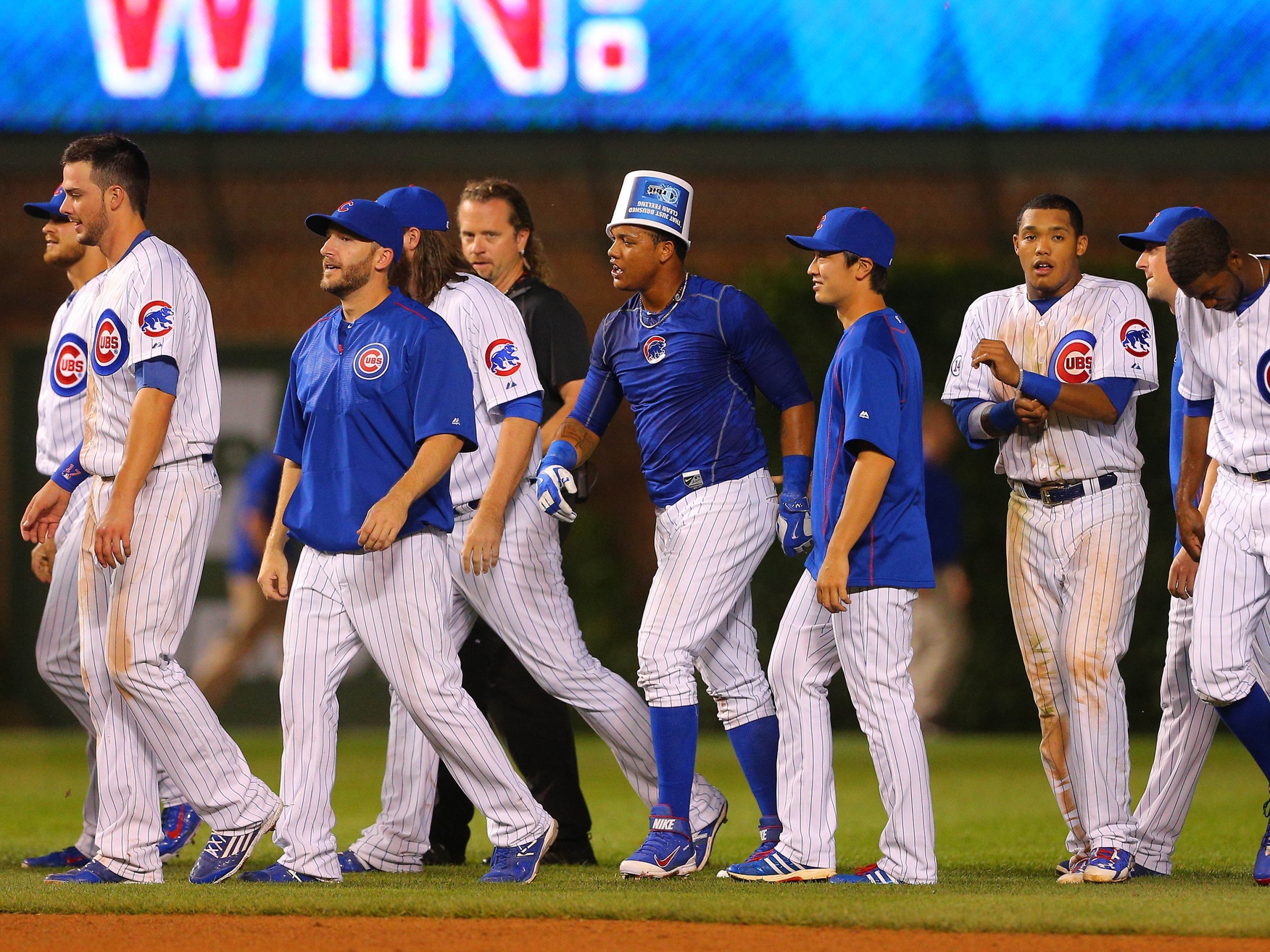 When new ownership shook up the organization, they hired Red Sox architect Theo Epstein away from Boston and initiated one of the largest youth movements since the baby boom. They are built for the long haul with a supremely talented group of younger players and are led on the field by one of the game's greatest modern tacticians: Joe Maddon. Here are some of the key young players you need to keep an eye on this weekend: Anthony Rizzo - 25 - 1B Ok, so he’s not young or recently called up. Now on his fifth season at the major league level he’s basically the team’s resident advisor. Under Epstein, the Red Sox drafted Rizzo out of high school but traded him to San Diego in exchange for Adrian Gonzalez. After Epstein moved to the Cubs, he re-acquired Rizzo in 2012 and he has entrenched himself at Wrigley as the starting first baseman and elder statesmen of the team. He gets on base a lot and plenty of that has to do with taking one for the team. Between this year and last, Rizzo has been hit by the pitch 29 times, the most in baseball. He has also shown some impressive power even if it is with some unorthodox swings. http://i.imgur.com/mAofukC.gif Kris Bryant - 23 - 3B Selected two spots in front of the Twins’ Kohl Stewart in the first round of the 2013 draft, Bryant quickly made a name for himself by hitting 43 home runs split between two levels in 2014. After the controversy over the service time when the Cubs kept him in Iowa for the first few weeks of the season, Bryant arrived and has hit .295/.398/.488 with eight home runs including this moonshot that traveled 477 feet according to StatCast -- tied for 5th furthest hit ball all year. http://i.imgur.com/wXcQurA.gif Kyle Schwarber - 22 - C/DH Selected by the Cubs in the first round of the 2014 draft, one slot ahead of the Twins’ Nick Gordon, this Indiana University product ascended Chicago’s system quickly. Loaded with power, Schwarber led the Southern League this year in slugging percentage just ahead of Minnesota’s Adam Brett Walker and Max Kepler. Reportedly a bat with power to all fields, the young catcher had that on display in Cleveland on Thursday when he hit his first major league home run. http://i.imgur.com/VGof5ZN.gif Addison Russell - 21 - 2B Acquired for Jeff Samardjiza trade with Oakland, Russell was a former 11th overall pick in 2012 -- the same year as Byron Buxton -- and was summoned to the bigs in late April. Russell has packed some punch with his bat and has been above average so far but his glove has been critically important at the up-the-middle slot. According to BillJamesOnline.net, Russell has been worth +8 runs in the field, the third best among all second basemen. http://i.imgur.com/EUMHMDz.gif For the Cubs, the future isn’t some distant, future-Delorean away, it’s now. That is why they are aggressively promoting their top talent in order to compete in the competitive NL Central. Fortunately for you, you can head on down to Target Field this weekend to watch some of these top athletes at work.
 -
When the Minnesota Twins signed the toolsy, projectable 16-year-old Max Kepler out of Germany, they received a player with promise and potential that was so raw he could be on the menu at a sushi joint. Kepler's development has been slow, particularly in the power department where his six-foot-four frame was forecast by Twins evaluators to hit the ball a long way, but judging from his 2015 season thus far he appears to have a solid future ahead.Age: 22 (DOB: 02/10/1993) 2015 Stats (A+/AA): 201 PA, .322/.383/.507 (891 OPS), 3 HR, 5 3B, 19 2B, 28/21 K/BB ETA: 2016 2014 Preseason Ranking: N/A -- 2015 Preseason Ranking: 12th Intro Kepler has been in the Twins system since 2009 when he signed for $800,000 as a teenager. It has been a slow climb for the outfielder/first baseman, who is now in his sixth season in the minors. Limited by an elbow injury in 2013, he witnessed his numbers tumble in Cedar Rapids. Kepler cited the fact that his top hand was weakened by the long rehabilitation process as a reason he struggled to drive the ball. That continued into the 2014 season at High-A in the Florida State League (a notoriously pitcher-friendly environment) as he started slow again but finished with a .307/.367/.451 line in his final 170 plate appearances after July 4th, signaling that his arm might finally be 100 percent again. What’s To Like This. That is an athletic swing that can generate plenty of hard hit balls. Since May 10, Kepler has compiled a .364/.430/.598 line in 149 plate appearances including 24 extra base hits and a well-balanced 16/17 walks-to-strikeouts ratio. "I've been seeing the ball pretty well," Kepler told MiLB.com's Robert Emrich recently. "I feel like I'm getting my foot down early, load and getting all that stuff out of the way, so I don't have much to think about; it's all coming fluid. All I have to do is see the ball, hit the ball, and it's working for me right now. While his power has not manifested in home runs, the gap power has resulted in an overall sluggng that is third in the Southern League behind Cubs' prospect Kyle Schwarber (who has since been promoted to the majors) and the Twins' powerhouse Adam Brett Walker. What’s Left To Work On Consistent production against left-handed pitching would serve him well. In 2011 he actually fared better against the sinister hurlers, hitting .351 in 45 plate appearances. When asked about his experience against lefties that season, Kepler told Hein News in a 2011 interview that "I always have the thought in the back of my head that lefty versus lefty is going to be tough. So I don’t know. Maybe I am more focused and stay more inside against lefties. But I seem to hit ‘em well.' But that was not always be the case. In 2013, perhaps because of the weakened arm strength, he hit just .117 against lefties, raising concerns that he might not be geared towards handling the better left-handed competition as he ascended the ranks. Nevertheless, that improved to .273 in 2014 and he is hitting at a robust .333 clip against them this year. "I think for some reason I've always thought that lefties are tougher to face and stuff, and I got rid of that thought this year," Kepler told Emrich last week. "It's just a ball coming from a different angle. I'm going to stick with that; it's working right now." Finding him a position in the field would be useful as well. Evaluators have said his outfield instincts have played well but with his arm strength he may be more suited for left field over right. He's spent the bulk of his time playing first base with Chattanooga this year which feels like a crowded pipeline at the major league level. What's Next? Rochester is the next logical step for the prospect as their outfield depth has been looted by the parent club and the first base position could use some help. Beyond this year is the real question. Provided Kepler can find a position, the Twins have few left-handed hitters in the system who can hit for power, making him a valuable commodity. Unfortunately there are two in Oswaldo Arcia (24) and Eddie Rosario (23) that qualify and are ahead of him on the depth chart, potentially blocking his path to Minnesota. Kepler's almost too athletic for first and lacks the home run power that should be associated with playing that position (oh, the Joe Mauer-laced irony). If he continues to hit like he has been, the Twins will need to make some serious decisions. Click here to view the article
-
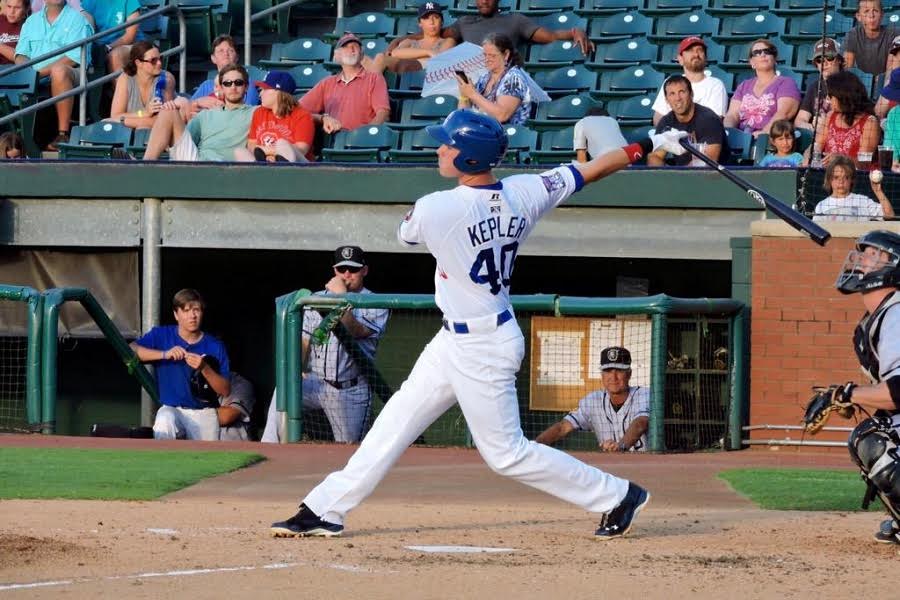 Age: 22 (DOB: 02/10/1993) 2015 Stats (A+/AA): 201 PA, .322/.383/.507 (891 OPS), 3 HR, 5 3B, 19 2B, 28/21 K/BB ETA: 2016 2014 Preseason Ranking: N/A -- 2015 Preseason Ranking: 12th Intro Kepler has been in the Twins system since 2009 when he signed for $800,000 as a teenager. It has been a slow climb for the outfielder/first baseman, who is now in his sixth season in the minors. Limited by an elbow injury in 2013, he witnessed his numbers tumble in Cedar Rapids. Kepler cited the fact that his top hand was weakened by the long rehabilitation process as a reason he struggled to drive the ball. That continued into the 2014 season at High-A in the Florida State League (a notoriously pitcher-friendly environment) as he started slow again but finished with a .307/.367/.451 line in his final 170 plate appearances after July 4th, signaling that his arm might finally be 100 percent again. What’s To Like This. https://twitter.com/twinsdaily/status/610523699943321601 That is an athletic swing that can generate plenty of hard hit balls. Since May 10, Kepler has compiled a .364/.430/.598 line in 149 plate appearances including 24 extra base hits and a well-balanced 16/17 walks-to-strikeouts ratio. "I've been seeing the ball pretty well," Kepler told MiLB.com's Robert Emrich recently. "I feel like I'm getting my foot down early, load and getting all that stuff out of the way, so I don't have much to think about; it's all coming fluid. All I have to do is see the ball, hit the ball, and it's working for me right now. While his power has not manifested in home runs, the gap power has resulted in an overall sluggng that is third in the Southern League behind Cubs' prospect Kyle Schwarber (who has since been promoted to the majors) and the Twins' powerhouse Adam Brett Walker. What’s Left To Work On Consistent production against left-handed pitching would serve him well. In 2011 he actually fared better against the sinister hurlers, hitting .351 in 45 plate appearances. When asked about his experience against lefties that season, Kepler told Hein News in a 2011 interview that "I always have the thought in the back of my head that lefty versus lefty is going to be tough. So I don’t know. Maybe I am more focused and stay more inside against lefties. But I seem to hit ‘em well.' But that was not always be the case. In 2013, perhaps because of the weakened arm strength, he hit just .117 against lefties, raising concerns that he might not be geared towards handling the better left-handed competition as he ascended the ranks. Nevertheless, that improved to .273 in 2014 and he is hitting at a robust .333 clip against them this year. "I think for some reason I've always thought that lefties are tougher to face and stuff, and I got rid of that thought this year," Kepler told Emrich last week. "It's just a ball coming from a different angle. I'm going to stick with that; it's working right now." Finding him a position in the field would be useful as well. Evaluators have said his outfield instincts have played well but with his arm strength he may be more suited for left field over right. He's spent the bulk of his time playing first base with Chattanooga this year which feels like a crowded pipeline at the major league level. What's Next? Rochester is the next logical step for the prospect as their outfield depth has been looted by the parent club and the first base position could use some help. Beyond this year is the real question. Provided Kepler can find a position, the Twins have few left-handed hitters in the system who can hit for power, making him a valuable commodity. Unfortunately there are two in Oswaldo Arcia (24) and Eddie Rosario (23) that qualify and are ahead of him on the depth chart, potentially blocking his path to Minnesota. Kepler's almost too athletic for first and lacks the home run power that should be associated with playing that position (oh, the Joe Mauer-laced irony). If he continues to hit like he has been, the Twins will need to make some serious decisions.
 -
Sick "I got a lot of work done" brag.
-
https://twitter.com/ParkerHageman/status/611619292111630336
-
RE: Bat speed & unluckiness. BaseballSavant.com tracks exit speeds. According to their leaderboard filter, Joe Mauer averages 89 MPH on the batted ball speed which is roughly league average (using the thumb eyeball test). He actually has a slightly better exit velocity than Joey Votto who is hitting .295/.396/.547 this year. Early research has shown that around 90 MPH a batted ball has a better chance of becoming a hit than it does an out. According to BaseballSavant, Mauer has hit over 49 balls of a batted ball rate of 90 MPH or above that have been turned into outs. Only six other batters have had that type of bad luck. M. Betts - 70 Pujols - 61 Melky Cabrera - 59 Fielder - 56 Granderson - 50 Prado - 50 Mauer - 49 There is no way to pull a historical track record of this but this leads me to believe that Mauer has hit plenty of at 'em balls or players have been positioned in places to take away a lot of those hard hit balls.
-
It's not necessarily bat speed that is keeping him from squaring up on pitches or driving the ball. Another data point about Mauer this season is an increase in foul balls on fastballs -- which is another way of saying he's missing them. I know Trackman doesn't date back that far but the only way really to see if his bat speed is slowing is to check on that system. Right. He's pulling the ball more but it's on the ground. He's pulling pitches that he normally wouldn't (those in the vertical middle of the zone) or on the inner-half (he would inside-out those) and when he does pull, it is on the ground. The defense can still do what it has been doing the last two years (outfield shift left, infield shift right) and take away hits.
-
Molitor addressed his thoughts on Mauer last week: http://www.startribune.com/twins-mauer-still-productive-despite-dip-in-batting-average/307077631/ Molitor also thinks Mauer has had some hits stolen from him.
-
Paragraph 4, sentence 3: "Aging, the rigors of catching, physical injuries and, of course, brain injuries have all likely played a role in his current status..." I don't want to ignore that -- I do believe there is some age-related decline in here -- but there are also numerous players who have played well into their 30's. And his second-half of last year witnessed solid production out of him. Now a lot of those players didn't catch or have concussions, which is why I think there is a blend of factors contributing to his decline. But those are the factors that are contributing to his inability to drive the ball. I have seen some references to a decline in bat speed on this site (and elsewhere) but the fact that he is ahead of more fastballs than he has been suggests to me that the bat speed is fine. Here's the thing -- aging, concussions, etc -- while they have some effects on his overall play, they are not the reason behind the change in pulling the ball more or avoiding hitting the ball into the left field corner. I don't blame the Twins for trying to get Mauer to pull the ball more -- that's a big vacancy in right field -- but I would rather he just go back to hitting into the shift and letting the cards fall as they may.
-
I'm hoping this thread just digresses into a debate about why they keep building a theme park on that dinosaur island. SMH
-
He has actually reduced the number of K's from last year but the ones he does have are mostly caught looking. It is down and away that has been the biggest culprit for called strikes. I didn't mention this in the post because I don't get paid by the word but Mauer's been more aggressive early in the count -- first pitch and otherwise -- than he has been in the past. He has had just 7% of his plate appearances going into the 3-1 count which is well-below is 13% 3-1 career average and means fewer walks and fewer counts to drive the ball.
-
With the Minnesota Twins experiencing a losing skid that threatens to take them below the .500 mark, there is no shortage of hand-wringing over Joe Mauer’s subpar performance. Inserted daily in a key middle-of-the-order position, Mauer has vastly underperformed his career rates. As Aaron Gleeman detailed this week, Mauer’s season has been borderline disastrous in terms of production at a position that places a premium on offensive contributions. Twins Daily’s Nick Nelson echoed those concerns as well, citing Justin Morneau’s on-going battle with concussions that has sidelined him for an indefinite period of time. The real question everyone is asking themselves is if this is how it ends for Mauer -- rather than going out with a bang, does he goes out with a whimper?Isolating the source behind Mauer’s apparent decline is a lot like trying to figure out why they keep trying to open a dinosaur theme park on that island. There are multiple factors at play and we may never know the real reason. Aging, the rigors of catching, physical injuries and, of course, brain injuries have all likely played a role in his current status. The concussion may be the easiest of the dots to connect considering his performance before and after the trauma, Mauer also managed to compile impressive second-half numbers in 2014 (.300/.388/.419 in his final 63 games) and battled an oblique injury in between. There is no denying that the concussion has had some effect on his game -- likely a significant one at that -- but the late season surge suggests that he is capable of playing through it. With that in mind, it is difficult to place the entire output decline this season squarely on the concussion. Early last season, opponents began to align their outfield defenses to combat his opposite field tendencies. The Rays were one of the first organizations to shade him almost as an exclusively opposite field hitter, moving their right fielder within steps of where a center fielder should normally play. Mauer, who averaged .422 batting average on balls in play from 2009-2013 when going the other way on the fly or on a line, suddenly found that some of those hits were being taken away. This season, with more teams joining in the outfield shift game, even fewer liners and flies are becoming hits and his average going the other way is down nearly 100 points from his 2011-2014 totals. It is somewhat surprising that it took until 2014 for teams to recognize Mauer’s radical split tendencies. After all, Fangraphs.com’s Dave Cameron was championing the use of the double shift (infielders shifting one way, outfielders the other). “So, stat guys working for MLB clubs reading this,” Cameron wrote over five years ago, “this is your challenge for 2010 – convince your manager to give the double-shift against Mauer a chance. Make him change his approach in order to get on base. Stop letting him beat you just because he’s so different than a normal hitter.” What teams finally saw in the data was a clear-cut pattern from Mauer in which almost none of his batted balls were reaching the far right portion of the outfield. At least not in the air. Why waste time covering real estate that isn’t going to get touched? Teams were smart to hedge their bets on Mauer’s opposite field tendencies. Download attachment: export.png Although the strategy only directly stole about 10 hits away from his overall totals, the shifting may have also had a psychological effect on Mauer which influenced his performance. The alignment would challenge Mauer to attempt to adjust from his bread-and-butter (opposite field liners) and try to elevate pitches on the pull side. In May manager Ron Gardenhire told the media that he felt Mauer would start hitting the ball in different zones in order to reset the defense. By the time June rolled around last year, he had successfully transitioned away from dumping balls into left and hit a higher percentage of them up the middle. His average and on-base percentage began to ramp up again as the outfield defenses began to play straight-up. This offseason Mauer and the Twins went to some length to correct the fly in the ointment to ensure the shift wouldn’t be an issue moving forward. In spring training, mlb.com’s Rhett Bollinger wrote that Mauer was working tediously with Tom Brunansky to pull the ball better than he did last season. Last season he finished with a .224 batting average when pulling the ball -- the lowest among qualified hitters. As one of the game’s best pure hitters, this was a giant pox and addressing it would be a must. After honing his craft, Mauer came out in this season’s first month with a 36% pull rate which was the highest distribution of batted balls to his pull side over the last six years. And it paid off too. He has hit .310 with a .431 slugging percentage when hitting that direction, a sizable improvement over 2014. But that may have also created new problems. One of Mauer’s most glaring problems this season has been a lack of performance against fastballs. From 2010 to 2014, he has batted .359/.451/.541 against the heat. Even last season he managed to hit .318/.408/.421 off fastballs. In all cases, the vast majority of those numbers came from driving fastballs the other way. In 2015 he is batting just .256/.310/.353 on the cheese and has attempted to pull those pitches at a much higher rate (from 18% in 2014 to 26% in 2015). What stands out the most in the data is that Mauer has increased the amount of times he chases after a fastball out of the zone -- particularly inside and off the plate: Download attachment: output_FifNOU.gif Download attachment: Mauer.png This is interesting because it appears that either Mauer or the coaching staff moved him slightly away from the plate as well. This may be a response to the jump in cutters and fastballs in on the hands. http://i.imgur.com/4DVFJe2.gif The shifting and Mauer’s response somewhat explains the decline in batting average but it certainly does not explain not being able to drive the ball with authority. While a new approach at the plate could result in some iffy contact, Mauer has witnessed a precipitous drop in both his hard hit ball figures as well as his fly ball distances. That is likely due to either his physical state or his concussion. However his game plan at the plate as well as the defensive alignment may be partly responsible for the loss of extra base hits. From 2011 through 2014, Mauer feasted upon the left field line, using that to accumulate numerous doubles. Download attachment: export (1).png With teams stationing a fielder on the chalk and a newly kindled effort to pull the ball, Mauer has hit fewer balls to the left field line than he had in the past. Download attachment: export (2).png Now when he receives a fastball on the inner-half or middle-in, instead of inside-outing the pitch or punching it towards left as he did in the past, he is now trying to go up the middle or towards right. This has resulted in a spike in grounders and the defense’s infield middle shift has taken away a number of would-be base hits. The notion that Mauer would become an power machine once he started to pull the ball more never manifested. While he has shown the ability to achieve a few more base hits on the right side, he still has not proven that he can elevate the ball in that direction and teams have opted to shade him to left to take away his extra base hit potential. Unless he can figure out a way to somehow drive the ball on the pull side, the tactics of yanking pitches has been detrimental to his overall approach. Even with the shaded defensive alignment, it may be in Mauer’s best interest to return to his strength of driving the ball the other way -- even if it means losing some hits in the process. Click here to view the article
-
 Isolating the source behind Mauer’s apparent decline is a lot like trying to figure out why they keep trying to open a dinosaur theme park on that island. There are multiple factors at play and we may never know the real reason. Aging, the rigors of catching, physical injuries and, of course, brain injuries have all likely played a role in his current status. The concussion may be the easiest of the dots to connect considering his performance before and after the trauma, Mauer also managed to compile impressive second-half numbers in 2014 (.300/.388/.419 in his final 63 games) and battled an oblique injury in between. There is no denying that the concussion has had some effect on his game -- likely a significant one at that -- but the late season surge suggests that he is capable of playing through it. With that in mind, it is difficult to place the entire output decline this season squarely on the concussion. Early last season, opponents began to align their outfield defenses to combat his opposite field tendencies. The Rays were one of the first organizations to shade him almost as an exclusively opposite field hitter, moving their right fielder within steps of where a center fielder should normally play. Mauer, who averaged .422 batting average on balls in play from 2009-2013 when going the other way on the fly or on a line, suddenly found that some of those hits were being taken away. This season, with more teams joining in the outfield shift game, even fewer liners and flies are becoming hits and his average going the other way is down nearly 100 points from his 2011-2014 totals. It is somewhat surprising that it took until 2014 for teams to recognize Mauer’s radical split tendencies. After all, Fangraphs.com’s Dave Cameron was championing the use of the double shift (infielders shifting one way, outfielders the other). “So, stat guys working for MLB clubs reading this,” Cameron wrote over five years ago, “this is your challenge for 2010 – convince your manager to give the double-shift against Mauer a chance. Make him change his approach in order to get on base. Stop letting him beat you just because he’s so different than a normal hitter.” What teams finally saw in the data was a clear-cut pattern from Mauer in which almost none of his batted balls were reaching the far right portion of the outfield. At least not in the air. Why waste time covering real estate that isn’t going to get touched? Teams were smart to hedge their bets on Mauer’s opposite field tendencies. Although the strategy only directly stole about 10 hits away from his overall totals, the shifting may have also had a psychological effect on Mauer which influenced his performance. The alignment would challenge Mauer to attempt to adjust from his bread-and-butter (opposite field liners) and try to elevate pitches on the pull side. In May manager Ron Gardenhire told the media that he felt Mauer would start hitting the ball in different zones in order to reset the defense. By the time June rolled around last year, he had successfully transitioned away from dumping balls into left and hit a higher percentage of them up the middle. His average and on-base percentage began to ramp up again as the outfield defenses began to play straight-up. This offseason Mauer and the Twins went to some length to correct the fly in the ointment to ensure the shift wouldn’t be an issue moving forward. In spring training, mlb.com’s Rhett Bollinger wrote that Mauer was working tediously with Tom Brunansky to pull the ball better than he did last season. Last season he finished with a .224 batting average when pulling the ball -- the lowest among qualified hitters. As one of the game’s best pure hitters, this was a giant pox and addressing it would be a must. After honing his craft, Mauer came out in this season’s first month with a 36% pull rate which was the highest distribution of batted balls to his pull side over the last six years. And it paid off too. He has hit .310 with a .431 slugging percentage when hitting that direction, a sizable improvement over 2014. But that may have also created new problems. One of Mauer’s most glaring problems this season has been a lack of performance against fastballs. From 2010 to 2014, he has batted .359/.451/.541 against the heat. Even last season he managed to hit .318/.408/.421 off fastballs. In all cases, the vast majority of those numbers came from driving fastballs the other way. In 2015 he is batting just .256/.310/.353 on the cheese and has attempted to pull those pitches at a much higher rate (from 18% in 2014 to 26% in 2015). What stands out the most in the data is that Mauer has increased the amount of times he chases after a fastball out of the zone -- particularly inside and off the plate: This is interesting because it appears that either Mauer or the coaching staff moved him slightly away from the plate as well. This may be a response to the jump in cutters and fastballs in on the hands. http://i.imgur.com/4DVFJe2.gif The shifting and Mauer’s response somewhat explains the decline in batting average but it certainly does not explain not being able to drive the ball with authority. While a new approach at the plate could result in some iffy contact, Mauer has witnessed a precipitous drop in both his hard hit ball figures as well as his fly ball distances. That is likely due to either his physical state or his concussion. However his game plan at the plate as well as the defensive alignment may be partly responsible for the loss of extra base hits. From 2011 through 2014, Mauer feasted upon the left field line, using that to accumulate numerous doubles. With teams stationing a fielder on the chalk and a newly kindled effort to pull the ball, Mauer has hit fewer balls to the left field line than he had in the past. Now when he receives a fastball on the inner-half or middle-in, instead of inside-outing the pitch or punching it towards left as he did in the past, he is now trying to go up the middle or towards right. This has resulted in a spike in grounders and the defense’s infield middle shift has taken away a number of would-be base hits. The notion that Mauer would become an power machine once he started to pull the ball more never manifested. While he has shown the ability to achieve a few more base hits on the right side, he still has not proven that he can elevate the ball in that direction and teams have opted to shade him to left to take away his extra base hit potential. Unless he can figure out a way to somehow drive the ball on the pull side, the tactics of yanking pitches has been detrimental to his overall approach. Even with the shaded defensive alignment, it may be in Mauer’s best interest to return to his strength of driving the ball the other way -- even if it means losing some hits in the process.
 -
On this week's NO JUICE PODCAST, Dan Anderson and Parker Hageman discuss the moment every Twins fan has been waiting for -- Byron Buxton has officially arrived. Did you know he's fast? You probably didn't know he is fast. Check out the videos below. LISTEN UP.Here's Byron Buxton legging out a stand-up triple with Chattanooga earlier this year: There are bound to be struggles -- particularly with sliders from right-handed pitchers -- but for now let us all enjoy watching the future of baseball play the ame with blinding speed. Listen below, on iTunes or on Stitcher: NO JUICE PODCAST, EPISODE #59: Byron Buxton's Debut Click here to view the article
-
 Here's Byron Buxton legging out a stand-up triple with Chattanooga earlier this year: https://twitter.com/ParkerHageman/status/609942007365005312 And here's Buxton beating out a routine ground out: Finally, his first career hit: https://twitter.com/ParkerHageman/status/610665940817199105 There are bound to be struggles -- particularly with sliders from right-handed pitchers -- but for now let us all enjoy watching the future of baseball play the ame with blinding speed. Listen below, on iTunes or on Stitcher: NO JUICE PODCAST, EPISODE #59: Byron Buxton's Debut
 -
Plouffe hit a home run tonight. Pitch was middle-up. Plouffe made two outs as well. Both of those were on fastballs in. Not sayin, just sayin.
-
Plouffe has become much more of steadier hitter as of late by avoiding the prolonged slumps he experienced earlier in his career. He used to have a giant hole in his swing on right-handed sliders away but he has since attacked those. It's possible that pitchers/teams noticed he was sitting on pitches on the outer-half in certain counts too much and started to bust him inside a little bit more rather than going away. He had been a really strong inside ball hitter so I'm sure he will turn on a few of those eventually. Edinson Volquez will be an interesting matchup tonight. He's got a running sinker but doesn't have the greatest command of it. Look for Plouffe to turn on one of those.
-
What makes you think he's lost bat speed?
-
Admittedly, Mauer does deserve a post all on his own.
-
No, headline aside, the post is about Plouffe's struggles.
-
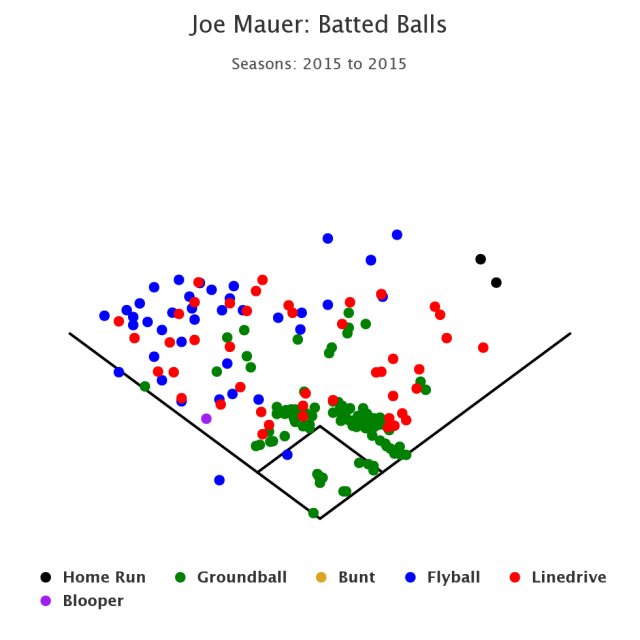
I'll start by prefacing my comment as this was not a post about Joe Mauer but, like all things, it ALWAYS turns into a discussion about Joe Mauer, right? I had to mention Mauer in the post because if I didn't, the comment section would be only remarks about not mentioning Mauer. The OF shift shouldn't be a shock. I detailed that development early last year (http://www.startribune.com/twinscentric-what-is-going-on-with-joe-mauer-here-s-the-data/261202251/). Teams are just responding to what his batted ball profile indicates. Even with all the efforts this spring to work on being a better pull hitter, he still doesn't elevate the ball to right field -- it's mostly grounders (70%) or liners (25%).
-
Once a prime contributor to the Minnesota Twins’ early season surge to the top of the American League Central, third baseman Trevor Plouffe has suddenly gone cold in the heart of the order. Unfortunately for the team, Joe Mauer shares similar woes at the plate. Since the beginning of June, the Twins are hitting a league-worst .119 (8-for-67) with just two extra base hits over the last nine games. In order to compete for a playoff berth, they will need better production from the middle of their order. Is this the beginning of a large slump for Plouffe or will he return to his early-season form?For Plouffe, April and May were extremely successful months in the batter's’ box. In the season’s first two months he helped buoy the middle of the order -- one that was vacated by Torii Hunter early in the season. At the end of May, he was holding the second-highest OPS on the team as well as a robust .721 slugging percentage with runners in scoring position. Plouffe was productive at all the right times which helped propel the Twins’ offense forward and confounded analysts attempting to explain how the Minnesota ballclub was on top of their division. Admittedly, the turn of the calendar is an arbitrary moment in the baseball season; nothing changes in the competition or in the player just because it is Ms. June’s time to shine on the clubhouse wall. That notwithstanding, Plouffe has appeared like an entirely different hitter this stretch. Mired in an extended 2-for-32 slump -- one which he showed signs of shaking off on Tuesday night by lashing a triple off the wall in right field -- Plouffe is wrestling with the toughest element of the game: adjusting to a new plan of attack. In the days bygone, reports traveled by word of tobacco-filled mouth. Now information is binary and able to be downloaded, disseminated and acted upon by the very next game. But baseball’s information game is a two-way street. The pitchers are armed with data and the hitters are prepared in kind. “We get so much information it can choke a cow,” Twins hitting coach Tom Brunansky likes to say about the flow of knowledge pertaining to his area of expertise. So shouldn’t hitters be just as prepared as their pitcher counterparts? While baseball’s hitter-pitcher matchup should behave like a stalemate cold war, the fact is the advantage often goes to the player who possesses the ball and is able to throw the pitch he wants. The problem for hitters is that the game never sleeps. Not for a second. Coaches, pitchers, scouts, and front office analysts are all trying to find the right combination that will get you out. If you were hitting balls hard in a certain situations, with a certain pitch, in a certain area of the zone, there is a strong chance that things will change the next time around. That has essentially happened to Plouffe. After showing that he could drive the ball on the outer-half to the opposite field, teams have tried something else. Somewhere between the end of May and the beginning of June, pitchers started to add another wrinkle. In the first two months pitchers would hammer him away with fastballs (40% inner-half of the zone). However, since the beginning of his slump, they have shifted that attack inside just off the plate (60% inner-half) and Plouffe has been unable to resist or put the ball in play effectively. The ESPN TruMedia heat maps below show how pitchers have shifted from throwing fastballs away to the inside portion: Download attachment: trumedia_baseball_grid (2).png Download attachment: trumedia_baseball_grid (3).png There has been a concerted effort particularly by right-handed pitchers to pound two-seamers in off the plate on Plouffe. In Fenway against the Red Sox, Plouffe offered at a running fastball that was down-and-in on a an one-one count: http://i.imgur.com/J00dTNw.gif When the Brewers visited, Milwaukee reliever Jeremy Jeffress also ran a fastball in off the plate which Plouffe bounced out on a one-oh count: http://i.imgur.com/9tVPm4o.gif Those types of pitches look appetizing coming in before they burrow their way into the bat handle at the point of contact. Not surprising, Plouffe’s chase rate grew in June as well with the majority being swings at pitches inside off the plate. This expansion of the zone has led to weaker contact as well as a drop in walks. Possibly because of his determination to drive runners in, Plouffe’s walk rate suffered in this time as well. Dating back to May 21, he has drawn just one walk in 62 plate appearances. To be fair, 30-plus plate appearances is not a real concern. It just takes a few decent at-bats to help pull a hitter out of the funk and the stretch will be forgotten. However, with the added issue of Joe Mauer’s lack of production in front of him, it has exacerbated the problem for the team overall. If the Twins expect to continue to battle for a top spot in the division, they will need Trevor Plouffe to re-calibrate quickly. Click here to view the article

