Nick Nelson
-
Posts
8,326 -
Joined
-
Last visited
-
Days Won
56
Content Type
Profiles
News
Minnesota Twins Videos
2026 Minnesota Twins Top Prospects Ranking
2022 Minnesota Twins Draft Picks
Minnesota Twins Free Agent & Trade Rumors, Notes, & Tidbits
Guides & Resources
2023 Minnesota Twins Draft Picks
The Minnesota Twins Players Project
2024 Minnesota Twins Draft Picks
2025 Minnesota Twins Draft Pick Tracker
2026 Minnesota Twins Draft Tracker: Picks & Bonuses
Forums
Blogs
Events
Store
Downloads
Gallery
Everything posted by Nick Nelson
-
 Late on Sunday night, the Twins traded Josh Donaldson, Ben Rortvedt, and newly-acquired shortstop Isiah Kiner-Falefa to the Yankees in exchange for Gary Sanchez and Gio Urshela. Fans were blindsided and bewildered by this move, which upended the team's entire offseason. We don't know much right now, and probably won't get the full picture until more moves are made. But here are four things we DO know. 1. The Twins REALLY wanted to get out from under Josh Donaldson's contract. I'm not at all surprised that the Twins were looking to trade Donaldson. Personally I've been on board with that course of action for some time, and wrote as much last July. At the time, I hoped they might be able to leverage the trade deadline or cover some of his remaining salary to lessen the blow of unloading such an undesirable contract. Alas, they did not. The front office was able to eventually finder a taker for Donaldson, and New York even took on the full remainder of his deal – all $50 million in guaranteed money. To make it happen, the Twins needed to part with Mitch Garver (via Isiah Kiner-Felafa) and Ben Rortvedt in addition to Donaldson, decimating their catching depth while reopening a total vacancy at shortstop. Minnesota also brought on two buy-low reclamation projects in the swap. It's hard to imagine that either Gio Urshela or Gary Sanchez were players the Twins coveted, coming off bad years with dwindling team control. But that was part of the deal. It's a deal the Twins made purely out of eagerness to escape Donaldson's contract. And I get it. He didn't fit here anymore and his big salaries at 36 and 37 were likely to be a hindrance. Now the Twins are free of that commitment, albeit at the expense of clearly downgrading the current roster. To what end? 2. They Twins now have, like, no catching depth. Garver, gone. Rortvedt, gone. Even our sweet baby boy Willians Astudillo is gone. It was notable that the our recent top 20 prospects breakdown included zero catchers, and now the Twins have suddenly parted with two of their three big-leaguers in one fell swoop. What are we doing here? This system has no depth to be wiping out the top shelf like that. Yes, Sanchez is here, but we're talking about a guy who's widely regarded as one of the worst defensive catchers in baseball. He's a terrible pitch-framer and borderline DH. Did the Twins just abandon their whole philosophy around the value of defense and catching depth? Oh, and: 3. They also have no shortstop (again). We'd all spent about 24 hours talking ourselves into Kiner-Falefa. "Yeah, the Andrelton Simmons thing didn't work out, but that doesn't mean the concept of a glove-first shortstop was bad. IKF is young and hungry! He's gritty!" And then, poof. The solution at shortstop was gone nearly as fast as he arrived, and thus, the Twins are back to square one. Meanwhile, every free agent option has dried up – Simmons and Jose Iglesias both signed over the weekend. The middle tier is gone. I mean, there are still a couple of big names out there. And, the biggest takeaway from all this is... 4. The Twins now have all kinds of flexibility to make at least one HUGE move. The front office freed up $50 million in future payroll commitments, on the same day they traded their 2021 first-round draft pick for a veteran front-line starter. These signs clearly point toward the Twins setting up for one or more extremely significant moves. It's fascinating to think about what that might look like. By this point all high-end free agent pitchers are gone. Two big-name shortstops remain, and I'm confident Minnesota is not signing Carlos Correa. So, are they going to sign Trevor Story? They are reportedly in contact with his camp, so it's definitely a possibility. But it can hardly be considered a lock, right? If the Twins don't land Story, what's the backup plan? And even if they do, how will they address their multiple remaining needs in the rotation, bullpen, and outfield? How are the Twins going to spend all this newly freed up money, with spring training already underway and Opening Day bearing down fast? Like I said, a lot of unknowns. But it's gonna be fun to find out. MORE FROM TWINS DAILY — Latest Twins coverage from our writers — Recent Twins discussion in our forums — Follow Twins Daily via Twitter, Facebook or email View full article
- 120 replies
-
- 1
-

-
- josh donaldson
- gary sanchez
- (and 1 more)
-
I think at this stage of his career Donaldson has an expectation of full-on contention and I don't think he'd be very content on a team that's taking a step back and looking to the future. On a more subjective note, I think this brashness and ego are better fits in a place like New York than with the culture Rocco's trying to build here.
- 237 replies
-
- 1
-
-
- josh donaldson
- gary sanchez
- (and 1 more)
-
An eventful weekend receives a stunning final twist. According to multiple reports, the Twins are sending Josh Donaldson and newly-acquired shortstop Isiah Kinfer-Falefa to the New York Yankees in exchange for catcher Gary Sanchez and infielder Gio Urshela. Talk about a blockbuster. Jon Heyman was first to break the news that Gary Sanchez was heading to Minnesota. Jeff Passan quickly followed up with an elaboration: Josh Donaldson and Isiah Kiner-Falefa are headed to New York in the deal. We soon learned the Twins are also giving up catcher Ben Rortvedt and getting infielder Gio Urshela, who will presumably be the Twins' new third baseman or shortstop. There's a lot going on here, and we'll surely spend the next several days unpacking it, but let's try and wrap our arms around this thing. To summarize the move, Yankees get: 3B Josh Donaldson, SS Isiah Kiner-Falefa, C Ben Rortvedt Twins get: C/DH Gary Sánchez, 3B/SS Gio Urshela It was already a whirlwind weekend before this move. Now the roster has been completely uprooted and transformed over a span of two days. Donaldson's presence and salary both looked like odd fits with the Twins seemingly entering a transitional year. Shipping him to the Yankees makes sense in terms of their contention status and spending capabilities. Donaldson also feels like a proper personality fit in the Bronx. Kiner-Falefa's inclusion in the deal is stunning. The Twins acquired him from Texas on Saturday in exchange for Mitch Garver. Were they setting up this deal all along? Did the acquisition pique New York's interest? Either way, the brevity of his Minnesota career would make Jaime Garcia blush (he was also instantly flipped to the Yankees in 2017, incidentally). Between Garver and now Rortvedt, the Twins have completely wiped out their pre-existing catching depth around Ryan Jeffers. However, they added some back in the form of Sánchez, who's coming off two tough seasons but is a two-time All-Star with 138 career home runs at age 29. He's due for free agency after the 2022 season. Urshela, who is two years from free agency (like Kiner-Falefa was) started 28 games at shortstop for the Yankees last year, and 96 at third base. He had started only 13 total games at short in his previous five seasons. Do the Twins envision him playing there, with Jose Miranda taking over at third? Or are they clearing salary room for Trevor Story? This feels like a stepping stone to something else. For now, it feels confusing and pretty overwhelming. Share your thoughts in the comments section. MORE FROM TWINS DAILY — Latest Twins coverage from our writers — Recent Twins discussion in our forums — Follow Twins Daily via Twitter, Facebook or email View full article
- 237 replies
-
- 1
-
-
- josh donaldson
- gary sanchez
- (and 1 more)
-
Twins Trade Donaldson, Kiner-Falefa to Yankees for Sanchez, Urshela
Nick Nelson posted an article in Twins
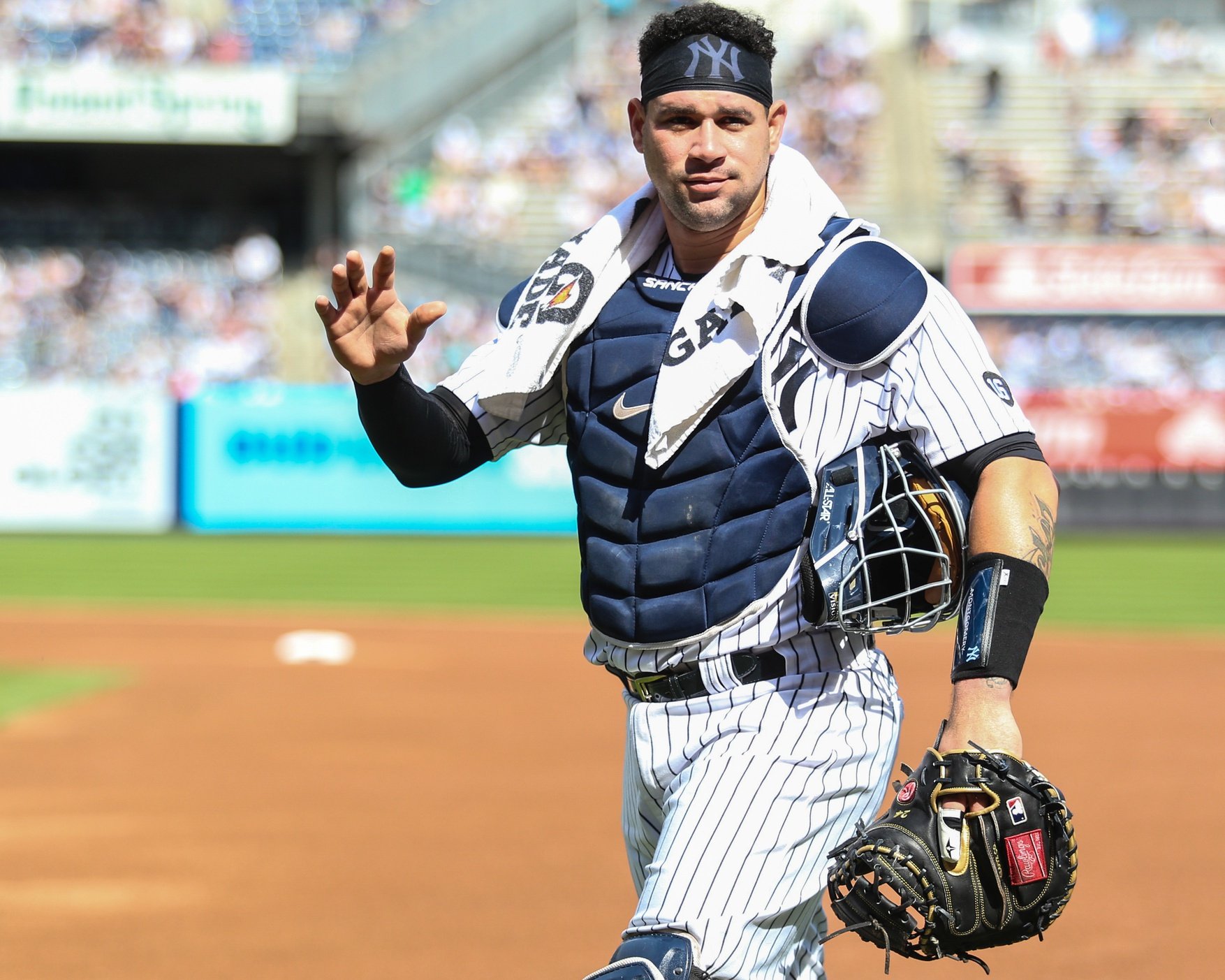 Jon Heyman was first to break the news that Gary Sanchez was heading to Minnesota. Jeff Passan quickly followed up with an elaboration: Josh Donaldson and Isiah Kiner-Falefa are headed to New York in the deal. We soon learned the Twins are also giving up catcher Ben Rortvedt and getting infielder Gio Urshela, who will presumably be the Twins' new third baseman or shortstop. There's a lot going on here, and we'll surely spend the next several days unpacking it, but let's try and wrap our arms around this thing. To summarize the move, Yankees get: 3B Josh Donaldson, SS Isiah Kiner-Falefa, C Ben Rortvedt Twins get: C/DH Gary Sánchez, 3B/SS Gio Urshela It was already a whirlwind weekend before this move. Now the roster has been completely uprooted and transformed over a span of two days. Donaldson's presence and salary both looked like odd fits with the Twins seemingly entering a transitional year. Shipping him to the Yankees makes sense in terms of their contention status and spending capabilities. Donaldson also feels like a proper personality fit in the Bronx. Kiner-Falefa's inclusion in the deal is stunning. The Twins acquired him from Texas on Saturday in exchange for Mitch Garver. Were they setting up this deal all along? Did the acquisition pique New York's interest? Either way, the brevity of his Minnesota career would make Jaime Garcia blush (he was also instantly flipped to the Yankees in 2017, incidentally). Between Garver and now Rortvedt, the Twins have completely wiped out their pre-existing catching depth around Ryan Jeffers. However, they added some back in the form of Sánchez, who's coming off two tough seasons but is a two-time All-Star with 138 career home runs at age 29. He's due for free agency after the 2022 season. Urshela, who is two years from free agency (like Kiner-Falefa was) started 28 games at shortstop for the Yankees last year, and 96 at third base. He had started only 13 total games at short in his previous five seasons. Do the Twins envision him playing there, with Jose Miranda taking over at third? Or are they clearing salary room for Trevor Story? This feels like a stepping stone to something else. For now, it feels confusing and pretty overwhelming. Share your thoughts in the comments section. MORE FROM TWINS DAILY — Latest Twins coverage from our writers — Recent Twins discussion in our forums — Follow Twins Daily via Twitter, Facebook or email
- 237 comments
-
- 3
-
-

-
- josh donaldson
- gary sanchez
- (and 1 more)
-
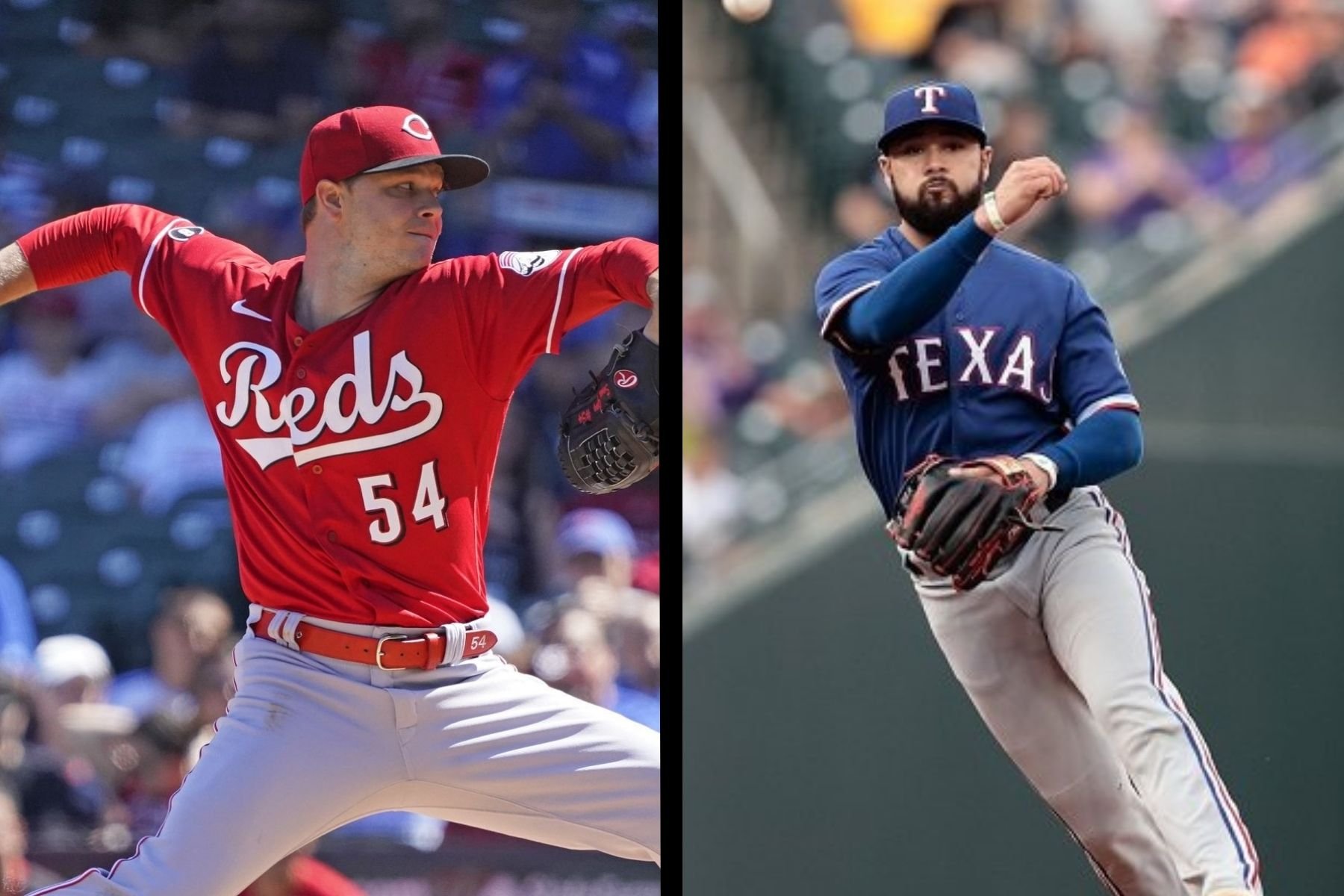 [Author's Note: Naturally, MINUTES after I said to myself, "Okay, probably safe to post this, the action has gotta be wrapped up for the weekend," we learned of a major blockbuster trade between the Twins and Yankees. You can learn about it here. And then read on to learn about the state of the roster ... just BEFORE that move.] Twins Send Garver to Texas for Kiner-Falefa Minnesota's front office checked off the "shortstop" box before turning its attention to the pitching staff, acquiring Isiah Kiner-Falefa from the Rangers alongside pitching prospect Ronny Henriquez. The cost was extremely high: Mitch Garver is gone. To procure this package from Texas, the Twins had to part with the 31-year-old who they drafted-and-developed, from ninth-round pick into elite slugging catcher and self-made pitch-framing specialist. Garver, under control for two more seasons just like Kiner-Falefa, is one of the biggest difference-making bats in the league as a nearly unrivaled offensive force from the catcher position. Despite his dwindling team control, I ranked Garver this year as the eighth-most valuable asset in the organization, and when sizing up the club's top trade candidates, I didn't see him as one of the top-five most likely to go. "One could theoretically add Mitch Garver or Ryan Jeffers to this list," I wrote, "although I'm not sure I have enough confidence in either one to feel good about trading the other." Therein lies my struggle with this move. Jeffers hasn't shown enough yet to be confident in his status as "The Guy" going forward, and the Twins are woefully short on qualified depth behind him and Ben Rortvedt in the system. The Twins gave up a lot for a light-hitting defensive specialist. Too much, in my opinion. But the team has firmly addressed its need at shortstop with a versatile young player who was highly regarded in Texas. The price they paid says a great deal about their belief in Kiner-Falefa. Frontline Pitching at Last: Twins Get Gray from Reds for Petty The rotation looks a lot more legitimate now than it did coming out of the lockout. There was plenty of buzz indicating the Twins were pursuing high-end pitching on the trade market, and the rumors came to fruition on Sunday with the extraction of right-hander Sonny Gray from the Reds. In this deal, the Twins gave up all future value, sending 2021 first-round draft pick Chase Petty to Cincinnati. I recently wrote the profile on Petty as our #9 Twins prospect, and got myself all jazzed about dreaming on his upside, but even the most optimistic analysis of Petty has to acknowledge his sky-high burnout risk. To exchange such a volatile asset for an established top-of-rotation for starter with two years of reasonably-priced team control remaining ($10.2M in 2022 with a $12M option for '23) should be viewed as a big win. Gray is a two-time All-Star with an extensive pitch mix, a bulldog mentality, and excellent strikeout rates (10.6 K/9 since 2019) who figures to benefit from a move away from Cincinnati's hitter-friendly ballpark. He posted a 3.44 ERA with six home runs allowed in 12 road starts last year, compared to 4.89 with 13 homers in 14 home starts. The addition of Gray certainly makes the Twins a better team in 2022, but between this and the Kiner-Falefa pickup – both players having team control for two more years – one can sense that the front office is primarily focused on building toward 2023, when Kenta Maeda returns to the fold. An Updated Look at the Roster and Payroll With Gray and Kiner-Falefa joining the party, here's how the Twins roster now projects. The payroll (which includes about $15M in new salary for those two, as well as Gray's $1M trade bonus, paid by the Twins) is creeping up on $100M. The team could theoretically fill the DH role with in-house options – rotating guys like Miguel Sanó, Josh Donaldson, and Luis Arraez. Same goes for the remaining bullpen openings – Juan Minaya, Lewis Thorpe, Griffin Jax, etc. But I think they need at least one more bat and a couple of back-end caliber arms to call roster complete. They definitely need at least one more starting pitcher. The team is reportedly pursuing some of the top remaining veteran names in the remaining middle tier of free agency, including Johnny Cueto, Zack Greinke, and old friend Michael Pineda. Spring training has already begun, but the Twins certainly aren't done shopping. Stay tuned into Twins Daily as we cover the moves in real-time. I'll keep these periodic status updates running as the fragmented offseason extends into camp. MORE FROM TWINS DAILY — Latest Twins coverage from our writers — Recent Twins discussion in our forums — Follow Twins Daily via Twitter, Facebook or email
 -
Offseason Status Update: Whirlwind Weekend
Nick Nelson posted a topic in Twins Daily Front Page News
After three months of lockout-induced stagnancy, Major League Baseball reopened for business over the weekend with a flurry of activity across the league. Your Minnesota Twins got in on the action with a pair of high-wattage trades addressing key areas of need. Let's catch up and reset the roster outlook as spring training officially gets underway. [Author's Note: Naturally, MINUTES after I said to myself, "Okay, probably safe to post this, the action has gotta be wrapped up for the weekend," we learned of a major blockbuster trade between the Twins and Yankees. You can learn about it here. And then read on to learn about the state of the roster ... just BEFORE that move.] Twins Send Garver to Texas for Kiner-Falefa Minnesota's front office checked off the "shortstop" box before turning its attention to the pitching staff, acquiring Isiah Kiner-Falefa from the Rangers alongside pitching prospect Ronny Henriquez. The cost was extremely high: Mitch Garver is gone. To procure this package from Texas, the Twins had to part with the 31-year-old who they drafted-and-developed, from ninth-round pick into elite slugging catcher and self-made pitch-framing specialist. Garver, under control for two more seasons just like Kiner-Falefa, is one of the biggest difference-making bats in the league as a nearly unrivaled offensive force from the catcher position. Despite his dwindling team control, I ranked Garver this year as the eighth-most valuable asset in the organization, and when sizing up the club's top trade candidates, I didn't see him as one of the top-five most likely to go. "One could theoretically add Mitch Garver or Ryan Jeffers to this list," I wrote, "although I'm not sure I have enough confidence in either one to feel good about trading the other." Therein lies my struggle with this move. Jeffers hasn't shown enough yet to be confident in his status as "The Guy" going forward, and the Twins are woefully short on qualified depth behind him and Ben Rortvedt in the system. The Twins gave up a lot for a light-hitting defensive specialist. Too much, in my opinion. But the team has firmly addressed its need at shortstop with a versatile young player who was highly regarded in Texas. The price they paid says a great deal about their belief in Kiner-Falefa. Frontline Pitching at Last: Twins Get Gray from Reds for Petty The rotation looks a lot more legitimate now than it did coming out of the lockout. There was plenty of buzz indicating the Twins were pursuing high-end pitching on the trade market, and the rumors came to fruition on Sunday with the extraction of right-hander Sonny Gray from the Reds. In this deal, the Twins gave up all future value, sending 2021 first-round draft pick Chase Petty to Cincinnati. I recently wrote the profile on Petty as our #9 Twins prospect, and got myself all jazzed about dreaming on his upside, but even the most optimistic analysis of Petty has to acknowledge his sky-high burnout risk. To exchange such a volatile asset for an established top-of-rotation for starter with two years of reasonably-priced team control remaining ($10.2M in 2022 with a $12M option for '23) should be viewed as a big win. Gray is a two-time All-Star with an extensive pitch mix, a bulldog mentality, and excellent strikeout rates (10.6 K/9 since 2019) who figures to benefit from a move away from Cincinnati's hitter-friendly ballpark. He posted a 3.44 ERA with six home runs allowed in 12 road starts last year, compared to 4.89 with 13 homers in 14 home starts. The addition of Gray certainly makes the Twins a better team in 2022, but between this and the Kiner-Falefa pickup – both players having team control for two more years – one can sense that the front office is primarily focused on building toward 2023, when Kenta Maeda returns to the fold. An Updated Look at the Roster and Payroll With Gray and Kiner-Falefa joining the party, here's how the Twins roster now projects. The payroll (which includes about $15M in new salary for those two, as well as Gray's $1M trade bonus, paid by the Twins) is creeping up on $100M. The team could theoretically fill the DH role with in-house options – rotating guys like Miguel Sanó, Josh Donaldson, and Luis Arraez. Same goes for the remaining bullpen openings – Juan Minaya, Lewis Thorpe, Griffin Jax, etc. But I think they need at least one more bat and a couple of back-end caliber arms to call roster complete. They definitely need at least one more starting pitcher. The team is reportedly pursuing some of the top remaining veteran names in the remaining middle tier of free agency, including Johnny Cueto, Zack Greinke, and old friend Michael Pineda. Spring training has already begun, but the Twins certainly aren't done shopping. Stay tuned into Twins Daily as we cover the moves in real-time. I'll keep these periodic status updates running as the fragmented offseason extends into camp. MORE FROM TWINS DAILY — Latest Twins coverage from our writers — Recent Twins discussion in our forums — Follow Twins Daily via Twitter, Facebook or email View full article -
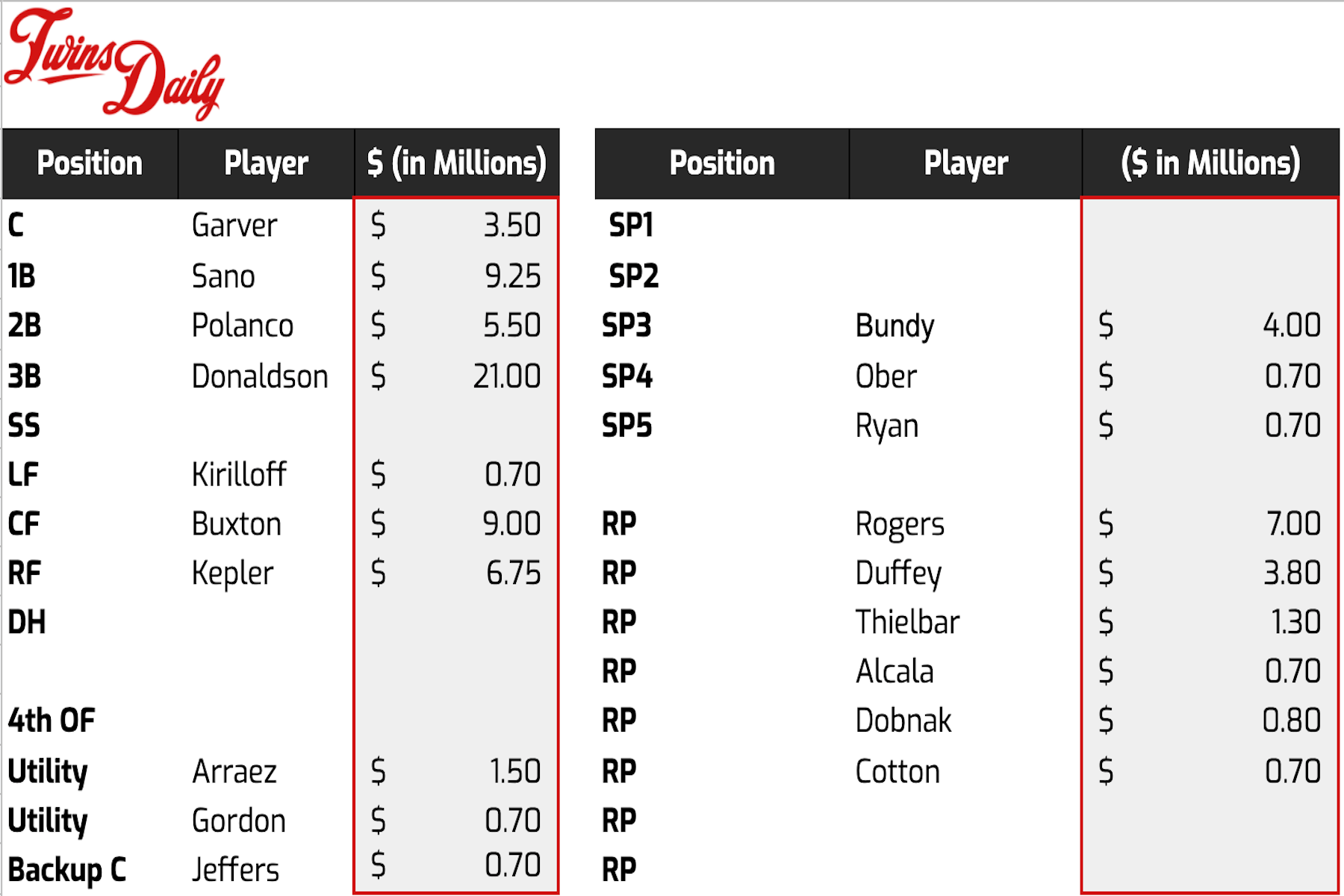 When we last provided one of these updates, the lockout had just commenced. We were celebrating Byron Buxton's newly minted contract extension, and factoring it into the projected payroll. Here's another look at that roster & payroll projection, which hasn't changed much except for a $100K bump to the rookie minimum (from ~$600K to ~$700K) as part of the new CBA. Here's the current lay of the land: If they're going to keep pace with their baseline spending from the past three years (a big "if" as they transition and recalibrate), the Twins theoretically have almost $50 million to spend, and not much time to spend it. With players reporting to camp by Sunday and exhibition games firing up in a week, teams will be compelled to act quickly and address their remaining offseason needs, in what little remains of the offseason. For the Twins, those needs are many. Expect plenty of activity all around the league in these next couple of days. From the buzz I'm hearing, it sounds like the Twins will be among the teams to strike early with a big move – maybe even by the time you're reading this on Friday morning. What's on tap? Here's some recommended content to prep you for what lies ahead for your favorite team, in an unprecedented condensed Hot Stove SZN: At the end of January, I laid out three top post-lockout priorities for the Twins: trade for starting pitcher, sign a free agent starting pitcher, and figure out the plan at shortstop. I wouldn't be at all surprised if it plays out in that exact order, and all three are done by Sunday. Shortly after the lockout started, Nash Walker outlined three different routes the Twins could take once it ended. Spread the money around in pursuit of fringe contention? Invest in rebounding quickly? Take a bare-bones approach and rebuild? I think we'll learn pretty quickly which path they intend to follow. According to Cody Pirkl, there are three signings the Twins need to make immediately with the lockout over. (The Rule of Threes is really at play in this round-up, which I suppose is fitting after a three-month lockout.) Yusei Kikuchi and Richard Rodriguez strike me as very logical and realistic. The last name mentioned is quite a bit spicier. If you haven't yet, make sure to catch up on our 2022 top 20 prospects list, which we unveiled within the past month or so. Many of these players stand to make an impact in the coming season. One will likely be in the Opening Day rotation. With the condensed timeline until the regular season and a lack of quality options available, I'll be very interested to see if the Twins turn to their simplest solution at the shortstop position. The bullpen shouldn't be overlooked as a key need. Matthew Taylor shares (you guessed it) three reliever trade targets they could realistically pursue this weekend. He's got a trio of realistic free agent targets for the bullpen, too. Luis Arraez is the subject of much attention this spring due to the uncertainty around him. The Twins could trade him (says me). Or they could not (says Theo Tollefson). Or they could extend him (says Nash). If you take Clayton Kershaw off the table as a Twins option (and you should), there's a clear-cut top name in the remaining free agent starter pool. Ted Schwerzler hopes the Twins sign him. I'm not sure I agree. Lotta risk. But admittedly a whole lotta upside. I think the Twins have a sneaky need for an outfielder, because I suspect they view Alex Kirilloff as more of a first baseman and Miguel Sano as more of a DH. (Max Kepler is also prime trade bait.) Here are the most intriguing options left on the outfield market. With that, you should be fully equipped to embrace the action on deck. Enjoy the weekend, and make sure you stay tuned to Twins Daily for new and analysis. I'm guessing I'll be back with another status update on Monday, featuring plenty to break down. MORE FROM TWINS DAILY — Latest Twins coverage from our writers — Recent Twins discussion in our forums — Follow Twins Daily via Twitter, Facebook or email
 -
Major League Baseball has finally struck a new CBA deal with its Players Association, and suddenly spring training will be underway in days. A frenzied flurry of free agency and trade action is anticipated over the weekend. Let's get up to speed with where things stand for the Twins going in. When we last provided one of these updates, the lockout had just commenced. We were celebrating Byron Buxton's newly minted contract extension, and factoring it into the projected payroll. Here's another look at that roster & payroll projection, which hasn't changed much except for a $100K bump to the rookie minimum (from ~$600K to ~$700K) as part of the new CBA. Here's the current lay of the land: If they're going to keep pace with their baseline spending from the past three years (a big "if" as they transition and recalibrate), the Twins theoretically have almost $50 million to spend, and not much time to spend it. With players reporting to camp by Sunday and exhibition games firing up in a week, teams will be compelled to act quickly and address their remaining offseason needs, in what little remains of the offseason. For the Twins, those needs are many. Expect plenty of activity all around the league in these next couple of days. From the buzz I'm hearing, it sounds like the Twins will be among the teams to strike early with a big move – maybe even by the time you're reading this on Friday morning. What's on tap? Here's some recommended content to prep you for what lies ahead for your favorite team, in an unprecedented condensed Hot Stove SZN: At the end of January, I laid out three top post-lockout priorities for the Twins: trade for starting pitcher, sign a free agent starting pitcher, and figure out the plan at shortstop. I wouldn't be at all surprised if it plays out in that exact order, and all three are done by Sunday. Shortly after the lockout started, Nash Walker outlined three different routes the Twins could take once it ended. Spread the money around in pursuit of fringe contention? Invest in rebounding quickly? Take a bare-bones approach and rebuild? I think we'll learn pretty quickly which path they intend to follow. According to Cody Pirkl, there are three signings the Twins need to make immediately with the lockout over. (The Rule of Threes is really at play in this round-up, which I suppose is fitting after a three-month lockout.) Yusei Kikuchi and Richard Rodriguez strike me as very logical and realistic. The last name mentioned is quite a bit spicier. If you haven't yet, make sure to catch up on our 2022 top 20 prospects list, which we unveiled within the past month or so. Many of these players stand to make an impact in the coming season. One will likely be in the Opening Day rotation. With the condensed timeline until the regular season and a lack of quality options available, I'll be very interested to see if the Twins turn to their simplest solution at the shortstop position. The bullpen shouldn't be overlooked as a key need. Matthew Taylor shares (you guessed it) three reliever trade targets they could realistically pursue this weekend. He's got a trio of realistic free agent targets for the bullpen, too. Luis Arraez is the subject of much attention this spring due to the uncertainty around him. The Twins could trade him (says me). Or they could not (says Theo Tollefson). Or they could extend him (says Nash). If you take Clayton Kershaw off the table as a Twins option (and you should), there's a clear-cut top name in the remaining free agent starter pool. Ted Schwerzler hopes the Twins sign him. I'm not sure I agree. Lotta risk. But admittedly a whole lotta upside. I think the Twins have a sneaky need for an outfielder, because I suspect they view Alex Kirilloff as more of a first baseman and Miguel Sano as more of a DH. (Max Kepler is also prime trade bait.) Here are the most intriguing options left on the outfield market. With that, you should be fully equipped to embrace the action on deck. Enjoy the weekend, and make sure you stay tuned to Twins Daily for new and analysis. I'm guessing I'll be back with another status update on Monday, featuring plenty to break down. MORE FROM TWINS DAILY — Latest Twins coverage from our writers — Recent Twins discussion in our forums — Follow Twins Daily via Twitter, Facebook or email View full article
-
Dear journal, It's been 98 days since darkness fell upon the world of baseball. We're closing in on triple digits, as the assurance of a shortened (at best) season sets in and the two sides continue to spin their wheels in contentious negotiations. Tuesday and Wednesday brought glimmers of hope, with marathon negotiating sessions seemingly leading to real breakthroughs. The league and union, at last, were moving toward a true compromise on core economic issues. Then, out nowhere, the international draft popped up and became a primary sticking point. With Wednesday's "deadline" bearing down, a late exchange of proposals and demands went nowhere, leading Rob Manfred to announce the cancellation of another week's worth of games. The dream of an on-time home opener at Target Field is now dead. The Twins won't be hosting the Mariners on a cool, crisp afternoon before thousands of eager fans on April 7th. The possibility of a full 162-game season – remote as it always might've been – is essentially out the window. Now, it's a question of how much the season will be shortened and devalued. How much more acrimony will be built in this bitter standoff. As paychecks and service time evaporate due to a league-imposed lockout, the grievances only mount and compound. The two sides continue to talk – perhaps out of grudging obligation as much as anything – but there's no indication of daylight in this dreary saga. They're propping up new hurdles before they can surpass the existing ones. They're getting further from the finish line. Sure doesn't feel like spring. View full article
-
 Tuesday and Wednesday brought glimmers of hope, with marathon negotiating sessions seemingly leading to real breakthroughs. The league and union, at last, were moving toward a true compromise on core economic issues. Then, out nowhere, the international draft popped up and became a primary sticking point. With Wednesday's "deadline" bearing down, a late exchange of proposals and demands went nowhere, leading Rob Manfred to announce the cancellation of another week's worth of games. The dream of an on-time home opener at Target Field is now dead. The Twins won't be hosting the Mariners on a cool, crisp afternoon before thousands of eager fans on April 7th. The possibility of a full 162-game season – remote as it always might've been – is essentially out the window. Now, it's a question of how much the season will be shortened and devalued. How much more acrimony will be built in this bitter standoff. As paychecks and service time evaporate due to a league-imposed lockout, the grievances only mount and compound. The two sides continue to talk – perhaps out of grudging obligation as much as anything – but there's no indication of daylight in this dreary saga. They're propping up new hurdles before they can surpass the existing ones. They're getting further from the finish line. Sure doesn't feel like spring.
 -
Also on the 40-man ? which is a real bummer because he's in the category of guys who could clearly benefit from a head-start
-
Ooh I like this comp. Just looked back at Molitor's age-23 season in the majors: .304/.372/.438 with 9 HR, 34 SB, and 48/48 K/BB while playing primarily second base. Obviously that's on the optimistic side but a feasible high-end projection for Martin.
- 23 replies
-
- 1
-
-
- austin martin
- matt canterino
- (and 2 more)
-
I've seen Strotman mentioned a couple times in this thread but he's on the 40-man so unfortunately unable to participate. Palacios is a good name to call out though, could get himself in the mix for a utility role.
-
Which Twins Prospects and Players Benefit from a Delayed MLB Season?
Nick Nelson posted an article in Twins
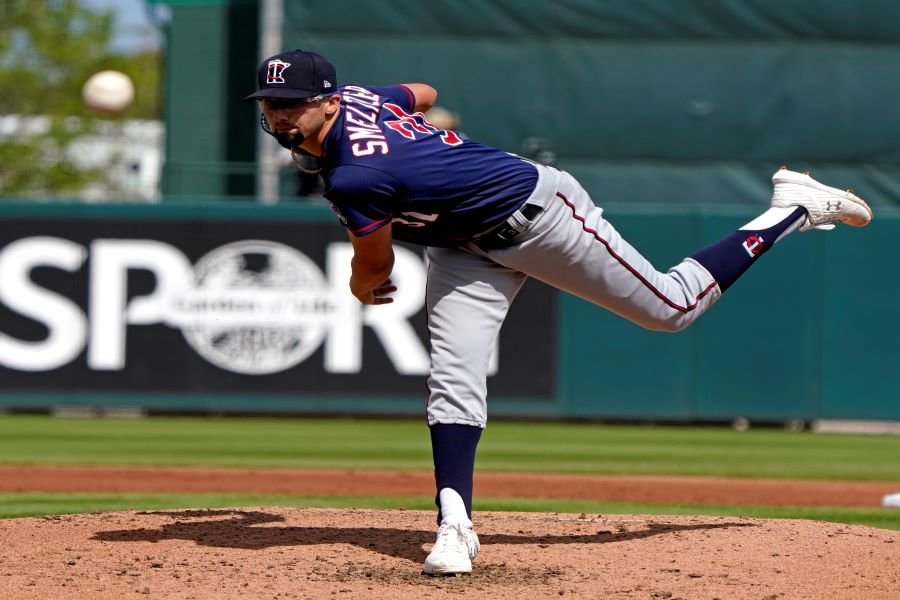 With all big-leaguers and many top prospects absent from camp, players who are not subject to MLB's lockout are able to take center stage as they work toward the starts of their seasons with Twins affiliates. Not only could this result in extra coaching and opportunities to make an impression, but the altered timeline of an MLB season starting well after these players get rolling in the minors could also play to their advantage. Last week Nash Walker called out five players who stand to be most negatively impacted by a shortened season. Today I'll try to flip the script by highlighting some prospects and players who stand to be benefit from this very unfortunate situation. 5 Positive Prospect Scenarios Made Possible by the Delayed Season Austin Martin shows he's ready. In some respects, Martin looks like an MLB-ready player. He was a top-five draft pick two years ago, based almost entirely on his polish and advanced skills. He led all of Double-A in on-base percentage last year, brandishing a plate approach that almost everyone agrees will play in the majors. Yet, as I wrote when profiling him as our #1 prospect, there are still a few elements of Martin's game that need to be ironed out before he can make the jump. He hasn't gotten any in-game experience outside of shortstop and center field, and his swing likely needs refinement. Were spring training and Opening Day playing out as normal, Martin probably wouldn't be in the mix for a big-league job right out of the gates, even if an opportunity opened up at – say – second base or center field. But if the season doesn't start until mid-May, and Martin has already had a successful spring and strong start in St. Paul? Different ballgame, so to speak. Matt Canterino earns an immediate nod. Like Martin, Canterino is a clear-cut MLB-caliber talent who has questions to answer before receiving a look in the majors. In his case, it's not so much the condensed timeline creating ambiguity – he was drafted out of college in 2019, and turned 24 in December – but a lack of reps. Due to the pandemic and injuries, Canterino has thrown only 48 total innings since joining the Twins system, including just 23 last year. He has yet to pitch above Single-A. It's unlikely that even a brilliant showing in a typical 2022 big-league camp would have put him in line to win an Opening Day job on the pitching staff, because there is just no baseline for stamina or durability. A strong showing in spring and a healthy, dominant run at Double-A through the early weeks of the minor-league season could convince Twins brass he's ready for a look right away when the delayed MLB season starts. Like with Martin, Canterino would potentially be able to impact a much larger portion of the Twins' season than he would otherwise. And unlike Martin, the path for Canterino is pretty much wide open. Minnesota has a desperate and immediate need for electric arms like his. Louie Varland accelerates his timeline. Varland was one of the best stories of the Twins system last year, going from a relatively unknown 15th-round draft pick in 2019 to the organization's Minor League Pitcher of the Year in 2021. With a powered-up fastball, he made mincemeat of hitters between Fort Myers and Cedar Rapids, posting a 2.10 ERA and 142-to-30 K/BB ratio and just six homers allowed in 103 innings. Tremendous work. But all of it done in Single-A. Varland is 24 so he's at an age where pitchers often break into the majors, but his development is lagging behind due to the pandemic. A delayed start for the big-leaguers, and other top prospects who are more advanced, could give him a chance to play catch-up. Aaron Sabato and Keoni Cavaco change their storylines. Sabato and Cavaco are both first-round draft picks from the past three years (2020 and 2019, respectively) but neither appeared in our recent top 20 prospect rankings, which is obviously a bad sign. Both had uphill climbs to justify their draft positions – Cavaco a raw prep player widely regarded as a stretch pick, Sabato a bat-only player who needed to mash immediately – and so far neither has come close, instead hurtling in the dreaded "bust" category. But in both cases, it's still early enough to remain hopeful. Eye-opening springs followed strong starts in the minors could help these downtrodden talents reverse their descending trajectories. Maybe by the time the Twins season starts, the view of one or both could be considerably different. Sabato is theoretically someone who could help this year with a big step forward. Devin Smeltzer puts himself back in the picture. Not every player in camp is a young prospect vying for their first chance at the big leagues. Smeltzer is an example of someone who's been there and is fighting to get back. The lefty spent more than two years on the Twins' 40-man roster before being outrighted last November, in the wake of a lost season. With more than two full seasons of service time, he was creeping up on arbitration eligibility. Now, he finds himself on the outside looking in. Except, in a more literal sense, he doesn't. Smeltzer's 40-man setback provides him with an opportunity to show he's gotten past the elbow issues of 2021, and is ready to help a needy Twins pitching staff again. As a 26-year-old with 70 innings of big-league experience and a 106 ERA+, he could put himself on the fast track by taking advantage of his head-start on other pitchers in similar positions, such as Randy Dobnak and Lewis Thorpe. MORE FROM TWINS DAILY — Order the Offseason Handbook — Latest Twins coverage from our writers — Recent Twins discussion in our forums — Follow Twins Daily via Twitter, Facebook or email
- 23 comments
-
- 5
-
-
- austin martin
- matt canterino
- (and 2 more)
-
The MLB season has already been delayed and it's about to get delayed further, meaning that major-leaguers and 40-man rostered prospects will continue to be off our radar for awhile. In the meantime, let's turn our focus to those players who are in Fort Myers and gearing up for minor-league seasons that will get underway in one month. With all big-leaguers and many top prospects absent from camp, players who are not subject to MLB's lockout are able to take center stage as they work toward the starts of their seasons with Twins affiliates. Not only could this result in extra coaching and opportunities to make an impression, but the altered timeline of an MLB season starting well after these players get rolling in the minors could also play to their advantage. Last week Nash Walker called out five players who stand to be most negatively impacted by a shortened season. Today I'll try to flip the script by highlighting some prospects and players who stand to be benefit from this very unfortunate situation. 5 Positive Prospect Scenarios Made Possible by the Delayed Season Austin Martin shows he's ready. In some respects, Martin looks like an MLB-ready player. He was a top-five draft pick two years ago, based almost entirely on his polish and advanced skills. He led all of Double-A in on-base percentage last year, brandishing a plate approach that almost everyone agrees will play in the majors. Yet, as I wrote when profiling him as our #1 prospect, there are still a few elements of Martin's game that need to be ironed out before he can make the jump. He hasn't gotten any in-game experience outside of shortstop and center field, and his swing likely needs refinement. Were spring training and Opening Day playing out as normal, Martin probably wouldn't be in the mix for a big-league job right out of the gates, even if an opportunity opened up at – say – second base or center field. But if the season doesn't start until mid-May, and Martin has already had a successful spring and strong start in St. Paul? Different ballgame, so to speak. Matt Canterino earns an immediate nod. Like Martin, Canterino is a clear-cut MLB-caliber talent who has questions to answer before receiving a look in the majors. In his case, it's not so much the condensed timeline creating ambiguity – he was drafted out of college in 2019, and turned 24 in December – but a lack of reps. Due to the pandemic and injuries, Canterino has thrown only 48 total innings since joining the Twins system, including just 23 last year. He has yet to pitch above Single-A. It's unlikely that even a brilliant showing in a typical 2022 big-league camp would have put him in line to win an Opening Day job on the pitching staff, because there is just no baseline for stamina or durability. A strong showing in spring and a healthy, dominant run at Double-A through the early weeks of the minor-league season could convince Twins brass he's ready for a look right away when the delayed MLB season starts. Like with Martin, Canterino would potentially be able to impact a much larger portion of the Twins' season than he would otherwise. And unlike Martin, the path for Canterino is pretty much wide open. Minnesota has a desperate and immediate need for electric arms like his. Louie Varland accelerates his timeline. Varland was one of the best stories of the Twins system last year, going from a relatively unknown 15th-round draft pick in 2019 to the organization's Minor League Pitcher of the Year in 2021. With a powered-up fastball, he made mincemeat of hitters between Fort Myers and Cedar Rapids, posting a 2.10 ERA and 142-to-30 K/BB ratio and just six homers allowed in 103 innings. Tremendous work. But all of it done in Single-A. Varland is 24 so he's at an age where pitchers often break into the majors, but his development is lagging behind due to the pandemic. A delayed start for the big-leaguers, and other top prospects who are more advanced, could give him a chance to play catch-up. Aaron Sabato and Keoni Cavaco change their storylines. Sabato and Cavaco are both first-round draft picks from the past three years (2020 and 2019, respectively) but neither appeared in our recent top 20 prospect rankings, which is obviously a bad sign. Both had uphill climbs to justify their draft positions – Cavaco a raw prep player widely regarded as a stretch pick, Sabato a bat-only player who needed to mash immediately – and so far neither has come close, instead hurtling in the dreaded "bust" category. But in both cases, it's still early enough to remain hopeful. Eye-opening springs followed strong starts in the minors could help these downtrodden talents reverse their descending trajectories. Maybe by the time the Twins season starts, the view of one or both could be considerably different. Sabato is theoretically someone who could help this year with a big step forward. Devin Smeltzer puts himself back in the picture. Not every player in camp is a young prospect vying for their first chance at the big leagues. Smeltzer is an example of someone who's been there and is fighting to get back. The lefty spent more than two years on the Twins' 40-man roster before being outrighted last November, in the wake of a lost season. With more than two full seasons of service time, he was creeping up on arbitration eligibility. Now, he finds himself on the outside looking in. Except, in a more literal sense, he doesn't. Smeltzer's 40-man setback provides him with an opportunity to show he's gotten past the elbow issues of 2021, and is ready to help a needy Twins pitching staff again. As a 26-year-old with 70 innings of big-league experience and a 106 ERA+, he could put himself on the fast track by taking advantage of his head-start on other pitchers in similar positions, such as Randy Dobnak and Lewis Thorpe. MORE FROM TWINS DAILY — Order the Offseason Handbook — Latest Twins coverage from our writers — Recent Twins discussion in our forums — Follow Twins Daily via Twitter, Facebook or email View full article
-
The Lockout Diaries: Week 13
Nick Nelson replied to Nick Nelson's topic in Twins Daily Front Page News
Those hires all end up being drops in the bucket for a franchise that's worth $2.2B and earns $100M+ in annual revenue. The Cardinals have had their highest payrolls ever in 2019/2021 while making these outside investments. The same can basically be said for the Twins, who have similarly invested heavily outside of player spending. It's not an either/or. Extremely disingenuous to frame it as such. Appreciate the condescension, but ultimately your appeal from authority is empty because you're just guessing and throwing out your own hypotheticals. You don't know any of the numbers because the owners blatantly lie and show no transparency about their finances. To the extent I have "considerable bias," it's toward known facts. We can all see what the players make, we can all see the general publicized economics of the game and its revenues. Those numbers don't add up to support anything resembling economic difficulties (other than the COVID-related ones that everyone has dealt with). -
The Lockout Diaries: Week 13
Nick Nelson replied to Nick Nelson's topic in Twins Daily Front Page News
They wouldn't benefit because they don't want to spend that money. The Yankees and Dodgers like having this impediment in place because they want an excuse for keeping their spending in check and pocketing more money. Your argument presumes good faith and the owners don't operate on it. We can talk in circles about CBT all we want but the undeniable bottom line is that player salaries have been declining while league revenues and inflation grow. That shouldn't be happening in a business so financially healthy (despite what the lying commissioner would have you believe). What about MLB's proposals do you see as strongly suited to correcting this trend? What's unreasonable about the MLBPA's requests (which the league won't take any serious steps in bridging the gap toward) from that view? -
The Lockout Diaries: Week 13
Nick Nelson replied to Nick Nelson's topic in Twins Daily Front Page News
This theory is not backed by reality. Teams use the CBT as an excuse NOT to spend more and increase their competitive advantage. They use it as a de facto ceiling while there is no corresponding floor on the other end. Other teams are concerned that if powerhouses like the Yankees (who were outspent by the PADRES last year) go back into full-on free spending mode it'll inflate the overall market. Which it will. Which it needs to. -
The Lockout Diaries: Week 13
Nick Nelson replied to Nick Nelson's topic in Twins Daily Front Page News
Sure, I'll have a rational discussion. I find the proposal on whole to be problematic and non-serious because it is not a legitimate effort to compromise and seems focused on no outcome other than saving owners money and winning these negotiations. The "rationales" you're putting forth are simply off-base. I'm not buying into that empty corporate messaging. You actually think they're trying to keep the increase in CBT modest because they want to "avoid increasing the gap in parity"? Come on. If that was their goal they'd implement a salary floor and find measures to stop Pittsburgh from spending $40M/year to constantly tank. They want to keep their own spending controls in place so teams like LA and NY have justification for spending increasingly small fractions of their revenue. Moreover, the bottom line is that owners are in control of their product. They initiated the lockout. They canceled games. It is their responsibility to provide terms that their labor finds fair and equitable. In failing to do so, I hold them fully accountable. -
Dear journal, It's been 91 days since darkness fell upon the world of baseball. The regular season has officially been delayed and games canceled. As much as it always felt like we'd reach this point, it still really sucks to be here. We're in early March. Usually spring training is full swing by now, with camp storylines and position battles already taking shape. Instead, the Lee County Sports Complex in Fort Myers is occupied only by various minor-leaguers, with a decided lack of buzz or excitement surrounding the early action. Monday's deadline for striking a deal to start the regular season on time came and went. Commissioner Rob Manfred has canceled Opening Day and the first week of the regular season. We're all but certain to see more cancellations ahead. There's a widely held belief that the league is not motivated to salvage any games in the first month of the season, when northern teams find it harder to draw fans due to weather and TV contracts are essentially unaffected. ("Local television contracts generally do not require clubs to issue rebates to their networks until about 25 games are missed," according to Ken Rosenthal.) That means all the pressure is on the players at this point, but they are pretty clearly united and defiant in their stance. They're not going to cave or relent to the non-serious proposals being put forth by the league. Good for them. Bad for us, of course. Baseball fans are left in the lurch as this stalemate whittles away the season with each passing day. I have little doubt that I'll be continuing to write these stupid journal entries for several more weeks at least. View full article
-
 We're in early March. Usually spring training is full swing by now, with camp storylines and position battles already taking shape. Instead, the Lee County Sports Complex in Fort Myers is occupied only by various minor-leaguers, with a decided lack of buzz or excitement surrounding the early action. Monday's deadline for striking a deal to start the regular season on time came and went. Commissioner Rob Manfred has canceled Opening Day and the first week of the regular season. We're all but certain to see more cancellations ahead. There's a widely held belief that the league is not motivated to salvage any games in the first month of the season, when northern teams find it harder to draw fans due to weather and TV contracts are essentially unaffected. ("Local television contracts generally do not require clubs to issue rebates to their networks until about 25 games are missed," according to Ken Rosenthal.) That means all the pressure is on the players at this point, but they are pretty clearly united and defiant in their stance. They're not going to cave or relent to the non-serious proposals being put forth by the league. Good for them. Bad for us, of course. Baseball fans are left in the lurch as this stalemate whittles away the season with each passing day. I have little doubt that I'll be continuing to write these stupid journal entries for several more weeks at least.
 -
We've spent the past couple of weeks rolling out our choices for the top 20 prospects in the Minnesota Twins organization heading into 2022. Today, we'll recap and analyze a system that is chock full of near-ready pitching with upside – seemingly exactly what's needed for this franchise at this moment in time. Will the pipeline pay off? Before I get started with recapping our preseason top 20 prospect list, I'm very excited to unveil a brand-new feature here at Twins Daily which will enable you to keep up with the system's best and brightest all year long, like never before. Introducing: The Twins Daily Top Prospect Tracker Brock's been hard at work on this great addition to the site, and now it's live for all to access. The prospect tracker is a regularly-updated interactive tool that keeps you up to speed on fluctuations in the rankings throughout the season, showcasing each player's latest monthly splits so you can track performances as the season plays out. Bookmark it and check in regularly. You'll also notice the widget popping up around the site. Okay, on with the breakdown. Minnesota Twins 2022 Top 20 Prospects 20. Steve Hajjar, LHP: Big 6-foot-5 southpaw drafted in the 2nd round last year, touted for his changeup. 19. Edouard Julien, INF: Versatile fielder drew 101 BB in 112 G last year at Single-A, good for a .434 OBP. 18. Spencer Steer, INF: Mashed 24 homers in a breakthrough power season, playing mostly 2B and 3B. 17. Blayne Enlow, RHP: Looked to be clicking last year before TJ surgery, which will cost him '22 season. 16. Emmanuel Rodríguez, OF: Extreme contact woes marred otherwise highly encouraging rookie-ball debut. 15. Louie Varland, RHP: Honored as the org's top minor-league pitcher in '21 thanks to dazzling A-ball performance. 14. Cole Sands, RHP: Polished righty has posted a 2.53 ERA, 10.3 K/9 in two seasons since joining Twins system. 13. Matt Wallner, OF: Huge raw power will play if he can shore up his plate discipline and whiffing tendency. 12. Gilberto Celestino, OF: Was overwhelmed during rushed MLB debut, but the skills are undeniable. 11. Noah Miller, SS: 38th pick in '21 draft out of HS swings from both sides with legit chance to stick at short. 10. Josh Winder, RHP: Absurdly dominant between AA/AAA last year, and is basically ready to go at 25. 9. Chase Petty, RHP: Team's top draft pick from last summer was a high-school phenom with 100-MPH heat. 8. Simeon Woods Richardson, RHP: Mechanics and control hold back premium arsenal, but he's still young. 7. Jhoan Duran, RHP: Imposing flamethrower has makeup to dominate but must get past scary elbow issues. 6. Matt Canterino, RHP: His 1.13 ERA and 76 Ks in 48 IP since being drafted in 2019 say it all, good and bad. 5. Joe Ryan, RHP: Amazing numbers in minors were made to look legit during 5-start run with Twins. 4. Jordan Balazovic, RHP: Safest combination of ceiling, floor, and proven durability among arms in the system. 3. José Miranda, 2B/3B: Perennial breakthrough candidate broke through with minor-league season for the ages. 2. Royce Lewis, SS: Missed 2 straight years, but has the elite skills, athleticism, and drive to catch up fast. 1. Austin Martin, SS/OF: Headliner of 2022 deadline sell-off is a worthy top prize, with evident star qualities. Top 20 Prospects Positional Breakdown C : 0 IF: 6 OF: 3 RHP: 10 LHP: 1 The Right Stuff The positional imbalance above is stark. Before we talk about some of the scarcities and what they mean, let's talk about the area of abundance: right-handed pitching. In our rankings, the top three prospects (Martin, Lewis, Miranda) are followed by seven straight right-handed pitchers, and there are three more in the back half. What's more, the majority of pitchers among these 10 are viable candidates to debut in 2022 (one already has). The Twins desperately need an infusion of impact arms and the system is poised to provide it. Six years after the new front office took over with a directive to develop pitching, they've got a pipeline bursting at the seams. Now, it's proving time. There's a whole lot riding on this group – especially if the Twins continue to take a relatively passive approach on the veteran pitching market. The team's fortunes over the next couple seasons may be dictated largely by this group. The lopsided ratio of RHP vs. LHP in these rankings definitely stands out – it's something I also remarked on when doing the organizational asset rankings, which included zero lefties. I'm not sure exactly what to make of this, or how much it matters. But it's definitely a thing. Emerging Areas of Scarcity Beyond their glut of pitching, the Twins are looking solid in the infield, although there's a lot of redundancy within that group – nearly all of the six are second/third base types, with only Lewis and Miller having any real shot to play shortstop in the majors. The scarce pipeline supplies in the outfield (3) and catcher (0) are not quite what they seem though. The past season saw Alex Kirilloff, Trevor Larnach, and Ryan Jeffers all graduate from prospect status. A year ago, those players ranked first, third, and fourth on this list. So yeah, that'll put a dent in the positional depth. Moreover, several of the players listed as infielders currently could easily end up in the outfield. Having said that, it would be nice to see some more catching talent emerge in the system. Mitch Garver is suddenly only two years from free agency, and the jury is out on Jeffers as a long-term solution. Ben Rortvedt, who also graduated from prospect status last year, has the makings of a solid backup. Do We Have a Shortstop? The Twins have an abundance of depth in the system to support their clear present need for pitching. Solutions at the shortstop position are less clear. Although we have three players listed (at least partially) as shortstops in these rankings, only two have a legit chance to play there in the majors: Miller, who is still probably four or five years away, and Lewis, who's gone two years without action on the field. The latter's viability at the position is in doubt. Keith Law of The Athletic recently reiterated his view on that matter: "Lewis is not a shortstop." Law is far from alone in his skepticism, although many others seem to more open-minded, including the Twins themselves who seem intent to keep pushing him at short for the time being. For his part, Lewis has his sights set on the big-league shortstop job. As he told Ted Schwerzler recently, "There’s an opening at short, and then the team looks very exciting. I’m just so ready to be a Minnesota Twin." At present, he might be the club's best present option at shortstop, which is to say they really have no options. Presumably that'll be addressed once the lockout ends. With the assumption that a short-term fix will be acquired, Lewis is seemingly being primed to take over in the not-too-distant future. (Otherwise, what IS the plan?) An Uneven Playing Field Before he can even be considered as a legitimate option to play shortstop in the majors, Lewis badly needs reps, and lots of 'em. Lamentably, with his presence on the 40-man roster, he's subject to the lockout, meaning he's unable to participate in spring training now, or minor leagues games when they start. Lewis isn't alone, although I feel his situation is more unfortunate than most. He's part of a group of nine players from our list, including six of the top 10, who will be unable to play so long as the lockout persists: Royce Lewis José Miranda Jordan Balazovic Joe Ryan Jhoan Duran Josh Winder Gilberto Celestino Cole Sands Blayne Enlow Should the lockout claim a chunk of the season, it will create a weird imbalance in development between these prospects and all the others, who will be able to proceed as usual with all the coaching, resources, and reps of a minor-league operation. Who's Your Pick to Click in 2022? Let's hear from y'all in the comments. If you had to pick a prospect who will enjoy a Miranda-like ascent in 2022, which is the first name that comes to mind? Ideally someone toward the back or outside of our Top 20 – either in the Honorable Mentions or entirely absent from our discussion. Maybe later on we can come back and see who made the best calls. For my part, I think I'm gonna go with right-handed pitcher Marco Raya. Past Rankings Twins Daily 2021 Top Prospects Twins Daily 2020 Top Prospects Twins Daily 2019 Top Prospects Twins Daily 2018 Top Prospects Twins Daily 2017 Top Prospects Twins Daily 2016 Top Prospects Twins Daily 2015 Top Prospects View full article
- 16 replies
-
- 1
-
-
- austin martin
- royce lewis
- (and 1 more)
-
 Before I get started with recapping our preseason top 20 prospect list, I'm very excited to unveil a brand-new feature here at Twins Daily which will enable you to keep up with the system's best and brightest all year long, like never before. Introducing: The Twins Daily Top Prospect Tracker Brock's been hard at work on this great addition to the site, and now it's live for all to access. The prospect tracker is a regularly-updated interactive tool that keeps you up to speed on fluctuations in the rankings throughout the season, showcasing each player's latest monthly splits so you can track performances as the season plays out. Bookmark it and check in regularly. You'll also notice the widget popping up around the site. Okay, on with the breakdown. Minnesota Twins 2022 Top 20 Prospects 20. Steve Hajjar, LHP: Big 6-foot-5 southpaw drafted in the 2nd round last year, touted for his changeup. 19. Edouard Julien, INF: Versatile fielder drew 101 BB in 112 G last year at Single-A, good for a .434 OBP. 18. Spencer Steer, INF: Mashed 24 homers in a breakthrough power season, playing mostly 2B and 3B. 17. Blayne Enlow, RHP: Looked to be clicking last year before TJ surgery, which will cost him '22 season. 16. Emmanuel Rodríguez, OF: Extreme contact woes marred otherwise highly encouraging rookie-ball debut. 15. Louie Varland, RHP: Honored as the org's top minor-league pitcher in '21 thanks to dazzling A-ball performance. 14. Cole Sands, RHP: Polished righty has posted a 2.53 ERA, 10.3 K/9 in two seasons since joining Twins system. 13. Matt Wallner, OF: Huge raw power will play if he can shore up his plate discipline and whiffing tendency. 12. Gilberto Celestino, OF: Was overwhelmed during rushed MLB debut, but the skills are undeniable. 11. Noah Miller, SS: 38th pick in '21 draft out of HS swings from both sides with legit chance to stick at short. 10. Josh Winder, RHP: Absurdly dominant between AA/AAA last year, and is basically ready to go at 25. 9. Chase Petty, RHP: Team's top draft pick from last summer was a high-school phenom with 100-MPH heat. 8. Simeon Woods Richardson, RHP: Mechanics and control hold back premium arsenal, but he's still young. 7. Jhoan Duran, RHP: Imposing flamethrower has makeup to dominate but must get past scary elbow issues. 6. Matt Canterino, RHP: His 1.13 ERA and 76 Ks in 48 IP since being drafted in 2019 say it all, good and bad. 5. Joe Ryan, RHP: Amazing numbers in minors were made to look legit during 5-start run with Twins. 4. Jordan Balazovic, RHP: Safest combination of ceiling, floor, and proven durability among arms in the system. 3. José Miranda, 2B/3B: Perennial breakthrough candidate broke through with minor-league season for the ages. 2. Royce Lewis, SS: Missed 2 straight years, but has the elite skills, athleticism, and drive to catch up fast. 1. Austin Martin, SS/OF: Headliner of 2022 deadline sell-off is a worthy top prize, with evident star qualities. Top 20 Prospects Positional Breakdown C : 0 IF: 6 OF: 3 RHP: 10 LHP: 1 The Right Stuff The positional imbalance above is stark. Before we talk about some of the scarcities and what they mean, let's talk about the area of abundance: right-handed pitching. In our rankings, the top three prospects (Martin, Lewis, Miranda) are followed by seven straight right-handed pitchers, and there are three more in the back half. What's more, the majority of pitchers among these 10 are viable candidates to debut in 2022 (one already has). The Twins desperately need an infusion of impact arms and the system is poised to provide it. Six years after the new front office took over with a directive to develop pitching, they've got a pipeline bursting at the seams. Now, it's proving time. There's a whole lot riding on this group – especially if the Twins continue to take a relatively passive approach on the veteran pitching market. The team's fortunes over the next couple seasons may be dictated largely by this group. The lopsided ratio of RHP vs. LHP in these rankings definitely stands out – it's something I also remarked on when doing the organizational asset rankings, which included zero lefties. I'm not sure exactly what to make of this, or how much it matters. But it's definitely a thing. Emerging Areas of Scarcity Beyond their glut of pitching, the Twins are looking solid in the infield, although there's a lot of redundancy within that group – nearly all of the six are second/third base types, with only Lewis and Miller having any real shot to play shortstop in the majors. The scarce pipeline supplies in the outfield (3) and catcher (0) are not quite what they seem though. The past season saw Alex Kirilloff, Trevor Larnach, and Ryan Jeffers all graduate from prospect status. A year ago, those players ranked first, third, and fourth on this list. So yeah, that'll put a dent in the positional depth. Moreover, several of the players listed as infielders currently could easily end up in the outfield. Having said that, it would be nice to see some more catching talent emerge in the system. Mitch Garver is suddenly only two years from free agency, and the jury is out on Jeffers as a long-term solution. Ben Rortvedt, who also graduated from prospect status last year, has the makings of a solid backup. Do We Have a Shortstop? The Twins have an abundance of depth in the system to support their clear present need for pitching. Solutions at the shortstop position are less clear. Although we have three players listed (at least partially) as shortstops in these rankings, only two have a legit chance to play there in the majors: Miller, who is still probably four or five years away, and Lewis, who's gone two years without action on the field. The latter's viability at the position is in doubt. Keith Law of The Athletic recently reiterated his view on that matter: "Lewis is not a shortstop." Law is far from alone in his skepticism, although many others seem to more open-minded, including the Twins themselves who seem intent to keep pushing him at short for the time being. For his part, Lewis has his sights set on the big-league shortstop job. As he told Ted Schwerzler recently, "There’s an opening at short, and then the team looks very exciting. I’m just so ready to be a Minnesota Twin." At present, he might be the club's best present option at shortstop, which is to say they really have no options. Presumably that'll be addressed once the lockout ends. With the assumption that a short-term fix will be acquired, Lewis is seemingly being primed to take over in the not-too-distant future. (Otherwise, what IS the plan?) An Uneven Playing Field Before he can even be considered as a legitimate option to play shortstop in the majors, Lewis badly needs reps, and lots of 'em. Lamentably, with his presence on the 40-man roster, he's subject to the lockout, meaning he's unable to participate in spring training now, or minor leagues games when they start. Lewis isn't alone, although I feel his situation is more unfortunate than most. He's part of a group of nine players from our list, including six of the top 10, who will be unable to play so long as the lockout persists: Royce Lewis José Miranda Jordan Balazovic Joe Ryan Jhoan Duran Josh Winder Gilberto Celestino Cole Sands Blayne Enlow Should the lockout claim a chunk of the season, it will create a weird imbalance in development between these prospects and all the others, who will be able to proceed as usual with all the coaching, resources, and reps of a minor-league operation. Who's Your Pick to Click in 2022? Let's hear from y'all in the comments. If you had to pick a prospect who will enjoy a Miranda-like ascent in 2022, which is the first name that comes to mind? Ideally someone toward the back or outside of our Top 20 – either in the Honorable Mentions or entirely absent from our discussion. Maybe later on we can come back and see who made the best calls. For my part, I think I'm gonna go with right-handed pitcher Marco Raya. Past Rankings Twins Daily 2021 Top Prospects Twins Daily 2020 Top Prospects Twins Daily 2019 Top Prospects Twins Daily 2018 Top Prospects Twins Daily 2017 Top Prospects Twins Daily 2016 Top Prospects Twins Daily 2015 Top Prospects
- 16 comments
-
- 1
-
-
- austin martin
- royce lewis
- (and 1 more)
-
In June of 2020, the Toronto Blue Jays drafted Austin Martin fifth overall. They paid $7 million to sign him (more than Royce Lewis got as the top overall pick three years earlier), envisioning the collegiate superstar as a centerpiece in their plans going forward. One year later, they traded him to the Twins at the deadline for José Berríos. Did the Jays sell low? Did the Twins buy high? Somewhere in between? That is the question. Age: 22 (DOB: 3/23/99) 2021 Stats (AA): 418 PA, .270/.414/.382, 5 HR, 35 RBI, 67 R, 14 SB ETA: 2022 2021 Ranking: NA National Top 100 Rankings BA: 47 | MLB: 36 | ATH: 25 | BP: 52 What's To Like Derek Falvey has likely had eyes on Martin for some time. Just months after Falvey claimed Minnesota's top front office job, Cleveland drafted Martin out of high school in the 37th round of the 2017 draft. Of course, he didn't sign. Instead, the Florida prep phenom headed to Vanderbilt, where he solidified himself as one of the best young baseball players in the country, dazzling evaluators with his athleticism and stellar plate discipline while putting up monster stats. Three years later, Martin had emerged as a top draft prospect, viewed by some as a worthy #1 overall pick. He ended up going fifth to Toronto, and instantly became one of the best prospects in the game. The COVID shutdown prevented him from debuting in 2020, but last year Martin went straight to Double-A, where he led the league in on-base percentage (.414). I can hardly overstate how impressive it is for a first-year pro to lead all of Double-A – a level populated by many of the game's finest prospects – in the most crucial offensive statistic. Martin blended his keen eye at the plate with his knack for taking an HBP to reach base at a spectacular rate. After coming to the Twins, he reached base via BB or HBP in 20% of his plate appearances. Meanwhile, he split time between the two most valuable (non-catcher) positions: center field and shortstop. He's an elite young talent, ranked as one of the top 50 (or so) prospects in the game by every major outlet. Martin has established a high floor as a contact-hitting OBP machine who brings value in every facet of the game. He's a plus runner, and while the power didn't show up in his first pro season, that is frequently a later tool to materialize. He has all the ingredients to make it happen. "Making it happen" is exactly what Martin has done up to this point. He brings a tremendous skill set and also that added dimension of "superstar aura," which exuded heavily at Vanderbilt. He's electric. He's confident. He's a gamer and a playmaker. You want to see him in big spots. An All-Star in the making? The Blue Jays seemingly didn't think so. What's Left To Work On Just like his immense talent, Martin's question marks and barriers are plain to see. First, there is the lack of a clear defensive home. Nobody believes he'll play shortstop in the majors and he's blocked in center field by Byron Buxton. From there, you're looking at different scenarios that diminish his value to varying degrees. Will he be a great defensive third baseman? A capable second baseman? A rangy left or right fielder? There's a whole spectrum of potential outcomes and it's hard to put a finger on which is most likely, since the only positions he's played as a pro are two we can feel pretty confident he won't play regularly as a Twin. Keith Law, who is higher on Martin's overall outlook than most (he has him ranked #25 on his top 100 list for The Athletic), has significant concerns about the 22-year-old's arm. As Law shared in a recent collab article with Aaron Gleeman, "There are two separate issues at play with Martin. One is his throwing, which went south on him in the spring of 2020, right before the shutdown, and still hasn’t improved. He was a plus defender at third base as a sophomore, but if he can’t throw well from the left side of the infield, that’s a non-starter." The second issue referenced by Law is one that weighs heavily against Martin in every evaluation: a conspicuous lack of power. Even with the aggressive assignment to Double-A, a .382 slugging percentage in Year 1 from a top five draft pick is troubling. In 93 games, he managed just five homers and 18 doubles. Says Law: "He’s had a tendency to shrink himself by crouching and striding toward the plate, which improved his plate coverage but robbed him of his ability to drive the ball." Says Baseball America: "Gaining more strength and hitting the ball with authority more frequently will determine whether Martin becomes an impact regular or more of an average, everyday type player." Says Jeffrey Paternostro of Baseball Prospectus: "He still needs to hit for some pop, or major league pitching isn’t gonna nibble." That really gets to the bottom of it: standout OBP skills from the minors tend to fade quickly if MLB pitchers don't consider you a threat. On the bright side, Martin has plenty of time to build on his power output, and there's reason to believe that will happen. In his interview with Gleeman, Law called Martin's power concerns "overblown," citing a hand/wrist injury and shift in approach as sapping the natural pop that still resides within him. "It’s not a lack of strength but a conscious choice to give up contact quality in favor of avoiding the strikeout, and that can be changed — he certainly hasn’t always hit this way," says Law. "I absolutely believe the Twins are already addressing this." What's Next Having proven himself in Double-A, and set to turn 23 in a month, Martin seems destined to open the 2022 season in St. Paul, where he'll be a stone's throw away from Target Field. From there it becomes a matter of opportunity. They won't call him up sit on the bench, and the multi-positional regular role is already occupied by Luis Arraez. An early injury to Byron Buxton, Jorge Polanco or Josh Donaldson might open a door for Martin to step in. Another scenario that creates a path is moving Miguel Sanó to DH, Alex Kirilloff to first, and planting Martin in left field. But the problem is that Martin has barely played left field – his last official action at the position came in the form of 15 freshman appearances at Vanderbilt. He also hasn't spent significant time at third base since 2019, and has virtually no experience at second. For this reason, it's likely the Twins will take a somewhat measured approach rather than rushing things. Martin is in some ways a refined product – he could pretty clearly take quality ABs in the major leagues, right now – but he'll benefit from getting reps at different positions, and there may be some work needed yet on his swing. Since he's not yet on the 40-man roster, Martin will be able to jump into action when the minor league season commences, even if the lockout delays the MLB season. He might be ready for the major leagues before the big-leaguers are. Martin has a high bar to reach if he hopes to justify what the Twins gave up for him. Previous Rankings Honorable Mentions Prospects 16-20 Prospects 11-15 #10: Josh Winder, RHP #9: Chase Petty, RHP #8: Simeon Woods Richardson, RHP #7: Jhoan Duran, RHP #6: Matt Canterino, RHP #5: Joe Ryan, RHP #4: Jordan Balazovic, RHP #3: José Miranda, 2B/3B #2: Royce Lewis, SS #1: Austin Martin, SS/OF View full article