



ashbury
-
Posts
42,535 -
Joined
-
Last visited
-
Days Won
472
Content Type
Profiles
News
Minnesota Twins Videos
2026 Minnesota Twins Top Prospects Ranking
2022 Minnesota Twins Draft Picks
Minnesota Twins Free Agent & Trade Rumors, Notes, & Tidbits
Guides & Resources
2023 Minnesota Twins Draft Picks
The Minnesota Twins Players Project
2024 Minnesota Twins Draft Picks
2025 Minnesota Twins Draft Pick Tracker
2026 Minnesota Twins Draft Tracker: Picks & Bonuses
Forums
Blogs
Events
Store
Downloads
Gallery
Everything posted by ashbury
-
The way that happens is usually that you got 7 years out of the player that were good enough to justify the huge payday for the coming year(s). It's just the way the CBA works. The hope under this system is to keep the pipeline of young cheap talent coming so that you can always afford multiple eight-figure salaries at any given time.
-
While I assume you are playing along with my little joke, a serious take on this is that if you click on Forums (or Forums Home), below the forums called "Minnesota Twins Talk" and "Twins Minor League Talk" there is "More Baseball", and if you go in there you could start a thread on any topic under the (baseball) sun. I doubt you'll find any threads already there talking much about other teams' prospects, but on any given day you never know.
-
Article: Catching up with Eric Fryer
ashbury replied to Seth Stohs's topic in Twins Daily Front Page News
This is what jumps out at me too, and helps explain the seeming wall he hit at AAA; he'd already achieved most of his potential by the time he got there, by that reading. -
Consult the user Forums on Other29TeamsDaily for information about these exciting prospects.
-
Johan Santana throws off mound, Twins in attendance
ashbury replied to Parker Hageman's topic in Minnesota Twins Talk
Is it just me, or does he look heavy in that photo? -
I kinda thought Dave covered that in his first sentence right after the comma.
-
Jason Bartlett preparing for outfield duty
ashbury replied to Parker Hageman's topic in Minnesota Twins Talk
This is shortsighted. How else are you going to carry 9 bullpen arms? -
Jason Bartlett preparing for outfield duty
ashbury replied to Parker Hageman's topic in Minnesota Twins Talk
Wonder if this will have the same outcome as Mastroianni taking reps at 2B a couple of springs ago. -
Article: Who ARE You People?!?
ashbury replied to John Bonnes's topic in Twins Daily Front Page News
__ under 45 __ 45-54 __ 55 __ 56 __ 57 __ 58 __ 59 __ 60 __ 61 __ 62 __ 63 __ 64 __ 65-74 __ 75-84 __ 85-94 __ 95-104 __ 105-114 __ 115-124 __ 125 and above Better? -
Winnah!
-
[video=youtube;J9u2UssRhyk]
-
Fear the Klaw!
-
"No, Ron, we're going to play a baseball game, just like it's scheduled. I'm not thumb-wrestling you for the AL crown. Nice try, though."
-
Yeah, complete coinflip.
-
Article: Position Battle: Designated Hitter
ashbury replied to Nick Nelson's topic in Twins Daily Front Page News
I haven't seen Kubel play but if he still can / will dive for balls hit in front of him, that will be his advantage. I believe Hammer just can't risk his back anymore. Aside from that I'd expect their defense to be about the same - lumberingly slow but otherwise sound. -
Article: Who ARE You People?!?
ashbury replied to John Bonnes's topic in Twins Daily Front Page News
-
He said mucho at one point. I believe this means "much".
-
Or against any of the other teams in the league, until we clinch a spot higher than DET. After that, he can knock himself out and pitch a CG no-hitter if he wants.
-
I discovered what I guess others already did: not too easy to find a good photo showing his uni number.
-
Thrylos >> Twinsnorth49
-
http://www.ultimasnoticias.com.ve/noticias/deportes/beisbol/fotos---criollos-en-grandes-ligas-se-solidarizan-c.aspx Part of an unofficial but league-wide expression of hopes for peace, it seems.
-
I like the way you think, sir.

-
That's one way of looking at it. Or, he signed for more guaranteed money. Here's one back-of-the-envelope analysis of the risk angle. Twins guarantee 3 years for a total of $42M. After that, various things can happen in Year 4, one of which is the triggering of the vesting option. By comparison, the Brewers guarantee $50M for 4 years. So, from a monetary standpoint, it comes down to what the odds are that he'll get more than $8M in that fourth year if he takes the Twins offer. If for simplicity's sake you assume only two possible outcomes, either the Twins $14M vesting option happens, or else it's $0, then if he thinks it's 50/50, he's money ahead taking the sure $8M. Do you gamble $8M in hopes of winning $6M? You need good odds for that. Of course other possibilities exist for that fourth year, and you also have to factor in the question of Year 5, which under the Twins plan is free agency and with the Brewers is a vesting option for $13M. So I'm sure his agent went through various scenarios, and gave the spreadsheet program a good workout. If he's completely not confident in his own health for the long-term, he'll take the greatest guarantee, period. But even with good confidence, the potential payoff has to be pretty high in order to make a gamble worthwhile.
-
Carnac: "No, but he's still working on it." Ed: This may be your most puzzling divination ever, oh Magnificent One. Carnac: Not as puzzling as how you ever got this job. Ed: We'll dispense with the hey-yos, and ask you to open the envelope. Carnac: "Rich Yett?"
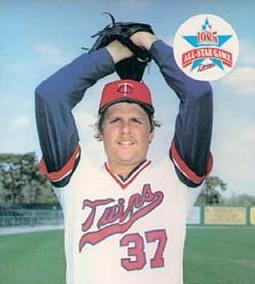
-
Any thoughts on Terry Ryan, or Jim Souhan?1 On-topic, I grew up in Indianapolis, so I didn't have a direct rooting interest at the time, and I found the hitless wonder White Sox an interesting story, also the expansion team Angels being in the race until near the end, but ultimately I was one of those lemon-juice pouring young jerks who rooted for the BoSox that year. 1 / yeah, I'm trolling. Trolling for people to ban!


