amjgt
-
Posts
3,298 -
Joined
-
Last visited
-
Days Won
2
Content Type
Profiles
News
Minnesota Twins Videos
2026 Minnesota Twins Top Prospects Ranking
2022 Minnesota Twins Draft Picks
Minnesota Twins Free Agent & Trade Rumors, Notes, & Tidbits
Guides & Resources
2023 Minnesota Twins Draft Picks
The Minnesota Twins Players Project
2024 Minnesota Twins Draft Picks
2025 Minnesota Twins Draft Pick Tracker
2026 Minnesota Twins Draft Pick Tracker
Forums
Blogs
Events
Store
Downloads
Gallery
Everything posted by amjgt
-
 There is ZERO chance that any teams will be forced to dump contracts to get cap ceiling compliant. None. Zero. Zilch. It just isn't going to happen. a) There's a 100% chance that if there's a cap there will be multiple years to get compliant (probably for the floor as well), and b) a 95+% chance that any existing contract gets some sort of grandfathering in, no matter how long it is.
- 50 replies
-
- 2
-

-
- ryan jeffers
- victor caratini
- (and 3 more)
-
Twins (Morris) vs Royals(Lugo): 6/04/26, 6:40 pm CDT
amjgt replied to C-Gangster's topic in Archived Game Threads
Obviously I have no idea what their plan is with Morris today, but I’m hoping it’s truly a 1 inning opener appearance. I like what I am seeing with him in that 1 inning roll. I’d hate to mess with the momentum he seems to be gathering with it. -
Here’s my take… It’ll either be a Comp A pick or nothing. Because the only way Jeffers rejects the $23M is if his management team thinks he’ll get something like 4/70 or 3/60. If they think it’s looking more like 3/45, then they’ll accept it and hit the open market in 2027 free and clear of the QO stuff. I didn’t mention it in my first post, but a potential MLB payroll floor (and teams needing to spend) could play a part in this as well.
- 50 replies
-
- 2
-
-
- ryan jeffers
- victor caratini
- (and 3 more)
-
Scenario 1) We offer him the QO and he accepts it Scenario 2) We offer him the QO and prior to accepting or declining, we work out an extension. Scenario 3) We offer him the QO and he declines. This likely means we would get a compensatory pick in the low 30s of the 2027 draft. Though a potential lockout mucks up that picture a little. Scenario 4) He’s traded at the deadline, which would disallow the new team from giving him the QO - this would be Scott Boras’ favorite, so I think we can assume he’ll apply whatever leverage he can, to push this towards happening Scenario 5) He’s not traded at the deadline. Not offered the QO. And becomes a free agent at the end of the season. At the very least the QO becomes a factor in what we should be potentially asking for him at the trade deadline. If we think we will make him a QO, then the very least we should ask for in return, from another team should be the same value as a Compensitory pick. It will probably be difficult to know much more about the QO situation by the trade deadline because he just will not have been back from his injury for very long at that point. In the same way that it might be difficult for a team looking to trade for Jeffers to know exactly what he’s going to give them post-deadline and might be unwilling to fork over value in prospects that the Twins view as equivalent to a QO. Regardless of if the Twins think they will give him a QO, they should definitely make it known that they think it’s a strong possibility Ultimately, we just won’t know by the trade deadline, because when he comes back, if he plays like he did before his injury, then it feels like kind of an easy YES, but if he goes back to more average catcher performance it feels like an easy NO. In my mind this uncertainly really diminishes the chances he’s traded at the deadline.
-
Twins (Bradley) vs White Sox (Fedde): 6/3/26, 12:40 pm CDT
amjgt replied to C-Gangster's topic in Archived Game Threads
Orlando Arcia in the 9th? -
Twins (Bradley) vs White Sox (Fedde): 6/3/26, 12:40 pm CDT
amjgt replied to C-Gangster's topic in Archived Game Threads
Shouldn't we have at least heard something by now on SWR? He went on waivers on Saturday. Isn't it 48 hours? It's been like 96. -
The beauty of doing it in the minor leagues is that the results don't really matter, so you can do whatever the hell you want. Even though many people are calling 2026 a lost season, the results still DO matter and being able to schedule out exactly Mick Abel throwing 50 pitches, then 5 days later throwing 65 pitches it just more difficult to ensure and the MLB level. Doable? Yes. But more difficult.
- 11 replies
-
- 4
-
-
- bailey ober
- cole sands
- (and 3 more)
-
Completely disagree on pitchers. Making an appearance or two in the minor leagues is the NBA equivalent of playing 10-15 minutes in a game. With let’s say Mick Abel specifically, he doesn’t do you a ton of good if his first two MLB appearances he can only go 2 or 3 innings. He needs to get stretched out “Able to throw” does not equal “ready to contribute” Minor league rehab assignments for pitchers tend to fall in one of two categories 1) Getting stretched out to a higher inning limit 2) Letting a guy, who was not performing all that great get some innings in before bringing them back up As for hitters, I mostly agree with you that rehab assignment are a waste of time. But also… I wouldn’t say the Twins have had many of their hitters go on rehab assignments. And certainly not for more than a couple days.
- 11 replies
-
- 5
-
-
- bailey ober
- cole sands
- (and 3 more)
-
I haven't seen all the games, but I feel like he's been really solid in RF since he got moved there semi-permanently with Wallner's demotion.
-
I was basically trying to say what @ashbury said but it a little snarkier way. I believe you're falling into the confirmation bias trap. You saw something happen, remembered other times it might have happened and then declared that it always happens. But it doesn't always happen. You just choose to remember the times that it does.
-
Didn’t we beat up on the Red Sox guy making his MLB debut?
-
I know a lot of people have been down on Shohei Ohtani, but my hot take is that he would improve this Twins club.
-
Who’s been down on Jeffers?
-
Twins (Ober) vs. Pirates (Keller): 5/30/26, 3:05 pm CDT
amjgt replied to Mortimerkenny21's topic in Archived Game Threads
Doesn’t really matter now… except for Buxton’s stats for my fantasy baseball team -
Twins (Ober) vs. Pirates (Keller): 5/30/26, 3:05 pm CDT
amjgt replied to Mortimerkenny21's topic in Archived Game Threads
Steelers and Vikings tied going into the 2Q -
Twins (Ober) vs. Pirates (Keller): 5/30/26, 3:05 pm CDT
amjgt replied to Mortimerkenny21's topic in Archived Game Threads
Cleared the riff raff out of this thread. -
Twins (Ober) vs. Pirates (Keller): 5/30/26, 3:05 pm CDT
amjgt replied to Mortimerkenny21's topic in Archived Game Threads
I’m sure this has been asked before, but what’s up with the formatting of your posts? Is there a story behind it? -
Twins (Ober) vs. Pirates (Keller): 5/30/26, 3:05 pm CDT
amjgt replied to Mortimerkenny21's topic in Archived Game Threads
I legitimately think Buxton would’ve scored -
Festa is already on the 60-day
-
Twins (Ober) vs. Pirates (Keller): 5/30/26, 3:05 pm CDT
amjgt replied to Mortimerkenny21's topic in Archived Game Threads
Who’s the other guy (not Plouffe) on the TV broadcast? Where’s Provus? -
Every single person you listed is a hitter. They have nothing to do with each other
-
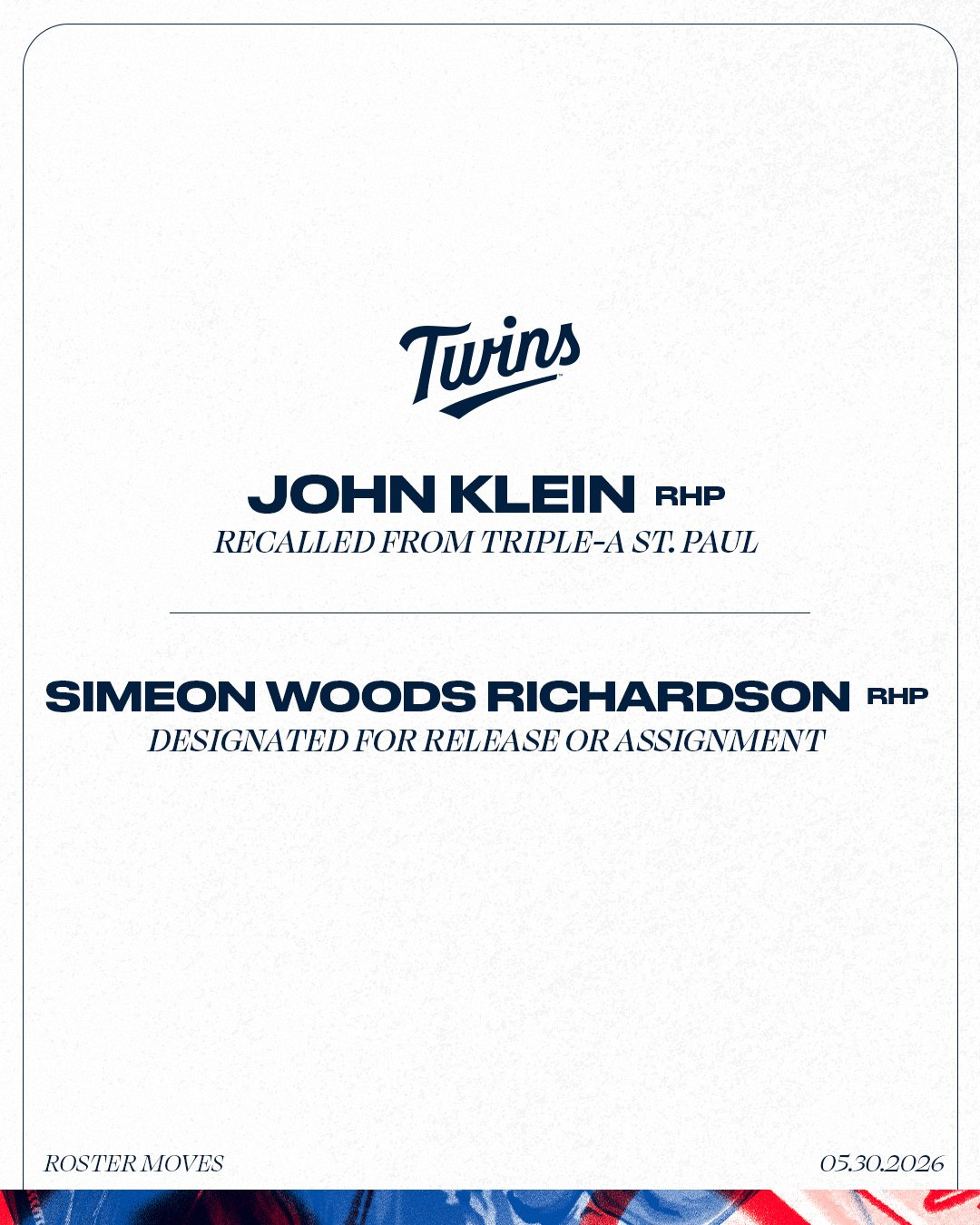
I assume the Twins thought that having him on the MLB club was unsustainable and that the only possible way to move forward was to get him to AAA. Then, based on his recent performances thought that if he’s ever going to clear waivers, this is when it would happen. We’ll see. Part of me thinks “of course someone is going to claim him” but then another part of me thinks “who’s actually going to roster him.” It’s not like the Twins are some upper echelon club and he was tanking us. The list of teams in May who can roster a guy like this is pretty small.
-
I did not see this coming. Especially with Rojas going on the IL I suppose if he’s ever going to get through waivers, this is the time.
-
How the Twins Can Get to MLB’s Proposed Salary Floor
amjgt replied to Cody Christie's topic in Twins Daily Front Page News
That definitely seems like the owners mostly likely path to success. Get the bottom 75% of players (Arb and pre-arb guys) asking the top 10% why they get to make all of the decisions and why those decision always seem to benefit the 10% and ignore the 75%.- 86 replies
-
- 1
-
-
- joe ryan
- ryan jeffers
- (and 8 more)
-
How the Twins Can Get to MLB’s Proposed Salary Floor
amjgt replied to Cody Christie's topic in Twins Daily Front Page News
I propose we sign Buxton to a 4 year 85M extension that pays him: $81M in 2027 $1M in 2028 $1M in 2029 $1M in 2030 That'll get us compliant and set us up for spending a bunch the next offseason I'm only partially kidding.- 86 replies
-
- 1
-
-
- joe ryan
- ryan jeffers
- (and 8 more)